From Surf Wiki (app.surf) — the open knowledge base
Discus throw
Event in track and field athletics

Event in track and field athletics
| Field | Value |
|---|---|
| event | Discus throw |
| image | Robert Harting (2008).jpg |
| caption | German 2012 Olympic champion Robert Harting |
| WRmen | Mykolas Alekna (2025) |
| ORmen | Roje Stona (2024) |
| CRmen | Daniel Ståhl (2023) |
| WRwomen | Gabriele Reinsch (1988) |
| ORwomen | Martina Hellmann (1988) |
| CRwomen | Martina Hellmann (1987) |
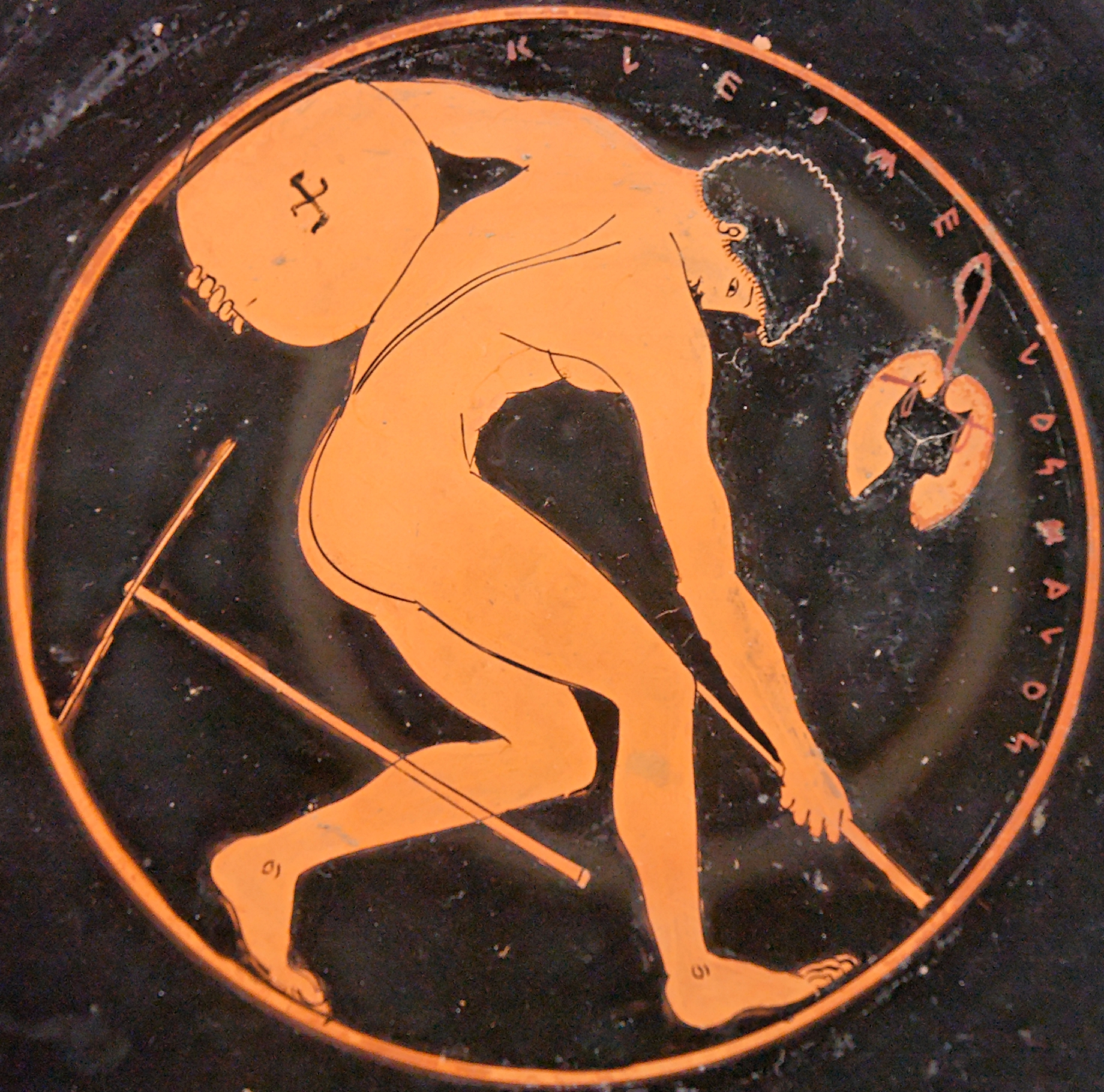
The discus throw (), also known as disc throw, is a track and field event in which the participant athlete throws an oblate spheroid weight called a discus in an attempt to mark a further distance than other competitors. It is an ancient sport, as demonstrated by the fifth-century-BC Myron statue Discobolus. Although not part of the current pentathlon, it was one of the events of the ancient Greek pentathlon, which can be dated back to at least 708 BC, and it is part of the modern decathlon.
History
The sport of throwing the discus traces back to it being an event in the original Olympic Games of Ancient Greece. The discus as a sport was resurrected in Magdeburg, Germany, by gymnastics teacher Christian Georg Kohlrausch and his students in the 1870s. Organized men's competition was resumed in the late 19th century, and has been a part of the modern Summer Olympic Games since the first modern competition, the 1896 Summer Olympics. Images of discus throwers figured prominently in advertising for early modern Games, such as fundraising stamps for the 1896 Games, and the main posters for the 1920 and 1948 Summer Olympics. Today the sport of discus is a routine part of modern track-and-field meets at all levels, and retains a particularly iconic place in the Olympic Games.

The first modern athlete to throw the discus while rotating the whole body was František Janda-Suk from Bohemia (the present Czech Republic). Janda-Suk invented this technique when studying the position of the statue of Discobolus. After a year of developing the technique, he earned a silver medal in the 1900 Olympics.
Women's competition began in the first decades of the 20th century. Following competition at national and regional levels, it was added to the Olympic program for the 1928 games.
Regulations
The event consists of throwing a heavy disc, with the weight or size depending on the competitor. Men and women throw different sized discs, with varying sizes and weights depending on age. The weight of the discus is either governed by World Athletics for international or USA Track & Field for the United States.
In the United States, Henry Canine advocated for a lighter-weight discus in high school competition. His suggestion was adopted by the National High School Athletic Association in 1938.
| Age | Men | Women |
|---|---|---|
| High School | 1.6 kg | 1 kg |
| Collegiate | 2 kg | 1 kg |
| Professional | 2 kg | 1 kg |
| Master's (35–59) | 1.5 kg | 1 kg |
| Master's (60–74) | 1 kg | 1 kg |
| Master's (75+) | 1 kg | 0.75 kg |
| Age | Men | Women |
|---|---|---|
| ≤17 | 1.5 kg | 1 kg |
| 18–19 | 1.75 kg | 1 kg |
| 20–49 | 2 kg | 1 kg |
| 50–59 | 1.5 kg | 1 kg |
| 60–74 | 1 kg | 1 kg |
| 75+ | 1 kg | 0.75 kg |
_IAAF_certified.jpg)
]]
_IAAF_certified,_side_view.jpg)

The typical discus has sides made of plastic, wood, fiberglass, carbon fiber or metal with a metal rim and a metal core to attain the weight. The rim must be smooth, with no roughness or finger holds. A discus with more weight in the rim produces greater angular momentum for any given spin rate, and thus more stability, although it is more difficult to throw. However, a higher rim weight, if thrown correctly, can lead to a longer throw. In some competitions, a solid rubber discus is used (see in the United States).
To make a throw, the competitor starts in a circle of diameter, which is recessed in a concrete pad by 20 mm. The thrower typically takes an initial stance facing away from the direction of the throw. They then spin anticlockwise (for right-handers) times while staying within the circle to build momentum before releasing the discus. The discus must land within a 34.92º circular sector that is centered on the throwing circle. The rules of competition for discus are virtually identical to those of shot put, except that the circle is larger, a stop board is not used and there are no form rules concerning how the discus is to be thrown.
The basic motion is a fore-handed sidearm movement. The discus is spun off the index finger or the middle finger of the throwing hand. In flight the disc spins clockwise when viewed from above for a right-handed thrower, and anticlockwise for a left-handed thrower. As well as achieving maximum momentum in the discus on throwing, the discus' distance is also determined by the trajectory the thrower imparts, as well as the aerodynamic behavior of the discus. Generally, throws into a moderate headwind achieve the maximum distance. Also, a faster-spinning discus imparts greater gyroscopic stability. The technique of discus throwing is quite difficult to master and needs much experience to perfect; thus most top throwers are 30 years old or more.
The discus throw is sometimes contested indoors, but it is not included at the World Athletics Indoor Championships. World Athletics used to keep "world indoor best" discus records, but since 2023 they now combine both indoor and outdoor marks.

Phases
The discus technique can be broken down into phases. The purpose is to transfer from the back to the front of the throwing circle while turning through one and a half circles. The speed of delivery is high, and speed is built up during the throw (slow to fast). Correct technique involves the buildup of torque so that maximum force can be applied to the discus on delivery.
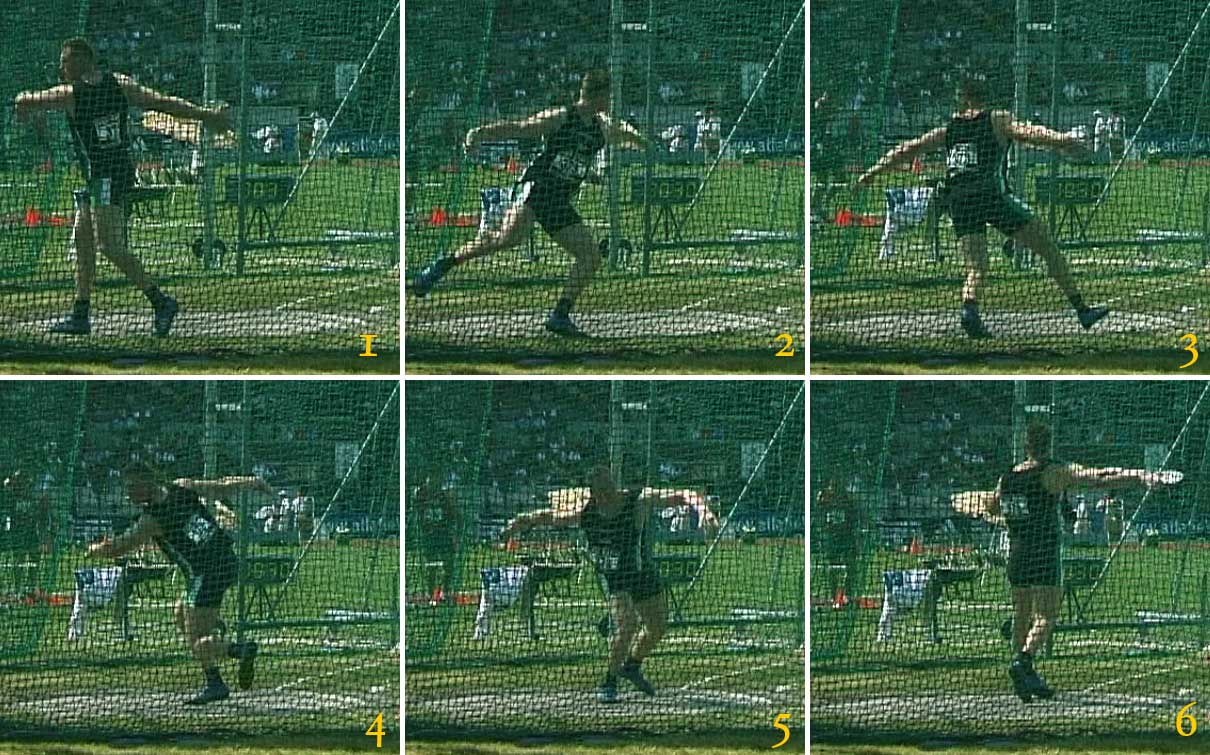
Initially, the thrower takes up their position in the throwing circle, distributing their body weight evenly over both feet, which are roughly shoulder width apart. They crouch in order to adopt a more efficient posture to start from whilst also isometrically preloading their muscles; this will allow them to start faster and achieve a more powerful throw. They then begin the wind-up, which sets the tone for the entire throw; the rhythm of the wind-up and throw is very important.
Focusing on rhythm can bring about the consistency to get in the right positions that many throwers lack. Executing a sound discus throw with solid technique requires perfect balance. This is due to the throw being a linear movement combined with a one and a half rotation and an implement at the end of one arm. Thus, a good discus thrower needs to maintain balance within the circle.
For a right handed thrower, the next stage is to move the weight over the left foot. From this position the right foot is raised, and the athlete 'runs' across the circle. There are various techniques for this stage where the leg swings out to a small or great extent, some athletes turn on their left heel (e.g. Ilke Wylluda) but turning on the ball of the foot is far more common.
The aim is to land in the 'power position', the right foot should be in the center and the heel should not touch the ground at any point. The left foot should land very quickly after the right. Weight should be mostly over the back foot with as much torque as possible in the body—so the right arm is high and far back. This is very hard to achieve.
The critical stage is the delivery of the discus, from this 'power position' the hips drive through hard, and will be facing the direction of the throw on delivery. Athletes employ various techniques to control the end-point and recover from the throw, such as fixing feet (to pretty much stop dead), or an active reverse spinning onto the left foot (e.g. Virgilijus Alekna).
Sports scientist Richard Ganslen researched the Aerodynamics of the Discus, reporting the discus will stall at an angle of 29°.
Culture
The discus throw has been the subject of a number of well-known ancient Greek statues and Roman copies such as the Discobolus and Discophoros. The discus throw also appears repeatedly in ancient Greek mythology, featured as a means of manslaughter in the cases of Hyacinth, Crocus, Phocus, and Acrisius, and as a named event in the funeral games of Patroclus.
Discus throwers have been selected as a main motif in numerous collectors' coins. One of the recent samples is the €10 Greek Discus commemorative coin, minted in 2003 to commemorate the 2004 Summer Olympics. On the obverse of the coin a modern athlete is seen in the foreground in a half-turned position, while in the background an ancient discus thrower has been captured in a lively bending motion, with the discus high above his head, creating a vivid representation of the sport.
All-time top 25
| *- denotes top performance (only) for other top 25 athletes who fall outside the top 25 discus throw marks* |
|---|
Men
- Correct as of August 2025.
| Ath.# | Perf.# | Mark | Athlete | Nation | Date | Place | ||||
|---|---|---|---|---|---|---|---|---|---|---|
| 1 | 1 | Mykolas Alekna | Lithuania | 13 April 2025 | Ramona | |||||
| 2 | M. Alekna #2 | 13 April 2025 | Ramona | |||||||
| 2 | 3 | Matthew Denny | Australia | 13 April 2025 | Ramona | |||||
| 4 | M. Alekna #3 | 14 April 2024 | Ramona | |||||||
| 5 | Denny #2 | 10 April 2025 | Ramona | date=11 April 2025 | title=Denny threatens world discus record with 74.25m in Ramona | url=https://worldathletics.org/news/report/matt-denny-discus-74-25-ramona | access-date=11 April 2025 | website=World Athletics}} | ||
| 3 | 6 | Jürgen Schult | East Germany | 6 June 1986 | Neubrandenburg | |||||
| 4 | 7 | Virgilijus Alekna | Lithuania | 3 August 2000 | Kaunas | |||||
| 5 | 8 | Gerd Kanter | Estonia | 4 September 2006 | Helsingborg | |||||
| 6 | 9 | Kristjan Čeh | Slovenia | 31 May 2025 | Slovenska Bistrica | |||||
| 10 | Čeh #2 | 24 May 2025 | Zagreb | |||||||
| 11 | M. Alekna #4 | 2 August 2025 | Palanga | |||||||
| 12 | M. Alekna #5 | 30 May 2025 | College Station | |||||||
| 13 | Čeh #3 | 25 May 2025 | Ptuj | |||||||
| 14 | Denny #3 | 6 April 2025 | Ramona | |||||||
| 15 | Kanter #2 | 3 May 2007 | Salinas | |||||||
| 7 | 16 | Ralford Mullings | Jamaica | 16 August 2025 | Ramona | |||||
| 17 | Kanter #3 | 8 May 2008 | Salinas | |||||||
| 8 | 18 | Yuriy Dumchev | Soviet Union | 29 May 1983 | Moscow | |||||
| Daniel Ståhl | Sweden | 29 June 2019 | Bottnaryd | |||||||
| 20 | Čeh #4 | 16 June 2023 | Jõhvi | |||||||
| 10 | 21 | Piotr Małachowski | Poland | 8 June 2013 | Hengelo | |||||
| 11 | 22 | Róbert Fazekas | Hungary | 14 July 2002 | Szombathely | |||||
| 23 | M. Alekna #6 | 19 July 2025 | London | |||||||
| 24 | Kanter #4 | 25 June 2009 | Kohila | |||||||
| 25 | V. Alekna #2 | 25 July 2007 | Kaunas | |||||||
| 12 | Lars Riedel | Germany | 3 May 1997 | Wiesbaden | ||||||
| 13 | Alex Rose | Samoa | 11 May 2024 | Allendale | ||||||
| 14 | Ben Plucknett | United States | 4 June 1983 | Eugene | ||||||
| 15 | Sam Mattis | United States | 13 April 2025 | Ramona | ||||||
| 16 | John Powell | United States | 9 June 1984 | San Jose | ||||||
| Rickard Bruch | Sweden | 15 November 1984 | Malmö | |||||||
| Imrich Bugár | Czechoslovakia | 25 May 1985 | San Jose | |||||||
| 19 | Art Burns | United States | 19 July 1983 | San Jose | ||||||
| 20 | Wolfgang Schmidt | East Germany | 9 August 1978 | Berlin | ||||||
| 21 | Anthony Washington | United States | 22 May 1996 | Salinas | ||||||
| 22 | Luis Delís | Cuba | 21 May 1983 | Havana | ||||||
| 23 | Clemens Prüfer | Germany | 13 April 2025 | Ramona | ||||||
| 24 | Mac Wilkins | United States | 9 July 1980 | Helsinki | ||||||
| 25 | Aleksander Tammert | Estonia | 15 April 2006 | Denton |
Notable series
- Matthew Denny had throws of 71.03, 73.46, 74.25, 72.93, 71.14 and 73.56 at the Oklahoma Throws Series in Ramona on 10 April 2025, becoming the second man to produce six throws above 70 meters in a single competition. He achieved a series average of 72.72 m, which is the best in history.
- Mykolas Alekna had throws of 72.21, 70.32, 72.89, 70.51, 74.35 and 70.50 at the Oklahoma Throws Series in Ramona on 14 April 2024, becoming the first man to produce three throws above 72 meters (and six throws above 70 meters) in a single competition.
- Kristjan Čeh had throws of 71.86, 71.70 and 71.19 in Jõhvi on 16 June 2023 becoming the first man to have three throws above 71 metres in a single competition.
- At the 2019 Diamond League Meeting in Doha, Qatar, Daniel Ståhl became the first man to produce six throws beyond 69.50 in a single competition.
Annulled marks
- Ben Plucknett also threw a world record of 72.34 in Stockholm on 7 July 1981. This performance was annulled due to doping offences.
- Kamy Keshmiri threw 70.84 in Salinas on 27 May 1992. This performance was annulled due to doping offences.
Non-legal marks
- Rickard Bruch also threw 72.18 at an exhibition meeting in Piteå on 23 July 1974.
- John Powell also threw 72.08 in Klagshamn on 11 September 1987, but the throw was made onto a sloping/downhill sector.
Women
- Correct as of April 2025.
| Ath.# | Perf.# | Mark | Athlete | Nation | Date | Place |
|---|---|---|---|---|---|---|
| 1 | 1 | Gabriele Reinsch | East Germany | 9 July 1988 | Neubrandenburg | |
| 2 | 2 | Zdeňka Šilhavá | Czechoslovakia | 26 August 1984 | Nitra | |
| Ilke Wyludda | East Germany | 23 July 1989 | Neubrandenburg | |||
| 4 | Reinsch #2 | 13 September 1988 | Berlin | |||
| 5 | Wyludda #2 | 13 September 1988 | Berlin | |||
| 4 | 6 | Diana Gansky | East Germany | 20 June 1987 | Karl-Marx-Stadt | |
| 7 | Gansky #2 | 27 June 1987 | Prague | |||
| 5 | 8 | Daniela Costian | Romania | 30 April 1988 | Bucharest | |
| 9 | Costian #2 | 24 April 1988 | Bucharest | |||
| 6 | 10 | Valarie Allman | United States | 12 April 2025 | Ramona | |
| 11 | Reinsch #3 | 12 June 1988 | Karl-Marx-Stadt | |||
| 7 | 12 | Irina Meszynski | East Germany | 17 August 1984 | Prague | |
| 13 | Gansky #2 | 11 June 1987 | Neubrandenburg | |||
| 8 | 14 | Galina Savinkova | Soviet Union | 8 September 1984 | Donetsk | |
| 15 | Savinkova #2 | 22 May 1983 | Leselidze | |||
| Gansky #3 | 6 June 1986 | Neubrandenburg | ||||
| 17 | Gansky #4 | 29 May 1987 | Leipzig | |||
| 9 | 18 | Tsvetanka Khristova | Bulgaria | 19 April 1987 | Kazanlak | |
| 19 | Wyludda #3 | 13 September 1988 | Berlin | |||
| 10 | 20 | Gisela Beyer | East Germany | 20 July 1984 | Berlin | |
| 11 | 21 | Yaime Pérez | Cuba | 13 April 2024 | Ramona | |
| 22 | Gansky #5 | 6 June 1987 | Potsdam | |||
| Wyludda #4 | 5 August 1989 | Gateshead | ||||
| 24 | Savinkova #3 | 23 June 1985 | Erfurt | |||
| 25 | Gansky #6 | 9 July 1988 | Neubrandenburg | |||
| 12 | Martina Hellmann | East Germany | 20 August 1987 | Potsdam | ||
| 13 | Galina Murashova | Soviet Union | 17 August 1984 | Prague | ||
| 14 | Mariya Vergova | Bulgaria | 13 July 1980 | Sofia | ||
| 15 | Xiao Yanling | China | 14 March 1992 | Beijing | ||
| 16 | Ellina Zvereva | Soviet Union | 12 June 1988 | Leningrad | ||
| 17 | Evelin Jahl | East Germany | 10 May 1980 | Potsdam | ||
| 18 | Sandra Perković | Croatia | 18 July 2017 | Bellinzona | ||
| 19 | Larisa Korotkevich | Russia | 29 May 1992 | Sochi | ||
| 20 | Ria Stalman | Netherlands | 15 July 1984 | Walnut | ||
| 21 | Hilda Ramos | Cuba | 8 May 1992 | Havana | ||
| 22 | Larisa Mikhalchenko | Soviet Union | 18 June 1988 | Kharkiv | ||
| 23 | Laulauga Tausaga | United States | 12 April 2025 | Ramona | ||
| 24 | Maritza Martén | Cuba | 18 July 1992 | Seville | ||
| 25 | Denia Caballero | Cuba | 20 June 2015 | Bilbao |
Annulled marks
- Daniela Costian of Romania threw a best of 73.48 in Bucharest on 30 April 1988. This performance was annulled due to doping offences.
- Darya Pishchalnikova of Russia threw a best of 70.69 in Cheboksary on 5 July 2012. This performance was annulled due to doping offences.
Non-legal marks
- Martina Hellmann also threw 78.14 at an unofficial meeting in Berlin on 6 September 1988.
- Ilke Wyludda also threw 75.36 at an unofficial meeting in Berlin on 6 September 1988.
Olympic medalists
Men
Women
World Championships medalists
Men
Women
Season's bests
Men
| Year | Mark | Athlete | Place |
|---|---|---|---|
| 1968 | Jay Silvester | Reno | |
| 1969 | Rickard Bruch | Malmö | |
| 1970 | Rickard Bruch | Malmö | |
| 1971 | Jay Silvester | Lancaster | |
| 1972 | Rickard Bruch | Stockholm | |
| 1973 | Rickard Bruch | Skellefteå | |
| 1974 | Rickard Bruch | Helsingborg | |
| 1975 | John Powell | Long Beach | |
| 1976 | Mac Wilkins | San Jose | |
| 1977 | Mac Wilkins | Westwood | |
| 1978 | Wolfgang Schmidt | Berlin | |
| 1979 | Mac Wilkins | Walnut | |
| 1980 | Mac Wilkins | Erfurt | |
| 1981 | John Powell | Modesto | |
| 1982 | Luis Delís | Salinas | |
| 1983 | Yuriy Dumchev | Moskva | |
| 1984 | John Powell | San Jose | |
| Ricky Bruch | Malmö | ||
| 1985 | Imrich Bugár | San Jose | |
| 1986 | Jürgen Schult | Neubrandenburg | |
| 1987 | Jürgen Schult | Neubrandenburg | |
| 1988 | Jürgen Schult | Berlin | |
| 1989 | Wolfgang Schmidt | Norden | |
| 1990 | Romas Ubartas | Smalininkai | |
| 1991 | Mike Buncic | Fresno | |
| 1992 | Jürgen Schult | Halle | |
| 1993 | Lars Riedel | Jena | |
| 1994 | Attila Horváth | Budapest | |
| 1995 | Lars Riedel | Bellinzona | |
| Monaco | |||
| 1996 | Anthony Washington | Salinas | |
| 1997 | Lars Riedel | Wiesbaden | |
| 1998 | John Godina | Salinas | |
| 1999 | Lars Riedel | Jena | |
| 2000 | Virgilijus Alekna | Kaunas | |
| 2001 | Virgilijus Alekna | Stellenbosch | |
| 2002 | Róbert Fazekas | Szombathely | |
| 2003 | Róbert Fazekas | Budapest | |
| 2004 | Virgilijus Alekna | Rethimno | |
| 2005 | Virgilijus Alekna | Madrid | |
| 2006 | Gerd Kanter | Helsingborg | |
| 2007 | Gerd Kanter | Salinas | |
| 2008 | Gerd Kanter | Salinas | |
| 2009 | Gerd Kanter | Kohila | |
| 2010 | Gerd Kanter | Chula Vista | |
| 2011 | Zoltán Kővágó | Budapest | |
| 2012 | Robert Harting | Turnov | |
| 2013 | Piotr Małachowski | Hengelo | |
| 2014 | Piotr Małachowski | Halle | |
| 2015 | Piotr Małachowski | Cetniewo | |
| 2016 | Daniel Ståhl | Sollentuna | |
| 2017 | Daniel Ståhl | Sollentuna | |
| 2018 | Daniel Ståhl | Eskilstuna | |
| 2019 | Daniel Ståhl | Bottnaryd | |
| 2020 | Daniel Ståhl | Sollentuna | |
| 2021 | Daniel Ståhl | Bottnaryd | |
| 2022 | Daniel Ståhl | Uppsala | |
| 2023 | Kristjan Čeh | Jöhvi | |
| 2024 | Mykolas Alekna | Ramona | |
| 2025 | Mykolas Alekna | Ramona |
Women
| Year | Mark | Athlete | Place |
|---|---|---|---|
| 1968 | Liesel Westermann | Werdohl | |
| 1969 | Liesel Westermann | Hamburg | |
| 1970 | Karin Illgen | Leipzig | |
| 1971 | Faina Melnik | Munich | |
| 1972 | Argentina Menis | Constanța | |
| 1973 | Faina Melnik | Edinburgh | |
| 1974 | Faina Melnik | Prague | |
| 1975 | Faina Melnik | Zürich | |
| 1976 | Faina Melnik | Sochi | |
| 1977 | Sabine Engel | Karl-Marx-Stadt | |
| 1978 | Evelin Jahl | Dresden | |
| 1979 | Evelin Jahl | Leipzig | |
| 1980 | Mariya Petkova | Sofia | |
| 1981 | Evelin Jahl | Berlin | |
| 1982 | Irina Meszynski | Karl-Marx-Stadt | |
| 1983 | Galina Savinkova | Leselidze | |
| 1984 | Zdeňka Šilhavá | Nitra | |
| 1985 | Galina Savinkova | Erfurt | |
| 1986 | Diana Gansky | Neubrandenburg | |
| 1987 | Diana Gansky | Karl-Marx-Stadt | |
| 1988 | Gabriele Reinsch | Neubrandenburg | |
| 1989 | Ilke Wyludda | Neubrandenburg | |
| 1990 | Ilke Wyludda | Tel Aviv | |
| 1991 | Tsvetanka Khristova | Tokyo | |
| 1992 | Xiao Yanling | Beijing | |
| 1993 | Larisa Korotkevich | Vénissieux | |
| 1994 | Daniela Costian | Auckland | |
| 1995 | Mette Bergmann | Florø | |
| 1996 | Ilke Wyludda | Atlanta | |
| 1997 | Xiao Yanling | Shanghai | |
| 1998 | Franka Dietzsch | Stendal | |
| 1999 | Natalya Sadova | Thessaloníki | |
| 2000 | Nicoleta Grasu | Bucharest | |
| 2001 | Natalya Sadova | Edmonton | |
| 2002 | Natalya Sadova | Tula | |
| 2003 | Natalya Sadova | Halle | |
| 2004 | Irina Yatchenko | Minsk | |
| 2005 | Vera Cechlová | Madrid | |
| 2006 | Franka Dietzsch | Schönebeck | |
| 2007 | Franka Dietzsch | Halle | |
| 2008 | Nicoleta Grasu | Istanbul | |
| 2009 | Li Yanfeng | Jinan | |
| 2010 | Nadine Müller | Wiesbaden | |
| 2011 | Li Yanfeng | Schönebeck | |
| 2012 | Sandra Perković | London | |
| 2013 | Sandra Perković | Lausanne | |
| 2014 | Sandra Perković | Zürich | |
| 2015 | Denia Caballero | Bilbao | |
| 2016 | Sandra Perković | Shanghai | |
| 2017 | Sandra Perković | Barcelona | |
| 2018 | Sandra Perković | Doha | |
| 2019 | Yaime Pérez | Sotteville | |
| 2020 | Valarie Allman | Rathdrum | |
| 2021 | Valarie Allman | Berlin | |
| 2022 | Valarie Allman | San Diego | |
| 2023 | Valarie Allman | Berlin | |
| 2024 | Yaime Pérez | Ramona | |
| 2025 | Valarie Allman | Ramona |
References
- (14 January 2018). "Sports – List of Summer and Winter Olympic Sports".
- "Discus Throwing {{!}} Encyclopedia.com".
- "History of Discus".
- "Discus Throw".
- (August 30, 1938). "Henry E. Canine resigns as mentor at high school in Aledo". The Daily Times (Davenport, Iowa).
- "Track and Field Throwing Implement Weight Requirements Rules".
- "Book of Rules {{!}} Official Documents".
- (2009-11-04). "The Rules and Regulations Every Discus Thrower Should Be Aware Of".
- "Kanter throws 69.51m world indoor best in Växjö {{!}} NEWS {{!}} World Athletics".
- (2023-05-23). "Indoor track to be renamed short track by World Athletics".
- Rosenbaum, Mike. (2018-12-11). "How to Throw a Discus Step-By-Step".
- Cappos, Scott. "Shot Put and Discus Technique and Training".
- throwhammer. (13 September 2010). "wyludda discus throw 1996 olympics".
- [http://trackandfield.about.com/od/discus/ss/discustechnique_8.htm#step-heading Power position] {{Webarchive. link. (2015-04-06 , about.com)
- ntujavelin. (26 December 2008). "2005 World Championship Men's Discus - 1st Virgilijus Alekna".
- "Archived copy".
- [http://www.iaaf.org/records/toplists/throws/discus-throw/outdoor/men/senior Discus Throw - men - senior - outdoor]. IAAF. Retrieved on 2014-01-20.
- (21 July 2019). "All-time men's best Discus Throw". alltime-athletics.com.
- (13 April 2025). "Alekna shatters discus world record with 75.56m in Ramona".
- "FLASH: Alekna breaks discus world record with 74.35m in Oklahoma {{!}} REPORT {{!}} World Athletics".
- (11 April 2025). "Denny threatens world discus record with 74.25m in Ramona".
- "Discus Throw Results".
- (24 May 2025). "75. Boris Hanžeković Memorial Men's Discus Throw results".
- (2 August 2025). "Karalis clears 6.08m in Volos as records fall around the world, athletes target Tokyo".
- "Discus Throw Results".
- "Discus Throw Results".
- Paul Reid. (16 August 2025). "Ralford Mullings shatters Jamaican men’s discus record". [[Jamaica Observer]].
- (29 June 2019). "Stahl goes to equal fourth on the world all-time discus list with 71.86m". European Athletics.
- (17 June 2023). "Ceh and Stahl throw beyond 71 metres in Jöhvi". World Athletics.
- (19 July 2025). "Wanda Diamond League London {{!}} Discus Throw Men {{!}} Results". [[Diamond League]].
- (12 May 2024). "Ta Lou-Smith among athletes to shine at Jamaica Athletics Invitational".
- "Ben Plucknett World Athletics Profile".
- (16 June 2019). "Discus Throw Results". sportresult.com.
- (11 April 2025). "10cm short of WR! Australian Matthew Denny achieves second-best throw in discus history". foxsports.com.au.
- (15 April 2024). "FLASH: Alekna breaks discus world record with 74.35m in Oklahoma".
- Bob Ramsak. (3 May 2019). "Stahl sends discus beyond 70 metres in Doha – IAAF Diamond League". IAAF.
- [http://www.iaaf.org/records/toplists/throws/discus-throw/outdoor/women/senior Discus Throw - women - senior - outdoor]. IAAF. Retrieved on 2014-01-20.
- (23 June 2019). "All-time women's best Discus Throw". alltime-athletics.com.
- (12 April 2025). "Allman throws 73.52m North American discus record in Ramona".
- "Perez launches discus 73.09m, Sears clocks 10.77 for 100m {{!}} REPORT {{!}} World Athletics".
- Diego Sampaolo. (19 July 2017). "Perkovic throws 71.41m in Bellinzona, world's best discus mark since 1992". IAAF.
- (21 June 2015). "Denia Caballero sets Discus world lead of 70.65, Pichardo debuts in long jump". watchathletics.com.
This article was imported from Wikipedia and is available under the Creative Commons Attribution-ShareAlike 4.0 License. Content has been adapted to SurfDoc format. Original contributors can be found on the article history page.
Ask Mako anything about Discus throw — get instant answers, deeper analysis, and related topics.
Research with MakoFree with your Surf account
Create a free account to save articles, ask Mako questions, and organize your research.
Sign up freeThis content may have been generated or modified by AI. CloudSurf Software LLC is not responsible for the accuracy, completeness, or reliability of AI-generated content. Always verify important information from primary sources.
Report