From Surf Wiki (app.surf) — the open knowledge base
United States presidential election
none

none
The election of the president and vice president of the United States is an indirect election in which citizens of the United States who are registered to vote in one of the fifty U.S. states or in Washington, D.C., cast ballots not directly for those offices, but instead for members of the Electoral College. These electors then cast direct votes, known as electoral votes, for the presidential and vice presidential candidate. The candidate who receives an absolute majority of electoral votes (at least 270 out of 538, since the Twenty-third Amendment granted voting rights to citizens of D.C.) is then elected to that office. If no candidate receives an absolute majority of the votes for president, the House of Representatives elects the president; likewise if no one receives an absolute majority of the votes for vice president, then the Senate elects the vice president.
United States presidential elections differ from many other republics around the world (operating under either the presidential system or the semi-presidential system) which use direct elections from the national popular vote ('one person, one vote') of their entire countries to elect their respective presidents. The United States instead uses indirect elections for its president through the Electoral College, and the system is highly decentralized like other elections in the United States. The Electoral College and its procedure are established in the U.S. Constitution by Article II, Section 1, Clauses 2 and 4; and the Twelfth Amendment (which replaced Clause3 after its ratification in 1804). Under Clause2, each state casts as many electoral votes as the total number of its Senators and Representatives in Congress, while (per the Twenty-third Amendment, ratified in 1961) Washington, D.C., casts the same number of electoral votes as the least-represented state, which is three. Also under Clause2, the manner for choosing electors is determined by each state legislature, not directly by the federal government. Many state legislatures previously selected their electors directly, but over time all switched to using votes cast by state voters to choose the state's members of the electoral college (electors). Beyond the parameters set in the U.S. Constitution, state law, not federal, regulates most aspects of administering the popular vote, including most of the voter eligibility and registration requirements.
Almost all states require that the winner of the plurality of its constituent statewide popular vote ('one person, one vote') shall receive all of that state's electors ("winner-takes-all'). A couple - Nebraska and Maine - determine a part of their electors by use of district votes within the respective state. Eighteen states also have specific laws that punish electors who vote in opposition to the plurality, known as "faithless" or "unpledged" electors. In modern times, faithless and unpledged electors have not affected the ultimate outcome of an election, so the results can generally be determined based on the state-by-state popular vote.
In addition, most of the time, the winner as determined by the electoral college also has received the largest part of the national popular vote. There have been four exceptions: 1876, 1888, 2000, and 2016, in which the Electoral College winner's portion of the popular vote was surpassed by an opponent. Although taking fewer votes, the winner claimed more electoral college seats, due to winning close and narrow pluralities in numerous swing states. In addition, the 1824 election was the only presidential election under the current system decided by a contingent election in Congress that elected a different president than the candidate with a plurality in both the electoral and popular vote. (The 1800 election and the 1824 election were decided in the House. In 1800 the House winner was the candidate who had won a plurality of the popular vote.)
Presidential elections occur every four years on Election Day, which since 1845 has been the first Tuesday after the first Monday in November. This date coincides with the general elections of various other federal, state, and local races; since local governments are responsible for managing elections, these races typically all appear on one ballot. The Electoral College electors then formally cast their electoral votes on the first Monday after December 12 at their state's capital. Congress then certifies the results in early January, and the presidential term begins on Inauguration Day, which since the passage of the Twentieth Amendment has been set at January 20.
The nomination process, consisting of the primary elections and caucuses and the nominating conventions, was not specified in the Constitution, but was developed over time by the states and political parties. These primary elections are generally held between January and June before the general election in November, while the nominating conventions are held in the summer. Though not codified by law, political parties also follow an indirect election process, where voters in the fifty states, Washington, D.C., and U.S. territories, cast ballots for a slate of delegates to a political party's nominating convention, who then elect their party's presidential nominee. Each party may then choose a vice presidential running mate to join the ticket, which is either determined by choice of the nominee or by a second round of voting. Because of changes to national campaign finance laws since the 1970s regarding the disclosure of contributions for federal campaigns, presidential candidates from the major political parties usually declare their intentions to run as early as the spring of the previous calendar year before the election (almost 21 months before Inauguration Day).
History
Electoral College
Article Two of the Constitution originally established the method of presidential elections, including the creation of the Electoral College. This was the result of a compromise between those constitutional framers who wanted Congress to choose the president and those who preferred a national popular vote.
As set forth in Article Two, each state is allocated a number of electors equal to the number of its delegates in both houses of Congress, combined. In 1961, the ratification of the Twenty-Third Amendment granted a number of electors to the District of Columbia, an amount equal to the number of electors allocated to the least populous state. However, U.S. territories are not allocated electors, and therefore are not represented in the Electoral College.
State legislatures - [[direct election]]
Constitutionally, the legislature of each state determines how its electors are chosen; ArticleII, Section1, Clause2 states that each state shall appoint electors "in such Manner as the Legislature Thereof May Direct". During the first presidential election in 1789, in four of the 11 states of the time, the electors were elected directly by voters. In two others, a hybrid system was used where both the voters and the state legislatures took part in electing the electors. In five, the state legislatures themselves elected the electors.
Gradually more states began conducting popular elections to choose their slate of electors. In 1800, five of the 16 states chose electors by a popular vote; by 1824, after the rise of Jacksonian democracy, 18 of the 24 states chose electors by popular vote. (In most cases simple state-wide plurality is sufficient to elect a general ticket using popular vote. But in the first presidential election in 1789, for example, some states used "open" list block voting; Maryland used block voting but had guaranteed seats for different parts of the state; Virginia elected its 12 electors by first-past-the-post voting contest in 12 districts. Other states later used multi-member districts, each covering a part of the state, to elect their electors.)
This movement toward greater democratization coincided with a gradual decrease in property restrictions for the franchise. By 1840, only one of the 26 states (South Carolina) still selected electors by the state legislature. Every other state was electing its electors by general ticket plurality voting state-wide. By 1872 no states elected their electors using the state legislature - all the states had switched to the general ticket method, Colorado having been the last hold-out. And today only two states - Maine and Nebraska - elect at least some of their electors through a different method than that general ticket method, in their cases it is First-past-the-post voting in districts covering part of the state.
Vice presidents
Under the original system established by Article 2, electors cast votes for two candidates for president. The candidate with the highest number of votes (provided it was a majority of the electoral votes) became the president, and the second-place candidate became the vice president. This presented a problem during the presidential election of 1800 when Aaron Burr received the same number of electoral votes as Thomas Jefferson and challenged Jefferson's election to the office. In the end, Jefferson was chosen as the president because of Alexander Hamilton's influence in the House.
In response to the 1800 election, the 12th Amendment was passed, requiring electors to cast two distinct votes: one for president and another for vice president. While this solved the problem at hand, it reduced the prestige of the vice presidency, as the office was no longer held by the leading challenger for the presidency. The separate ballots for president and vice president became something of a moot issue later in the 19th century when it became the norm for popular elections to determine a state's Electoral College delegation. Electors chosen this way are pledged to vote for a particular presidential and vice presidential candidate (offered by the same political party). Although the president and vice president are legally elected separately, in practice they are chosen together.
Tie votes
The Twelfth Amendment also established rules when no candidate wins a majority vote in the Electoral College. In the presidential election of 1824, Andrew Jackson received a plurality, but not a majority, of electoral votes cast. The election was thrown to the House, and John Quincy Adams was elected president. A deep rivalry resulted between Andrew Jackson and House Speaker Henry Clay, who had also been a candidate in the election.
Since the vice presidential candidate John Calhoun received a majority of votes, having been on the ticket for both Jackson and Adams, there was no need for the Senate to vote for a vice president.
Popular vote
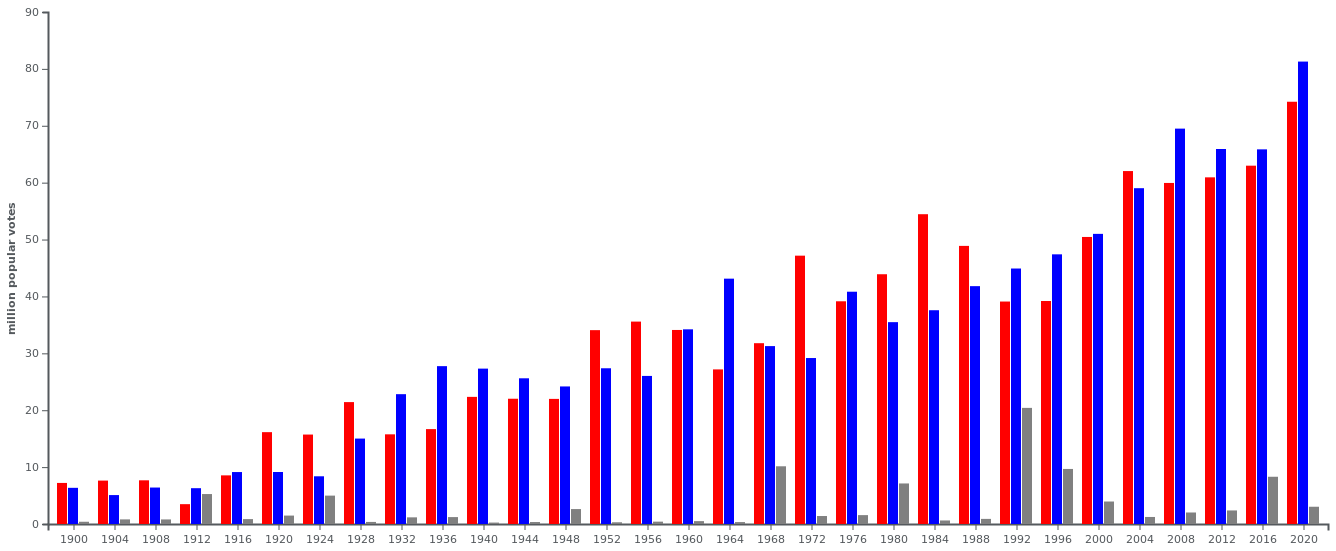
Since 1824, aside from the occasional "faithless elector", the popular vote indirectly determines the winner of a presidential election by determining the electoral vote, as each state or district's popular vote determines its electoral college vote. Although the nationwide popular vote does not directly determine the winner of a presidential election, it does strongly correlate with who is the victor. In 54 of the 59 total elections held so far (about 91 percent), the winner of the national popular vote has also carried the Electoral College vote. The winners of the nationwide popular vote and the Electoral College vote have differed only in close elections. In highly competitive elections, candidates focus on turning out their vote in the contested swing states critical to winning an electoral college majority, so they do not try to maximize their popular vote by real or fraudulent vote increases in one-party areas.
However, candidates have failed to get the most votes in the nationwide popular vote in a presidential election and still won. In the 1824 election, Jackson won the popular vote, but no one received a majority of electoral votes. According to the Twelfth Amendment, the House must choose the president out of the top three people in the election. Clay had come in fourth, so he threw his support to Adams, who then won. Because Adams later named Clay his Secretary of State, Jackson's supporters claimed that Adams gained the presidency by making a deal with Clay. Charges of a "corrupt bargain" followed Adams through his term.
]]
In five presidential elections (1824, 1876, 1888, 2000, and 2016), the winner of the electoral vote lost the popular vote outright. Numerous constitutional amendments have been submitted seeking to replace the Electoral College with a direct popular vote, but none has ever successfully passed both Houses of Congress. Another alternate proposal is the National Popular Vote Interstate Compact, an interstate compact whereby individual participating states agree to allocate their electors based on the winner of the national popular vote instead of their respective statewide results.
Election dates
Electoral Count Act of 1887
Main article: Electoral Count Act
Congress passed the Electoral Count Act in 1887 in response to the disputed 1876 election, in which several states submitted competing slates of electors. The law established procedures for the counting of electoral votes. It has subsequently been codified into law in Title 3 of the United States Code. It also includes a "safe harbor" deadline where states must finally resolve any controversies over the selection of their electors.
Inauguration day
Campaign spending
The Federal Election Campaign Act of 1971 was enacted to increase disclosure of contributions for federal campaigns. Subsequent amendments to law require that candidates to a federal office must file a Statement of Candidacy with the Federal Election Commission before they can receive contributions aggregating in excess of $5,000 or make expenditures aggregating in excess of $5,000. Thus, this began a trend of presidential candidates declaring their intentions to run as early as the spring of the preceding calendar year so they can start raising and spending the money needed for their nationwide campaign.
Political parties
There is no provision for the role of political parties in the U.S. Constitution, since the Founding Fathers did not originally intend for American politics to be partisan. Thus, the first president, George Washington, was elected as an independent. Since the emergence of the American two-party system, and the election of Washington's successor, John Adams, in 1796, all winners of U.S. presidential elections have represented one of two major parties. Third parties have taken second place only twice, in 1860 and 1912. The last time a third (independent) candidate achieved significant success (although still finishing in third place) was Ross Perot in 1992, and the last time a third-party candidate received any electoral votes not from faithless electors was George Wallace in 1968.
Primaries, caucuses, and nominating conventions
Main article: United States presidential primary#History
In the first two presidential elections, the Electoral College handled both the nominations and elections in 1789 and 1792 that selected Washington. Starting with the 1796 election, congressional party or a state legislature party caucus selected the party's presidential candidates. That system collapsed in 1824, and since 1832 the preferred mechanism for nomination has been a national convention. Delegates to the national convention were usually selected at state conventions whose own delegates were chosen by district conventions. Sometimes they were dominated by intrigue between political bosses who controlled delegates; the national convention was far from democratic or transparent.
Progressive Era reformers then looked to the primary election as a way to measure popular opinion of candidates, as opposed to the opinion of the bosses. Florida enacted the first presidential primary in 1901. The Wisconsin direct open primary of 1905 was the first to eliminate the caucus and mandate direct selection of national convention delegates. In 1910, Oregon became the first state to establish a presidential preference primary, which requires delegates to the National Convention to support the winner of the primary at the convention. The impetus for national adoption of the binding primary election was the 1968 Democratic National Convention. Vice President Hubert Humphrey secured the presidential nomination despite not winning a single primary under his own name. After this, a Democratic National Committee-commissioned panel led by Senator George McGovern – the McGovern–Fraser Commission – recommended that states adopt new rules to assure wider participation. A large number of states, faced with the need to conform to more detailed rules for the selection of national delegates in 1972, chose a presidential primary as an easier way to come into compliance with the new national Democratic Party rules. The result was that many more future delegates would be selected by a state presidential primary. The Republicans also adopted many more state presidential primaries.
Procedure
Eligibility requirements

Article Two of the Constitution stipulates that for a person to serve as president, the individual must be a natural-born citizen of the United States, at least 35 years old, and a resident of the United States for a period of no less than 14 years. A candidate may start running their campaign early before turning 35 years old or completing 14 years of residency, but must meet the age and residency requirements by Inauguration Day. The Twenty-second Amendment to the Constitution also sets a term limit: a president cannot be elected to more than two terms.
The U.S. Constitution also has two provisions that apply to all federal officers appointed by the president, and debatably also to the presidency. When Senator Barack Obama was elected president a legal debate concluded that the president was not an "office under the United States" for many reasons, but most significantly because Article I, Section 3, Clause 7 would violate the legal principle of surplusage if the president were also a civil officer. There exists no case law to resolve the debate however public opinion seems to favor that the presidency is also bound by the following qualifications:
Upon conviction at impeachment, the Senate may vote to disqualify that person from holding any "public office... under the United States" in the future. Section 3 of the Fourteenth Amendment prohibits the election to any federal office of any person who engaged in insurrection after having held any federal or state office, rebellion or treason; this disqualification can be waived if such an individual gains the consent of two-thirds of both houses of Congress.
In addition, the Twelfth Amendment establishes that the vice president must meet all the qualifications of being a president.
Although not a mandatory requirement, Federal campaign finance laws including the Federal Election Campaign Act state that a candidate who intends to receive contributions aggregating in excess of $5,000 or make expenditures aggregating in excess of $5,000, among others, must first file a Statement of Candidacy with the Federal Election Commission. This has led presidential candidates, especially members from the two major political parties, to officially announce their intentions to run as early as the spring of the previous calendar year so they can start raising or spending the money needed for their nationwide campaign. Potential candidates usually form exploratory committees even earlier to determine the feasibility of them actually running.
Decentralized election system and voter eligibility
The U.S. presidential election process, like all other elections in the United States, is a highly decentralized system. While the U.S. Constitution does set parameters for the election of the president and other federal officials, state law, not federal, regulates most aspects of elections in the U.S., including the primaries, the eligibility of voters (beyond the basic constitutional definition), and the specific details of running each state's electoral college meeting. All elections, including federal, are administered by the individual states.
Thus, the presidential election is really an amalgamation of separate state elections instead of a single national election run by the federal government. Candidates must submit separate filings in each of the 50 states if they want to qualify on each state's ballot, and the requirements for filing vary by state.
The eligibility of an individual for voting is set out in the Constitution and regulated at state level. The 15th, 19th and 26th Amendments to the Constitution state that suffrage cannot be denied on grounds of race or color, sex, or age for citizens eighteen years or older, respectively. Beyond these basic qualifications, it is the responsibility of state legislatures to regulate voter eligibility and registration. And the specific requirements for voter eligibility and registration also vary by state, e.g. some states ban convicted felons from voting.
Nominating process
Main article: United States presidential primary, United States presidential nominating convention


The modern nominating process of U.S. presidential elections consists of two major parts: a series of presidential primary elections and caucuses held in each state, and the presidential nominating conventions held by each political party. This process was never included in the Constitution, and thus evolved over time by the political parties to clear the field of candidates.
The primary elections are run by state and local governments, while the caucuses are organized directly by the political parties. Some states hold only primary elections, some hold only caucuses, and others use a combination of both. These primaries and caucuses are staggered generally between January and June before the federal election, with Iowa and New Hampshire traditionally holding the first presidential state caucus and primary, respectively.
Like the general election, presidential caucuses or primaries are indirect elections. The major political parties officially vote for their presidential candidate at their respective nominating conventions, usually all held in the summer before the federal election. Depending on each state's law and state's political party rules, when voters cast ballots for a candidate in a presidential caucus or primary, they may be voting to award delegates "bound" to vote for a candidate at the presidential nominating conventions, or they may simply be expressing an opinion that the state party is not bound to follow in selecting delegates to their respective national convention.
Unlike the general election, voters in the U.S. territories can also elect delegates to the national conventions. Furthermore, each political party can determine how many delegates to allocate to each state and territory. In 2012 for example, the Democratic and Republican party conventions each used two different formulas to allocate delegates. The Democrats-based theirs on two main factors: the proportion of votes each state gave to the Democratic candidate in the previous three presidential elections, and the number of electoral votes each state had in the Electoral College. In contrast, the Republicans assigned to each state 10 delegates, plus three delegates per congressional district. Both parties then gave a fixed number of delegates to each territory, and finally bonus delegates to states and territories that passed certain criteria.
Along with delegates chosen during primaries and caucuses, state and U.S. territory delegations to both the Democratic and Republican party conventions also include "unpledged" delegates who have a vote. For Republicans, they consist of the three top party officials from each state and territory. Democrats have a more expansive group of unpledged delegates called "superdelegates", who are party leaders and elected officials.
Each party's presidential candidate also chooses a vice presidential nominee to run with him or her on the same ticket, and this choice is rubber-stamped by the convention.
If no single candidate has secured a majority of delegates (including both pledged and unpledged), then a "brokered convention" results. All pledged delegates are then "released" and can switch their allegiance to a different candidate. Thereafter, the nomination is decided through a process of alternating political horse trading, and additional rounds of re-votes.
The conventions have historically been held inside convention centers, but since the late 20th century both the Democratic and Republican parties have favored sports arenas and domed stadiums to accommodate the increasing attendance.
Campaign strategy
One major component of getting elected to any office is running a successful campaign. There are, however, multiple ways to go about creating a successful campaign. Several strategies are employed by candidates from both sides of the political spectrum. Though the ideas may differ the goal of them all are the same, "...to mobilize supporters and persuade undecided voters..." (Sides et al., pg. 126 para, 2).
The goal of any campaign strategy is to create an effective path to victory for the intended candidate. Joel Bradshaw is a political scientist who has four propositions necessary to develop such a strategy. The first one being, the separation of the eligible voters into three groups: Undecided voters, opponent voters, and your voting base. Second, is the utilization of previous election results and survey data that can be used to identify who falls into the categories given in section one. Third, it is not essential, nor possible to get the support of every voter in an election. The campaign focus should be held mostly to keeping the base and using data to determine how to swing the undecided voters. Fourth, now that the campaign has identified the ideal base strategy, it is now time to allocate resources properly to make sure your strategy is fulfilled to its extent, (Sides et al. pg. 126, para 4, and pg. 127, para 1).
Campaign tactics are also an essential part of any strategy and rely mostly on the campaign's resources and the way they use them to advertise. Most candidates draw on a wide variety of tactics in the hopes to flood all forms of media, though they do not always have the finances. The most expensive form of advertising is running ads on broadcast television and is the best way to reach the largest number of potential voters. This tactic does have its drawback, however, as it is the most expensive form of advertisement. Even though it reaches the largest number of potential voters it is not the most effective way of swaying voters. The most effective way is believed to be through personal contact as many political scientists agree. It is confirmed that it is much more effective than contacting potential voters by email or by phone, (Sides et al., pg. 147 para, 2, 3). These are just some of the wide variety of tactics used in campaigns.
The popular vote on Election Day
.jpg)
Under the United States Constitution, the manner of choosing electors for the Electoral College is determined by each state's legislature. Although each state designates electors by popular vote, other methods are allowed. For instance, instead of having a popular vote, a number of states used to select presidential electors by a direct vote of the state legislature itself.
However, federal law does specify that all electors must be selected on the same day, which is "the Tuesday next after the first Monday in November," i.e., a Tuesday no earlier than November2 and no later than November8. Today, the states and the District of Columbia each conduct their own popular elections on Election Day to help determine their respective slate of electors.
Generally, voters are required to vote on a ballot where they select the candidate of their choice. The presidential ballot is a vote "for the electors of a candidate", meaning the voter is not voting for the candidate, but endorsing a slate of electors pledged to vote for a specific presidential and vice presidential candidate.
Many voting ballots allow a voter to "blanket vote" for all candidates in a particular political party or to select individual candidates on a line by line voting system. Which candidates appear on the voting ticket is determined through a legal process known as ballot access. Usually, the size of the candidate's political party and the results of the major nomination conventions determine who is pre-listed on the presidential ballot. Thus, the presidential election ticket will not list every candidate running for president, but only those who have secured a major party nomination or whose size of their political party warrants having been formally listed. Laws allow other candidates pre-listed on a ticket, provided enough voters have endorsed that candidate, usually through a signature list.
The final way to be elected for president is to have one's name written in at the time of election as a write-in candidate. This method is used for candidates who did not fulfill the legal requirements to be pre-listed on the voting ticket. However, since a slate of electors must be associated with these candidates to vote for them (and someone for vice president) in the electoral college in the event they win the presidential election in a state, most states require a slate of electors be designated before the election in order for a write-in candidate to win, essentially meaning that most write-in votes do not count. In any event, a write-in candidate has never won an election in a state for president of the United States. Write-in votes are also used by voters to express a distaste for the listed candidates, by writing in an alternative candidate for president such as Mickey Mouse or comedian Stephen Colbert (whose application was voted down by the South Carolina Democratic Party).
Because U.S. territories are not represented in the Electoral College, U.S. citizens in those areas do not vote in the general election for president. Guam has held straw polls for president since the 1980 election to draw attention to this fact.
Electoral college
Main article: United States Electoral College

Most state laws establish a winner-take-all system, wherein the ticket that wins a plurality of votes wins all of that state's allocated electoral votes, and thus has their slate of electors chosen to vote in the Electoral College. Maine and Nebraska do not use this method, giving two electoral votes to the statewide winner and one electoral vote to the winner of each Congressional district instead.
Each state's winning slate of electors then meets at their respective state's capital on the first Monday after the second Wednesday in December to cast their electoral votes on separate ballots for president and vice president. Although Electoral College members can vote for anyone under the U.S. Constitution, 32 states plus the District of Columbia have laws against faithless electors, those electors who do not cast their electoral votes for the person for whom they have pledged to vote. The Supreme Court ruled unanimously in the case Chiafalo v. Washington on July 6, 2020, that the constitution does not prevent states from penalizing or replacing faithless electors.
.jpg)
In early January, the total Electoral College vote count is opened by the sitting vice president, acting in his or her capacity as president of the Senate, and read aloud to a joint session of the incoming Congress, which was elected at the same time as the president. Members of Congress are free to object to any or all of a state's electoral vote count, provided that the objection is presented in writing and is signed by at least one member of each house of Congress. If such an objection is submitted, both houses of Congress adjourn to their respective chambers to debate and vote on the objection. The approval of both houses of Congress is required to invalidate those electoral votes in question.
If no candidate receives a majority of the electoral vote (at least 270), the president is determined by the rules outlined by the Twelfth Amendment. Specifically, the selection of president would then be decided by a contingent election in a ballot of the House of Representatives. For the purposes of electing the president, each state has only one vote. A ballot of the Senate is held to choose the vice president. In this ballot, each senator has one vote. The House has chosen the victor of the presidential race only twice, in 1800 and 1824; the Senate has chosen the victor of the vice-presidential race only once, in 1836.
If the president is not chosen by Inauguration Day, the vice president-elect acts as president. If neither are chosen by then, Congress by law determines who shall act as president, pursuant to the Twentieth Amendment.
Unless there are faithless electors, disputes, or other controversies, the events in December and January mentioned above are largely a formality since the winner can be determined based on the state-by-state popular vote results. Between the general election and Inauguration Day, this apparent winner is referred to as the "president-elect" (unless it is a sitting president who has won re-election).
Election calendar
The typical periods of the presidential election process are as follows, with the dates corresponding to the 2024 general election:
- Late 2022 to early 2023 – Candidates announce their intentions to run, and (if necessary) file their Statement of Candidacy with the Federal Election Commission
- June 2023 to January 2024 – Primary and caucus debates
- January to June 2024 – Primaries and caucuses
- Late May to August 2024 – Nominating conventions (including those of the minor third parties)
- September and October 2024 – Presidential election debates
- November 5, 2024 – Election Day
- December 17, 2024 – Electors cast their electoral votes
- January 6, 2025 – Congress counts and certifies the electoral votes
- January 20, 2025 - Presidential inauguration
Trends
Previous experience

Among the 45 persons who have served as president, only Donald Trump had never held a position in either government or the military prior to taking office. The only previous experience Zachary Taylor, Ulysses S. Grant, and Dwight D. Eisenhower had was in the military. Herbert Hoover previously served as the Secretary of Commerce. Everyone else served in elected public office before becoming president, such as being vice president, a member of Congress, or a state or territorial governor.
Fifteen presidents also served as vice president. Six of them – John Adams (1796), Thomas Jefferson (1800), Martin Van Buren (1836), Richard Nixon (1968), George H. W. Bush (1988), and Joe Biden (2020) – began their first term after winning an election. The remaining nine began their first term as president according to the presidential line of succession after the intra-term death or resignation of their predecessor. Of these, Theodore Roosevelt, Calvin Coolidge, Harry S. Truman, and Lyndon B. Johnson were subsequently elected to a full term of their own, while John Tyler, Millard Fillmore, Andrew Johnson, Chester A. Arthur, and Gerald Ford were not. Ford's accession to the presidency is unique in American history in that he became vice president through the process prescribed by the Twenty-fifth Amendment rather than by winning an election, thus making him the only U.S. president to not have been elected to either office.
Sixteen presidents had previously served in the U.S. Senate, including four of the five who served between 1945 and 1974. However, only three were incumbent senators at the time they were elected president (Warren G. Harding in 1920, John F. Kennedy in 1960, and Barack Obama in 2008). Eighteen presidents had earlier served in the House of Representatives. However, only one was a sitting representative when elected to the presidency (James A. Garfield in 1880).
Four of the last seven presidents (Jimmy Carter, Ronald Reagan, Bill Clinton and George W. Bush) have been governors of a state. Geographically, these presidents were from either very large states (Reagan from California, Bush from Texas) or from a state south of the Mason–Dixon line and east of Texas (Carter from Georgia, Clinton from Arkansas). In all, sixteen presidents have been former governors, including seven who were incumbent governors at the time of their election to the presidency.
The most common job experience, occupation or profession of U.S. presidents has been lawyer; 26 presidents had served as attorneys. Twenty-two presidents were also in the military. Eight presidents had served as Cabinet Secretaries, with five of the six presidents who served between 1801 and 1841 having held the office of U.S. Secretary of State.
After leaving office, one president, William Howard Taft, served as Chief Justice of the United States. Two others later served in CongressJohn Quincy Adams in the House and Andrew Johnson in the Senate.
Technology and media
Advances in technology and media have also affected presidential campaigns. The invention of radio and then television gave way to reliance upon national political advertisements such as Lyndon B. Johnson's 1964 "Daisy", Ronald Reagan's 1984 "Morning in America", and George H. W. Bush's 1988 "Revolving Door", all of which became major factors. In 1992, George H. W. Bush's promise of "Read my lips: no new taxes" was extensively used in the commercials of Bill Clinton and Bush's other opponents with significant effect during the campaign.
Since the development of the internet in the mid-90s, Internet activism has also become an invaluable component of presidential campaigns, especially since 2000. The internet was first used in the 1996 presidential elections, but primarily as a brochure for the candidate online. It was only used by a few candidates and there is no evidence of any major effect on the outcomes of that election cycle.
In 2000, both candidates (George W. Bush and Al Gore) created, maintained, and updated campaign websites. But it was not until the 2004 presidential election cycle was the potential value of the internet seen. By the summer of 2003, ten people competing in the 2004 presidential election had developed campaign websites. Howard Dean's campaign website from that year was considered a model for all future campaign websites. His website played a significant role in his overall campaign strategy. It allowed his supporters to read about his campaign platform and provide feedback, donate, get involved with the campaign, and connect with other supporters. A Gallup poll from January 2004 revealed that 49 percent of Americans have used the internet to get information about candidates, and 28 percent said they use the internet to get this information frequently.
Use of the Internet for grassroots fundraising by US presidential candidates such as Howard Dean, Barack Obama, Ron Paul and Bernie Sanders established it as an effective political tool. In 2016, the use of social media was a key part of Donald Trump campaign. Trump and his opinions were established as constantly "trending" by posting multiple times per day, and his strong online influence was constantly reinforced. Internet channels such as YouTube were used by candidates to share speeches and ads and to attack candidates by uploading videos of gaffes.
A study done by the Pew Internet & American Life Project in conjunction with Princeton Survey Research Associates in November 2010 shows that 54% of adults in the United States used the internet to get information about the 2010 midterm elections and about specific candidates. This represents 73% of adult internet users. The study also showed that 22 percent of adult internet users used social networking sites or Twitter to get information about and discuss the elections and 26 percent of all adults used cell phones to learn about or participate in campaigns.
E-campaigning, as it has come to be called, is subject to very little regulation. On March 26, 2006, the Federal Election Commission voted unanimously to "not regulate political communication on the Internet, including emails, blogs and the creating of Web sites". This decision made only paid political ads placed on websites subject to campaign finance limitations. A comment was made about this decision by Roger Alan Stone of Advocacy Inc. which explains this loophole in the context of a political campaign: "A wealthy individual could purchase all of the e-mail addresses for registered voters in a congressional district... produce an Internet video ad, and e-mail it along with a link to the campaign contribution page... Not only would this activity not count against any contribution limits or independent expenditure requirements; it would never even need to be reported."
A key part of the United States presidential campaigns is the use of media and framing. Candidates are able to frame their opponents and current issues in ways to affect the way voters will see events and the other presidential candidates. This is known as "priming". For example, during the 2016 presidential election Donald Trump successfully influenced the way voters thought about Hillary Clinton, by encouraging voters to think of Clinton as "Crooked Hillary" or a "Nasty woman". The media, and Trump, tended to focus on what was presented as her email scandal, and when voters thought about her that is what came to mind. Trump played into voters' anti-government interests, while Clinton appealed to the future of the country for the better of future children. Trump was unexpectedly successful at connecting to what a huge portion of Americans perceived as their interests. It was not always Clinton's strong point, but that may not have been her fault. Americans vote based on whether they feel the country is in a time of gain or a time of loss. Trump's campaign slogan, "Make America Great Again", made Americans feel like the country was in a time of loss, willing to take a risk on voting for a candidate without political experience. Trump was convincing with his anti-everything rhetoric, and his message reached the electorate with the help of the media. Over half of the media coverage on Trump was focused on where he stood in the race, while only 12% focused on issues, stances, and political beliefs (including problematic comments).
Criticism
Main article: Criticism of the United States Electoral College, Criticism of United States presidential primary, History of United States presidential nominating convention
The presidential election process is controversial, with critics arguing that it is inherently undemocratic, and discourages voter participation and turnout in many areas of the country. Because of the staggered nature of the primary season, voters in Iowa, New Hampshire and other small states which traditionally hold their primaries and caucuses first in January usually have a major impact on the races. Campaign activity, media attention, and voter participation are usually higher in these states, as the candidates attempt to build momentum and generate a bandwagon effect in these early primaries. Conversely, voters in California and other large states which traditionally hold their primaries last in June usually end up having no say in who the presidential candidates will be. The races are usually over by then, and thus the campaigns, the media, and voters have little incentive to participate in these late primaries. As a result, more states vie for earlier primaries to claim a greater influence in the process. However, compressing the primary calendar in this way limits the ability of lesser-known candidates to effectively corral resources and raise their visibility among voters, especially when competing with better-known candidates who have more financial resources and the institutional backing of their party's establishment. Primary and caucus reform proposals include a National Primary held on a single day; or the Interregional Primary Plan, where states would be grouped into six regions, and each region would rotate every election on who would hold their primaries first.
With the primary races usually over before June, the political conventions have mostly become scripted, ceremonial affairs. As the drama has left the conventions, and complaints grown that they were scripted and dull pep rallies, public interest and viewership has fallen off. After having offered gavel-to-gavel coverage of the major party conventions in the mid-20th century, the Big Three television networks now devote only approximately three hours of coverage (one hour per night).
Critics also argue that the Electoral College is archaic and inherently undemocratic. With all states, except Maine and Nebraska, using a winner-takes-all system, most of the states' seats are allocated ina blocks to either the Democratic or the Republican candidate and in all but a few states the citizens predominantly and perennially vote for the Democratic Party or the Republican Party (and even in Maine and Nebraska, most of the state seats have historically gone to the Democratic Party or the Republican Party, respectively). This encourages presidential candidates to focus exponentially more time, money, and energy campaigning in a few so-called "swing states", states in which no single candidate or party has overwhelming support. Such swing states (Arizona, Georgia, Michigan, Nevada, North Carolina, Pennsylvania and Wisconsin) are inundated with campaign visits, saturation television advertising, get-out-the-vote efforts by party organizers, and debates. Meanwhile, candidates and political parties have no incentive to mount nationwide campaign efforts, or work to increase voter turnout, in predominantly Democratic Party "safe states" like California, Illinois or New York or predominantly Republican Party "safe states" like Wyoming, Alabama or Utah. In practice, the winner-takes-all system also both reinforces the country's two-party system and decreases the importance of third and minor political parties. Furthermore, a candidate can win the electoral vote without securing the greatest amount of the national popular vote, such as during the 1824, 1876, 1888, 2000 and 2016 elections. It would even be possible in theory to secure the necessary 270 electoral votes from only the twelve most populous states and ignore the rest of the country.
Proposed changes to the election process
In 1844, Representative Samuel F. Vinton of Ohio proposed an amendment to the constitution that would replace the electoral college system with a lot system. The Joint Resolution called for each state to elect, by a simple majority, a presidential candidate of said state. Each state would notify Congress of the presidential election results. Congress would then inscribe the name of every state on uniform balls, equal to the number of said state's members of Congress, and deposit into a box. In a joint session of Congress, a ball would be drawn, and the elected candidate of the state of which is written on the drawn ball would be named president. A second ball would immediately be drawn after, and that state's candidate would be named vice president. The resolution did not pass the House. Representative Vinton proposed an identical amendment in 1846. Again, it was unsuccessful. The driving force behind the introduction of the resolution is unclear, as there is no recorded debate for either proposal.
The Every Vote Counts Amendment, another proposed constitutional amendment, would replace the Electoral College with a direct popular vote, which proponents argue would increase turnout and participation. One proposal that would not require Congressional authorization is the National Popular Vote Interstate Compact, an interstate compact whereby individual participating states would agree to allocate their electors based on the winner of the national popular vote, instead of their respective statewide results.
Another proposal is for every state to adopt the District system used by Maine and Nebraska: give two electoral votes to the statewide winner and one electoral vote to the winner of each Congressional district. The Proportional Plan, often compared to the District Plan, would distribute electoral votes in each state in proportion to the popular vote, increasing the number of electors allocated to third parties.
The Automatic Plan would replace the Electors with an automatic tallying of votes to eliminate the possibility of a faithless elector affecting the outcome of the election.
The House Plan is another proposed constitutional amendment to allocate electors based on the House apportionment alone to lessen small state advantage.
Electoral college results
Main article: List of United States presidential elections by Electoral College margin, List of United States presidential elections by popular vote margin
This is a table of electoral college results. Included are candidates who received at least one electoral vote or at least five percent of the popular vote.
Faithless electors and unpledged electors are denoted by a pink background.
| Year | Party | Presidential candidate | Vice presidential candidate | Popular vote | % | Electoral votes | Notes |
|---|---|---|---|---|---|---|---|
| 1788 | Independent | George Washington | None | 43,782 | 100.0% | ||
| Federalist | John Adams | N/A | N/A | ||||
| John Jay | |||||||
| Robert H. Harrison | |||||||
| John Rutledge | |||||||
| John Hancock | |||||||
| Anti-Administration | George Clinton | ||||||
| Federalist | Samuel Huntington | ||||||
| John Milton | |||||||
| James Armstrong | |||||||
| Benjamin Lincoln | |||||||
| Anti-Administration | Edward Telfair | ||||||
| 1792 | Independent | George Washington | 28,579 | 100.0% | |||
| Federalist | John Adams | N/A | N/A | ||||
| Democratic-Republican | George Clinton | ||||||
| Thomas Jefferson | |||||||
| Aaron Burr | |||||||
| 1796 | Federalist | John Adams | 35,726 | 53.4% | |||
| Democratic-Republican | Thomas Jefferson | 31,115 | 46.6% | ||||
| Federalist | Thomas Pinckney | N/A | N/A | ||||
| Democratic-Republican | Aaron Burr | ||||||
| Samuel Adams | |||||||
| Federalist | Oliver Ellsworth | ||||||
| Democratic-Republican | George Clinton | ||||||
| Federalist | John Jay | ||||||
| James Iredell | |||||||
| Independent | George Washington | ||||||
| Democratic-Republican | John Henry | ||||||
| Federalist | Samuel Johnston | ||||||
| Charles Cotesworth Pinckney | |||||||
| 1800 | Democratic-Republican | Thomas Jefferson | Aaron Burr | 41,330 | 61.4% | ||
| Federalist | John Adams | Charles Cotesworth Pinckney | 25,952 | 38.6% | |||
| John Jay | |||||||
| 1804 | Democratic-Republican | Thomas Jefferson | George Clinton | 104,110 | 72.8% | ||
| Federalist | Charles Cotesworth Pinckney | Rufus King | 38,919 | 27.2% | |||
| 1808 | Democratic-Republican | James Madison | George Clinton | 124,732 | 64.7% | ||
| John Langdon | |||||||
| Federalist | Charles Cotesworth Pinckney | Rufus King | 62,431 | 32.4% | |||
| Democratic-Republican | George Clinton | James Madison | N/A | N/A | |||
| James Monroe | |||||||
| 1812 | Democratic-Republican | James Madison | Elbridge Gerry | 140,431 | 50.4% | ||
| Democratic-Republican/ | |||||||
| Federalist | DeWitt Clinton | Jared Ingersoll | 132,781 | 47.6% | |||
| Elbridge Gerry | |||||||
| 1816 | Democratic-Republican | James Monroe | Daniel D. Tompkins | 76,592 | 68.2% | ||
| Federalist | Rufus King | John Eager Howard | 34,740 | 30.9% | |||
| James Ross | |||||||
| John Marshall | |||||||
| Robert Goodloe Harper | |||||||
| 1820 | Democratic-Republican | James Monroe | Daniel D. Tompkins | 87,343 | 80.6% | ||
| Richard Stockton (F) | |||||||
| Daniel Rodney (F) | |||||||
| Robert Goodloe Harper (F) | |||||||
| John Quincy Adams | Richard Rush (F) | N/A | N/A | ||||
| 1824 | Democratic-Republican | ||||||
| (Adams faction) | John Quincy Adams | John C. Calhoun | 113,122 | 30.9% | |||
| Andrew Jackson | |||||||
| N/A | |||||||
| Democratic-Republican | |||||||
| (Jackson faction) | Andrew Jackson | John C. Calhoun | 151,271 | 41.4% | |||
| Democratic-Republican | |||||||
| (Crawford faction) | William H. Crawford | Nathaniel Macon | 40,856 | 11.2% | |||
| Martin Van Buren | |||||||
| John C. Calhoun | |||||||
| Henry Clay | |||||||
| Nathan Sanford | |||||||
| Andrew Jackson | |||||||
| Democratic-Republican | |||||||
| (Clay faction) | Henry Clay | Nathan Sanford | 47,531 | 13.0% | |||
| John C. Calhoun | |||||||
| Andrew Jackson | |||||||
| 1828 | Democratic | Andrew Jackson | John C. Calhoun | 642,553 | 56.0% | ||
| William Smith | |||||||
| National Republican | John Quincy Adams | Richard Rush | 500,897 | 43.6% | |||
| 1832 | Democratic | Andrew Jackson | Martin Van Buren | 701,780 | 54.2% | ||
| William Wilkins | |||||||
| National Republican | Henry Clay | John Sergeant | 484,205 | 37.4% | |||
| Nullifier | John Floyd | Henry Lee | N/A | N/A | |||
| Anti-Masonic | William Wirt | Amos Ellmaker | 100,715 | 7.8% | |||
| 1836 | Democratic | Martin Van Buren | Richard Mentor Johnson | 763,291 | 50.8% | ||
| William Smith | |||||||
| Whig | William Henry Harrison | Francis Granger | 549,907 | 36.6% | |||
| John Tyler | |||||||
| Hugh L. White | John Tyler | 146,107 | 9.7% | ||||
| Daniel Webster | Francis Granger | 41,201 | 2.7% | ||||
| Willie Person Mangum | John Tyler | N/A | N/A | ||||
| 1840 | Whig | William Henry Harrison | John Tyler | 1,275,390 | 52.9% | ||
| Democratic | Martin Van Buren | Richard Mentor Johnson | 1,128,854 | 46.8% | |||
| Littleton W. Tazewell | |||||||
| James K. Polk | |||||||
| 1844 | Democratic | James K. Polk | George M. Dallas | 1,339,494 | 49.5% | ||
| Whig | Henry Clay | Theodore Frelinghuysen | 1,300,004 | 48.1% | |||
| 1848 | Whig | Zachary Taylor | Millard Fillmore | 1,361,393 | 47.3% | ||
| Democratic | Lewis Cass | William Orlando Butler | 1,223,460 | 42.5% | |||
| 1852 | Democratic | Franklin Pierce | William R. King | 1,607,510 | 50.8% | ||
| Whig | Winfield Scott | William Alexander Graham | 1,386,942 | 43.9% | |||
| 1856 | Democratic | James Buchanan | John C. Breckinridge | 1,836,072 | 45.3% | ||
| Republican | John C. Frémont | William L. Dayton | 1,342,345 | 33.1% | |||
| American | Millard Fillmore | Andrew Jackson Donelson | 873,053 | 21.6% | |||
| 1860 | Republican | Abraham Lincoln | Hannibal Hamlin | 1,865,908 | 39.8% | ||
| Democratic (Southern) | John C. Breckinridge | Joseph Lane | 848,019 | 18.1% | |||
| Constitutional Union | John Bell | Edward Everett | 590,901 | 12.6% | |||
| Democratic (Northern) | Stephen A. Douglas | Herschel V. Johnson | 1,380,202 | 29.5% | |||
| 1864 | National Union | Abraham Lincoln (R) | Andrew Johnson (D) | 2,218,388 | 55.0% | ||
| Democratic | George B. McClellan | George H. Pendleton | 1,812,807 | 45.0% | |||
| 1868 | Republican | Ulysses S. Grant | Schuyler Colfax | 3,013,650 | 52.7% | ||
| Democratic | Horatio Seymour | Francis Preston Blair Jr. | 2,708,744 | 47.3% | |||
| 1872 | Republican | Ulysses S. Grant | Henry Wilson | 3,598,235 | 55.6% | ||
| Democratic | Thomas A. Hendricks | Benjamin Gratz Brown (LR) | 2,834,761 | 43.8% | |||
| William S. Groesbeck | |||||||
| George Washington Julian (LR) | |||||||
| John M. Palmer (LR) | 0 or 1 / 352 | ||||||
| Liberal Republican | Benjamin Gratz Brown | Alfred H. Colquitt (D) | |||||
| George Washington Julian | |||||||
| Thomas E. Bramlette (D) | |||||||
| John M. Palmer | |||||||
| Nathaniel P. Banks | |||||||
| Willis Benson Machen (D) | |||||||
| William S. Groesbeck (D) | |||||||
| Horace Greeley | Benjamin Gratz Brown | ||||||
| Democratic | Charles J. Jenkins | Benjamin Gratz Brown | |||||
| Liberal Republican | David Davis | Benjamin Gratz Brown | |||||
| William S. Groesbeck (D) | |||||||
| George Washington Julian | |||||||
| John M. Palmer | |||||||
| 1876 | Republican | Rutherford B. Hayes | William A. Wheeler | 4,034,142 | 47.9% | ||
| Democratic | Samuel J. Tilden | Thomas A. Hendricks | 4,286,808 | 50.9% | |||
| 1880 | Republican | James A. Garfield | Chester A. Arthur | 4,446,158 | 48.3% | ||
| Democratic | Winfield Scott Hancock | William Hayden English | 4,444,260 | 48.3% | |||
| 1884 | Democratic | Grover Cleveland | Thomas A. Hendricks | 4,914,482 | 48.9% | ||
| Republican | James G. Blaine | John A. Logan | 4,856,903 | 48.3% | |||
| 1888 | Republican | Benjamin Harrison | Levi P. Morton | 5,443,892 | 47.8% | ||
| Democratic | Grover Cleveland | Allen G. Thurman | 5,534,488 | 48.6% | |||
| 1892 | Democratic | Grover Cleveland | Adlai Stevenson I | 5,553,898 | 46.0% | ||
| Republican | Benjamin Harrison | Whitelaw Reid | 5,190,819 | 43.0% | |||
| Populist | James B. Weaver | James G. Field | 1,026,595 | 8.5% | |||
| 1896 | Republican | William McKinley | Garret Hobart | 7,111,607 | 51.0% | ||
| Democratic/Populist | William Jennings Bryan | Arthur Sewall (D) | 6,509,052 | 46.7% | |||
| Thomas E. Watson (Pop.) | |||||||
| 1900 | Republican | William McKinley | Theodore Roosevelt | 7,228,864 | 51.6% | ||
| Democratic | William Jennings Bryan | Adlai Stevenson I | 6,370,932 | 45.5% | |||
| 1904 | Republican | Theodore Roosevelt | Charles W. Fairbanks | 7,630,457 | 56.4% | ||
| Democratic | Alton B. Parker | Henry G. Davis | 5,083,880 | 37.6% | |||
| 1908 | Republican | William Howard Taft | James S. Sherman | 7,678,335 | 51.6% | ||
| Democratic | William Jennings Bryan | John W. Kern | 6,408,979 | 43.0% | |||
| 1912 | Democratic | Woodrow Wilson | Thomas R. Marshall | 6,296,284 | 41.8% | ||
| Progressive | Theodore Roosevelt | Hiram Johnson | 4,122,721 | 27.4% | |||
| Republican | William Howard Taft | Nicholas Murray Butler | 3,486,242 | 23.2% | |||
| 1916 | Democratic | Woodrow Wilson | Thomas R. Marshall | 9,126,868 | 49.2% | ||
| Republican | Charles Evans Hughes | Charles W. Fairbanks | 8,548,728 | 46.1% | |||
| 1920 | Republican | Warren G. Harding | Calvin Coolidge | 16,144,093 | 60.3% | ||
| Democratic | James M. Cox | Franklin D. Roosevelt | 9,139,661 | 34.2% | |||
| 1924 | Republican | Calvin Coolidge | Charles G. Dawes | 15,723,789 | 54.0% | ||
| Democratic | John W. Davis | Charles W. Bryan | 8,386,242 | 28.8% | |||
| Progressive | Robert M. La Follette | Burton K. Wheeler | 4,831,706 | 16.6% | |||
| 1928 | Republican | Herbert Hoover | Charles Curtis | 21,427,123 | 58.2% | ||
| Democratic | Al Smith | Joseph Taylor Robinson | 15,015,464 | 40.8% | |||
| 1932 | Democratic | Franklin D. Roosevelt | John Nance Garner | 22,821,277 | 57.4% | ||
| Republican | Herbert Hoover | Charles Curtis | 15,761,254 | 39.7% | |||
| 1936 | Democratic | Franklin D. Roosevelt | John Nance Garner | 27,752,648 | 60.8% | ||
| Republican | Alf Landon | Frank Knox | 16,681,862 | 36.5% | |||
| 1940 | Democratic | Franklin D. Roosevelt | Henry A. Wallace | 27,313,945 | 54.7% | ||
| Republican | Wendell Willkie | Charles L. McNary | 22,347,744 | 44.8% | |||
| 1944 | Democratic | Franklin D. Roosevelt | Harry S. Truman | 25,612,916 | 53.4% | ||
| Republican | Thomas E. Dewey | John W. Bricker | 22,017,929 | 45.9% | |||
| 1948 | Democratic | Harry S. Truman | Alben W. Barkley | 24,179,347 | 49.6% | ||
| Republican | Thomas E. Dewey | Earl Warren | 21,991,292 | 45.1% | |||
| Dixiecrat | Strom Thurmond | Fielding L. Wright | 1,175,930 | 2.4% | |||
| 1952 | Republican | Dwight D. Eisenhower | Richard Nixon | 34,075,529 | 55.2% | ||
| Democratic | Adlai Stevenson II | John Sparkman | 27,375,090 | 44.3% | |||
| 1956 | Republican | Dwight D. Eisenhower | Richard Nixon | 35,579,180 | 57.4% | ||
| Democratic | Adlai Stevenson II | Estes Kefauver | 26,028,028 | 42.0% | |||
| Walter Burgwyn Jones | Herman Talmadge | N/A | N/A | ||||
| 1960 | Democratic | John F. Kennedy | Lyndon B. Johnson | 34,220,984 | 49.7% | ||
| Republican | Richard Nixon | Henry Cabot Lodge Jr. | 34,108,157 | 49.6% | |||
| Southern Democratic | Harry F. Byrd | Strom Thurmond | 610,409 | 0.4% | |||
| Barry Goldwater (R) | |||||||
| 1964 | Democratic | Lyndon B. Johnson | Hubert Humphrey | 43,127,041 | 61.0% | ||
| Republican | Barry Goldwater | William E. Miller | 27,175,754 | 38.5% | |||
| 1968 | Republican | Richard Nixon | Spiro Agnew | 31,783,783 | 43.4% | ||
| Democratic | Hubert Humphrey | Edmund Muskie | 31,271,839 | 42.7% | |||
| American Independent | George Wallace | Curtis LeMay | 9,901,118 | 13.5% | |||
| 1972 | Republican | Richard Nixon | Spiro Agnew | 47,168,710 | 60.7% | ||
| Democratic | George McGovern | Sargent Shriver | 29,173,222 | 37.5% | |||
| Libertarian | John Hospers | Tonie Nathan | 3,674 | ||||
| 1976 | Democratic | Jimmy Carter | Walter Mondale | 40,831,881 | 50.1% | ||
| Republican | Gerald Ford | Bob Dole | 39,148,634 | 48.0% | |||
| Ronald Reagan | N/A | N/A | |||||
| 1980 | Republican | Ronald Reagan | George H. W. Bush | 43,903,230 | 50.7% | ||
| Democratic | Jimmy Carter | Walter Mondale | 35,480,115 | 41.0% | |||
| 1984 | Republican | Ronald Reagan | George H. W. Bush | 54,455,472 | 58.8% | ||
| Democratic | Walter Mondale | Geraldine Ferraro | 37,577,352 | 40.6% | |||
| 1988 | Republican | George H. W. Bush | Dan Quayle | 48,886,597 | 53.4% | ||
| Democratic | Michael Dukakis | Lloyd Bentsen | 41,809,476 | 45.6% | |||
| Lloyd Bentsen | Michael Dukakis | N/A | N/A | ||||
| 1992 | Democratic | Bill Clinton | Al Gore | 44,909,806 | 43.0% | ||
| Republican | George H. W. Bush | Dan Quayle | 39,104,550 | 37.4% | |||
| 1996 | Democratic | Bill Clinton | Al Gore | 47,401,185 | 49.2% | ||
| Republican | Bob Dole | Jack Kemp | 39,197,469 | 40.7% | |||
| 2000 | Republican | George W. Bush | Dick Cheney | 50,456,002 | 47.9% | ||
| Democratic | Al Gore | Joe Lieberman | 50,999,897 | 48.4% | |||
| 2004 | Republican | George W. Bush | Dick Cheney | 62,040,610 | 50.7% | ||
| Democratic | John Kerry | John Edwards | 59,028,444 | 48.3% | |||
| John Edwards | 5 | ||||||
| 2008 | Democratic | Barack Obama | Joe Biden | 69,498,516 | 52.9% | ||
| Republican | John McCain | Sarah Palin | 59,948,323 | 45.7% | |||
| 2012 | Democratic | Barack Obama | Joe Biden | 65,915,795 | 51.1% | ||
| Republican | Mitt Romney | Paul Ryan | 60,933,504 | 47.2% | |||
| 2016 | Republican | Donald Trump | Mike Pence | 62,984,828 | 46.1% | ||
| Ron Paul (L) | 124 | ||||||
| Democratic | Hillary Clinton | Tim Kaine | 65,853,514 | 48.2% | |||
| Republican | |||||||
| (cast by Democratic electors) | Colin Powell | Susan Collins | 25 | ||||
| Maria Cantwell (D) | |||||||
| Elizabeth Warren (D) | |||||||
| Republican | John Kasich | Carly Fiorina | 2,684 | ||||
| Democratic | Bernie Sanders | Elizabeth Warren | 108,776 | 0.08% | |||
| Faith Spotted Eagle | Winona LaDuke (G) | N/A | N/A | ||||
| 2020 | Democratic | Joe Biden | Kamala Harris | 81,283,501 | 51.3% | ||
| Republican | Donald Trump | Mike Pence | 74,223,975 | 46.9% | |||
| 2024 | Republican | Donald Trump | JD Vance | 77,302,169 | 49.8% | ||
| Democratic | Kamala Harris | Tim Walz | 75,015,834 | 48.3% |
Maps of results
Popular vote results
Historically, presidents seeking re-election with a job approval rating of 50 percent or higher among American voters have easily won a second term, while those with an approval rating of less than 50 percent have lost the election.

| State delegations won by Jefferson are color coded in green, and those won by Burr in red. Vote results listed in that order, with abstentions at end. |
|---|
This election was in many ways unique in American history: several different factions of the Democratic-Republican Party were named after the last names of the candidates in this race, and nominated their own candidates. As no candidate received a majority of electoral votes, the House of Representatives chose Adams to be president.
| State delegations that Adams won are colored in , for Jackson, and for Crawford. Vote results listed in that order. |
|---|
Voter turnout
Voter turnout in the 2004 and 2008 elections showed a noticeable increase over the turnout in 1996 and 2000. Prior to 2004, voter turnout in presidential elections had been decreasing while voter registration, measured in terms of voting age population (VAP) by the U.S. census, has been increasing. The VAP figure, however, includes persons ineligible to vote – mainly non-citizens and ineligible felons – and excludes overseas eligible voters. Opinion is mixed on whether this decline was due to voter apathy or an increase in ineligible voters on the rolls. The difference between these two measures are illustrated by analysis of turnout in the 2004 and 2008 elections. Voter turnout from the 2004 and 2008 election was "not statistically different", based on the voting age population used by a November 2008 U.S. census survey of 50,000 households. If expressed in terms of vote eligible population (VEP), the 2008 national turnout rate was 61.7% from 131.3 million ballots cast for president, an increase of over 1.6 percentage points over the 60.1% turnout rate of 2004, and the highest since 1968.
Financial disclosures
Prior to 1967, many presidential candidates disclosed assets, stock holdings, and other information which might affect the public trust. In that year, Republican candidate George W. Romney went a step further and released his tax returns for the previous twelve years. although few of the major party nominees have equaled or exceeded George Romney's twelve. The Tax History Project – a project directed by Joseph J. Thorndike and established by the nonprofit Tax Analysts group – has compiled the publicly released tax returns of presidents and presidential candidates (including primary candidates).
In 2016, Republican presidential nominee Donald Trump broke with tradition, becoming the only major-party candidate since Gerald Ford in 1976 to not make any of his full tax returns public. Trump said that his refusal to do so was because he was under audit by the IRS.
Presidential coattails
Main article: Coattail effect
Presidential elections are held on the same date as those for all the seats in the House of Representatives, the full terms for 33 or 34 of the 100 seats in the Senate, the governorships of several states, and many state and local elections. Presidential candidates tend to bring out supporters who then vote for their party's candidates for those other offices. These other candidates are said to ride on the presidential candidates' coattails. Voter turnout is also generally higher during presidential election years than either midterm election years or off-year elections years.
Since the end of World War II, there have been a total of five American presidential elections that had significant coattail effects: Harry Truman in 1948, Dwight Eisenhower in 1952, Lyndon Johnson in 1964, Ronald Reagan in 1980, and Barack Obama in 2008. However, Truman's victory in 1948 and Eisenhower's victory in 1952 remain the last two elections in which the same party both won the White House and elected enough members of the House take control of it from its opponents. The last American presidential election in which the same party both won the White House and elected enough members of the Senate to take control of it from its opponents was Barack Obama's win in 2008.
Comparison with other U.S. general elections
Notes
References
References
- Dixon, Robert G. Jr.. (1950). "Electoral College Procedure". The Western Political Quarterly.
- Edwards III, George C.. (2011). "Why the Electoral College is Bad for America". Yale University Press.
- Chang, Alvin. (November 9, 2016). "Trump will be the 4th president to win the Electoral College after getting fewer votes than his opponent". [[Vox (website).
- "2016 Presidential Election".
- Cronin, Thomas E.. (1979). "The Direct Vote and the Electoral College the Case for Meshing Things Up!". Presidential Studies Quarterly.
- (November 3, 2016). "What Is The Winner-Takes-All Rule In The Presidential Election? It's Steeped In Controversy".
- Tures, John A.. (December 9, 2020). "The Electoral College system isn't 'one person, one vote'".
- {{UnitedStatesCode. 3. 1 and {{UnitedStatesCode. 3. 21
- (November 4, 2015). "A Viewer's Guide to the Next Year in Presidential Politics". NBC News.
- (October 29, 2012). "Could a Hurricane Like Sandy Postpone the Presidential Election?".
- Bugh, Gary. (2010). "Electoral College Reform: Challenges and Possibilities". Ashgate Publishing, Ltd..
- link. (March 8, 2021 {{"'In Such Manner as the Legislature Thereof May Direct": The Outcome in ''Bush v Gore'' Defended, 68 ''University of Chicago Law Review'' 613, 614 (2001).)
- (January 7, 2023). "The election of George Washington was weirder than you think".
- Mary Beth Norton et al., ''A People and a Nation: A History of the United States'', Vol. I (11th ed. 2019), p. 340.
- (August 21, 2012). "How the Electoral College Became Winner-Take-All".
- Donald Richard Deskins, Hanes Walton & Sherman C. Puckett, ''Presidential Elections, 1789–2008: County, State, and National Mapping of Election Data'' (University of Michigan Press, 2010), p. 117.
- Rose, Douglas Dana. "The Ten Most Competitive American Presidential Elections". ResearchGate.
- "Past Attempts at Reform".
- "Efforts to Replace Electoral College". CBS.
- (October 27, 2000). "The Electoral College: A2020 Presidential Election Timeline". [[Congressional Research Service]].
- Richard Hofstadter, ''The Idea of a Party System: The Rise of Legitimate Opposition in the United States, 1780–1840'' (1970)
- Gordon S. Wood, ''Empire of Liberty: A History of the Early Republic, 1789–1815 (Oxford History of the United States)''
- (1988). "Bifurcated Politics: Evolution and Reform in the National Party Convention". Harvard University Press.
- James S. Chase; ''Emergence of the Presidential Nominating Convention, 1789–1832'' (1973)
- "U.S. Constitutional Requirements for Presidential Candidates".
- (Jan 2008). "The Great Divorce: The Current Understanding of Separation of Powers and the Original Meaning of the Incompatibility Clause". University of Pennsylvania Law Review Online.
- "2016 Presidential Form 2 Filers". Federal Election Commission.
- Jose A. DelReal. (April 3, 2015). "Why Hillary Clinton might have just two more weeks or so to announce she's running for president". Washington Post.
- "Election Administration at State and Local Levels". National Conference of State Legislatures.
- "Elections & Voting". [[whitehouse.gov]].
- (October 25, 2019). "Time running short for new 2020 Democrats to jump in as filing deadlines approach". Washington Examiner.
- Gonchar, Michael. (February 18, 2014). "Should Felons Be Allowed to Vote After They Have Served Their Time?".
- "Democratic Detailed Delegate Allocation – 2012". The Green Papers.
- "Republican Detailed Delegate Allocation – 2012". The Green Papers.
- Paul, Katie. (2008-02-07). "Convention Wisdom". Newsweek.
- Eun Kyung Kim. (2008-02-10). ["Convention Q & A"](http://www.freep.com/apps/pbcs.dll/article?AID=/20080210/NEWS15/802100609/1009/NEWS07 }}{{dead link). Detroit Free Press.
- Clift, Eleanor. (2008-02-06). "A Ticking Clock". Newsweek.
- Gold, Jeffrey. (2008-02-09). "Post-primary questions answered". Courier-Post }}{{dead link.
- (2019). "Campaigns and elections : rules, reality, strategy, choice".
- "Sandy unlikely to postpone election". USA Today.
- (August 27, 2019). "What is the Electoral College?". U.S. National Archives and Records Administration.
- "Planning to write in Paul Ryan or Bernie Sanders? It won't count in most states.". The Washington Post.
- (2008-07-10). "Guam Legislature Moves General Election Presidential Vote to the September Primary". Ballot Access News.
- "Faithless Elector State Laws".
- "Laws Binding Electors".
- (November 15, 2016). "Counting Electoral Votes: An Overview of Procedures at the Joint Session, Including Objections by Members of Congress". Congressional Research Service.
- Montanaro, Domenico. (April 23, 2017). "Trump's First 100 Days: An 'Entry-Level' Presidency". NPR.
- International Law, US Power: The United States' Quest for Legal Security, p. 10, Shirley V. Scott (2012)
- (2009). "The Role of the Internet in Presidential Campaigns". Communications Studies.
- Endres, Warnick. (2004). "Text-based Interactivity in Candidate Campaign Web Sites: A Case Study from the 2002 Elections". Western Journal of Communication.
- (July 5, 2018). "Trump, social media and the first Twitter-based Presidency".
- Smith, Aaron. "Pew Internet & American Life Project". Pew Research Center.
- Bimbaum, Jeffrey. (June 11, 2006). "Loophole a Spigot for E-Mail; Critics Fear Voters Will Be Deluged as Fall Elections Near". The Washington Post.
- Trent & Friedenberg. (2008). "Political Campaign Communication Principles & Practices". Rowman & Littlefield Publishers, Inc..
- Vavreck, Lynn. (2016-05-19). "Big Picture for Trump vs. Clinton? It's All in the Framing". The New York Times.
- Dickinson, Matthew. (2016-07-14). "Yes, blame the media for Donald Trump. Up to a point".
- (October 26, 2016). "How Trump And Clinton Are Framing Their Closing Arguments".
- Jerry Fresia. (February 28, 2006). "Third Parties?". Zmag.org.
- (January 13, 1846). "House Joint Resolution (H.J. Res.) 8 Proposing a Constitutional Amendment to Elect the President by Lot". Center for Legislative Archives, National Archives and Records Administration.
- (24 October 2016). "What Is The Every Vote Counts Amendment? It Would Make Presidential Elections Much More Democratic". Bustle.
- (6 October 2022). "The National Popular Vote, Explained". Brennan Center for Justice.
- Melcher, James P., "[https://www.academia.edu/1536978/Electing_to_Reform_Maine_and_the_District_Plan_for_Selection_of_Presidential_Electors Electing to Reform: Maine and the District Plan for Selection of Presidential Electors] {{Webarchive. link. (March 7, 2021 ", 2004, New England Political Science Association. Viewed October 23, 2014.)
- (13 May 2020). "What if the Electoral Vote was Proportional?".
- (May 20, 2019). "U. S. Electoral College".
- (July 20, 2009). "Voter Turnout Increases by 5 Million in 2008 Presidential Election, U.S. Census Bureau Reports". U.S. Census Bureau News.
- (2003-07-29). "National Voter Turnout in Federal Elections: 1960–1996". [[Federal Election Commission]].
- "Election Information: Election Statistics". [[Office of the Clerk]].
- "Voting and Registration Date". [[U.S. Census Bureau]].
- (March 12, 2009). "Voter Turnout Frequently Asked Questions". Elections.gmu.edu.
- (March 12, 2009). "2008 Preliminary Voter Turnout". Elections.gmu.edu.
- link. (November 9, 2021 , ''St. Joseph Gazette'', United Press International, November 27, 1967.)
- Shaxson, Nicholas. (August 2012). "Where the Money Lives".
- Sherman, Amy (August 19, 2012), [http://www.miamiherald.com/2012/08/18/2958158/debbie-wasserman-schultz-claim.html Debbie Wasserman Schultz' claim about release of tax returns of major candidates is false, says PolitiFact Florida] {{Webarchive. link. (2013-02-23 , ''Miami Herald''.)
- Robert Farley, [http://factcheck.org/2012/07/romney-and-the-tax-return-precedent/ Romney and the Tax Return Precedent] {{Webarchive. link. (August 1, 2021 , [[FactCheck.org]], [[Annenberg Public Policy Center]], July 19, 2012.)
- [http://www.taxhistory.org/www/website.nsf/Web/AboutTheProject?OpenDocument About the Project] {{Webarchive. link. (November 7, 2021 , Tax History Project.)
- [http://www.taxhistory.org/www/website.nsf/web/presidentialtaxreturns Presidential Tax Returns] {{Webarchive. link. (July 28, 2011 , Tax History Project.)
- link. (October 11, 2016 , ''New York Times'' (May 11, 2016).)
- However, no law or precedent prevents a person from releasing their tax returns while under audit. President [[Richard M. Nixon]] released his tax returns while they were under audit.Jeanne Sahadi, [https://money.cnn.com/2016/05/11/pf/taxes/nixon-trump-tax-returns/ Nixon released his tax returns under audit. Why can't Trump?] {{Webarchive. link. (October 5, 2021 , CNN Money (May 11, 2016).)
- Sean Gorman, [http://www.politifact.com/virginia/statements/2016/oct/05/tim-kaine/tim-kaine-correctly-notes-richard-nixon-released-t/ Tim Kaine correctly notes Richard Nixon released tax returns despite audit] {{Webarchive. link. (December 15, 2019 , ''PolitiFact'' (October 5, 2016).)
- "Government By the People; national, state, and local version" Prentice Hall publishers, by Cronin Magleby O'Brien Light
- Desilver, D. (2014) [http://www.pewresearch.org/fact-tank/2014/07/24/voter-turnout-always-drops-off-for-midterm-elections-but-why/ Voter turnout always drops off for midterm elections, but why?] {{Webarchive. link. (November 24, 2021 Pew Research Center, July 24, 2014.)
- "Voter Turnout". [[FairVote]].
- Crespi, Irving. (23 August 1988). "Pre-Election Polling: Sources of Accuracy and Error". Russell Sage Foundation.
This article was imported from Wikipedia and is available under the Creative Commons Attribution-ShareAlike 4.0 License. Content has been adapted to SurfDoc format. Original contributors can be found on the article history page.
Ask Mako anything about United States presidential election — get instant answers, deeper analysis, and related topics.
Research with MakoFree with your Surf account
Create a free account to save articles, ask Mako questions, and organize your research.
Sign up freeThis content may have been generated or modified by AI. CloudSurf Software LLC is not responsible for the accuracy, completeness, or reliability of AI-generated content. Always verify important information from primary sources.
Report