From Surf Wiki (app.surf) — the open knowledge base
Two Medicine Formation
Geological formation in Montana, United States and Alberta, Canada

Geological formation in Montana, United States and Alberta, Canada
| Field | Value | |
|---|---|---|
| name | Two Medicine Formation | |
| image | Two Medicine.jpg | |
| caption | Outcrop of the Two Medicine Formation near "Egg Mountain" in northern Montana | |
| type | Geological formation | |
| age | Campanian | |
| ~ | ||
| period | Campanian | |
| prilithology | Sandstone | |
| namedfor | Two Medicine River | |
| namedby | Stebinger | |
| year_ts | 1914 | |
| region | Montana, Alberta | |
| country | United States, Canada | |
| coordinates | ||
| paleocoordinates | ||
| subunits | Rock City Member, Shields Crossing Member, Hagans Crossing Member, Flag Butte Member | |
| underlies | Bearpaw Shale | |
| overlies | Virgelle Sandstone | |
| thickness | 600 m (western portion) | |
| map | {{Location map+ | United States#Montana |
| relief | 1 | |
| width | 250 | |
| float | center | |
| lat_deg | 48.1 | |
| lon_deg | -112.3 | |
| mark | Lightgreen pog.svg | |
| marksize | 10 |
~ The Two Medicine Formation is a geological formation, or rock body, in northwestern Montana and southern Alberta that was deposited between 82.4 Ma and 74.4 Ma, during Campanian (Late Cretaceous) time. It crops out to the east of the Rocky Mountain Overthrust Belt, and the western portion (about 600 m thick) of this formation is folded and faulted while the eastern part, which thins out into the Sweetgrass Arch, is mostly undeformed plains. Below the formation are the nearshore (beach and tidal zone) deposits of the Virgelle Sandstone, and above it is the marine Bearpaw Shale. Throughout the Campanian, the Two Medicine Formation was deposited between the western shoreline of the Late Cretaceous Interior Seaway and the eastward advancing margin of the Cordilleran Overthrust Belt. The Two Medicine Formation is mostly sandstone, deposited by rivers and deltas.
History of research
In 1913, a US Geological Survey crew headed by Eugene Stebinger and a US National Museum crew headed by Charles Gilmore worked together to excavate the first dinosaur of the formation. Stebinger was the first to identify the Two Medicine Formation and formally described the first fossils in a scientific paper published in 1914. Gilmore returned to the Formation in 1928 and 1935. During this time frame only three species were named and of these only Styracosaurus ovatus and Edmontonia rugosidens are still regarded as valid. Barnum Brown prospected the formation in 1933, but found nothing significant. Both of their research were interrupted by World War II. In 1977, Trexler reports finding hadrosaur remains west of Choteau, Montana. During the next year baby hadrosaurs were discovered. In 1979, Horner and Makela referred these hadrosaur bones to Maiasaura peeblesorum. The announcement attracted renewed scientific interest to the formation and many new kinds of dinosaurs were discovered. More nesting sites were discovered later, including the Devil's Coulee site yielding Hypacrosaurus stebingeri in southern Alberta in 1987.
Geology
Age
The Two Medicine Formation spans from 82.4 to 74.4 Ma, nearly the entire length of the Campanian stage. The age of the different members of the formation are as follows:
- Rock City Member: 82.4-80.8 Ma
- Shields Crossing Member: 80.8-80.2 Ma
- Hagans Crossing Member: 80.2-77 Ma
- Flag Butte Member: 77-74.8 Ma
Equivalents
There are several equivalents to the Two Medicine Formation, as with many geologic formations (most of which are named after their type locality). The Sweetgrass Arch in Montana divides the Two Medicine from the Judith River Formation, Bearpaw Shale, Claggett Shale, and Eagle Sandstone. Across the Canada–United States border, the Two Medicine Formation correlates to the Belly River Group in southwest Alberta, and the Pakowki Formation eastward.
Stratigraphy
The Two Medicine overlies the Virgelle Sandstone, which formed from the beach sands exposed on northern and western shores of the receding Colorado Sea. A Cretaceous Interior Seaway transgression submerged the area briefly early on in Two Medicine history leaving anomalous paralic sediments and isolated shale bodies about 100 m above the base of the formation. The Middle portion of the two medicine formation is about 225 m thick, deposited while the Clagette Sea was receding and the Bearpaw Sea transgressing. This portion is stratigraphically equivalent to the Judith River Formation and Judith River Group. The sediments are mainly bentonitic siltstones and mudstones with "occasional sandstone lenses." These sediments are thought to be the remains of a coastal plain "far removed" from the interior sea. The upper portion is about one half of the formation. Its sediments are similar to the middle portions but punctuated by extensive red beds and caliche horizons. The uppermost 80 m were deposited after the inundation of the Judith River equivalent sediments by the Bearpaw Sea. They are thought to have been deposited in only 500,000 years. Bentonitic ash is common in the Two Medicine. To the south extrusive volcanic activity occurred in association with the Boulder Batholith collectively called the Elkhorn Volcanics.
Taphonomy
Most of the vertebrate fossils are preserved by CaCo3 permineralization. This type of preservation preserves high levels of detail, even down to the microscopic level. However, it also leaves specimens vulnerable to weathering when exposed to the surface.
Paleoenvironment
Climate
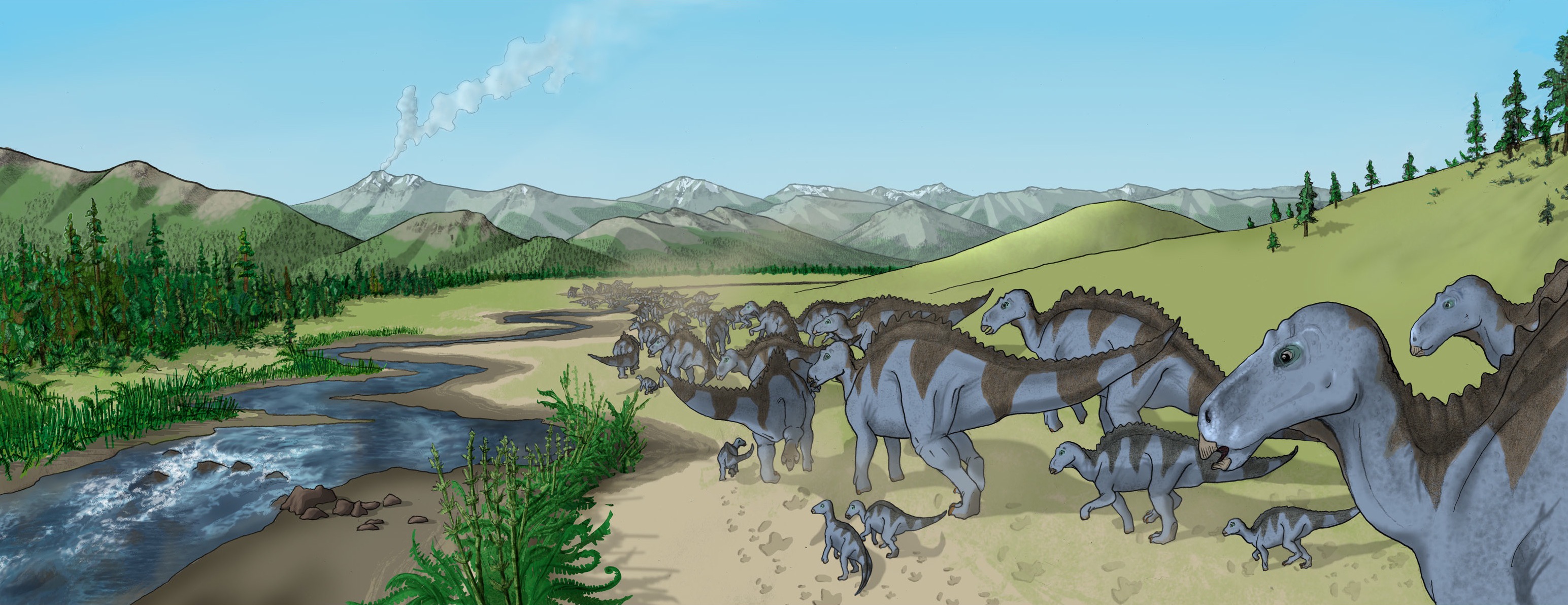
The Two Medicine Formation was deposited in a seasonal, semi-arid climate with possible rainshadows from the Cordilleran highlands. This region during the Campanian experienced a long dry season and warm temperatures. Lithologies, invertebrate faunas, and plant and pollen data support the above interpretation. The extensive red beds and caliche horizons of the upper Two Medicine are evidence of at least seasonally arid conditions. Some of the dinosaurs from the formation have been speculated to have shown signs of drought-related death.
Elevation
A more upland environment existed in the south of the Two Medicine Formation. Streams had a northeasterly flow away from these southwestern uplands. The southern part of the Two medicine formation grades into brackish water siltstone/sandstone series called the Horsethief Formation. The sediments of the Horsethief represent shallower water deposits than the Bearpaw Shale adding further evidence of higher elevation areas existing in the south.
Egg Mountain site
Egg Mountain, which is near Choteau, Montana, was discovered in 1977 by Marion Brandvold, owner of the Trex Agate Rock Shop in Bynum, Montana, who discovered the bones of juvenile dinosaurs at this site. It is a colonial nesting site on the Willow Creek Anticline in the Two Medicine Formation that is famous for its fossil eggs of Maiasaura, which demonstrated for the first time that at least some dinosaurs cared for their young. The eggs were arranged in dug-out earthen nests, each nest about a parent's body length from the next, and baby dinosaurs were also found with skeletons too cartilaginous for them to walk - similar to those of altricial (helpless) baby birds. The parent(s) must then have brought food to the young, and there is plant matter in the nests that may be evidence of either this or for incubation of the eggs. Maiasaura also grew extremely fast, at rates comparable to modern birds. Skeletons of Orodromeus and skeletons and eggs of Troodon were also found at Egg Mountain.
Biostratigraphy

Most dinosaur-bearing rock formations do not contain multiple distinct faunas at different positions within the formation's stratigraphic column. Usually the lower sediments of a given formation will contain the same kinds of dinosaurs as the upper sediments, or the species composition changes only gradually. However, some researchers had argued that the Two Medicine Formation was an exception, preserving multiple distinct dinosaur faunas.
Later research came to find that the supposedly distinct dinosaur faunas at different levels of the formations were more similar than had been previously thought. While the dinosaur fauna of the lower and middle sections Two Medicine was apparently diverse, the quality of preservation was low and few of these remains can be referred to individual species. The middle Two Medicine is a better source of fossils, but still poor overall. This makes it difficult to argue that these sections of the formation preserve distinct faunas.
The upper portion of the formation is more diverse and preserves better quality fossils. However, many of the taxa that supposedly distinguished it as a separate fauna have since been found in older sediments. In particular, Gryposaurus latidens and Hypacrosaurus have been found to coexist with Maiasaura. Further, there are fossil teeth that seem to show the presence of certain taxa are unbroken throughout the whole formation.
Nevertheless, some true changes in faunal composition seem to occur in the upper Two Medicine. The appearance of Maiasaura in the formation precedes the arrival of a diverse variety of other ornithischians. According to David Trexler, thorough examination of strata found along the Two Medicine River (which exposes the entire upper half of the Two Medicine Formation) indicates that the apparent diversification was a real event rather than a result of preservational biases.
The timeline below follows the stratigraphic chart presented by Horner et al. 2001. ImageSize = width:1000px height:auto barincrement:15px PlotArea = left:10px bottom:50px top:10px right:10px Period = from:-81 till:-72.5 TimeAxis = orientation:horizontal ScaleMajor = unit:year increment:1 start:-81 ScaleMinor = unit:year increment:1 start:-74 TimeAxis = orientation:hor AlignBars = justify Colors =
- legends id:CAR value:claret id:ANK value:rgb(0.4,0.3,0.196) id:HER value:teal id:HAD value:green id:OMN value:blue id:black value:black id:white value:white id:cretaceous value:rgb(0.675,0.675,0.35) id:jurassic value:rgb(0.753,0.753,0.486) id:triassic value:rgb(0.827,0.827,0.65) id:mesozoic value:rgb(0.54,0.54,0.258) BarData= bar:eratop bar:space bar:NAM1 bar:NAM2 bar:NAM3 bar:NAM4 bar:NAM15 bar:NAM5 bar:NAM6 bar:NAM7 bar:NAM8 bar:NAM9 bar:NAM10 bar:NAM11 bar:NAM12 bar:NAM13 bar:NAM14 bar:space bar:period bar:space bar:era PlotData= align:center textcolor:black fontsize:M mark:(line,black) width:25 shift:(7,-4) bar:eratop from: -81 till: -72.5 color:mesozoic text:Late Cretaceous PlotData= align:left fontsize:M mark:(line,white) width:5 anchor:till align:left color:HAD bar:NAM1 from: -80.6 till: -76.9 text:Gryposaurus latidens color:CAR bar:NAM2 from: -80.6 till: -76.9 text:Dromaeosaurus sp. color:CAR bar:NAM3 from: -80.6 till: -76.9 text:Richardoestesia sp. color:CAR bar:NAM4 from: -80.6 till: -76.6 text:Saurornitholestes sp. color:HAD bar:NAM15 from: -79.2 till: -79 text:Acristavus gagslarsoni color:HAD bar:NAM5 from: -76.9 till: -76.6 text:Maiasaura peeblesorum color:HAD bar:NAM6 from: -76.9 till: -76.6 text:Orodromeus makelai color:CAR bar:NAM7 from: -76.9 till: -76.6 text:Troodon formosus color:CAR bar:NAM8 from: -76.9 till: -76.6 text:Bambiraptor feinbergorum color:HAD bar:NAM9 from: -76.6 till: -74 text:Hypacrosaurus stebingeri color:HAD bar:NAM10 from: -76.6 till: -74 text:Prosaurolophus maximus color:ANK bar:NAM11 from: -76.6 till: -74 text:Scolosaurus cutleri color:HER bar:NAM12 from: -74.7 till: -74.5 text:Rubeosaurus ovatus color:HER bar:NAM13 from: -74.5 till: -74 text:Einiosaurus procurvicornis color:HER bar:NAM14 from: -74.2 till: -74 text:Achelousaurus horneri PlotData= align:center textcolor:black fontsize:M mark:(line,black) width:25 bar:period from: -72.5 till: -74 color:triassic text:BPF from: -76.6 till: -74 color:triassic text:Unit 5 from: -76.9 till: -76.6 color:jurassic text:4 from: -80.6 till: -76.9 color:triassic text:Unit 3 from: -80.8 till: -80.6 color:jurassic text:2 from: -81 till: -80.8 color:triassic text:1 bar:era from: -81 till: -80.5 color:mesozoic text:E. Camp. from: -80.5 till: -75.9 color:cretaceous text:Middle Campanian from: -75.9 till: -72.5 color:jurassic text:Late Campanian
Dinosaurs
Some of the dinosaurs from the formation have been speculated to show signs of drought related death. Very few articulated dinosaurs have been found in the formation; most specimens are isolated, bone bed, poorly preserved or broken remains. Early studies assumed that the Two Medicine Formation would have the same dinosaurs as the Judith River Formation. It was only in 1978, that it was discovered that the formation had endemic dinosaurs. Even some genera regarded as wide-ranging predators exhibited a species difference between the Two Medicine and other formations. No ecological barriers have been postulated apart from upland/lowland habitat preference differences between the Two Medicine and Judith River Formation. There is no unequivocal evidence for intermingling between the wildlife of the Two Medicine and geographically adjacent contemporary formations. Dinosaur remains are more common in the upper part of the Two Medicine.
Ankylosaurs
| Ankylosaurs of the Two Medicine Formation | Genus | Species | Location | Stratigraphic position | Material | Notes | Images | ||||||||||||||||
|---|---|---|---|---|---|---|---|---|---|---|---|---|---|---|---|---|---|---|---|---|---|---|---|
| Edmontonia | E. rugosidens | Flag Butte Member | A skull with right mandible, cervical vertebrae, dorsal vertebrae, sacral vertebrae, caudal vertebrae, ribs, partial right ilium, left and right ischia, right pubis and osteoderms. | A nodosaurid also known from the Horseshoe Canyon Formation and Dinosaur Park Formation. | [[File:Edmontonia_rugosidens_armour_AMNH_5381.jpg | center | 200px]] | ||||||||||||||||
| Euoplocephalus | E. tutus | Flag Butte Member | Misclassified, actually represent Scolosaurus | ||||||||||||||||||||
| Indeterminate | Flag Butte Member | Misclassified, probably Scolosaurus | |||||||||||||||||||||
| Oohkotokia | O. horneri | Flag Butte Member | [Four] skulls, cervical vertebra, proximal caudal vertebra, ribs partial scapula, distal humerus, a left scapulocoracoid, ischia, [two] tail clubs, cervical half-ring, osteoderms, fragments and an undescribed specimen. | Penkalski (2013) referred to Oohkotokia all ankylosaurine specimens from this formation. Arbour and Currie (2013) later referred Oohkotokia to Scolosaurus. | [[File:Oohkotokia_skull.jpg | center | 200px]] | ||||||||||||||||
| last1=Arbour | first1=Victoria M. | last2=Currie | first2=Philip J. | date=8 May 2013 | title=Euoplocephalus tutus and the Diversity of Ankylosaurid Dinosaurs in the Late Cretaceous of Alberta, Canada, and Montana, USA | journal=PLOS ONE | volume=8 | issue=5 | article-number=e62421 | doi=10.1371/journal.pone.0062421 | pmid=23690940 | pmc=3648582 | bibcode=2013PLoSO...862421A | doi-access=free }} | S. cutleri | Flag Butte Member | [Four] skulls, cervical vertebra, proximal caudal vertebra, ribs partial scapula, distal humerus, a left scapulocoracoid, ischia, [two] tail clubs, cervical half-ring, osteoderms, fragments and an undescribed specimen. | An ankylosaurine ankylosaurid. These remains were previously considered to represent Euoplocephalus and then referred to Oohkotokia before being placed in Scolosaurus. | [[File:Oohkotokia_horneri.jpg | center | 200px]] |
Avialans
| Avialans of the Two Medicine Formation | Genus | Species | Location | Stratigraphic position | Material | Notes | Images | ||||||||||||||
|---|---|---|---|---|---|---|---|---|---|---|---|---|---|---|---|---|---|---|---|---|---|
| last1=Atterholt | first1=Jessie | last2=Hutchison | first2=J. Howard | last3=O'Connor | first3=Jingmai K. | year=2018 | title=The most complete enantiornithine from North America and a phylogenetic analysis of the Avisauridae | journal=PeerJ | volume=6 | article-number=e5910 | doi=10.7717/peerj.5910 | pmid=30479894 | pmc=6238772 | doi-access=free }} | G. gloriae | Upper | "Tarsometatarsus" | An avisaurid enantiornithean |
Marginocephalians
| Marginocephalians of the Two Medicine Formation | Genus | Species | Location | Stratigraphic position | Material | Notes | Images | ||||||||||||||||||
|---|---|---|---|---|---|---|---|---|---|---|---|---|---|---|---|---|---|---|---|---|---|---|---|---|---|
| Achelousaurus | A. horneri | Landslide Butte | Upper Flag Butte Member | "[Three] partial skulls, [one] partial skeleton." | A centrosaurine ceratopsid | [[File:Achelousaurus dinosaur.png | center | 200px]] | |||||||||||||||||
| Brachyceratops | B. montanensis | Flag Butte Member | "[Six] partial skulls, skeletons, subadult." | A centrosaurine ceratopsid. Might be a juvenile Styracosaurus | [[File:Brachyceratops BW.jpg | center | 200px]] | ||||||||||||||||||
| Brontotholus | B. harmoni | Skull domes. | A pachycephalosaurid | [[File:Brontotholus harmoni.png | frameless]] | ||||||||||||||||||||
| Cerasinops | C. hodgskissi | Lower Hagans Crossing Member | A leptoceratopsid | [[File:Cerasinops BW.jpg | center | 200px]] | |||||||||||||||||||
| Einiosaurus | E. procurvicornis | Landslide Butte | Upper Flag Butte Member | "[Three] adult skulls, juvenile and subadult cranial and postcranial elements." | A centrosaurine ceratopsid | [[File:Einiosaurus BW.jpg | center | 200px]] | |||||||||||||||||
| Prenoceratops | P. pieganensis | Upper Flag Butte Member | A leptoceratopsid | [[File:Prenoceratops BW.jpg | center | 200px]] | |||||||||||||||||||
| title=A new, transitional centrosaurine ceratopsid from the Upper Cretaceous Two Medicine Formation of Montana and the evolution of the 'Styracosaurus-line' dinosaurs | last1=Wilson | first1=John P. | last2=Ryan | first2=Michael J. | last3=Evans | first3=David C. | journal= Royal Society Open Science | year=2020 | volume=7 | issue=4 | article-number=200284 | doi=10.1098/rsos.200284 | pmid=32431910 | pmc=7211873 | bibcode=2020RSOS....700284W | doi-access=free }} | S. ancellae | Landslide Butte | Flag Butte Member | "Nasal horn and fragmentary parietal frill." | A centrosaurine ceratopsid | [[File:Stellasaurus TD.png | center | 200px]] | |
| Styracosaurus | S. ovatus | Flag Butte Member | Fragmentary parietal frill. | A centrosaurine ceratopsid | [[File:Styracosaurus BW.jpg | center | 200px]] |
Non-avialan eumaniraptorans
| Non-avialan eumaniraptorans of the Two Medicine Formation | Genus | Species | Location | Stratigraphic position | Material | Notes | Images | |||||||||||||||||||||
|---|---|---|---|---|---|---|---|---|---|---|---|---|---|---|---|---|---|---|---|---|---|---|---|---|---|---|---|---|
| Bambiraptor | B. feinbergi | Flag Butte Member | "Almost complete skull and postcrania," type specimen | A saurornitholestine dromaeosaur | [[File:Bambiraptor reconstruction.jpg | center | 150px]] | |||||||||||||||||||||
| Dromaeosaurus | Indeterminate | Hagans Crossing Member | [[File:Dromaeosaurus Restoration.png | center | 150px]] | |||||||||||||||||||||||
| Dromaeosauridae | gen. et sp. nov. | Glacier County | On display at the Museum of the Rockies | [[File:MOR 660 front.jpg | center | thumb | 192x192px | The mount of MOR 660]] | ||||||||||||||||||||
| Richardoestesia | Indeterminate | Flag Butte Member | Teeth | |||||||||||||||||||||||||
| Saurornitholestes | Indeterminate | Partial skeleton, isolated pedal elements | A saurornitholestine dromaeosaur | [[File:Saurornitholestes digging Burrows wahweap.jpg | center | 150px]] | ||||||||||||||||||||||
| last1=Varricchio | first1=David J. | last2=Hogan | first2=Jason D. | last3=Gardner | first3=Jacob D. | date=2025-05-13 | title=Troodontid specimens from the Cretaceous Two Medicine Formation of Montana (USA) and the validity of Troodon formosus | journal=Journal of Paleontology | volume=99 | issue=1 | language=en | pages=219–240 | doi=10.1017/jpa.2024.67 | bibcode=2025JPal...99..219V | issn=0022-3360 | doi-access=free }} | T. formosus? | Flag Butte Member | Partial skulls, several vertebrae, ribs, gastralia, chevrons, a sacrum, partial pelvis, and partial fore and hind limbs | The remains are controversial, typically assigned to Troodon, but later studies suggested that the genus may be dubious. However, it has been proposed that these remains do indeed belong to Troodon formosus, and that one specimen should probably serve as the neotype | [[File:MOR Troodon.jpg | center | thumb | 195x195px | The [[Troodon]] mount at the [[Museum of the Rockies]], containing material from MOR and [[Royal Tyrrell Museum of Palaeontology | Royal Tyrell Museum of Paleontology]] specimens]] |
Ornithopods
An unidentified lambeosaurine has been collected from the same stratigraphic placement, west of Bynum, and is in preparation at The Montana Dinosaur Center
| Ornithopods and parksosaurs of the Two Medicine Formation | Genus | Species | Location | Stratigraphic position | Material | Notes | Images | ||||||||||||||||||||||||||||||||||||
|---|---|---|---|---|---|---|---|---|---|---|---|---|---|---|---|---|---|---|---|---|---|---|---|---|---|---|---|---|---|---|---|---|---|---|---|---|---|---|---|---|---|---|---|
| last1=Gates | first1=T.A. | last2=Horner | first2=J.R. | last3=Hanna | first3=R.R. | last4=Nelson | first4=C.R. | year=2011 | title=New unadorned hadrosaurine hadrosaurid (Dinosauria, Ornithopoda) from the Campanian of North America | journal=Journal of Vertebrate Paleontology | volume=31 | issue=4 | pages=798–811 | doi=10.1080/02724634.2011.577854 | bibcode=2011JVPal..31..798G | s2cid=8878474 }} | A. gagslarsoni | doi=10.1130/B37498.1 | title=Updating the Upper Cretaceous (Campanian) Two Medicine Formation of Montana: Lithostratigraphic revisions, new CA-ID-TIMS U-Pb ages, and a calibrated framework for dinosaur occurrences | date=2024 | last1=Rogers | first1=Raymond R. | last2=Horner | first2=John R. | last3=Ramezani | first3=Jahandar | last4=Roberts | first4=Eric M. | last5=Varricchio | first5=David J. | journal=Geological Society of America Bulletin | volume=137 | issue=1–2 | pages=315–340 }} | A saurolophine hadrosaur | [[File:Acristavus MOR.jpg | center | thumb | 172x172px | The skull of the holotype]] | |||
| Glishades | G. ericksoni | last=Prieto-Márquez | first=Albert | year=2010 | title=Glishades ericksoni, a new hadrosauroid (Dinosauria: Ornithopoda) from the Late Cretaceous of North America | journal=Zootaxa | volume=2452 | issue=1 | pages=1–17 | url=http://mapress.com/zootaxa/2010/f/z02452p017f.pdf | doi=10.11646/zootaxa.2452.1.1 }} or an indeterminate juvenile saurolophine hadrosaur. | ||||||||||||||||||||||||||||||||
| Gryposaurus | G. latidens | Two Medicine River | "Several partial skulls and postcranial skeletons." Also known from isolated teeth which may have been redeposited fossils, although this explanation is unlikely. | A saurolophine hadrosaur. The isolated G. latidens teeth are a rare component of channel lag deposits in the middle portion of the formation. | [[File:Gryposaurus BW.jpg | center | 200px]] | ||||||||||||||||||||||||||||||||||||
| Indeterminate | Flag Butte Member | ||||||||||||||||||||||||||||||||||||||||||
| Hypacrosaurus | H. stebingeri | Flag Butte Member | A very abundant species of lambeosaurine hadrosaur. | [[File:Hypacrosaurus stebingeri holotype.jpg | center | thumb | 199x199px | The holotype skull]] | |||||||||||||||||||||||||||||||||||
| Maiasaura | M. peeblesorum | Upper Hagans Crossing Member | "More than [two hundred] specimens including articulated skull and postcrania, embryo to adult." | last1=Dawson | first1=John | title=Egg Mountain, the Two Medicine, and the Caring Mother Dinosaur | url=https://www.nps.gov/articles/mesozoic-egg-mountain-dawson-2014.htm | website=National Park Service | publisher=U. S. Department of the Interior | access-date=20 March 2021}} | [[File:Maiasaura MOR.jpg | center | thumb | 195x195px | A skeleton of [[Maiasaura]]]] | ||||||||||||||||||||||||||||
| Orodromeus | O. makelai | "Choteau/Bynum" | Lacustrine Interval, Lower Flag Butte Member | An orodromine thescelosaur which was the most common small herbivore in the Egg Mountain area. | [[File:Orodromeus (pencil 2013).png | center | 200px]] | ||||||||||||||||||||||||||||||||||||
| Prosaurolophus | P. maximus | Upper Flag Butte Member | "Disarticulated, associated skull and postcrania pertaining to at least [four] individuals." | A saurolophine hadrosaur. Prosaurolophus blackfeetensis, erected for Two Medicine fossils, is a synonym of P. maximus. | [[File:Prosaurolophus Maximus.jpg | center | 200px]] |
Oviraptorosaurs
The first find of an oviraptorosaur in Montana was an articular region from the lower jaw of Caenagnathus sternbergi, from the Two Medicine Formation, according to a 2001 paper by David J. Varrichio. This species had previously only been known from the Canadian province of Alberta. Varricchio observes that during the late Campanian, Alberta and Montana had very similar theropods despite significant differences in the types of herbivorous dinosaur faunas.
| Oviraptorosaurs of the Two Medicine Formation | Genus | Species | Location | Stratigraphic position | Material | Notes | Images |
|---|---|---|---|---|---|---|---|
| Chirostenotes | C. pergracilis | Known from the articular region of a lower jaw, catalogued as MOR 1107 | Was previously referred to Caenagnathus sternbergi (a synonym of Chirostenotes) |
Tyrannosauroids
| Tyrannosauroids of the Two Medicine Formation | Genus | Species | Location | Stratigraphic position | Material | Notes | Images | ||||||||||||
|---|---|---|---|---|---|---|---|---|---|---|---|---|---|---|---|---|---|---|---|
| Daspletosaurus | D. horneri | Flag Butte Member | Bonebed | [[File:Daspletosaurus_torosus_steveoc_flipped.jpg | center | 200px]] | |||||||||||||
| D. wilsoni | Flag Butte Member | Bonebed | |||||||||||||||||
| Gorgosaurus | G. sp | "Choteau/Bynum" | Flag Butte Member | Includes TCM 2001.89.1., the undescribed skeleton | [[File:Gorgosaurus.png | center | 200px]] | ||||||||||||
| Teratophoneini | Indeterminate | Frontal | last1=Rivera-Sylva | first1=Héctor E. | last2=Longrich | first2=Nicholas R. | year=2024 | title=A New Tyrant Dinosaur from the Late Campanian of Mexico Reveals a Tribe of Southern Tyrannosaurs | journal=Fossil Studies | volume=2 | issue=4 | pages=245–272 | doi=10.3390/fossils2040012 | doi-access=free}} | |||||
| Tyrannosaurus | T. sp. | last1=Dalman | first1=Sebastian G. | last2=Lucas | first2=Spencer G. | last3=Malinzak | first3=D. Edward | date=2018 | title=Tyrannosaurid teeth from the upper Cretaceous (Campanian) Two Medicine Formation of Montana | url=https://www.researchgate.net/publication/328676947 | journal=New Mexico Museum of Natural History and Science Bulletin | volume=79 | issue= | pages=125–139}} | right lacrimal, isolated tooth | More similar to Tyrannosaurini than other Campanian tyrannosaurids |
Other fauna
Many other fossil animals have been found, such as freshwater bivalves, gastropods, turtles, lizards such as Magnuviator, and champsosaurs. The multituberculate mammal Cimexomys has been found on Egg Mountain. The species Piksi barbarulna was described based on forelimb bones from the Two Medicine Formation; it was initially thought to be a bird, but subsequently it was reinterpreted as a pterosaur, likely a member of Ornithocheiroidea. Azhdarchoid pterosaurs are also known from the Two Medicine Formation, including a very large, yet-unnamed azhdarchid, the estimated wingspan of which was 8 m, and smaller Montanazhdarcho minor, a non-azhdarchid azhdarchoid. Insect and mammal burrows have also been discovered, as well as dinosaur coprolites.
References
Bibliography
- Dodson, P., C.A. Forster, and S.D. Sampson. 2004. Ceratopsidae in Weishampel, D.B., P. Dodson, and H. Osmolska (eds.) The Dinosauria. 2nd Edition, University of California Press.
- Trexler, D., 2001, Two Medicine Formation, Montana: geology and fauna: In: Mesozoic Vertebrate Life, edited by Tanke, D. H., and Carpenter, K., Indiana University Press, pp. 298–309.
- Varricchio, D. J. 2001. Late Cretaceous oviraptorosaur (Theropoda) dinosaurs from Montana. pp. 42–57 in D. H. Tanke and K. Carpenter (eds.), Mesozoic Vertebrate Life. Indiana University Press, Indianapolis.
References
- Horner, J. R., Schmitt, J. G., Jackson, F., & Hanna, R. (2001). Bones and rocks of the Upper Cretaceous Two Medicine-Judith River clastic wedge complex, Montana. In Field trip guidebook, Society of Vertebrate Paleontology 61st Annual Meeting: Mesozoic and Cenozoic Paleontology in the Western Plains and Rocky Mountains. Museum of the Rockies Occasional Paper (Vol. 3, pp. 3-14).
- "3.11 Montana, United States; 6. Upper Two Medicine Formation". in Weishampel, ''et al.'' (2004). Page 583.
- (2013). "A new ankylosaurid from the late Cretaceous Two Medicine Formation of Montana, USA". Acta Palaeontologica Polonica.
- (2013-05-08). "''Euoplocephalus tutus'' and the Diversity of Ankylosaurid Dinosaurs in the Late Cretaceous of Alberta, Canada, and Montana, USA". PLOS ONE.
- (8 May 2013). "Euoplocephalus tutus and the Diversity of Ankylosaurid Dinosaurs in the Late Cretaceous of Alberta, Canada, and Montana, USA". PLOS ONE.
- (2018). "The most complete enantiornithine from North America and a phylogenetic analysis of the Avisauridae". PeerJ.
- "Table 11.1". in Weishampel, ''et al.'' (2004). Page 212.
- "Table 23.1". in Weishampel, ''et al.'' (2004). Page 495.
- (October 1, 2025). "The first pachycephalosaurid from the Late Cretaceous Two Medicine Formation: effects of the Western Interior Seaway on North American pachycephalosaurid evolution". [[Zoological Journal of the Linnean Society]].
- (2007). "A New Neoceratopsian Dinosaur Linking North American and Asian Taxa". Journal of Vertebrate Paleontology.
- (2020). "A new, transitional centrosaurine ceratopsid from the Upper Cretaceous Two Medicine Formation of Montana and the evolution of the 'Styracosaurus-line' dinosaurs". Royal Society Open Science.
- (2020). "Morphological variation and asymmetrical development in the skull of ''Styracosaurus albertensis''". Cretaceous Research.
- "Table 10.1". in Weishampel, ''et al.'' (2004). Page 198.
- "3.11 Montana, United States; 2. Lower Two Medicine Formation". in Weishampel, ''et al.'' (2004). Pages 582-583.
- (2025-05-13). "Troodontid specimens from the Cretaceous Two Medicine Formation of Montana (USA) and the validity of Troodon formosus". Journal of Paleontology.
- (2011). "New unadorned hadrosaurine hadrosaurid (Dinosauria, Ornithopoda) from the Campanian of North America". Journal of Vertebrate Paleontology.
- (2024). "Updating the Upper Cretaceous (Campanian) Two Medicine Formation of Montana: Lithostratigraphic revisions, new CA-ID-TIMS U-Pb ages, and a calibrated framework for dinosaur occurrences". Geological Society of America Bulletin.
- Prieto-Márquez, Albert. (2010). "''Glishades ericksoni'', a new hadrosauroid (Dinosauria: Ornithopoda) from the Late Cretaceous of North America". Zootaxa.
- (2012). "''Glishades ericksoni'', an indeterminate juvenile hadrosaurid from the Two Medicine Formation of Montana: implications for hadrosauroid diversity in the latest Cretaceous (Campanian-Maastrichtian) of western North America". Palaeobiodiversity and Palaeoenvironments.
- "3.11 Montana, United States; 2. Lower Two Medicine Formation" and "3.11 Montana, United States; 6. Upper Two Medicine Formation". in Weishampel, ''et al.'' (2004). Pages 582-583.
- "Table 20.1". in Weishampel, ''et al.'' (2004). Page 440.
- Varricchio, David J.. (April 1995). "Taphonomy of Jack's Birthday Site, a diverse dinosaur bonebed from the Upper Cretaceous Two Medicine Formation of Montana". Palaeogeography, Palaeoclimatology, Palaeoecology.
- "Egg Mountain, the Two Medicine, and the Caring Mother Dinosaur". U. S. Department of the Interior.
- (1990). "Eggs and eggshell fragments from the Upper Cretaceous Two Medicine Formation of Montana". Journal of Vertebrate Paleontology.
- (March 17, 1998). "A comparative embryological study of two ornithischian dinosaurs". Nature.
- (2013). "Cranial anatomy and variation in '''Prosaurolophus maximus''' (Dinosauria: Hadrosauridae)". Zoological Journal of the Linnean Society.
- "Table 5.1". in Varricchio (2001). Page 44.
- (30 March 2017). "A new tyrannosaur with evidence for anagenesis and crocodile-like facial sensory system". Scientific Reports.
- Currie, Trexler, Koppelhus, Wicks and Murphy (2005). "An unusual multi-individual tyrannosaurid bonebed in the Two Medicine Formation (Late Cretaceous, Campanian) of Montana (USA)." P.p. 313-324 in Carpenter, K. (ed.), ''The Carnivorous Dinosaurs. III. Theropods as living animals.''
- Yun, Chan-gyu. (2022-07-22). "Probable Juvenile Frontal of Daspletosaurus Horneri (Dinosauria: Theropoda) from the Two Medicine Formation of Montana, with Implications for Tyrannosaurid Ontogeny". Acta Palaeontologica Romaniae.
- (2024). "A New Tyrant Dinosaur from the Late Campanian of Mexico Reveals a Tribe of Southern Tyrannosaurs". Fossil Studies.
- (2018). "Tyrannosaurid teeth from the upper Cretaceous (Campanian) Two Medicine Formation of Montana". New Mexico Museum of Natural History and Science Bulletin.
- (December 2006). "Evidence of a Giant Tyrannosaurid (Dinosauria: Theropoda) from the Upper Cretaceous (?Campanian) of Montana". Annals of Carnegie Museum.
- Scherer, Charlie Roger. (January 11, 2025). "Multiple lines of evidence support anagenesis in Daspletosaurus and cladogenesis in derived tyrannosaurines". Cretaceous Research.
- (2012). "Systematic reinterpretation of ''Piksi barbarulna'' Varricchio, 2002 from the Two Medicine Formation (Upper Cretaceous) of Western USA (Montana) as a pterosaur rather than a bird". Geodiversitas.
- (January 30, 2013). "A new azhdarchid pterosaur: the view from Europe becomes ever more interesting". Tetrapod Zoology.
- Carroll, N.. (2015). "Reassignment of ''Montanazhdarcho minor'' as a non-azhdarchid member of the Azhdarchoidea". Journal of Vertebrate Paleontology, Programs and Abstracts.
- "Abstract". Varricchio (2001); page 42.
- "Abstract". Trexler (2001); page 298.
- "Introduction". Trexler (2001); pages 298-299.
- "Introduction". Trexler (2001); page 299.
- "Previous Work". Trexler (2001); page 300.
- "Introduction". Trexler (2001); pages 299-300.
- "Geological Setting". Trexler (2001); page 300.
- "Geological Setting". Trexler (2001); pages 300-301.
- "Geological Setting". Trexler (2001); page 301.
- "Geological Setting". Trexler (2001); page 302.
- "Two Medicine Fauna". Trexler (2001); page 302.
- "Two Medicine Fauna". Trexler (2001); pages 302-303.
- "Two Medicine Fauna". Trexler (2001); page 303.
- "Two Medicine Fauna". Trexler (2001); page 304.
- "Faunal Turnover, Migration, and Evolution". Trexler (2001); page 304.
- "Faunal Turnover, Migration, and Evolution". Trexler (2001); page 306.
This article was imported from Wikipedia and is available under the Creative Commons Attribution-ShareAlike 4.0 License. Content has been adapted to SurfDoc format. Original contributors can be found on the article history page.
Ask Mako anything about Two Medicine Formation — get instant answers, deeper analysis, and related topics.
Research with MakoFree with your Surf account
Create a free account to save articles, ask Mako questions, and organize your research.
Sign up freeThis content may have been generated or modified by AI. CloudSurf Software LLC is not responsible for the accuracy, completeness, or reliability of AI-generated content. Always verify important information from primary sources.
Report