From Surf Wiki (app.surf) — the open knowledge base
Sub-brown dwarf
Astronomical objects of planetary size that did not form in orbit around a star
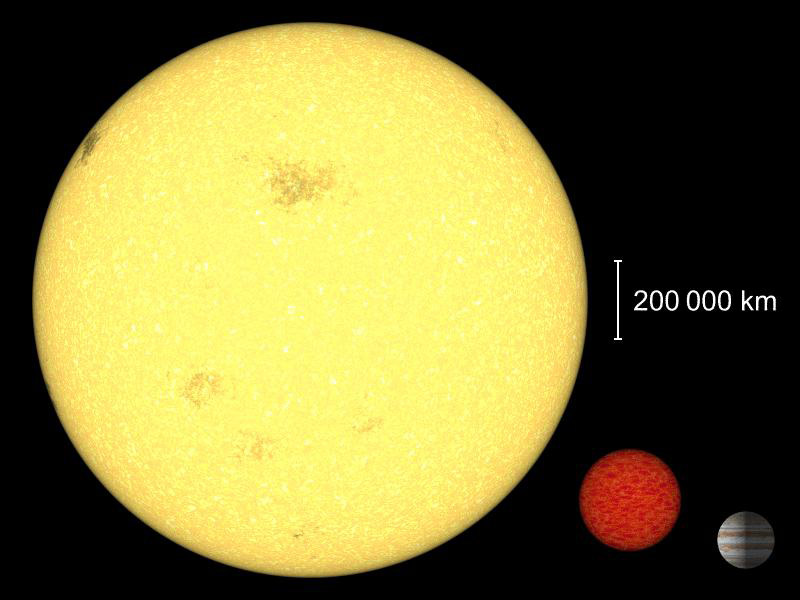
Astronomical objects of planetary size that did not form in orbit around a star
A sub-brown dwarf or planetary-mass brown dwarf is an astronomical object that formed in the same manner as stars and brown dwarfs (i.e. through the collapse of a gas cloud) but that has a planetary mass, therefore by definition below the limiting mass for thermonuclear fusion of deuterium (about ). Some researchers include them in the category of rogue planets whereas others call them planetary-mass brown dwarfs.
Description
Sub-brown dwarfs are formed in the manner of stars, through the collapse of a gas cloud (perhaps with the help of photo-erosion) but there is no consensus amongst astronomers on whether the formation process should be taken into account when classifying an object as a planet. Free-floating sub-brown dwarfs can be observationally indistinguishable from rogue planets, which originally formed around a star and were ejected from orbit. Similarly, a sub-brown dwarf formed free-floating in a star cluster may be captured into orbit around a star, making distinguishing sub-brown dwarfs and large planets also difficult. A definition for the term "sub-brown dwarf" was put forward by the IAU Working Group on Extra-Solar Planets (WGESP), which defined it as a free-floating body found in young star clusters below the lower mass cut-off of brown dwarfs.
Lower mass limit
The smallest mass of gas cloud that could collapse to form a sub-brown dwarf is about 1 Jupiter mass (MJ). This is because to collapse by gravitational contraction requires radiating away energy as heat and this is limited by the opacity of the gas. A 3 MJ candidate is described in a 2007 paper.{{citation|arxiv=0711.2510v1| title=Dusty disks at the bottom of the IMF
List of possible sub-brown dwarfs
Orbiting one or more stars
There is no consensus whether these companions of stars should be considered sub-brown dwarfs or planets. Some authors agree these objects should be considered sub-brown dwarfs, since they likely formed on their own, like a "failed star".
Nonetheless, the IAU working definition of an exoplanet ignored formation mechanism as a criterion, and based on it these objects would be considered planets.
- WD 0806-661 B
- HD 106906 b
- ROXs 42Bb
Orbiting a brown dwarf
At around 2022 the IAU working definition of an exoplanet excludes these objects as planets. The only fitting label would be as sub-brown dwarfs, but they are more often referred as planetary mass objects. Other definitions, like from the NASA Exoplanet Archive would include these as exoplanets. There is no consensus whether these companions of brown dwarfs should be considered sub-brown dwarfs or planets.
WISE J0336−0143B
Main article: WISE J0336−0143
WISE J0336−0143B orbits a brown dwarf or sub-brown dwarf. The primary has a mass of 8.5 to 18 and secondary has a mass of 5-11.5 . This object does not fit the IAU working definition of an exoplanet. This definition requires a mass ratio of about q
2M1207b
Main article: 2M1207b
2M1207b orbits around a young brown dwarf with a circumstellar disk and itself is likely surrounded by a circumstellar disk. The mass ratio is well above the upper limit of q=0.04 for exoplanets according to the IAU.
Others
Other examples of planetary-mass objects orbiting brown dwarfs and with MB0.04:
- CFHTWIR-Oph 98B, with MB= and q=
- 2MASS J0249-0557ABc, with Mc= and q={M_{c} \over M_{AB}}=0.13
Free-floating
Also called rogue planets:
- WISE 0855–0714 3–10 MJ about 7 light years away
- S Ori 52
- UGPS 0722-05 10–25 MJ 13 light years away
- Cha 110913-773444 5–15 MJ 163 light years away
- CFBDSIR 2149−0403 4–7 MJ 130 light years away
- OTS 44 11.5 MJ 550 light years away
- PSO J318.5−22 6–8 MJ about 80 light years away
- Cha 1107−7626 620 light years away
References
References
- [http://www.dtm.ciw.edu/boss/definition.html Working Group on Extrasolar Planets – Definition of a "Planet"] {{webarchive. link. (16 September 2006 POSITION STATEMENT ON THE DEFINITION OF A "PLANET" (IAU))
- Delorme, P.. (December 2012). "CFBDSIR2149-0403: a 4–7 Jupiter-mass rogue planet in the young moving group AB Doradus ?". Astronomy & Astrophysics.
- Luhman, K. L.. (21 April 2014). "Discovery of a ~250 K Brown Dwarf at 2 pc from the Sun". [[The Astrophysical Journal Letters]].
- [https://web.archive.org/web/20010502150203/http://www.space.com/scienceastronomy/solarsystem/planet_confusion_001101-1.html What is a Planet? Debate Forces New Definition], by Robert Roy Britt, 2 November 2000
- IAU WGESP, [http://www.astro.iag.usp.br/~dinamica/WGEP.html 'Position Statement on the Definition of "Planet"'], 28 February 2003
- (2003). "Nomenclature: Brown Dwarfs, Gas Giant Planets, and ?". Brown Dwarfs.
- (2009). "Substellar Objects in Nearby Young Clusters (Sonyc): The Bottom of the Initial Mass Function in Ngc 1333". The Astrophysical Journal.
- (May 2011). "The Ultra Cool Brown Dwarf Companion of WD 0806-661B: Age, Mass, and Formation Mechanism". [[The Astrophysical Journal Letters]].
- (2022-03-17). "The IAU Working Definition of an Exoplanet". New Astronomy Reviews.
- "Exoplanet Criteria for Inclusion in the Exoplanet Archive".
- (2023-04-01). "JWST/NIRCam Discovery of the First Y+Y Brown Dwarf Binary: WISE J033605.05-014350.4". The Astrophysical Journal.
- (2023-06-01). "JWST/NIRSpec Observations of the Planetary Mass Companion TWA 27B". The Astrophysical Journal.
- (2020-12-01). "A Wide Planetary-mass Companion to a Young Low-mass Brown Dwarf in Ophiuchus". The Astrophysical Journal.
- (2018-08-01). "The Hawaii Infrared Parallax Program. III. 2MASS J0249-0557 c: A Wide Planetary-mass Companion to a Low-mass Binary in the β Pic Moving Group". The Astronomical Journal.
This article was imported from Wikipedia and is available under the Creative Commons Attribution-ShareAlike 4.0 License. Content has been adapted to SurfDoc format. Original contributors can be found on the article history page.
Ask Mako anything about Sub-brown dwarf — get instant answers, deeper analysis, and related topics.
Research with MakoFree with your Surf account
Create a free account to save articles, ask Mako questions, and organize your research.
Sign up freeThis content may have been generated or modified by AI. CloudSurf Software LLC is not responsible for the accuracy, completeness, or reliability of AI-generated content. Always verify important information from primary sources.
Report