From Surf Wiki (app.surf) — the open knowledge base
Sher Bahadur Deuba
Former Prime Minister of Nepal

Former Prime Minister of Nepal
| Field | Value | ||
|---|---|---|---|
| native_name | शेर बहादुर देउवा | ||
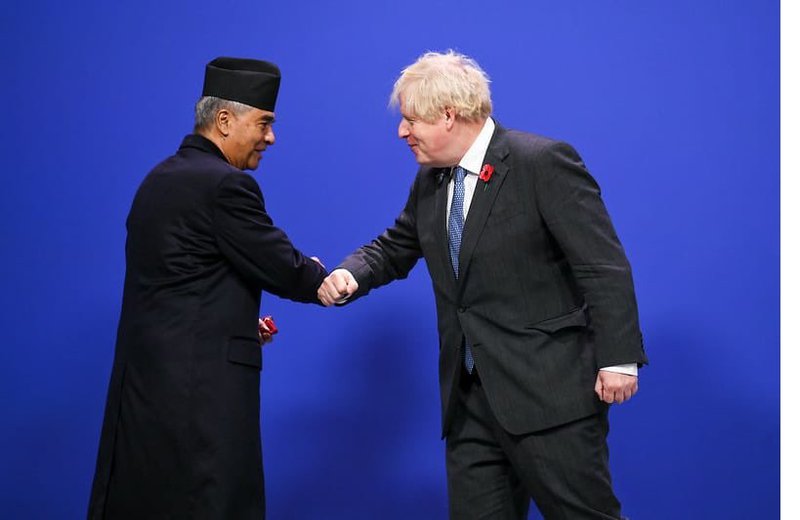
| image | Sher Bahadur Deuba November 2021 crop.jpg | ||
| caption | Deuba in 2017 | ||
| office | 32nd Prime Minister of Nepal | ||
| term_start | 13 July 2021 | ||
| president | Bidya Devi Bhandari | ||
| term_end | 26 December 2022 | ||
| predecessor | KP Sharma Oli | ||
| successor | Pushpa Kamal Dahal | ||
| president1 | Bidya Devi Bhandari | ||
| term_start1 | 7 June 2017 | ||
| term_end1 | 15 February 2018 | ||
| deputy1 | Bijay Kumar Gachhadar | ||
| predecessor1 | Pushpa Kamal Dahal | ||
| successor1 | KP Sharma Oli | ||
| monarch2 | Gyanendra | ||
| term_start2 | 4 June 2004 | ||
| term_end2 | 1 February 2005 | ||
| predecessor2 | Surya Bahadur Thapa | ||
| successor2 | Girija Prasad Koirala | ||
| monarch3 | Gyanendra | ||
| term_start3 | 26 July 2001 | ||
| term_end3 | 4 October 2002 | ||
| predecessor3 | Girija Prasad Koirala | ||
| successor3 | Lokendra Bahadur Chand | ||
| monarch4 | Birendra | ||
| term_start4 | 12 September 1995 | ||
| term_end4 | 12 March 1997 | ||
| predecessor4 | Man Mohan Adhikari | ||
| successor4 | Lokendra Bahadur Chand | ||
| {{Collapsed infobox section begin | Other senior positions | titlestyle | background-color:lavender}} |
| office5 | Leader of the Opposition | ||
| president5 | Ram Chandra Paudel | ||
| primeminister5 | Pushpa Kamal Dahal | ||
| predecessor5 | Khadga Prasad Sharma Oli | ||
| successor5 | Pushpa Kamal Dahal | ||
| term_start5 | 4 March 2024 | ||
| term_end5 | 12 July 2024 | ||
| president6 | Bidya Devi Bhandari | ||
| primeminister6 | Pushpa Kamal Dahal | ||
| predecessor6 | KP Sharma Oli | ||
| successor6 | KP Sharma Oli | ||
| term_start6 | 26 December 2022 | ||
| term_end6 | 27 February 2023 | ||
| president7 | Bidya Devi Bhandari | ||
| primeminister7 | KP Sharma Oli | ||
| predecessor7 | KP Sharma Oli | ||
| successor7 | KP Sharma Oli | ||
| term_start7 | 15 February 2018 | ||
| term_end7 | 13 July 2021 | ||
| president8 | Bidya Devi Bhandari | ||
| primeminister8 | KP Sharma Oli | ||
| predecessor8 | Sushil Koirala | ||
| successor8 | KP Sharma Oli | ||
| term_start8 | 7 March 2016 | ||
| term_end8 | 24 August 2016 | ||
| office9 | Minister of Home Affairs | ||
| term_start9 | 1991 | ||
| term_end9 | 1994 | ||
| monarch9 | Birendra | ||
| primeminister9 | Girija Prasad Koirala | ||
| predecessor9 | Yog Prasad Upadhyay | ||
| successor9 | Khadga Prasad Sharma Oli | ||
| office10 | President of the Nepali Congress | ||
| term_start10 | 7 March 2016 | ||
| vicepresident10 | Bimalendra Nidhi | ||
| Bijay Kumar Gachhadar | |||
| Purna Bahadur Khadka | |||
| Dhanraj Gurung | |||
| predecessor10 | Sushil Koirala | ||
| {{Collapsed infobox section end | Other senior positions | titlestyle | background-color:lavender}} |
| {{Collapsed infobox section begin | Parliamentary offices | titlestyle | background-color:lavender}} |
| office11 | Member of the Parliament, Pratinidhi Sabha | ||
| term_start11 | 4 March 2018 | ||
| predecessor11 | Himself (as member of the Legislature Parliament) | ||
| constituency11 | Dadeldhura 1 | ||
| term_start12 | May 1991 | ||
| term_end12 | April 2008 | ||
| predecessor12 | Constituency created | ||
| successor12 | Himself (as member of the Constituent Assembly) | ||
| constituency12 | Dadeldhura 1 | ||
| office13 | Member of the Constituent Assembly / Legislature Parliament | ||
| term_start13 | 28 May 2008 | ||
| term_end13 | 14 October 2017 | ||
| predecessor13 | Himself (as member of the House of Representatives) | ||
| successor13 | Himself (as member of the House of Representatives) | ||
| constituency13 | Dadeldhura 1 | ||
| birth_date | |||
| birth_place | Ashigram, Kingdom of Nepal | ||
| party | Nepali Congress (before 2002; 2007–2026) | ||
| otherparty | Nepali Congress (Democratic) (2002–2007) | ||
| spouse | Arzu Rana Deuba | ||
| alma_mater | Tribhuvan University (BA, LL.B, MA), LSE | ||
| signature | Signature of Sher Bahadur Deuba.png | ||
| website | |||
| native_name_lang | ne |
Bijay Kumar Gachhadar Purna Bahadur Khadka Dhanraj Gurung Sher Bahadur Deuba (born 13 June 1946) is a Nepalese politician who served as the 32nd prime minister of Nepal for five terms (1995–1997, 2001–2002, 2004–2005, 2017–2018 and 2021–2022). He was the president of the Nepali Congress since 2016 until 2026 and was the Member of Parliament for the parliamentary constituency of Dadeldhura 1 before the parliament was dissolved on 12 September 2025. During the Gen Z protests he along with his wife Arzu Rana Deuba were brutally beaten by the protesters in their residence. His tenure in office has been controversial for nepotism, corruption and illusion with citizens.
Born and raised in Ashigram, a remote village in Ganyapdhura Rural Municipality of Dadeldhura, Deuba completed his primary education there and his secondary education in Doti. He completed his higher education at Tri-Chandra College In 1991, he was elected to the House of Representatives and served as the Minister of Home Affairs in the cabinet led by Girija Prasad Koirala. Deuba became prime minister after Man Mohan Adhikari tried to dissolve the parliament for the second time in two years in 1995. He oversaw the signature of the Mahakali treaty with India during his first term. His second premiership started in July 2001 amidst the rise of the Maoists and he later declared a state of emergency and listed the Communist Party of Nepal (Maoist) as a "terrorist organization". He was dismissed by King Gyanendra in October 2002, but after a public backlash, he was reappointed prime minister in June 2004. He was arrested after the 2005 coup d'état by King Gyanendra, and released in February 2006 after the Supreme Court declared his arrest unlawful.
Deuba was sworn in as prime minister for a fourth stint in June 2017, as per an agreement to form a rotational government by Congress and the CPN (Maoist Centre). His government successfully conducted the elections of all three levels of government in different phases in 2017. On 12 July 2021, the Supreme Court ordered the appointment of Deuba as prime minister within 28 hours, and he was appointed prime minister for a fifth term by President Bidya Devi Bhandari in accordance with Article 76(5) of the Constitution of Nepal the next day.
Early life and education
Deuba was born on 13 June 1946 in Ashigram, Kingdom of Nepal. He completed his primary education from Ashigram Primary School. He then attended Mahendra High School in Doti where he completed his School Leaving Certificate exam. He moved to Kathmandu for his higher education and in 1963 enrolled in Tri-Chandra College.
In 1988, Deuba, with the help of acting Nepali Congress president Krishna Prasad Bhattarai, got a scholarship through Socialist International and was sent to London to attend the London School of Economics where he was a research student studying political science. In London he worked as a part-time translator for the BBC World Service.
Political career
Beginnings (1963–1990)
He started his political career as the member of the Far Western Zonal Student Union in 1963. The organization was founded by students from Far-Western Development Region who were studying in Kathmandu at the time. While studying at Tri-Chandra Multiple Campus, he became a member of the Arjun Narasingha K.C. led Student Rally Coordination Committee along with Ram Chandra Poudel. He became a founding member of the Nepal Student Union in 1970. The next year, he became the president of the union, a position that he held for eight years.
Deuba was arrested in connection with the Jaisidewal bomb plot. He served nine years in jail during the 1970s and 80s for his participation in pro-democracy activities.
Multiparty era (1991–2002)
After the 1990 revolution, Deuba came back from London and was elected from Dadeldhura 1 at the 1991 election from Nepali Congress. He became Home Minister in Girija Prasad Koirala's cabinet.
He was reelected from Dadeldhura 1 at the 1994 election. Following the party losing their majority in the election, party president Girija did not stand for parliamentary party leader and Deuba was elected unopposed after rivals Ram Chandra Poudel and Shailaja Acharya withdrew their candidacy.
First cabinet (1995–1997)
Main article: First Deuba cabinet
After the minority government of Manmohan Adhikari fell, Deuba was appointed as prime minister in 1995 with the support of Rastriya Prajatantra Party and Nepal Sadbhawana Party. He came into controversy for having 52 cabinet members in his eighteen month long tenure a move that was criticized by party president Girija Prasad Koirala. His government was also accused of bribing MPs from minor parties and sending Rastriya Prajatantra Party MP's to Bangkok in order to avoid key votes in the parliament. His administration also introduced pensions, allowances and other privileges for legislators.
Deuba's administration frequently solicited the advice of the opposition in major domestic and foreign policy issues. His cabinet signed the Mahakali treaty with India, which had been initiated by the previous CPN (UML) government, introduced a system of voter ID and ended dual ownership of land through consensus in the parliament. Contunuing with party policy, his administration favored economic liberalization that the Koirala government in 1991 had started. Value-added taxes were introduced during his tenure. Deuba completed state visits to India, China, Pakistan, the United Kingdom and the United States during his tenure.
He resigned in March 1997 after two MPs from his party abstained from voting against a no-confidence motion. He also resigned as parliamentary party leader after losing support in the parliamentary group and was replaced by Girija Prasad Koirala.
In the 1999 election, Deuba was reelected from Dadeldhura 1. After the resignation of Krishna Prasad Bhattarai as prime minister and parliamentary party leader, Deuba faced off against Girija Prasad Koirala at the party but lost. He also lost stood against Koirala at the party's tenth general convention in January 2001 for the past of party president but faced defeat again.
Second cabinet (2001–2002)
Main article: Second Deuba cabinet
After Koirala was forced to resign following the Holeri scandal in July 2001, Deuba defeated Sushil Koirala in the contest for parliamentary party leader and was appointed as prime minister for the second time. His government invited the Maoists for negotiations and agreed upon a cease-fire with them until the end of negotiations. The special Socio-Economic Reform Programs which covered land reforms, abolition of social discrimination, electoral reforms and women's property rights were brought in by his government as preemptive measures before negotiations with the Maoists. Following a breakdown in negotiations, the Maoists resumed their attacks on the government and a state of emergency was declared for six months in February 2002 after a parliamentary vote.
The July 2002 local elections were also postponed following the escalation of violence. After Deuba failed to get a two-thirds majority to extend the state of emergency and dissent within his party on the government's handling of the Maoist issue, Deuba requested King Gyanendra to dissolve the parliament and called for new elections within the next six months.
The Deuba government failed to hold new elections and asked for fourteen more months citing the growing Maoist insurgency. He was subsequently removed as prime minister by King Gyanendra in November 2002. Removing an elected prime minister was seen as a autocratic move from the king and was followed by wide spread protests.
Nepali Congress (Democratic) (2002–2007)
Deuba's move to extend the state of emergency and dissolving the House of Representatives was severely criticized by party chairman Girija Prasad Koirala. After Deuba was expelled from the Nepali Congress, his faction of the party called a general convention that deposed Koirala . Koirala declared this general convention illegal and was supported by two-thirds of the members of the committee. In September 2002, the Election Commission declared that Koirala's group was the official Nepali Congress following which Deuba split the party and formed Nepali Congress (Democratic).
Third cabinet (2004–2005)
Main article: Third Deuba cabinet
After months of protests from the major political parties, King Gyanendra agreed to let the parties nominate the next prime minister. When no consensus was reached among the parties, Deuba was reinstated as prime minister in June 2004.
He remained as prime minister until 1 February 2005, when the king seized executive power and placed leading politicians including Deuba under house arrest. In July, Deuba was sentenced to two years in jail on corruption charges related to Melamchi Water Supply Project by the Royal Commission on Corruption Control set up by King Gyanendra. After the Supreme Court dismissed the commission for being unconstitutional, he was released from prison.
In September 2007, he re-united the Nepali Congress (Democratic) with the Nepali Congress.
Constituent Assembly (2008–2015)
He was elected from Dadeldhura 1 and Kanchanpur 4 at the 2008 Constituent Assembly election, the latter of which he vacated. Deuba was the candidate for Nepali Congress for prime minister but lost to CPN (Maoist) leader Pushpa Kamala Dahal, 464-113. He faced off against Ram Chandra Poudel for parliamentary party leader but lost. Deuba also unsuccessfully challenged acting president Sushil Koirala at the party's 12th general convention in September 2010.
He was reelected from Dadeldhura 1 at the 2013 Constituent Assembly election. He challenged party president Sushil Koirala for parliamentary party leader but lost.
Congress president (2016–present)
.jpg)
At the party's 13th general convention, Deuba contested against Ram Chandra Poudel and Krishna Prasad Sitaula for party president. Deuba fell 11 votes short of winning in the first round and was elected in the second round, defeating Poudel with 58% of the vote.
Fourth cabinet (2017–2018)
Main article: Fourth Deuba cabinet
In August 2016, the party agreed on a deal with CPN (Maoist Centre) to run the government for nine months each until the next election. As per the agreement, Deuba was sworn in as prime minister for the fourth time on 7 June 2017. He was elected from Dadeldhura 1 at the 2017 election but the left alliance of CPN (UML) and CPN (Maoist Centre) gained a majority in the House of Representatives. He resigned in February 2018 to make way for the new government. In the contest for parliamentary party leader he defeated Prakash Man Singh.
Fifth cabinet (2021–2022)
Main article: Fifth Deuba cabinet
After KP Sharma Oli lost a no-confidence motion against him, Deuba was proposed as prime minister by the CPN (Maoist Centre) and some members of the opposition CPN (UML). President Bidhya Devi Bhandari denied this claim and reappointed Oli as prime minister who requested that the House of Representatives be dissolved and called for new elections. This was met by a legal challenge in the Supreme Court which ruled in favor of restoring the lower house and appointing Deuba as prime minister in July 2021. Deuba was then appointed prime minister for the fifth time.
At the party's 14th general convention in December 2021, he faced a challenge from Shekhar Koirala, Prakash Man Singh, Bimalendra Nidhi and Kalyan Gurung. Deuba got 48% of the vote in the first round and faced Koirala in the second round. Deuba was re-elected as president defeating Shekhar Koirala with 60% of the vote after Singh and Nidhi supported him in the second round.
He was reelected from Dadeldhura 1 at the 2022 election. He was also reelected as the parliamentary party leader, surviving a challenge from general secretary Gagan Thapa. Deuba was replaced by Pushpa Kamal Dahal following the election.
Personal life
Deuba is married to Arzu Rana Deuba. They have a son, Jaybir Singh Deuba. In November 2016, Deuba was conferred an honorary doctorate degree by Jawaharlal Nehru University in India. During the 2025 Nepalese Gen Z protests, Deuba and his wife were injured after their house was attacked and set on fire by protesters on 9 September and were rescued by Nepal Army and Armed Police Force officers.
Electoral performance
Notes
References
References
- "Personal information of Sher Bahadur Deuba published in".
- (13 September 2025). "Nepal made history once again: First female CJ now first female PM".
- (January 26, 2026). "Ex-Nepal PM Sher Bahadur Deuba Bleeds As Army Rescues Him And Wife Arzu Rana Deuba After Protestors Break Into Home".
- "संसदीय विवरण पुस्तिका, प्रतिनिधि सभा (२०५६ - २०५९)".
- (2017-06-19). "Nepal: Transitional uncertainty".
- "IPU PARLINE database: NEPAL (Sambidhan Sabha) ELECTIONS IN 2008".
- "Sher Bahadur Deuba sworn in as Nepal prime minister, for fifth time".
- (2021-07-13). "Sher Bahadur Deuba becomes Nepal's prime minister for the fifth time".
- "Personal information of Sher Bahadur Deuba published in".
- "शेरबहादुरका साथीः पाइन्ट किन्नेदेखि रक्सी पिउनेसम्म !".
- "LSE people". London School of Economics.
- (2002-07-12). "Deuba at lse".
- "पाँचौँ पटक प्रधानमन्त्री बनेका शेरबहादुर देउवा को हुन्?". BBC News नेपाली.
- "को हुन् देउवा ? के चाहन्छन् उनी ?".
- Khatiwada, Sudarshan. (2023-01-02). "ती 'बहादुर' शेर, यी शेरबहादुर".
- (2005-07-26). "Former Nepali PM Deuba convicted". [[CNN]].
- (21 December 2022). "कांग्रेस संसदीय दलमा देउवाकाे चौथो इन्ट्री, यसअघि काे-काेसँग थियाे प्रतिस्पर्धामा ?".
- Hachhethu, Krishna. (1997). "Nepal in 1996: Experimenting with a Coalition Government". Asian Survey.
- Khanal, Y. N.. (1998). "Nepal in 1997: Political Stability Eludes". Asian Survey.
- "कांग्रेसको सातौं देखि १३ औं महाधिवेशनसम्म".
- Baral, Lok Raj. (2002). "Nepal in 2001: The Strained Monarchy". Asian Survey.
- Krämer, Karl-Heinz. (2003-02-01). "Nepal in 2002: Emergency and Resurrection of Royal Power". Asian Survey.
- (November 2020). "तीनवटा पञ्चायतको पतनपछि पाँचवटा पैसातन्त्र".
- Hutt, Michael. (2005). "Nepal and Bhutan in 2004: Two Kings, Two Futures". Asian Survey.
- Hutt, Michael. (2006). "Nepal and Bhutan in 2005: Monarchy and Democracy, Can They Co-exist?". Asian Survey.
- Uppal, Disha. (2007-09-26). "Nepali Congress Re-Unites".
- [http://www.iht.com/articles/ap/2008/08/16/asia/AS-Nepal-Premiership-Election.php "Ex-rebels' chief chosen as Nepal's new PM"] {{Webarchive. link. (19 September 2008, Associated Press (''International Herald Tribune''), 15 August 2008.)
- "Sushil does it, clinches the post".
- (2014-01-26). "Sushil Koirala elected PP leader of NC, set to become PM". The Economic Times.
- Koirala, Keshav P.. (2016-03-07). "Sher Bahadur Deuba elected Nepali Congress president".
- "Deuba sworn in as 40th PM, forms Cabinet by inducting 7 ministers". The Kathmandu Post.
- (7 June 2017). "Sher Bahadur Deuba sworn in as Prime Minister". The Himalayan Times.
- (15 February 2018). "Sher Bahadur Deuba resigns, KP Oli to take over as Nepal PM".
- (10 May 2021). "President Bhandari calls on parties to form majority government, allots three days' time".
- (22 May 2021). "Neither Deuba nor Oli can be appointed PM: President Bhandari".
- "In a midnight drama, Nepal President dissolves House and calls polls for November 12 and 19".
- (12 July 2021). "Supreme Court reinstates House, issues verdict in favour of Deuba's claim".
- (2021-07-12). "Nepal Court Replaces Prime Minister After Months of Turbulence". The New York Times.
- "Deuba set to govern for a year and a half as he wins House confidence".
- "Sher Bahadur Deuba sworn in as Nepal prime minister, for fifth time".
- "Deuba reelected as Nepali Congress President".
- "Sher Bahadur Deuba defeats Shekhar Koirala to reclaim Congress president post".
- "Prime Minister Sher Bahadur Deuba re-elected from Dadeldhura".
- (2022-12-21). "Deuba elected NC parliamentary party leader".
- "President appoints Pushpa Kamal Dahal prime minister".
- "Deuba active again after returning from Singapore, starts meeting leaders".
- (7 November 2016). "Deuba conferred JNU's honorary doctorate degree". [[The Kathmandu Post]].
- "देउवा दम्पतीलाई कुटपिट र लछारपछार गरेर सुरक्षाकर्मीको जिम्मा लगाए प्रदर्शनकारीले". Setopati.
This article was imported from Wikipedia and is available under the Creative Commons Attribution-ShareAlike 4.0 License. Content has been adapted to SurfDoc format. Original contributors can be found on the article history page.
Ask Mako anything about Sher Bahadur Deuba — get instant answers, deeper analysis, and related topics.
Research with MakoFree with your Surf account
Create a free account to save articles, ask Mako questions, and organize your research.
Sign up freeThis content may have been generated or modified by AI. CloudSurf Software LLC is not responsible for the accuracy, completeness, or reliability of AI-generated content. Always verify important information from primary sources.
Report