From Surf Wiki (app.surf) — the open knowledge base
Senedd constituencies and electoral regions
Welsh Parliament electoral districts

Welsh Parliament electoral districts
| Field | Value | |
|---|---|---|
| name | Senedd constituencies and electoral regions | |
| alt_name | Senedd Cymru / Welsh Parliament constituencies and electoral regions | |
| map | [[File:Senedd constituencies and electoral regions.svg | 255px]] |
| caption | Map of the 40 constituencies (left side) and the 5 electoral regions (right side) of the Senedd in Wales | |
| category | Electoral district | |
| territory | Wales | |
| start_date | ||
| current_number | 40 constituencies | |
| 5 regions | ||
| number_date | 2021 | |
| population_range | Constituency: | |
| 43,125 (Arfon) – | ||
| 81,366 (Cardiff South and Penarth) | ||
| Region: | ||
| 413,569 (South Wales West) – | ||
| 523,096 (South Wales Central) | ||
| government | Senedd | |
| legislation_begin | Government of Wales Act 1998 | government1=Welsh Government |
5 regions 43,125 (Arfon) – 81,366 (Cardiff South and Penarth)
Region: 413,569 (South Wales West) – 523,096 (South Wales Central)
The Senedd constituencies and electoral regions () are the electoral districts used to elect members of the Senedd (MS; ) to the Senedd (Welsh Parliament; ), and have been used in some form since the first election of the then National Assembly for Wales in 1999.
There are currently forty single-member constituencies and five four-member regions. The five electoral regions are: Mid and West Wales, North Wales, South Wales Central, South Wales East, and South Wales West, with the forty constituencies listed below. Voting last took place in all districts in the 2021 Senedd election, and is not used for local government. The current boundaries were introduced for the 2007 Assembly election.
The constituencies were created through the Government of Wales Act 1998, which established the National Assembly for Wales. The Assembly's constituencies were initially linked to the boundaries used for UK Parliament constituencies in Wales, set by the UK Parliament's Boundary Commission for Wales, except a delay in implementing new boundaries between the 2007 Assembly election and the subsequent 2010 UK election. The Parliamentary Voting System and Constituencies Act 2011, unlinked the two sets of constituencies, meaning any changes to one set, no longer affected the other. Subsequently, the UK Parliament introduced new constituencies for its 2024 UK election, and the Democracy and Boundary Commission Cymru was set up in 2024 to conduct boundary reviews of Senedd constituencies, with the constituencies not been overseen by a statutory body prior to 2024.
As part of Senedd reforms, new boundaries will be introduced for the 2026 Senedd election following a boundary review, consisting of sixteen general ticket constituencies with Welsh-only names, while the electoral regions are being abolished. Another review will be conducted for the 2030 election.
History
Establishment
Following the 1997 Welsh devolution referendum, where a narrow majority voted in support of the creation of a devolved Welsh Assembly, constituencies of the devolved legislature were established.
Section 2 of the Government of Wales Act 1998 stipulates that the constituencies for the National Assembly for Wales be the same as the constituencies used for elections to the United Kingdom Parliament. The same act sets out the creation of five regions which would use the same borders as the five European Parliamentary constituencies in Wales which themselves were set out in the European Parliamentary Constituencies (Wales) Order 1994, used for elections to the European Parliament between 1994 and 1999. The electoral regions set out are still used, despite the abolishment of the five European Parliamentary constituencies for an all-Wales constituency, and the withdrawal of the UK from the European Union. Although minor border adjustments to the regions have taken place.
2007 change in boundaries
In 2006, the Government of Wales Act 2006 was enacted. When enacted the act reinforced the link between Assembly and UK Parliamentary constituencies, and that the number of electoral regions is five.
Following the fifth periodic review of Westminster constituencies, new borders for the constituencies and electoral regions were defined by the Parliamentary Constituencies and Assembly Electoral Regions (Wales) Order 2006.
The order detailed the abolition of three constituencies (Caernarfon, Conwy, and Meironnydd Nant Conwy), with three new constituencies to replace them (Aberconwy, Arfon, and Dwyfor Meirionnydd). Nine constituencies were subject to "substantial" border adjustments involving the transfer of more than 3,000 inhabitants between constituencies. A further eight constituencies were subject to boundary changes resulting in the redistribution of fewer than 3,000 inhabitants between each constituency, and a further four constituencies were subject to minor boundary adjustments that led to minimal transfers of inhabitants between constituencies. The remaining sixteen constituencies were not subject to any boundary or name modifications.
The three new constituencies straddled the border of the electoral regions of Mid and West Wales and North Wales, leading to adjustments in the boundaries of both electoral regions, in addition to minor adjustments to the constituency of Montgomeryshire also leading to minor regional boundary adjustments. In south Wales, the boundaries of the electoral regions, South Wales West, and South Wales Central were altered to accommodate changes to the boundaries of Bridgend, and Vale of Glamorgan constituencies.
The changes in the boundaries for constituencies and electoral regions of the Senedd came into force for the 2007 National Assembly for Wales election.
Delinking from UK parliament constituencies
Section 13(1) of the Parliamentary Voting System and Constituencies Act 2011 states that: Constituencies and Assembly Electoral Regions (Wales) Order 2006 (S.I. 2006/1041)24 as amended by— the Parliamentary Constituencies and Assembly Electoral Regions (Wales) (Amendment) Order 2008 (S.I. 2008/1791)|title=|source=Parliamentary Voting System and Constituencies Act 2011}} This details that any further changes to the UK Parliament constituencies in Wales specified in the act (notably the proposed reduction in constituencies to 30) will not be applied to Assembly (Senedd) constituencies.
In a session of the House of Commons where the then secretary of state for Wales, Cheryl Gillan was questioned on the Labour party's opposition to the decoupling of the two constituencies, she replied: Members are well aware that the Parliamentary Voting System and Constituencies Act 2011 broke the link between Assembly constituencies and parliamentary constituencies. I have agreed that we need to look carefully at the implications of having constituency boundaries relating to different areas and regions for UK and Assembly elections in Wales.|author=Rt. Hon Cheryl Gillan MP}}
Boundaries of Senedd constituencies and electoral regions were initially not overseen by any statutory review body, following the delinking of Senedd and UK Parliament constituencies in 2011. With the responsibility for proposing alterations to the boundaries of UK Parliament constituencies in Wales, and reporting to the UK Government, lay with the Boundary Commission for Wales. At the time, both constituencies had the same boundaries. Organisations such as the Electoral Reform Society Cymru indicated a preference for coterminosity (mirroring Senedd and UK Parliament constituencies, especially during the 2016 proposed reforms). However, such coterminosity was merely desired and was not enforced by law, meaning any changes to UK Parliament constituencies in Wales did not need to be mirrored for Senedd constituencies. The 2023 review of Westminster constituencies reduced the number of UK Parliament constituencies in Wales from 40 to 32, and were used from the 2024 UK election. While the Senedd is to introduce larger constituencies composed of pairings of the 32 from 2026.
2020 renaming
On 6 May 2020, the Senedd and Elections (Wales) Act 2020 came into force, renaming the Assembly constituencies and Assembly electoral regions of the National Assembly for Wales, to the Senedd constituencies and Senedd electoral regions of "Senedd Cymru" or "the Welsh Parliament", known in both Welsh and English as the Senedd.
2024–25 boundary review
Main article: 2026 review of Senedd constituencies
The Senedd Cymru (Members and Elections) Act 2024, passed by the Senedd in May 2024, gave the responsibility for conducting boundary reviews of Senedd constituencies to the Democracy and Boundary Commission Cymru. The commission would be responsible to conduct reviews for specifically both the 2026 Senedd election and the 2030 Senedd election, as well as regular reviews thereafter. The 2026 review was time-constricted, therefore the 2030 review, the first full boundary review in 18 years, would provide the commission with more flexibility.
The Senedd Cymru (Members and Elections) Act 2024 legislated that the 2026 election should use 16 six-member constituencies, replacing the existing 40 constituencies and five regions, with the Democracy and Boundary Commission Cymru conducting the review. The law set out that they must be contiguous pairings of the 32 UK Parliament constituencies used in Wales since 2024, and to only use a single name in both Welsh and English, unless it could be considered unacceptable for a single name. The review commenced in July 2024, with initial proposals revealed in September 2024, and revised proposals in December 2024. A major change in the revised proposals was the use of mostly Welsh-language names only to meet the condition in law, therefore all (except four) had only one name, its Welsh name. The decision received support from Cymdeithas yr Iaith, but opposition from Andrew RT Davies, former leader of the Welsh Conservatives. In March 2025, the commission published its final determinations, for the 16 constituencies (see ). The original initial proposal boundaries were re-adopted, while all constituencies were made to use Welsh-only names, with a reiteration of both support and opposition from Cymdeithas and Davies respectively, as well as consultation respondents. By law, the Senedd must put these final determinations into effect for the 2026 Senedd election without alteration.
Multi-member constituencies (from 2026)
The following is a list of the constituencies set to be used under the multi-member general ticket system from the 2026 Senedd election. All constituencies are named in Welsh and each constituency will have six members.
| Senedd constituency | UK parliament constituencies |
|---|---|
| (Welsh name, if relevant) | |
| Aberafan Maesteg | |
| Rhondda and Ogmore | |
| Rhondda ac Ogwr | |
| Bangor Aberconwy | |
| Ynys Môn | |
| Blaenau Gwent and Rhymney | |
| Blaenau Gwent a Rhymni | |
| Caerphilly | |
| Caerffili | |
| Cardiff North | |
| Gogledd Caerdydd | |
| Cardiff East | |
| Cardiff West | |
| Gorllewin Caerdydd | |
| Cardiff South and Penarth | |
| De Caerdydd a Phenarth | |
| Newport East | |
| Dwyrain Casnewydd | |
| Newport West and Islwyn | |
| Gorllewin Casnewydd ac Islwyn | |
| Ceredigion Preseli | |
| Mid and South Pembrokeshire | |
| Canol a De Sir Benfro | |
| Clwyd East | |
| Clwyd North | |
| Alyn and Deeside | |
| Wrexham | |
| Wrecsam | |
| Dwyfor Meirionnydd | |
| Montgomeryshire and Glyndŵr | |
| Maldwyn a Glyndŵr | |
| Caerfyrddin | |
| Llanelli | |
| Brecon, Radnor and Cwm Tawe | |
| Neath and Swansea East | |
| Castell Nedd a Dwyrain Abertawe | |
| Swansea West | |
| Gorllewin Abertawe | |
| Gower | |
| Gŵyr | |
| Merthyr Tydfil and Aberdare | |
| Pontypridd | |
| Monmouthshire | |
| Sir Fynwy | |
| Torfaen | |
| Vale of Glamorgan | |
| Bro Morgannwg | |
| Bridgend | |
| Pen-y-bont ar Ogwr |
Additional Member System (1999–2026)
Senedd constituencies are grouped into electoral regions consisting of between seven and nine constituencies. An additional member system is used to elect four additional Members of the Senedd from each region, in addition to the MSs elected by the constituencies. The Electoral Regions boundaries were based upon the pre-1999 European Parliament constituencies. At each general election of the Senedd, each elector has two votes, one constituency vote and one regional party-list vote. Each constituency elects one Member by the first past the post (single-member district plurality, SMDP) system, and the additional Senedd seats are filled from regional closed party lists, under the D'Hondt method, with constituency results being taken into account, to produce a degree of proportional representation for each region. Altogether, the sixty Members of the Senedd are elected from the forty constituencies and five electoral regions, creating a Senedd of forty constituency MSs and twenty additional MSs. Every constituent is represented by one constituency member and four regional members.
Wales is currently made up of 40 constituencies for elections to the Senedd; the constituencies were the same until the 2024 United Kingdom general election but were not linked to those used for elections to the House of Commons of the United Kingdom, with each constituency containing a population of around 60,000.
The borders of each constituency are drawn using Local government boundaries, defined in Parliamentary Voting System and Constituencies Act 2011 as "the boundaries of counties, county boroughs, electoral divisions, communities and community wards".
Wales is organised into five electoral regions for elections to the Senedd. Each region contains between 7 and 9 constituencies within them. Each region elects four additional members of the Senedd and roughly contains 500,000 people.
Constituencies
List of Senedd constituencies
| Constituency | Electoral population (March 2020) | Principal areas | Electoral region |
|---|---|---|---|
| Aberavon | 51,450 | Neath Port Talbot | South Wales West |
| Aberconwy (2007–2026) | 45,426 | Conwy | North Wales |
| Alyn and Deeside | 65,183 | Flintshire; Wrexham | North Wales |
| Arfon (2007–2026) | 43,125 | Gwynedd | North Wales |
| Blaenau Gwent | 51,495 | Blaenau Gwent | South Wales East |
| Brecon and Radnorshire | 55,124 | Powys | Mid and West Wales |
| Bridgend | 64,245 | Bridgend | South Wales West |
| Caerphilly | 64,926 | Caerphilly; Newport | South Wales East |
| Cardiff Central | 63,017 | Cardiff | South Wales Central |
| Cardiff North | 69,143 | Cardiff | South Wales Central |
| Cardiff South and Penarth | 81,366 | Cardiff | South Wales Central |
| Cardiff West | 69,511 | Cardiff | South Wales Central |
| Carmarthen East and Dinefwr | 58,048 | Carmarthenshire | Mid and West Wales |
| Carmarthen West and South Pembrokeshire | 59,924 | Carmarthenshire; Pembrokeshire | Mid and West Wales |
| Ceredigion | 56,634 | Ceredigion | Mid and West Wales |
| Clwyd South | 54,747 | Denbighshire; Wrexham | North Wales |
| Clwyd West | 58,024 | Conwy; Denbighshire | North Wales |
| Cynon Valley | 51,461 | Rhondda Cynon Taf | South Wales Central |
| Delyn | 55,604 | Conwy; Flintshire | North Wales |
| Dwyfor Meirionnydd (2007–2026) | 44,882 | Gwynedd | Mid and West Wales |
| Gower | 62,763 | Swansea | South Wales West |
| Islwyn | 56,841 | Caerphilly | South Wales East |
| Llanelli | 62,196 | Carmarthenshire; Swansea | Mid and West Wales |
| Merthyr Tydfil and Rhymney | 57,883 | Caerphilly; Merthyr Tydfil | South Wales East |
| Monmouth | 67,252 | Monmouthshire | South Wales East |
| Montgomeryshire | 49,691 | Powys | Mid and West Wales |
| Neath | 57,032 | Neath Port Talbot | South Wales West |
| Newport East | 60,936 | Newport | South Wales East |
| Newport West | 68,748 | Newport | South Wales East |
| Ogmore | 57,934 | Rhondda Cynon Taf; Bridgend | South Wales West |
| Pontypridd | 60,923 | Rhondda Cynon Taf | South Wales Central |
| Preseli Pembrokeshire | 60,025 | Pembrokeshire | Mid and West Wales |
| Rhondda | 50,471 | Rhondda Cynon Taf | South Wales Central |
| Swansea East | 60,726 | Swansea | South Wales West |
| Swansea West | 59,419 | Swansea | South Wales West |
| Torfaen | 63,061 | Torfaen | South Wales East |
| Vale of Clwyd | 56,307 | Denbighshire | North Wales |
| Vale of Glamorgan | 77,204 | Vale of Glamorgan | South Wales Central |
| Wrexham | 52,713 | Wrexham | North Wales |
| Ynys Môn | 52,610 | Isle of Anglesey | North Wales |
1999–2007 constituencies
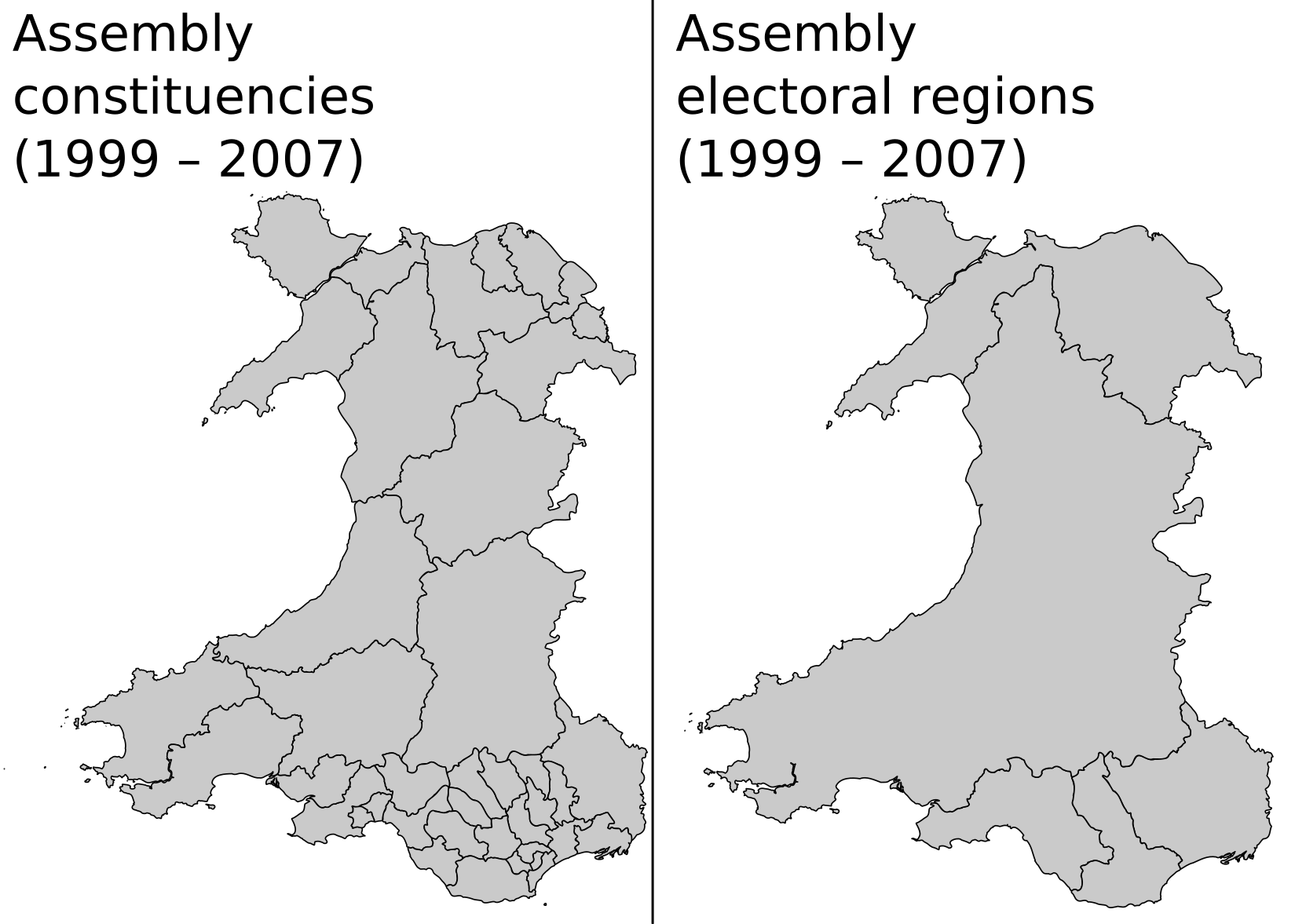
Between the first election in 1999 for the then National Assembly for Wales, to the 2007 election, there were three former constituencies. These constituencies were replaced at the 2007 election, with new boundaries and names.
Three constituency names, Conwy, Caernarfon, and Meirionydd Nant Conwy, became historic, and the new boundaries defined three constituencies with new names: Arfon, Dwyfor Meirionnydd, and Aberconwy. Generally, the new boundaries define each constituency taking into account local government ward boundaries, and define constituencies close to equal in terms of the sizes of their electorates.
| Former constituency | Region of former constituency | Replacement constituencies | Regions of replacement constituencies | Preserved county |
|---|---|---|---|---|
| Caernarfon | North Wales | Arfon | North Wales | Gwynedd |
| Dwyfor Meirionnydd | Mid and West Wales | |||
| Conwy | North Wales | Arfon | North Wales | Clwyd |
| Aberconwy | Gwynedd | |||
| Meirionnydd Nant Conwy | Mid and West Wales | Aberconwy | North Wales | Clwyd |
| Dwyfor Meirionnydd | Mid and West Wales | Gwynedd |
Electoral regions
| Electoral region | Number of constituencies | Constituencies | Electoral population (March 2020) | Image | |
|---|---|---|---|---|---|
| Mid and West Wales | 8 | Brecon and Radnorshire, Carmarthen East and Dinefwr, Carmarthen West and South Pembrokeshire, Ceredigion, Dwyfor Meirionnydd, Llanelli, Montgomeryshire, Preseli Pembrokeshire | 446,524 | [[File:Mid Wales Senedd region 2021.svg | 200px]] |
| North Wales | 9 | Aberconwy, Alyn and Deeside, Arfon, Clwyd South, Clwyd West, Delyn, Vale of Clwyd, Wrexham, Ynys Môn | 483,739 | [[File:North Wales Senedd region 2021.svg | 200px]] |
| South Wales Central | 8 | Cardiff Central, Cardiff North, Cardiff South and Penarth, Cardiff West, Cynon Valley, Pontypridd, Rhondda, Vale of Glamorgan | 523,096 | [[File:South Wales Central Senedd region 2021.svg | 200px]] |
| South Wales East | 8 | Blaenau Gwent, Caerphilly, Islwyn, Merthyr Tydfil and Rhymney, Monmouth, Newport East, Newport West, Torfaen | 491,142 | [[File:South Wales East Senedd region 2021.svg | 200px]] |
| South Wales West | 7 | Aberavon, Bridgend, Gower, Neath, Ogmore, Swansea East, Swansea West | 413,569 | [[File:South Wales West Senedd region 2021.svg | 200px]] |
Notes
References
References
- "Senedd and Elections (Wales) Act 2020".
- "Government of Wales Act 2006".
- "Data for the Senedd Cymru constituency areas: 2021". Senedd Research.
- "The Parliamentary Constituencies and Assembly Electoral Regions (Wales) Order 2006".
- "Parliamentary Voting System and Constituencies Act 2011". [[UK Parliament]].
- "Government of Wales Act 1998". [[Act of Parliament (UK).
- (24 February 1994). "The European Parliamentary Constituencies (Wales) Order 1994". [[UK Parliament]].
- (2011). "The review of parliamentary constituencies in Wales". [[National Assembly for Wales.
- (11 May 2011). "Parliamentary Debates - Wednesday 11 May 2011". [[House of Commons (UK).
- Roberts, Owain. (September 2011). "The review of parliamentary constituencies in Wales". [[National Assembly for Wales]].
- "Reshaping the Senedd".
- (2021-09-08). "Major changes to cut number of Welsh MPs published". BBC News.
- Mosalski, Ruth. (2024-05-08). "The multi-million pound plan to expand the Senedd to 96 MSs has become law".
- (2024-12-17). "Democracy and Boundary Commission Cymru [HTML] {{!}} GOV.WALES".
- (2025-03-11). "Senedd expansion: Welsh-only names for all Welsh Parliament seats".
- (2025-03-11). "Final constituencies created ahead of 2026 Senedd elections".
- (2024-08-21). "Senedd reform {{!}} GOV.WALES".
- (2024-09-03). "2026 Review: Initial Proposals {{!}} DBCC".
- "New constituencies for the 2026 Senedd election announced".
- (17 December 2024). "Welsh-only names for most new big Senedd seats revealed".
- (17 December 2024). "Proposed Senedd constituency names divides opinion". [[ITV News]].
- (2025-03-11). "2026 Review: Final Determinations {{!}} DBCC".
- Price, Emily. (2025-03-11). "New Senedd 'super constituencies' confirmed".
- (11 April 2006). "Parliamentary Constituencies and Assembly Electoral Regions (Wales) Order 2006". [[UK Parliament]].
This article was imported from Wikipedia and is available under the Creative Commons Attribution-ShareAlike 4.0 License. Content has been adapted to SurfDoc format. Original contributors can be found on the article history page.
Ask Mako anything about Senedd constituencies and electoral regions — get instant answers, deeper analysis, and related topics.
Research with MakoFree with your Surf account
Create a free account to save articles, ask Mako questions, and organize your research.
Sign up freeThis content may have been generated or modified by AI. CloudSurf Software LLC is not responsible for the accuracy, completeness, or reliability of AI-generated content. Always verify important information from primary sources.
Report