From Surf Wiki (app.surf) — the open knowledge base
Population and housing censuses by country
none

none
This is a list of national population and housing censuses.
Census advisory
The United Nations recommends a census enumeration at least once every ten years, and once every five years for even better data, rather than simply relying on estimates and projections alone. Complications to carrying out a census include tribal conflict, war, borders not demarcated, budget, inexperience, political snags, lack of manpower, and poor geographic information systems. A number of nations have not carried them out once a decade. It is not uncommon for a scheduled census to be deferred or delayed.
Lebanon has not held a census since 1932. Afghanistan is closing in on five decades without a census. DRC and Uzbekistan stand out as not having a census since before 1990. Eritrea has only had one as a part of Ethiopia in the 1990s.
Methods of conducting population census
More countries are switching to using administrative data to hold a census. This allows a simulated census to be conducted by linking several different administrative databases at an agreed time.
| Using administrative data/combined data | Using collected data |
|---|---|
| Netherlands, Norway, Sweden, Switzerland, Denmark, Finland | United Kingdom, United States, Japan |
Africa
Algeria
Population and housing censuses have been carried out in Algeria in 1966, 1977, 1987, 1998, 2008, and 2020.
Angola
General censuses of population and housing (Portuguese: Recenseamento Geral da População e Habitação (RGPH)) were carried out in 1970 and 2014. The 1970 census counted 5,646,166 habitants. The 2014 census counted 25,789,024 habitants as of May 16, 2014.
Benin
Population and housing censuses have been carried out in 1978, 1992, 2002 and 2013. 2013 census preliminary results have been published. Final results were published in 2015.
Botswana
Main article: Census in Botswana
Censuses in Botswana are run by the Statistics Botswana (formerly Central Statistics Office). There have been twelve censuses in Botswana's history. The most recent occurred in April 2022.
Burkina Faso
The Institut National de la Statistique et de la Demographie has conducted four censuses: in 1975, 1985, 1996, 2006 and 2019.
Congo (DRC)
The first and so far only census conducted in DR Congo dates from 1984.
Egypt
Main article: Census in Egypt
The Statistical Department of the Ministry of Finance conducted the first census in 1882, which considered as a preparatory step; the first true population census was conducted in 1897. Thereafter, censuses were conducted at ten-year intervals in 1907, 1917, 1927 and so on. The last one being in 2017.
Ethiopia
Three censuses have been taken in Ethiopia: 1984, 1994 and in 2007. The responsible institution is the Central Statistical Agency. Most of the census in 2007 was taken in August, while the Somali Region and the Afar Region were not covered. The northern Afar region is a remote, hot and arid area. The eastern Somali region (Ogaden) hosts a large nomadic Somali population and is a conflict area where Ethiopian regular forces are fighting against Ogaden National Liberation Front (ONLF).
Ivory Coast
Four general censuses of population and housing (French: Recensement Général de la Population et de l'Habitat (RGPH)) have been carried out in, the latest ones being in 1998 and 2014.
Kenya
The first census in Kenya was conducted in 1948, when Kenya was still a colony administered by the British. Since 1969 census has been taken every ten years. The last census, overseen by the Kenya National Bureau of Statistics, was in 2019 and recorded a population of 47.6 million.
Madagascar
Madagascar had its latest census in 2018, the third census to be conducted. It recorded a total resident population of 25,674,186 inhabitants.
Mauritius
Population and housing censuses for Mauritius was collected in 1972, 1983, 2000, and 2011; although respondents were asked to identify their race/ethnic origin in the 1972 census, this question was dropped from the following censuses because "the government felt that it was a divisive question". The Statistics Act directed that all official censuses be conducted by Statistics Mauritius, as well as serve as the central depository for this information.
Morocco
Main article: Moroccan census
General censuses of population and housing (Arabic: الإحصاء العام للسكان والسكنى / French: Recensement Général de la Population et de l'Habitat (RGPH)) have been carried out since independence in 1960, 1971, 1982, 1994, 2004 and 2014. The 2014 census results will be published on http://rgph-2014.hcp.ma/ by the end of 2014.
Mozambique
The first census was taken in 1980. The second in 1997. The third was taken August 1–14, 2007. The fourth and most recent was taken in 2017.
Namibia
In accordance with the Statistics Act No. 66 of 1976, Namibia conducts a Population and Housing Census every ten years. After independence the first one was carried out in 1991, further rounds followed in 2001 and 2011.{{cite web |access-date = February 21, 2012 |url-status = dead |archive-url = https://web.archive.org/web/20120111224420/http://www.npc.gov.na/census/index.htm |archive-date = January 11, 2012 |access-date = February 21, 2012 |url-status = dead |archive-url = https://web.archive.org/web/20120111224420/http://www.npc.gov.na/census/index.htm |archive-date = January 11, 2012
Nigeria
Population censuses have been taken in Nigeria during colonial time in 1866, 1871, 1896, 1901, 1911, 1921 and 1952. The censuses covered only the southern part of the country except for the 1952 census which was country wide, and the censuses before 1921 were based on administrative estimates rather than on an actual enumeration.
Censuses during independence were taken 1962, 1963, 1973, 1991 and 2006. The results of the 1962 census were considered inaccurate enough that a new census was ordered on February 19, 1963. The results from 1973 and 2006 were highly disputed, but no recounts were taken. The preliminary results for 2006 indicates a population of 140 million people. 700,000 enumerators were engaged in this operation.
Rwanda
Main article: National Institute of Statistics of Rwanda

| Demographic and historical evolution | ||||
|---|---|---|---|---|
| of the Rwandan population since the | ||||
| first official census carried out in 1978. | N. | Year | Population | |
| Rwanda | Population and | |||
| Housing Census | ||||
| 20th century | ||||
| 1st | 1978 | 4,831,527 | 1978 Rwandan census | |
| 2nd | 1991 | 7,157,551 | 1991 Rwandan census | |
| 21st century | ||||
| 3rd | 2002 | 8,128,553 | 2002 Rwandan census | |
| 4th | 2012 | 10,515,973 | 2012 Rwandan census | |
| 5th | 2022 | 13,246,394 | 2022 Rwandan census |
Somalia
There has been only one successful census in Somalia, carried out in 1975. The 1986 census remained incomplete, and its results were never published.
South Africa
The Cape of Good Hope conducted the first modern scientific census in 1865, following the principles laid down by the British Colonial Office and repeated the exercise in 1875 and 1891.23 The Orange Free State followed in 1880 and 1890, copying many of the features of the Cape of Good Hope.24 The South African Republic (Transvaal) followed in 1890.However, the enumeration was restricted to the White population. After the South African War of 1899–1902, all the colonies undertook censuses in April 1904, but although broad coordination took place the results were presented according to the views of the four individual census commissioners.28 The detailed coordination of censuses evident in pre-federation Australia was therefore not in evidence in South Africa. The establishment of the Union of South Africa as a British dominion in 1910 necessitated a new start to enumeration in the country and the statistical definition of the new state and ordering of its population through the census. The first census of Union of South Africa was taken in 1911. Several enumerations have occurred since then, with the most recent three being carried out by Statistics South Africa in 1996, 2001, 2011 and 2022.
Sudan
Population censuses have been carried out in Sudan in 1955/56, 1973 (national), 1983 (national) and 1993 (only north). A census was conducted in April 2008. Some areas—namely Darfur, Juba, and Malakal—were difficult to measure.
Togo
General population and housing censuses were carried out in 1960, 1970, 1981 and 2010.
Tunisia
General censuses of population and housing (French: Recensement Général de la Population et de l'Habitat (RGPH)) have been carried out in 1921, 1926, 1931, 1936, 1946, 1956, 1966, 1975, 1984, 1994, 2004 and 2014. First results (20%) were published on September 12, 2014, the final results will be published between January and December 2015.
Uganda
Main article: Uganda Bureau of Statistics
The first censuses in Uganda were taken in 1911, 1921 and 1931. It was done in a rather primitive way. The enumeration unit was 'huts' and not individuals. More scientific censuses were taken 1948 and 1959 where the enumeration unit was persons. The census was however divided into two separate enumerations, one for Africans, and one for the non-African population.
The censuses during independence 1969, 1980, 1991 were taken jointly for all races. The censuses 1980 and 1991 included housing information and in addition a larger questionnaire for a sample of the population. However, the questionnaires for the 1980 were lost and only provisional figures are available from this census.
The census in 2002 involved some 50,000 enumerators and supervisors. It covered several topics including: population and housing; agriculture; and Micro- and small Enterprises administered at individual/household level. The Preliminary Results were published two weeks after the enumeration. The Final Results were released in March 2005, while the analytical findings and the district level results were scheduled to be released in the second quarter of 2006.
The next census was conducted in August 2014 under the theme of ‘Counting for Planning and Improved Service Delivery’. Provisional results were released in November 2014 and the main report was released in March 2016. In August 2024, the latest census was conducted under the theme of 'It matters to be counted'. The final report was released in December 2024.

| Demographic and historical evolution | ||||
|---|---|---|---|---|
| of the Ugandan population since the | ||||
| first official census carried out in 1911. | N. | Year | Population | |
| Uganda | Population and | |||
| Housing Census | ||||
| 20th century | ||||
| **** | 1911 | 2,466,325 | 1911 Colonial census | |
| **** | 1921 | 2,854,608 | 1921 Colonial census | |
| **** | 1931 | 3,542,281 | 1931 Colonial census | |
| **** | 1948 | 4,958,520 | 1948 Colonial census | |
| **** | 1959 | 6,536,616 | 1959 Colonial census | |
| 1st | 1969 | 9,535,051 | 1969 Ugandan census | |
| 2nd | 1980 | 12,636,179 | 1980 Ugandan census | |
| 3rd | 1991 | 16,671,705 | 1991 Ugandan census | |
| 21st century | ||||
| 4th | 2002 | 24,227,297 | 2002 Ugandan census | |
| 5th | 2014 | 34,634,650 | 2014 Ugandan census | |
| 6th | 2024 | 45,905,417 | 2024 Ugandan census |
Americas
Antigua and Barbuda
Main article: Census in Antigua and Barbuda
Population & Housing Censuses was carried out in 1991, 2001, and 2011. The 2011 census was released in May 2014.
Argentina
Main article: National Institute of Statistics and Census of Argentina
.svg)
National population censuses are carried out in Argentina roughly every ten years, the last ones having been carried out in 2001, October 27, 2010 and May 18, 2022.
| Demographic and historical evolution | ||||
|---|---|---|---|---|
| of the Argentinian population since the | ||||
| first official census carried out in 1869. | N. | Year | Population | |
| Argentina | Population and | |||
| Housing Census | ||||
| 19th century | ||||
| 1st | 1869 | 1,877,490 | 1869 Argentinian census | |
| 2nd | 1895 | 4,044,911 | 1895 Argentinian census | |
| 20th century | ||||
| 3rd | 1914 | 7,903,662 | 1914 Argentinian census | |
| 4th | 1947 | 15,893,811 | 1947 Argentinian census | |
| 5th | 1960 | 20,013,793 | 1960 Argentinian census | |
| 6th | 1970 | 23,364,431 | 1970 Argentinian census | |
| 7th | 1980 | 27,949,480 | 1980 Argentinian census | |
| 8th | 1991 | 32,615,528 | 1991 Argentinian census | |
| 21st century | ||||
| 9th | 2001 | 36,260,140 | 2001 Argentinian census | |
| 10th | 2010 | 40,117,096 | 2010 Argentinian census | |
| 11th | 2022 | 45,892,285 | 2022 Argentinian census |
Barbados
Censuses on population sizes in Barbados are conducted by the Barbados Statistical Service (BSS). The last major census was conducted in 2021.
Bolivia
Main article: National Institute of Statistics of Bolivia

Bolivia became independent from Spain on August 6, 1825, and since that time the country has managed to carry out around 11 population and housing censuses throughout its history as an independent country.
The first population census of Bolivia was carried out in 1831 and four years later the second census was carried out in 1835, the third in 1845, the fourth in 1854 and finally the fifth census was in 1882, this being the last 19th century census.
During the 20th century, Bolivia only carried out four censuses; the first at the beginning of the century in 1900 and the second census was in 1950 (after 50 years) already in the middle of the 20th century. The next census was carried out 26 years later in 1976 and the next census was carried out after 16 years in 1992, this being also the last of the century.
At the beginning of the 21st century, Bolivia carried out a new population census in 2001 and after 11 years the next census was carried out again in 2012. Currently and after 12 years, Bolivia will carry out its third census on March 23, 2024, this being the third population and housing census of the century
| Demographic and historical evolution | ||||
|---|---|---|---|---|
| of the Bolivian population since the | ||||
| first official census carried out in 1831. | N. | Year | Population | |
| Bolivia | Population and | |||
| Housing Census | ||||
| 19th century | ||||
| 1st | 1831 | 1,088,768 | 1831 Bolivian census | |
| 2nd | 1835 | 1,060,777 | 1835 Bolivian census | |
| 3rd | 1845 | 1,378,896 | 1845 Bolivian census | |
| 4th | 1854 | 2,326,126 | 1854 Bolivian census | |
| 5th | 1882 | 1,172,156 | 1882 Bolivian census | |
| 20th century | ||||
| 6th | 1900 | 1,766,451 | 1900 Bolivian census | |
| 7th | 1950 | 2,704,165 | 1950 Bolivian census | |
| 8th | 1976 | 4,613,419 | 1976 Bolivian census | |
| 9th | 1992 | 6,420,792 | 1992 Bolivian census | |
| 21st century | ||||
| 10th | 2001 | 8,274,325 | 2001 Bolivian census | |
| 11th | 2012 | 10,059,856 | 2012 Bolivian census | |
| 12th | 2024 | 11,365,333 | 2024 Bolivian census | |
| National Institute of Statistics of Bolivia (INE) |
Brazil
The Brazilian census is carried out by the Brazilian Institute of Geography and Statistics every 10 years. The last one was in 2010. Earlier censuses were taken in 1872 (the first), 1900, 1920, 1941, 1950, 1960, 1970, 1980, 1991, 2000 and 2010.
Brazil's Demographic Census is one of the most hierarchical collection of census data in the world. Its hierarchies include: Brazil (Country), Major Regions, States, Macro-regions, micro-regions, municipalities, districts, sub-districts, Neighborhoods and census tracts.
Depending on the administrative hierarchy, some types of data are not published to respect confidentiality.
For example:
- The lower area of data collection is the census tract, with approximately 300 households, and information is collected on age, condition of the home, gender, income, among others.
- Districts: information on race, color, religion, disability, etc.
- Municipalities (cities): in addition to the information already described, there is information of GDP, industrial production, agricultural production, migration between cities to study or work, to live migration, inflation, employment rates, number of industries, the quantity of trade, etc. Information is collected with handheld computers equipped with GPS receivers and digitized maps.
Next census was scheduled to begin August 1, 2020 but was delayed two times due to the ongoing COVID-19 pandemic. The Census is scheduled to begin on August 1, 2022. More than one million people applied for 206.891 positions.

| Demographic and historical evolution | ||||
|---|---|---|---|---|
| of the Brazilian population since the | ||||
| first official census carried out in 1872. | N. | Year | Population | |
| Brazil | Population and | |||
| Housing Census | ||||
| 19th century | ||||
| 1st | 1872 | 9,930,478 | 1872 Brazilian census | |
| 2nd | 1890 | 14,333,915 | 1890 Brazilian census | |
| 20th century | ||||
| 3rd | 1900 | 17,438,434 | 1900 Brazilian census | |
| 4th | 1920 | 30,635,605 | 1920 Brazilian census | |
| 5th | 1940 | 41,236,315 | 1940 Brazilian census | |
| 6th | 1950 | 51,944,397 | 1950 Brazilian census | |
| 7th | 1960 | 70,992,343 | 1960 Brazilian census | |
| 8th | 1970 | 94,508,583 | 1970 Brazilian census | |
| 9th | 1980 | 121,150,573 | 1980 Brazilian census | |
| 10th | 1991 | 146,917,459 | 1991 Brazilian census | |
| 21st century | ||||
| 11th | 2000 | 169,590,693 | 2000 Brazilian census | |
| 12th | 2010 | 190,755,799 | 2010 Brazilian census | |
| 13th | 2022 | 203,062,512 | 2022 Brazilian census |
Canada
Main article: Census in Canada
The Canadian census is run by Statistics Canada. The 1666 census of New France was conducted by French intendant Jean Talon, when he took a census to ascertain the number of people living in New France. The method and data was later used when Canada was founded 201 years later. The individual provinces (sometimes in conjunction with each other) conducted censuses in the 19th century and before. In 1871, Canada's first formal census was conducted, which counted the population of Nova Scotia, Ontario, New Brunswick, and Quebec.
Censuses in Canada are conducted in five-year intervals. The last census was conducted in 2021. Censuses taken in mid-decade (1976, 1986, 1996, etc.) are referred to as quinquennial censuses. Others are referred to as decennial censuses. The first quinquennial census was conducted in 1956.
For the 2006 Census of Canada, respondents were able to complete their census questionnaire online for the first time. Other options for answering the questionnaire included postal mail (using a pre-paid envelope) and telephone (using an 800 number).
At a sub-national level, two provinces (Alberta and Saskatchewan) and two territories (Nunavut and Yukon) have legislation that allows local governments to conduct their own municipal censuses.

| Demographic and historical evolution | ||||
|---|---|---|---|---|
| of the Canadian population since the | ||||
| first official census carried out in 1871. | N. | Year | Population | |
| Canada | Population and | |||
| Housing Census | ||||
| 19th century | ||||
| 1st | 1871 | 3,485,761 | 1871 Canadian census | |
| 2nd | 1881 | 4,278,327 | 1881 Canadian census | |
| 3rd | 1891 | 4,833,239 | 1891 Canadian census | |
| 20th century | ||||
| 4th | 1901 | 5,371,315 | 1901 Canadian census | |
| 5th | 1911 | 7,204,838 | 1911 Canadian census | |
| 6th | 1921 | 8,788,483 | 1921 Canadian census | |
| 7th | 1931 | 10,376,379 | 1931 Canadian census | |
| 8th | 1941 | 11,506,655 | 1941 Canadian census | |
| 9th | 1951 | 14,009,429 | 1951 Canadian census | |
| 10th | 1956 | 16,080,791 | 1956 Canadian census | |
| 11th | 1961 | 18,238,247 | 1961 Canadian census | |
| 12th | 1966 | 20,014,880 | 1966 Canadian census | |
| 13th | 1971 | 21,568,311 | 1971 Canadian census | |
| 14th | 1976 | 22,992,604 | 1976 Canadian census | |
| 15th | 1981 | 24,343,181 | 1981 Canadian census | |
| 16th | 1986 | 25,309,331 | 1986 Canadian census | |
| 17th | 1991 | 27,296,859 | 1991 Canadian census | |
| 18th | 1996 | 28 846 761 | 1996 Canadian census | |
| 21st century | ||||
| 19th | 2001 | 30,007,094 | 2001 Canadian census | |
| 20th | 2006 | 31,612,897 | 2006 Canadian census | |
| 21th | 2011 | 33,476,688 | 2011 Canadian census | |
| 22th | 2016 | 35,151,728 | 2016 Canadian census | |
| 23th | 2021 | 36,991,981 | 2021 Canadian census | |
| 24th | 2026 | Projection | 2026 Canadian census |
Chile
National population censuses are carried out in Chile every ten years by the National Statistics Institute (INE). The last one took place in 2012, but its results were dismissed by the INE due to a high omission rate and other problems. A new abbreviated census took place in April 2017, with a full census to be carried out in 2022. The last official census results are from 2002.

| Demographic and historical evolution | ||||
|---|---|---|---|---|
| of the Chilean population since the | ||||
| first official census carried out in 1835. | N. | Year | Population | |
| Chile | Population and | |||
| Housing Census | ||||
| 19th century | ||||
| 1st | 1835 | 1,010,336 | 1835 Chilean census | |
| 2nd | 1843 | 1,083,701 | 1843 Chilean census | |
| 3rd | 1854 | 1,439,120 | 1854 Chilean census | |
| 4th | 1865 | 1,819,223 | 1865 Chilean census | |
| 5th | 1875 | 2,075,971 | 1875 Chilean census | |
| 6th | 1885 | 2,507,005 | 1885 Chilean census | |
| 7th | 1895 | 2,695,625 | 1895 Chilean census | |
| 20th century | ||||
| 8th | 1907 | 3,231,022 | 1907 Chilean census | |
| 9th | 1920 | 3,720,235 | 1920 Chilean census | |
| 10th | 1930 | 4,287,445 | 1930 Chilean census | |
| 11th | 1940 | 5,023,539 | 1940 Chilean census | |
| 12th | 1952 | 5,932,995 | 1952 Chilean census | |
| 13th | 1960 | 7,374,115 | 1960 Chilean census | |
| 14th | 1970 | 8,884,768 | 1970 Chilean census | |
| 15th | 1982 | 11,329,736 | 1982 Chilean census | |
| 16th | 1992 | 13,348,401 | 1992 Chilean census | |
| 21st century | ||||
| 17th | 2002 | 15,116,435 | 2002 Chilean census | |
| 18th | 2012 | 16 634 603 | 2012 Chilean census | |
| 19th | 2017 | 17,574,003 | 2017 Chilean census | |
| 20th | 2024 | 18,480,432 | 2024 Chilean census |
Colombia
Population and Housing Censuses in Colombia were conducted by the National Administrative Department of Statistics in 1825, 1835, 1843, 1851, 1864, 1870, 1905, 1912, 1918, 1928, 1938, 1951, 1964, 1973, 1985, 1993, 2005 and 2018.

| Demographic and historical evolution | ||||
|---|---|---|---|---|
| of the Colombian population since the | ||||
| first official census carried out in 1825. | N. | Year | Population | |
| Colombia | Population and | |||
| Housing Census | ||||
| 19th century | ||||
| 1st | 1825 | 2,583,799 | 1825 Colombian census | |
| 2nd | 1835 | 1,687,109 | 1835 Colombian census | |
| 3rd | 1843 | 1,932,279 | 1843 Colombian census | |
| 4th | 1851 | 2,243,730 | 1851 Colombian census | |
| 5th | 1864 | 2,441,300 | 1864 Colombian census | |
| 6th | 1870 | 2,681,637 | 1870 Colombian census | |
| 20th century | ||||
| 7th | 1905 | 4,533,777 | 1905 Colombian census | |
| 8th | 1912 | 5,472,604 | 1912 Colombian census | |
| 9th | 1918 | 5,855,077 | 1918 Colombian census | |
| 10th | 1928 | 7,851,110 | 1928 Colombian census | |
| 11th | 1938 | 8,697,041 | 1938 Colombian census | |
| 12th | 1951 | 11,548,172 | 1951 Colombian census | |
| 13th | 1964 | 17,484,510 | 1964 Colombian census | |
| 14th | 1973 | 20,666,920 | 1973 Colombian census | |
| 15th | 1985 | 27,853,432 | 1985 Colombian census | |
| 16th | 1993 | 33,109,839 | 1993 Colombian census | |
| 21st century | ||||
| 17th | 2005 | 41,468,384 | 2005 Colombian census | |
| 18th | 2018 | 48,258,494 | 2018 Colombian census |
Costa Rica
Costa Rica carried out its tenth population census in 2011. INEC, National Institute of Statistics and Census is in charge of conduct these censuses. Past Costa Rican censuses were conducted in 1864, 1883, 1892, 1927, 1950, 1963, 1973, 1984, and 2000. The next census is scheduled for 2022.

| Demographic and historical evolution | ||||
|---|---|---|---|---|
| of the Costa Rican population since the | ||||
| first official census carried out in 1864. | N. | Year | Population | |
| Costa Rica | Population and | |||
| Housing Census | ||||
| 19th century | ||||
| 1st | 1864 | 120,499 | 1864 Costa Rican census | |
| 2nd | 1883 | 182,073 | 1883 Costa Rican census | |
| 3rd | 1892 | 243,205 | 1892 Costa Rican census | |
| 20th century | ||||
| 4th | 1927 | 471,524 | 1927 Costa Rican census | |
| 5th | 1950 | 800,875 | 1950 Costa Rican census | |
| 6th | 1963 | 1,336,274 | 1963 Costa Rican census | |
| 7th | 1973 | 1,871,780 | 1973 Costa Rican census | |
| 8th | 1984 | 2,416,809 | 1984 Costa Rican census | |
| 21st century | ||||
| 9th | 2000 | 3,810,179 | 2000 Costa Rican census | |
| 10th | 2011 | 4,301,712 | 2011 Costa Rican census | |
| 11th | 2022 | 5,044,197 | 2022 Costa Rican census |
Cuba
Cuba carried out its eighteenth population census in 2012. The next census is scheduled for 2025.
Curaçao
General censuses of population and housing have been carried out in 1960, 1971, 1981, 1992, 2001, and 2011. In 2021 a new census will be conducted by the Central Bureau of Statistics of Curaçao. For more information and the results of the older censuses visit the DIgitallibrary of CBS
Ecuador
Main article: Ecuadorian census
The most recent censuses in Ecuador were in 2001, 2010 and 2022.

| Demographic and historical evolution | ||||
|---|---|---|---|---|
| of the Ecuadorian population since the | ||||
| first official census carried out in 1825. | N. | Year | Population | |
| Ecuador | Population and | |||
| Housing Census | ||||
| 19th century | ||||
| 1st | 1825 | 496,846 | 1825 Ecuadorian Census | |
| 2nd | 1840 | 616,209 | 1840 Ecuadorian Census | |
| 3rd | 1858 | 748,297 | 1858 Ecuadorian Census | |
| 4th | 1889 | 1,271,761 | 1889 Ecuadorian Census | |
| 20th century | ||||
| 5th | 1909 | 1,642,856 | 1909 Ecuadorian Census | |
| 6th | 1926 | 2,929,314 | 1926 Ecuadorian Census | |
| 7th | 1933 | 2,600,116 | 1933 Ecuadorian Census | |
| 8th | 1942 | 3,084,963 | 1942 Ecuadorian Census | |
| 9th | 1950 | 3,202,757 | 1950 Ecuadorian Census | |
| 10th | 1962 | 4,476,007 | 1962 Ecuadorian Census | |
| 11th | 1974 | 6,500,845 | 1974 Ecuadorian Census | |
| 12th | 1982 | 8,138,974 | 1982 Ecuadorian Census | |
| 13th | 1990 | 9,697,979 | 1990 Ecuadorian Census | |
| 21st century | ||||
| 14th | 2000 | 12,156,608 | 2000 Ecuadorian Census | |
| 15th | 2010 | 14,483,499 | 2010 Ecuadorian Census | |
| 16th | 2022 | 16,938,986 | 2022 Ecuadorian Census |
Guatemala
Modern population censuses have been taken in Guatemala in 1930, 1950, 1964, 1973, 1981, 1994, 2002 and 2018. Controversial censuses include those in 1950 and 1964 (misclassification of the Maya population) and 1994 (generally questioned). About 14,000,000 people live in Guatemala as of July 2009.

| Demographic and historical evolution | ||||
|---|---|---|---|---|
| of the Guatemalan population since the | ||||
| first official census carried out in 1880. | N. | Year | Population | |
| Guatemala | Population and | |||
| Housing Census | ||||
| 19th century | ||||
| 1st | 1880 | 1,224,602 | 1880 Guatemalan Census | |
| 2nd | 1893 | 1,364,678 | 1893 Guatemalan Census | |
| 20th century | ||||
| 3rd | 1921 | 2,004,900 | 1921 Guatemalan Census | |
| 4th | 1940 | 2,400,000 | 1940 Guatemalan Census | |
| 5th | 1950 | 2,790,868 | 1950 Guatemalan Census | |
| 6th | 1964 | 4,287,997 | 1964 Guatemalan Census | |
| 7th | 1973 | 5,160,221 | 1973 Guatemalan Census | |
| 8th | 1981 | 6,054,227 | 1981 Guatemalan Census | |
| 9th | 1994 | 8,331,874 | 1994 Guatemalan Census | |
| 21st century | ||||
| 10th | 2002 | 11,237,196 | 2002 Guatemalan Census | |
| 11th | 2018 | 14,901,286 | 2018 Guatemalan Census |
Haiti
General censuses of population and housing (French: Recensement Général de la Population et de l'Habitat (RGPH)) have been carried out in 1950, 1971, 1982, 2003 and 2014. First results of the 2014 census will be published between November and December 2014; final results will be published in November 2015.
Honduras
Honduras has held a national census every 11–14 years since 1950. Its first census as an independent country took place in 1881. The next census is scheduled to be held in 2026.

| Demographics and historical evolution of the | ||||
|---|---|---|---|---|
| Honduran population since the | ||||
| first official census in 1881. | N. | Year | Population | Population and |
| Housing Census | ||||
| 19th century | ||||
| 1st | 1881 | 307,289 | 1883 Honduran census | |
| 2nd | 1887 | 331,917 | 1887 Honduran census | |
| 3rd | 1895 | 398,877 | 1895 Honduran census | |
| 20th century | ||||
| 4th | 1901 | 543,741 | 1901 Honduran census | |
| 5th | 1905 | 500,136 | 1905 Honduran census | |
| 6th | 1910 | 553,446 | 1910 Honduran census | |
| 7th | 1916 | 605,997 | 1916 Honduran census | |
| 8th | 1930 | 854,184 | 1930 Honduran census | |
| 9th | 1935 | 962,000 | 1935 Honduran census | |
| 10th | 1940 | 1,107,859 | 1940 Honduran census | |
| 11th | 1945 | 1,200,542 | 1945 Honduran census | |
| 12th | 1950 | 1,399,588 | 1950 Honduran census | |
| 13th | 1961 | 1,996,185 | 1961 Honduran census | |
| 14th | 1974 | 2,966,244 | 1974 Honduran census | |
| 15th | 1988 | 4,614,377 | 1988 Honduran census | |
| 21st century | ||||
| 16th | 2001 | 6,535,344 | 2001 Honduran census | |
| 17th | 2013 | 8,303,771 | 2013 Honduran census | |
| 18th | 2026 | 2026 Honduran census |
Mexico
Main article: Censo General de Población y Vivienda
- National population censuses have been carried out in 1910, 1921, 1930, 1940, 1950, 1960, 1970, 1980, 1990, 1995, 2000, 2005 and 2010.
- National economic censuses have been carried out in 1989, 1994, 1999, 2004, 2009 and 2014.

| Demographic and historical evolution | ||||
|---|---|---|---|---|
| of the Mexican population since the | ||||
| first official census carried out in 1880. | N. | Year | Population | |
| Mexico | Population and | |||
| Housing Census | ||||
| 19th century | ||||
| 1st | 1895 | 12,491,573 | 1895 Mexican Census | |
| 20th century | ||||
| 2nd | 1900 | 13,545,462 | 1900 Mexican Census | |
| 3rd | 1910 | 15,160,369 | 1910 Mexican Census | |
| 4th | 1921 | 14,334,096 | 1921 Mexican Census | |
| 5th | 1930 | 16,552,722 | 1930 Mexican Census | |
| 6th | 1940 | 19,653,552 | 1940 Mexican Census | |
| 7th | 1950 | 25,791,017 | 1950 Mexican Census | |
| 8th | 1960 | 34,923,129 | 1960 Mexican Census | |
| 9th | 1970 | 48,225,238 | 1970 Mexican Census | |
| 10th | 1980 | 66,846,833 | 1980 Mexican Census | |
| 11th | 1990 | 81,249,645 | 1990 Mexican Census | |
| 21st century | ||||
| 12th | 2000 | 97,483,412 | 2000 Mexican Census | |
| 13th | 2010 | 112,336,538 | 2010 Mexican Census | |
| 14th | 2020 | 126,014,024 | 2020 Mexican Census |
Nicaragua

| Demographic and historical evolution | ||||
|---|---|---|---|---|
| of the Nicaraguan population since the | ||||
| first official census carried out in 1906. | N. | Year | Population | |
| Nicaragua | Population and | |||
| Housing Census | ||||
| 20th century | ||||
| 1st | 1906 | 501,849 | 1906 Nicaraguan Census | |
| 2nd | 1920 | 633,622 | 1920 Nicaraguan Census | |
| 3rd | 1940 | 829,831 | 1940 Nicaraguan Census | |
| 4th | 1950 | 1,049,611 | 1950 Nicaraguan Census | |
| 5th | 1963 | 1,535,588 | 1963 Nicaraguan Census | |
| 6th | 1971 | 1,877,952 | 1971 Nicaraguan Census | |
| 7th | 1995 | 4,357,099 | 1995 Nicaraguan Census | |
| 21st century | ||||
| 8th | 2005 | 5,142,098 | 2005 Nicaraguan Census |
Panama

| Demographic and historical evolution | ||||
|---|---|---|---|---|
| of the Panamanian population since the | ||||
| first official census carried out in 1911. | N. | Year | Population | |
| Panama | Population and | |||
| Housing Census | ||||
| 20th century | ||||
| 1st | 1911 | 336,742 | 1911 Panamanian Census | |
| 2nd | 1920 | 446,098 | 1920 Panamanian Census | |
| 3rd | 1930 | 467,459 | 1930 Panamanian Census | |
| 4th | 1940 | 622,576 | 1940 Panamanian Census | |
| 5th | 1950 | 805,285 | 1950 Panamanian Census | |
| 6th | 1960 | 1,075,541 | 1960 Panamanian Census | |
| 7th | 1970 | 1,428,082 | 1970 Panamanian Census | |
| 8th | 1980 | 1,805,287 | 1980 Panamanian Census | |
| 9th | 1990 | 2,329,329 | 1990 Panamanian Census | |
| 21st century | ||||
| 10th | 2000 | 2,839,177 | 2000 Panamanian Census | |
| 11th | 2010 | 3,405,813 | 2010 Panamanian Census | |
| 12th | 2023 | 4,064,780 | 2023 Panamanian Census |
Paraguay

| Demographic and historical evolution | ||||
|---|---|---|---|---|
| of the Paraguayan population since the | ||||
| first official census carried out in 1846. | N. | Year | Population | |
| Paraguay | Population and | |||
| Housing Census | ||||
| 19th century | ||||
| 1st | 1846 | 233,394 | 1846 Paraguayan Census | |
| 2nd | 1870 | 116,351 | 1870 Paraguayan Census | |
| 20th century | ||||
| 3rd | 1950 | 1,328,452 | 1950 Paraguayan Census | |
| 4th | 1962 | 1,819,103 | 1962 Paraguayan Census | |
| 5th | 1972 | 2,357,955 | 1972 Paraguayan Census | |
| 6th | 1982 | 3,029,830 | 1982 Paraguayan Census | |
| 7th | 1992 | 4,152,588 | 1992 Paraguayan Census | |
| 21st century | ||||
| 8th | 2002 | 5,163,198 | 2002 Paraguayan Census | |
| 9th | 2012 | 6,461,041 | 2012 Paraguayan Census | |
| 10th | 2022 | 6,109,644 | 2022 Paraguayan Census |
Peru
Main article: Census in Peru
The first census in Peru was carried out in 1836. The 12th and latest one was the 2017 Census and was carried out by Instituto Nacional de Estadística e Informática in October 2017.

| Demographic and historical evolution | ||||
|---|---|---|---|---|
| of the Peruvian population since the | ||||
| first official census carried out in 1836. | N. | Year | Population | |
| Peru | Population and | |||
| Housing Census | ||||
| 19th century | ||||
| 1st | 1836 | 1,873,736 | 1836 Peruvian census | |
| 2nd | 1850 | 2,001,203 | 1850 Peruvian census | |
| 3rd | 1862 | 2,487,916 | 1862 Peruvian census | |
| 4th | 1876 | 2,699,105 | 1876 Peruvian census | |
| 20th century | ||||
| 5th | 1940 | 7,023,111 | 1940 Peruvian census | |
| 6th | 1961 | 10,420,357 | 1961 Peruvian census | |
| 7th | 1972 | 14,121,564 | 1972 Peruvian census | |
| 8th | 1981 | 17,762,231 | 1981 Peruvian census | |
| 9th | 1993 | 22,639,443 | 1993 Peruvian census | |
| 21st century | ||||
| 10th | 2005 | 27,219,264 | 2005 Peruvian census | |
| 11th | 2007 | 28,220,764 | 2007 Peruvian census | |
| 12th | 2017 | 31,237,385 | 2017 Peruvian census | |
| 13th | 2025 | TBD | 2025 Peruvian census |
United States
Main article: United States census, State censuses in the United States
The United States Constitution and federal law mandate that a census be taken every ten years to apportion the number of members of the United States House of Representatives among the several states.{{cite web
The first U.S. Census was conducted in 1790 by Federal Marshals. During the 19th century and through the 1940 census, enumeration was accomplished through political districts. Each ward was responsible for producing a census.
From 1950 onward, census forms were mailed to every address on record with the United States Post Office, including the Armed Services Postal System, in an effort to enhance completeness of the data collected. Beginning in 1970, it was made illegal to fail to return a completed census form. Computer technology was also introduced.
The 2010 census counted over 308 million people.
By law (92 Stat. 915, Public Law 95-416, enacted on October 5, 1978), individual census records are sealed for 72 years. The individual census data most recently released to the public was the 1940 census, released on April 2, 2012. Aggregate census data are released when available.
In addition to the decennial federal census, local censuses have also been conducted, for example, in Massachusetts, which conducted a statewide census every five years until 1985. Some states conducted limited censuses for various purposes, and these are typically located in state archives.
Next census was scheduled to begin 1 April 2020 but delays due to the ongoing COVID-19 pandemic meant most areas did not assign enumerators and begin counting until after August 1, 2020, even while their questions are still written to tabulate information about a housing unit's status on the prior date.
The 2020 census counted for over 331 million people.

| Demographic and historical evolution | ||||
|---|---|---|---|---|
| of the United States population since the | ||||
| first official census carried out in 1790. | N. | Year | Population | |
| United States | Population and | |||
| Housing Census | ||||
| 18th century | ||||
| 1st | 1790 | 3,929,214 | 1790 United States census | |
| 19th century | ||||
| 2nd | 1800 | 5,308,483 | 1800 United States census | |
| 3rd | 1810 | 7,239,881 | 1810 United States census | |
| 4th | 1820 | 9,638,454 | 1820 United States census | |
| 5th | 1830 | 12,866,020 | 1830 United States census | |
| 6th | 1840 | 17,069,453 | 1840 United States census | |
| 7th | 1850 | 23,191,876 | 1850 United States census | |
| 8th | 1860 | 31,443,321 | 1860 United States census | |
| 9th | 1870 | 38,925,598 | 1870 United States census | |
| 10th | 1880 | 50,189,209 | 1880 United States census | |
| 11th | 1890 | 62,979,766 | 1890 United States census | |
| 20th century | ||||
| 12th | 1900 | 76,212,168 | 1900 United States census | |
| 13th | 1910 | 92,228,496 | 1910 United States census | |
| 14th | 1920 | 106,021,537 | 1920 United States census | |
| 15th | 1930 | 122,775,046 | 1930 United States census | |
| 16th | 1940 | 132,164,569 | 1940 United States census | |
| 17th | 1950 | 151,325,798 | 1950 United States census | |
| 18th | 1960 | 179,323,175 | 1960 United States census | |
| 19th | 1970 | 203,392,031 | 1970 United States census | |
| 20th | 1980 | 226,545,805 | 1980 United States census | |
| 21th | 1990 | 248,709,873 | 1990 United States census | |
| 21st century | ||||
| 22th | 2000 | 281,421,906 | 2000 United States census | |
| 23th | 2010 | 308,745,538 | 2010 United States census | |
| 24th | 2020 | 331,449,281 | 2020 United States census | |
| 25th | 2030 | Projection | 2030 United States Census |
Uruguay

| Demographic and historical evolution | ||||
|---|---|---|---|---|
| of the Uruguayan population since the | ||||
| first official census carried out in 1852. | N. | Year | Population | |
| Uruguay | Population and | |||
| Housing Census | ||||
| 19th century | ||||
| 1st | 1852 | 131,969 | 1852 Uruguayan census | |
| 2nd | 1860 | 223,238 | 1860 Uruguayan census | |
| 20th century | ||||
| 3rd | 1908 | 1,042,686 | 1908 Uruguayan census | |
| 4th | 1963 | 2,595,510 | 1963 Uruguayan census | |
| 5th | 1975 | 2,788,429 | 1975 Uruguayan census | |
| 6th | 1985 | 2,955,241 | 1985 Uruguayan census | |
| 7th | 1996 | 3,137,188 | 1996 Uruguayan census | |
| 21st century | ||||
| 8th | 2004 | 3,241,003 | 2004 Uruguayan census | |
| 9th | 2011 | 3,286,314 | 2011 Uruguayan census | |
| 10th | 2023 | 3,499,451 | 2023 Uruguayan census |
Venezuela
The study of the population in Venezuela is in charge of the National Institute of Statistics, which is in charge of collecting, analyzing and publishing data. Its best known publication is the Population Census, which is carried out in a period of no more than 15 years.
The last study of this type was carried out in 2011 between September and November.

| Demographic and historical evolution | ||||
|---|---|---|---|---|
| of the Venezuelan population since the | ||||
| first official census carried out in 1873. | N. | Year | Population | |
| Venezuela | Population and | |||
| Housing Census | ||||
| 19th century | ||||
| 1st | 1873 | 1,732,411 | 1873 Venezuelan Census | |
| 2nd | 1881 | 2,005,139 | 1881 Venezuelan Census | |
| 3rd | 1891 | 2,221,572 | 1891 Venezuelan Census | |
| 20th century | ||||
| 4th | 1920 | 2,479,525 | 1920 Venezuelan Census | |
| 5th | 1926 | 2,814,131 | 1926 Venezuelan Census | |
| 6th | 1936 | 3,364,347 | 1936 Venezuelan Census | |
| 7th | 1941 | 3,850,771 | 1941 Venezuelan Census | |
| 8th | 1950 | 5,034,838 | 1950 Venezuelan Census | |
| 9th | 1961 | 7,523,999 | 1961 Venezuelan Census | |
| 10th | 1971 | 10,721,522 | 1971 Venezuelan Census | |
| 11th | 1981 | 14,516,735 | 1981 Venezuelan Census | |
| 12th | 1990 | 18,105,265 | 1990 Venezuelan Census | |
| 21st century | ||||
| 13th | 2001 | 23,054,210 | 2001 Venezuelan Census | |
| 14th | 2011 | 27,227,930 | 2011 Venezuelan Census | |
| - | 2021 | 28,199,867 | *World Bank estimates* |
Asia
Afghanistan
A partial and incomplete population census was taken in Afghanistan in June 1979. Wars since then have caused significant population displacement and there has not been an updated count nor does the nation seem to have the technical ability nor will to tackle a modern census.
Armenia
Main article: Census in Armenia
Population censuses have been taken in Armenia under Russian/Soviet rule in 1831, 1873, 1886, 1897, 1922, 1926, 1939, 1959, 1970, 1979, and 1989. Beginning in 1991, three more censuses' have been carried out in Armenia: one in 2001, one in 2011 and one in 2022.
Azerbaijan
Main article: Census in Azerbaijan
Population censuses have been taken in Azerbaijan under Russian/Soviet rule in 1897, 1926, 1937, 1939, 1959, 1970, 1979, and 1989. Beginning in 1991, two more censuses have been carried out in Azerbaijan: one in 1999 and one in 2009.
Bangladesh
Population censuses were conducted by the Bangladesh Bureau of Statistics (BBS) in 1974, 1981, 1991, 2001, 2011 and 2022. The 2022 Census was the nation's first digital census.
China
Main article: Census in China
From the end of the imperial period in 1911, China's first censuses were irregular: the Republic of China held censuses in 1913 and 1944. Under Mao Zedong, the People's Republic of China held its first in 1952, but the second in 1963 was secret and unacknowledged until the early 1980s.
The 1982 Chinese census was much more thorough and well-conducted than the first two, and similar censuses have been conducted decennially in 1990, 2000, 2010, and 2020. These are the world's biggest censuses and over 6 million enumerators were engaged in the 2000 and 2010 censuses.
Between the national censuses, 1% National Population Sample Surveys were taken in 1987, 1995, and 2005; 0.1% National Population Sample Surveys have been taken annually since 2000. National agricultural, economic, and industrial censuses are also taken on a regular basis. The first economic census was taken in 2004 and the second 2008.
| Demographic and historical evolution | ||||
|---|---|---|---|---|
| of the mainland Chinese population since the | ||||
| first official census carried out in 1953. | N. | Year | Population | |
| Mainland China | National Population | |||
| Census | ||||
| 20th century | ||||
| 1st | 1953 | 582,603,417 | 1953 Chinese census | |
| 2nd | 1964 | 694,581,759 | 1964 Chinese census | |
| 3rd | 1982 | 1,008,180,738 | 1982 Chinese census | |
| 4th | 1990 | 1,133,683,417 | 1990 Chinese census | |
| 21st century | ||||
| 5th | 2000 | 1,245,110,826 | 2000 Chinese census | |
| 6th | 2010 | 1,339,724,852 | 2010 Chinese census | |
| 7th | 2020 | 1,411,778,724 | 2020 Chinese census |
Hong Kong
Main article: Population Census in Hong Kong
Census takes place every 10 years and by-census between two censuses by the Census and Statistics Department of Hong Kong. The last census was the 2021 Population Census in Hong Kong.
India
Main article: Census of India
The decennial census of India is the primary source of information about the demographic characteristics of the population of India. The 2011 census is one of the largest censuses in the history of mankind.
The first census in India in modern times was conducted in 1873. First regular census was started in 1881 by Lord Ripon. Since then, a population census has been carried out every 10 years. The latest census commenced on May 1, 2010. It will create a National Population Register with photographs and fingerprints of every resident. All usual residents of India will also be provided with their Unique ID numbers and National Identity Cards. The census is carried out by the office of the Registrar General and Census Commissioner of India, Delhi, an office in the Ministry of Home Affairs, Government of India, under the 1948 Census of India Act. The act gives Central Government many powers like to notify a date for Census, power to ask for the services of any citizen for census work. The law makes it compulsory for every citizen to answer the census questions truthfully. The Act provides penalties for giving false answers or not giving answers at all to the census questionnaire. One of the most important provisions of law is the guarantee for the maintenance of secrecy of the information collected at the census of each individual. The census records are not open to inspection and also not admissible in evidence.
The census is conducted in two phases: first, house listing and house numbering phase and second, the actual population enumeration phase. The census is carried out by the canvassing method. In this method, each household is visited and the information is collected by specially trained enumerator. They collect data related to households e.g. number of members, water & electricity supply, ownership of land, vehicles, computers and other assets and services. In the second phase, total population is counted and statistics related to individuals are collected and saved into the governments hand.
Indonesia
The first population census was done during the colonial era, 1930. Before that, a non-overall census was already conducted in 1920. After that census was done irregularly. The first census after independence was 1961, followed by 1971. Since 1980 it is conducted regularly every 10 years. In between, there is also economical census (every 10 years, five years after population census) and agricultural census (three years after population census). The last census was held in September 2020 (2020 Indonesian census).
Iran
Main article: Demographics of Iran
The Statistical Center of Iran carries out nationwide population and housing censuses every ten years, the first of which conducted in 1956 (1335 AP) reporting a total population of 19 million people. Since then, seven other censuses were conducted in 1966, 1976, 1986, 1996, 2006, 2011, 2016. As seen, the two censuses in 2006 and 2011 were conducted on a five-year basis, following a 2008 law. The law was rescinded in 2020, with the president announcing that the next census would be conducted in 2026, due to modernizing method to Register-based Census.
Iraq
Main article: Demographics of Iraq
The Central Statistical Organization – Ministry of Planning of Iraq is responsible for population and housing censuses.
According to the British government in Iraq, the population estimate in 1920 was 3 million. In 1927, the General Directorate of Population carried out the census, the population estimate was 2,968,054. Later, there were another 8 censuses in the years 1934, 1947, 1957, 1965, 1977, 1987, 1997 and the last one that was carried out in 2024.
The 1997 census was considered to be incomplete as the Kurdistan region was not counted at the census.
After the War of Iraq, there was a plan for a new population and housing census, and in November 2024 the first nationwide census in nearly 40 years, however the ethnicity question was omitted due to conflicts. The 2024 census counted that 45.4 million people lived in Iraq
Israel
The first census in the state of Israel was held in November 1948, six months after its creation, to establish the population registry. Subsequent censuses were conducted by the Israel Central Bureau of Statistics (ICBS) in 1961, 1972, 1983, 1995 and 2008. In these, 20% of households completed a detailed survey and the remainder a shorter questionnaire. There is no legal requirement to hold a census within a given interval; in practice, the ICBS requests and the government decides. The next census is scheduled for 2022.
Japan
Main article: Demographics of Japan
Since 1920, Japan has conducted to collect census information every five years, with the exceptions of the 6th in 1947 instead of 1945 and some extra censuses during 1944–1948.{{Cite web |url-status = dead |archive-url = https://web.archive.org/web/20121115193524/http://www.stat.go.jp/data//kokusei/2010/special/english/index.htm |archive-date = November 15, 2012
The questionnaires were frequently changed in the early history of the Population Census, but they were almost fixed by the 1970s. Since then, they include 16–23 topics, with a small difference between the large-scale censuses and the simplified ones. They solicit information such as name, gender, relationship to head of household, year and month of birth, marital status, nationality, number of the household members, type and tenure of dwelling, floor area of the dwelling, number of hours worked during the week prior to October 1, employment status, name of employer and type of business, kind of work, and the place of work or schooling.{{Cite web
Regardless of nationality or legal status, all residents in Japan are required to complete the census. All information collected by the census is confidential and protected by the . Information provided by census can never be used for any investigation purposes such as immigration control, police investigation, tax collections and so on. After the census, all forms are destroyed.
For the first time in 2010, residents of Tokyo were given an option to complete the census questionnaires online in lieu of the conventional paper questionnaires. Unique ID and password were provided with the census form. Tokyo was chosen as the initial rollout for the online questionnaires due to the high concentration of people living in apartment buildings or gated communities, which restricts the access of census workers. The online options were made available across Japan from the 2015 census.
The 2020 census was conducted in midst of global COVID-19 pandemic and the Japanese government urged the residents to respond the census online. Those who are unable to respond online may complete and mail back the paper questionnaires. The online census questionnaires are available in Japanese, English, Simplified Chinese, Traditional Chinese, Korean, Vietnamese, Spanish, and Portuguese. The paper census form was only written in Japanese, but translation was available in 29 different languages upon request. Since 2020, administrative information can be used on limited basis, only to complete the number of persons from nonresponding households.{{Cite news| language=ja
Jordan
The first population census after Jordanian independence in 1946 was taken in 1952. It only counted the number of people in households, and could therefore be considered only to be a housing census. The first complete census was taken in 1961, with further censuses taken in 1979, 1994, 2004 and 2015. The distribution of Palestinians and Jordanians within the population has been a politically sensitive issue since the Six-Day war in 1967.
Lebanon
No census has been conducted in Lebanon since 1932. It indicated a population of 861,399 Lebanese. Various estimates of the population have been taken since; in 1956 it was estimated a population of 1,411,416, with 54% Christian and 44% Muslim. Conducting a census since then has been complicated by various conflicts in the 1970s and 1980s, as well as by the sensitivity of religious issues.
Malaysia
Main article: Census in Malaysia
The census in Malaysia is carried out every 10 years, like many nations, since 1960 (with the exception of the fourth census, which was carried out in 1991). The next census should be carried out in 2030. The most recent census was from July 7 to October 24, 2020.
Myanmar
Main article: Census in Myanmar
A general census of population and housing has been conducted in years 1973, 1983, 2014 and 2024 with the 2024 Census data considered unreliable with a provisional count of 51.3 million. A decrease from 51.5 Million, with prelimeneary census being published in December 2024.
Nepal
Main article: Census in Nepal
Census in Nepal are taken by Central Bureau of Statistics. Population censuses are conducted every ten years in Nepal. The first was held in 1911 and the most recent was held in 2021. The census in 2021 is the first census of Federal Nepal.
Oman
Censuses have been taken in the Sultanate of Oman in 1993, 2003, 2010 and 2020.
Pakistan
Philippines
Main article: Census in the Philippines
The census of the Philippines is enumerated every 5 years (beginning in 1960, except in 2005 where it was moved to 2007 due to budgetary constraints) and the results are used to allocate Congressional seats (congressional apportionment) and government program funding.
The census is performed by the Philippine Statistics Authority. The first official census in the Philippines was carried out by the Spanish government pursuant to a royal decree calling for the counting of persons living as of the midnight of December 31, 1877. The first door-to-door census was conducted in 1903 to fulfill Public Act 467 which was approved by the U.S. Congress in July 1902. The last national census was held in 2020. For years between the censuses, the PSA issues estimates made using surveys and statistical models.
| Demographic and historical evolution | ||||
|---|---|---|---|---|
| of the Philippine population since the | ||||
| first official census carried out in 1877. | N. | Year | Population | |
| Philippines | Population and | |||
| Housing Census | ||||
| 19th century | ||||
| 1st | 1877 | 5,567,685 | 1877 Philippine census | |
| 2nd | 1887 | 5,984,727 | 1887 Philippine census | |
| 20th century | ||||
| 3rd | 1903 | 7,635,426 | 1903 Philippine census | |
| 4th | 1918 | 10,314,310 | 1918 Philippine census | |
| 5th | 1939 | 16,000,303 | 1939 Philippine census | |
| 6th | 1948 | 19,234,182 | 1948 Philippine census | |
| 7th | 1960 | 27,087,685 | 1960 Philippine census | |
| 8th | 1970 | 36,684,486 | 1970 Philippine census | |
| 9th | 1975 | 42,070,660 | 1975 Philippine census | |
| 10th | 1980 | 48,098,460 | 1980 Philippine census | |
| 11th | 1990 | 60,703,206 | 1990 Philippine census | |
| 12th | 1995 | 68,616,536 | 1995 Philippine census | |
| 21st century | ||||
| 13th | 2000 | 76,506,928 | 2000 Philippine census | |
| 14th | 2007 | 88,566,732 | 2007 Philippine census | |
| 15th | 2010 | 92,337,852 | 2010 Philippine census | |
| 16th | 2015 | 100,981,437 | 2015 Philippine census | |
| 17th | 2020 | 109,035,343 | 2020 Philippine census | |
| 18th | 2024 | 112,729,484 | 2024 Philippine census |
Saudi Arabia
Population censuses have been taken in Saudi Arabia in 1962/63 (incomplete), 1974 (complete but not reliable), 1992, 2004, 2010 and 2022. An agriculture census was taken in 1999 and 2015.
Singapore
Population censuses have been taken in Singapore every ten years, in 1970, 1980, 1990, 2000, 2010 and 2020
South Korea
South Korea had its first "modern" census in 1925.
The Census has been conducted 18 times every 5 years, most recently in 2020.
Sri Lanka
The census in Sri Lanka is carried out by the Department of Census and Statistics every 10 years, with the next one being planned for 2033. The 2011 one being the first post-war census in three decades. The census will cover all Grama Niladhari (GN) divisions of the country. The first scientific census in Sri Lanka was conducted on March 27, 1871. The last four were in 1963, 1971, 1981, 2001, 2012 and 2023 with a census estimate in 1989. The 2001 census was only carried out in 18 Districts due to the Sri Lankan Civil War.
Syria
The first population census in Syria was taken by the French Mandatory Regime in 1921–22. This is however not considered reliable. Censuses during independence have been taken 1947, 1960 (the first comprehensive demographic investigation), 1970, 1976 (a sample census), 1981, 1994 and 2004 and the next would be taken at 2017.
Taiwan
The first census in Taiwan was conducted in 1905, while Taiwan was under Japanese rule.
Thailand
A census is conducted every 10 years, the latest being in 2020. The National Statistical Office of Thailand is in charge of conducting the census.
Turkey
Main article: Census in Turkey
The Turkish census is run by the Turkish Statistical Institute. The first census in Turkey was conducted in 1927. After 1935, it took place every 5 years until 1990. Now, the census takes place every 10 years. The last census was in 2000. It can be noted that the census enumeration takes place on one single day in Turkey (in other countries it takes 1–2 weeks). This required some 900,000 enumerators in 2000. The 15th census based on improved geographical information systems is planned for 2010.
A census was taken in the Ottoman Empire 1831–38 by Sultan Mahmud II (1808–1839) as a part of the reform movement Tanzimat. Christian and Jewish men were counted but the female population was excluded.
Uzbekistan
The last census in Uzbekistan was carried out in 1989 during Soviet rule. Uzbekistan itself will carry out their first post-Soviet census either in 2025 or 2026.
Europe
Albania
Main article: Census in Albania
The latest population census was conducted in Albania on September 18, 2023.
The previous census was conducted in September 2011. Prior to that, censuses were conducted in April 2001 and in 1989 at the end of the Communist regime.

| Demographic and historical evolution | ||||
|---|---|---|---|---|
| of the Albanian population since the | ||||
| first official census carried out in 1923. | N. | Year | Population | |
| Albania | Population and | |||
| Housing Census | ||||
| 20th century | ||||
| 1st | 1923 | 814,380 | 1923 Albanian Census | |
| 2nd | 1930 | 833,618 | 1930 Albanian Census | |
| 3rd | 1945 | 1,122,044 | 1945 Albanian Census | |
| 4th | 1950 | 1,218,943 | 1950 Albanian Census | |
| 5th | 1955 | 1,391,499 | 1955 Albanian Census | |
| 6th | 1960 | 1,626,315 | 1960 Albanian Census | |
| 7th | 1969 | 2,068,155 | 1969 Albanian Census | |
| 8th | 1979 | 2,590,600 | 1979 Albanian Census | |
| 9th | 1989 | 3,182,417 | 1989 Albanian Census | |
| 21st century | ||||
| 10th | 2001 | 3,069,275 | 2001 Albanian Census | |
| 11th | 2011 | 2,821,977 | 2011 Albanian Census | |
| 12th | 2023 | 2,402,113 | 2023 Albanian Census |
Austria
The Austrian census is run by Statistics Austria. It is carried out every ten years, the last one on October 31, 2011.

| Demographic and historical evolution | ||||
|---|---|---|---|---|
| of the Austrian population since the | ||||
| first official census carried out in 1869. | N. | Year | Population | |
| Austria | Population and | |||
| Housing Census | ||||
| 19th century | ||||
| 1st | 1869 | 4,497,880 | 1869 Austrian Census | |
| 2nd | 1880 | 4,963,528 | 1880 Austrian Census | |
| 3rd | 1890 | 5,417,360 | 1890 Austrian Census | |
| 20th century | ||||
| 4th | 1900 | 6,003,845 | 1900 Austrian Census | |
| 5th | 1910 | 6,648,310 | 1910 Austrian Census | |
| 6th | 1934 | 6,760,044 | 1934 Austrian Census | |
| 7th | 1951 | 6,933,905 | 1951 Austrian Census | |
| 8th | 1961 | 7,073,807 | 1961 Austrian Census | |
| 9th | 1971 | 7,491,526 | 1971 Austrian Census | |
| 10th | 1981 | 7,555,338 | 1981 Austrian Census | |
| 11th | 1991 | 7,795,786 | 1991 Austrian Census | |
| 21st century | ||||
| 12th | 2001 | 8,032,926 | 2001 Austrian Census | |
| 13th | 2011 | 8,401,940 | 2011 Austrian Census | |
| 14th | 2021 | 8,969,068 | 2021 Austrian Census |
Belgium
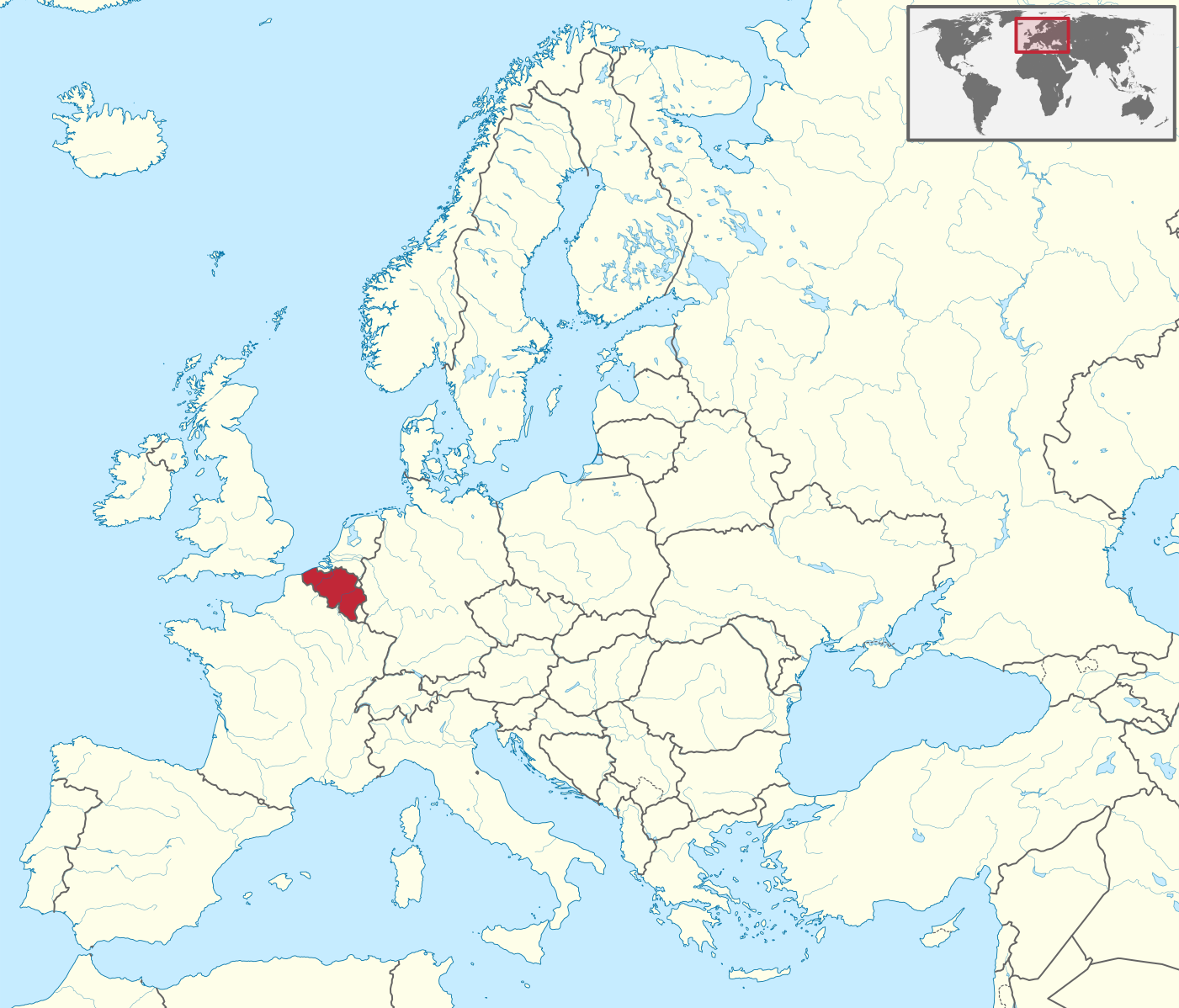
The Belgium census is run by Statistics Belgium. The first census was carried out in 1846. The last census was taken in 2011. This is the first registered based census.https://bib.kuleuven.be/ebib/project-belgische-historische-tellingen/project-bht
Since 1968, the population number is permanently up to date through the National Register.
| Demographic and historical evolution | ||||
|---|---|---|---|---|
| of the Belgian population since the | ||||
| first official census carried out in 1846. | N. | Year | Population | |
| Belgium | Population and | |||
| Housing Census | ||||
| 19th century | ||||
| 1st | 1846 | 4,337,196 | 1846 Belgian Census | |
| 2nd | 1856 | 4,529,460 | 1856 Belgian Census | |
| 3rd | 1866 | 4,827,833 | 1866 Belgian Census | |
| 4th | 1876 | 5,336,185 | 1876 Belgian Census | |
| 5th | 1880 | 5,520,009 | 1880 Belgian Census | |
| 6th | 1890 | 6,069,321 | 1890 Belgian Census | |
| 20th century | ||||
| 7th | 1900 | 6,693,548 | 1900 Belgian Census | |
| 8th | 1910 | 7,423,784 | 1910 Belgian Census | |
| 9th | 1920 | 7,465,782 | 1920 Belgian Census | |
| 10th | 1930 | 8,092,004 | 1930 Belgian Census | |
| 11th | 1947 | 8,512,195 | 1947 Belgian Census | |
| 12th | 1961 | 9,189,741 | 1961 Belgian Census | |
| 13th | 1970 | 9,650,944 | 1970 Belgian Census | |
| 14th | 1981 | 9,848,647 | 1981 Belgian Census | |
| 15th | 1991 | 9,978,681 | 1991 Belgian Census | |
| 21st century | ||||
| 16th | 2001 | 10,296,350 | 2001 Belgian Census | |
| 17th | 2011 | 11,000,638 | 2011 Belgian Census | |
| 18th | 2021 | 11,521,238 | 2021 Belgian Census |
Bosnia and Herzegovina
Population censuses in Bosnia and Herzegovina were conducted in 1879, 1885, 1895, 1910, 1921, 1931, 1948, 1953, 1961, 1971, 1981 and 1991. The 2013 Census was organized in period between October 1–15, 2013. This is the first census after the end of the Bosnian War.
Bulgaria
Bulgarian governors organized a national census soon after the liberation of the Bulgarian lands. In 1881 a census took place in the Principality, while in 1884 a census was organized in Eastern Rumelia. The first census covering the unified state took place in 1887.
Since these first accounts, Bulgarian authorities had organized several population censuses: 1892, 1900, 1905, 1910, 1920, 1926, 1934, 1946, 1956, 1965, 1975, 1985, 1992, 2001, and 2011.
The data provided in the Bulgarian censuses from 1888 until World War II is regarded as highly reliable according to the standards of the time. The Bulgarian leading statisticians of the period were generally educated in Western universities and participated vividly in the international cooperation, therefore insisted and succeeded in introducing the best practices of the time. The quality of the data provided of later censuses is a matter of debate. The religion question in the 2001 census didn't allow the unaffiliated Bulgarians to be counted as such.

| Demographic and historical evolution | ||||
|---|---|---|---|---|
| of the Bulgarian population since the | ||||
| first official census carried out in 1880. | N. | Year | Population | |
| Bulgaria | Population and | |||
| Housing Census | ||||
| 19th century | ||||
| 1st | 1880 | 2,007,919 | 1880 Bulgarian Census | |
| 2nd | 1887 | 3,154,375 | 1887 Bulgarian Census | |
| 3rd | 1892 | 3,310,713 | 1892 Bulgarian Census | |
| 20th century | ||||
| 4th | 1900 | 3,744,283 | 1900 Bulgarian Census | |
| 5th | 1905 | 4,035,575 | 1905 Bulgarian Census | |
| 6th | 1910 | 4,337,513 | 1910 Bulgarian Census | |
| 7th | 1920 | 4,846,971 | 1920 Bulgarian Census | |
| 8th | 1926 | 5,478,741 | 1926 Bulgarian Census | |
| 9th | 1934 | 6,077,939 | 1934 Bulgarian Census | |
| 10th | 1946 | 7,029,349 | 1946 Bulgarian Census | |
| 11th | 1956 | 7,613,709 | 1956 Bulgarian Census | |
| 12th | 1965 | 8,227,866 | 1965 Bulgarian Census | |
| 13th | 1975 | 8,727,771 | 1975 Bulgarian Census | |
| 14th | 1985 | 8,948,649 | 1985 Bulgarian Census | |
| 15th | 1992 | 8,487,317 | 1992 Bulgarian Census | |
| 21st century | ||||
| 16th | 2001 | 7,928,901 | 2001 Bulgarian Census | |
| 17th | 2011 | 7,364,570 | 2011 Bulgarian Census | |
| 18th | 2021 | 6,519,789 | 2021 Bulgarian Census |
Croatia
The census in Croatia is carried out every 10 years. The last census was taken in 2021 with final population count of 3.9 million. The first census was in 1857 when what is now Croatia was part of the Austrian Empire.
Cyprus
The British carried out seven censuses in Cyprus in total: six at ten-year intervals between 1881 and 1931, and the last in 1946. Following the establishment of the modern state, there have been seven more censuses: in 1960 (the year of establishment), 1973, 1976, 1982, 1992, 2001 and 2011. The Statistical Service of the Cypriot government counts from the first British census, i.e. the latest census, in 2011, is referred to as the 14th census. In Northern Cyprus there have been three censuses: in 1996, 2006 and 2011. All three have been a matter of controversy, both in the north and the south, and abroad.
Czech Republic
The census in the Czech Republic is carried out every 10 years by the Czech Statistical Office. The last census was taken in 2021. Earlier censuses were taken in 1869, 1880, 1890, 1900, 1910, 1921, 1930, 1950, 1961, 1970, 1980, 1991, 2001 and 2011.
The results of the last census are also available via the interactive model based software.
Denmark
The first Danish census was in 1700–1701, and contained statistical information about adult men. Only about half of it still exists. A census of school children was taken during the 1730s.
Following these early undertakings, the first census to attempt completely covering all citizens (including women and children who had previously been listed only as numbers) of Denmark-Norway was taken in 1769. At that point there were 797,584 citizens in the kingdom. Georg Christian Oeder took a statistical census in 1771 which covered Copenhagen, Sjælland, Møn, and Bornholm.
After that, censuses followed somewhat regularly in 1787, 1801, and 1834, and between 1840 and 1860, the censuses were taken every five years, and then every ten years until 1890. Special censuses for Copenhagen were taken in 1885 and 1895.
In the 20th century, censuses were taken every five years from 1901 to 1921, and then every ten years from 1930. The last traditional census was taken in 1970.
A limited population census based on registers was taken in 1976. From 1981 and each year onwards information that corresponds to a population and housing census is retrieved from registers. Denmark was the first country in the world to conduct these censuses from administrative registers. The most important registers are the Population Register (Det Centrale Personregister), the Building and Dwelling Register (Bygnings- og Boligregistret) and the Enterprise Register (Det Centrale Virksomhedsregister). The central statistical office, Statistics Denmark is responsible for compiling these data. This information is available online in the Statbank Denmark.
It is possible to search a portion of the Danish censuses online at the Dansk Demografisk Database, and also view scanned versions at Arkivalier Online.
Estonia
Population censuses have been carried out in 1881, 1897, 1922, 1934, 1959, 1970, 1979, 1989, 2000 and 2011.
The censuses of 1881 and 1897 were carried out during the reign of the Russian Empire, when Estonia was divided between the Governorate of Estonia and the Governorate of Livonia. The latter also included territories of modern-day Latvia, however its Estonian-populated counties of Võru, Tartu, Viljandi, Pärnu and Saaremaa roughly corresponded to the later borders of the Republic of Estonia. Only later Estonian territories of Valga, Narva, Jaanilinn and Petseri County remained outside these figures.
The 1922 and 1934 censuses were carried out by the independent Republic of Estonia. The 1959, 1979 and 1989 censuses were carried out by the Estonian SSR of the Soviet Union and excluded Jaanilinn and Petseri County, which were annexed by the Russian SFSR in 1945. The 2000 and 2011 censuses were again carried out by the independent Republic of Estonia and also excluded the territories annexed by Russia in 1945. The current responsible institution is the Statistics Estonia.
Finland
The first population census was taken in 1749 when Finland was a part of Sweden. Although the parliament authorized a modern census in 1938, it was not undertaken until 1950. Finland has an accurate population registry system, thus censuses are in practice conducted by studying the registry, rather than as a separate project. Statistics Finland publishes various statistics on population: preliminary population statistics are published monthly, population structure report is published annually and population projections every three years. Once in ten years, the official locations and demarcations for densely populated areas (taajama) for traffic purposes, and official numbers of the speakers of national languages (Finnish or Swedish), for bilinguality, are reviewed.
France
The census in France is currently carried out by INSEE. The first census in France was conducted in 1801. Since 2004, a partial census has been carried out every year, and the results published as averages over 5 years.
Germany
Main article: Census in Germany
The first systematic population on the European continent was taken in 1719 in Prussia (roughly corresponding to today's northern Germany and western Poland).
The first large-scale census in the German Empire took place in 1895. Attempts at introducing a census in West Germany sparked strong popular resentment in the 1980s since many quite personal questions were asked. Some campaigned for a boycott. In the end the Constitutional Court stopped the census in 1980 and 1983. The last census of West Germany was in 1987. Germany has since used population samples in combination with statistical methods, in place of a full census. But finally, on May 9, 2011, a new census of Germany was completed.
Greece
Main article: Census in Greece
Census takes place every 10 years and is carried out by the National Statistical Service of Greece. The 2011 census ended on 24 May.
Hungary
Official decennial censuses have been taken in Hungary since 1870; the latest one – in line with the recommendations of the United Nations and the Statistical Office of the European Union – was carried out in 2011. Starting from 1880 the Hungarian census system was based on native language (the language spoken at home in the early life of the person and at the time of the survey), vulgar language (the most frequently used language in the family), and other spoken languages.
Iceland
The first Icelandic census took place in 1703, following upon the first Danish census of 1700–1701. Further censuses were carried out in 1801, 1845 and 1865. The 1703 exercise was the first census ever to cover all inhabitants of an entire country, mentioning the name, age, and social position of each individual. All of the information still exists, although some of the original documents have been lost.
The need for censuses was eliminated through the setting up, in 1952, of the National Registry (Þjóðskrá), which later merged with other entities to form Registers Iceland. All those born in Iceland, and all new residents, are automatically registered. Individuals are identified in the registry by means of a national identification number (the so-called kennitala), a number composed of the date of birth in the format and four additional digits, the third of which is a control digit, and the last of which indicates the century in which the person was born (9 for the 1900s and 0 for the 2000s).
The National Registry doubles as an electoral register. Likewise, all bank accounts are linked to the national identification of the owner (companies and institutions all have their own identification numbers).
Ireland
Main article: 2022 census of Ireland
Population censuses covering all of Ireland were conducted every ten years from 1821 to 1911 inclusive. The first census following independence was conducted in 1926 and done every ten years until 1946. Since then, most censuses have been conducted every five years from 1951 to 2011 with two exceptions. Instead of censuses in 1976 and 2001, they were instead conducted in 1979 and 2002 respectively. The next census is scheduled for 2022, having been postponed from 2021 due to the COVID-19 pandemic. All original census returns from 1901 onwards survive, together with some 19th century fragments.
The census in Ireland is carried out by the Central Statistics Office. The census is taken every five years, with more detailed information collected in years ending in 1 and less in the years ending in 6. The 1976 census was cancelled as a cost-saving measure, but a supplementary census was held in 1979 after it became apparent that the 1970s had seen major demographic changes. The census scheduled for 2001 was postponed until 2002 due to the outbreak of foot-and-mouth disease.
Data from the 1901 Census of Ireland and the 1911 census of Ireland were first made publicly available in 1961. Subsequent census records will be made available 100 years after collection. The 1901 and 1911 census returns, together with the 19th century fragments, are freely available to view at the National Archives of Ireland website.
Italy
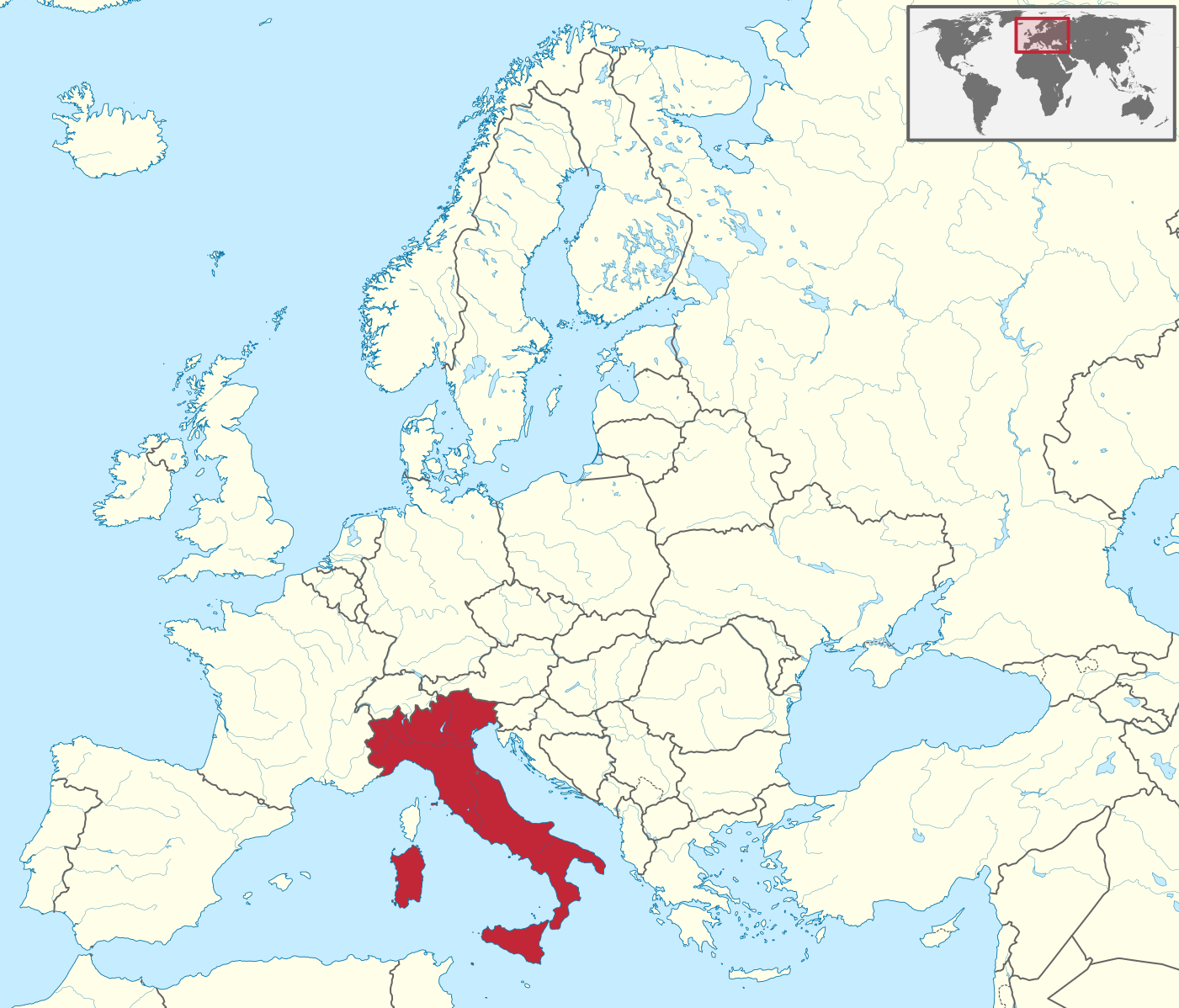
The census in Italy is carried out by ISTAT every 10 years. The last five were in 1971, 1981, 1991, 2001 and 2011. From 2018, the census will be done every year, using a sample of population to correct databases that ISTAT create from registry offices and other public offices.
| Demographic and historical evolution | ||||
|---|---|---|---|---|
| of the Italian population since the | ||||
| first official census carried out in 1861. | N. | Year | Population | |
| Italy | Population and | |||
| Housing Census | ||||
| 19th century | ||||
| 1st | 1861 | 22,176,477 | 1861 Italian Census | |
| 2nd | 1871 | 27,299,883 | 1871 Italian Census | |
| 3rd | 1881 | 28,951,546 | 1881 Italian Census | |
| 20th century | ||||
| 4th | 1901 | 32,963,316 | 1901 Italian Census | |
| 5th | 1911 | 35,841,563 | 1911 Italian Census | |
| 6th | 1921 | 39,396,757 | 1921 Italian Census | |
| 7th | 1931 | 41,043,489 | 1931 Italian Census | |
| 8th | 1936 | 42,398,489 | 1936 Italian Census | |
| 9th | 1951 | 47,515,537 | 1951 Italian Census | |
| 10th | 1961 | 50,623,569 | 1961 Italian Census | |
| 11th | 1971 | 54,136,547 | 1971 Italian Census | |
| 12th | 1981 | 56,556,911 | 1981 Italian Census | |
| 13th | 1991 | 56,778,031 | 1991 Italian Census | |
| 21st century | ||||
| 14th | 2001 | 56,995,744 | 2001 Italian Census | |
| 15th | 2011 | 59,433,744 | 2011 Italian Census | |
| 16th | 2021 | 59,030,133 | 2021 Italian Census |
Kosovo
Kosovo declared independence on 17 February 2008. Then, the Kosovo Agency of Statistics organized the first census of the new country in 2011.
The most recent census was done in April and May 2024.
Latvia
The most recent census in Latvia was in 2011. Before that, most censuses were conducted under Soviet control. The census is carried out by the Centrālā Statistikas Pārvalde (Central Statistical Bureau).
Netherlands
The first census in the Netherlands was conducted in 1795, and the last in 1971. A law was produced on April 22, 1879, ordering a census to be conducted every ten years.
The census that was planned for 1981 was postponed and later cancelled. A call for privacy was responsible for the cancellation of any further census since 1991. Censuses are being conducted by the Centraal Bureau voor de Statistiek since 1899. The censuses today are mostly (population, fiscal) register based, combined with surveying.
North Macedonia
The independence of the Republic of North Macedonia followed the breakup of former Yugoslavia in 1991. The first population and housing census was conducted in the summer of 1994. The second census was conducted in the autumn of 2002. Both censuses were observed by international experts due to the sensitive issue regarding the ethnic distribution. The next census operation started in 2011 but it was aborted with the census declared unsuccessful. Following delay, a census was conducted in September 2021, which also included the diaspora.
Norway
The two first male censuses was conducted during the 1660s and 1701. Later statistical censuses were held in 1769, 1815, 1835, 1845, and 1855. Norway's first nominative, complete census was taken in 1801, when Norway still was ruled by the Oldenburg dynasty of Denmark-Norway. The scope of the census followed the de jure principle, so military persons should be included as well as foreigners if they were residents. The 1801, 1865, 1900 and 1910 censuses are transcribed and made searchable on the internet. The census records are made publicly available when 100 years have passed. Since 1900, a census has been conducted every ten years. (However, the 1940 census was postponed to 1946, and the census after 1990 came in 2001.) Since 2001 the population census has been combined with the housing statistics. The 2001 questionnaire only asked about households and who was living in them, while no questionnaires will be mailed out for the 2011 census, since the administrative data on households is sufficient.
Poland
Main article: Census in Poland
The census in Poland is carried out by GUS approximately every 10 years. The 2002 census was conducted between 21 May and June 8. Poland's most recent census was held in 2011. The next census is scheduled for 2021.
Portugal
The first systematic census in Portugal was carried out on January 1, 1864. The census in Portugal is carried out by Instituto Nacional de Estatística (INE) every 10 years. The last census was taken on March 21, 2011.
Romania
Main article: Census in Romania
The first census in Romania was carried out in 1859. It is now carried out every ten years by the Institutul Naţional de Statistică (INSSE). The last census was in 2011.

| Demographic and historical evolution | ||||
|---|---|---|---|---|
| of the Romanian population since the | ||||
| first official census carried out in 1866. | N. | Year | Population | |
| Romania | Population and | |||
| Housing Census | ||||
| 19th century | ||||
| 1st | 1866 | 4,424,961 | 1866 Romanian Census | |
| 2nd | 1887 | 5,500,000 | 1887 Romanian Census | |
| 3rd | 1899 | 5,956,690 | 1899 Romanian Census | |
| 20th century | ||||
| 4th | 1912 | 7,234,919 | 1912 Romanian Census | |
| 5th | 1930 | 18,057,028 | 1930 Romanian Census | |
| 6th | 1941 | 13,535,757 | 1941 Romanian Census | |
| 7th | 1948 | 15,872,624 | 1948 Romanian Census | |
| 8th | 1956 | 17,489,450 | 1956 Romanian Census | |
| 9th | 1966 | 19,103,163 | 1966 Romanian Census | |
| 10th | 1977 | 21,559,910 | 1977 Romanian Census | |
| 11th | 1992 | 22,810,035 | 1992 Romanian Census | |
| 21st century | ||||
| 12th | 2002 | 21,680,974 | 2002 Romanian Census | |
| 13th | 2011 | 20,121,641 | 2011 Romanian Census | |
| 14th | 2021 | 19,053,815 | 2021 Romanian Census |
Russia and USSR
Main article: Census in Russia
In Russia, the first census of the tax-payers was made in 1722–1723 by the order of Peter the Great (only men were counted), and was ordered to be repeated every twenty years. The only complete Russian Empire Census was carried out in 1897. All-Union Population Censuses were carried out in the USSR (which included RSFSR and the other republics) in 1920 (urban only), 1926, 1937, 1939, 1959, 1970, 1979, and 1989. The first post-Soviet Russian Census was carried out in 2002, followed by the 2010 Census. Currently, the census is the responsibility of the Federal State Statistics Service.
San Marino
Parish priests in San Marino maintained 'libri d'anime' or 'books of souls' as a population register between 1634 and 1860. The first general population census was conducted in 1865. Further censuses were held in 1874, 1899, 1947, and 1976. The Ufficio Informatica, Tecnologia, Dati e Statistica conducted the sixth population census on 7 November 2010.
Serbia
Main article: Census in Serbia
The census ordinarily takes place every 10 years. The last census was in 2011, the previous one was in 2002 (although having been planned for 2001) and the next is planned for 2021. The censuses before were organized in 1991, 1981, 1971, 1961, 1953 and 1948, during Communist Yugoslavia. During the Kingdom of Yugoslavia, censuses were conducted in 1931 and 1921; the census in 1941 was never conducted due to the outbreak of WWII.
The autonomous Principality of Serbia, had conducted the first population census in 1834; the subsequent censuses were conducted in 1841, 1843, 1846, 1850, 1854, 1859, 1863 and 1866 and 1874. During the era of the independent Kingdom of Serbia, six censuses were conducted starting on 1884 and the last one being in 1910. And then the frequent wars had prevented organizing any census prior to the Yugoslav one in 1921.
For the portions of Serbia ruled by Austria-Hungary until 1918, there were a total of five Austro-Hungarian censuses—1910, 1900, 1890, 1880 and 1869, immediately after the Dual Monarchy's constitution.
Slovakia
First modern census in the area of today's Slovakia was taken in 1869. Today, the census is conducted every 10 years by the Statistical Office of Slovak Republic. Last census was in May 2021.
Slovenia
The first census of modern Slovenia was carried in 1991, after independence had been declared. The Statistical Office of the Republic of Slovenia conducted the second census in 2002. Further censuses were carried out in 2011 and then every 10 years.
Spain
Main article: Census in Spain
The census in Spain is carried out by INE every 10 years. Although there has been an old tradition and like for making census in Spain, the oldest ones dating back to the 12th century (by Alfonso VII of the Kingdom of Castile), the first modern census was carried out in 1768 by Conde de aranda, under the reign of Carlos III. The last five were in 1971, 1981, 1991, 2001, and 2011.
Sweden
The first population census in Sweden was carried out in 1749. The last population and housing census was carried out in 1990. It is planned to conduct population and housing censuses based on registers in the future.
Switzerland
Main article: Census in Switzerland
In Switzerland, the Federal Population Census (, , , ) has been carried out every 10 years starting in 1850. The census was initiated by Federal Councillor Stefano Franscini, who evaluated the data of the first census all by himself after Parliament failed to provide the necessary funds. The census is now being conducted by the Swiss Federal Statistical Office.
Data collected include population data (citizenship, place of residence, place of birth, position in household, number of children, religion, languages, education, profession, place of work, etc.), household data (number of individuals living in the household, etc.), accommodation data (surface area, amount of rent paid, etc.) and building data (geocoordinates, time of construction, number of floors, etc.). Participation is compulsory and reached 99.87% of the population in 2000.
Since 2010, the population census has been carried out and analysed annually in a new format by the Federal Statistical Office (FSO). To ease the burden on the population, the information is primarily drawn from population registers and supplemented by sample surveys. Only a small proportion of the population (about 5%) is surveyed in writing or by telephone. The first reference day for the new census was December 31, 2010.
Ukraine
Main article: Censuses in Ukraine
The first post-Soviet Ukrainian Census was carried out by State Statistics Committee of Ukraine in 2001, 12 years after the last All-Union census in 1989.
United Kingdom
Main article: Census in the United Kingdom
In the seventh century, Dál Riata was the first territory in what is now the UK to conduct a census. The Domesday Book of 1086 in England contained listings of households but its coverage was not complete and its intent was not the same as modern censuses.
Following the influence of Malthus and concerns stemming from his An Essay on the Principle of Population the UK census as we know it today started in 1801. The census has been conducted every ten years since 1801.
The first four censuses (1801–1831) were mainly headcounts and contained little personal information. The 1841 Census, conducted by the General Register Office, was the first to record the names of everyone in a household or institution. From 1851 onwards the census shows the stated age and relationship to the head of household for each individual. Because of World War II, there was no census in 1941. The actual census dates were 6 June 1841, 30 March 1851, 7 April 1861, 2 April 1871, 3 April 1881, 5 April 1891, 31 March 1901, 27 March 1911.
The census of England & Wales is undertaken for the government by the Office for National Statistics (ONS). The General Register Office for Scotland (GROS) conducts its own census, while the census in Northern Ireland is carried out by the Northern Ireland Statistics and Research Agency (NISRA). Public access to the census returns is restricted under the terms of the 100-year rule. The most recent returns made available to researchers are those of the 1921 census.
The most recent UK census took place in England, Wales and Northern Ireland on 21 March 2021. Because of the COVID-19 pandemic the census in Scotland was delayed to 20 March 2022. It was revealed that the 2021 UK Census could be the last census conducted, as Prof Sir Ian Diamond said in early 2020 that he is "hopeful" other, newer data sources could replace the British census, adding "better and more granular" sources in a "cheaper" and "more timely" way could replace the 2021 census. A 2018 UK Government white paper said its "ambition" is for "other sources of data" to be used following the 2021 census.
Oceania
Australia
Main article: Census in Australia
The Australian census is operated by the Australian Bureau of Statistics. It is currently conducted every five years, the last occurrence being on August 10, 2021. Past Australian censuses were conducted in 1911, 1921, 1933, 1947, 1954, and every five years since 1961. In 2016, for the first time, Australians were able to complete their census online.
New Zealand
Main article: New Zealand census
The census in New Zealand is carried out by Statistics New Zealand (Tatauranga Aotearoa), usually every five years. The 1951 census was the first year in which Māori and European New Zealanders were treated equally, with European New Zealanders having had a different census form in previous years and separate censuses in the 19th century. Results for those censuses before 1966 have been destroyed with a few exceptions and those since will not be available before 2066.
For the 2001, 2006 and 2013 Censuses of New Zealand, respondents could choose to complete their census questionnaire online. The census was scheduled on 8 March 2011. However, it was cancelled due to the September 2010 and February 2011 Canterbury earthquake. The 1931 census was also cancelled due to the effects of the Great Depression, and was the 1941 census due to the Second World War.
A census was instead held on 5 March 2013. For the 2018 census, online participation was prioritised, with paper forms available upon request.
The most recent census was conducted on 7 March 2023.
References
References
- "Principles and Recommendations for Population and Housing Censuses Revision 2".
- "Population". National Statistical Office (Algeria).
- "Résultats Du Recensement Général De La Population et De L'Habitat 2008". National Statistical Office (Algeria).
- "Historical".
- "''Resultados definitivos do recenseamento geral – 2014''". Instituto Nacional de Estatística (INE).
- "Recensement Général de la Population et de l'Habitation – INSAE".
- "Investissements publics et les mesures prioritaires du Gouvernement :3 milliards pour promouvoir la culture béninoise en 2015 – 1er Portail Béninois d'Informations".
- "Catalogue de données central › Recensement Généraux de la Population et de l'Habitat". Institut National de la Statistique et de la Demographie (Burkina Faso).
- [https://ireda.ceped.org/inventaire/ressources/cod-1984-rec-o1_resultats_provisoires.pdf Recensement scientifique de la population 1984. Résultats provisoires]
- "Informations Importantes".
- "L'ODSEF en Côte d'Ivoire – ODSEF".
- (November 4, 2019). "2019 Kenya Population and Housing Census Results".
- (May 4, 2021). "Résultats définitifs du RGPH-3 2018 {{!}} Troisième Recensement Général de la Population et de l'Habitation".
- [http://www.statssa.gov.za/asc/WebsiteReports/Mauritius.pdf "2010 Round of Censuses: Learning from the 2000 Round Country position: Mauritius February 2006"] {{Webarchive. link. (June 10, 2007 . Retrieved April 3, 2009.)
- "Central Statistics Office: The Statistics Act 2000".
- Sobhaz, Sobha. "Aperçu sur les recensements au Maroc".
- Larry Diamond, ''Class, Ethnicity, and Democracy in Nigeria: The Failure of the First Republic'' (Syracuse University Press, 1988) p136
- (December 5, 2014). "Somali National Bureau of Statistics".
- (November 2011). "The Union of South Africa censuses 1911-1960: an incomplete record". Historia.
- G20-'66, Census of the Colony of the Cape of Good Hope 1865 (Government Printer, Cape Town, 1866); G42-'76, Census of the Colony of the Cape of Good Hope 1875, Part I Summaries (Government Printer, Cape Town, 1877); G6-'92, Census of the Colony of the Cape of Good Hope 1891 (Government Printer, Cape Town, 1892)
- "South Africa – Population".
- "Institut National de la Statistique et des Etudes Économiques et Démographiques".
- "Dépliant premiers résultats du Recensement de la population et de".
- "Resultats | Institut National des Statistiques".
- "Premiers résultats du Recensement 2014 | Institut National des Statistiques".
- "Calendrier | Institut National des Statistiques".
- [http://www.statssa.gov.za/asc/WebsiteReports/Uganda.pdf "Country submission for Uganda: The 2010 World Programme on Population and Housing Censuses"] {{Webarchive. link. (June 10, 2007 , Africa Symposium on the 2010 Round of Population and Housing Censuses (Cape Town, South Africa), January 30 – February 2, 2006. Retrieved April 3, 2009.)
- "2014 Census – Uganda Bureau of Statistics".
- Uganda Bureau of Statistics (2016). ''The National Population and Housing Census 2014: Final Results, Main Report''. Kampala: Uganda Bureau of Statistics. Available at: https://uganda.unfpa.org/sites/default/files/pub-pdf/CENSUS%202014%20Final%20Results_0.pdf (accessed 10 October 2025).
- Uganda Bureau of Statistics (2025). ''National Population and Housing Census 2024: Final Report, Volume I — Main Report''. Kampala: Uganda Bureau of Statistics. Available at: https://statistics.ubos.org/nphc/reports/National-Population-and-Housing-Census-2024-Final-Report-Volume-1-Main.pdf (accessed 10 October 2025).
- "Official Website for the Government of Antigua and Barbuda".
- National Institute of Statistics of Bolivia. (2015-02-01). "Population and Housing Census of Bolivia for the year 2012: Characteristics of the Population".
- (2020-03-17). "Censo 2020 adiado para 2021".
- (2021-04-23). "Adiamento do Censo Demográfico".
- (2022-01-23). "Concurso do Censo 2022 tem mais de 1,1 milhão de inscritos para 206,8 mil vagas".
- (May 31, 2006). "Municipal Census Policy (City Council Agenda Item No. E.1.l)". City of Edmonton.
- "INE concluye que datos del "mejor censo de la historia de Chile" no sirven para nada". El Mercurio.
- (November 24, 2014). "Directora del INE se reúne por primera vez con Comité Asesor Externo del Censo Abreviado 2017". El Mercurio.
- (2017-12-17). "Línea de tiempo: los censos en Colombia". DANE.
- "Censo 2022".
- National Institute of Statistics and Censuses of Ecuador. (2015-05-22). "A Historical Look at the Statistics of Ecuador".
- "Portal de Resultados del Censo 2018".
- National Institute of Statistics of Guatemala. (2019-12-01). "XII National Population Census and VII Housing Census: Results of the Guatemalan Census of the year 2018".
- "IHSI – Produits – Enquêtes Nationales".
- (December 16, 2013). "5e Recensement Général de la Population et de l'Habitat (Ve RGPH-2014) by MEF Haiti – Issuu".
- "Le MEF et l'IHSI lancent le 5e Recensement général de la population et de l'habitat".
- Instituto Nacional de Estadística de Honduras. (2013). "Resultados Generales del Censo de Honduras del año 2013 : XVII de población y VI de Vivienda".
- Instituto Nacional de Estadística de Honduras. (2013). "Boletín informativo del Censo de Honduras del año 2013".
- (2013). "Censos Oficiales de Honduras".
- (November 13, 2010). "INEGI – México en cifras".
- "Censos Económicos".
- National Institute of Statistics of Guatemala. (2019-12-01). "XII National Population Census and VII Housing Census: Results of the Guatemalan Census of the year 2018".
- National Institute of Statistics and Informatics of Peru. (2007). "History of the Censuses in Peru".
- National Institute of Statistics and Informatics of Peru. (2018-08-01). "Peru : Sociodemographic profile and national report of the 2017 population and housing census".
- "Article 1, Section 2 of the United States Constitution".
- US Census Bureau, Census History Staff. "Legislation 1974 – 1983 – History – U.S. Census Bureau".
- [[2020 United States census]]
- "U.S. Census Bureau QuickFacts: United States (V2021)".
- "INE da a conocer los Primeros Resultados del Censo 2011".
- World Bank. (2021-12-31). "Population of the Bolivarian Republic of Venezuela as of 2021".
- Foundation, Encyclopaedia Iranica. "Welcome to Encyclopaedia Iranica".
- (December 2010). "Census in Different Countries of the World". Orissa Review.
- [https://armenpress.am/en/article/1110018 Armenia’s permanent population is 2,928,914, according to new census]. ''[[Armenpress]]''. May 2, 2023. Retrieved September 23, 2024.
- [https://www.rferl.org/content/Population_Census_Gets_Under_Way_In_Azerbaijan/1608527.html Population Census Gets Under Way In Azerbaijan]. ''Radio Free Europe''. April 14, 2009. Retrieved April 29, 2010.
- link. Stats.gov.cn
- (December 21, 2009). "李克强主持召开人口普查领导小组会议时强调 把握我国基本国情 促进可持续发展". Stats.gov.cn.
- (December 25, 2009). "Communiqué on Major Data of the Second National Economic Census (No.1)". Stats.gov.cn.
- (April 1, 2010). "Census-2011 kicks off today – India – DNA". Dnaindia.com.
- (2020-05-13). "سرشماری عمومی نفوس و مسکن، سال ۱۴۰۵ برگزار میشود".
- (November 25, 2024). "Iraq's population grew to 45.4 million according to the first survey in decades".
- (November 19, 2024). "Iraq to hold first nationwide census since 1987". Reuters.
- Kamen, Charles S.. (February 2005). "The 2008 Israel Integrated Census of Population and Housing: Basic conception and procedure". Israel Central Bureau of Statistics.
- [http://www.cbs.gov.il/census/census/main_mifkad08.html Main Mifkad] cbs.gov.il {{in lang. he {{dead link. (September 2023)
- "Population Census".
- 佐藤正広. (2015). "国勢調査: 日本社会の百年". 岩波書店.
- Statistics Bureau of Japan. (2021). "令和2年国勢調査調査結果の利用案内: ユーザーズガイド". 総務省統計局.
- . ["Census 2020"](https://www.kokusei2020.go.jp/en/index.html). *Ministry of Internal Affairs and Communications*.
- . ["Language support"](https://www.kokusei2020.go.jp/household/language.html). *Ministry of Internal Affairs and Communications*.
- al-Issawi, Omar. (June 4, 2009). "Lebanon's Palestinian refugees". [[Al Jazeera English.
- Rolland, John C. (2003). ''Lebanon: current issues and background.'' Nova Publishers. p. 65.
- [https://countrystudies.us/lebanon/34.htm Lebanon]. Country studies.
- (January 2025). "Myanmar says 2024 census shows population of 51.3 million". Reuters.
- (2020). "2020 Philippine Statistical Yearbook". [[Philippine Statistics Authority]].
- (2022). "2022 Philippine Statistical Yearbook". [[Philippine Statistics Authority]].
- "2020 인구주택총조사".
- (May 16, 2010). "Sri Lanka News". Sundayobserver.lk.
- "The Modernization of Taiwan".
- (March 17, 2024). "Population census in Uzbekistan is now scheduled for 2025−2026".
- "Population and Housing Census 2011, 2011".
- Statistics Austria. (2021). "Historic censuses of Austria".
- "Objavljeni konačni rezultati Popisa 2021".
- "Census 1769".
- "Statbank Denmark". Statbank.dk.
- "Dansk Demografisk Database". Ddd.dda.dk.
- "Arkivalier Online". Arkivalieronline.dk.
- "General data for 1881, 1897, 1922, 1934, 1959, 1970, 1979, 1989 censuses – Statistics Estonia".
- "Publications of the results of the 1959, 1970, 1979, 1989 censuses – Statistics Estonia".
- "2000 Population and Housing Census – Statistics Estonia".
- "REL2011 – Rahvaloendus käivitus hoogsalt".
- "Population censuses in Estonia – Statistics Estonia".
- (July 19, 2010). "Statistics Estonia". Stat.ee.
- "Counting the population".
- "Κεντρική Σελίδα ΕΛΣΤΑΤ".
- "Census 2011". Apografi2011.gr.
- "Postponement of Census 2021".
- "History of Irish Census Records". National Archives of Ireland.
- "CSO Census Home Page".
- (May 2016). "Census: Historical perspective". CSO.
- (2002). "Census 2002 Results". CSO.
- "Access to old records". CSO.
- "Census of Ireland, Dublin 1911". National Archives of Ireland.
- (May 2019). "Census Search". National Archives of Ireland.
- "Regjistrimi i Popullsisë, Ekonomive Familjare dhe Banesave në Kosovë 2011 – Rezultatet Përfundimtare: Të Dhënat Demografike sipas Komunave". [[Kosovo Agency of Statistics]].
- "Population and housing census in Kosovo preliminary results - July 2024".
- (November 10, 2004). "Documenting the Norwegian Censuses: The male censuses of the 1660s and 1701". Rhd.uit.no.
- "The Digital Archives". Regional State Archives in Bergen.
- "Population and Housing Census 2001". Ssb.no.
- (October 15, 2010). "Datainnsamling: Folketellingen som forsvant?". Statistisk sentralbyrå.
- [https://stat.gov.pl/download/gfx/portalinformacyjny/pl/defaultaktualnosci/5670/21/1/1/1_miejscowosci_ludnosc_nsp2011.xlsx Miejscowosci ludnosc] gov.pl
- (July 19, 2018). "TVN24bis.pl".
- Instituto Nacional de Estatística (2009) – [http://www.ine.pt/xportal/xmain?xpid=CENSOS&xpgid=censos-pt-mundo "Censos em Portugal"]
- "The next census will take place in 2011".
- (5 April 2006). "Censimenti e 'libri d'anime': dall'Archivio di Stato alla Rete". [[San Marino RTV]].
- (12 January 2009). "Census of population". Agenzia per lo Sviluppo Economico – Camera di Commercio – Repubblica di San Marino.
- "6th General Census of the Population of the Republic of San Marino". Ufficio Informatica, Tecnologia, Dati e Statistica (San Marino).
- "1869 Hungarian Census". Museum of Jewish Heritage.
- "Register-based census".
- [https://www.bfs.admin.ch/bfs/portal/en/index/infothek/erhebungen__quellen/blank/blank/vz/geschichte.html History of the Federal Population Census], Swiss Federal Statistical Office. Retrieved October 2007.
- [http://www.bfs.admin.ch/bfs/portal/en/index/infothek/erhebungen__quellen/blank/blank/vz/uebersicht.html Overview of the Federal Population Census] {{Webarchive. link. (November 15, 2012 , Swiss Federal Statistical Office. Retrieved October 2007.)
- "All-Ukrainian population census". Ukrcensus.gov.ua.
- "Census 2021 milestones".
- (17 July 2020). "News release – Scotland's Census to be moved to March 2022".
- "Changes for 2022".
- (2020-02-12). "UK's 2021 census could be the last, statistics chief reveals". BBC News.
- "The UK's next census will be its last — here's why".
- (February 24, 2011). "Census cancelled due to quake". Fairfax Media (Stuff.co.nz).
This article was imported from Wikipedia and is available under the Creative Commons Attribution-ShareAlike 4.0 License. Content has been adapted to SurfDoc format. Original contributors can be found on the article history page.
Ask Mako anything about Population and housing censuses by country — get instant answers, deeper analysis, and related topics.
Research with MakoFree with your Surf account
Create a free account to save articles, ask Mako questions, and organize your research.
Sign up freeThis content may have been generated or modified by AI. CloudSurf Software LLC is not responsible for the accuracy, completeness, or reliability of AI-generated content. Always verify important information from primary sources.
Report