From Surf Wiki (app.surf) — the open knowledge base
Politics of Wales
none

none
| Field | Value |
|---|---|
| name | Politics of Wales |
| native_name | |
| image | Royal Badge of Wales (2008-2024).svg |
| caption | The Royal Badge as used in Wales |
| type | Devolved parliamentary legislature within a constitutional monarchy |
| legislature | Senedd |
| legislature_type | Unicameral |
| legislature_place | Senedd, Cardiff Bay |
| legislature_speaker | Elin Jones MS |
| legislature_speaker_title | Llywydd |
| upperhouse_appointer | Senedd elections |
| title_hos | Monarch |
| current_hos | |
| title_hog | First Minister |
| current_hog | Eluned Morgan |
| appointer_hog | Monarch |
| cabinet | Welsh Cabinet |
| current_cabinet | Eluned Morgan government |
| cabinet_leader | First Minister |
| cabinet_deputyleader | Deputy First Minister |
| cabinet_appointer | The Monarch |
| cabinet_hq | Crown Buildings, Cathays Park, Cardiff |
| cabinet_ministries | 30 |
| judiciary | |
| civil_service | Permanent Secretary (Civil Service) |
| leader_cs | Andrew Goodall |
Politics in Wales forms a distinctive polity in the wider politics of the United Kingdom, with Wales as one of the four constituent countries of the United Kingdom (UK).
Constitutionally, the United Kingdom is a unitary state with one sovereign parliament delegating power to the devolved national parliaments, with some executive powers divided between governments. Under a system of devolution adopted in the late 1990s three of the four countries of the United Kingdom, Wales, Scotland and Northern Ireland, voted for limited self-government, subject to the ability of the UK Parliament in Westminster, nominally at will, to amend, change, broaden or abolish the national governmental systems. As such, the Senedd (Welsh Parliament; ) is not de jure sovereign. Since then, further Welsh devolution has granted the Senedd additional powers.
Executive power in the United Kingdom is vested in the King-in-Council, while legislative power is vested in the King-in-Parliament (the Crown and the Parliament of the United Kingdom at Westminster in London). The Government of Wales Act 1998 established devolution in Wales, and certain executive and legislative powers have been constitutionally delegated to the Welsh Parliament. The scope of these powers has been further widened by the Government of Wales Act 2006, Wales Act 2014 and Wales Act 2017.
Overview
Since 1999 most areas of domestic policy have been decided within Wales via the Senedd and the Welsh Government (the "Welsh Assembly Government" between 1999 and 2011 (de facto)/2014 (de jure)).
Judicially, Wales remains within the jurisdiction of England and Wales. In 2007, the National Assembly for Wales (renamed as the Senedd from May 2020) gained the power to enact Wales-specific Measures. Following the 2011 Welsh devolution referendum, the National Assembly was given the power to create Acts.
Wales, together with Cheshire, used to come under the jurisdiction of the Court of Great Session, and therefore was not within the English circuit court system. Yet it has not been its own distinct jurisdiction since the Laws in Wales Acts 1535 and 1542, at which point Welsh Law was replaced by English Law.
Before 1998, there was no separate government in Wales. Executive authority rested in the hands of the HM Government, with substantial authority within the Welsh Office since 1965. Legislative power rested within the Parliament of the United Kingdom. Judicial power has always been with the Courts of England and Wales, and the Supreme Court of the United Kingdom (or its predecessor the Law Lords).
History
English rule
Main article: History of Wales
Wales was conquered by England in 1283. The 1284 Statute of Rhuddlan annexed the territory to England. Owain Glyndwr briefly restored Welsh independence in a national uprising that began in 1400 after his supporters declared him Prince of Wales. He convened Wales' first Senedd in Machynlleth in 1404, but the rebellion was put down by 1412.
The Laws in Wales Acts 1535 and 1542, passed by the English Parliament in the reign of Henry VIII, united the Principality and the Marches of Wales, creating a formalised border for the first time. Wales became part of the realm England. The Welsh legal system of Hywel Dda that had existed alongside the English system since the conquest by Edward I, was now fully replaced. Penal laws enacted after the Welsh revolt were obsoleted by acts that made the Welsh people citizens of the realm, and all the legal rights and privileges of the English were extended to the Welsh for the first time. These changes were widely welcomed by the Welsh people, although more controversial was the requirement that Welsh members elected to parliament must be able to speak English, and that English would be the language of the courts.
The Wales and Berwick Act 1746 stated that all laws applying to England would also be applicable to Wales, unless the body of the law explicitly stated otherwise. However, during the latter part of the 19th century and early part of the 20th century the notion of a distinctive Welsh polity gained credence. In 1881 the Welsh Sunday Closing Act was passed, the first such legislation exclusively concerned with Wales. The Central Welsh Board was established in 1896 to inspect the grammar schools set up under the Welsh Intermediate Education Act 1889, and a separate Welsh Department of the Board of Education was formed in 1907. The Agricultural Council for Wales was set up in 1912, and the Ministry of Agriculture and Fisheries had its own Welsh Office from 1919.
Home rule movement
Despite the failure of popular political movements such as Cymru Fydd, a number of institutions, such as the National Eisteddfod (1861), the University of Wales (Prifysgol Cymru) (1893), the National Library of Wales (Llyfrgell Genedlaethol Cymru) (1911) and the Welsh Guards (Gwarchodlu Cymreig) (1915) were created. The campaign for disestablishment of the Anglican Church in Wales, achieved by the passage of the Welsh Church Act 1914 (effective from 1920), was also significant in the development of Welsh political consciousness. Without a popular base, the issue of home rule did not feature as an issue in subsequent general elections and was quickly eclipsed by the depression. By August 1925 unemployment in Wales rose to 28.5%, in contrast to the economic boom in the early 1920s, rendering constitutional debate an exotic subject. In the same year Plaid Cymru was formed with the goal of securing a Welsh-speaking Wales.
Following the Second World War the Labour Government of Clement Attlee established the Council for Wales and Monmouthshire, an unelected assembly of 27 with the brief of advising the UK government on matters of Welsh interest. By that time, most UK government departments had set up their own offices in Wales. In 1959 the Labour council title was changed from "Welsh Regional council" to "Welsh council", and the Labour body was renamed Labour Party Wales in 1975.
The post of Minister of Welsh Affairs was first established in 1951, but was at first held by the UK home secretary. Further incremental changes also took place, including the establishment of a Digest of Welsh Statistics in 1954, and the designation of Cardiff (Caerdydd) as Wales's capital city in 1955. However, further reforms were catalysed partly as a result of the controversy surrounding the flooding of Capel Celyn in 1956. Despite almost unanimous Welsh political opposition the scheme had been approved, a fact that seemed to underline Plaid Cymru's argument that the Welsh national community was powerless.
In 1964 the incoming Labour Government of Harold Wilson created the Welsh Office under a Secretary of State for Wales, with its powers augmented to include health, agriculture and education in 1968, 1969 and 1970 respectively. The creation of administrative devolution effectively defined the territorial governance of modern Wales.
Labour's incremental embrace of a distinctive Welsh polity was arguably catalysed in 1966 when Plaid Cymru president Gwynfor Evans won the Carmarthen by-election (although in fact Labour had endorsed plans for an elected council for Wales weeks before the by-election). However, by 1967 Labour retreated from endorsing home rule mainly because of the open hostility expressed by other Welsh Labour MPs to anything "which could be interpreted as a concession to nationalism" and because of opposition by the Secretary of State for Scotland, who was responding to a growth of Scottish nationalism.
In response to the emergence of Plaid Cymru and the Scottish National Party (SNP) Harold Wilson's Labour Government set up the Royal Commission on the Constitution (the Kilbrandon Commission) to investigate the UK's constitutional arrangements in 1969. Its eventual recommendations formed the basis of the 1974 White Paper Democracy and Devolution: proposals for Scotland and Wales., which proposed the creation of a Welsh Assembly. However, voters rejected the proposals by a majority of four to one in a referendum held in 1979.
The election of a Labour Government in 1997 brought devolution back to the political agenda. In July 1997, the government published a White Paper, A Voice for Wales, which outlined its proposals for devolution, and in September 1997 an elected Assembly with competence over the Welsh Office's powers was narrowly approved in a referendum. The National Assembly for Wales (Cynulliad Cenedlaethol Cymru) was created in 1999, with further authority devolved in 2007, with the creation of a Welsh legal system to adjudicate on specific cases of Welsh law. Following devolution, the role of the secretary of state for Wales greatly reduced. Most of the powers of the Welsh Office were handed over to the National Assembly; the Wales Office was established in 1999 to supersede the Welsh Office and support the secretary of state.
Devolved era
Main article: Welsh devolution
Between 1999 and 2007 there were three elections for the National Assembly. Labour won the largest share of votes and seats in each election and has always been in government in Wales, either as a minority administration or in coalition, first with the Liberal Democrats (2000 to 2003) and with Plaid Cymru between 2007 and 2011. The predominance of coalitions is a result of the Additional Member System used for Assembly elections, which has worked to the benefit of Labour (it won a higher share of seats than votes in the 1999, 2003 and 2007 elections) but not given it the same advantage the party has enjoyed in first-past-the-post elections to Welsh seats in the House of Commons.
Policy divergence between Wales and England has arisen largely because Welsh governments have not followed the market-based English public service reforms introduced during the premiership of Tony Blair. In 2002, First Minister Rhodri Morgan said that a key theme of the first four years of the Assembly was the creation of a new set of citizenship rights that are free at the point of use, universal and unconditional. He accepted the Blairite mantra of equality of opportunity and equality of access, but emphasised what he called "the fundamentally socialist aim of equality of outcome" - in stark contrast to the approach of Blair, who said that the true meaning of equality is specifically "not equality of outcome".
Marking ten years of devolution in a 2009 speech, Morgan highlighted free prescriptions, primary school breakfasts and free swimming as 'Made in Wales' initiatives that had made "a real difference to people's everyday lives" since the National Assembly came into being. However, some authors have argued that the approach to public services in England has been more effective than that in Wales, with health and education "cost(ing) less and delivering more". Unfavourable comparisons between National Health Service waiting lists in England and Wales were a contentious issue in the first and second Assemblies.
Nevertheless, a 'progressive consensus' based on faith in the power of government, universal rather than means-tested services, co-operation rather than competition in public services, a rejection of individual choice as a guide to policy and a focus on equality of outcome continued to underpin the One Wales coalition government in the Third Assembly. The commitment to universalism may be tested by increasing budgetary constraints; in April 2009 a senior Plaid Cymru adviser warned of impending health and education cuts.
On 1 June 2020, the Senedd and Elections (Wales) Act 2020 came into force, giving 16- and 17-year-olds in Wales and legally resident foreign nationals the right to vote in Senedd (Welsh Parliament) elections.
Political parties
Labour Party
Main article: Welsh Labour
Throughout much of the 19th century, Wales was a bastion of the Liberal Party. From the early 20th century, the Labour Party has emerged as the most popular political party in Wales. Before 2009 they had won the largest share of the vote in Wales at every UK general election, National Assembly for Wales election and European Parliament election since 1922. An all Wales unit was formed within the Labour Party for the first time in 1947. The Wales Labour Party has traditionally been most successful in the industrial south Wales valleys, north east Wales and urban coastal areas, such as Cardiff, Newport and Swansea.
Conservative Party
Main article: Welsh Conservatives
The Welsh Conservative Party has historically been the second political party of Wales, having obtained the second largest share of the vote in Wales in a majority of UK general elections since 1885. In four general elections (1906, 1997, 2001 and 2024) no Conservative MPs were returned to Westminster, while on only two occasions in the 20th century (1979 and 1983) have more than a quarter of Welsh constituencies been represented by Conservatives. However, in the 2009 European Parliament elections the Conservatives polled higher than the Labour party in Wales.
Plaid Cymru
Main article: Plaid Cymru
Plaid Cymru is the principal Welsh nationalist political party in Wales. The Party was formed in 1925, but did not contest a majority of Welsh seats in any UK general election until 1959. In 1966 the first Plaid Cymru MP was returned to Parliament. Plaid Cymru's share of the vote since has averaged 10%, with the highest share ever - 14.3% - gained in the 2001 general election. Plaid Cymru is strongest in rural Welsh-speaking areas of north and west Wales.
Liberal Democrats
Main article: Welsh Liberal Democrats
The Welsh Liberal Democrats are part of the UK Liberal Democrats, and were formed by the merger of the Social Democratic Party (the SDP) and the Liberal Party in 1988. Since then they have gained an average vote share of 14% with the highest share - 18% - gained at the 2005 general election. The Welsh Liberal Democrats have the strongest support in rural mid and west Wales. The party performs relatively strongly in local government elections.
Senedd
Main article: Senedd
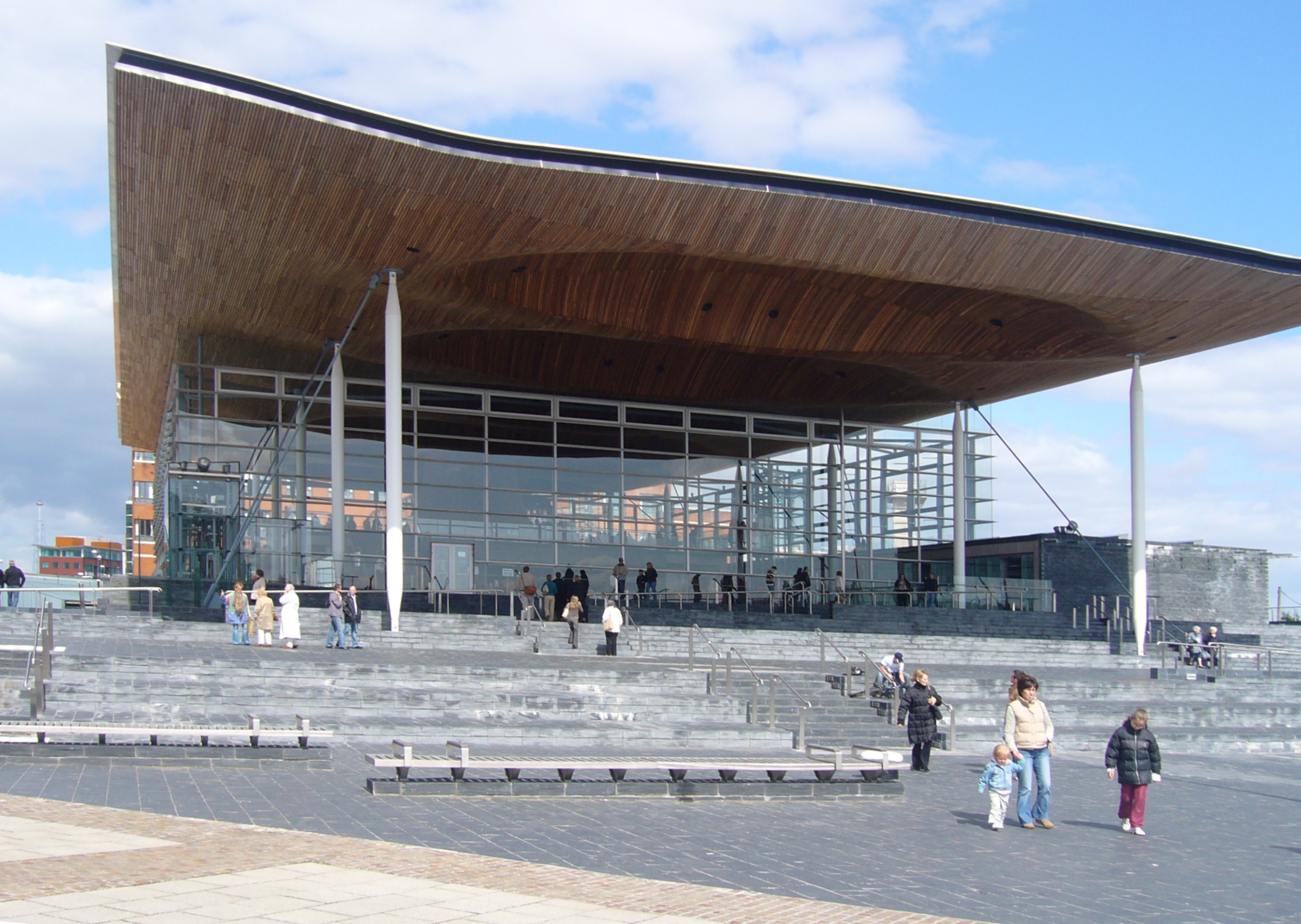
The Welsh Parliament or Senedd Cymru, commonly known as the Senedd and formerly known as the National Assembly for Wales, is a devolved parliament with power to make legislation in Wales. The body meets in the Senedd building, on the Senedd estate in Cardiff Bay. Both English and Welsh languages are treated on a basis of equality in the conduct of business in the Senedd.
The present day Senedd was formed as the Assembly under the Government of Wales Act 1998, by the Labour government, following a referendum in 1997. The campaign for a 'yes' vote in the referendum was supported by Welsh Labour, Plaid Cymru, the Liberal Democrats and much of Welsh civic society, such as church groups and the trade union movement. The Conservative Party was the only major political party in Wales to oppose devolution.[[File:Royal Badge of Wales (2008).svg|thumb|147x147px|The [[Royal Badge of Wales]] appears on [[Act of Senedd Cymru|Acts of Senedd Cymru]].]]The election in 2003 produced an assembly in which half of the assembly seats were held by women. This is thought to be the first time elections to a legislature have produced equal representation for women.
The Senedd consists of 60 elected members. They use the title Member of the Senedd (MS) or Aelod o'r Senedd (AS). The Senedd's Llywydd, or presiding officer, is Plaid Cymru member Elin Jones.
The Welsh Government is led by First Minister Eluned Morgan of Welsh Labour.
The executive and civil servants are based in Cardiff's Cathays Park while the Members of the Senedd, the Parliamentary Service and Ministerial support staff are based in Cardiff Bay. The main debating chamber (known as 'Y Siambr' (the chamber)) and committee rooms are located in the £67 million Senedd building that was built in 2006. The Senedd building is part of the Senedd estate that includes Tŷ Hywel and the Pierhead Building.
Until May 2007 one important feature of the Assembly was that there was no legal or constitutional separation of the legislative and executive functions, since it was a single corporate entity. Even compared with other parliamentary systems, and other UK devolved countries, this was highly unusual. In reality however there was day to day separation, and the terms "Assembly Government" and "Assembly Parliamentary Service" were used to distinguish between the two arms. The Government of Wales Act 2006 regularised the separation once it came into effect following the 2007 Assembly Election.
The Senedd also has limited tax varying and borrowing powers. These include powers over Business Rates, Land Transaction Tax (replacing Stamp Duty), Landfill Disposal Tax (replacing Landfill Tax) and a portion of Income Tax.
In terms of charges for government services it also has some discretion. Notable examples where this discretion has been used and varies significantly to other areas in the UK include:-
- Charges for NHS prescriptions in Wales - these have been abolished, while patients are still charged in England. Northern Ireland abolished charges in 2010, with Scotland following suit in 2011.
- Charges for University Tuition - are different for Welsh resident students studying at Welsh Universities, compared with students from or studying elsewhere in the UK.
- Charging for Residential Care - In Wales there is a flat rate of contribution towards the cost of nursing care, (roughly comparable to the highest level of English Contribution) for those who require residential care. "NHS Continuing Care - Commons Health Select Committee", News and Views - NHFA. Retrieved 2006-11-10.
This means in reality there is a wider definition of "nursing care" than in England and therefore less dependence on means testing in Wales than in England, meaning that more people are entitled to higher levels of state assistance. These variations in the levels of charges, may be viewed as de facto tax varying powers.
This model of more limited legislative powers is partly because Wales had a more similar legal system to England from 1536, when it was annexed and legally became an integral part of the Kingdom of England (although Wales retained its own judicial system, the Great Sessions, until 1830). Ireland and Scotland were incorporated into the United Kingdom through negotiations between the respective Kingdoms' Parliaments, and so retained some more differences in their legal systems. The Scottish Parliament and the Northern Ireland Assembly have wider powers.
The Assembly inherited the powers and budget of the Secretary of State for Wales and most of the functions of the Welsh Office. After May 2007 the National Assembly for Wales had more extensive powers to legislate, in addition to the function of varying laws passed by Westminster using secondary legislation conferred under the original Government of Wales Act 1998. This was significantly enhanced after a referendum in 2011, and the Assembly had primary legislative powers over 20 areas, including Education and Health, from that time. This was changed again in 2018 to a system whereby certain powers were 'reserved to' Westminster, and everything not listed was within the powers of the Assembly. The post of Secretary of State for Wales, retains a very limited residual role.
Welsh Government
Main article: Welsh Government
The Welsh Government (), is the executive body of the Senedd, consisting of the First Minister and their Cabinet.
Following the 2021 Senedd election, working majority Welsh Labour Governments were formed from May 2021, with the current formed in August 2024 under First Minister Eluned Morgan. A full reshuffle of the cabinet is expected in Autumn 2024. The current cabinet members of the 13th Welsh Government consisting of members of the 6th Senedd are:
First Minister
- Rt Hon The Baroness Morgan of Ely MS (Labour)
Cabinet Secretaries
- Huw Irranca-Davies MS, Deputy First Minister of Wales Cabinet Secretary for Climate Change and Rural Affairs (Labour)
- Rebecca Evans MS, Cabinet Secretary for Finance, Constitution and Cabinet Office (Labour)
- Jayne Bryant MS, Cabinet Secretary for Housing, Local Government, and Planning (Labour)
- Mark Drakeford MS, Cabinet Secretary for Health and Social Care (Labour)
- Ken Skates MS, Cabinet Secretary for the Economy, Transport and North Wales (Labour)
- Jane Hutt MS, Cabinet Secretary for Culture, Social Justice, Trefnydd (House Leader) and Chief Whip (Labour)
- Lynne Neagle MS, Cabinet Secretary for Education (Labour)
Ministers
- Sarah Murphy MS, Minister for Mental Health and Early Years (Labour)
- Dawn Bowden MS, Minister for Social Care (Labour)
- Jack Sargeant MS, Minister for Social Partnership (Labour)
- Elisabeth Jones, Counsel General-designate
The Welsh Government had no independent executive powers in law - unlike for instance, the Scottish Ministers and Ministers in the UK government. The Assembly was established as a "body corporate" by the Government of Wales Act 1998 and the executive, as a committee of the Assembly, only had those powers that the Assembly as a whole votes to vest in ministers. The Government of Wales Act 2006 has now formally separated the Senedd and the Welsh Government giving Welsh Ministers independent executive authority.
Shadow Cabinet
Main article: Shadow Cabinet (Wales)
Current party representation
Following the 2021 Senedd election and the 2024 United Kingdom general election in Wales:
| Party | MPs | MSs |
|---|---|---|
| 27 of 32 | 29 of 60 | |
| 4 of 32 | 13 of 60 | |
| 0 of 32 | 13 of 60 | |
| 1 of 32 | 1 of 60 | |
| 0 of 32 | 2 of 60 | |
| 0 of 32 | 2 of 60 |
Local politics

For the purposes of local government, Wales was divided into 22 council areas in 1996. These unitary authorities are responsible for the provision of all local government services, including education, social work, environment and roads services. Elections for these areas take place every five years. The lowest tier of local government in Wales is the community council, which is analogous to a civil parish in England.
The Monarch appoints a Lord Lieutenant to represent them in the eight Preserved counties of Wales, which are combinations of council areas.
In January 2021, the Local Government and Elections (Wales) Act 2021 came into force. This among other measures extended the voting franchise to 16- and 17-year-olds and foreign citizens legally resident in Wales for local elections, made changes to voter registration and enabled principal councils to choose between the first-past-the-post (FPTP) or the single transferable vote (STV) voting systems.
As of the 2022 Welsh local elections Welsh Labour remain the largest party on a local level with 517 councillors across Wales, Plaid are second with 204 councillors, the Conservative party meanwhile are in third place with 111 councillors. Some councils in Wales, such as Pembrokeshire, have a strong tradition of independent politics, as such there are 327 independent councillors across Wales.
Contemporary Welsh law
Main article: Contemporary Welsh Law
Since the Laws in Wales Acts 1535–1542, Wales was annexed into England and has since shared a single legal system. England and Wales are considered a single unit for the conflict of laws. This is because the unit is the constitutional successor to the former Kingdom of England. If considered as a subdivision of the United Kingdom, England & Wales would have a population of 53,390,300 and an area of 151,174 km2.
Wales was brought under a common monarch with England through conquest with the Statute of Rhuddlan in 1284 and annexed to England for legal purposes by the Laws in Wales Acts 1535-1542. However, references in legislation for 'England' were still taken as excluding Wales. The Wales and Berwick Act 1746 meant that in all future laws, 'England' would by default include Wales (and Berwick-upon-Tweed). This was later repealed in 1967 and current laws use "England and Wales" as a single entity. Cardiff was proclaimed as the Welsh capital in 1955.
Westminster
In the UK Parliament
In the House of Commons – the 650-member lower house of the UK Parliament – there are 32 members of Parliament (MPs) who represent Welsh constituencies. At the 2024 general election, 27 Labour and Labour Co-op MPs were elected, along with 4 Plaid Cymru MPs and 1 Liberal Democrat MP from Wales.
By election
- 1979 United Kingdom general election in Wales
- 1983 United Kingdom general election in Wales
- 1987 United Kingdom general election in Wales
- 1992 United Kingdom general election in Wales
- 1997 United Kingdom general election in Wales
- 2001 United Kingdom general election in Wales
- 2005 United Kingdom general election in Wales
- 2010 United Kingdom general election in Wales
- 2015 United Kingdom general election in Wales
- 2017 United Kingdom general election in Wales
- 2019 United Kingdom general election in Wales
- 2024 United Kingdom general election in Wales
By region
- United Kingdom general election results in Mid and West Wales
- United Kingdom general election results in North Wales
- United Kingdom general election results in South Central Wales
- United Kingdom general election results in South East Wales
- United Kingdom general election results in South West Wales
In the UK Government
The Wales Office (Swyddfa Cymru) is a United Kingdom government department. It is a replacement for the old Welsh Office (Swyddfa Gymreig), which had extensive responsibility for governing Wales prior to Welsh devolution in 1999. Its current incarnation is significantly less powerful: it is primarily responsible for carrying out the few functions remaining to the Secretary of State for Wales that have not been transferred already to Senedd and securing funds for Wales as part of the annual budget settlement.
The secretary of state for Wales has overall responsibility for the office but it is located administratively within the Department for Constitutional Affairs. This was carried out as part of the changes announced on 12 June 2003 that were part of a package intended toward replacing the Lord Chancellor's Department.
There is also a Parliamentary Under-Secretary of State for Wales.
Secretaries of State for Wales have included:
- Jo Stevens MP (July 2024 – )
- David TC Davies MP (October 2022 – July 2024)
- Robert Buckland MP (July 2022 – October 2022)
- Simon Hart MP (December 2019 – July 2022)
European Union

The entire country of Wales was a constituency of the European Parliament. It elected four Members of the European Parliament using the d'Hondt method of party-list proportional representation, representation had been reduced from five seats in 2004.
In the 2016 Brexit referendum, Wales voted by a majority for Leave, in all but five of its council areas, with Remain having majorities in Cardiff, Monmouthshire, Vale of Glamorgan, Gwynedd and Ceredigion. Scotland and Northern Ireland voted to remain in the EU, whereas England also voted for Leave.
According to Danny Dorling, professor of geography at the Oxford University, "If you look at the more genuinely Welsh areas, especially the Welsh-speaking ones, they did not want to leave the EU."
Intergovernmental relations
The Concordat on Co-ordination of European Union Policy Issues between the UK Government and the devolved administrations notes that "as all foreign policy issues are non-devolved, relations with the European Union are the responsibility of the Parliament and Government of the United Kingdom, as Member State". However, Welsh Government civil servants participate in the United Kingdom Permanent Representation to the EU (UKRep), and Wales is represented on the EU's Committee of the Regions and Economic and Social Committee.
Outside Europe
United States
Relations between Wales and America is primarily conducted through the prime minister of the United Kingdom, in addition to their Secretary of Foreign Affairs and Ambassador to the United States. Nevertheless, the Welsh Government has deployed their own envoy to America, primarily to promote Wales-specific business interests. The primary Welsh Government Office is based out of the Washington British Embassy, with satellites in New York, Chicago, San Francisco, and Atlanta.
US Congress Friends of Wales Caucus
Commensurately, the United States has established a caucus to build direct relations with Wales comprising:
| Representative | Party | State | Senator | Party | State | Secretary | Party | Office |
|---|---|---|---|---|---|---|---|---|
| Morgan Griffith | Republican | Virginia | ||||||
| Kenny Marchant | Republican | Texas | ||||||
| Ted Lieu | Democratic | California | ||||||
| Doug Lamborn | Republican | Colorado | ||||||
| Jeff Miller | Republican | Florida | ||||||
| Keith Rothfus | Republican | Pennsylvania | ||||||
| Bob Goodlatte | Republican | Virginia | ||||||
| Charles W. Dent | Republican | Pennsylvania | ||||||
| Roger Williams | Republican | Texas | ||||||
| Senate | ||||||||
| Joe Manchin | Democratic | West Virginia | ||||||
| Executive | ||||||||
| Tom Price | Republican | Health and Human Services |
Political campaign groups and ideologies
Main article: List of movements in Wales
- All Under One Banner Cymru
- Labour for an independent Wales
- Movement to end the Prince of Wales title
- Proposed St David's Day bank holiday
- Unionism in Wales
- Welsh devolution
- Welsh independence
- Welsh republicanism
- YesCymru
Think tanks
Wales has typically been underserved by think tanks and research bodies relative to the rest of the United Kingdom. Nevertheless, a number of bodies exist across areas including the economy, social issues, housing, research, and more.
- Melin Drafod (est 2021), an independent think tank promoting Welsh Independence and answering 'practical questions' such as finance, currency and international relations. Supported by groups such as Cymdeithas yr Iaith, Yes Cymru, Undod and AUOB Cymru.
- Welsh Centre for International Affairs (est 1973) - established to promote the international exchange of ideas, build partnerships connecting Welsh people and global organisations, and encourage global action by Welsh people and groups.
- Institute of Welsh Affairs (est 1987) - a centre-right but 'independent' Welsh think tank.
- Gorwel (, est 2012) - a cross-sector national and international ideas think tank founded by David Melding, Prof Russell Deacon, and Axel Kaehne.
- Bevan Foundation (est 2014) - a group debating social and economic problems, and solutions to inequality and injustice, founded by a number of people and previously led by Rowan Williams.
- WISERD (est 2014) - the Wales Institute of Social and Economic Research, Data and Methods.
- Public Policy Institute for Wales (2014–2017) - a former independent policy research institution based at Cardiff University.
- Wales Centre for Public Policy (est 2017) - an independent policy research institution focussed on public policy decision making, and based on the UK What Works network.
- Centre for Welsh Studies - (est 2017) a conservative, pro-Brexit, pro-free market think tank founded by Matthew Mackinnon.
- Morgan Academy, Swansea University (est 2018) - a think tank named after former First Minister Rhodri Morgan and based within the Swansea University Public Affairs Institute. Previously led by Helen Mary Jones.
- Nova Cambria (est 2019) - an arms-length Plaid Cymru backed think tank and journal aimed at achieving a Plaid Cymru majority at the 2021 Senedd election.
Political media outlets
- BBC Wales Politics
- Betsan Powys's blog, BBC Wales's political editor
- David Cornock's blog, BBC Wales's parliamentary correspondent
- Vaughan Roderick's blog (in Welsh), BBC's Welsh affairs editor
- Wales Online Politics – from the Western Mail and its sister publications
- Cambria – Current affairs magazine
- Barn – Welsh language current affairs magazine
- Nation.Cymru - Current affairs website
Notes
References
Bibliography
- {{cite book | last=Andrews | first=Leighton | authorlink=Leighton Andrews | title=Wales says yes: the inside story of the yes for Wales referendum campaign | year=1999 | publisher=Seren | location=Bridgend}}
- {{cite book | last=Butt-Phillip | first=A. | title=The Welsh Question | year=1975 | publisher= University of Wales Press}}
- {{cite book | last=Davies | first = John | authorlink= John Davies (historian) | title=A History of Wales | isbn=0-14-014581-8 | year=1994 | publisher=Penguin}}
- {{cite book | last=Morgan | first = Kenneth O. | authorlink=Kenneth O. Morgan | title=Rebirth of a Nation | url=https://archive.org/details/rebirthofnationw0000morg | url-access=registration | year=1981 | publisher=Oxford University Press| isbn = 9780198217367 }}
- {{cite book | last=Williams | first=Gwyn Alf | authorlink=Gwyn A. Williams | title=When Was Wales? | year=1985 | publisher=Black Raven Press}}
References
- Rhodes, R. A. W.. (2003). "Decentralizing the civil service : from unitary state to differentiated polity in the United Kingdom". Open University.
- Jones, Francis. (1969). "The Princes and Principality of Wales". University of Wales P..
- Gower, John. (2013). "The Story of Wales". BBC Books.
- (1995). "The revolt of Owain Glyn Dŵr". Oxford University Press.
- Williams, Glanmor. (1993). "Renewal and Reformation: Wales C. 1415-1642". Oxford University Press.
- Williams, Glanmor. (1993). "Renewal and Reformation: Wales C. 1415-1642". Oxford University Press.
- Archives, The National. "The Discovery Service".
- {{harvnb. Morgan. 1981
- {{harvnb. Butt-Phillip. 1975
- {{harvnb. Davies. 1994
- "Labour Party Wales Archives - National Library of Wales Archives and Manuscripts".
- {{harvnb. Davies. 1994
- [https://www.bbc.co.uk/wales/history/sites/nation/pages/new_nation01.shtml ''The road to the Welsh Assembly''] from '''BBC [https://www.bbc.co.uk/wales/history/ Wales History]''' website. Retrieved 23 August 2006. {{webarchive. link. (21 April 2006)
- {{harvnb. Davies. 1994
- [http://www.dca.gov.uk/constitution/devolution/ukdev.htm#part3 Devolution in the UK]: ''Department for Constitutional Affairs''. UK State website. Retrieved 9 July 2005.
- [https://www.bbc.co.uk/politics97/devolution/wales/briefing/79referendums.shtml The 1979 Referendums]: '''BBC website'''. Retrieved 9 July 2006.
- McLean, I. "The National Question" in Seldon, A., ed. (2007) ''Blair's Britain 1997-2007''. Cambridge: Cambridge University Press.
- (June 2016)
- (March 2019). "Welsh Government-News".
- (29 May 2018). "Drop in hospital waiting times".
- Osmond, J. (2008) Cardiff Bay Papers No. 1: Unpacking the Progressive Consensus. Institute of Welsh Affairs
- [http://news.bbc.co.uk/1/hi/wales/8027302.stm BBC NEWS. Wales. "Axe fear for free prescriptions", 30 April 2009]
- Mortimer, Josiah. (1 June 2020). "16 and 17 year olds have secured the right to vote in Wales". The Electoral Reform Society.
- Jones, B, ''Welsh Elections 1885 - 1997'' (1999), Lolfa. See also [http://www.psr.keele.ac.uk/area/uk/e01/seats.htm UK 2001 General Election results by region] {{Webarchive. link. (2 July 2009 , [http://www.psr.keele.ac.uk/area/uk/ge05/seats.htm UK 2005 General Election results by region], [http://www.parliament.uk/commons/lib/research/rp99/rp99-051.pdf#search=%221999%20Welsh%20Assembly%20election%20share%20of%20the%20vote%22 1999 Welsh Assembly election results] {{webarchive). link. (27 March 2009 , [http://www.psr.keele.ac.uk/area/uk/ass03/partycand.htm 2003 Welsh Assembly election results] {{Webarchive). link. (21 May 2008 and [http://news.bbc.co.uk/1/shared/bsp/hi/vote2004/euro_uk/html/20.stm 2004 European Parliament election results in Wales (BBC)])
- "Waleslabourparty.org.uk".
- Jones, B, ''Welsh Elections 1885 - 1997''(1999), Lolfa
- (8 June 2009). "Cameron hails 'historic' victory". BBC News.
- Jones, B, ''Welsh Elections 1885 - 1997'' (1999), Lolfa. See also [http://www.psr.keele.ac.uk/area/uk/e01/seats.htm UK 2001 General Election results by region] {{Webarchive. link. (2 July 2009 , [http://www.psr.keele.ac.uk/area/uk/ge05/seats.htm UK 2005 General Election results by region])
- {{harvnb. Andrews. 1999
- ''[https://www.bbc.co.uk/politics97/devolution/wales/briefing/partypolicy.shtml The Politics of Devolution - Party policy]'': ''Politics '97'' pages, [[BBC]]. Retrieved 8 September 2006.
- (9 July 2008). "First Welsh law's royal approval".
- [https://www.theguardian.com/guardianpolitics/story/0,3605,948552,00.html Women win half Welsh seats]: By Nicholas Watt, ''The Guardian'', 3 May 2003. Retrieved 7 July 2006.
- Hayward, Will. (2020-05-06). "The Welsh Assembly is now a Parliament - this is what AMs are now called".
- (20 March 2013). "Cabinet Members". Welsh Government.
- link. (14 February 2006 in ''Guide to government: Devolved and local government'', Directgov, UK state website. Retrieved 2006-07-13.)
- [http://www.wales.gov.uk/assemblybuilding/index.htm Assembly Building]: Welsh government website. Retrieved 2006-07-13. {{webarchive. link. (8 January 2007)
- [http://news.bbc.co.uk/1/hi/wales/4686944.stm New assembly building opens doors]: [[BBC]] News, 1 March 2006. Retrieved 2006-07-13.
- (5 April 2019). "Tax is changing in Wales".
- [http://news.bbc.co.uk/1/hi/wales/3706876.stm Q and A: Welsh prescription prices]: BBC News, 1 October 2004. Retrieved 2006-07-31.
- link. (7 August 2007)
- [http://news.bbc.co.uk/1/hi/wales/4119268.stm Q&A: Welsh top-up fees]: BBC News, 22 June 2005. Retrieved 2006-07-31.
- {{harvnb. Williams. 1985
- "Cabinet Secretaries and Ministers | GOV.WALES".
- Browne, Adrian. (6 August 2024). "Mark Drakeford back in Welsh government as health secretary".
- (18 November 2020). "Local Government and Elections (Wales) Act 2021".
- "Open Council Data UK - compositions councillors parties wards elections emails".
- Masters, Adrian. (5 July 2024). "General Election overnight results and analysis from Wales". [[ITV News]].
- Jones, Moya. (16 March 2017). "Wales and the Brexit Vote". Revue Française de Civilisation Britannique. French Journal of British Studies.
- Mosalski, Ruth. (17 November 2019). "How every Welsh constituency voted in the EU referendum".
- Dunin-Wasowicz, Roch. (2 August 2016). "Wales, already impoverished, is set to get even poorer". [[London School of Economics]].
- (25 September 2019). "EU referendum results by region: Wales". [[Electoral Commission (United Kingdom).
- "EU Referendum Results - BBC News".
- Perraudin, Frances. (2019-09-22). "English people living in Wales tilted it towards Brexit, research finds".
- "Concordat on Co-ordination of European Union Policy Issues".
- "United Kingdom Permanent Representation to the EU (UKRep)".
- "EU Advisory Committees".
- "USA".
- Lungren McCollum, Kelly. (6 September 2016). "Congressional Friends of Wales Caucus Welcomes First Minister Carwyn Jones".
- (2021-05-30). "Cornwall joins Scotland and Wales in marching All Under One Banner".
- "Labour supporters lay out vision of independent Wales".
- Ellis, John Stephen. (2008). "Investiture: Royal Ceremony and National Identity in Wales, 1911-1969". University of Wales Press.
- (2022-06-23). "Extra bank holiday for St David's Day Notice of Motion not supported {{!}} tenby-today.co.uk".
- (2021-02-05). "Why Unionism in Wales will be harder to budge than YesCymru may think".
- "'Wales for the Assembly' Campaign - Archives Hub".
- "The Politics Of Welsh Independence - Could It Ever Happen?".
- "Welsh Republican Movement/Mudiad Gweriniaethol Cymru - National Library of Wales Archives and Manuscripts".
- "YesCymru EN".
- Martin Shipton. (28 November 2020). "Controversial US Group helped fund Welsh think tank". [[Western Mail (Wales).
This article was imported from Wikipedia and is available under the Creative Commons Attribution-ShareAlike 4.0 License. Content has been adapted to SurfDoc format. Original contributors can be found on the article history page.
Ask Mako anything about Politics of Wales — get instant answers, deeper analysis, and related topics.
Research with MakoFree with your Surf account
Create a free account to save articles, ask Mako questions, and organize your research.
Sign up freeThis content may have been generated or modified by AI. CloudSurf Software LLC is not responsible for the accuracy, completeness, or reliability of AI-generated content. Always verify important information from primary sources.
Report