From Surf Wiki (app.surf) — the open knowledge base
North Carolina Democratic Party

| Field | Value | |
|---|---|---|
| name | North Carolina Democratic Party | |
| logo | North Carolina Democratic Party logo (cropped).svgclass=skin-invert | |
| colorcode | ||
| chairwoman | Anderson Clayton | |
| leader1_title | Governor | |
| leader1_name | Josh Stein | |
| leader2_title | Lieutenant Governor | |
| leader2_name | Rachel Hunt | |
| leader3_title | Senate Leader | |
| leader3_name | Sydney Batch | |
| leader4_title | House Leader | |
| leader4_name | Robert Reives | |
| foundation | 1828 | |
| colors | Blue | |
| headquarters | 220 Hillsborough Street, Raleigh, NC 27603 | |
| membership_year | 2025 | |
| membership | 2,310,608 | |
| national | Democratic Party | |
| seats1_title | Council of State | |
| seats1 | ||
| seats2_title | Seats in the North Carolina Senate | |
| seats2 | ||
| seats3_title | Seats in the North Carolina House of Representatives | |
| seats3 | ||
| seats4_title | U.S. Senate | |
| seats4 | ||
| seats5_title | U.S. House of Representatives | |
| seats5 | ||
| seats6_title | State Supreme Court | |
| seats6 | ||
| website | ||
| country | North Carolina | |
| symbol | [[File:Democratic Disc.svg | 100px]] |
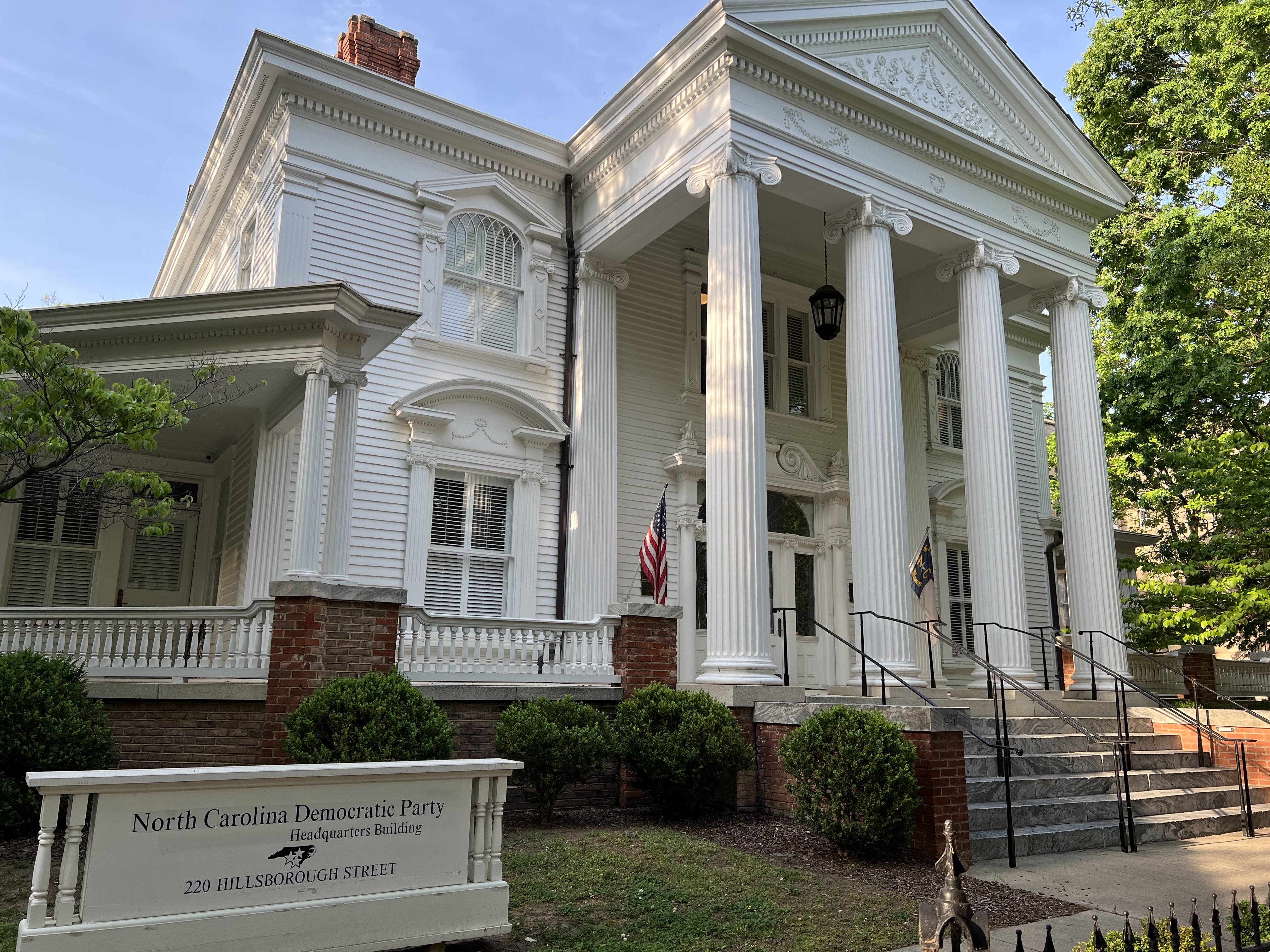
The North Carolina Democratic Party (NCDP) is the North Carolina affiliate of the Democratic Party. It is headquartered in the historic Goodwin House, located in Raleigh.
The party controls the governorship and 4 other non-judicial statewide elected offices, as well as 4 of the state's 14 U.S. House seats. Since the 2010 passage of the Affordable Care Act, North Carolina Democrats have advocated for increasing the state's minimum wage.
History
The Second Party System emerged from a divide in the Democratic-Republican Party in 1828. They split off into two groups, the Democrats, led by Andrew Jackson, and the Whigs. In North Carolina, people from the west and northeast supported the Whigs mainly for their policies on education and internal improvements. Meanwhile, eastern North Carolina was dominated by wealthy planters who tended to oppose activist government. During the Civil War, Whigs and Unionist Democrats formed the Conservative Party and elected Zebulon Vance as governor on a platform of supporting the Confederate war effort while defending states' rights and civil liberties against the Confederate government in Richmond. Postwar, the Conservative Party reorganized to oppose the reconstruction policies enacted by the U.S. Congress following the Civil War. By 1870, the two main parties were the Conservatives (who changed their name to "Democratic-Conservatives" and then to Democrats by 1876) and the Republicans.
Before the 1960s, many NCDP leaders, as was the case with most state parties in the South, supported racial segregation. But beginning with the Republicans' 1964 presidential campaign and Richard Nixon's "Southern strategy" in 1968, white segregationists, including former U.S. Senator Jesse Helms, flocked to the Republican Party. Since then, most minority voters have supported the NCDP. Jimmy Carter carried North Carolina in the 1976 election, but from 1980 to 2004, the Republican presidential nominee won the state.
In spite of the conservative bent of North Carolina politics, a number of Democrats, such as Terry Sanford and John Edwards, have been elected to represent the state at the federal level. Edwards was the Democratic nominee for vice president in 2004. Republican U.S. Senator Elizabeth Dole was defeated for reelection in 2008 by Democrat Kay Hagan, the same year Barack Obama carried the state in his victory over Republican John McCain by a margin of less than one half of a percentage point.
Since the passage of the Affordable Care Act, North Carolina Democrats have prioritized advocating Medicaid expansion in the state, a policy that would provide a federally subsidized healthcare plan to approximately 500,000 North Carolinians. Another priority for North Carolina Democrats in the 2010s and 2020s has been increasing the minimum wage.
Leadership
The state party chair is Anderson Clayton, who was elected in 2023. The chair is elected by and leads the State Executive Committee (the "SEC"), a body of more than 500 Democratic Party leaders and activists from all 100 counties, which governs the party. Jonah Garson is the First Vice-Chair, Kimberly Hardy is the second Vice-Chair, Elijah King is the Third Vice-Chair and Melvin Williams is the Secretary.
Kian Sadjadi was named Executive Director on November 1, 2023.
County Parties
Organized
Unorganized
NCDP organizations
- North Carolina Democratic Women
- Young Democrats of North Carolina
- College Democrats of North Carolina
- NC Senior Democrats
- NC Teen Democrats
- African American Caucus of the NC
- NCDP Hispanic American Caucus
- LGBT Democrats of North Carolina
- NCDP Disability Issues Caucus
Recent electoral results
2006
North Carolina Democrats scored impressive victories in the 2006 general elections, increasing their majorities in both houses of the North Carolina General Assembly and defeating incumbent Republican U.S. Representative Charles H. Taylor. In addition, most candidates backed by Democrats in the non-partisan races for the North Carolina Supreme Court and the North Carolina Court of Appeals were elected. These victories came despite controversies surrounding Jim Black, a Democrat and former Speaker of the North Carolina House of Representatives.
2008
In 2008, the North Carolina Democratic Party once again earned major victories in state and federal elections. For the first time since 1976, the Democratic nominee carried North Carolina in the presidential election. Meanwhile, Kay Hagan was elected to the U.S. Senate over incumbent Elizabeth Dole, and Beverly Perdue was elected governor to succeed fellow Democrat Mike Easley.
2010
In 2010, Republicans swept North Carolina, taking control of both houses of the General Assembly for the first time since 1896, reelecting Richard Burr to a second term by double digits, and unseating incumbent Democratic U.S. Representative Bob Etheridge.
2012
Bev Perdue retired as governor and the Democratic nominee for governor, Lieutenant Governor of North Carolina Walter H. Dalton was defeated in the general election by Republican Pat McCrory. Incumbent Democratic U.S. Representative Larry Kissell was unseated, and two open U.S. House seats previously controlled by Democrats were also gained by Republicans.
2014
2014 saw incumbent Senator Kay Hagan defeated for reelection, and the seat of U.S. Representative Mike McIntyre who had retired was taken by a Republican. Democrats in the North Carolina House of Representatives flipped four seats from Republican held districts in Wake and Buncombe counties. The state party also saw success in the non-partisan races for North Carolina Supreme Court and the North Carolina Court of Appeals.
2016
In 2016, Democrats retook the governor's office, electing then-Attorney General Roy Cooper, while also electing a Democrat to succeed him as Attorney General, Josh Stein. Meanwhile, Democrats lost seats in the North Carolina Council of State, picked up one seat in the state House and lost one seat in the state Senate. Democratic nominee Deborah K. Ross lost the U.S. Senate election to incumbent Richard Burr. Democrats retook the majority on the North Carolina Supreme Court for the first time in the 21st century.
2018
In 2018, Democrats added a seat to their judicial majority on the North Carolina Supreme Court when Anita Earls defeated Incumbent Republican Justice Barbara Jackson and lawyer Chris Anglin winning by a plurality vote of 48.79%. Democrats also gained two seats on the North Carolina Court of Appeals and incumbent judge John S. Arrowood ran for his first full term after being appointed by Governor Roy Cooper in 2017. Legislative Democrats were able to break the Republican supermajority's in both the State House and Senate for the first time since losing control of both chambers in 2010.
2020
In 2020, Democratic governor Roy Cooper won reelection.
2022
in 2022, Democrats flipped the redrawn 13th district from Republican control, and won the newly created 14th district, yielding an even 7—7 House delegation.
Republicans won a narrow majority in the NC house by 2 new seats, and a smaller majority in the senate also by 2 new seats. In the state's supreme court Republicans won both seats on the Supreme Court and all four races for the Court of Appeals. As a result of these elections, Republicans holds a 5–2 majority on the North Carolina Supreme Court.
Current elected officials
Members of Congress
U.S. Senate
- None
Both of North Carolina's U.S. Senate seats have been held by Republicans since 2015. Kay Hagan was the last Democrat to represent North Carolina in the U.S. Senate. First elected in 2008, Hagan lost her bid for a second term in 2014 to Republican challenger Thom Tillis who has held the seat since.
U.S. House of Representatives
Out of the 14 seats North Carolina is apportioned in the U.S. House of Representatives, 4 are held by Democrats:
| District | Member | Photo | |||
|---|---|---|---|---|---|
| 1st | [[File:Portrait of Congressman Don Davis.jpg | center | frameless | 130px]] | |
| 2nd | [[File:Deborah Ross 117th U.S Congress.jpg | center | frameless | 130px]] | |
| 4th | [[File:U.S. Rep. Valerie Foushee - 118th Congress.jpg | center | frameless | 130px]] | |
| 12th | [[File:Alma Adams official portrait (cropped 2).jpg | center | frameless | 130px]] |
Statewide offices
Democrats control five of the ten elected statewide offices:
File:Josh Stein speaking during Kamala Harris rally at Wake Tech on August 16, 2024 (53934613418 2).jpg|Governor File:Senator Rachel Hunt 2023-25 Legislative Portrait (cropped).jpg|Lieutenant Governor File:Rep. Jeff Jackson - 118th Congress (Updated) (cropped).jpg|Attorney General File:Elaine Marshall IACA 2018 (cropped).jpg|Secretary of State File:3x4.svg|Superintendent of Public Instruction
State legislative leaders
- Senate Minority Leader: Sydney Batch
- Senate Minority Whip: Jay Chaudhuri
- Senate Minority Caucus Secretary: Julie Mayfield
- House Minority Leader: Robert Reives
- House Deputy Minority Leader: Cynthia Ball
- House Minority Whips: Cynthia Ball, Garland Pierce, Deb Butler, Carla Cunningham, and Amos Quick.
State House

There are 48 Democratic State House members as of 2024. Current members are listed below:
- District 2: Ray Jeffers
- District 8: Gloristine Brown
- District 11: Allison Dahle
- District 18: Deb Butler
- District 21: Ya Liu
- District 23: Shelly Willingham
- District 27: Michael Wray
- District 29: Vernetta Alston
- District 30: Marcia Morey
- District 31: Zack Forde-Hawkins
- District 33: Rosa Gill
- District 34: Tim Longest
- District 35: Terence Everitt
- District 36: Julie von Haefen
- District 38: Abe Jones
- District 39: James Roberson
- District 40: Joe John
- District 41: Maria Cervania
- District 42: Marvin Lucas
- District 44: Charles Smith
- District 45: Frances Jackson
- District 48: Garland Pierce
- District 49: Cynthia Ball
- District 50: Renee Price
- District 54: Robert Reives
- District 56: Allen Buansi
- District 57: Ashton Clemmons
- District 58: Amos Quick
- District 60: Cecil Brockman
- District 61: Pricey Harrison
- District 66: Sarah Crawford
- District 71: Kanika Brown
- District 72: Amber Baker
- District 73: Diamond Staton-Williams
- District 88: Mary Belk
- District 92: Terry Brown
- District 99: Nasif Majeed
- District 100: John Autry
- District 101: Carolyn Logan
- District 102: Becky Carney
- District 103: Laura Budd
- District 104: Brandon Lofton
- District 105: Wesley Harris
- District 106: Carla Cunningham
- District 107: Bobby Drakeford
- District 114: Eric Ager
- District 115: Lindsey Prather
- District 116: Caleb Rudow
State Senate

There are 20 Democratic State Senators. Current senators are listed below:
- District 5: Kandie Smith
- District 13: Lisa Grafstein
- District 14: Dan Blue
- District 15: Jay Chaudhuri
- District 16: Gale Adcock
- District 17: Sydney Batch
- District 18: Mary Wills Bode
- District 19: Val Applewhite
- District 20: Natalie Murdock
- District 22: Mike Woodard
- District 23: Graig Meyer
- District 27: Michael Garrett
- District 28: Gladys Robinson
- District 32: Paul Lowe Jr.
- District 38: Mujtaba Mohammed
- District 39: DeAndrea Salvador
- District 40: Joyce Waddell
- District 41: Natasha Marcus
- District 42: Woodson Bradley
- District 49: Julie Mayfield
Mayors
- Charlotte: Vi Lyles (1)
- Raleigh: Janet Cowell (2)
- Greensboro: Nancy Vaughan (3)
- Durham: Leonardo Williams (4)
- Winston-Salem: Allen Joines (5)
- Fayetteville: Mitch Colvin (6)
- Cary: Harold Weinbrecht (7)
- Wilmington: Bill Saffo (8)
- High Point: Cyril Jefferson (9)
- Asheville: Esther Manheimer (11)
- Apex: Jacques Gilbert (14)
- Huntersville: Christy Underwood Clark (16)
- Chapel Hill: Jessica Anderson (17)
Notes
References
- "Goodwin House – North Carolina Democratic Party".
- "Voter Registration Statistics". North Carolina State Board of Election.
- Faulkner, Ronnie W.. "Conservative Party". North Carolina Government & Heritage Library at the State Library of North Carolina.
- "The North Carolina Election of 1898 · UNC Libraries".
- [http://docsouth.unc.edu/nc/demconserv/demconserv.html Address of the Central Executive Committee]
- "Whigs and Democrats - North Carolina Digital History".
- "President Map - Election Results 2008". The New York Times.
- (27 October 2020). "A Chance to Expand Medicaid Rallies Democrats in Crucial North Carolina".
- (January 2021). "$7.25 an hour has been state's minimum wage for 12th consecutive year".
- (13 February 2023). "NCDP Elects New Party Chair, Announces 2023-2025 Party Leadership". North Carolina Democratic Party.
- Specht, Paul. (2023-11-01). "NC Democrats hire Sadjadi as new executive director". WRAL News.
- (8 January 2024). "NCDP County Parties". North Carolina Democratic Party.
- (8 January 2024). "NCDP County Parties". North Carolina Democratic Party.
- "Archived copy".
- "newsobserver.com {{!".
- [https://ballotpedia.org/North_Carolina_House_of_Representatives_elections,_2016 Ballotpedia: North Carolina House of Representatives elections, 2016]
- [https://ballotpedia.org/North_Carolina_State_Senate_elections,_2016 Ballotpedia: North Carolina State Senate elections, 2016]
- (6 November 2022). "NC voters could shift political balance of state's highest court". WRAL.com.
- "Two Republicans win seats on the NC Supreme Court, flipping majority". The Daily Tar Heel.
- "N.C. House of Representatives". NC Democratic Party website.
- "North Carolina Representatives 2019-2020 Session". ncleg.gov.
- "NC Senate". NC Democratic Party website.
- "North Carolina Senators 2019-2020 Session".
This article was imported from Wikipedia and is available under the Creative Commons Attribution-ShareAlike 4.0 License. Content has been adapted to SurfDoc format. Original contributors can be found on the article history page.
Ask Mako anything about North Carolina Democratic Party — get instant answers, deeper analysis, and related topics.
Research with MakoFree with your Surf account
Create a free account to save articles, ask Mako questions, and organize your research.
Sign up freeThis content may have been generated or modified by AI. CloudSurf Software LLC is not responsible for the accuracy, completeness, or reliability of AI-generated content. Always verify important information from primary sources.
Report