From Surf Wiki (app.surf) — the open knowledge base
Lancia Stratos
Rally racing sports car 1973–1978

Rally racing sports car 1973–1978
| Field | Value |
|---|---|
| name | Lancia Stratos HF |
| image | 1974 Lancia Stratos Stradale at Greenwich 2021, front left.jpg |
| caption | Lancia Stratos HF Stradale (road version) |
| manufacturer | Lancia |
| assembly | Italy: Turin |
| production | 1973–1978 |
| ca. 492 produced | |
| designer | Marcello Gandini at Bertone |
| class | Sports car |
| Rally car | |
| layout | Transverse mid-engine, rear-wheel drive |
| body_style | 2-door coupé |
| chassis | Steel space-frame structure with integral roll-cage. Fiberglass body |
| engine | Ferrari 2418 cc Dino V6 24v |
| powerout | Stradale: 190 hp |
| transmission | 5-speed manual |
| wheelbase | 2180 mm |
| length | 3710 mm |
| width | 1750 mm |
| height | 1110 mm |
| weight | Stradale: 980 kg |
| Group 4: 880 kg | |
| predecessor | Lancia Fulvia HF |
| successor | Lancia Rally 037 |
ca. 492 produced Rally car Group 4: 880 kg
The Lancia Stratos HF (Tipo 829), known as Lancia Stratos, is a rear mid-engined sports car designed for rallying, made by Italian car manufacturer Lancia. It was highly successful in competition, winning the World Rally Championship in 1974, 1975 and 1976; as well as winning the 1974 Targa Florio, winning the Tour de France Automobile five times and the Giro d'Italia automobilistico three times.
History

Lancia had traditionally worked with the design house Pininfarina and had not used Bertone before. Bertone desired to create an opportunity for a relationship with Lancia and knew that Lancia was looking for a replacement for the aging Fulvia for use in rally sports. Bertone decided to design an eye-catching model to show to Lancia. Bertone used the running gear of a Fulvia Coupé which belonged to one of his friends and built a running model around it. When Bertone himself appeared at the Lancia factory gates with the Stratos Zero he passed underneath the barrier, to great applause from the Lancia workers. After that Lancia and Bertone agreed to develop a new rally car based on the ideas of Bertone's designer Marcello Gandini. Gandini had already designed the Lamborghini Miura and was working on the Countach at the time.
Lancia presented the Bertone-designed Lancia Stratos HF prototype at the 1971 Turin Motor Show, a year after the announcement of the Stratos Zero concept car. The prototype Stratos HF (Chassis 1240) was fluorescent red in colour and featured a distinctive crescent-shaped wrap-around windshield providing maximum forward visibility with almost no rear visibility. The prototype had three different engines in its early development life: the Lancia Fulvia engine, the Lancia Beta engine and finally, for the 1971 public launch, the mid-mounted Dino Ferrari V6 producing 190 hp in road trim. The use of this engine had been planned from the beginning of the project, but Enzo Ferrari was reluctant to sign off the use of this engine in a car he saw as a competitor to his own Dino V6. After the production of the Dino had ended, the "Commendatore" (a popular nickname for Enzo Ferrari) agreed to deliver the engines for the Stratos, upon which Lancia suddenly received 500 units.

The final design shares several striking features with Gandini's Lamborghini Miura: the dual clamshell hoods (the front opening forward, over the spare wheel placed identically, and the rear hinging rearward, with stepped black louvres above the engine and integrating a trunk behind it) – as well as the way the door-glass bottom rears curve upward, giving the otherwise frameless doors an upward-swept frame section. In contrast though, the Stratos' body received an unmistakable short and wide wedge shape, so extreme that the nose drops below the top crests of the front wheel wells, and made unique by the semi-elliptical greenhouse's windshield and door glass ensemble, when seen from above.
_(cropped).jpg)
The Stratos was a successful rally car during the 1970s and early 1980s. It started a new era in rallying as it was the first car designed from scratch for this kind of competition. The three leading men behind the entire rallying project were Lancia team manager Cesare Fiorio, British racer/engineer Mike Parkes and factory rally driver Sandro Munari, with Bertone's Designer Marcello Gandini taking a personal interest in designing and producing the bodywork. A dedicated calculations engineer from Lancia was tasked with performing calculations on many of the chassis, steering, suspension and engine components: Nicola Materazzi.
Lancia undertook extensive testing with the Stratos and raced the car in several racing events where Group 5 prototypes were allowed during the 1972 and 1973 seasons. Production of the 500 cars required for homologation in Group 4 commenced in 1973 and the Stratos was homologated for the 1974 World Rally Championship season. The Ferrari Dino V6 engine was phased out in 1974, but 500 engines - among the last examples built - were delivered to Lancia. Production ended in 1975, when it was thought that only 492 were made (for the 1976 season, the Group 4 production requirement was reduced to 400 in 24 months). The manufacturer of the car was Bertone in Turin, with final assembly by Lancia at the Chivasso plant. Powered by the Dino 2.4 L V6 engine that was also fitted to the rallying versions, but in a lower state of tune, it resulted in a power output of 140 kW at 7,000 rpm and 23 kgm at 4,000 rpm of torque, giving the road car a 0–100 km/h time of 6.8 seconds, and a top speed of 232 km/h. The car was sold as the Lancia Stratos HF Stradale.
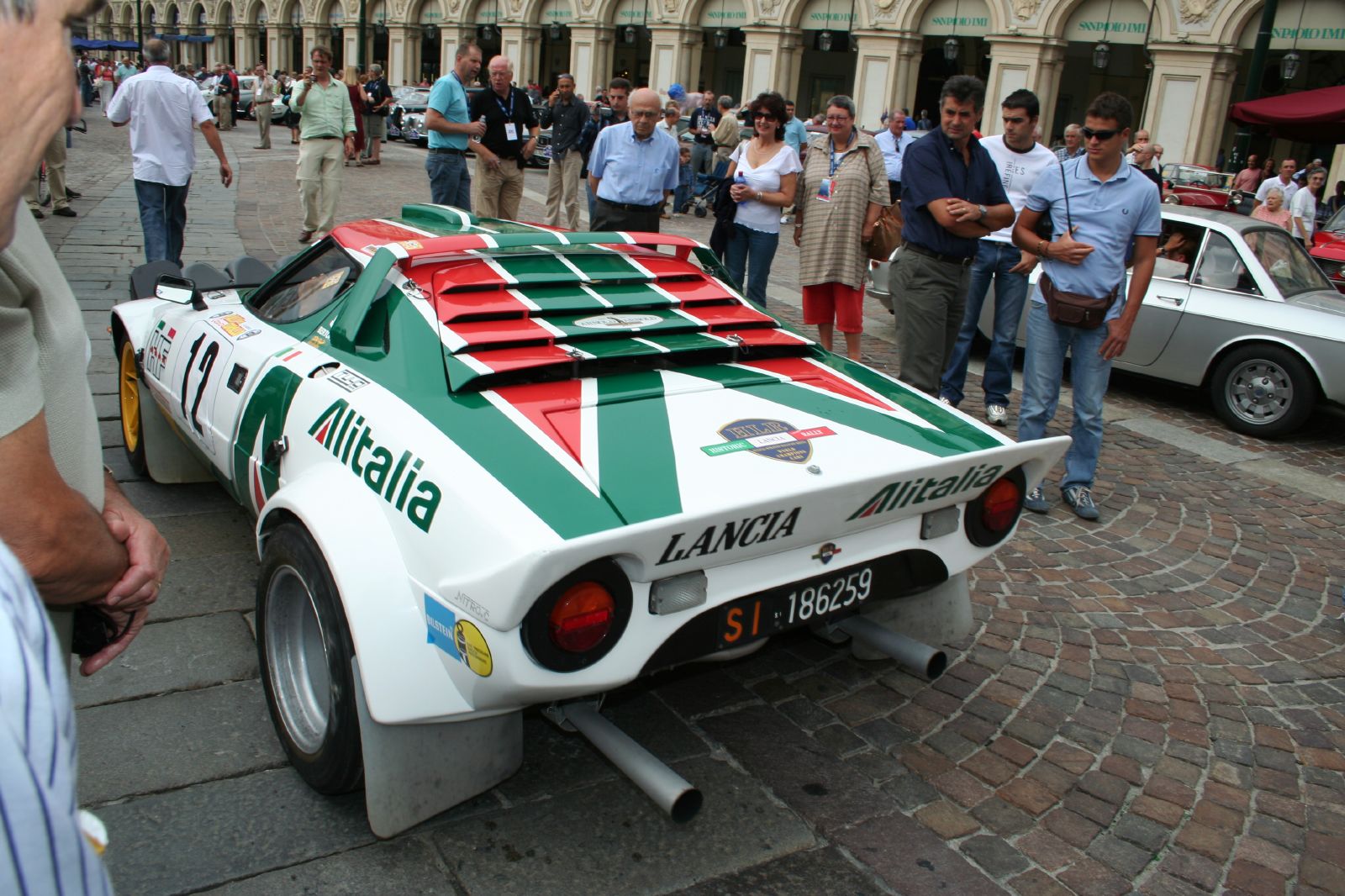
The Stratos weighed between 900 and 950 kilograms, depending on configuration. Power output was around 275 hp for the original 12 valve version and 320 hp for the 24 valve version. Beginning with the 1978 season the 24 valve heads were banned from group 4 competition by a change to the FIA rules (which would have required additional production of 24-valve cars for re-homologation). Even with this perceived power deficit the Stratos was the car to beat in competition and when it did not suffer an accident or premature transmission failure (of the latter there were many) it had great chances to win.
The car won the 1974, 1975 and 1976 championship titles in the hands of Sandro Munari and Björn Waldegård, and might have gone on to win more had not internal politics within the Fiat group placed rallying responsibility on the Fiat 131 Abarths. As well as victories on the 1975, 1976 and 1977 Monte Carlo Rally, all courtesy of Munari, the Stratos won the event with the private Chardonnet Team as late as 1979.

Without support from Fiat, and despite new regulations that restricted engine power, the car would remain a serious competitor and proved able to beat works cars in several occasions when entered by an experienced private team with a talented driver. The last victory of the Stratos was in 1981, at the Tour de Corse Automobile, another World Rally Championship event, with a victory by longtime Stratos privateer Bernard Darniche.
When the Fiat group favoured the Fiat 131 for rallying, Lancia also built two Group 5 turbocharged 'silhouette' Stratos for closed-track endurance racing. The powertrain and aerodynamics were engineered by Nicola Materazzi based on experience gained with the earlier generation. These cars failed against the Porsche 935s on closed tracks but proved successful in hybrid events. Stratos won a record 5 times the Tour de France Automobile between 1973 and 1980, and also the 1974, 1976 and 1978 Giro d'Italia automobilistico, an Italian counterpart of the Tour de France Automobile. One of the cars was destroyed in Zeltweg, when it caught fire due to overheating problems. The last surviving car would win the Giro d'Italia event again before it was shipped to Japan to compete in the Fuji Speedway based Formula Silhouette series, which was never raced. The car would then be sold and reside in the Matsuda Collection before then being sold to a collector of Stratos', Ernst Hrabalek, who had the largest Lancia Stratos Collection in the world at the time, 11 unique Lancia Stratos cars, including the fluorescent red 1971 factory prototype and the 1977 Safari Rally car.Many sources in the 2000s claimed the car belonged to the son of Ernst, Christian Hrabalek, when in fact it was 'loaned' to him. The Stratos also gained limited success in 24 Hours of Le Mans, with a car, driven by Christine Dacremont and Lella Lombardi, finishing 20th overall and 2nd in GTP class in 1976.

Another unique Group 5 car is the Lancia Stratos HF of Austrian Rallycross driver Andy Bentza. The car was first driven by his Memphis teammate Franz Wurz, father of Formula One pilot Alexander Wurz. In 1976 Wurz claimed the first ever European Rallycross title recognised by the FIA with the car, by then still featuring a 2.4-litre engine with first a 12- and later a 24-valve head. For the ERC series of 1977 Wurz was entrusted with an experimental 24-valve engine by Mike Parkes, equipped with a special crankshaft to bring the engine capacity up to just under 3000 cc. For 1978 Bentza took the Stratos over from Wurz, sold his own 2.4 L 12V Stratos to compatriot Reneé Vontsina and won the GT Division title of the ERC. The one and only 3.0 litre Stratos worldwide was raced by Bentza till the end of 1983. After keeping the car for another 30 years Bentza has sold the Stratos to Alexander Wurz. It was fully restored over a period of almost two years and revealed to the public in May 2016, converted back to its 1976 rallycross specification with Memphis livery.
WRC victories
:{|class="wikitable" style="font-size: 95%; " ! No. ! Event ! Season ! Driver ! Co-driver |- | 1 | Italy 16º Rallye Sanremo | 1974 | ITA Sandro Munari
| ITA Mario Mannucci |
|---|
| 2 |
| Canada 3rd Rally Rideau Lakes |
| 1974 |
| ITA Sandro Munari |
| ITA Mario Mannucci |
| - |
| 3 |
| France 18ème Tour de Corse |
| 1974 |
| FRA Jean-Claude Andruet |
| FRA Michèle Petit |
| - |
| 4 |
| Monaco 43ème Rallye Automobile de Monte-Carlo |
| 1975 |
| ITA Sandro Munari |
| ITA Mario Mannucci |
| - |
| 5 |
| Sweden 25th International Swedish Rally |
| 1975 |
| SWE Björn Waldegård |
| SWE Hans Thorszelius |
| - |
| 6 |
| Italy 17º Rallye Sanremo |
| 1975 |
| SWE Björn Waldegård |
| SWE Hans Thorszelius |
| - |
| 7 |
| France 19ème Tour de Corse |
| 1975 |
| FRA Bernard Darniche |
| FRA Alain Mahé |
| - |
| 8 |
| Monaco 44ème Rallye Automobile de Monte-Carlo |
| 1976 |
| ITA Sandro Munari |
| ITA Silvio Maiga |
| - |
| 9 |
| Portugal 9º Rallye de Portugal Vinho do Porto |
| 1976 |
| ITA Sandro Munari |
| ITA Silvio Maiga |
| - |
| 10 |
| Italy 18º Rallye Sanremo |
| 1976 |
| SWE Björn Waldegård |
| SWE Hans Thorszelius |
| - |
| 11 |
| France 20ème Tour de Corse |
| 1976 |
| ITA Sandro Munari |
| ITA Silvio Maiga |
| - |
| 12 |
| Monaco 45ème Rallye Automobile de Monte-Carlo |
| 1977 |
| ITA Sandro Munari |
| ITA Silvio Maiga |
| - |
| 13 |
| Italy 20º Rallye Sanremo |
| 1978 |
| FIN Markku Alén |
| FIN Ilkka Kivimäki |
| - |
| 14 |
| Spain 26º RACE Rallye de España |
| 1978 |
| ITA Tony Carello |
| ITA |
| - |
| 15 |
| Monaco 47ème Rallye Automobile de Monte-Carlo |
| 1979 |
| FRA Bernard Darniche |
| FRA Alain Mahé |
| - |
| 16 |
| Italy 21º Rallye Sanremo |
| 1979 |
| ITA Antonio "Tony" Fassina |
| ITA Mauro Mannini |
| - |
| 17 |
| France 23ème Tour de Corse |
| 1979 |
| FRA Bernard Darniche |
| FRA Alain Mahé |
| - |
| 18 |
| France 25ème Tour de Corse |
| 1981 |
| FRA Bernard Darniche |
| FRA Alain Mahé |
| } |
Concept cars
Stratos Zero
Main article: Lancia Stratos Zero
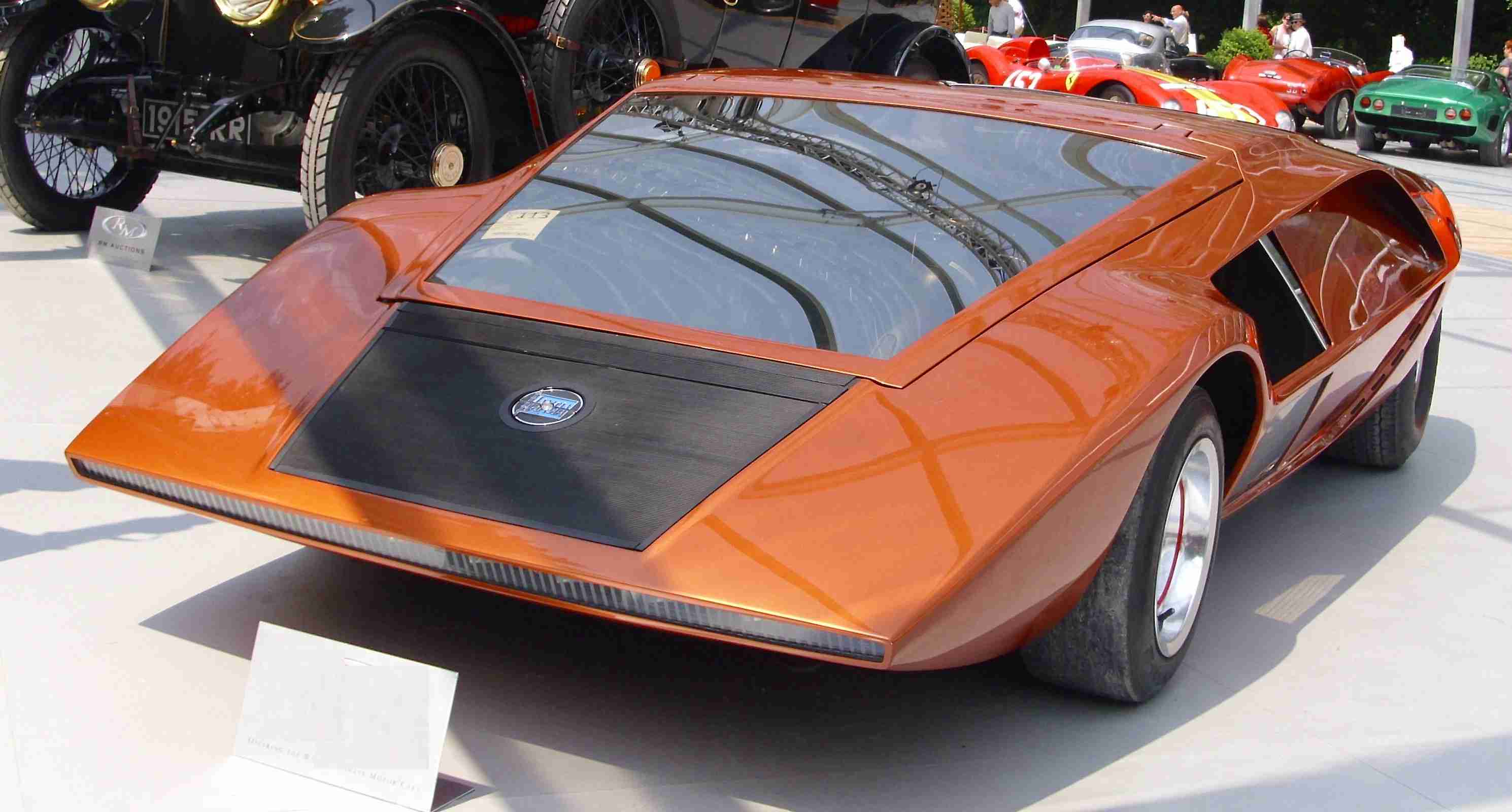
The Lancia Stratos Zero (or 0) preceded the Lancia Stratos HF prototype by 12 months and was first shown to the public at the Turin Motor Show in 1970. The futuristic bodywork was designed by Marcello Gandini, head designer at Bertone, and featured a 1.6 L Lancia Fulvia V4 engine. The Lancia Stratos HF Zero was exhibited in Bertone's museum for many years. In 2011, it was sold during an auction in Italy for €761,600. It has been displayed in the exhibit "Sculpture in Motion: Masterpieces of Italian Design" at the Petersen Automotive Museum in Los Angeles. It was at the High Museum of Art in Atlanta at the "Dream Cars" exhibit in 2014, on loan from the XJ Wang Collection of New York City.
The car's body is wedge-shaped and finished in distinctive orange. It is unusually short in length (3.58 m) and height (84 cm), and it shares little with the production version. The Zero appeared in Michael Jackson's 1988 film Moonwalker.
Lancia Sibilo
Main article: Lancia Sibilo

In 1978, Bertone designed and built the Lancia Sibilo, a concept car based on the Stratos, the wheelbase of which was lengthened from 2180 to 2280 mm. It was conceived as a futuristic two-seater coupè, with glass surfaces that seemed almost integrated into the volumes of the body.
Stola S81
.jpg)
In 2000, Marcello Gandini designed a modern interpretation of his Lancia Stratos, built by Stola of Turin. It debuted at the 2000 Turin Auto Show, 30 years after the Stratos Zero concept debuted at the same show. The concept is a two-seater coupe, painted in a similar shade of orange to the original 1971 Stratos HF prototype, and sharing key design elements with the Stratos, such as the wedge shape and wraparound windshield. It also featured new technologies such as LED headlights and taillights, and electric door openers. It was initially built as just a static model, although it was envisioned to be able to fit a Maserati V8 engine. It was later fitted with an electric motor in 2014. The design initially planned to incorporate the Lancia shield into the front bumper, but after Lancia viewed the car, they requested that their logo not be used in order to not cause confusion. After this, the design was changed to incorporate Gandini’s own logo instead. However, a wheel design was chosen that featured centers which formed the triangular shape of Lancia’s logo.
Fenomenon Stratos (2005)
At the 2005 Geneva Auto Show, a British design firm known as Fenomenon, who had rights to the Stratos name, exhibited a retro-modern concept version of the Stratos, designed by Chris Hrabalek and following its exhibition at the Frankfurt show, developed by Prodrive. The concept was based around a mid-mounted 419 hp V8 engine.
New Stratos
Manifattura Automobili Torino 6-speed manual
Following the stalled Fenomenon project, one interested backer funded a one-off model. Commissioned by Michael Stoschek (a keen rally driver and chairman of Brose Group) and his son, Maximilian, the New Stratos was announced in 2010 based on the overall design and concept of the original Stratos and was designed and developed by Pininfarina.
The car made use of a Ferrari 430 Scuderia as a donor car, using the chassis (shortened by 200 mm resulting in a wheelbase of 2400 mm) and much of the mechanical elements including the 4.3 L V8 engine (4,308 cm3), tuned to generate 540 hp at 8,200 rpm (also reported at 550 bhp) and torque of 520 Nm at 3,750 rpm.
The New Stratos weighs 1247 kg and is claimed to accelerate to 100 km/h (62 mph) in 3.3 seconds and on to a top speed close to 200 mi/h. While shorter than its donor car, the New Stratos is a little larger than the original Stratos, with a length of 4181 mm, 1971 mm wide and 1240 mm tall. There were reports that given sufficient interest a small production run of up to 25 cars could be possible. Ferrari did not consent to this plan, and forbade its suppliers to support the project. However, on 10 February 2018, Italian coachbuilding firm Manifattura Automobili Torino of Paolo Garella announced that it would be commencing with the production of the originally planned 25 cars.
| [[File:Interior of the New Stratos at 2018 Trento-Bondone.jpg | thumb | Interior]] | [[File:New Stratos Back Genf 2018.jpg | thumb | Rear view]] |
|---|
In popular culture
The Autobot character Wheeljack from the Transformers franchise transforms into an Alitalia-sponsored Stratos in the Generation 1 toy line and its cartoon adaptation, albeit with the Alitalia markings on the toy intentionally misspelled as "Alitalla" (presumably to avoid trademark infringement). Earlier samples of the character's toy from Takara's Diaclone toy line (where most of ''Transformers''' character designs came from) were sold with a Marlboro-inspired livery.
Notes
References
References
- "Designer".
- (2013). "Million Dollar Classics: The World's Most Expensive Cars". Chartwell Books.
- "Lancia Stratos HF Group 4 and Stradale Specification".
- "Technical specifications of 1974 Lancia Stratos".
- "World Sports Racing Prototypes - Non Championship Races 1974".
- "1975 Lancia Stratos".
- Nicola Domenico Senatore. "L'altra storia terra mia: Nicola Materazzi".
- "Lancia/Models/Lancia Stratos".
- Thorson, Thor. (February 2013). "1974 Lancia Stratos Groupe 4". [[Sports Car Market]].
- (1976). "International Sporting Code 1976". [[Fédération Internationale de l'Automobile.
- (February 2011). "Lancia Stratos".
- Robson, Graham. (2007). "Lancia Stratos". Veloce Publishing Ltd.
- Cironi. (28 July 2017). "Materazzi Racconta Lancia Stratos".
- Delbo. "We sit down with the man who engineered the Ferrari F40 and 288 GTO".
- "6 h Zeltweg results".
- (23 February 2015). "Father and son in court battle over four classic rally cars worth £2.2m".
- "Archived copy".
- "Beyond the Stratos-phere".
- "Le Mans 24 Hours 1976 - Race Results".
- "Historical collection".
- "Lot 113 – 1970 Lancia Stratos HF Zero".
- "Upcoming Exhibitions: Dream Cars: Innovative Design, Visionary Ideas". High Museum of Art.
- (2005). "''End credits''". Warner Brothers.
- "2000 Stola S81 Lancia Stratos: Concept We Forgot".
- "2000 Lancia 'New Stratos' Stola".
- "STUDIOTORINO - 199909_s81 (2)".
- Hull, Nick. (1 March 2005). "First Sight – Fenomenon Stratos".
- "Wild Fenomenon Stratos Concept Brings Back Glory Days of Lancia Rally Domination".
- (5 October 2005). "Prodrive takes on Stratos".
- "New Stratos".
- "Lancia New Stratos: design sketches and updates".
- Bremner, Richard. (26 August 2010). "New Lancia Stratos – latest pics".
- Barker, John. (29 November 2010). "New Lancia Stratos supercar review".
- Matai, Banzai. (July 22, 2021). "Rally Dreaming In The MAT Stratos".
- Kew, Ollie. (9 February 2018). "The New Stratos will return as a 550bhp rally-ready supercar".
- Barlow, Jason. (30 November 2010). "Exclusive first drive in new Stratos supercar".
- Madden, Luke. (16 August 2010). "Lancia Stratos officially revealed".
- Spinks, Jez. (14 July 2011). "Ferrari blocks iconic sports car".
- "Paolo Garella".
- Bellomo, Mark. (July 5, 2016). "The Ultimate Guide to Vintage Transformers Action Figures". Krause Publications.
This article was imported from Wikipedia and is available under the Creative Commons Attribution-ShareAlike 4.0 License. Content has been adapted to SurfDoc format. Original contributors can be found on the article history page.
Ask Mako anything about Lancia Stratos — get instant answers, deeper analysis, and related topics.
Research with MakoFree with your Surf account
Create a free account to save articles, ask Mako questions, and organize your research.
Sign up freeThis content may have been generated or modified by AI. CloudSurf Software LLC is not responsible for the accuracy, completeness, or reliability of AI-generated content. Always verify important information from primary sources.
Report