From Surf Wiki (app.surf) — the open knowledge base
Flemish Parliament
Elected legislative body of Flanders

Elected legislative body of Flanders
| Field | Value | |
|---|---|---|
| name | Flemish Parliament | |
| native_name | nl | |
| legislature | 2024–2029 legislature | |
| logo | Flemish Parliament logo 2022.svg | |
| logo_res | 250px | |
| house_type | Unicameral | |
| term_limits | None | |
| leader1_type | Speaker | |
| leader1 | Freya Van den Bossche | |
| party1 | Vooruit | |
| election1 | 8 January 2025 | |
| leader2_type | Group leaders | |
| - majority | ||
| leader2 | ||
| Wilfried Vandaele | ||
| party2 | N-VA | |
| election2 | 4 October 2019 | |
| leader3 | Peter Van Rompuy | |
| party3 | CD&V | |
| election3 | 6 February 2019 | |
| leader4 | Willem-Frederik Schiltz | |
| party4 | Open VLD | |
| election4 | 2 October 2019 | |
| leader5_type | - opposition | |
| leader5 | Hannelore Goeman | |
| party5 | Forward | |
| election5 | 28 December 2019 | |
| leader6 | Mieke Schauvliege | |
| party6 | Groen | |
| election6 | 26 April 2023 | |
| leader7 | Chris Janssens | |
| party7 | Vlaams Belang | |
| election7 | 25 June 2014 | |
| structure1 | Vlaams Parlement 2024.svg | |
| structure1_res | 250px | |
| members | 124 | |
| 118 from the Flemish Region | ||
| 6 from the Brussels-Capital Region | ||
| political_groups1 | Government (65) | |
| * | border | darkgray}} N-VA (31) |
| * | border | darkgray}} Vooruit (18) |
| * | border | darkgray}} CD&V (16) |
| * | border | darkgray}} Vlaams Belang (31) |
| * | border | darkgray}} Groen (9) |
| * | border | darkgray}} Open Vld (9) |
| * | border | darkgray}} PVDA (9) |
| * | border | darkgray}} Team Fouad Ahidar (1) |
| term_length | 5 years | |
| voting_system1 | Open list proportional representation (using D'Hondt method) within six constituencies, with 5% constituency electoral threshold | |
| last_election1 | 9 June 2024 | |
| next_election1 | June 2029 | |
| session_room | Flemish Parliament Brussels.jpg | |
| session_res | 250 | |
| meeting_place | Koepelzaal, Flemish Parliament building, Brussels | |
| website | http://www.vlaamsparlement.be/ |
- majority Wilfried Vandaele 118 from the Flemish Region 6 from the Brussels-Capital Region
- N-VA (31)
- Vooruit (18)
- CD&V (16) Opposition (59)
- Vlaams Belang (31)
- Groen (9)
- Open Vld (9)
- PVDA (9)
- Team Fouad Ahidar (1)
The Flemish Parliament (Dutch: , formerly called Flemish Council or Vlaamse Raad) constitutes the legislative power in Flanders for matters which fall within the competence of Flanders, both as a geographic region and as a cultural community of Belgium (unlike the French Community and Wallonia, which each have separate legislatures: the Parliament of the French Community and the Parliament of Wallonia).
The Flemish Parliament approves decrees, which are Flemish laws, applicable to all persons in the Flemish Region, and to Flemish institutions in Brussels; it appoints and supervises the Flemish Government; and it approves the Flemish budget. The Flemish Parliament meets in the Flemish Parliament building in central Brussels, and its members and staff are housed in the House of the Flemish Representatives.
History
From 1830 until 1970, Belgium was a unitary state with a single government and a bicameral national parliament. The laws issued by Parliament applied to all Belgians, and government ministers exercised their authority across the length and breadth of the country. Between 1970 and 2001 the Belgian Parliament approved five successive constitutional reforms. Slowly they changed Belgium from a unitary into a federal state. Part of this was to give the communities and later the regions, their own parliaments.
On 7 December 1971, the Cultural Council for the Dutch-speaking Cultural Community held its first meeting; later followed a parliament for the Flemish Region. Flanders decided as early as 1980 to merge the Flemish Community with the Flemish Region. As a result, Flanders now has a single parliament and a single government with competence over community as well as over regional matters. This Parliament was called the Vlaamse Raad until it was officially renamed Vlaams Parlement (Flemish Parliament) on 13 June 1995. Over the last thirty years, Flanders has thus developed into a separate state within the federalised Belgium.
Members are called "Vlaamse Volksvertegenwoordigers". In English, they are referred to as "Members of the Flemish Parliament" (MFPs), like the MSPs in Scotland and the MEPs in the European Union. The title "Flemish Representative" is also used in English. Since 1995 members of the Flemish Parliament have been directly elected.
Currently, many voices in the Flemish Movement would like the Flemish Parliament to acquire certain sovereign powers in addition to those concerning language, culture and education.
Competencies (Jurisdiction)
The Flemish Parliament enacts decrees, which are Flemish laws, either as a decree of the Flemish Community or as a decree of the Flemish Region (or often as a decree combining provisions for both entities). Regional legislation is only applicable to all persons in the Flemish Region whereas community legislation also applies to Flemish institutions or services in Brussels (and thus to persons in Brussels who choose to make use of these institutions or services, such as schools).
No hierarchy exists between (federal) laws and Flemish decrees, as each level is supposed to have clearly defined subject-matter jurisdiction. The basis for the community subject-matter jurisdiction is defined in the Belgian Constitution, but the Special Law on Institutional Reform defines all matters in high detail. They can be summarised as follows:
Competencies for the entire Flemish Community
- Culture: The Flemish parliament is competent for all cultural matters. This includes protection of the cultural heritage (e.g. literature, fine arts), tourism and the media. The public Flemish radio and television broadcasting company is the VRT.
- Language use: including language use in schools and universities, in the Flemish and local administrations, and in relations between employers and employees in the Dutch-speaking part of Belgium, with exception of the "language facilities" enjoyed in some municipalities.
- All "matters relating to the person": youth protection, family policy and childcare, together with policy regarding the handicapped, old age pensioners, equal opportunities and the integration of migrants.
- Education: from kindergarten to university including scholarships, though the establishment of the period of compulsory education, requirements for awarding degrees, and pension schemes for teachers remain at the federal level.
- Health care: including preventive health care, home care, institutions for mental health care, but excluding health insurance, financing of hospitals and most other competencies that remained federal.
Competencies for the Flemish Region only
- Economy, employment and energy policy: includes government support for business, employment policy, agriculture and fisheries, the distribution of electricity and natural gas, the exploitation of new energy sources and the promotion of responsible use of energy
- Town and country planning, housing, land development & nature conservation: including regional planning, building permits, housing policy, social housing, urban renewal, preservation of monuments and natural sites, land consolidation and nature conservation
- Environment and water policy: including the reduction of air, land and water pollution, noise control, the purification of waste water, the production and distribution of drinking water and waste disposal policy
- Scientific research: this field is the full responsibility of the regional authorities, except for aerospace and military research (that remained federal).
- Public works and transport: includes roads, ports (the Port of Antwerp, Port of Bruges-Zeebrugge, Port of Ghent and the Port of Ostend), the regional airports (including Antwerp International Airport and Ostend-Bruges International Airport), and urban and regional transport.
- Agriculture: includes the Agricultural Investment Fund, the agricultural education, the development of rural regions, the sale of agricultural and horticultural products and the fisheries policy. By the stipulations of the Lambermont Agreement (2001), the regions are competent for almost the complete agricultural policy but a few security aspects like food security and animal welfare which remained under the competence of the federal government.
- Local government: includes the allocating of financial resources to the 300 Flemish municipalities and to the five Flemish provinces, and administrative supervision of these communes and provinces and their laws.
International affairs
For all areas within its sphere of competence (both vis-à-vis community or regional competences), the Flemish region can conclude international treaties with other states, whether they are national states or member states of a federation. This competence includes development cooperation and foreign trade.
Procedure
A regular legislative session starts in September, when the Government presents its "September Declaration" (Septemberverklaring), a practice based on the speech from the throne. Plenary sessions are usually held on Wednesdays.
The Flemish Parliament largely functions like its federal, community and regional counterparts, mutatis mutandis. Bills are usually introduced by the Government (ontwerp van decreet), but members of parliament can also propose bills (voorstel van decreet or private member's bill). Bills are first considered in committee, after which they are put to a vote in the plenary. Votes are usually recorded electronically. For example, during the 2009–14 legislature, 407 government bills were adopted, while only 102 private member's bills were made law.
Elections and membership
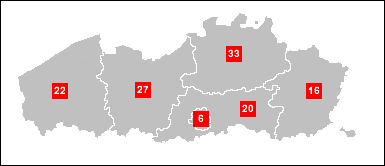
118 members are directly elected in the Flemish Region. They have voting rights for both regional and community competencies. Six members are directly elected in the Brussels-Capital Region by those voters who voted for a Dutch-speaking party in the Brussels regional elections. They have no voting rights for the regional competencies.
The elections take place every five years, simultaneously with the elections for the other regional and community parliaments and for the European Parliament. Thus, de facto the European decision-makers determine when the Flemish Parliament elections occur.
This table shows the distribution of seats following the 2024 regional election:
| Affiliation | Constituency | Total | Ant. | E-Fl. | Fl-Br. | Lim. | W-Fl. | Bru. |
|---|---|---|---|---|---|---|---|---|
| New Flemish Alliance (N-VA) | 10 | 7 | 5 | 4 | 5 | 1 | 31 | |
| Flemish Interest (Vlaams Belang) | 8 | 6 | 4 | 5 | 6 | 1 | 31 | |
| Forward (Vooruit) | 4 | 5 | 3 | 2 | 3 | 1 | 18 | |
| Christian Democratic and Flemish (CD&V) | 3 | 3 | 3 | 3 | 4 | 0 | 16 | |
| Open Flemish Liberals and Democrats (Open Vld) | 2 | 2 | 3 | 1 | 1 | 0 | 9 | |
| Workers' Party of Belgium (PVDA) | 4 | 2 | 1 | 1 | 1 | 0 | 9 | |
| Green (Groen) | 2 | 2 | 2 | 0 | 1 | 2 | 9 | |
| Team Fouad Ahidar (TFA) | 0 | 0 | 0 | 0 | 0 | 1 | 1 | |
| Total | 33 | 27 | 21 | 16 | 21 | 6 | 124 |
Previous legislative terms
The following table lists each legislative term since 1995, when the Flemish Parliament was first directly elected following the fourth state reform.
The parties are ordered by size in the respective term. Green coloured parties indicate the government majority, whereas red parties form the opposition.
| Legislative term | Inaugural composition | Government | ||
|---|---|---|---|---|
| 2024–2029]] | ||||
| (elected in 2024) | N-VA | |||
| 2019–2024]] | ||||
| (elected in 2019) | [[File:Zetelverdeling-VP-2019.png | 200px | Seat division 2019-2024]] | N-VA |
| 2014–2019]] | ||||
| (elected in 2014) | [[File:Zetelverdeling-VP-2014.png | 200px | Seat division 2014-2019]] | N-VA |
| 2009–2014]] | ||||
| (elected in 2009) | [[File:Zetelverdeling-VP-2009.gif | 200px | Seat division 2009-2014]] | CD&V |
| 2004–2009]] | ||||
| (elected in 2004) | [[File:Zetelverdeling-VP-2004.gif | 200px | Seat division 2004-2009]] | CD&V/N-VA |
| 1999–2004]] | ||||
| (elected in 1999) | [[File:Zetelverdeling-VP-1999.gif | 200px | Seat division 1999-2004]] | CVP |
| 1995–1999]] | ||||
| (elected in 1995) | [[File:Zetelverdeling-VP-1995.gif | 200px | Seat division 1995-1999]] | CVP |
1995–1999
| Agalev | SP | CVP | VLD | VU | VB | UF |
|---|
1999–2004
| Agalev | SP | CVP | VLD | VU-ID | VB | UF |
|---|
2004–2009
| Groen | SP.A + Spirit | CD&V + N-VA | VLD + Vivant | VB | UF |
|---|
2009–2014
| Groen | SP.A | CD&V | Open VLD | LDD | N-VA | VB | UF |
|---|
2014–2019
| Groen | SP.A | CD&V | Open VLD | N-VA | VB | UF |
|---|
2019–2024
| PVDA | Groen | SP.A | CD&V | Open VLD | N-VA | VB |
|---|
2024–present
| TFA | PVDA | Groen | Vooruit | CD&V | Open VLD | N-VA | VB |
|---|
Officers
At the beginning of each parliamentary year, on the fourth Monday in September, the Flemish Parliament elects its Speaker. The Speaker chairs the plenary sessions of the Flemish Parliament and acts as its official representative. The speaker determines whether a certain initiative is admissible and thus can be put to parliament at all. The Flemish Ministers take the oath before the Speaker of the Flemish Parliament. Only the head of the Flemish government, the Flemish Minister-President, takes the oath before the King.
The Speaker of the Flemish Parliament is assisted by the Bureau, which consists of the Speaker, four Deputy Speakers and three Secretaries. The Bureau is responsible for the day-to-day activities of the Flemish Parliament and meets at least once every two weeks. The Extended Bureau, which consists of the Bureau and the floor leaders of the recognised political fractions in the Flemish Parliament coordinates the political activities of the Flemish Parliament and sets the agenda for the plenary session. It usually meets every week on Monday.
Speakers
Main article: Speaker of the Flemish Parliament
;Cultural Council for the Dutch Cultural Community (Cultuurraad voor de Nederlandse Cultuurgemeenschap)
- 1971-1974: Robert Vandekerckhove (CVP)
- 1974-1977: Jan Bascour (PVV)
- 1977-1979: Maurits Coppieters (VU)
- 1979-1980: Rik Boel (BSP)
;Flemish Council (Vlaamse Raad)
- 1980-1981: Rik Boel (BSP)
- 1981-1985: Jean Pede (PVV)
- 1985-1988: Frans Grootjans (PVV)
- 1988: Jean Pede (PVV)
- 1988-1994: Louis Vanvelthoven (SP)
- 1994-1995: Eddy Baldewijns (SP)
;Flemish Parliament (Vlaams Parlement)
- 1995–2006: Norbert De Batselier (sp.a)
- 2006–2009: Marleen Vanderpoorten (Open Vld)
- 2009–2019: Jan Peumans (N-VA)
- 2019: Kris Van Dijck (N-VA)
- 2019: Wilfried Vandaele (N-VA)
- 2019–2025: Liesbeth Homans (N-VA)
- 2025–present: Freya Van den Bossche (Vooruit)
Timeline
ImageSize = width:1000 height:auto barincrement:15 PlotArea = top:5 bottom:20 right:120 left:10 AlignBars = early DateFormat = dd/mm/yyyy Period = from:01/01/1970 till:23/03/2025 TimeAxis = orientation:horizontal ScaleMajor = unit:year increment:5 start:01/01/1970 ScaleMinor = unit:year increment:1 start:01/01/1970 Colors = id:canvas value:rgb(0.97,0.97,0.97) Backgroundcolors = canvas:white BarData = barset:Rulers PlotData= width:10 align:left fontsize:S shift:(5,-5) anchor:till barset:Rulers from: 07/12/1971 till: 09/05/1974 color:Orange text:"Robert Vandekerckhove" from: 09/05/1974 till: 14/06/1977 color:Blue text: "Jan Bascour" from: 14/06/1977 till: 24/04/1979 color:Yellow text: "Maurits Coppieters" from: 24/04/1979 till: 22/12/1981 color:Red text: "Rik Boel" from: 22/12/1981 till: 03/12/1985 color:Blue text: "Jean Pede" from: 03/12/1985 till: 02/02/1988 color:Blue text: "Frans Grootjans" from: 02/02/1988 till: 18/10/1988 color:Blue text: "Jean Pede" from: 18/10/1988 till: 13/01/1994 color:Red text: "Louis Vanvelthoven" from: 13/01/1994 till: 13/06/1995 color:Red text: "Eddy Baldewijns" from: 13/06/1995 till: 12/07/2006 color:Red text: "Norbert De Batselier" from: 13/07/2006 till: 13/07/2009 color:Blue text: "Marleen Vanderpoorten" from: 13/07/2009 till: 26/05/2019 color:Yellow text: "Jan Peumans" from: 18/06/2019 till: 11/07/2019 color:Yellow text: "Kris Van Dijck" from: 13/07/2019 till: 02/10/2019 color:Yellow text: "Wilfried Vandaele" from: 02/10/2019 till: 08/01/2025 color:Yellow text: "Liesbeth Homans" from: 08/01/2025 till: end color:Red text: "Freya Van den Bossche" barset:skip
Committees
Much of the work of the Flemish Parliament is done in committee. The Flemish Parliament currently has eleven standing committees. Each committee is specialised in a particular subject area and consists of 15 Members of the Flemish Parliament. The primary task of the committees is to examine the texts of decree proposals and organise hearings and discussions on decree proposals. There are usually also ad hoc committees, such as the Digital Flanders Committee and the Flemish Constitution Committee.
List of standing committees
- Committee for General Affairs and Financial and Budgetary Matters
- Subcommittee on Finance and Budget
- Committee for Brussels and its Flemish Periphery
- Committee for Administrative Affairs, Institutional and Administrative Reform and Decree Evaluation
- Committee for Housing, Urban Policy, Integration and Equal Opportunities
- Committee for Foreign Policy, European Affairs, International Co-operation and Tourism
- Committee for Education, Training, Science and Innovation
- Committee for Culture, Youth, Sports and Media
- Committee for Public Well-Being, Public Health and Family Affairs
- Committee for Economic Affairs, Employment and Social Economics
- Subcommittee on Arms Trade
- Committee for Environmental and Nature Conservation Issues, Agriculture, Fishery and Rural Development Policy and Town and Country Planning and Real Estate
- Subcommittee on Agriculture, Fishery and Rural Policy
- Committee for Public Works, Mobility and Energy
References
References
- Deschouwer, Kris. (2012). "The Politics of Belgium: Governing a Divided Society". Palgrave Macmillan.
- Witte, Els. (2009). "Political History of Belgium from 1830 Onwards". ASP – Academic & Scientific Publishers.
- [https://books.google.com/books?id=t5s-pd848ZYC&dq=MFPs+Members+of+the+Flemish+Parliament&pg=PA185 ''Regional Institutions and Governance in the European Union''], José María Magone, Greenwood Publishing Group, page 173
- "Septemberverklaring".
- "Wat gebeurt er tijdens de plenaire vergadering? {{!}} Vlaams Parlement".
- [https://books.google.com/books?id=jS22ZtBzJ1MC&dq=flemish+parliament+voting+rights+brussels&pg=PA39 'Reflections on the Belgian federal state', Patrick Peeters, ''Multinational Federations''], eds. Michael Burgess, John Pinder, Routledge, April 2007, pages 39-40
This article was imported from Wikipedia and is available under the Creative Commons Attribution-ShareAlike 4.0 License. Content has been adapted to SurfDoc format. Original contributors can be found on the article history page.
Ask Mako anything about Flemish Parliament — get instant answers, deeper analysis, and related topics.
Research with MakoFree with your Surf account
Create a free account to save articles, ask Mako questions, and organize your research.
Sign up freeThis content may have been generated or modified by AI. CloudSurf Software LLC is not responsible for the accuracy, completeness, or reliability of AI-generated content. Always verify important information from primary sources.
Report