From Surf Wiki (app.surf) — the open knowledge base
Ed Miliband
British politician (born 1969)
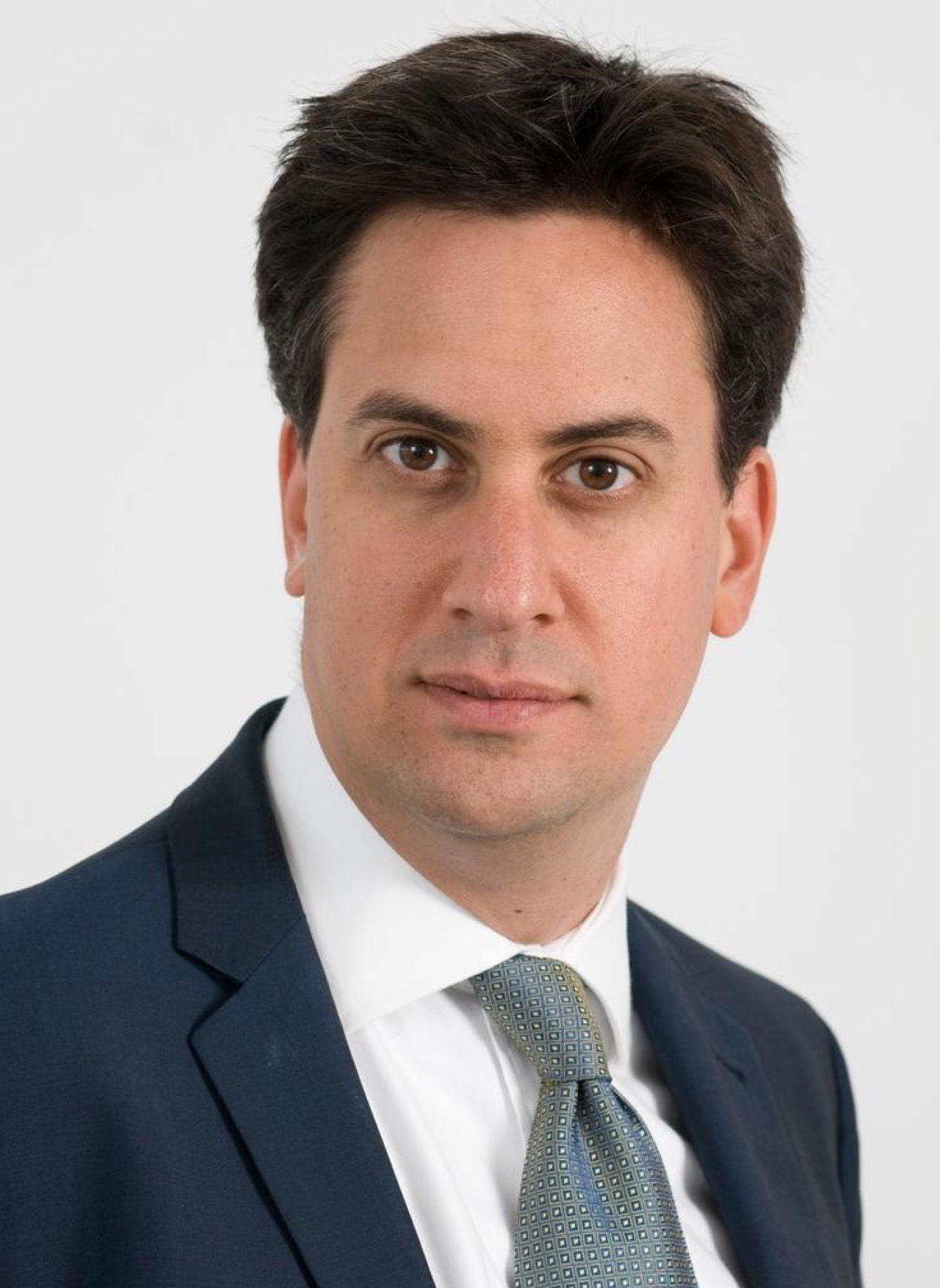
British politician (born 1969)
| Field | Value | ||
|---|---|---|---|
| name | Ed Miliband | ||
| honorific-prefix | The Right Honourable | ||
| honorific-suffix | |||
| image | Ed Miliband 2024 (cropped) 2.jpg | ||
| office3 | Secretary of State for Energy Security and Net Zero | ||
| primeminister3 | Keir Starmer | ||
| term_start3 | 5 July 2024 | ||
| predecessor3 | Claire Coutinho | ||
| primeminister4 | Gordon Brown | ||
| term_start4 | 3 October 2008 | ||
| term_end4 | 11 May 2010 | ||
| predecessor4 | Office established | ||
| successor4 | Chris Huhne | ||
| office5 | Leader of the Opposition | ||
| monarch5 | Elizabeth II | ||
| primeminister5 | David Cameron | ||
| deputy5 | Harriet Harman | ||
| term_start5 | 25 September 2010 | ||
| term_end5 | 8 May 2015 | ||
| predecessor5 | Harriet Harman | ||
| successor5 | Harriet Harman | ||
| office6 | Leader of the Labour Party | ||
| term_start6 | 25 September 2010 | ||
| term_end6 | 8 May 2015 | ||
| deputy6 | Harriet Harman | ||
| predecessor6 | Gordon Brown | ||
| successor6 | Jeremy Corbyn | ||
| {{Collapsed infobox section begin | last | yes | Ministerial offices |
| 2006–2008 | |||
| titlestyle | border:1px dashed lightgrey;}}{{Infobox officeholder | embed=yes | |
| office2 | Minister for the Cabinet Office | ||
| Chancellor of the Duchy of Lancaster | |||
| primeminister2 | Gordon Brown | ||
| term_start2 | 28 June 2007 | ||
| term_end2 | 3 October 2008 | ||
| predecessor2 | Hilary Armstrong | ||
| successor2 | Liam Byrne | ||
| office3 | Minister for the Third Sector | ||
| primeminister3 | Tony Blair | ||
| term_start3 | 6 May 2006 | ||
| term_end3 | 28 June 2007 | ||
| predecessor3 | Phil Woolas | ||
| successor3 | Phil Hope | ||
| {{Collapsed infobox section begin | last | yes | Shadow Cabinet posts |
| titlestyle | border:1px dashed lightgrey;}}{{Infobox officeholder | embed=yes | |
| office | Shadow Secretary of State for Energy Security and Net Zero | ||
| leader | Keir Starmer | ||
| predecessor | Barry Gardiner | ||
| successor | Claire Coutinho | ||
| term_start | 29 November 2021 | ||
| term_end | 5 July 2024 | ||
| term_start1 | 11 May 2010 | ||
| term_end1 | 8 October 2010 | ||
| leader1 | Harriet Harman (acting) | ||
| predecessor1 | Greg Clark | ||
| successor1 | Meg Hillier | ||
| office2 | Shadow Secretary of State for Business, Energy and Industrial Strategy | ||
| term_start2 | 6 April 2020 | ||
| term_end2 | 29 November 2021 | ||
| leader2 | Keir Starmer | ||
| predecessor2 | Rebecca Long-Bailey | ||
| successor2 | Jonathan Reynolds | ||
| office8 | Member of Parliament | ||
| for Doncaster North | |||
| term_start8 | 5 May 2005 | ||
| predecessor8 | Kevin Hughes | ||
| majority8 | 9,126 (29.4%) | ||
| party | Labour | ||
| birth_name | Edward Samuel Miliband | ||
| birth_date | |||
| birth_place | Fitzrovia, London, England | ||
| spouse | |||
| children | 2 | ||
| parents | Ralph Miliband | ||
| Marion Kozak | |||
| relatives | David Miliband (brother) | ||
| signature | Signature of Ed Miliband.svg | ||
| module | {{Listen | ||
| embed | yes | ||
| title | Miliband's voice | ||
| filename | Ed Miliband BBC Radio4 Desert Island Discs 24 Nov 2013 b03j8srb.flac | ||
| type | speech | ||
| description | from the BBC programme Desert Island Discs, 24 November 2013}} | ||
| caption | Official portrait, 2024 | ||
| website | |||
| termend1 | 5 July 2024 | ||
| education | Haverstock School | ||
| alma_mater | Corpus Christi College, Oxford (BA) | ||
| London School of Economics (MSc) |
| honorific-prefix = The Right Honourable | honorific-suffix = Chancellor of the Duchy of Lancaster for Doncaster North Marion Kozak London School of Economics (MSc)
Edward Samuel Miliband (born 24 December 1969) is a British politician who has served as Secretary of State for Energy Security and Net Zero since July 2024. He has been Member of Parliament (MP) for Doncaster North since 2005. Miliband was Leader of the Labour Party and Leader of the Opposition from 2010 to 2015. Alongside his brother, David Miliband, he served in the Cabinet from 2007 to 2010 under Prime Minister Gordon Brown.
Miliband was born in the Fitzrovia district of Central London to Marion Kozak and Ralph Miliband, Polish Jewish immigrants. His father was a Marxist intellectual and native of Brussels who fled Belgium during the Second World War. He graduated from Corpus Christi College, Oxford and later from the London School of Economics. Miliband became first a television journalist, then a Labour Party researcher and a visiting scholar at Harvard University, before rising to become one of Chancellor Gordon Brown's confidants and chairman of HM Treasury's Council of Economic Advisers. He was elected to the House of Commons in 2005 and Prime Minister Tony Blair made him Minister for the Third Sector in May 2006. When Brown became Prime Minister in 2007, he appointed Miliband Minister for the Cabinet Office and Chancellor of the Duchy of Lancaster. Miliband was subsequently promoted to the new post of Secretary of State for Energy and Climate Change, a position he held from 2008 to 2010.
After the Labour Party was defeated at the 2010 general election, Brown resigned as Leader of the Labour Party; in September 2010, Miliband was elected to replace him. His tenure as Labour leader was characterised by a leftward shift in his party's policies under the "One Nation Labour" branding, and by opposition to the Conservative–Liberal Democrat coalition government's cuts to the public sector. Miliband also abolished the electoral college system to elect the leader and deputy leader of the Labour Party, and replaced it with a "one member, one vote" system in 2014. He led his party into several elections, including the 2014 European Parliament election.
Following Labour's defeat by the Conservative Party at the 2015 general election, Miliband resigned as leader on 8 May 2015. He was succeeded following a leadership election by Jeremy Corbyn, and returned to the backbenches. In 2020, Keir Starmer appointed Miliband Shadow Secretary of State for Business, Energy and Industrial Strategy, and later Shadow Secretary of State for Climate Change and Net Zero in 2021. Following Labour's victory in the 2024 general election, Miliband returned to government after being appointed Secretary of State for Energy Security and Net Zero by Starmer.
Early life and education
Ed Miliband was born on 24 December 1969 in University College Hospital in Fitzrovia, London. He is the son of immigrant parents, Belgian-born Marxist sociologist Ralph Miliband and Polish-born Marion Kozak, both from Polish Jewish families. His mother, a human rights campaigner and early CND member, survived the Holocaust thanks to being protected by Catholic Poles, but her father, Ed's maternal grandfather, did not. His father Ralph was a Marxist academic whose father fled with him to England during the Second World War. The family lived on Edis Street in Primrose Hill, London. His elder brother, David Miliband, still owns the house as of 2010.
Ralph Miliband left his academic post at the London School of Economics in 1972 to take up a chair at the University of Leeds as a professor of politics. His family moved to Leeds with him in 1973; Miliband attended Featherbank Infant School in Horsforth between 1974 and 1977, during which time he became a fan of Leeds United.
Owing to his father's later employment as a roving teacher, Miliband spent two spells living in Boston, Massachusetts, one year when he was seven and one middle school term when he was twelve. Miliband remembered his time in the US as some of his happiest, during which he became a fan of American culture, watching Dallas and the New England Patriots.
Between 1978 and 1981, Ed Miliband attended Primrose Hill Primary School, near Primrose Hill in Camden, and then from 1981 to 1989 at Haverstock Comprehensive School in Chalk Farm. He learned to play the violin while at school,
In 1989, Miliband gained four A Levels—in Mathematics (A), English (A), Further Mathematics (B) and Physics (B)—and then read Philosophy, Politics and Economics at Corpus Christi College, Oxford. In his first year, he was elected JCR President, leading a student campaign against a rise in rent charges. In his second year he dropped philosophy and was awarded an upper-second-class Bachelor of Arts degree. He went on to graduate from the London School of Economics as a Master of Science in Economics.
Political career
Special adviser
In 1992, after graduating from the University of Oxford, Miliband began his working career in the media as a researcher to co-presenter Andrew Rawnsley in the Channel 4 show A Week in Politics. In 1993, Shadow Chief Secretary to the Treasury Harriet Harman approached Rawnsley to recruit Miliband as her policy researcher and speechwriter. At the time, Yvette Cooper also worked for Harman as part of Labour's Shadow Treasury team.
In 1994, when Harriet Harman was moved by the newly elected Labour Leader Tony Blair to become Shadow Secretary of State for Employment, Miliband stayed on in the Shadow Treasury team and was promoted to work for Shadow Chancellor Gordon Brown. In 1995, with encouragement from Gordon Brown, Miliband took time out from his job to study at the London School of Economics, where he obtained a master's degree in economics. Following Labour's 1997 landslide victory, Miliband was appointed as a special adviser to Chancellor Gordon Brown from 1997 to 2002.
Harvard
On 25 July 2002, it was announced that Miliband would take a 12-month unpaid sabbatical from HM Treasury to be a visiting scholar at the Center for European Studies of Harvard University for two semesters. He spent his time at Harvard teaching economics, and stayed there after September 2003 for an additional semester teaching a course titled "What's Left? The Politics of Social Justice".Adams, Richard (30 September 2003). "City diary". The Guardian (London). p. 19. During this time, he was granted "access" to Senator John Kerry and reported to Brown on the presidential hopeful's progress. After Miliband returned to the UK in January 2004 Gordon Brown appointed him Chairman of HM Treasury's Council of Economic Advisers as a replacement for Ed Balls, with specific responsibility for directing the UK's long-term economic planning.
Parliamentary career
In early 2005, Miliband resigned his advisory role to HM Treasury to stand for election. Kevin Hughes, then the Labour MP for Doncaster North, announced in February of that year that he would be standing down at the next election due to being diagnosed with motor neurone disease. Miliband applied for selection to be the candidate in the safe Labour seat and won, beating off a close challenge from Michael Dugher, then a SPAD to Defence Secretary Geoff Hoon.
Gordon Brown visited Doncaster North during the general election campaign to support his former adviser. Miliband was elected on 5 May 2005, with 55.5% of the vote and a majority of 12,656. He made his maiden speech in the House of Commons on 23 May, responding to comments made by future Speaker John Bercow. In Blair's frontbench reshuffle in May 2006, he was made Minister for the Third Sector, with responsibility for voluntary and charity organisations.
Cabinet
On 28 June 2007, the day after Brown became Prime Minister, Miliband was sworn of the Privy Council and appointed Minister for the Cabinet Office and Chancellor of the Duchy of Lancaster, being promoted to the cabinet. This meant that he and his brother, Foreign Secretary David Miliband, became the first brothers to serve in a British cabinet since Edward and Oliver Stanley in 1938. He was additionally given the task of drafting Labour's manifesto for the 2010 general election.
On 3 October 2008, Miliband was promoted to become Secretary of State for the newly created Department of Energy and Climate Change in a cabinet reshuffle. On 16 October, Miliband announced that the British government would legislate to oblige itself to cut greenhouse emissions by 80% by 2050, rather than the 60% cut in carbon dioxide emissions previously announced.
In March 2009, while Secretary of State for Energy and Climate Change, Miliband attended the UK premiere of climate change film The Age of Stupid, where he was ambushed by actor Pete Postlethwaite, who threatened to return his OBE and vote for any party other than Labour if the Kingsnorth coal-fired power station were to be given the go-ahead by the government. A month later, Miliband announced to the House of Commons a change to the government's policy on coal-fired power stations, saying that any potential new coal-fired power stations would be unable to receive government consent unless they could demonstrate that they would be able to effectively capture and bury 25% of the emissions they produce immediately, with a view to seeing that rise to 100% of emissions by 2025. This, a government source told the Guardian, effectively represented "a complete rewrite of UK energy policy for the future".
Miliband represented the UK at the 2009 Copenhagen Summit, from which emerged a global commitment to provide an additional US$10 billion a year to fight the effects of climate change, with an additional $100 billion a year provided by 2020. The conference was not able to achieve a legally binding agreement. Miliband accused China of deliberately foiling attempts at a binding agreement; China explicitly denied this, accusing British politicians of engaging in a "political scheme".
During the 2009 parliamentary expenses scandal, Miliband was named by the Daily Telegraph as one of the "saints" of the scandal, due to his claiming one of the lowest amounts of expenses in the House of Commons and submitting no claims that later had to be paid back.
Leadership of the Labour Party (2010–2015)
Main article: Labour Party leadership of Ed Miliband
Leadership election
Main article: 2010 Labour Party leadership election (UK)
Following the formation of the Conservative–Liberal Democrat coalition government on 11 May 2010, Gordon Brown resigned as Prime Minister of the United Kingdom and Leader of the Labour Party with immediate effect. Deputy Leader Harriet Harman took over as Acting Leader and became Leader of the Opposition. On 14 May, Miliband announced that he would stand as a candidate in the forthcoming leadership election. He launched his campaign during a speech given at a Fabian Society conference and was nominated by 62 fellow Labour MPs. The other candidates were left-wing backbencher Diane Abbott, Shadow Education Secretary Ed Balls, Shadow Health Secretary Andy Burnham and Miliband's elder brother, Shadow Foreign Secretary David Miliband.
On 23 May, former Labour leader Neil Kinnock announced that he would endorse Ed Miliband's campaign, saying that he had "the capacity to inspire people" and that he had "strong values and the ability to 'lift' people". Other senior Labour figures who backed the younger Miliband included Tony Benn and former deputy leaders Roy Hattersley and Margaret Beckett. By 9 June, the deadline for entry into the leadership election, Miliband had been nominated by just over 24% of the Parliamentary Labour Party, double the threshold. By September, Miliband had received the support of six trade unions, including both Unite and UNISON, 151 of 650 Constituency Labour Parties, three affiliated socialist societies, and half of Labour MEPs.
Miliband subsequently won the election, the result of which was announced on 25 September 2010, after second, third and fourth preferences votes were counted, achieving the support of 50.654% of the electoral college, defeating his brother by 1.3%. In the fourth and final stage of the redistribution of votes after three candidates had been eliminated, Ed Miliband led in the trade unions and affiliated organisations section of the electoral college (19.93% of the total to David's 13.40%), but in both the MPs and MEPs section (15.52% to 17.81%), and Constituency Labour Party section (15.20% to 18.14%), came second. In the final round, Ed Miliband won with a total of 175,519 votes to David's 147,220 votes.
Leader of the Opposition
Miliband's tenure as Labour leader was characterised by a leftward shift in his party's policies under the One Nation Labour branding which replaced the New Labour branding, and by opposition to the Conservative–Liberal Democrat coalition government's cuts to the public sector. Miliband also abolished the electoral college system to elect the leader and deputy leader of the Labour Party, and replaced it with a "one member, one vote" system in 2014.
Shadow Cabinet
Main article: Miliband shadow cabinet
The first election to the Shadow Cabinet that took place under Miliband's leadership was on 7 October 2010. Ending days of speculation, David Miliband announced that he would not seek election to the Shadow Cabinet on 29 September, the day nominations closed, saying he wanted to avoid "constant comparison" with his brother Ed. The three other defeated candidates for the Labour leadership all stood in the election, though Diane Abbott failed to win enough votes to gain a place.
Following the election, Miliband unveiled his Shadow Cabinet on 8 October 2010. Among others, he appointed Alan Johnson as Shadow Chancellor of the Exchequer, Yvette Cooper was chosen as Shadow Foreign Secretary, and both defeated Labour leadership candidates Ed Balls and Andy Burnham were given senior roles, becoming Shadow Home Secretary and Shadow Education Secretary respectively. Burnham was also given responsibility for overseeing Labour's election co-ordination.
Sadiq Khan, who managed Miliband's successful leadership campaign, was appointed Shadow Justice Secretary and Shadow Lord Chancellor, and continuing Deputy Leader Harriet Harman continued to shadow Deputy Prime Minister Nick Clegg, as well as being made Shadow International Development Secretary. Alan Johnson would later resign, stepping down for "personal reasons" on 20 January 2011, necessitating Miliband's first reshuffle, in which he made Balls Shadow Chancellor, Cooper Shadow Home Secretary and Douglas Alexander Shadow Foreign Secretary.
Election results and resignation
Miliband's first electoral tests as Labour Leader came in the elections to the Scottish Parliament, Welsh Assembly and various councils across England, excluding London, on 5 May 2011. The results for Labour were described as a "mixed bag", with the party performing well in Wales – falling just one seat short of an overall majority and forming the next Welsh Government on its own – and making large gains from the Liberal Democrats in northern councils, including Sheffield, Leeds, Liverpool and Manchester.
Miliband launched Labour's campaign for the 2012 local elections with a speech in Birmingham, accusing the coalition government of "betrayal", and claiming that it "lacked the values" that Britain needed. The Labour results were described as a success, with the party building on its performance the previous year in the north of England and Wales, consolidating its position in northern cities and winning control of places such as Cardiff and Swansea. Labour performed well in the Midlands and South of England, winning control of councils including Birmingham, Norwich, Plymouth and Southampton. Labour was less successful in Scotland than England and Wales, but retained control of Glasgow despite predictions it would not. Overall, Labour gained over 800 councillors and control of 22 councils.
In April 2013, Miliband pledged ahead of the upcoming county elections that Labour would change planning laws to give local authorities greater authority to decide what shops can open in their high streets. He also said that Labour would introduce more strenuous laws relating to pay-day lenders and betting shops. Labour subsequently gained nearly 300 councillors, as well as control of Nottinghamshire and Derbyshire County Councils.
In May 2014, Miliband led Labour through the European Parliament elections, where the party increased its number of Members of the European Parliament from 13 to 20. Labour came second with 24.4% of the vote, finishing ahead of the Conservatives but behind UKIP. This was the first time since the 1984 that the largest opposition party had failed to win the most seats in European elections. On the same day, Labour polled ahead of all other parties at the local elections, winning 31% of the vote and taking control of six additional councils.
On 30 March 2015, a general election was called for 7 May. Miliband began his campaign by launching a "manifesto for business", stating that only by voting Labour would the UK's position within the European Union be secure. Miliband subsequently unveiled five pledges at a rally in Birmingham which would form the focus of a future Labour government, specifically identifying policies on deficit reduction, living standards, the NHS, immigration controls and tuition fees. He included an additional pledge on housing and rent on 27 April. On 14 April, Labour launched its full manifesto, which Miliband said was fully funded and would require no additional borrowing. During this time an online campaign began known as Milifandom.
Miliband was portrayed during Labour's 2015 election campaign as being genuine in his desire to improve the lives of working people and to display progression from New Labour, but was unable to defeat interpretations of him as being ineffectual, or even cartoonish in nature. Miliband insisted that Cameron should debate him one on one as part of a televised election broadcast in order to highlight differences in policies between the two major parties, but this did not happen, with the pair instead being interviewed separately by Jeremy Paxman as part of the first major televised political broadcast of the election involving multiple parties.
Despite opinion polls leading up to the general election predicting a tight result, Labour decisively lost the 7 May general election to the Conservatives. Although gaining 22 seats, Labour lost all but one of its MPs in Scotland and ended up with a net loss of 26 seats, failing to win a number of key marginal seats that it had expected to win comfortably. After being returned as MP for Doncaster North, Miliband stated that it had been a "difficult and disappointing" night for Labour. Following Cameron's success in forming a majority government, Miliband resigned as Leader of the Labour Party on 8 May, with Harman becoming acting leader while a leadership election was initiated. Jeremy Corbyn succeeded Miliband as leader.
Post-leadership (2015–present)
Backbencher
As a backbencher, Miliband spoke about the need to tackle inequality and in favour of the Paris climate change agreement. In May 2016, he appeared on the BBC's Question Time, speaking in favour of Remain in the UK's EU referendum and he subsequently campaigned for a Remain vote.
In the aftermath of the referendum result, Miliband said that, although he had supported Jeremy Corbyn since his election as leader, he had "reluctantly reached the conclusion his position [was] untenable", calling for Corbyn to step down in June 2016. In the ensuing contest, Miliband supported leadership challenger Owen Smith. Miliband later admitted that he was "clearly wrong" to call for Corbyn's resignation. In September 2016, Miliband joined the editorial board of The Political Quarterly journal, an unremunerated role.
Renewing his previous stance on the issue in 2011, Miliband criticised Rupert Murdoch's bid to takeover telecommunications company Sky in December 2016, subsequently supporting an inquiry by Ofcom.
At the snap 2017 general election, Miliband was again re-elected with an increased vote share of 60.8% and an increased majority of 14,024.
At the 2019 general election, Miliband was again re-elected, with a decreased vote share of 38.7% and a decreased majority of 2,370. Following the election, it was announced that Miliband would sit on a panel of party figures to overview and investigate the electoral failure.
Return to Shadow Cabinet
On 6 April 2020, Keir Starmer appointed Miliband to his Shadow Cabinet, after winning the contest to become leader of the Labour Party two days before. Miliband assumed the role of Shadow Secretary of State for Business, Energy and Industrial Strategy in the new shadow cabinet.
In September 2020, Miliband faced Prime Minister Boris Johnson during a debate on the UK Internal Market Bill, in a speech accusing him of "legislative hooliganism".
On 27 October 2021, Miliband took Prime Minister's Questions following the October 2021 budget on behalf of Keir Starmer, who had contracted COVID-19.
In the November 2021 shadow cabinet reshuffle, Miliband was appointed to the newly established post of Shadow Secretary of State for Climate Change and Net Zero, assuming the energy responsibility from his previous role. He was succeeded as Shadow Secretary of State for Business and Industrial Strategy by Jonathan Reynolds. Miliband did not have a direct department to shadow until February 2023, when Grant Shapps was appointed Secretary of State for Energy Security and Net Zero in the new Department for Energy Security and Net Zero. Accordingly, Miliband's portfolio was renamed to Shadow Secretary of State for Energy Security and Net Zero, mirroring that of the government, in the 2023 shadow cabinet reshuffle.
Miliband's re-appointment to the cabinet also led to the New Statesman naming him the twenty-first most influential British left-wing figure of 2023.
Secretary of State for Energy Security and Net Zero


At the 2024 general election, Miliband was again re-elected, with an increased vote share of 52.4% and an increased majority of 9,126. Following Labour's victory at the general election, Miliband was appointed Secretary of State for Energy Security and Net Zero by Starmer. He was among several ministers under Blair and Brown to be appointed to Starmer's cabinet. Two days after being appointed, Miliband lifted the onshore wind ban. He has clarified that despite disagreeing with the prospect of building a third runway at Heathrow Airport, he would not be resigning over the matter.
Policies and views
Miliband is generally seen as being on the soft left of the Labour Party.
Self-described views

Miliband described himself as a new type of Labour politician, looking to move beyond the divisiveness of Blairism and Brownism, and calling for an end to the "factionalism and psychodramas" of Labour's past. He also repeatedly spoke of the need for a "new politics".
During the Labour leadership campaign, he described himself as a socialist, and spoke out against some of the actions of the Blair ministry, including criticising its record on civil liberties and foreign policy. Though he was not yet an MP at the time of the 2003 vote, Miliband was a strong critic of the Iraq War. He backed UK military action and intervention in Afghanistan and Libya respectively.
Miliband called for "responsible capitalism" when Google's Eric Schmidt commented on his corporation's non-payment of tax. He also supported making the UK's 50% top rate of tax permanent, as well as the institution of a new financial transaction tax, mutualising Northern Rock, putting limits on top salaries, scrapping tuition fees in favour of a graduate tax, implementing a living wage policy and the scrapping of the ID cards policy, and spoke in favour of a "National Care Service".
Miliband worked closely with the think tank Policy Network on the concept of predistribution as a means to tackle what he described as 'the growing crisis in living standards'. His announcement that predistribution would become a cornerstone of the UK Labour Party's economic policy was jokingly mocked by Prime Minister David Cameron during Prime Minister's Questions in the House of Commons.
Though Labour remained officially neutral, he in a personal capacity supported the failed "Yes to AV" campaign in the Alternative Vote referendum on 5 May 2011, saying that it would benefit Britain's "progressive majority". In September 2011, Miliband stated that a future Labour Government would immediately cut the cap on tuition fees for university students from £9,000 per year to £6,000, though he also stated that he remained committed to a graduate tax in the long-run. Together with Shadow Chancellor Ed Balls, Miliband also promoted a "five-point plan for jobs and growth" aimed at helping the UK economy, involving extending the bonus tax on banks pioneered by Alistair Darling, bringing forward planned long-term investment to help reduce unemployment, cutting the rate of VAT from 20% back to 17.5%, cutting VAT on home improvements to 5% for a temporary one-year period, and instigating a one-year National Insurance break to encourage employers to hire more staff. Miliband also endorsed the Blue Labour trend in the Labour Party, founded by Maurice Glasman. This was seen to have influenced his 2011 conference speech, signalling "predatory and productive capitalism".
Miliband is progressive in regard to issues of gender and sexuality. He publicly identifies as a feminist. In March 2012, Miliband pledged his support for same sex marriage. As he signed an 'equal marriage pledge', he said, "I strongly agree gay and lesbian couples should have an equal right to marry and deserve the same recognition from the state and society as anyone else."
.jpg)
In June 2014, while speaking to the Labour Friends of Israel, Miliband stated that if he became Prime Minister he would seek "closer ties" with Israel and opposed the boycott of Israeli goods, saying that he would "resolutely oppose the isolation of Israel" and that nobody in the Labour Party should question Israel's right to exist. He also stated that, as a Jew and a friend of Israel, he must criticise Israel when necessary, opposing the "killing of innocent Palestinian civilians". Miliband criticised Israel for its conduct during the 2014 Israel–Gaza conflict.
Since the end of his leadership of the Labour Party, Miliband has expressed regret for not having been "radical enough" in his manifesto, and has described himself as "not following the normal route, which is to become more right wing as you get older", but instead becoming "more left wing".
On 30 April 2019, Miliband joined Caroline Lucas and Laura Sandys in calling for a Green New Deal in the UK.
Comments on other politicians

During his time as Labour leader, Miliband criticised the Conservative Leader and Prime Minister David Cameron for "sacrificing everything on the altar of deficit reduction", and has accused him of being guilty of practising "old politics", citing alleged broken promises on areas such as crime, policing, bank bonuses, and child benefit.{{cite news |url-status=live |archive-date=14 December 2010 |archive-url=https://web.archive.org/web/20101214051952/http://www.bbc.co.uk/news/uk-politics-11981011
Miliband was also particularly critical of former Liberal Democrat Leader and Deputy Prime Minister Nick Clegg following the Conservative–Liberal Democrat coalition agreement, accusing him of "betrayal" and of "selling-out" his party's voters. In 2010, he stated that he would demand Clegg's resignation before any Labour–Liberal Democrat coalition under his leadership. In the 2011 Alternative Vote referendum campaign he refused to share a platform with Clegg, stating that he had become "too toxic" a brand and that he would harm the "Yes to AV" campaign. He shared platforms during the campaign with former Liberal Democrat Leaders Lord Ashdown and Charles Kennedy, Liberal Democrat Deputy Leader Simon Hughes, the Green Party Leader Caroline Lucas and Business Secretary Vince Cable, among others. As Labour leader, Miliband made speeches aimed at winning over disaffected Liberal Democrats, identifying a difference between "The Orange Book" Lib Dems, who were closer to the Conservatives, and Lib Dems on the centre-left, offering the latter a role in helping Labour's policy review at that time.[[File:Miliband, Ed (2007).jpg|thumb |upright=0.75 |Miliband in 2007]]
Following the death of former Prime Minister and Conservative Leader Margaret Thatcher in 2013, Miliband spoke in a House of Commons sitting specially convened to pay tributes to her. He noted that, although he disagreed with a few of her policies, he respected "what her death means to the many, many people who admired her". He also said that Thatcher "broke the mould" in everything she had achieved in her life, and that she had had the ability to "overcome every obstacle in her path". He had previously praised Thatcher shortly before the Labour Party Conference in September 2012 for creating an "era of aspiration" in the 1980s.
Miliband has previously spoken positively of his brother David, praising his record as Foreign Secretary, and saying that "his door was always open" following David's decision not to stand for the Shadow Cabinet in 2010. Upon David's announcement in 2013 that he would resign as a Labour MP and move to New York to head the International Rescue Committee, Miliband said that British politics would be "a poorer place" without him, and that he thought David "would once again make a contribution to British public life."
When asked to choose the greatest British Prime Minister, Miliband answered with Labour's post-war Prime Minister and longest-serving Leader, Clement Attlee. He has also spoken positively of his two immediate predecessors as Labour leader, Tony Blair and Gordon Brown, praising their leadership and records in government.
Media portrayal
Miliband was portrayed during Labour's 2015 election campaign as being genuine in his desire to improve the lives of working people and to display progression from New Labour, but he was unable to defeat interpretations of him as being ineffectual, or even cartoonish in nature. Political illustrators perceived a resemblance to Wallace of the British animation Wallace & Gromit and greatly exaggerated this in caricatures; various images circulated in the press and online media of Miliband performing day-to-day activities such as ineptly eating a bacon sandwich, donating money to a beggar, and giving a kiss to his wife, all while displaying apparently awkward facial expressions. In a March 2015 Newsnight election debate, he was challenged by Jeremy Paxman as to whether or not he was 'tough enough' to be Prime Minister, responding, "Hell yes, I'm tough enough", in reference to his reluctance to support air strikes against extremist targets in Syria.
Other works
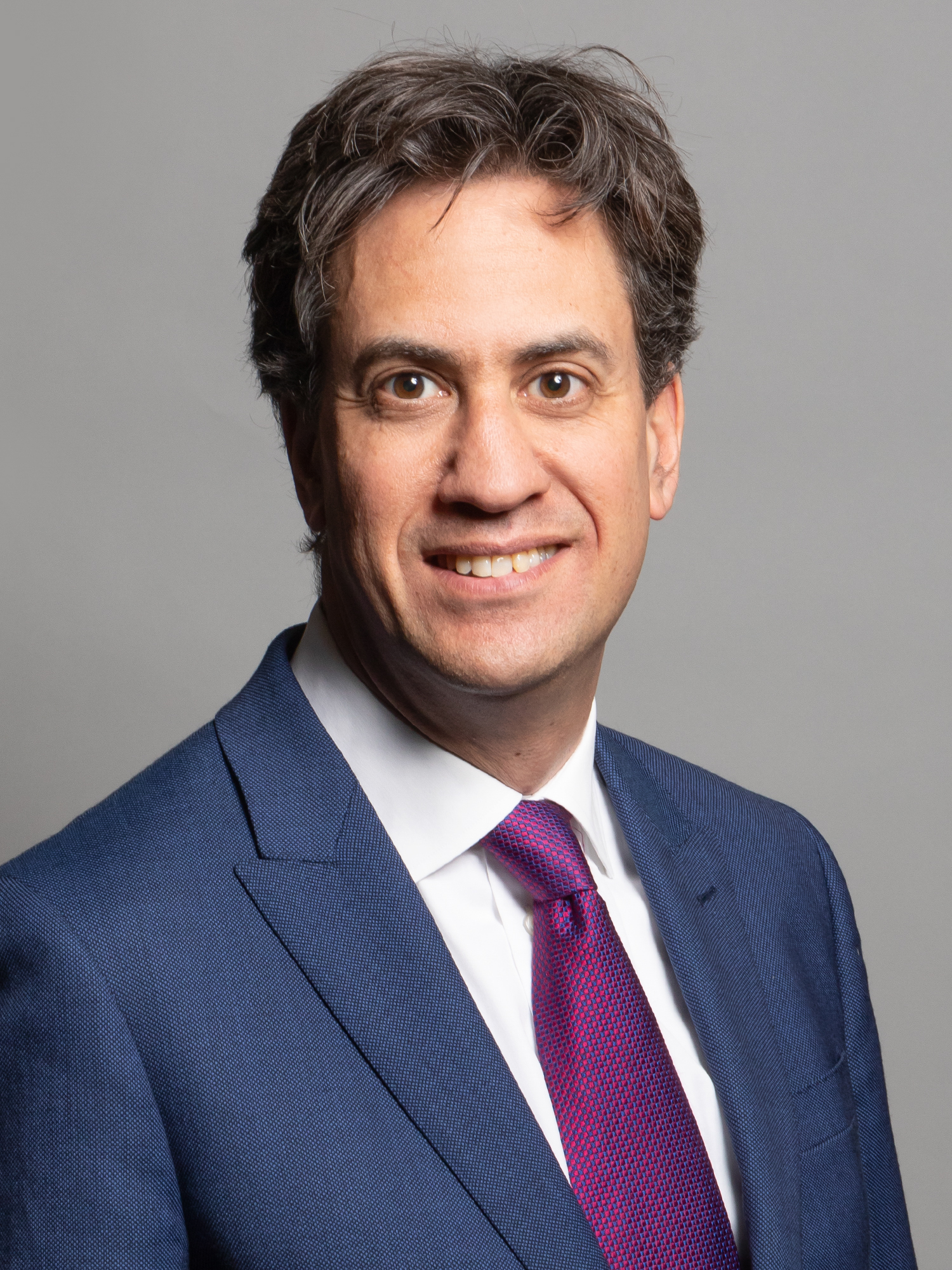
In June 2017, Miliband guest-presented Jeremy Vine's BBC Radio 2 show.
Miliband co-hosts a popular podcast, entitled Reasons to be Cheerful, with radio presenter Geoff Lloyd. In November 2017, Miliband and Lloyd appeared as joint guests on Richard Herring's Leicester Square Theatre Podcast.
Personal life
Miliband is married to Justine Thornton, a High Court Judge. The couple met in 2002 before becoming engaged in March 2010 and married on 27 May 2011 at Langar Hall in Langar, Nottinghamshire. They have two sons, Daniel, born 2009, and Samuel, born 2010. They live in Dartmouth Park, north London.
Miliband is of Jewish heritage — the first ethnically Jewish leader of the Labour Party — and describes himself as a Jewish atheist. After marrying Thornton in a civil ceremony on 27 May 2011, he paid tribute to his Jewish heritage by following the tradition of breaking a glass. In 2012, Miliband wrote, "Like many others from Holocaust families, I have a paradoxical relationship with this history. On one level I feel intimately connected with it – this happened to my parents and grandparents. On another, it feels like a totally different world."
Styles
- Mr. Edward Samuel Miliband (1969–2005)
- Mr. Edward Samuel Miliband MP (2005–2007)
- The Right Honourable Edward Samuel Miliband MP (2007–present)
Bibliography
Notes
References
|archive-date=30 June 2009 |url-status=live |archive-url=https://web.archive.org/web/20090630013226/http://www.thejc.com/news/uk-news/40603/ed-miliband-hamas-ken-livingstone-and-jewish-values
Sources
References
- (24 November 2013). "Ed Miliband".
- "Ministerial Appointments: July 2024".
- (2021). "ChangeMaker Chat with Ed Miliband: Political Parties as Agents of Change".
- (3 December 2014). "Ed Miliband: the Labour leader who beat his brother to the top".
- Gelles, David. (21 April 2019). "Corner Office: The Devil Can't Have the Best Tunes". The New York Times.
- (7 November 2010). "A New Generation". [[Labour Party (UK).
- "Ed Miliband sets out his leadership vision in keynote Labour conference speech". professionalmanager.co.uk.
- Tchorek, Kamil. (24 June 2009). "David Miliband visits family grave in Poland". [[The Times]].
- (28 September 2010). "Ed Miliband: Labour leader's 2010 conference speech in full". [[BBC News]].
- Beckett, Andy. (28 February 2004). "In the house of the rising sons". [[The Guardian]].
- Michael Crick. (23 September 2010). "What influence did Ralph Miliband have on his sons". BBC News.
- (14 October 2011). "'Once a Featherbanker...' Ed Miliband returns to the Horsforth school that fostered his love of Leeds United". [[The Yorkshire Post]].
- (21 July 2010). "The Ed Miliband interview". Labour Uncut blog.
- "The Ed Miliband Interview (July 21st 2010)".
- (31 January 2013). "United Nation (January 1st 2013)".
- Benn, Tony. (1995). "The Benn Diaries". Arrow.
- Rawnsley, Andrew. (29 September 2012). "Ed Miliband's big test is to make voters see him as prime minister". The Guardian.
- "In conversation with... Harriet Harman". Total Politics.
- Mulholland, Hélène. (9 June 2010). "Who are the Labour leadership candidates?". The Guardian.
- Barker, Alex. (26 September 2010). "Miliband declares New Labour dead". Financial Times.
- (27 September 2010). "Rt Hon Ed Miliband MP elected Labour leader". NHS Confederation.
- Nelson, Fraser (26 July 2002). "Brown confirms adviser's sojourn in Harvard". ''The Scotsman'' (Edinburgh). p. 9.
- Pickard, Jim. (25 September 2010). "Profile: Ed Miliband". [[Financial Times]].
- (6 March 2004). "Miliband talks to Democratic presidential candidate". [[The Scotsman]].
- Grice, Andrew. (10 January 2004). "Brown shuffles advisers to prepare for Balls' departure". The Independent.
- ''Yorkshire Post'', 26 March 2005
- ''Doncaster Free Press'', 14 April 2005
- "Election Data 2005". [[Electoral Calculus]].
- (5 May 2005). "Doncaster North: Constituency > Politics > guardian.co.uk". The Guardian.
- (23 May 2005). "Home Affairs and Communities". [[Hansard]] via [[TheyWorkForYou]].
- (2 June 2006). "The third sector's big tent". Senscot.net.
- (5 May 2006). "At-a-glance: Tony Blair reshuffle". [[BBC News 24]].
- (28 June 2007). "Brown unveils huge Cabinet revamp". BBC News Channel.
- Debnath, Neela. (27 September 2010). "Oh brother!Siblings who share the limelight". The Independent.
- (15 July 2007). "Work begins on new manifesto". BBC News Channel.
- Parkinson, Justin. (3 October 2008). "As it happened: Brown reshuffle". BBC News Channel.
- (16 October 2008). "Tougher climate target unveiled". BBC News.
- Siegle, Lucy. (16 March 2009). "The night Ed Miliband said 'I'm with Stupid, but...'". The Guardian.
- (24 April 2009). "Ed Miliband promises new era of clean coal – but who will pay?". The Guardian.
- Miliband, Ed. (20 December 2009). "The road from Copenhagen". The Guardian.
- (22 December 2009). "China rejects UK claims it hindered Copenhagen talks". BBC News.
- (18 May 2009). "MPs' expenses: The saints". The Daily Telegraph.
- (16 May 2010). "Ed Miliband to take on brother David in leader battle". BBC News.
- Baldwin, Tom. (15 May 2010). "Ed Miliband to stand against his brother in leadership race". [[The Times]].
- Stratton, Allegra. (26 September 2010). "Ed Miliband's partner Justine Thornton is shy but steely". The Guardian.
- Helm, Toby. (23 May 2010). "Ed Miliband wins crucial backing from Neil Kinnock in Labour leadership race". The Guardian.
- (17 May 2010). "Ed Miliband's support: 73 MPs, 6 MEPs, 151 CLPs, 6 TUs, 3 SSocs". [[Labour List]].
- (25 September 2010). "Ed Miliband is elected leader of the Labour Party". BBC News.
- Rogers, Simon. (26 September 2010). "Labour leadership result: get the full data". The Guardian.
- Mulholland, Helene. (29 September 2010). "David Miliband quits frontline politics". The Guardian.
- "Labour's New Shadow Cabinet". [[Labour Party (UK)]].
- (20 January 2011). "Alan Johnson 'to quit front-line politics'". BBC News Online.
- Geoghegan, Ben. (2 April 2012). "Ed Miliband launches Labour's local election campaign". BBC News.
- (4 May 2012). "At-a-glance: Elections 2012". BBC News.
- (8 April 2013). "Labour 'Wants Payday Lenders Off High Street'". [[Sky News]].
- (3 May 2013). "Ed Miliband 'pleased' with local election results". BBC News.
- Eaton, George. (3 May 2012). "Local elections: Labour isn't where it needs to be to win". New Statesman.
- (3 May 2013). "Ukip local election surge: sea-change or flash in the pan". [[Channel 4]].
- (28 April 2015). "European Elections: UKIP Tops British Polls". Sky News.
- "Election Live – 30 March". BBC News.
- Wintour, Patrick. "Ed Miliband to announce Labour's five election pledges at Birmingham rally". The Guardian.
- "Ed Miliband's speech in Stockton-on-Tees".
- "Election 2015: Labour manifesto at-a-glance". BBC News.
- "Ed Miliband to David Cameron: 'Debate me one on one'". BBC News.
- "Results of the 2015 General Election".
- (8 May 2015). "Election results: Conservatives win majority". [[BBC News]].
- (8 March 2015). "The marginal seats that swung the wrong way for Labour". [[The Guardian]].
- (8 May 2015). "Ed Miliband resigns as Labour leader". The Guardian.
- McIntyre, Sophie. (8 May 2015). "How many seats did Labour win?". The Independent.
- Mason, Rowena. (4 June 2015). "Ed Miliband returns to the Commons with speech on inequality". The Guardian.
- Miliband, Ed. (22 November 2015). "Yes, the Paris climate change conference can save the planet". The Guardian.
- Syal, Rajeev. (6 March 2016). "Ed Miliband calls for law to make CO2 emissions target legally binding". The Guardian.
- McCann, Kate. (27 May 2016). "Ed Miliband gets called 'David' Miliband twice in one evening". The Telegraph.
- Cowburn, Ashley. (26 May 2016). "Jeremy Corbyn and Ed Miliband are joining forces to warn about climate change". The Independent.
- Stone, Jon. (29 June 2016). "Ed Miliband calls for Jeremy Corbyn to resign". The Independent.
- Stewart, Heather. (9 August 2016). "Ed Miliband urges Labour members to vote for Owen Smith". The Guardian.
- (24 September 2017). "Ed Miliband: I was wrong to call for Jeremy Corbyn to quit".
- Commons, House of. "House of Commons – The Register of Members' Financial Interests (31st October 2016: Miliband, Edward)".
- "About PQ".
- Martinson, Jane. (20 December 2016). "Ed Miliband slams Sky bid: 'Murdoch has learned nothing'". The Guardian.
- (10 February 2017). "Ed Miliband asks Ofcom for inquiry into Rupert Murdoch Sky bid". The Guardian.
- Sweney, Mark. (31 March 2017). "Ofcom must block Murdoch's Sky takeover, Miliband and Cable say". The Guardian.
- "Doncaster North parliamentary constituency – Election 2017". [[BBC News]].
- (29 January 2019). "Commons Briefing Paper 7979. General Election 2017: results and analysis". [[House of Commons Library]].
- "Doncaster North parliamentary constituency – Election 2019".
- Allen, Damian. (14 November 2019). "Statement of persons nominated and notice of poll. Election of a Member of Parliament for Doncaster North Constituency". [[Doncaster Metropolitan Borough Council]].
- (28 January 2020). "Commons Briefing Paper 8749. General Election 2019: results and analysis". [[House of Commons Library]].
- (23 December 2019). "Ed Miliband to join review of Labour poll failure".
- (6 April 2020). "Ed Miliband returns to Labour top team". BBC News.
- Braddick, Imogen. (14 September 2020). "Ed Miliband tells Boris Johnson to stop blaming others for his Brexit 'mess' as PM defends power to break international law". Evening Standard.
- (27 October 2021). "Budget 2021: Labour leader Sir Keir Starmer misses debate after positive Covid test". BBC News.
- (29 November 2021). "Cooper, Lammy and Nandy among beneficiaries of Starmer's reshuffle". The Guardian.
- (7 February 2023). "Key appointments in Rishi Sunak's cabinet reshuffle". The Guardian.
- Statesman, New. (17 May 2023). "The New Statesman's left power list".
- "General Parliamentary Elections 2024".
- "Ed Miliband: The former Labour leader with a big role in Sir Keir Starmer's top team".
- (8 July 2024). "Ed Miliband scraps de facto ban on onshore wind farms".
- (23 January 2025). "Ed Miliband: I won't quit over Heathrow expansion".
- (26 September 2010). "Ed Miliband leadership: 'Red Ed' yearns to put forward his centrist vision". The Guardian.
- Kite, Melissa. (25 September 2010). "Ed Miliband: Self-confessed maths 'geek' with a talent for diplomacy". The Daily Telegraph.
- Dunt, Ian. (25 September 2010). "Ed Miliband is more dangerous than they think". Politics.
- (28 September 2010). "Ed Miliband leader's speech". edMiliband.org.
- (29 January 2011). "Ed Miliband makes first visit to Afghanistan". The Guardian.
- (24 April 2015). "Ed Miliband: UK failures 'contributed to Libya crisis'". BBC News.
- Miliband, Ed. (22 May 2013). "What responsible capitalism is all about". [[The First Post]].
- (25 September 2010). "Ed Miliband: his shadow cabinet and key policies". The Daily Telegraph.
- Green, Jessica. (17 February 2011). "Labour calls for progress on gay marriage". [[Pink News]].
- (21 June 2013). "Jacob Hacker on pre distribution and Cameron PMQ jibe". BBC News.
- "Pre-distribution and the crisis in living standards". [[Policy Network]].
- (16 March 2011). "AV referendum: Labour 'no' camp wrong, says Miliband". BBC News Online.
- (29 March 2011). "Ed Miliband unites with Lib Dems for AV 'yes' campaign". The Daily Telegraph.
- Hawkins, Ross. (25 September 2011). "Tuition fees: Labour pledges maximum cap of £6,000". BBC News Online.
- (19 October 2011). "Labour's plan for jobs and growth". Labour Party.
- Wintour, Patrick. (17 May 2011). "Ed Miliband endorses 'Blue Labour' thinking". The Guardian.
- Davis, Rowenna. (29 September 2011). "How Blue Labour shaped Miliband's speech". New Statesman blog.
- Halliday, Cresci, Josh, Elena. (27 October 2014). "David Cameron under fire for refusing to wear pro-feminist T-shirt". The Guardian.
- Morris, Nigel. (6 March 2012). "Miliband gives his backing to same-sex marriages". The Independent.
- Piggott, Mark. (17 June 2014). "Miliband Pledges Closer Ties to Israel if he Leads New Labour Government". [[International Business Times UK]].
- "Miliband warms the hearts of the Labour Friends [of Israel]". The Jewish Chronicle.
- Castle, Stephen (23 October 2014). [https://www.nytimes.com/2014/10/24/world/europe/milibands-embrace-of-jewish-heritage-complicates-criticism-of-israel-.html "British Labour Chief, a Jew Who Criticizes Israel, Walks a Fine Line"] {{Webarchive. link. (11 July 2018. ''The New York Times''.)
- (2 August 2014). "Ed Miliband accuses David Cameron of 'inexplicable silence' in row over Gaza". The Guardian.
- (15 February 2020). "Ed Miliband on not being 'radical enough' and becoming 'more left-wing'". LBC.
- (30 April 2019). "Let's seize the moment and create a Green New Deal for the UK".
- (18 August 2010). "Ed Miliband 'won't work in coalition with Clegg'". BBC News.
- (6 February 2011). "Ed Miliband cool on sharing AV campaign platform with Nick Clegg". The Guardian.
- (10 April 2013). "David Cameron and Ed Miliband pay tribute to Baroness Thatcher". The Guardian.
- Ross, Tim. (14 September 2012). "Ed Miliband: it's good to be rich 'if you make it the hard way'". The Daily Telegraph.
- (29 September 2010). "David Miliband says he won't join brother Ed's team". BBC News Online.
- Watt, Nicholas. (27 March 2013). "Ed Miliband: British politics will be a poorer place without David". The Guardian.
- Griffiths, Emma. (15 June 2010). "As it happened: Newsnight Labour leader hustings". BBC News.
- (28 September 2010). "Ed Miliband: Labour leader's 2010 conference speech in full". BBC News Online.
- Cockerell, Michael. (26 August 2015). "Who is Ed Miliband?". BBC Newsnight (official YouTube channel).
- Bennett, Asa. (4 November 2014). "15 Hilariously Awkward Ed Miliband Photos".
- (27 March 2015). "Analysis: 'Hell yes, I'm tough enough to be PM'". BBC News.
- "Ed Miliband sits in, Jeremy Vine – BBC Radio 2".
- (24 September 2017). "Ed Miliband and Geoff Lloyd start a podcast".
- "RHLSTP 156 – Ed Miliband and Geoff Lloyd".
- (27 May 2011). "Ed Miliband weds Justine Thornton in civil ceremony". The Daily Telegraph.
- (7 June 2009). "Battle for survival at No 10: Mandelson key to defeat of rebels". [[The Independent on Sunday]].
- (29 September 2010). "Ed Miliband 'will marry' but politics 'got in the way'". BBC News.
- "Ed Miliband wedding day – a very private affair".
- (2011-03-30). "Miliband to marry long-term partner". BelfastTelegraph.co.uk.
- (8 November 2010). "Ed Miliband's partner Justine gives birth to second son". BBC News Online.
- (9 November 2010). "Ed Miliband's new baby boy is named Samuel". BBC News Online.
- "Access Restricted".
- Jennifer Lipman. (26 September 2010). "Ed Miliband is Labour's first Jewish leader". [[The Jewish Chronicle]].
- Howard Jacobson. (5 October 2012). "I'm Jewish. Ed Miliband is Jewish. We're all Jewish. So maybe Britain is One Nation, after all". [[The Independent]].
- Steven Swinford. (12 April 2014). "Ed Miliband's hope to be 'Britain's first Jewish PM'". The Telegraph.
- Lippman, Jennifer. (27 May 2011). "Mazel Tov: Ed Miliband marks wedding by smashing glass". The Jewish Chronicle.
- Hall, Richard. (26 May 2011). "The other wedding of the century?". The Independent.
- Miliband, Ed. (23 May 2012). "Ed Miliband: the patriotism of a refugee". New Statesman.
This article was imported from Wikipedia and is available under the Creative Commons Attribution-ShareAlike 4.0 License. Content has been adapted to SurfDoc format. Original contributors can be found on the article history page.
Ask Mako anything about Ed Miliband — get instant answers, deeper analysis, and related topics.
Research with MakoFree with your Surf account
Create a free account to save articles, ask Mako questions, and organize your research.
Sign up freeThis content may have been generated or modified by AI. CloudSurf Software LLC is not responsible for the accuracy, completeness, or reliability of AI-generated content. Always verify important information from primary sources.
Report