From Surf Wiki (app.surf) — the open knowledge base
Democratic Party (Mongolia)
Political party in Mongolia
.jpg)
Political party in Mongolia
| Field | Value | ||||||||||||
|---|---|---|---|---|---|---|---|---|---|---|---|---|---|
| name | Democratic Party | ||||||||||||
| native_name | Ардчилсан Нам | ||||||||||||
| native_name_lang | mn | ||||||||||||
| logo | Democratic Party of Mongolia logo.png | ||||||||||||
| colorcode | |||||||||||||
| abbreviation | DP (English) | ||||||||||||
| АН (Mongolian) | |||||||||||||
| presidium | National Policy Committee | ||||||||||||
| foundation | (MDP) | ||||||||||||
| (DP) | |||||||||||||
| newspaper | Daily News (Өдрийн сонин) | ||||||||||||
| merger | {{Collapsible list | ||||||||||||
| title | See list: | ||||||||||||
| student_wing | Democratic Student's Union | ||||||||||||
| youth_wing | Democratic Youth Union | ||||||||||||
| womens_wing | Democratic Women's Union | ||||||||||||
| membership | 172,000 | ||||||||||||
| ideology | {{ubl | class=nowrap | |||||||||||
| Liberal conservatism<ref>{{cite report | last1 | Uribe Burcher | first1= Catalina | last2= Casal Bértoa | first2= Fernando | date= 15 November 2018 | title= Political Finance in Mongolia: Assessment and Recommendations | url=https://www.idea.int/sites/default/files/publications/political-finance-in-mongolia.pdf | publisher= International Institute for Democracy and Electoral Assistance; Open Society Forum | page= 13 | doi=10.31752/idea.2018.68 | access-date=22 June 2020 | isbn=978-91-7671-217-7}} |
| Liberalism<ref>{{Cite web | url | http://www.demparty.mn/article/8/1 | title=Үзэл Баримтлал | access-date=2020-05-22 | archive-date=2020-05-10 | archive-url=https://web.archive.org/web/20200510071603/http://www.demparty.mn/article/8/1 | url-status=dead }} | ||||||
| Economic liberalism<ref>{{Cite book | author | Julia Bader | title=China's Foreign Relations and the Survival of Autocracies | publisher=Routledge | year=2015 | page=88}} | |||||||
| Mongolian nationalism<ref>{{cite web | url | http://www.aljazeera.com/video/news/2017/07/mongolia-khaltmaa-battulga-wins-election-nationalist-platform-170709101449331.html | title=Mongolia: Khaltmaa Battulga wins election on nationalist platform | website=www.aljazeera.com | access-date=25 April 2018 | url-status=live | archive-url=https://web.archive.org/web/20180303160127/https://www.aljazeera.com/video/news/2017/07/mongolia-khaltmaa-battulga-wins-election-nationalist-platform-170709101449331.html | archive-date=3 March 2018}} | |||||
| membership_year | 2024 | ||||||||||||
| position | Centre-right | ||||||||||||
| headquarters | Ulaanbaatar | ||||||||||||
| international | International Democracy Union | ||||||||||||
| colors | Blue | ||||||||||||
| seats1_title | State Great Khural | ||||||||||||
| seats1 | |||||||||||||
| seats2_title | Provincial Governors | ||||||||||||
| seats2 | |||||||||||||
| seats3_title | Ulaanbaatar District Governors | ||||||||||||
| seats3 | |||||||||||||
| flag | Mongolian Democratic Party Flag.svg | ||||||||||||
| website | |||||||||||||
| country | Mongolia | ||||||||||||
| leader1_name | Odongiin Tsogtgerel | ||||||||||||
| leader1_title | Chairman |
АН (Mongolian) (DP) |Mongolian National Democratic Party |Mongolian Social Democratic Party (faction) |Mongolian Democratic Renaissance Party |Mongolian Religious Democratic Party |Traditions Revival Party | Liberal conservatism | Liberalism | Economic liberalism | Mongolian nationalism
The Democratic Party (DP) () is a centre-right political party in Mongolia. It was founded through the merger of five opposition political parties that advocated for democratic and economic reforms during the country's post-communist transition. The DP is currently one of the two main dominant political parties in Mongolian politics.
Founded on 6 December 2000, the DP is Mongolia's second-oldest politically active party, the oldest being the Mongolian People's Party (MPP), an ex-communist party that ruled the Mongolian People's Republic from 1921 to 1990 as a one-party state. The DP traces its historic roots back to the 1990 Democratic Revolution, when young intellectuals and foreign-taught students began demonstrating against the state in favour of free and fair elections and a free market economy. The establishment of the Mongolian Democratic Union in late 1989 laid the groundwork for Mongolia's main opposition force and the DP's earliest predecessor, the Mongolian Democratic Party, on 18 February 1990.
History
Founding and early years
Main article: 1990 Democratic Revolution in Mongolia
After the 1990 Democratic Revolution, Mongolia became a country with a multi-party system. The democratic revolution transformed Mongolia from a single-party communist state into a dynamic representative democracy. Those who pioneered the democratic revolution established political parties such as the Mongolian Democratic Party (MDP), the Mongolian National Progress Party (MNPP), and the Mongolian Social Democratic Party (MSDP) in early 1990.
The Democratic Union Coalition (DUC), between the Mongolian National Democratic Party (merger of the MNPP and the MDP) and the MSDP, saw its first major victory in the 1996 election, where the dominant Mongolian People's Revolutionary Party was out of power for the first time since 1921. Despite the electoral success, the democratic government would oversee four years of rampant party infighting, unstable governance, and economic slowdown. Between 1996 and 2000, there were a total of four different governments led by the DUC.
The democratic opposition faced an electoral wipeout in the 2000 parliamentary election, winning only a single seat in the State Great Khural. Furthermore, the murder of Sanjaasürengiin Zorig, a key leader during the 1990 revolution, in October 1998 led to the breakaway of Zorig's allies and the formation of the Civil Will Party in 2000.
In the aftermath of their defeat, five political parties – including the Mongolian National Democratic Party, Mongolian Social Democratic Party, and others merged and established the Democratic Party of Mongolia on 6 December 2000.
On 1 April 2006, a party convention elected Tsakhiagiin Elbegdorj as the party leader. Four candidates had run for the party leadership elections in the first round. Elbegdorj won 46% of the vote, Erdeniin Bat-Uul won 40% and two other candidates won the rest. Without an absolute majority, a second ballot between the leading candidates resulted in Elbegdorj winning with 57.2% of the votes.
On 30 August 2008, the National Consultative Committee of Democratic Party elected Norovyn Altankhuyag as the new leader of the party.
2012–2016
.png)
In the 2012 parliamentary election, the party won 34 seats in the country's 76-seat unicameral legislature, which was only a handful short of the simple majority requirement to unilaterally govern the country. As such, the party teamed up with ex-president Nambaryn Enkhbayar's Mongolian People's Revolutionary Party and their coalition partner, Mongolian National Democratic Party, to form a government under Norovyn Altankhuyag's premiership. The party's ascension to power coincided with a rapid economic boom largely attributed to the country's mining mega-projects, with The Economist dubbing the country Mine-golia.
During its first two years in power, the government introduced a number of large-scale bonds, with the most significant ones being the Chinggis Bond and the Samurai Bond to fund its ambitious infrastructure projects. Later in 2021, a parliamentary investigation into the Development Bank of Mongolia found massive mismanagement and favouritism in the loan selection process, prompting the country's anti-corruption agency to launch a full-scale investigation into Altankhuyag's involvement in the scandal.
In 2014, DP lawmakers ousted Altankhuyag from the party leadership and the premiership, partly due to his failure to reach an agreement with Rio Tinto, and appointed Chimediin Saikhanbileg in a highly controversial move. In 2015, the stagnation of the Chinese economic growth severely impacted Mongolia's economic prospects and damaged the mineral prices, which the country heavily relied on. The country went into an economic recession, with the GDP shrinking by about 1%.
In 2015, Prime Minister Saikhanbileg travelled to Dubai to finance the Oyu Tolgoi project and a struck a deal with Rio Tinto and other investors, which was colloquially named the Dubai Agreement. The investment agreement was heavily scrutinised both within and outside the party: Mongolia would not profit from the project at least until 2034. Zandaakhuugiin Enkhbold, who was the Democratic Speaker of the parliament at that time, and a handful of other Democrats condemned the move. In 2016, just a few weeks before his end of term, Saikhanbileg's government relinquished its exclusive right to purchase the 49% stake in the Erdenet mine, one of the most profitable projects in the country, when the Russian side decided to sell it – without any authorization from the parliament. Saikhanbileg hastily left the country when the country's anti-corruption agency started an investigation into him.
2016–2020

In the 2016 parliamentary election, the DP lost heavily, retaining only nine seats despite retaining 33% of the national vote. The following year, an internal congress elected Sodnomzunduin Erdene as party chairman. Under his leadership, the DP sought to reorganise its structure, strengthen its grassroots branches, and improve candidate selection processes. In 2017, the party's nominee, Khaltmaagiin Battulga, won the presidential election, giving the DP the presidency even though it remained a minority in parliament.
During Erdene’s tenure, the party positioned itself as the main opposition force, frequently criticising the Mongolian People’s Party (MPP) government on issues such as economic management, transparency, and judicial independence. The DP also achieved modest gains in the 2020 local elections. However, in the 2020 parliamentary election, the party secured only 11 seats, leaving the MPP with another supermajority. Party chairman Erdene had lost his own seat in the election.
2020–2024
After the 2020 parliamentary defeat, Erdene announced he was stepping down and transferred interim roles to MP-elect Tsevegdorjyn Tuvaan, but soon re-entered the leadership dispute that followed. He argued that internal rules required a proper party congress and challenged attempts to alter nomination procedures. The party would soon split on the matter of re-nominating incumbent president Battulga for the 2021 election.
By March 2021, the party had effectively split into pro and anti-Battulga camps, each led by different chairman-elects, Odongiin Tsogtgerel and Mainbayaryn Tulgat. Neither of the two leaders was officially recognized by the Supreme Court. Therefore, the inability of the DP to unite led to two different primaries being held and two different candidates being nominated. Former chairman and PM Norovyn Altankhuyag was nominated by all 11 Democratic MPs and the Tsogtgerel-led faction, whilst Erdene was nominated by the Tulgat-led faction.
Despite divisions within the party, Erdene was formally nominated as the Democratic candidate in the 2021 presidential election, where he campaigned on a platform of democratic values, anti-corruption, and economic recovery. His nomination was accepted by the General Election Commission (GEC). The supporters of Altankhuyag's nomination protested the GEC decision, and the Democratic MPs launched hunger strikes in Sükhbaatar Square.
The period from 2021 to 2023 was marked by parallel party structures supporting either Erdene or former president Battulga. In 2022, the Supreme Court’s ruling in favour of the anti-Battulga faction effectively reaffirmed Erdene’s authority until the party’s next internal congress. He remained active in promoting democratic principles, maintaining international party contacts, and preparing the organisation for the 2024 election, before handing over leadership to former Minister of Education and chairman-elect Luvsannyamyn Gantömör in early 2023.
2024–Present
In the 2024 parliamentary election, the DP gained 31 seats in the expanded parliament. The MPP gained only 6 seats and was left with a slim majority in the State Great Khural. Subsequently, on July 9, the DP, the MPP, and the smaller HUN Party formed a coalition government led by MPP chairman and then-Prime Minister Luvsannamsrain Oyun-Erdene. In June 2025, during the 2025 anti-Oyun-Erdene protests, PM Oyun-Erdene resigned after losing a motion of no confidence in the State Great Khural. This led to the collapse of Oyun-Erdene's second tenure and the expulsion of the DP from the coalition government.
On 31 August 2025, Gantömör resigned as party chairman, and the party's National Policy Committee elected party caucus leader and pro-business MP Odongiin Tsogtgerel as the next chairman.
Election results

In the 2004 parliamentary elections, the party was a constituent part of the Motherland Democratic Coalition that won 44.7% of the popular vote and 34 out of 76 seats at the Parliament. Party leader Tsakhiagiin Elbegdorj became the prime minister of a grand coalition government and held that position until January 2006.
In 2005 presidential election, its candidate Mendsaikhany Enkhsaikhan won only 19.7%, ranking second place in the four-way race.
In the 2008 parliamentary elections, the Democratic Party won 28 seats out of 76 in the Parliament. After the elections, two major parties (Democratic Party of Mongolia and Mongolian People's Party) formed a coalition government. Within the government, party leader Norovyn Altankhuyag became First Deputy Prime Minister and the party keeps the seats of Finance Minister, Health Minister, Minister of Environment and Tourism, Minister of Roads, Transportation, Construction and Urban Development, and Minister of Defense.
2009 presidential election
Main article: 2009 Mongolian presidential election
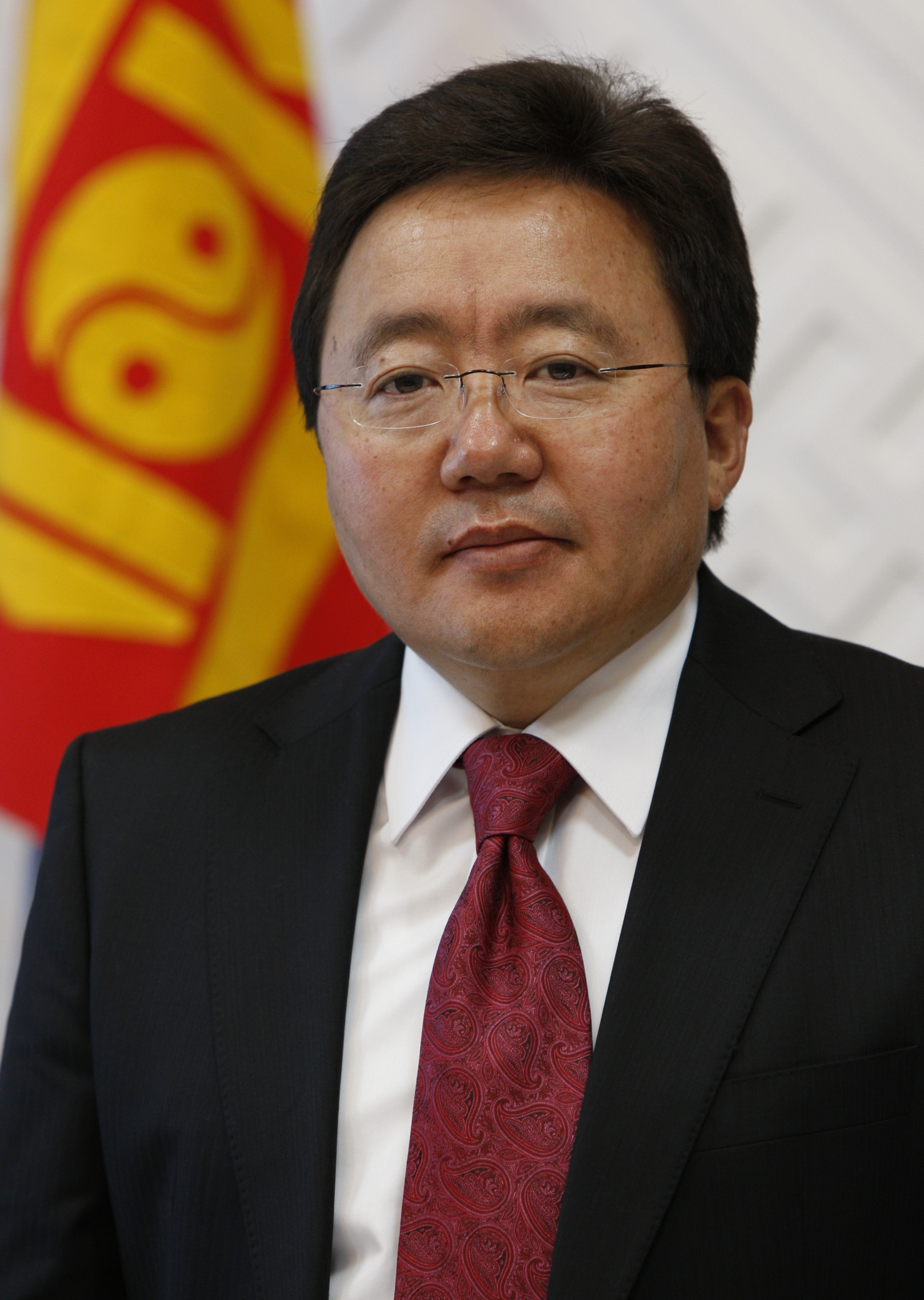
At the Democratic Party's convention on 3 April 2009, Tsakhiagiin Elbegdorj defeated Erdeniin Bat-Üül in a contest for the party's nomination for the presidency of Mongolia in 2009. Elbegdorj won with 65.3% of the total vote. After Elbegdorj was announced as the candidate, the Civic Will Party and the Mongolian Green Party endorsed Elbegdorj's presidential candidacy.
Tsakhiagiin Elbegdorj won the 2009 Mongolian presidential election on 24 May 2009 with 51.21% of the votes. Defeating incumbent president Enkhbayar who got 47.41%. Elbegdorj was sworn into office as President of Mongolia on 18 June 2009.
2012 parliamentary elections
Main article: 2012 Mongolian legislative election
In the 2012 parliamentary elections, the Democratic Party won the elections and became the majority by winning 34 seats out of 76 seat in the Parliament. Party Leader Norovyn Altankhuyag became the prime minister. It formed a coalition government with the Mongolian People's Revolutionary Party with majority seats at the government Cabinet belonging to the Democratic Party.
2013 presidential election
Main article: 2013 Mongolian presidential election
The Democratic Party's National Policy Committee held its convention on 7 May 2013 and decided to re-nominate Elbegdorj as a presidential candidate with 100% votes. And the Congress of Democratic Party, with 7,000 participants in Ulaanbaatar plus participants in all provincial centers connected via live internet video conference voted 100% for Elbegdorj's nomination from the Democratic Party for the 2013 presidential election on 8 May 2013. Civil Will-Green Party and Mongolian National Democratic Party – which have seats at both the parliament and the government cabinet – endorsed Elbegdorj's presidential candidacy. The Republican Party and the Motherland Party expressed their full support for Elbegdorj's candidacy also.
Elbegdorj won the 2013 presidential election on 26 June 2013 with 50.23% of total votes while opposition Mongolian People's Party's candidate Badmaanyambuugiin Bat-Erdene received 41.97%, and Natsagiin Udval, candidate of Mongolian People's Revolutionary Party got 6.5% of total votes.
2016 parliamentary elections
Main article: 2016 Mongolian legislative election
In the 2016 parliamentary elections, the Democratic Party lost to a landslide victory of the Mongolian People's Party, retaining only 9 of 76 seats in the Great Khural. While they just lost under 2% of the popular vote, a new electoral law passed by the Democratic Party itself when in government to promote two-party politics, together with a 14% rise of the MPP, ended up making them lose 25 of 34 seats.
2017 presidential election
Main article: 2017 Mongolian presidential election

The Democratic Party's candidate Khaltmaagiin Battulga narrowly won the second round of the 2017 presidential election.
2020 parliamentary election
Main article: 2020 Mongolian legislative election
In June 2020, DP got only 11 seats of the 76 seats. Ruling MPP won a landslide victory in the election.
2021 presidential election
Main article: 2021 Mongolian presidential election
In the 2021 presidential election, DP fell to the third place with only 6.37% of the popular vote and thus lost the presidency. The MPP secured a landslide victory with 72.02% of the popular vote. The social democratic Right Person Electorate Coalition (RPEC) finished second.
In early 2022, DP selected ex-president Khaltmaagiin Battulga as its new chairman, but due to the party's internal division his selection was challenged and Battulga's official filing with the Supreme Court was stalled.
Leaders
- Dambyn Dorligjav (2000–2002)
- Mendsaikhany Enkhsaikhan (2002–2005)
- Radnaasümbereliin Gonchigdorj (2005–2006)
- Tsakhiagiin Elbegdorj (2006–2008)
- Norovyn Altankhuyag (2008–2014)
- Zandaakhuugiin Enkhbold (2014–2016)
- Sodnomzunduin Erdene (2016–2023)
- Luvsannyamyn Gantömör (2023–2025)
- Odongiin Tsogtgerel (2025–present)
Organisation

The party is organised on national, provincial, municipal, and district levels. Currently, the party has around 30 provincial party associations and 432 grassroots organisations.
- National Convention (NC): Each provincial association sends delegates to the National Convention, which is held every 4 years.
- National Policy Committee (NPC): No more than two times a year, NPC is organised, and there are 228 members of NPC.
Affiliated organisations
The Democratic Party has the following affiliated groups and organisations.
- Democratic Youth Union
- Democratic Women's Union
- Democratic Elders' Union
Electoral history
Presidential elections
| Election | Party candidate | Votes | % | Result |
|---|---|---|---|---|
| 2001 | Radnaasümbereliin Gonchigdorj | 365,363 | 37.2% | Lost |
| 2005 | Mendsaikhany Enkhsaikhan | 184,743 | 20.20% | Lost |
| 2009 | Tsakhiagiin Elbegdorj | 562,718 | 51.21% | Elected |
| 2013 | 622,794 | 50.23% | Elected | |
| 2017 | Khaltmaagiin Battulga | 611,226 | 50.61% | Elected |
| 2021 | Sodnomzunduin Erdene | 72,394 | 6.38% | Lost |
State Great Khural elections
Notes
References
References
- "Ардчилсан нам: Намын тухай".
- "Үзэл Баримтлал".
- (2020). "The Future of the State: Philosophy and Politics". [[Rowman & Littlefield]].
- Julia Bader. (2015). "China's Foreign Relations and the Survival of Autocracies". Routledge.
- "Mongolia: Khaltmaa Battulga wins election on nationalist platform".
- (23 December 2020). "Үндсэн дүрэм".
- (2016-12-21). "Ардчилсан намын түүхэн товчоон-туршлага ба сургамж".
- Chris Kaplonski: [http://www.chriskaplonski.com/mongolia/parties.html ''Mongolia: Political Parties''] {{webarchive. link. (6 February 2007 (Retrieved 29 January 2007))
- "Ex-Communists Lose In Mongolia Election". [[Reuters]].
- "Монголын ардчилал ба АН-ын "түүхэн замнал"".
- Schafferer, Christian. (2004-12-31). "The 2004 parliamentary election in Mongolia: Big surprises and small victories". Journal of Contemporary Eastern Asia.
- "Түүхэн товчоо".
- Luke Distelhorst: [http://www.mongolia-web.com/content/view/334/2/ '' Ts. Elbegdorj Mongolia's New Democratic Party Leader''] {{webarchive. link. (10 May 2007, Mongolia-Web, 1 April 2006)
- [http://www.mongolei.de/news/2008aug5.htm www.mongolei.de: Aktuelle Nachrichten aus der Mongolei / 25. bis 31. August 2008] {{webarchive. link. (19 July 2011 (in German))
- (2012-07-02). "Mongolia Democratic Party Confident of Victory After Voting". Bloomberg.com.
- (2012-08-20). "Шинэчлэлийн Засгийн газрын танхим бүрдлээ {{!}} News.MN".
- "Mine, all mine". The Economist.
- iKon.mn, А. Төгөлдөр. (2022-05-27). "УИХ-ын гишүүн Н.Алтанхуяг, Эдийн засаг, хөгжлийн сайд асан Н.Батбаяр нарыг хилээр гарахыг хориглов".
- Ч.Болортуяа. (2014-11-05). "Шинэчлэлийн ЗАСГИЙН ГАЗАР ОГЦОРЛОО".
- Hille, Kathrin. (2014-12-02). "Moscow expects recession in 2015".
- "Rio secures $US4.4b to expand Oyu Tolgoi".
- (2018-11-30). "З.Энхболд: Оюутолгой дээр ганц Дубайн гэрээ биш, огт орж ирээгүй тэрбумаас дээш долларын асуудал байгаа".
- iKon.mn, С. Бадрал. (2017-01-25). ""Эрдэнэт" үйлдвэр "Ростех"-н мэдэлд очсон талаарх Засгийн газар хоорондын протокол".
- (23 January 2020). "iToim.mn - ҮНЭНИЙ ТАЛД".
- "Populist judo champ to be Mongolian president – DW – 07/08/2017".
- (2020-06-25). "2020 Election: Ruling Mongolian People's Party wins 62 of 76 parliament seats".
- B, Ariunzaya. (2021-02-01). "Ц.Туваан С.Эрдэнийг "хөөж", С.Эрдэнэ Ц.Тувааныг чөлөөлөв".
- (2021-03-27). "Ардчилсан намын даргын сонгуульд нэр дэвшигчдийн олон нийтийн санал асуулгыг Одонгийн Цогтгэрэл тэргүүлжээ".
- (2021-04-28). "АН нэгдэж чадалгүй ЕРӨНХИЙЛӨГЧИЙН СОНГУУЛИЙГ өнжих үү!".
- Г., Номин. (2021-05-01). "О.Цогтгэрэл даргатай АН-аас УИХ-ын гишүүн Н.Алтанхуягийг Ерөнхийлөгчийн сонгуульд нэр дэвшүүлэхээр болжээ".
- Г., Номин. (2021-05-01). "М.Тулгат даргатай АН-аас Ерөнхийлөгчийн сонгуульд өрсөлдөх нэр дэвшигчээр С.Эрдэнэ тодорчээ".
- А. Намуун. (8 May 2021). "Ерөнхийлөгчийн сонгуульд нэр дэвшигчдийн үнэмлэхийг тавдугаар сарын 24-нд олгож, нийтэд мэдээлнэ".
- Т., Саран. (2021-05-05). "ФОТО: Нэр дэвшигчээ бүртгэхийг шаардаж, өлсгөлөн зарлаж буй АН-ын гишүүд".
- П, Зоригт. (2023-01-19). "Ардчилсан Намын даргаар БСШУ-ны сайд асан Лу.Гантөмөрийг сонгохоор дэмжив".
- Weekly, Mongolia. (2024-06-28). "Mongolia Election 2024: MPP Wins Third Term, But Majority Reduced".
- B, Ooluun. (2024-07-08). "Leaders of Three Parties in Parliament Sign Memorandum to Cooperate in 2024-2028".
- Chuluunbaatar, Sumiya. (24 May 2025). "Unraveling Mongolia's Prime Minister Resignation Protests".
- Adiya, Amar. (2025-09-03). "Mongolia's Democratic Party Names Pragmatic Chief".
- (4 April 2009). "Presidential election May, 2009". Business-Mongolia.com.
- Schrapel, Thomas. (2009). "Report on the Presidential elections in Mongolia on May 24, 2009".
- (3 November 2011). "Mongolia Profile". BBC News.
- Enkhbayar, Roland-Holst, Sugiyarto, Shagdar, David and Guntur. (September 2010). "Mongolia's investment priorities from a national development perspective". berkeley.edu.
- (18 June 2009). "Mongolia's new president sworn in". euronews.com.
- (7 May 2013). "Democratic Party's National consultative committee's 42nd convention supports Elbegdorj's candidacy 100%". Odriin sonin (Daily News) (in Mongolian).
- B., Mandakh. (8 May 2013). "Congress of Democratic Party taken place". news.mn (in Mongolian).
- E, Dari. (27 May 2013). "The unique features of the 6th Presidential Election of Mongolia". UB Post.
- (29 May 2013). "Motherland Party and Republican Party are to support Ts.Elbegdorj". vip76.mn (in Mongolian).
- D., Tsetseg. (27 June 2013). "It is announced that Ts.Elbegdorj won by preliminary result". shuud.mn (in Mongolian).
- (27 June 2013). "Incumbent Mongolian president wins 2nd term on pro-Western, anti-graft platform". The Washington Post.
- (30 June 2016). "Mongolian opposition wins landslide, voters fed up with hard times". Reuters.
- link. (1 July 2016 Reuters, 20 May 2016)
- "Mongolia Just Chose a New President. What Now?".
- (2020-07-07). "Analysis {{!}} Here's how an unpopular ruling party swept Mongolia's June elections". [[The Washington Post]].
- Adiya, Amar. (2022-05-25). "What You Need To Know About Mongolia and What's On the Horizon in H2 2022".
This article was imported from Wikipedia and is available under the Creative Commons Attribution-ShareAlike 4.0 License. Content has been adapted to SurfDoc format. Original contributors can be found on the article history page.
Ask Mako anything about Democratic Party (Mongolia) — get instant answers, deeper analysis, and related topics.
Research with MakoFree with your Surf account
Create a free account to save articles, ask Mako questions, and organize your research.
Sign up freeThis content may have been generated or modified by AI. CloudSurf Software LLC is not responsible for the accuracy, completeness, or reliability of AI-generated content. Always verify important information from primary sources.
Report