From Surf Wiki (app.surf) — the open knowledge base
Civic Platform
Political party in Poland (2001–2025)
Political party in Poland (2001–2025)
| Field | Value |
|---|---|
| name | Civic Platform of |
| the Republic of Poland | |
| native_name | Platforma Obywatelska |
| Rzeczypospolitej Polskiej | |
| native_name_lang | pl |
| logo | Civic Platform of the Republic of Poland logo.svg |
| logo_size | 280px |
| colorcode | |
| abbreviation | PO |
| chairman | Maciej Płażyński (first) |
| Donald Tusk (last) | |
| founders | |
| founded | |
| dissolved | |
| split | |
| headquarters | ul. Wiejska 12A, 00-490 Warsaw |
| merged | Civic Coalition (party) |
| membership_year | 2025 |
| membership | ~25,000 |
| ideology | {{ublist |
| position | Centre-right |
| european | European People's Party |
| national | Civic Coalition |
| Senate 2001 (2001) | |
| Senate Pact 2023 (2023) | |
| europarl | European People's Party Group |
| colours | |
| website | |
| country | Poland |
the Republic of Poland Rzeczypospolitej Polskiej Donald Tusk (last) | Liberal conservatism | Christian democracy | Pro-Europeanism Senate 2001 (2001) Senate Pact 2023 (2023) The Civic Platform (, PO)The party was officially the Civic Platform of the Republic of Poland (Platforma Obywatelska Rzeczypospolitej Polskiej). was a centre-right liberal conservative political party in Poland. The party's most prominent leader was Donald Tusk, party chairman between 2003–2014 and 2021–2025.
It was formed in 2001 by splinter factions from the Solidarity Electoral Action, the Freedom Union and the Conservative People's Party, and it later placed second in the 2001 Polish parliamentary election. It remained at the opposition until the 2007 Polish parliamentary opposition, when it overtook Law and Justice, won 209 seats, and Tusk was elected as Prime Minister of Poland. Following the Smolensk air disaster in 2010, Bronisław Komorowski served as acting president of Poland and later won the 2010 Polish presidential election. Tusk continued to serve as prime minister and leader of Civic Platform until he resigned in 2014 to assume the post of the president of the European Council. The party was defeated in the 2015 Polish parliamentary and presidential elections. It placed second in the 2019 Polish parliamentary election, and its 2020 Polish presidential election candidate, Rafał Trzaskowski, won 49% of the popular vote in the second round and lost the election to Andrzej Duda.
Initially positioned as a Christian democratic party with strong economically liberal tendencies, it soon adopted liberal conservatism throughout the 2000s. During its time in power, it was aligned with more pragmatic and centrist views, and was characterized as a catch-all party. In the 2010s, the Civic Platform adopted more socially liberal policies, aligned itself with conservative liberalism and economic neoliberalism, and it has since been positioned in the centre-right. It has also strongly advocated for Poland's membership in the European Union and NATO. It was a member of the European People's Party.
The party headed an electoral alliance Civic Coalition, which was founded in 2018. Since its creation, it had shown strong electoral performances in Warsaw, the west, and the north of Poland. Since the 2000s, the Civic Platform had established itself as one of the dominant political parties in Poland. On 25 October 2025, the party merged into a new party called Civic Coalition, bearing the same name as the PO-led electoral coalition from 2018.
History
Establishment
The Civic Platform was founded in 2001 as economically liberal, Christian-democratic split from existing parties. Founders Andrzej Olechowski, Maciej Płażyński, and Donald Tusk were sometimes jokingly called "the Three Tenors" by Polish media and commentators. Olechowski and Płażyński left the party during the 2001–2005 parliamentary term, leaving Tusk as the sole remaining founder, and current party leader.
First elections
In the 2001 general election, the party secured 12.6% of the vote and 65 deputies in the Sejm, making it the largest opposition party to the government led by the Democratic Left Alliance (SLD). In the 2002 local elections, PO stood together with Law and Justice in 15 voivodeships (in 14 as POPiS, in Podkarpacie with another centre-right political parties). They stood separately only in Mazovia.
The POPiS coalition won 12% of the popular vote nationally, which was well below the expectations. Ludwik Dorn, the chairman of the PiS parliamentary club at the time, remarked: "Together, we gained as much as the PO itself collected a year earlier." This marked the point at which PO and PiS, until now ideological and political allies, started to grow apart. The leadership of PiS decided that it had to distance itself from PO and change its ideology in order to increase its popular support.
In 2005, PO led all opinion polls with 26% to 30% of public support. However, in the 2005 general election, in which it was led by Jan Rokita, PO polled only 24.1% and unexpectedly came second to the 27% garnered by Law and Justice (PiS). A centre-right coalition of PO and PiS (nicknamed POPiS) was deemed most likely to form a government after the election. Yet the putative coalition parties had a falling out in the wake of the fiercely contested Polish presidential election of 2005.
In the 2005 elections, PiS attacked PO by campaigning on a difference between "liberal Poland" and its "social Poland". The former was marked by economic liberalism, austerity, deregulation and "serving the rich". In contrast, Law and Justice stressed its "social" character, pledging policies that would help the poor. The party attacked Civic Platform's flat tax proposal and advocated a much more active role of the state in the economy. Law and Justice also made "an offer to the left", stressing its economically left-wing policies.
Ultimately, Lech Kaczyński (PiS) won the second round of the presidential election on 23 October 2005 with 54% of the vote, ahead of Tusk, the PO candidate. Due to the demands of PiS for control of all the armed ministries (the Defence Ministry, the Ministry of the Interior and the Ministry of Foreign Affairs) and the office of the prime minister, PO and PiS were unable to form a coalition. Instead, PiS formed a coalition government with the support of the League of Polish Families (LPR) and Self-Defense of the Republic of Poland (SRP). PO became the opposition to this PiS-led coalition government.
Ruling government (2007–2015)
The PiS-led coalition fell apart in 2007 amid a corruption scandal involving Andrzej Lepper and Tomasz Lipiec and internal leadership disputes. These events led to new elections, and in the 21 October 2007 parliamentary election PO won 41.51% of the popular vote and 209 out of 460 seats in the Sejm and 60 out of 100 seats in the Senate of Poland. Civic Platform, now the largest party in both houses of parliament, subsequently formed a coalition with the Polish People's Party (PSL).
Despite declaring the parliamentary election campaign the will to limit taxation in Poland, the Civic Platform implemented an ideologically diverse set of policies - it increased the excise imposed on diesel oil, alcoholic beverages, tobacco, and oil. It had also eliminated tax exemptions.
At the 2010 Polish presidential election, following the Smolensk air disaster which killed the incumbent Polish president Lech Kaczyński, Tusk decided not to present his candidature, considered an easy possible victory over PiS leader Jarosław Kaczyński. During the PO primary elections, Bronisław Komorowski defeated Foreign Minister Radosław Sikorski. At the polls, Komorowski defeated Jarosław Kaczyński, ensuring PO dominance over the contemporary Polish political landscape.
In November 2010, local elections granted Civic Platform about 30.1 percent of the votes and PiS at 23.2 percent, an increase for the former and a drop for the latter compared to the 2006 elections.
In the 2014 European elections, Civic Platform came first place nationally, achieving 32.13% of the vote and returning 19 MEPs. In the 2014 local elections, PO achieved 179 seats, the highest single number. In the 2015 presidential election, PO endorsed Bronisław Komorowski, a former member of PO from 2001 till 2010. He lost the election receiving 48.5% of the popular vote, while Andrzej Duda won with 51.5%.
Opposition (2015–2023)
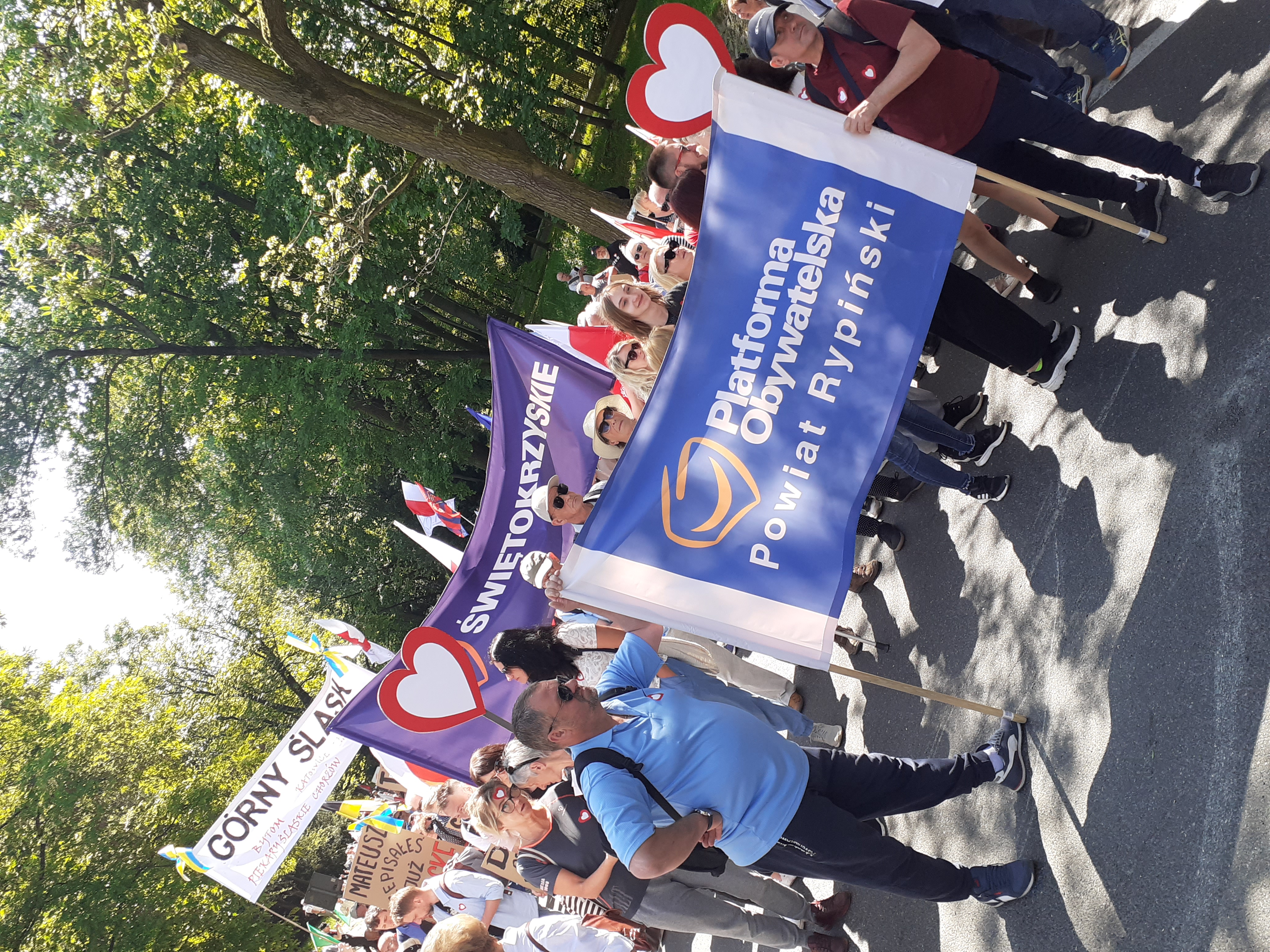
In the 2015 parliamentary election, PO came in second place, after PiS, achieving 24.09% of the popular vote, 138 out of 460 seats in the Sejm, and 34 out of 100 seats in the Senate. In the 2018 local elections, PO achieved 26.97% of the votes, coming second after PiS. In the 2019 European elections, PO participated in the European Coalition electoral alliance which achieved 38.47%, coming second after PiS. On 1 October 2023, it held The Million Hearts march in Warsaw.
Return to power (2023–2025) and unification
The Civic Platform returned to power in a coalition with the Polish People's Party, Poland 2050 and New Left in the 2023 parliamentary election.
Main article: Civic Coalition unification congress
In October 2025, the party announced its plans to merge into a new party with two of its smaller coalition partners, Modern and Polish Initiative. The unification convention was held on 25 October 2025, where the three parties merged into a single party known as the Civic Coalition. Some members of the 2018 electoral alliance Civic Coalition, such as the Greens, opted to remain a separate party. The leader of the new party became Donald Tusk, and the new party is to complete its leadership election on 26 January 2026. The creation of Civic Coalition marked the dissolution of the Civic Platform.
Ideology
The Civic Platform was mainly described as a centre-right political party.{{refn|PO has often been described as centre-right:
- }} Due to the peculiarity of Polish politics, as a major liberal opponent of the conservative PiS, the party was also classified as centristPO has often been described as centrist:
- or centre-left,PO has often been described as centre-left:
- although since 2023 the party was considered to have shifted back towards the centre-right. It has also been described as liberal-conservative, Christian democratic, conservative, conservative-liberal, classical-liberal, liberal, and social-liberal. It was also described as pragmatic and big tent. It supported Poland's membership in the European Union.
Since 2007, when Civic Platform formed the government, the party has gradually moved from its Christian-democratic stances, and many of its politicians hold more liberal positions on social issues. In 2013, the Civic Platform's government introduced public funding of in vitro fertilization program. Civic Platform also supported civil unions for same-sex couples but was against same-sex marriage and the adoption of children by same-sex couples. The party also supported liberalization of the abortion law, which it had opposed while in government. In response to the climate crisis, the Civic Platform pledged to end the use of coal for energy in Poland by 2040.
PO was described as neoliberal,PO has often been described as neoliberal:
- economically liberal, right-wing liberal, and fiscally conservative. It represented moderately conservative positions, and pursued deregulatory economic policies. The Third Cabinet of Donald Tusk led by the Civic Platform pursued economic deregulation, lowering healthcare tax for business, restricting immigration and tax cuts. It also pursued laissez-faire economic policies, such as introducing tax exemptions for self-employed and high earners.
After becoming the biggest opposition party, the Civic Platform became more culturally liberal and populist. This tendency became especially popular among the younger generation of the party's politicians, such as mayor of Warsaw and presidential candidate Rafał Trzaskowski. In contrast, Dan Davison argued that the party's shift on social issues "stem not from any meaningful change in their substantive politics, but rather from cynical triangulation", as "even now, the concessions PO has made to social liberalism are very limited compromises." After returning to the government in 2023, the party adopted an anti-immigration stance to migrants coming from Russia and Belarus.
Organization
Party leaders
| No. | Image | Chairman | Tenure |
|---|---|---|---|
| 1 | Maciej Płażyński | 18 October 2001 – 1 June 2003 | |
| 2 | Donald Tusk | 1 June 2003 – 8 November 2014 | |
| 3 | Ewa Kopacz | 8 November 2014 – 26 January 2016 | |
| 4 | Grzegorz Schetyna | 26 January 2016 – 29 January 2020 | |
| 5 | Borys Budka | 29 January 2020 – 3 Jul 2021 | |
| 6 | Donald Tusk | 3 Jul 2021 – 25 October 2025 |
Notable politicians
Image:Bronisław Komorowski (2).jpg|Bronisław Komorowski former president of Poland (2010–2015) Image:Jerzy Buzek 2015.jpg|Jerzy Buzek former president of the European Parliament (2009–2012) and former Prime Minister of Poland (1997–2001) Image:MEP Borys Budka during ITRE Committee constitutive meeting (cropped).jpg|Borys Budka former minister of justice and leader of Platforma Obywatelska (2020–2021) Image:Bogdan Borusewicz Kancelaria Senatu 2023.jpg|Bogdan Borusewicz former marshal of the Senate (2005–2015) Image:GRONKIEWICZ-WALTZ Hanna (EPP, PL).jpg|Hanna Gronkiewicz-Waltz former mayor of Warsaw (2006–2018) Image:EPP_Congress_Bucharest_-Day_1_IMG_8903(53571547784)_(cropped).jpg|Rafał Trzaskowski Mayor of Warsaw candidate for President of Poland in 2020 and 2025 Image:Min. Radosław Sikorski 2024 (cropped2).jpg|Radosław Sikorski Minister of Foreign Affairs (2007–2014, 2023–present), Deputy Prime Minister (2025–present)
Political support

As of 2020, the party enjoyed the greatest support in large cities and among people with higher education and in managerial positions, while in terms of age, the electorate was evenly distributed, and the electoral base of the Civic Platform lay in middle-aged, highly educated gold-collar and white-collar workers of the middle and upper-middle classes. As of 2020, the Civic Platform electorate was made up of more women than men, was disproportionally represented by middle-aged, urban and middle-class voters, and was characterized by higher levels of education, higher position in the socio-professional structure, as well as moderate religiosity and Roman Catholicism. The party consistently enjoyed overwhelming support of workers such as directors, managers and specialists, business owners and co-owners, and administrative workers. At the same time, the party underperformed amongst blue-collar workers, young voters, farmers and students, as well as unemployed voters. In regards to age, Civic Platform performed the best amongst voters aged 40–49, while also performing strongly among 30-39 and 50-59 year olds. The party performs the worst amongst the oldest (aged 60 or more) and the youngest (aged 29 or less) voters. The party strongly appealed to urban voters, as almost a half of voters living in big cities (500,000 people or more) vote for Civic Platform; support for the party remains strong in middle-sized cities but strongly declines in small towns and the countryside, as on average only 15% of rural voters support it.
As of 2016, an overwhelming majority of party's supporters (83%) were Roman Catholics, and 44% of these voters partook in religious practices at least once a week. As of 2016, the party was supported by the Christian left, as well as liberal and moderate Catholics, while most of conservative Catholics in Poland support Law and Justice instead. Churchgoing Catholics are roughly evenly split between Civic Platform and Law and Justice, with a significant minority of churchgoers supporting Polish People's Party as well. Catholics who support Civic Platform "oppose, on the one hand, the state's enforcement of religious norms and, on the other, do not condone their violation". This was largely consistent with the party's attitude towards religion, which combines a moderately conservative and politically Catholic program with left-wing economic slogans, supported by Catholic social teaching and the teaching of John Paul II contained in the encyclical Centesimus annus.
As of 2020, most of Civic Platform's electorate identified as liberal conservatives, centrists and moderate conservatives.{{cite journal |last=Zagała |first=Zbigniew |year=2020 |title=Partie polityczne i ich elektoraty. Od sympatii do antagonizmu. Na przykładzie Platformy Obywatelskiej i Prawa i Sprawiedliwości |publisher=Wydawnictwo Naukowe Wydziału Nauk Politycznych i Dziennikarstwa UAM
As of 2021, according to CBOS, Civic Platform was overwhelmingly popular amongst pro-European voters, with almost 80% of party's supporters wishing to cooperate with the European Union more. The party was generally supported by moderates, as most of the party's voters wish for a "compromise" on issues such as abortion. Economically, the party was supported by pro-business and welfare-oriented voters alike; while most of Civic Platform's supporters believe that Poland should become a welfare state, they are evenly split on issues such as progressive taxation and flat tax, and nationalization vs. privatization. The party has also enjoyed the support of regionalists, autonomists and voters supportive of decentralization and localism in general. Over 90% of Civic Platform supporters believe that local governments should have more power and that the national government should devolve its power to the regional governments of gminas and voivodeships. The party was supported by Silesian regionalists, and had organized joint electoral lists with Silesian parties like Silesian Autonomy Movement and Silesian Regional Party. Local politicians of the Civic Platform in Silesia are often associated with Silesian regionalism as well. The party also enjoys support from the Kashubians and their local autonomist movement, with the co-founder of the party, Donald Tusk, having expressed his support for autonomous Kashubia in 1992.
In March 2023, Tusk stated that Silesian should be considered a language rather than an ethnolect as it has unique literature and grammar, and promised to recognize Silesian as an official, statutory language of Upper Silesia. Tusk also declared that he was a regionalist.
Election results
Presidential
| Election year | Candidate | 1st round | 2nd round | # of overall votes | % of overall vote | # of overall votes | % of overall vote | 2005 | 2010 | 2015 | 2020 | 2025 |
|---|---|---|---|---|---|---|---|---|---|---|---|---|
| Donald Tusk | 5,429,666 | 36.3 (#1) | 7,022,319 | 46.0 (#2) | ||||||||
| Bronisław Komorowski | 6,981,319 | 41.5 (#1) | 8,933,887 | 53.0 (#1) | ||||||||
| Supported Bronisław Komorowski | 5,031,060 | 33.8 (#2) | 8,112,311 | 48.5 (#2) | ||||||||
| Rafał Trzaskowski | 5,917,340 | 30.5 (#2) | 10,018,263 | 48.9 (#2) | ||||||||
| Rafał Trzaskowski | 6,147,797 | 31.4 (#1) | 10,237,286 | 49.1 (#2) |
Sejm
| Election | Leader | Votes | % | Seats | +/– | Government | 2001 | 2005 | 2007 | 2011 | 2015 | 2019 | 2023 |
|---|---|---|---|---|---|---|---|---|---|---|---|---|---|
| Maciej Płażyński | 1,651,099 | 12.7 (#2) | |||||||||||
| Donald Tusk | 2,849,259 | 24.1 (#2) | 68 | ||||||||||
| 6,701,010 | 41.5 (#1) | 76 | |||||||||||
| 5,629,773 | 39.2 (#1) | 2 | |||||||||||
| Ewa Kopacz | 3,661,474 | 24.1 (#2) | 69 | ||||||||||
| Grzegorz Schetyna | 5,060,355 | 27.4 (#2) | 36 | ||||||||||
| As part of Civic Coalition, which won 134 seats in total. | |||||||||||||
| Donald Tusk | 6,629,402 | 30.7 (#2) | 25 | ||||||||||
| As part of Civic Coalition, which won 157 seats in total. |
Senate
| Election | Vtes | % | Seats | +/– | Majority | 2001 | 2005 | 2007 | 2011 | 2015 | 2019 | 2023 |
|---|---|---|---|---|---|---|---|---|---|---|---|---|
| 6,582,224 | 24.34 (#2) | |||||||||||
| As part of the Senate 2001 coalition, which won 15 seats. | ||||||||||||
| 4,090,497 | 16.94 (#2) | 32 | ||||||||||
| 12,734,742 | 39.14 (#1) | 26 | ||||||||||
| 5,173,300 | 35.60 (#1) | 3 | ||||||||||
| 4,323,789 | 28.85 (#2) | 29 | ||||||||||
| 6,490,306 | 35.66 (#2) | 7 | ||||||||||
| As part of the Civic Coalition, which won 43 seats. | ||||||||||||
| 6,187,295 | 28.91 (#2) | 0 | ||||||||||
| As part of the Senate Pact 2023, which won 66 seats. |
European Parliament
| Election | Leader | votes | % | Seats | +/– | EP Group | 2004 | 2009 | 2014 | 2019 | 2024 |
|---|---|---|---|---|---|---|---|---|---|---|---|
| Jerzy Buzek | 1,467,775 | 24.1 (#1) | New | EPP-ED | |||||||
| Danuta Hübner | 3,271,852 | 44.4 (#1) | 10 | EPP | |||||||
| 2,271,215 | 32.1 (#1) | 6 | EPP | ||||||||
| Włodzimierz Cimoszewicz | 5,249,935 | 27.89 (#2) | 5 | EPP | |||||||
| As part of the European Coalition, that won 22 seats in total. | |||||||||||
| Marcin Kierwiński | 4,359,443 | 37.04 (#1) | 4 | EPP | |||||||
| As part of the Civic Coalition, that won 21 seats in total. |
Regional assemblies
| Election year | % of | ||||||||
|---|---|---|---|---|---|---|---|---|---|
| vote | # of | ||||||||
| overall seats won | +/– | 2002 | 2006 | 2010 | 2014 | 2018 | 2024 | ||
| 12.1 (#4) | |||||||||
| In coalition with Law and Justice (POPiS). | |||||||||
| 27.2 (#1) | |||||||||
| 30.9 (#1) | 36 | ||||||||
| 26.3 (#2) | 43 | ||||||||
| 27.1 (#2) | 15 | ||||||||
| As the Civic Coalition. | |||||||||
| 30.6 (#2) | 16 | ||||||||
| As the Civic Coalition. |
Voivodeship Marshals
| Name | Image | Voivodeship | Date Vocation | |
|---|---|---|---|---|
| Elżbieta Polak | [[File:Elzbieta Polak.JPG | 60px]] | Lubusz Voivodeship | 29 November 2010 |
| Marek Woźniak | [[File:Marek Wozniak 546.JPG | 60px]] | Greater Poland Voivodeship | 10 October 2005 |
| Piotr Całbecki | [[File:Całbecki.JPG | 60px]] | Kuyavian-Pomeranian Voivodeship | 24 January 2006 |
| Olgierd Geblewicz | [[File:Olgierd Geblewicz fran Parliamentary Forum of the Southern Baltic Sea talar vid BSPC-s mote i Visby 2008-09-01.jpg | 60px]] | West Pomeranian Voivodeship | 7 December 2010 |
| Mieczysław Struk | [[File:Mieczysław Struk (2010).JPG | 60px]] | Pomeranian Voivodeship | 22 February 2010 |
| Andrzej Buła | [[File:Andrzej Buła.jpg | 60px]] | Opole Voivodeship | 12 November 2013 |
Notes
References
Sources
- Adam Zakowski, A leading force, Polityka, March 2009
References
- Wójcik, Piotr. (4 June 2025). "Wójcik: Wahadło jeszcze wychyli się w lewą stronę".
- Budny, Michał. (2022). "The Process of Acquiring Political Relevance of Law and Justice Elections". Institute of Local Initiatives.
- Millard, Frances. (2007). "The 2005 parliamentary and presidential elections in Poland". University of Essex.
- (22 October 2007). "BBC News (2007-10-22): Massive win for Polish opposition".
- (2 October 2013). "ząd podwyższa akcyzę i zamraża płace". forsal.pl.
- (23 October 2011). "Rząd zaciska pasa: zamraża pensje, podnosi akcyzę na papierosy i paliwa". wyborcza.biz.
- (26 July 2012). "Dziś dowiemy się, dlaczego rząd zabierze nam ulgi". bankier.pl.
- Sebastian Bobrowski. (25 March 2014). "Zmiany w odliczaniu VAT od samochodów. Sprawdź ile i kiedy możesz odliczyć". mamstartup.pl.
- (16 December 2011). "Głosowanie nad przyjęciem w całości projektu ustawy o zmianie niektórych ustaw związanych z realizacją ustawy budżetowej, w brzmieniu proponowanym przez Komisję Finansów Publicznych, wraz z przyjętymi poprawkami". sejm.gov.pl.
- [http://www.wbj.pl/blog/The_business_of_politics/post-254-civic-platform-almighty.htm Warsaw Business Journal] {{webarchive. link. (20 December 2010)
- "Elections 2011 - Election results". National Electoral Commission.
- "Pkw {{pipe}} Pkw". Pe2014.pkw.gov.pl.
- "Oficjalne wyniki wyborów samorządowych. Zobacz, kto wygrał".
- Jęczmionka, Paulina. (11 May 2015). "Oficjalne wyniki wyborów 2015: Bronisław Komorowski wziął Poznań i Wielkopolskę [INFOGRAFIKA]".
- (27 October 2015). "Wybory parlamentarne 2015. PKW podała ostateczne wyniki".
- (20 October 2018). "Znamy wyniki wyborów! Relacja na żywo. Wybory samorządowe 2018".
- "Oficjalne wyniki wyborów do europarlamentu".
- Jan Cienski. (1 October 2023). "Huge but glum: Poland's opposition puts a million people on the streets". Politico.
- (2025-10-03). "Partię Donalda Tuska czeka rewolucja. Będzie nowa nazwa i logo".
- Bałczyk, Piotr. (25 October 2025). "Koniec Platformy Obywatelskiej. Tusk przedstawił nowe ugrupowanie".
- Szpala, Iwona. (25 October 2025). "Tusk: Od dzisiaj nazywamy się Koalicja Obywatelska, bo jako KO wygrywaliśmy już wybory i wygramy następne".
- (25 October 2025). "Koniec Platformy Obywatelskiej, premier ogłasza. "Rzecz niełatwa"".
- (25 October 2025). "Koniec Platformy Obywatelskiej, premier ogłasza. "Rzecz niełatwa"".
- Pietruszka, Radek. (25 October 2025). "Platforma Obywatelska znika ze sceny politycznej. Nowa formuła według Tuska".
- (2025). "Anti-LGBTIQ rhetoric and electoral outcomes under the shadow of war: Evidence from Poland's 2023 parliamentary election". [[Wiley (publisher).
- Thevenin, Elodie. (2025). "Differentiation and Dominance in Europe's Poly-Crises". [[Routledge]].
- Mix, Derek E.. (10 July 2025). "Poland: Background and U.S. Relations". Congressional Research Service.
- (2025). "Refugee Exposure and Political Backlash: Poland During the Russia-Ukraine War". Institute of Labor Economics.
- "The Green State of the Nation(s): Poland". Think Europa.
- Chiodi, Luisa. (2025). "Political Parties in the EU and the Challenges of Enlargement". [[Foundation for European Progressive Studies]].
- (1 June 2024). "Polish parties running in the European parliamentary elections - the essentials".
- (2022). "Is it possible to defeat right-wing populist authorities by winning elections? The erosion of democracy and the system of the triple-masters class in Poland". Frontiers in Political Science.
- (2023). "Populist Parties and Democratic Resilience: A Cross-National Analysis of Populist Parties' Impact on Democratic Pluralism in Europe". Routledge.
- (2008). "Sticking Together: Explaining Comparative Centre—Right Party Success in Post-Communist Central and Eastern Europe". Party Politics.
- (2012). "Ideological Identification of Medium–Level Party Cadres in Poland". Polish Political Science Yearbook.
- Szczerbiak, Aleks. (30 November 2016). "An anti-establishment backlash that shook up the party system? The October 2015 Polish parliamentary election". European Politics and Society.
- (June 2025). "The right road: The future of the European centre-right". Konrad Adenauer Stiftung.
- Schindler, Frederik. (21 November 2025). "Dieser AfD-Mann verärgert den polnischen Ministerpräsidenten".
- Lepiarz, Jacek. (27 October 2025). "Polen: Oppositionschef erklärt EU und Deutschland zum Gegner".
- Malmgren, Agnes. (2024). "Grandmother Memories for the Future. Solidaric Practices and (Slow) Memory in Contemporary Oppositional Struggles in Poland". Slovak Academy of Sciences.
- (2008). "Sticking Together: Explaining Comparative Centre—Right Party Success in Post-Communist Central and Eastern Europe". Party Politics.
- (2008). "Why Is There No Christian Democracy in Poland — and Why Should We Care?". Party Politics.
- Igor Guardiancich. (July 2008). "Wahlkampf Attacken im konservativen Lager". Ashgate.
- (2017). "Christian Democracy in Poland (19th–21st Century)". Annales Universitatis Mariae Curie-Skłodowska, Sectio K – Politologia.
- Kowalczyk, Krzysztof. (2015). "Stanowiska polskich partii politycznych wobec religii i Kościoła. Propozycja typologii". University of Silesia in Katowice.
- José Magone. (2010). "Contemporary European Politics: A Comparative Introduction". Routledge.
- (26 May 2019). "Poland's PiS smashes opposition in European election vote".
- Marjorie Castle. (2015). "Politics in Europe". CQ Press.
- (4 May 2017). "Tusk Vs Kaczyński: Explaining the Conflict". [[Krytyka Polityczna.
- Mart Laar. (4 February 2019). "Europe, A Political Profile: An American Companion to European Politics". ABC-CLIO.
- Alan G. Smith. (2016). "A Comparative Introduction to Political Science: Contention and Cooperation". Rowman & Littlefield.
- Paul Kubicek. (3 July 2021). "European Politics". Taylor & Francis.
- "Explainer: Whatever happened to Polish liberal conservatives?".
- Szczepański, Jarosław. (2015). "Raport z badania : trójkąt ideologiczny". Wydział Dziennikarstwa i Nauk Politycznych UW.
- (4 May 2017). "Is Poland's Civic Platform a serious threat to the ruling party?".
- Riishøj, Søren. (2011). "The Civic Platform in Poland - the first decade 2001-2011". University of Southern Denmark.
- Szczerbiak, Aleks. (18 January 2016). "What Are The Prospects For Poland's Opposition?".
- Ingo Peters. (2011). "20 Years Since the Fall of the Berlin Wall: Transitions, State Break-Up and Democratic Politics in Central Europe and Germany". BWV Verlag.
- (18 February 2021). "Platforma Obywatelska przedstawia nowe stanowisko w sprawie aborcji".
- "Premier na Kongresie Kobiet: przeciw radykalnym rozwiązaniom".
- (15 July 2019). "Poland coal phase out pledged for 2040 by opposition government".
- (2016). "Political Parties and Trade Unions in the Post-Communist Poland: Class Politics that Have Never a Chance to Happen". Polish Political Science Yearbook.
- (2012). "Opposing Neoliberalism? Poland's Renewed Populism and Post-Communist Transition". Third World Quarterly.
- (15 December 2022). "Is it possible to defeat right-wing populist authorities by winning elections? The erosion of democracy and the system of the triple-masters class in Poland". Frontiers in Political Science.
- Korycki, Kate. (2023). "Weaponizing The Past: Collective Memory and Jews, Poles, and Communists in Twenty-First-Century Poland". Berghahn Books.
- Davison, Dan. (6 February 2024). "Whither Poland? The Polish Left and Far Right under Tusk’s New Government". Spectre.
- (29 June 2005). "Wahlkampf-Attacken im konservativen Lager". [[Der Standard]].
- (25 April 2008). "Zur Lage der Bürgerplattform (PO) in Polen". [[Konrad Adenauer Foundation]].
- (2022). "The Role of Social Partners in Managing Europes Great Recession: Crisis Corporatism or Corporatism in Crisis?". Routledge.
- (10 September 2015). "Polish nurses set to strike over low pay". [[Politico]].
- (18 February 2025). "We Know Who the Deregulation Experts Are. This Initiative May Not Be as "Apolitical" as Promised".
- Ptak, Alicja. (4 April 2025). "Poland's Sejm approves bill to cut health contributions for business owners".
- (26 May 2025). "Polish presidential hopefuls rally supporters ahead of election".
- Łobodziński, Wojciech Albert. (28 May 2025). "Failing government, rising far right, and fragmentation of the Polish duopoly".
- Søren Riishøj. (2010). "The Civic Platform in Poland - the first decade 2001-2011". Political Science Publications.
- (9 July 2023). "Polish politicians attack migrants for electoral gain".
- "There Are Right and Wrong Ways to Fight For Democracy". [[The Washington Post]].
- (2011). "Mourning Populism. The Case of Poland". Polish Sociological Review.
- Kość, Dawid. (14 February 2024). "Uncontrolled immigration will lead to 'world collapse' warns Poland's new PM Donald Tusk".
- "Duda appoints new members of Polish government".
- Biskup, Bartłomiej. (2020). "Portret wyborców AD 2019. Zmiany w preferencjach elektoratów partyjnych w Polsce". Warsaw University.
- Zagała, Zbigniew. (2020). "Partie polityczne i ich elektoraty. Od sympatii do antagonizmu. Na przykładzie Platformy Obywatelskiej i Prawa i Sprawiedliwości". Wydawnictwo Naukowe Wydziału Nauk Politycznych i Dziennikarstwa UAM.
- Secler, Bartłomiej. (2016). "Religia i Religijność a Poziom Frekwencji Wyborczej". Wydawnictwo Morpho.
- Kowalczyk, Krzysztof. (2015). "Stanowiska polskich partii politycznych wobec religii i Kościoła. Propozycja typologii". University of Silesia in Katowice.
- Koczanowicz, Leszek. (December 2016). "The Polish Case: Community and Democracy under the PiS". New Left Review.
- Jartyś, Janusz. (2016). "Kwestie obyczajowe w programie i działalności Platformy Obywatelskiej Rzeczypospolitej Polskiej". Uniwersytet Szczeciński.
- Søren Riishøj. (2010). "The Civic Platform in Poland - the first decade 2001-2011". Political Science Publications.
- Roguska, Beata. (August 2021). "Elektoraty o istotnych kwestiach społeczno-politycznych". Centre for Public Opinion Research.
- Jedlecki, Przemysław. (8 August 2019). "Śląscy autonomiści dołączają do Koalicji Obywatelskiej". Wyborcza.
- Pawlik, Paweł. (9 August 2019). "Ruch Autonomii Śląska na listach Koalicji Obywatelskiej". Onet.
- (8 August 2019). "Śląskie Porozumienie Wyborcze nawiązuje współpracę z Koalicją Obywatelską. Śląski wyborca musi mieć pewność, że głos na regionalistów nie będzie głosem zmarnowanym".
- Noch, Jakub. (6 October 2015). ""Zemsta za Tuska i brak poparcia PiS". Jak i dlaczego Kaszubi jednoczą się przeciw PiS, który chce ich "rozbioru"". NaTemat.
- Tusk, Donald. (June 1992). "Regionalizm jako samodzielna siła polityczna". Pomerania.
- (19 March 2023). "Tusk: Śląski będzie językiem regionalnym, też na poziomie ustawowym". [[:pl:Bankier.pl.
- (19 March 2023). "Tusk: język śląski będzie uznany za język regionalny". [[Polish Press Agency]].
This article was imported from Wikipedia and is available under the Creative Commons Attribution-ShareAlike 4.0 License. Content has been adapted to SurfDoc format. Original contributors can be found on the article history page.
Ask Mako anything about Civic Platform — get instant answers, deeper analysis, and related topics.
Research with MakoFree with your Surf account
Create a free account to save articles, ask Mako questions, and organize your research.
Sign up freeThis content may have been generated or modified by AI. CloudSurf Software LLC is not responsible for the accuracy, completeness, or reliability of AI-generated content. Always verify important information from primary sources.
Report