From Surf Wiki (app.surf) — the open knowledge base
Battle of Lynchburg
Battle of the American Civil War
Battle of the American Civil War
| Field | Value |
|---|---|
| conflict | Battle of Lynchburg |
| image | Lynchburg-Location.svg |
| caption | Lynchburg, Virginia |
| partof | the American Civil War |
| date | – |
| place | Lynchburg, Virginia |
| result | Confederate victory |
| combatant1 | United States (Union) |
| combatant2 | CSA (Confederacy) |
| units1 | Dept. of West Virginia |
| units2 | II Corps, Army of N.VA |
| Breckinridge's Division | |
| Various cavalry units | |
| commander1 | David Hunter |
| commander2 | Jubal Early |
| John C. Breckinridge | |
| strength1 | 16,643 |
| strength2 | 14,000* |
| casualties1 | 700 (estimated) |
| casualties2 | 200 (estimated) |
| campaignbox | |
| notes | Only a portion of the II Corps arrived in time to fight in the battle. The entire II Corps was available for the post-battle pursuit, which would increase the Confederate strength of 14,000. Union casualties totaling 938 are for the period of June 10 - June 23. |
Breckinridge's Division Various cavalry units John C. Breckinridge
The Battle of Lynchburg was fought on June 17–18, 1864, as part of the American Civil War. Over30,000 soldiers participated in the battle, which included cavalry and infantry. The fighting took place outside of Lynchburg, Virginia. The Union Army of West Virginia, commanded by Major General David Hunter, attempted to capture the city but was repulsed by troops under the command of Confederate Lieutenant General Jubal Early. Following the battle, Confederate troops pursued the Union army as it retreated into West Virginia.
Lynchburg was important to the Confederate Army. It had three railroads, a canal, military hospitals, and was a distribution center for food and military supplies. Telecommunication lines strung along the railroads enabled Confederate military headquarters in Richmond to communicate with regional headquarters in western Virginia and Tennessee. Because of its importance, Lieutenant General Ulysses S. Grant wanted Hunter to attack the city and its railroads.
Hunter retreated west into West Virginia after his defeat at Lynchburg. This left the Shenandoah Valley open to the Confederate Army down to Maryland. Early moved down the valley and threatened Washington, DC, until his defeat in the Battle of Fort Stevens on July 11–12. After this battle, which took place less than 4 mi from the White House, Early began a retreat back to the Shenandoah Valley. On July 30, cavalry sent by Early, and commanded by John McCausland, moved into Pennsylvania and burned the city of Chambersburg.
Background
Grant's plan
During March 1864, Lieutenant General Ulysses S. Grant became commander of all Union armies.{{cite web |access-date=October 25, 2019 |archive-date=July 2, 2019 |archive-url=https://web.archive.org/web/20190702010536/https://www.battlefields.org/learn/biographies/ulysses-s-grant |url-status=live |access-date=October 29, 2025 |archive-date=October 1, 2025 |archive-url=https://web.archive.org/web/20251001030516/https://www.battlefields.org/learn/biographies/robert-e-lee |url-status=live
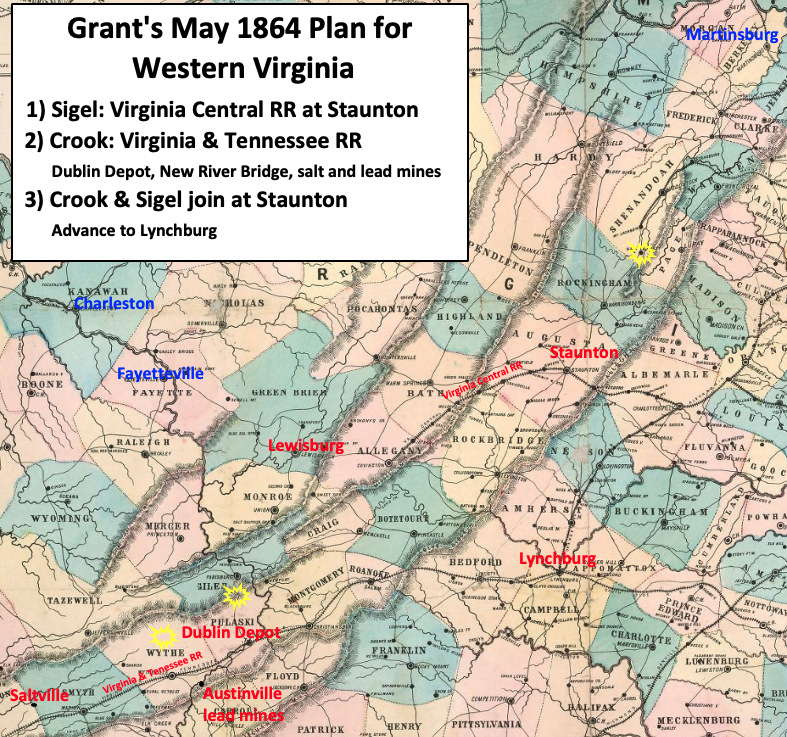
The Union plan of attack had Major General Franz Sigel leading the Army of the Shenandoah south in the Shenandoah Valley to capture Staunton, which was a stop for the Virginia Central Railroad. An army located in West Virginia, led by Brigadier General George Crook, would attack the Virginia & Tennessee Railroad. A small force of cavalry from Crook's army, led by Brigadier General William W. Averell, would attack the same railroad further west, including some salt mines located on a branch line. Crook and Averell would join Siegel at Staunton after the missions were completed. Then the combined force would attack Lynchburg.
Staunton and Lynchburg
Staunton is located in the Shenandoah Valley at the intersection of the Valley Pike, Staunton and Parkersburg Turnpike, and the Virginia Central Railroad. The town served as a supply depot, and was the home of mills, factories, foundries, and warehouses.{{cite web |access-date=October 3, 2025 |archive-date=April 9, 2025 |archive-url=https://web.archive.org/web/20250409014227/https://npshistory.com/brochures/nha/shvb/staunton.pdf |url-status=live
Further south, Lynchburg was located at the eastern terminus of the Virginia & Tennessee Railroad. The western end of the railroad connected with other railroads in Tennessee. At Lynchburg, goods could continue to Richmond using the Orange & Alexandria Railroad or the South Side Railroad. The James River and Kanawha Canal was navigable between Lynchburg and Richmond, offering another (although slower) mode for transportation. Telegraph line enabled communication between Richmond and Lynchburg, and between Lynchburg and Knoxville, Tennessee.
Because of its location, Lynchburg was the depot for food and supplies gathered from southwestern Virginia by the Virginia & Tennessee Railroad. Among vital minerals gathered were salt for food preservation and lead for bullets. Food, livestock, and manufactured goods all came from this region. Lynchburg was also the storage site for medical supplies and the home of multiple hospitals.
Failure in western Virginia
Sigel departed from Martinsburg, West Virginia, on April 29. After two weeks, he was still 50 mi away from Staunton.{{cite web |access-date=September 3, 2025 |archive-date=December 16, 2022 |archive-url=https://web.archive.org/web/20221216174936/https://www.battlefields.org/learn/civil-war/battles/new-market |url-status=live
Further west, Crook won the Battle of Cloyd's Mountain on May9, and burned the New River railroad bridge near Central Depot (northeast of Wytheville) on May10. Averell chose not to attack the well-guarded salt mines, and was prevented from reaching the lead mines on May10 in the Battle of Cove Mountain.{{multiref|;|{{cite web |access-date=March 26, 2025 |archive-date=June 2, 2021 |archive-url=https://web.archive.org/web/20210602213543/https://www.nps.gov/civilwar/search-battles-detail.htm?battleCode=va109 |url-status=live
Hunter takes command
Major General David Hunter replaced Siegel on May 21.{{cite web |access-date=September 2, 2025 |archive-date=August 10, 2025 |archive-url=https://web.archive.org/web/20250810123709/https://www.battlefields.org/learn/biographies/david-hunter |url-status=live
In a letter dated June 6, Lieutenant General Grant wrote to Hunter saying that he should attack the "Lynchburg branch of the Virginia Central" Railroad at Lynchburg.{{#tag:ref|The Orange and Alexandria Railroad runs northeast from Lynchburg and connects with the Virginia Central Railroad at Charlottesville.{{multiref|{{Cite map |archive-date = April 4, 2025 |archive-url = https://web.archive.org/web/20250404093429/https://www.loc.gov/item/lva0000099/ |url-status = live |access-date=March 14, 2025 |archive-date=February 8, 2025 |archive-url=https://web.archive.org/web/20250208054334/https://home.nps.gov/articles/000/raid-on-lexington-virginia-military-institute.htm |url-status=live
Confederate reaction to Piedmont

Lee's response to the defeat at Piedmont was to send Breckinridge with Wharton's and Echol's brigades from the Richmond area to the Shenandoah Valley.{{#tag:ref|Wharton's Brigade was commanded by Colonel Augustus Forsberg, and sometimes referred to as Forsberg's Brigade. Echol's Brigade was, in this case, commanded by Colonel George S. Patton Sr., and sometimes referred to as Patton's Brigade.{{multiref|;|{{cite web |access-date=October 1, 2025}}}}|group=Note}} Breckinridge had been injured in battle when his horse fell upon him, and could no longer ride. On June 7 the two brigades, commanded by Brigadier General Gabriel C. Wharton, boarded railcars in Richmond without Breckinridge. They rode on trains until they were near Rockfish Gap and Waynesboro on the evening of June 8.
Separate from Wharton's troops, Breckinridge arrived by rail in Charlottesville on the morning of June 9. He now had a total of about 5,000 soldiers from Jones' defeated army and Wharton. Also available to Breckinridge was a cavalry brigade located further west under the command of Brigadier General John McCausland, which would increase his cavalry to about 4,000 riders. Breckinridge also requested that Richmond send artillery for support. By June 10 Breckinridge had a temporary headquarters at Rockfish Gap, and cavalry commanded by Brigadier General John D. Imboden had arrived.
Opposing forces
Union

The Union force consisted of 16,643 men commanded by Major General David Hunter.{{#tag:ref|The American Battlefield Trust lists the Union force as 16,643, while author Richard R. Duncan says "some twenty thousand and thirty-six pieces of artillery".{{multiref|{{cite web |access-date=October 31, 2025 |archive-date=October 1, 2025 |archive-url=https://web.archive.org/web/20251001021232/https://www.battlefields.org/learn/civil-war/battles/lynchburg |url-status=live
Some of the Union regiments under Hunter's command were equipped with seven-shot Spencer repeating rifles (or carbines), including the 14th Pennsylvania Cavalry Regiment and the 1st West Virginia Cavalry Regiment. Both cavalry divisions, as well as the 2nd Infantry Division, were supported by artillery. Artillery was assigned to one of the infantry divisions and both cavalry divisions. Captain James R. McMullin led two batteries that marched with the 2nd Infantry Division. One section of a battery rode with the 1st Cavalry Division. Four batteries, led by Captain Henry A. du Pont, rode mostly with the 2nd Cavalry Division.
|File:Brigadier General Jeremiah Cutler Sullivan.jpg |BG J.C. Sullivan, 1st Infantry |File:George Crook.jpg |BG G. Crook, 2nd Infantry |File:Alfred Napoléon Alexander Duffié.jpg |BG A.N. Duffié, 1st Cavalry |File:William W. Averell.jpg |BG W.W. Averell, 2nd Cavalry
Confederate

The size of the Confederate force is unclear; it is sometimes listed as around 14,000 men.{{multiref|{{cite web |access-date=October 31, 2025 |archive-date=October 1, 2025 |archive-url=https://web.archive.org/web/20251001021232/https://www.battlefields.org/learn/civil-war/battles/lynchburg |url-status=live |access-date=January 7, 2026
Major General John C. Breckinridge arrived on June 15 and took command of Lynchburg. With him was a division under Brigadier General Gabriel C. Wharton, consisting of two brigades commanded by Colonel Augustus Forsberg and Colonel George S. Patton Sr.. Backing the infantry was King's Artillery Battalion. Breckinridge was bedridden because of injuries suffered in an earlier battle, and gave visiting Major General D. H. Hill unofficial command of Lynchburg. Hill placed troops and artillery around the city, and ordered the construction of redoubts and trenches. He was assisted by Brigadier General Harry T. Hays, who was in town recovering from wounds received in battle. Breckenridge's cavalry was commanded by Brigadier General John D. Imboden, and supported by two guns of horse artillery from each of McClanahan's Artillery and Lurty's Battery.{{multiref|;|{{cite web |access-date=October 29, 2025 |archive-date=December 5, 2021 |archive-url=https://web.archive.org/web/20211205020647/https://www.nps.gov/civilwar/search-battle-units-detail.htm?battleUnitCode=CVALURTCA |url-status=live |access-date=October 29, 2025 |archive-date=June 6, 2024 |archive-url=https://web.archive.org/web/20240606092606/https://www.nps.gov/civilwar/search-battle-units-detail.htm?battleUnitCode=CVAMCCLCA |url-status=live
Understanding that he was outnumbered by the Union force approaching the city, Breckinridge requested more assistance from Richmond. Major General Jubal Early was sent to Lynchburg with his Second Corps, Army of Northern Virginia. Early and a portion of his command (a division commanded by Major General Stephen Dodson Ramseur) arrived by train in Lynchburg on June 17 around 1:00pm. After conferring with Breckenridge, Early agreed to take command of Lynchburg and modified Hill's troop placements. On the afternoon of June 18, Major General Arnold Elzey replaced Hill in official command of Lynchburg, but participated only in the pursuit after the battle. Around the same time, Major General Robert Ransom arrived to take command of the cavalry. A portion of Brigadier General John B. Gordon's Division from Early's Second Corps arrived partway through the battle. |File:Breckinridge, CSA LOC cwpb.07428 (cropped).jpg |MG J.C. Breckinridge |File:JMcCausland.jpg |Col J. McCausland, Cavalry |File:Br Gen John D. Imboden CSA.png |BG J.D. Imboden, Cavalry |File:Death of General Ramseur (7222734234) (cropped).jpg |MG S.D. Ramseur, Infantry
Disposition of forces and movement to battle

Initially, leaders such as Grant, Lee, and Breckinridge believed that Lynchburg should/would be attacked by a movement from Staunton to Charlottesville and then southwest. Hunter's staff believed that Major General Philip Sheridan would lead his troops on a mission to Charlottesville before proceeding to Lynchburg.
On June 8 Hunter met with Averell, who proposed a plan of attack that was approved. Hunter's main force would make a movement further up the Shenandoah Valley (southwest) to Buchanan, while Duffié's 1st Cavalry Division would move east as if it was moving to Charlottesville. Instead of moving through Rockfish Gap to Charlottesville, Duffié would move southwest along the west side of the Allegheny Mountains to threaten any enemy units posted at mountain gaps. He would also make raids on the Orange & Alexandria Railroad. The main force would cross the mountains from Buchanan through the Peaks of Otter and then proceed east to Lynchburg (attacking from the west). Duffié would eventually cross the mountains and attack Lynchburg from the north after destroying some railroad line—all before forming a junction with Hunter's main force.
Crook had reservations about the plan. He believed Lynchburg needed to be attacked as soon as possible, and offered to conduct the attack solely with his infantry division*.* Imboden's cavalry was the main Confederate force between Staunton and Lynchburg, although some reports believed that more cavalry was moving to join Imboden—and Breckinridge was returning to western Virginia from Richmond. Crook's offer was rejected, and Hunter believed some delays for supplies were unavoidable. The Union army waited until June 10.
Hunter departs from Staunton

On June 10, shortly after midnight, Duffié's cavalry moved east from Staunton for its feint toward Charlottesville. Encountering little resistance at the mountains, he began moving southwest and camped for the night at Nelson County's Tye River Gap. Hunter was still waiting to be resupplied in Staunton, but chose to depart with the main force around 11:00AM. He rode with Sullivan's infantry on the road to Greensville, while Crook took the road to Brownsburg (Valley Pike) and Averell's cavalry took a road west of Crook.
Crook's troops skirmished with McCausland's cavalry shortly after the departure from Staunton. McCausland knew that he could not stop Hunter by himself—but any delay of the Union Army would give more time for reinforcements to arrive in Lynchburg. Tactics used by McCausland included barricades across the road and ambushes. That evening, Crook's infantry camped near Brownsburg, while McCausland met with the superintendent of the Virginia Military Institute, Colonel Francis Henney Smith, to develop a plan for defending Lexington.
Lexington
Skirmishing near Lexington, mostly with artillery, began on the morning of June 11. By 4:00PM, Hunter's victorious troops marched down Lexington's Main Street. The next several days were spent foraging for food and burning buildings—instead of advancing to Lynchburg. Among buildings burnt were the Virginia Military Institute and the home of former Virginia governor John Letcher.{{multiref|;|{{cite web |access-date=November 5, 2025 |archive-date=June 20, 2025 |archive-url=https://web.archive.org/web/20250620005358/https://libguides.vmi.edu/archives-research-guides/Hunter |url-status=live |access-date=November 7, 2025}} Some of the Union soldiers, such as Brigadier General Crook, were opposed to the burning of VMI.|group=Note}} Hunter blamed some of the delay on a wagon train of supplies that was late, and lack of communication from Duffié (who was following his mission). Hunter sent a courier with orders for Duffié to abandon his planned route and join the main force at Lexington. On the morning of June 13, Hunter sent most of Averell's division on to Buchanan. Two hundred of Averell's men, under the command of Captain Ashbel F. Duncan of the 14th Pennsylvania Cavalry, were sent on a different mission that involved circling Lynchburg and cutting communications. Duffié arrived in Lexington on the afternoon of June13. Hunter's troops left Lexington on June 14.
While Hunter was in Lexington, Lynchburg, city commander Brigadier General Francis T. Nicholls grew concerned about the Union presence on his north side, and telegraphed Confederate leadership in Richmond to request reinforcements. Further north on June 12, Union Major General Sheridan was defeated in the Battle of Trevilian Station and moved toward Grant instead of Lynchburg. Breckinridge sent orders to Brigadier General John Imboden to move his cavalry toward Lynchburg. On June 13, Confederate General Robert E. Lee ordered Lieutenant General Jubal Early to move his corps of 8,000 soldiers to the Shenandoah Valley.
Buchanan
While Hunter was at Buchanan, Breckinridge received a telegram at Rockfish Gap that let him know that Early was on his way and Sheridan had been driven back. With this news, Breckinridge decided to relocate to Lynchburg. He arrived on June 15 and took command of the city. His brigades arrived the next day. Breckinridge was exhausted, and his injuries from a previous battle had not healed. His friend Major General D.H. Hill happened to be in town, and Breckinridge asked him to set up a defensive perimeter. Elsewhere, Early and his troopers advanced as far as Trevilian Station on June 15, and planned to be at Charlottesville by sunset. Breckinridge sent every available piece of rolling stock to Charlottesville to help move Early's soldiers.
Liberty and Lynchburg

In the advance, Averell's cavalry occupied Liberty. On the morning of June 16, Hunter's infantry entered the town. Hunter spent the day burning buildings, and had Crook's infantry destroy rail line. Crook and his men were unhappy about the delay in movement to Lynchburg. While Crook was at Liberty, Averell moved toward Lynchburg. Near the end of the day, he attacked McCausland in a short action at New London. Although McCausland had been reinforced by Imboden, the Confederates moved back toward Lynchburg. By the evening of June 16, Hunter was believed to be somewhere west of the Big Otter River (between Liberty and New London).
While Hunter was near Liberty, the Virginia Military Institute cadets arrived (8:00am on June 16) as reinforcements for Lynchburg. They had moved via the James River and Kanawha Canal, and brought six pieces of artillery. Breckinridge's troops also arrived in Lynchburg on June 16. On the evening of June 16, Early arrived in Charlottesville. He learned that Hunter was about 20 mi west of Lynchburg, which caused him to begin a move to Lynchburg instead of the valley. He also learned that much of the damage inflicted by Duffié's cavalry on the Orange and Alexandria Railroad had been repaired.
Battle, June 17
Because of the news that Averell was skirmishing at New London, Hunter decided at 2:00am on June 17 to join Averell near the front. He began moving there with his staff, while one of his aides was sent to Brigadier General Sullivan to get his infantry division moving. The aide could not find Sullivan, causing a two-hour delay. Hunter also sent an order to Crook, who was camping with his division near the Forest Road and Big Otter River. The order was for Crook to move south toward New London, and flank the Confederates facing Averell. Crook reached the main road to Lynchburg by 10:00am, and waited for Sullivan.
While Crook was waiting for Sullivan, Jubal Early and one of his divisions arrived in Lynchburg during the early afternoon. After meeting the bed–ridden Breckinridge, Early agreed to take overall command and have Hill command Breckinridge's troops. Around an estimated time of 1:30pm, Early then rode with Hill to inspect the defensive perimeter. By that time, Imboden was skirmishing with Hunter's advance (Averell). Hill's defensive perimeter was along the city border and designed to be manned by a small force. Early was concerned about enemy artillery fire from positions just outside the original perimeter, so he established a second perimeter further from the city.
Crook did not resume his march until 4:00pm, when Sullivan caught up with him. Elsewhere, Duffié and his cavalry division moved to the Forestville Road to approach Lynchburg further north from Averell. A portion of his riders were sent to Balcony Falls (between Lexington and Lynchburg) because of a rumor that Breckenridge was there.
Quaker Meeting House

At dawn on June 17, Averell moved toward Lynchburg using the "old road", which was approximately 2 mi to the right of Crook's infantry. About 8 mi from Lynchburg, Averell met enemy skirmishers. Once he advanced to within sight of a Quaker Meeting House (a.k.a. "the stone church"), about 4 mi from Lynchburg, the fighting became more serious.
Waiting for Averell near the old stone church were three Confederate cavalry brigades, with artillery, under the command of Imboden.{{#tag:ref|The three Confederate cavalry brigades near the Quaker Meeting House were Imboden's, Jackson's, and Jones'. The artillery was Bryan's Battery.{{Cite map |archive-date = July 9, 2025 |archive-url = https://web.archive.org/web/20250709012911/https://www.loc.gov/item/2005625265/ |url-status = live
At first, Imboden's force repelled Averell's attackers. However, Averell had sent a request for support to Crook, and Crook quickly responded with his three infantry brigades. Two of the brigades, commanded by Colonel Carr B. White and Colonel Rutherford B. Hayes, moved to the skirmish line and stopped the Confederates. The other brigade, commanded by Colonel Jacob M. Campbell, moved to the left and cleared the woods. Fighting for Campbell's brigade involved clubbed muskets and bayonets. Eventually the woods caught on fire and Imboden's force began being driven back toward fortifications around Lynchburg.
Seeing the danger, Early sent for Major General Stephen Dodson Ramseur's infantry division, which repositioned to the Salem Pike at a redoubt between the old stone church and the city. A portion of Gordon's infantry division also arrived. Eventually the fighting became a stalemated artillery duel, and day became night. Ramseur's division (brigades commanded by brigadier generals Robert D. Johnston, Robert D. Lilley, and William G. Lewis) was positioned on the Confederate right, while Gordon's fighters (brigades commanded by brigadier generals Zebulon York and Clement A. Evans) were on the left. Hayes' Union brigade waited at the front line until 8:00pm hoping to receive an order to continue the attack. Crook and Averell were in favor of a night attack, as was one of Averell's brigade commanders (Powell). Hunter and his staff preferred to continue the attack in the morning, so they spent the night at a nearby home that became their headquarters. The homeowner was an acquaintance of Hunter, and the home was called Sandusky House.
Forest Road first day
While three of Hunter's divisions approached Lynchburg along the Salem Road, Duffié's cavalry approached Lynchburg further north on the Forest Road. During the early afternoon, Imboden sent McCausland's cavalry to defend the road with a section of artillery. The road was narrow and heavily wooded on both sides, making it difficult for effective use of cavalry. McCausland positioned his force, which included some infantry, and met the dismounted Union cavalry in a wooded area by 1:30pm. Skirmishing lasted for about two hours as the Confederates fell back a short distance. As fighting erupted further south around the Salem pike, McCausland's force fell back to about 5 mi from the city. Sometime during the day, McCausland was joined by Jackson's cavalry. Duffié rested his division for the night at Clay's Mill. This position was (at the time) about 5 mi from Lynchburg, and near Blackwater Creek and the Virginia & Tennessee Railroad.
First evening
At least one historian has questioned that an intentional train deception was used by Early, and believes that the train ruse was historical negationism typical of the Lost Cause Myth of the Confederacy. No ruse was mentioned by Early in his June 19 report or his post-war memoirs, and no trickery was mentioned by two major Confederate newspapers in their June articles.{{multiref|;|;|;|;|{{cite news
That evening, Hunter rested comfortably at Sandusky House and planned a morning attack. Early was without his corps' artillery and wagons, and he only had a portion of his entire force in place at Lynchburg. He had his soldiers put up more earthworks to strengthen his lines. Early may have also began a series of deceptions that led Hunter to believe more Confederate reinforcements were arriving in Lynchburg. He had the 51st Virginia Infantry Regiment march and counter-march all night, and he had a yard locomotive continuously run in and out of the city on the South Side Railroad line. Noise and the beating of drums were welcome, as was cheering. The noise from the trains convinced Union soldiers that Confederate reinforcements were arriving. Hunter's report says "During the night the trains on the different railroads were heard running without intermission, while repeated cheers and the beating of drums indicated the arrival of large bodies of troops...."
Battle, June 18
Morning situation

Shortly after 2:00am, Early had Breckinridge's brigades (including Forsberg and Patton) moved west from the inner circle to the northern part of the outer line, connecting with Early's line that was next to the Salem Pike. By now, Hunter's army was low on ammunition and supplies, and deep in enemy territory. The various delays between Staunton and Lynchburg had diminished his advantage in troops because it allowed time for Confederate reinforcements to arrive. As Hunter and his commanders became aware of Confederate reinforcements, they became more cautious. They may have believed that the shifting of Breckinridge's brigades were the arrival of more Confederate troops. The main Union battle line on the west side of Lynchburg began a few miles south of the Forest Road and stretched south to slightly across the Salem Pike. The terrain of woods and hills gave an advantage to the Confederate defenders.
Noticing that Confederates had strengthened their fortifications, Hunter searched for weak points that he could exploit. He sent Colonel Powel's cavalry brigade (from Averell's division) to the extreme Union right, which involved moving east in Campbell County and going through Campbell Court House. From there, Powell could move north to the south side of Lynchburg using the Campbell Court House Road. Added to Powell's brigade was a brigade of infantry and two artillery pieces. Hunter hoped to have Lynchburg approached from three points: Duffe on Forest Road, the main force on the Salem Pike, and Powell on Campbell Court House Road.
Powell at Campbell Court House Road
Powell's force began its mission during the night—either late on June 17 or early on June 18. Powell was aware that Union messengers were getting lost in the dark in unfamiliar territory, so he used a local for his guide. After wandering through the hills in the dark for hours, Powell realized that his guide was probably leading the Union force to nowhere. The guide was executed and Powell continued on his mission. Powell's force threatened Campbell Court House, and drove back some of Imboden's cavalry. Powell's cavalry got close enough to Lynchburg that it could see the town's church spires in the distance.
Duffié at Forest Road
The terrain between Forest Road and the Salem Pike made it difficult for couriers to communicate with Duffié, and he received no orders during the early morning. He began advancing along the road, on his own initiative, in the morning. Around 9:00am he encountered McCausland's skirmishers, and near the railroad bridge over Ivy Creek the resistance became more serious. Duffié attacked and drove McCausland back from the bridge before it could be completely destroyed. At 10:30am a courier from Averell brought an order to attack, and promised assistance. Duffié renewed his attack, and drove the Confederates back to a point about 2 mi from the city. From there, a previously hidden infantry force stopped the Union advance. Duffié could also see dust in the air that convinced him that his left flank was in danger, and then it appeared his right flank was also in a precarious position. Near 5:00pm, a Confederate assault aided by artillery pushed Duffié back across Backwater Creek.
Despite having driven the Confederates back twice, Duffié believed he was outnumbered. Part of this belief was from observations of Confederate troop movements that caused him to believe fresh troops from the division of Confederate Major General Robert E. Rodes had arrived. Confederate Brigadier General Wharton had marched, and counter-marched his troops—a deception that made his force appear larger than it was. Duffié's messages to Hunter expressing his fear of a Confederate force that was increasing in size may have added to Hunter's fears. Historian Charles Minor Blackford believed that an approach to Lynchburg from the north by any Union force, through Judge Daniel's Rivermont farm that was east of Duffié's position, would have been fairly easy since Early did not have the resources to protect that side of the town.{{multiref|;|;|{{Cite map |archive-date = July 9, 2025 |archive-url = https://web.archive.org/web/20250709012911/https://www.loc.gov/item/2005625265/ |url-status = live
Main Union force at Salem Pike

The action near the Salem Pike began more slowly than it did at Forest Road. Hunter advanced his skirmishers on the Salem Pike, followed by the two infantry divisions with artillery. Averell's cavalry was held in reserve. Sullivan's infantry was on the Union left, Du Pont's artillery was in the center across the pike, and Crook's infantry was on the right. Hoping to flank the Confederate left, Crook's division was moved further to the Union right. Sullivan, and one of his division commanders, became more concerned about the growing Confederate presence in their front.
More of Early's troops had arrived during hours before dawn, but some were still en route. Early expected a Union attack after dawn, and began making use of his artillery on Union positions around sunrise. Around 1:00pm Early decided to push forward against the cautious Union soldiers. He began with an artillery assault on the middle of the Union line. Then Ramseur's division (brigades commanded by Johnston, Lilley, and Lewis) and Gordon's partial division (brigades commanded by York and Evans) attacked. This drove the Union skirmishers back upon Sullivan's infantry, causing a general retreat until the brigade of Colonel George D. Wells ambushed the advancing Confederates.{{multiref|;|{{Cite map |archive-date = July 9, 2025 |archive-url = https://web.archive.org/web/20250709012911/https://www.loc.gov/item/2005625265/ |url-status = live
Hunter ordered Crook to return from his flanking maneuver through a wooded area, which Crook did promptly. The two Union infantry divisions then drove Early's soldiers back to their fortifications. Although Early's assault failed to defeat Hunter's army, it succeeded in a different way. Confederate prisoners interrogated by Hunter's staff confirmed that Early's II Corps had arrived in Lynchburg—including Early himself. The arrival of trains and the cheering of local citizens could be heard in the late afternoon, and this added credibility to the Confederate prisoners' claims. Fearing a Confederate force larger than his army, and being low on supplies, Hunter ordered his wagon trains to withdraw westward toward Buford Gap.
Worried that any failure on his part could jeopardize his own command and Lee's army too, Early made no more major attacks that evening. He preferred to wait until his entire army arrived in Lynchburg, and needed to rest his exhausted soldiers. Major Generals Arnold Elzey and Robert Ransom, Jr. had arrived from Richmond, and needed to be briefed. Elzey would assume command of Breckinridge's infantry, and Ransom would supersede Imboden as commander of the cavalry. Early planned to attack at daybreak (June 19).
Retreat

Hunter made the decision to retreat during dinnertime (June 18). He sent pickets closer to the Confederate lines, while the remaining troops quietly withdrew. No campfires were allowed. The pickets pressed the Confederate lines until midnight. Further north, Duffié received an order from Averell around 7:00pm to advance, and then shortly later received another dispatch that said the army was going to retreat. No other instructions came. Duffié waited until 10:00pm for more instructions. Without orders, he decided to withdraw west on Forest Road. After moving 3 mi, he halted and sent a captain to contact Hunter. The captain reported back that the army was gone. Continuing his retreat all night, Duffié finally found Hunter's rear guard about 4 mi from Liberty.
Southeast of the main force, Powell received a message early in the morning (June 19) that the army was in retreat. This surprised his officers, and they realized they were in danger of being cut off from the main force. They withdrew while keeping off the main road, and caught up with the fleeing Union army around daybreak (June 19) near New London. A northern route of retreat had too many obstacles, so Hunter's force retreated westward toward Charleston, West Virginia—with the Confederate army in pursuit. Duffié's cavalry took the lead, while Averell's cavalry was the rear guard.
Early pursues
Shortly after midnight Early began to suspect that the Union Army might have retreated, but he was unsure if the retreat was actually a move to another side of Lynchburg. At daybreak (June 19), Hunter's absence was confirmed, and Early began a pursuit. Early's Corps moved west on the Salem Pike, while Elzey led Breckinridge's brigades along the Forest Road with Ransom's cavalry on the right. Because of the rush to get most of these troops to Lynchburg, they did not have their wagon trains with food and ammunition—and many officers did not have their horses. Early arrived at New London at 9:30am, June 19. Skirmishing occurred near Liberty later in the day. Union scouts entered Liberty around 8:00am, but the main force did not enter town until past noon.
Major points along Hunter's retreat route were New London, Liberty, Buford's Gap (June 20), Salem (June 21), New Castle (June 22), Sweet Springs (June 23), White Sulphur Springs (June 24), Gauley Bridge (June 27–29), and Charleston (June 30). Early's original strategy was to block routes north to Buchanan and Fincastle. There were various skirmishes along the route of retreat, but the major threat to the Union Army ended after it crossed the mountains near Sweet Springs. Hunter's army was finally resupplied near Gauley Bridge.
Aftermath

Crook's fear that Hunter's army would take too long to get to Lynchburg was fully justified. The long route, and various delays, enabled Confederate troops to arrive at Lynchburg in time to successfully defend the city. Hunter wasted too much time burning buildings, and tried to pass blame for his delays onto others. In his report, Hunter implied that his supply wagon train, Duffié, and Averell all caused delays.
By retreating into West Virginia, Hunter left the Shenandoah Valley open to Early. On June 23, after a rest, Early began moving down the Valley toward the Potomac River.{{multiref|;|{{cite web |access-date=January 9, 2026 |archive-date=December 3, 2025 |archive-url=https://web.archive.org/web/20251203233556/https://www.nps.gov/articles/000/early-raid-ops-vs-borr.htm |url-status=live |access-date=January 11, 2026 |archive-date=October 7, 2025 |archive-url=https://web.archive.org/web/20251007070551/https://www.nps.gov/articles/early-s-raid.htm |url-status=live |access-date=January 9, 2026 |archive-date=August 3, 2025 |archive-url=https://web.archive.org/web/20250803101016/https://www.nps.gov/articles/the-fortifications-of-washington.htm |url-status=live |access-date=January 16, 2026}} A city of Alexandria article says approximately 7 mi.{{cite web |access-date=January 16, 2026}} Breckenridge is said to have been able "to see the white dome of the Capitol".{{cite news |access-date=January 9, 2026 |archive-date=August 3, 2025 |archive-url=https://web.archive.org/web/20250803185524/https://www.nps.gov/articles/000/mccausland-chambersburg.htm |url-status=live
Casualties
Hunter left 117 seriously wounded soldiers at Hutter's barn on the Sandusky House property during the retreat. The Union report in the Official Record did not list casualties for only the Battle of Lynchburg. Instead, it listed casualties for June 10 through June 23. Total casualties were 103 killed, 564 wounded, and 271 captured or missing—a total of 938. Two sources, the U.S. National Park Service and the American Battlefield Trust, list estimated casualties for the battle as 700 for the Union force and 200 for the Confederacy.{{multiref|{{cite web |access-date=January 11, 2026 |archive-date=September 9, 2025 |archive-url=https://web.archive.org/web/20250909194757/https://www.nps.gov/civilwar/search-battles-detail.htm?battleCode=va064 |url-status=live |access-date=January 11, 2026 |archive-date=October 1, 2025 |archive-url=https://web.archive.org/web/20251001021232/https://www.battlefields.org/learn/civil-war/battles/lynchburg |url-status=live
Preservation
The remnants of a roughly square earthen fort built as part of Lynchburg's outer defense is now called Fort Early. A building inside the fort, constructed in 1922, is the Fort Hill Women's Club headquarters. The headquarters houses a museum with exhibits related to the battle. Located near what was called Salem Pike, the fort is now listed as near the intersection of Fort Avenue and Memorial Avenue.{{multiref|{{cite web |access-date=January 13, 2026 |archive-date=October 6, 2025 |archive-url=https://web.archive.org/web/20251006113208/https://www.dhr.virginia.gov/historic-registers/118-5162/ |url-status=live |access-date=January 13, 2026 |archive-date=July 2, 2021 |archive-url=https://web.archive.org/web/20210702122023/https://www.dhr.virginia.gov/VLR_to_transfer/PDFNoms/118-5162_Fort_Early%26Jubal_Early_Monument_2002_Final_Nomination.pdf |url-status=live
Notes
Footnotes
Citations
References
- {{Cite book |author-link=William W. Averell |editor-last=Scott |editor-first=Robert N. |access-date=June 23, 2024
- {{Cite book | editor1-last = Ainsworth | editor1-first = Fred C. | editor2-last = Kirkley | editor2-first = Joseph W. | access-date = March 12, 2025
- {{cite book |access-date = March 11, 2025
- {{Cite book | editor-last = Clark | editor-first = Walter
- {{Cite book |author-link=George Crook |editor-last=Scott |editor-first=Robert N. |access-date=June 23, 2024
- {{Cite book | access-date = October 28, 2025
- {{Cite book
- {{Cite book | editor1-last = Ainsworth | editor1-first = Fred C. | editor2-last = Kirkley | editor2-first = Joseph W. | access-date = March 12, 2025
- {{Cite book
- {{Cite book |author-link=Jubal Early |editor-last=Scott |editor-first=Robert N. |access-date=June 23, 2024
- {{Cite book
- {{Cite book
- {{Cite book
- {{Cite book | access-date = 2021-05-29 | archive-date = 2021-06-08 | archive-url = https://web.archive.org/web/20210608130309/https://www.jstor.org/stable/43264984 | url-status = live
- {{Cite book | editor1-last = Ainsworth | editor1-first = Fred C. | editor2-last = Kirkley | editor2-first = Joseph W. | access-date = March 12, 2025
- {{Cite book | editor1-last = Ainsworth | editor1-first = Fred C. | editor2-last = Kirkley | editor2-first = Joseph W. | access-date = March 12, 2025
- {{Cite book
- {{Cite book | editor1-last = Ainsworth | editor1-first = Fred C. | editor2-last = Kirkley | editor2-first = Joseph W. | access-date = March 12, 2025
- {{Cite journal | archive-date = 2024-07-08 | access-date = 2025-12-04 | archive-url = https://web.archive.org/web/20240708094121/https://digitalshowcase.lynchburg.edu/cgi/viewcontent.cgi?article=1081&context=utcp | url-status = live
- {{Cite book | url-access = subscription | access-date = September 5, 2025
- {{Cite book |author-link= |editor-last1=Davis |editor-first1=George B. |editor-last2=Perry |editor-first2=Leslie J. |editor-last3=Kirkley |editor-first3=Joseph W. |access-date=September 11, 2025
- {{Cite book
- {{Cite book | archive-date = 2025-03-13 | access-date = 2025-10-25 | archive-url = https://web.archive.org/web/20250313015531/https://www.latinamericanstudies.org/civil-war/The_military_telegraph_during_the_Civil_.pdf | url-status = live
- {{Cite book | author-link = James Seddon | access-date = October 3, 2025
- {{Cite book | access-date = March 28, 2025
- {{Cite book
- {{cite book |orig-year=1915
- {{Cite book | editor1-last = Ainsworth | editor1-first = Fred C. | editor2-last = Kirkley | editor2-first = Joseph W. | access-date = March 26, 2025
- {{Cite book
- {{Cite book | orig-year = 1892 | access-date = March 23, 2025
- {{Cite book | access-date =July 10, 2024 | archive-date =March 5, 2022 | archive-url =https://web.archive.org/web/20220305170910/https://energy.virginia.gov/commercedocs/VAMIN_VOL42_NO02.pdf | url-status =live
- {{cite journal | access-date =July 10, 2024 | archive-date =December 18, 2021 | archive-url =https://web.archive.org/web/20211218180126/https://energy.virginia.gov/commercedocs/VAMIN_VOL42_NO03.pdf | url-status =live
- {{cite journal | access-date =July 11, 2024 | archive-date =November 16, 2021 | archive-url =https://web.archive.org/web/20211116170430/https://energy.virginia.gov/commercedocs/VAMIN_VOL43_NO04.pdf | url-status =live
- {{Cite book
- {{Cite book |author-link= |editor-last1=Davis |editor-first1=George B. |editor-last2=Perry |editor-first2=Leslie J. |editor-last3=Kirkley |editor-first3=Joseph W. |access-date=September 23, 2025
References
- {{harvnb. Patchan. 2007
- {{harvnb. Duncan. 1998
- {{harvnb. Seddon. Confederate States of America. 1864
- {{harvnb. Duncan. 1998
- {{harvnb. Whisonant. 2015
- {{harvnb. Whisonant. 2015
- {{harvnb. Walker. 1989
- {{harvnb. Plum. 1882
- {{harvnb. Blackford. 1901
- {{harvnb. Fordney. 2008
- {{harvnb. Whisonant. 1997
- {{multiref. {{harvnb. Fordney. 2008. {{harvnb. Whisonant. 1997
- {{multiref. {{harvnb. Whisonant. 2015. {{harvnb. Walker. 1989
- {{harvnb. Patchan. 2007
- {{harvnb. Duncan. 1998
- {{multiref. {{harvnb. Whisonant. 1997. {{harvnb. Duncan. 1998
- {{harvnb. Duncan. 1998
- {{harvnb. Whisonant. 1997
- {{harvnb. Hunter. 1902
- {{multiref. {{harvnb. Hunter. 1902. {{harvnb. Duncan. 1998. {{harvnb. Walker. 1989
- {{harvnb. Duncan. 1998
- {{harvnb. Sheridan. 1888
- {{harvnb. Sheridan. 1888
- {{harvnb. Sutton. 2001
- {{harvnb. Duncan. 1998
- {{harvnb. Duncan. 1998
- {{harvnb. Duncan. 1998
- {{harvnb. Duncan. 1998
- {{harvnb. Davis. 1974
- {{harvnb. Walker. 1989
- {{harvnb. Not Listed. 1902
- {{harvnb. Not Listed. 1902
- {{harvnb. Not Listed. 1902
- {{multiref. {{harvnb. Walker. 1989. {{harvnb. Slease. Gancas. 1999. {{harvnb. Lang. 1895
- {{harvnb. Not Listed. 1902
- {{multiref. {{harvnb. Walker. 1989. {{harvnb. Blackford. 1901
- {{harvnb. Davis. 1974
- {{harvnb. Walker. 1989
- {{harvnb. Walker. 1989
- {{multiref. {{harvnb. Otey. 1892. {{harvnb. Walker. 1989. {{harvnb. Duncan. 1998
- {{harvnb. Walker. 1989
- {{harvnb. Walker. 1989
- {{multiref. {{harvnb. Duncan. 1998. {{harvnb. Walker. 1989
- {{multiref. {{harvnb. Walker. 1989. {{harvnb. Duncan. 1998
- {{multiref. {{harvnb. Withers. 1892. {{harvnb. Walker. 1989
- {{harvnb. Walker. 1989
- {{multiref. {{harvnb. Walker. 1989. {{harvnb. Duncan. 1998
- {{harvnb. Duncan. 1998
- {{harvnb. Duncan. 1998
- {{harvnb. Duncan. 1998
- {{multiref. {{harvnb. Walker. 1989. {{harvnb. Duncan. 1998
- {{harvnb. Duncan. 1998
- {{harvnb. Walker. 1989
- {{harvnb. Walker. 1989
- {{multiref. {{harvnb. Duncan. 1998. {{harvnb. Walker. 1989
- {{harvnb. Duncan. 1998
- {{harvnb. Duncan. 1998
- {{harvnb. Walker. 1989
- {{multiref. {{harvnb. Duncan. 1998. {{harvnb. Walker. 1989
- {{harvnb. Duncan. 1998
- {{harvnb. Duncan. 1998
- {{harvnb. Duncan. 1998
- {{multiref. {{harvnb. Hunter. 1902. {{harvnb. Duncan. 1998
- {{harvnb. Duncan. 1998
- {{multiref. {{harvnb. Duncan. 1998. {{harvnb. Walker. 1989
- {{harvnb. Duncan. 1998
- {{harvnb. Duncan. 1998
- {{harvnb. Walker. 1989
- {{harvnb. Walker. 1989
- {{harvnb. Walker. 1989
- {{harvnb. Walker. 1989
- {{harvnb. Walker. 1989
- {{harvnb. Duncan. 1998
- {{multiref. {{harvnb. Duncan. 1998. {{harvnb. Averell. 1902
- {{multiref. {{harvnb. Duncan. 1998. {{harvnb. Walker. 1989
- {{harvnb. Duncan. 1998
- {{harvnb. Walker. 1989
- {{harvnb. Davis. 1974
- {{harvnb. Walker. 1989
- {{harvnb. Davis. 1974
- {{harvnb. Walker. 1989
- {{harvnb. Duncan. 1998
- {{multiref. {{harvnb. Duncan. 1998. {{harvnb. Averell. 1902. {{harvnb. Walker. 1989. {{harvnb. Imboden. 1902
- {{multiref. {{harvnb. Walker. 1989. {{harvnb. Imboden. 1902. {{harvnb. Duncan. 1998
- {{harvnb. Walker. 1989
- {{harvnb. Walker. 1989
- {{harvnb. Duncan. 1998
- {{harvnb. Walker. 1989
- {{harvnb. Duncan. 1998
- {{harvnb. Walker. 1989
- {{harvnb. Duncan. 1998
- {{harvnb. Duffié. 1902
- {{harvnb. Walker. 1989
- {{harvnb. Averell. 1902
- {{multiref. {{harvnb. Averell. 1902. {{harvnb. Duncan. 1998
- {{harvnb. Duncan. 1998
- {{harvnb. Walker. 1989
- {{multiref. {{harvnb. Duncan. 1998. {{harvnb. Walker. 1989. {{harvnb. Clark. 1901
- {{harvnb. Duncan. 1998
- {{harvnb. Duncan. 1998
- {{harvnb. Walker. 1989
- {{harvnb. Walker. 1989
- {{harvnb. Marks. 2009
- {{multiref. {{harvnb. Duncan. 1998. {{harvnb. Blackford. 1901. {{harvnb. Walker. 1989
- {{harvnb. Duncan. 1998
- {{harvnb. Hunter. 1902
- {{harvnb. Walker. 1989
- {{harvnb. Duncan. 1998
- {{harvnb. Duncan. 1998
- {{harvnb. Duncan. 1998
- {{harvnb. Sutton. 2001
- {{harvnb. Walker. 1989
- {{harvnb. Duncan. 1998
- {{harvnb. Sutton. 2001
- {{multiref. {{harvnb. Duncan. 1998. {{harvnb. Duffié. 1902
- {{harvnb. Duncan. 1998
- {{harvnb. Duncan. 1998
- {{harvnb. Du Pont. 1925
- {{harvnb. Duncan. 1998
- {{harvnb. Du Pont. 1925
- {{harvnb. Du Pont. 1925
- {{harvnb. Duncan. 1998
- {{harvnb. Duncan. 1998
- {{harvnb. Duncan. 1998
- {{harvnb. Duncan. 1998
- {{harvnb. Duncan. 1998
- {{multiref. {{harvnb. Duncan. 1998. {{harvnb. Sutton. 2001
- {{harvnb. Walker. 1989
- {{harvnb. Walker. 1989
- {{harvnb. Duncan. 1998
- {{harvnb. Duncan. 1998
- {{harvnb. Duncan. 1998
- {{harvnb. Walker. 1989
- {{harvnb. Hunter. 1902
- {{harvnb. Duncan. 1998
- {{harvnb. Walker. 1989
- {{multiref. {{harvnb. Hunter. 1902. {{harvnb. Walker. 1989
- {{harvnb. Duncan. 1998
- {{harvnb. Not Listed. 1902
This article was imported from Wikipedia and is available under the Creative Commons Attribution-ShareAlike 4.0 License. Content has been adapted to SurfDoc format. Original contributors can be found on the article history page.
Ask Mako anything about Battle of Lynchburg — get instant answers, deeper analysis, and related topics.
Research with MakoFree with your Surf account
Create a free account to save articles, ask Mako questions, and organize your research.
Sign up freeThis content may have been generated or modified by AI. CloudSurf Software LLC is not responsible for the accuracy, completeness, or reliability of AI-generated content. Always verify important information from primary sources.
Report