From Surf Wiki (app.surf) — the open knowledge base
72nd Street station (Second Avenue Subway)
New York City Subway station in Manhattan

New York City Subway station in Manhattan
| Field | Value | ||||
|---|---|---|---|---|---|
| name | 72 Street | ||||
| accessible | yes | ||||
| image | 72nd St - 2 Av - Platform.jpg | ||||
| address | 72nd Street & Second Avenue | ||||
| New York, New York | |||||
| borough | Manhattan | ||||
| locale | Upper East Side, Lenox Hill | ||||
| coordinates | |||||
| division | IND | ||||
| line | IND Second Avenue Line | ||||
| service | Second | ||||
| service_header | Second header | ||||
| other | NYCT Bus: | ||||
| platforms | 1 island platform | ||||
| tracks | 2 | ||||
| structure | Underground | ||||
| opened | |||||
| services | {{Adjacent stations | system=New York City Subway | |||
| line | Second | left=86th Street | right=Lexington Avenue–63rd Street | note-left= | note-right=}} |
| footnotes | |||||
| route_map | {{Routemap | inline=y | |||
| legend | track | ||||
| *S1!_abbr | track S1 continues northeast\*S2!_abbr=track S2 continues northeast | ||||
| udSTRf!~+d*S1__align | t,abbr=trackway for future track S1 stub-ends\d\!~+d*S2__align=t,abbr=trackway for future track S2 stub-ends\udSTRg ~~ ~~ ~~ Future Phase 3 | ||||
| uSTR3!~dMFADEgq!~uSTRc2\uSTR3+1\uSTRc4!~*G3__align | b,abbr=track G3 veers to the southwest | ||||
| uSTRc4!~uSTR3+1!~MFADEgq\uSTRc4\*G4__align | b,abbr=track G4 veers to the southwest ~~ ~~ ~~ to |
New York, New York
- S1!_abbr=track S1 continues northeast*S2!_abbr=track S2 continues northeast
uSTR!
MFADEg\uSTR!+d*S2__align=t,abbr=trackway for future track S2 stub-ends\udSTRg ~~ ~~ ~~ Future Phase 3 uSTR\uSTR uSTR\uSTRc2\uSTR3 uSTR3!~dMFADEgq!MFADEg ~~ ~~ ~~ to numN330\uSTRf\uSTRg+d*S1__align=t,abbr=trackway for future track S1 stub-ends\d!
uABZg2\uABZg3 uABZg+1\uABZg+4 uPSTR(L)\uPSTR(R) uPSTR(L)\uPSTR(R) uPSTR(L)\uPSTR(R) uPSTR(L)\uPSTR(R) uABZg2\uABZg3 uABZg+1\uABZg+4 uxv-SHI2gr\d\uxvSHI2gl- udSTR\uexdENDEe\d\uexdENDEe\udSTR udSTRf!uSTRc2\uSTR3+1\uSTRc4!*G3__align=b,abbr=track G3 veers to the southwest uSTRc4!~uSTR3+1!~MFADEgq\uSTRc4*G4__align=b,abbr=track G4 veers to the southwest ~~ ~~ ~~ to
The 72nd Street station is a station on the first phase of the Second Avenue Line of the New York City Subway. Located at the intersection of Second Avenue and 72nd Street, in the Lenox Hill section of the Upper East Side in Manhattan, it opened on January 1, 2017. The station is served by the Q train at all times, as well as limited rush-hour N trains and one northbound A.M. rush hour R train.
72nd Street has two tracks and one island platform; when planning for the line started in the early 2000s, the station was originally proposed with 3 tracks and 2 island platforms, but this was cut back due to the line's rising costs. This is the southernmost station on the first phase of the Second Avenue Line; south of this station, the BMT 63rd Street Line diverges to the west, towards the Lexington Avenue–63rd Street station, and bellmouths exist for a future extension to Second Avenue–Houston Street and Hanover Square.
The station was not originally proposed as part of the Program for Action in 1968, but a later revision to that plan entailed building a Second Avenue Subway with one of its stops located at 72nd Street. Construction on that project started in 1972, but stalled in 1975 due to lack of funding. In 2007, a separate measure authorized a first phase of the Second Avenue Line to be built between 65th and 105th Streets, with stations at 72nd, 86th, and 96th Streets. The station opened on January 1, 2017, with provisions to extend the line south to Houston Street in Phase 3. Since opening, the presence of the Second Avenue Subway's three Phase 1 stations has improved real estate prices along the corridor. The 72nd Street station was used by approximately 9.5 million passengers in 2019.
The station, along with the other Phase 1 stations along the Second Avenue Subway, contains features not found in most New York City Subway stations. It is fully compliant with the Americans with Disabilities Act of 1990, containing six elevators for disabled access. Additionally, the station contains air conditioning and is waterproofed, a feature only found in newer stations. The artwork at 72nd Street is Perfect Strangers, a set of portrait mosaics by artist and photographer Vik Muniz.
TOC
History
Background


The Second Avenue Line was originally proposed in 1919 as part of a massive expansion of what would become the Independent Subway System (IND). Work on the line never commenced, as the Great Depression crushed the economy. Numerous plans for the Second Avenue Subway appeared throughout the 20th century, but these were usually deferred due to lack of funds. In anticipation of the never-built new subway line, the Second and Third Avenue elevated lines were demolished in 1942 and 1955, respectively. The Second Avenue Elevated had one station at 72nd Street and Second Avenue—right above the same intersection where the current subway station is locatedSee:
-
{{cite web |access-date=January 25, 2009 |archive-url=https://web.archive.org/web/20090127041414/http://nycsubway.org/lines/2ndave-el.html |archive-date=January 27, 2009 |url-status=live
-
{{cite web |access-date=January 25, 2009 |archive-url=https://web.archive.org/web/20090130064659/http://stationreporter.net/2avl.htm |archive-date=January 30, 2009 |url-status=dead
-
{{cite web |access-date=January 25, 2009 |archive-url=https://web.archive.org/web/20090127041419/http://nycsubway.org/lines/3rdave-el.html |archive-date=January 27, 2009 |url-status=live
-
{{cite web |access-date=January 25, 2009 |archive-url=https://web.archive.org/web/20100609061601/http://www.stationreporter.net/3avl.htm |archive-date=June 9, 2010 |url-status=dead
Unrealized proposals
As part of the New York City Transit Authority's 1968 Program for Action, the construction of the full-length Second Avenue Subway was proposed. It was to be built in two phases—the first phase from 126th to 34th Streets, the second phase from 34th to Whitehall Streets. The line's planned stops in Manhattan, spaced farther apart than those on existing subway lines, proved controversial; the Second Avenue line was criticized as a "rich man's express, circumventing the Lower East Side with its complexes of high-rise low- and middle-income housing and slums in favor of a silk stocking route." People protested for almost a year over the lack of stations at 72nd Street, and a Lenox Hill (72nd Street) station was added in October 1970.
All Second Avenue Subway stations built under the Program for Action would have included escalators, high intensity lighting, improved audio systems, platform edge strips, and non-slip floors to accommodate the needs of the elderly and people with disabilities, but no elevators. Space at each station would have been used for ancillary facilities. The stations were to be made with brick walls and pavers alongside stainless steel, and would have relatively small dimensions, with 10 ft mezzanine ceilings. Carson, Lundin & Thorson received a contract for the design of the 72nd Street station.
A combination of Federal and State funding was obtained, and despite the controversy over the number of stops and route, a groundbreaking ceremony was held on October 27, 1972, at Second Avenue and 103rd Street. Although work on the 72nd Street station never commenced, three short segments of tunnel in East Harlem and Chinatown were built. However, the city soon experienced its most dire fiscal crisis yet, due to the stagnant economy of the early 1970s, combined with the massive outflow of city residents to the suburbs, and in September 1975, construction on the line stopped, and the tunnels were sealed.
In 1999, the Regional Plan Association considered a full-length Second Avenue Subway, which included 72nd Street as one of its planned 31 stations. The entrances to 72nd Street station were to be located at 70th, 72nd, and 74th Streets. The final environmental impact statement was released for the station in April 2004. The initial design of the 72nd Street station lasted about eight years, between 1999 and 2007.
Construction
In March 2007, plans for the construction of the Second Avenue Subway were revived. The line's first phase, the "first major expansion" to the New York City Subway in more than a half-century, included three stations in total (at 72nd, 86th, and 96th Streets), which collectively cost $4.45 to $4.5 billion.*
Its construction site was designated as being from 105th Street and Second Avenue to 63rd Street and Third Avenue. The MTA awarded a $337 million contract—one that included constructing the tunnels between 92nd and 63rd Streets, building a launch box for the tunnel boring machine (TBM) at 92nd to 95th Streets, and erecting access shafts at 69th and 72nd Streets—to Schiavone Construction, Skanska USA Civil, and J.F. Shea Construction.
| title-bg = #
| title-color = black
uSTR!~MFADEg\uSTR!~MFADEg ~~ ~~ ~~ to 86 St
numN330\uSTRf\uSTRg
uBS2+l\uBS2+lr\uBS2+r
uPSTR(L)\uPSTR\uPSTR(R)
uPSTR(L)\uPSTR\uPSTR(R)
uPSTR(L)\uPSTR\uPSTR(R)
uPSTR(L)\uPSTR\uPSTR(R)
uSHI1l\uSPLa\uSHI1r
uvÜST\uvÜST
uvSTRf\uvSTRg
uv-STR!~uvSTRc2\uvSTR3\uvSTR-
uvSTRc2!~MFADEgq!~POINTERf@f\uv-STR!~uvSTR3+1\uvSTRc4\uvSTR-*G3__align=b,abbr=southbound track G3 veers to the southwest
uvSTR3+1!~MFADEgq\uv-STR!uvSTRc4\uvSTR-~ ~~ ~~to Lex Av–63 St
uvSTRc4!~MFADEgq!~POINTERg@g\d\uSHI1+r\uSHI1+l\d*G4__align=t,abbr=northbound track G4 veers to the southwest
uSTR!~MFADEf\uSTR!~MFADEf ~~ ~~ ~~ Extension southward
- S1!_abbr=track S1 continues south\d*S2!_abbr=track S2 continues south Due to cost increases for construction materials and diesel fuel affecting the prices of contracts not yet signed, the MTA announced in June 2008 that certain features of the Second Avenue Subway would be simplified to save money. One set of changes, which significantly reduced the footprint of the subway in the vicinity of 72nd Street, was the alteration of the 72nd Street station from a three-track, two-platform design to a two-track, single island platform design, paired with a simplification of the connection to the Broadway Line spur. Supplemental environmental impact studies covering the changes for the 72nd Street station was completed in June 2009.
In May 2010, a tunnel boring machine beginning at 92nd Street started to dig down Second Avenue through the 72nd Street area, to 63rd Street and Lexington Avenue.
On October 1, 2010, MTA awarded a $431 million contract to SSK Constructors (a joint venture) for the mining of the tunnels connecting the 72nd Street station to the existing 63rd Street station, and for the excavation and heavy civil structures of the 72nd Street Station. Construction was to be done through two shafts at 69th and 72nd Streets, the locations of the future entrances; shaft sinking work was started in late 2010. Projected completion of the contract was estimated at November 2013. The rock around the area is mostly Manhattan schist, and was generally considered to be a stable location for blasting, so blasting for the station commenced on January 18, 2011.
On August 8, 2012, a controlled blast at 72nd Street caused rocks to fly over the station site. Nearly two weeks later, on August 21, 2012, an uncontrolled blast for the Second Avenue Subway station at 72nd Street was done incorrectly, causing a large explosion that sent debris into the air and broke windows of buildings in the area and damaged nearby sidewalks.
.jpg)
Cavern drilling was finished in August 2012; however, blasting for the station entrances was not completed until February 28, 2013. Demolition of a muck house, erected in August 2011 to remove mud from the tunnels, was finished by October 2013. By January 2013, almost 96.3% of excavation was completed, with 177873 yd3 of dirt excavated from the station; waterproofing was also being done in the station and the tunnels south of it. The contract for the station's finishing touches, including the electrical, plumbing, track, and signal systems, as well as entrances and exits, was awarded to Judlau Contracting at a price of $258 million in February 2013. , the mezzanine level of the station was completed and being used to store equipment. In September, the station's size was gauged by Gothamist to be so large that "55,000 elephants could fit" within the enormous cavern.
The station's ancillaries at 72nd and 69th Street were planned to be completed in winter 2014–2015, but by October 2016, the finishing touches on the ancillaries were still being applied. The station's mezzanine, plumbing, electricity and machinery were originally scheduled to be finished in fall 2015, but the estimated completion date was pushed back to September 2016 and then later to simply the "fall of 2016".
, the station was 56% complete, and , the station was 92% complete. However, in July 2016, it was reported that the station's opening could be delayed because the station's elevator had not been delivered and because the communication systems at the station had yet to be finished. The elevators and communication systems still needed to be finished by October 2016, and it was possible that the station's opening could be delayed. With the station being delayed, the possibility of opening the other two stations of the line in December but skipping this station was being considered. On December 14, though, the MTA announced that all of the line's stations would open at the same time. Still, systems testing at this station had not been completed by December 19. The station opened on January 1, 2017.
Phase Three
.jpg)
Once construction on Phase 2 of the Second Avenue Subway, which will run from 105th Street to the Harlem–125th Street station at Lexington Avenue, is completed, construction is expected to start on Phase 3, which would extend the Second Avenue Subway south down Second Avenue to Houston Street. The tracks would diverge from the tracks that continue to the BMT 63rd Street Line running south on Second Avenue. There is currently a large provisional cavern, or bellmouth, for this line. However, no funding has been committed to this phase. After Phase 3, a new T service will operate from Harlem–125th Street to Houston Street.
An additional two-track connection, tracks ST-1 and ST-2, is planned between the line toward Lower Manhattan (around 63rd Street) and the IND 63rd Street Line toward Queens using existing bellmouths that are at 63rd Street and First Avenue. Current plans do not call for it to be used by regular service, but instead to be used for non-revenue moves, and to provide a connection to the Jamaica Yard maintenance depot. The connection would allow for trains to run from the Financial District to Queens if the capacity of the IND Queens Boulevard Line was increased, or if the Queens Super-Express Bypass was built.
Station layout
| Northbound | toward () → |
|---|---|
| toward 96th Street (select rush hour trips) (86th Street) → | |
| toward 96th Street (one AM rush hour trip) (86th Street) → |

The 72nd Street station is served by Q trains at all times, some N trains during rush hours, and one northbound R train during the AM rush hours. The station is between 86th Street to the north and Lexington Avenue–63rd Street to the south. It has two tracks and an island platform. The station is built so that it is more wide open than most other underground subway stations in the system, like other Second Avenue Subway stations but unlike existing New York City Subway stations. Due to its openness, the station was likened to a Washington Metro station by Michael Horodniceanu, President of MTA Capital Construction. The deep-level platform is approximately 99 feet (30 m) below ground, making it the deepest of the three stations built under phase 1. The platform for the 72nd Street station, like the other Second Avenue Subway stations, is 27.8 ft wide. As with other stations on the first phase of the Second Avenue Subway, it was designed and engineered by a joint venture of Arup and AECOM.
The station has air-cooling systems to make it at least 10 F-change cooler than other subway stations during the summer. This requires the station to have large ventilation and ancillary buildings, rather than traditional subway grates. The station is also compliant with current fire codes, whereas most existing stations are not. Additionally, the station is waterproofed with concrete liners and fully drained. In early plans, the Second Avenue Subway was supposed to have platform screen doors to assist with air-cooling, energy savings, ventilation, and track safety, but this plan was scrapped in 2012 as cost-prohibitive. According to an internal study prepared for the MTA in 2020, the 72nd Street station could theoretically accommodate half-height platform edge doors. Full-height platform screen doors would be possible but would necessitate the installation of structural bracing and relocation of several mechanical systems.
Track layout
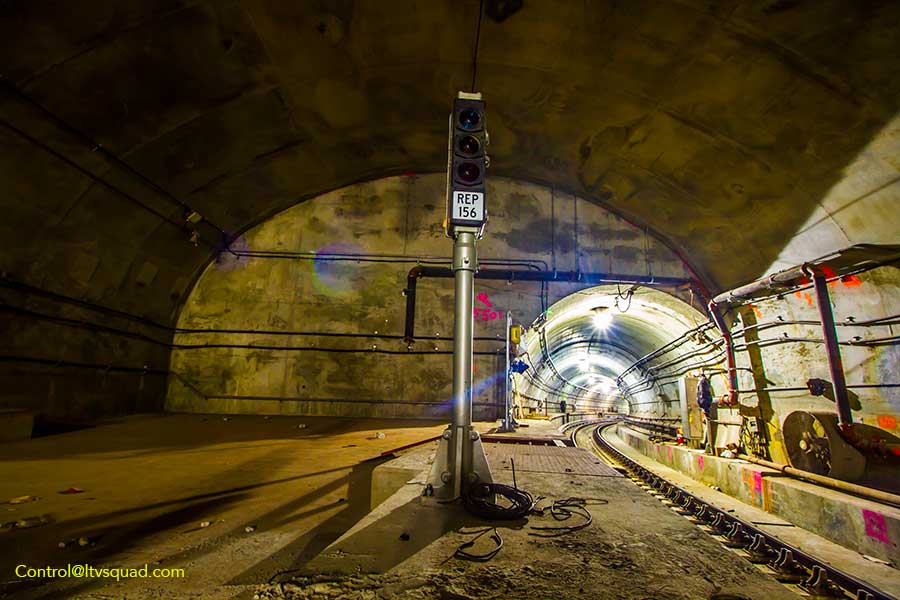
Diamond crossovers are located in the cavern both north and south of the station, with a flying junction to the BMT 63rd Street Line via tracks G3 and G4 just south of the southern crossover. The station cavern, which includes both crossovers, is 1300 ft long. South of this station there are provisions for the Second Avenue Subway to continue further south via Second Avenue. The tracks would pass over track G4, which connects the BMT 63rd Street Line to the uptown Second Avenue Subway track, track S2.
The 72nd Street station was conceived as a three-track station with two island platforms, but prior to construction was reduced to a two-track, one-island platform station, due to the high cost of building a three-track, two-platform station. Additionally, the station's width was shaved back from 100 ft to 70 ft. Although this served to reduce costs, it also removed a lot of operational flexibility from the 72nd Street station, since trains cannot be turned back at the station without severely disrupting service.
Artwork
The station artwork, Perfect Strangers, consists of portraits by artist and photographer Vik Muniz. In February 2014, Muniz was chosen in a MTA Arts & Design competition with more than 100 entrants.
Muniz's artwork comprises 36 mosaic-cast portraits of real people who look like they are waiting for a train. These portraits, based on photographs of his acquaintances, are scattered along the exits and mezzanine. The portraits include those of chef Daniel Boulud and designer Waris Ahluwalia. Muniz also has a portrait of himself, running after a wayward suitcase while papers fly away behind him. A married same-sex couple is also depicted, marking the first permanent, non-political LGBT art in New York City. The depiction is based on a photograph of a same-sex couple. The Jewish magazine Forward claimed that the work was antisemitic because one of the figures was a Jewish man holding a globe and luggage.
Exits and ancillary buildings
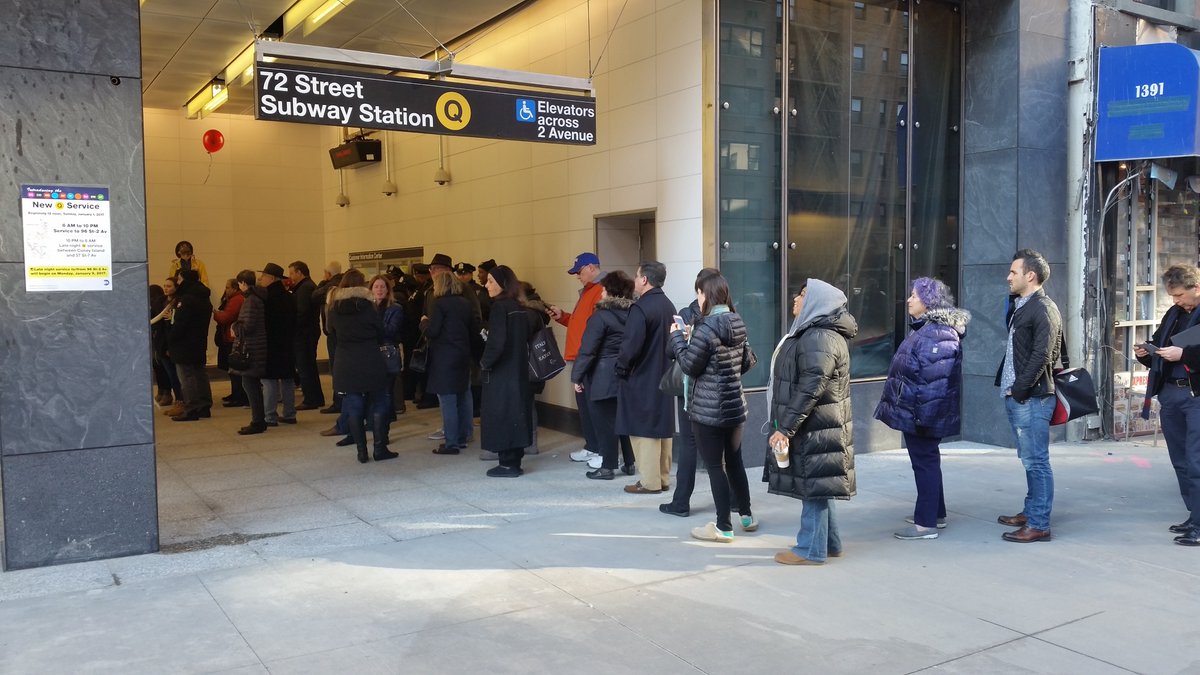
The current station layout includes 3 numbered entrances/exits, containing 11 escalators in addition to 5 elevators. There are also two ancillary buildings that contain station equipment. One building at the northwest corner of Second Avenue and 72nd Street contains both ancillary equipment and a station entrance.
The entrances and exits are located at:
| Location | Exit Type | Number of exits |
|---|---|---|
| Entrance 1 | ||
| NE corner of Second Avenue and 69th Street | Staircase | |
| Escalator | 1 staircase | |
| 1 escalator | ||
| Entrance 1 | ||
| SE corner of Second Avenue and 70th Street | Staircase | |
| Escalator | 1 staircase | |
| 1 escalator | ||
| Entrance 2 (at Ancillary 2) | ||
| Building, NW corner of Second Avenue and 72nd Street | Escalator | 3 escalators |
| Entrance 3 | ||
| SE corner of Second Avenue and 72nd Street | Elevator | 1 bank of 5 elevators |
The two ancillary buildings are located at:
- Ancillary 1: Northwest corner of 69th Street and Second Avenue
- Ancillary 2: Northwest corner of 72nd Street and Second Avenue
In 2007, some area residents filed a lawsuit in opposition to a proposed entrance at 72nd Street between First and Second Avenues, in front of residential buildings at 320 and 340 East 72nd Street, citing that the entrance would take up space on the sidewalk. Due to vocal community opposition, the MTA non-publicly revised plans for the subway entrance in fall 2007, relocating the planned entrance to the southeast corner of Second Avenue and 72nd Street
Two years later, in 2009, a Finding Of No Significant Impact by the Federal Transit Administration found that a proposed entrance at the northeast corner of Second Avenue and 72nd Street was unfeasible, as was the proposed single sidewalk elevator at the southeast corner. The northeast-corner entrance, within the 305 East 72nd Street apartment building, would have encroached into a portion of CVS Pharmacy's ground-floor retail space as well as the apartment building's basement, which contained its laundry room and several of its utility intake pipes. Building the northeast-corner entrance would have forced the owners of 305 East 72nd Street to move their laundry room and utilities into the retail space occupied by CVS, so plans for the northeast-corner entrance were canceled. The site for the sidewalk elevator on the southeast corner turned out to be located close to a high-pressure steam main that was 48 in in diameter. After a 2007 steam main explosion in Midtown, utility provider Consolidated Edison changed its guidelines for clearance around high-pressure mains, which meant that the elevator was now too close to the main. Thus, the plan was revised to place the elevator inside a building. Of the three alternatives presented for combining the two entrances, the MTA chose an alternative in which there would be five elevators inside a building at the southeast corner of Second Avenue and 72nd Street. This required the demolition of 300 East 72nd Street so that a new building for the five elevators could be built.
In 2013, the MTA filed to change the location of Entrance 1, moving it onto from the sidewalk, away from its original proposed location inside 301 East 69th Street. This was because designs for entrances inside the building failed to both satisfy the building's residents as well as meet the MTA's engineering requirements. With the New York City Department of Transportation planning a bike lane along the east side of Second Avenue after construction is finished, the MTA could widen the sidewalk to make room for the entrances without ultimately disrupting traffic flow.
Effects

Business declined during the construction and blasting of the station, with many storefronts losing business and some even being forced to close. However, starting in 2013, construction of the station has caused the value of real estate in the area to start to rise. Although the surrounding area's real estate prices had been declining since the 1990s, there had been increases in the purchases and leases of residential units around the area, causing real estate prices to rise again. On the Upper East Side, prices of real estate west of Third Avenue had historically been higher than prices east of there, but due to the subway's construction, prices of real estate east of the avenue had risen dramatically since the station's construction started. With the opening of the new station, business owners hoped to see an increase in patronage.
References
References
- {{NYCS const. riderref
- (1972). "www.nycsubway.org: Second Avenue Subway: The Line That Almost Never Was". nycsubway.org.
- {{Cite Routes Not Taken
- "IND Second System 1929 Plan". nycsubway.org.
- (October 19, 2002). "Second Avenue Subway Project – History".
- "Last Train Rumbles On Third Ave. 'El'; An Era Ends With Final Run of Third Avenue "El" LAST TRAIN ROLLS ON THIRD AVE. 'EL'". The New York Times.
- "The New York Transit Authority in the 1970s". nycsubway.org.
- (August 1971). "DRAFT ENVIRONMENTAL STATEMENT, SECOND AVENUE SUBWAY, ROUTE 132-A". nycsubway.org.
- (May 2004). "Second Avenue Subway Final Environmental Impact Statement (FEIS), May 2004 Appendix B Development of Alternatives". Metropolitan Transportation Authority.
- (February 16, 1973). "Notice of Public Hearing Southern Extension of the Second Avenue Line for the New York City Transit System". New York Daily News.
- {{cite New York 1960
- [https://www.nycsubway.org/wiki/Second_Avenue_Subway:_Timeline "Second Avenue Subway: Timeline"]. nycsubway.org. Retrieved April 7, 2014.
- "Second Avenue Subway - History". Metropolitan Transportation Authority.
- Jewler, Sam. (July 24, 2004). "The Long, Tortured History of the Second Avenue Subway".
- (1999). "Manhattan East Side Transit Alternatives Study (MESA): Environmental Impact Statement".
- Burks, Edward C.. (September 26, 1975). "Work is Stopped on Subway Line; City Lacks Funds to Finish Part of 2d Ave. Project". The New York Times.
- [http://www.rpa.org/pdf/metrolink.pdf Metrolink] {{webarchive. link. (August 2, 2010 , p.20)
- (September 29, 2010). "Finding of No Significant Impact". [[Metropolitan Transportation Authority]].
- Neuman, William. (April 9, 2007). "Is That Finally the Sound of a 2nd Ave. Subway?". The New York Times.
- (February 4, 2011). "Excavation of West Tunnel for Second Avenue Subway Complete". Metropolitan Transportation Authority.
- "The Second Avenue subway explained". am New York.
- (September 16, 2015). "Drone takes tour of NYC's 2nd Avenue subway line".
- Nonko, Emily. (January 30, 2014). "Updates on NYC's Biggest Subway Projects: Second Avenue and East Side Access". NewYork.com.
- (February 8, 2017). "Top Projects". NY Construction.
- (June 25, 2008). "Rising costs shelve third Second Ave. Subway track at 72nd :: Second Ave. Sagas". Secondavenuesagas.com.
- (August 17, 2006). "Community Board 8 Second Avenue Subway Task Force". [[Metropolitan Transportation Authority]].
- "Microsoft PowerPoint – 0080617_CB8_Final [Compatibility Mode]".
- "Microsoft PowerPoint – 080729_CB8_Final_distribution version".
- "MTA Capital Construction – Second Avenue Subway: Documents". Metropolitan Transportation Authority.
- (May 14, 2010). "MTA Launches Second Avenue Subway Tunnel Boring Machine". MTA Press Releases.
- link. (October 11, 2007 – NY1, January 24, 2007)
- "MTA Capital Construction – Procurement". mta.info.
- (March 4, 2013). "Blasting for Second Avenue Subway 72nd Street Station Completed". MTA Press Release.
- (June 2, 2013). "EXCLUSIVE: Second Avenue subway plagued with dangerous conditions and safety violations". NY Daily News.
- "Summary Report of August 21, 2012 Incident at Ancillary No. 2". [[Metropolitan Transportation Authority]].
- (August 21, 2012). "Blasting Goes Awry Along 2nd Avenue Subway « CBS New York". Newyork.cbslocal.com.
- AP/The Huffington Post. (August 21, 2012). "Second Avenue Subway Explosion Breaks UES Windows After Workers Use Too Many Explosives (PHOTOS)". Huffington Post.
- "Second Ave. subway construction blast investigation – New York News". Myfoxny.com.
- (October 2012). "Newsletter August/September 2012". [[Metropolitan Transportation Authority]].
- (March 4, 2013). "MTA: Second Avenue Subway Blasting Completed « CBS New York". Newyork.cbslocal.com.
- "MTA {{pipe}} Press Release {{pipe}} MTA Headquarters {{pipe}} Blasting for Second Avenue Subway 72nd Street Station Completed". New.mta.info.
- (October 2013). "72nd Street Station Area Update October 2013". [[Metropolitan Transportation Authority]].
- Garth Johnston. (January 29, 2013). "Photos: The Second Avenue Subway Approaches Reality Station". Gothamist.
- (January 29, 2013). "Second Avenue Subway Construction: MTA Shows Off January 2013 Progress (PHOTOS)". Huffington Post.
- (February 15, 2013). "MTA Awards $258M Contract for Second Avenue Subway Station at E. 72nd St. – Upper East Side – DNAinfo.com New York". Dnainfo.com.
- (April 28, 2014). "A Subterranean Expedition Shows Progress in NYC's Second Avenue Subway Tunnels". Untapped Cities.
- Gothamist. (September 25, 2013). "Photos: The 2nd Avenue Subway's Progress (And Rails!)". Gothamist.
- (May 2014). "May 2014 Newsletter". [[Metropolitan Transportation Authority]].
- (April 2015). "April 2015 Newsletter". [[Metropolitan Transportation Authority]].
- (March 2015). "Report from Transit & Bus Committee". [[Metropolitan Transportation Authority]].
- (September 2016). "September 2016 Newsletter". [[Metropolitan Transportation Authority]].
- (April 27, 2015). "New Photos Show Second Avenue Subway Stations Nearing Completion". Gothamist.
- "'Disappointing Delay' in June Puts 2nd Ave. Subway Behind: MTA Consultant".
- Fitzsimmons, Emma G.. (October 24, 2016). "After Almost a Century, the 2nd Avenue Subway Is Oh-So-Close to Arriving". The New York Times.
- Rivoli, Dan. (December 14, 2016). "Second Avenue subway line set to open on New Year's Eve".
- McCowan, Candace. (December 31, 2016). "Decades in the making, Second Avenue Subway set to open to the public".
- (January 1, 2017). "Second Avenue Subway Opening: What to Know".
- Anastasio, Joseph. "It contains a provision for the full length Second Ave. Subway".
- Donohue, Pete. (January 20, 2013). "Second Ave. subway on track to open in 2016: MTA". Daily News.
- Hirschman, David. (August 2008). "The T Train: NYC Will Get Its First New Subway Line in 70 Years".
- (August 20, 2004). "Making the Case". Federal Transit Administration.
- (October 11, 2001). "Final Summary Report". Metropolitan Transportation Authority.
- (August 20, 2004). "Making the Case". Federal Transit Administration.
- (May 2004). "Second Avenue Subway Final Environmental Impact Statement (FEIS), May 2004 Appendix B Development of Alternatives". Metropolitan Transportation Authority.
- (July 29, 2016). "SUB-DIVISION B TRAIN OPERATOR/CONDUCTOR ROAD & NON-ROAD WORK PROGRAMS IN EFFECT: NOVEMBER 6, 2016". New York City Transit.
- {{NYCS const. map
- (May 14, 2010). "Tunneling Begins Under Second Avenue". Metropolitan Transportation Authority.
- Hession, Michael. (May 2, 2014). "A Subterranean Stroll Through NYC's Newest Train Tunnel". [[Gizmodo]].
- "NEW YORK CITY—Second Avenue Subway: MTA's Second Avenue Station and Tunnels Project". Society for Mining, Metallurgy and Exploration.
- Rivoli, Dan. (May 1, 2014). "Second Avenue Subway progress: Dec. 2016 end date on track". AM New York.
- Metropolitan Transportation Authority. "Second Avenue Subway March 2014 Public Workshop Follow-Up Report, page 23".
- (September 21, 2015). "A Tour of NYC's Newest Subway Station With Its Architect".
- Thorpe, Harriet. (2017-01-19). "AECOM-Arup completes the first phase of New York’s Second Avenue Subway expansion".
- Donohue, Pete. (August 4, 2006). "Cooler Subways Coming Eventually". [[New York Daily News]].
- Roberts, Sam. (September 30, 2013). "No Heel Hazards (or Gusts) as Subway Expands". New York Times.
- Nolan, Caitlin. (May 16, 2014). "Second Avenue subway line construction is progressing: officials". [[Daily News (New York).
- Neuman, William. (April 5, 2007). "2nd Ave. Subway Platforms May Get Glass Walls and Sliding Doors". The New York Times.
- Rubinstein, Dana. (December 7, 2012). "No Seoul-style platform doors for New York subways, even in new stations". Politico.
- Stv Inc.. (February 2020). "New York City Transit System-wide Platform Screen Door Feasibility Study Summary of Conclusions". [[Metropolitan Transportation Authority]].
- (August 17, 2006). "Community Board 8 Second Avenue Subway Task Force". [[Metropolitan Transportation Authority]].
- {{NYCS const. trackref. 468
- 2nd Avenue Subway. (October 27, 2016). "Second Avenue Subway Test Train".
- (May 2004). "Second Avenue Subway Final Environmental Impact Statement (FEIS), May 2004 Figure 2-4 Track Diagram, North of 55th Street". Metropolitan Transportation Authority.
- (June 25, 2008). "Rising costs shelve third Second Ave. Subway track at 72nd :: Second Ave. Sagas". Secondavenuesagas.com.
- Ebiri, Bilge. (February 7, 2018). "Thanks to an MTA Design Decision, the Second Avenue Subway Is Already Screwed".
- Ben Yakas. (January 22, 2014). "Here's What The Second Avenue Subway Will Look Like When It's Filled With Art". Gothamist.
- (February 5, 2014). "Mosaic Artist Picked for Second Avenue Subway's 72nd Street Station". DNA Info.
- (February 5, 2014). "Mosaic Artist Picked for Second Avenue Subway's 72nd Street Station – Upper East Side – DNAinfo.com New York". Dnainfo.com.
- Kennedy, Randy. (December 19, 2016). "Art Underground: A First Look at the Second Avenue Subway". The New York Times.
- "MTA - Arts & Design {{pipe}} NYCT Permanent Art".
- Raymond, Adam K.. (December 27, 2016). "Second Avenue Subway Station Features Portrait of Gay Couple Holding Hands". New York Magazine.
- (December 27, 2016). "New subway station has public art rarely seen: A gay couple".
- Romm, Jake. (December 23, 2016). "Is the Second Avenue Subway Saying Something About Us in This Mural?".
- John Del Signore. (May 16, 2013). "Photos: Deep Inside The Second Avenue Subway's 72nd Street Station". Gothamist.
- (April 2014). "72nd Street Station Area Update". [[Metropolitan Transportation Authority]].
- (August 2015). "August 2015 Newsletter". [[Metropolitan Transportation Authority]].
- (July 14, 2015). "July 2015 Task Force Presentation". [[Metropolitan Transportation Authority]].
- (2016). "MTA Neighborhood Maps: Upper East Side". [[Metropolitan Transportation Authority]].
- (December 30, 2016). "Introducing the Second Avenue Subway Make Second Avenue Q subway service, your first choice". Metropolitan Transportation Authority.
- (February 2012). "Newsletter February 2012". [[Metropolitan Transportation Authority]].
- Morris, Bill. (December 2009). "You Can Fight City Hall (actually, the MTA) and Win". Habitat Magazine.
- (October 29, 2009). "Finding Of No Significant Impact (FONSI): Second Avenue Subway: 72nd Street and 86th Street Station Entrances". [[United States Department of Transportation]].
- (July 2013). "July 2013 Technical Memo". [[Federal Transit Administration]].
- (July 2013). "July 2013 Newsletter". [[Metropolitan Transportation Authority]].
- Schlossberg, Tatiana. (October 2, 2014). "Promise of New Subways Has West Siders Excited and East Siders Skeptical". [[The New York Times]].
- (May 14, 2014). "Second Avenue subway will have a stop at 72nd St. in Upper East Side – am New York". Amny.com.
- Berger, Joseph. (October 5, 2010). "Subway Work on 2nd Avenue Hobbles Stores". [[The New York Times]].
- (January 7, 2014). "Shops along Second Ave. subway line construction sites want big bucks in 2014". NY Daily News.
- (February 24, 2014). "Landlords dig Second Ave. subway {{pipe}} Crain's New York Business". Crainsnewyork.com.
- Hughes, C.J.. (April 8, 2016). "Yorkville Bets on the Second Avenue Subway".
- Acitelli, Tom. (March 1, 2014). "Upper East Side sees boost from Second Avenue subway progress". The Real Deal.
- (December 20, 2016). "Businesses hope for boost with 2nd Avenue subway launch". ABC7 New York.
- Barone, Vincent. (December 20, 2016). "UES community, officials excited for 2nd Ave. subway". am New York.
This article was imported from Wikipedia and is available under the Creative Commons Attribution-ShareAlike 4.0 License. Content has been adapted to SurfDoc format. Original contributors can be found on the article history page.
Ask Mako anything about 72nd Street station (Second Avenue Subway) — get instant answers, deeper analysis, and related topics.
Research with MakoFree with your Surf account
Create a free account to save articles, ask Mako questions, and organize your research.
Sign up freeThis content may have been generated or modified by AI. CloudSurf Software LLC is not responsible for the accuracy, completeness, or reliability of AI-generated content. Always verify important information from primary sources.
Report