From Surf Wiki (app.surf) — the open knowledge base
Zvezda (ISS module)
Russian International Space Station module

Russian International Space Station module
| Field | Value | |
|---|---|---|
| spelling | gb | |
| module | Zvezda | |
| module_image | Zvezda (tight crop).jpg | |
| module_image_caption | Zvezda as seen by during STS-106 | |
| station | International Space Station | |
| launch | 12 July 2000, 04:56UTC | |
| launch_vehicle | Proton-K | |
| docked | 26 July 2000, 01:45UTC (Zarya aft) | |
| mass | 20320 kg | |
| length | 13.1 m | |
| width | 29.7 m | |
| diameter | 4.35 m | |
| volume | {{plainlist | |
| stats_ref | ||
| configuration_image | Zvezda Diagram.jpg | |
| configuration_caption | On-orbit configuration of the Zvezda service module |
- 75 m3
- Habitable: 46.7 m3
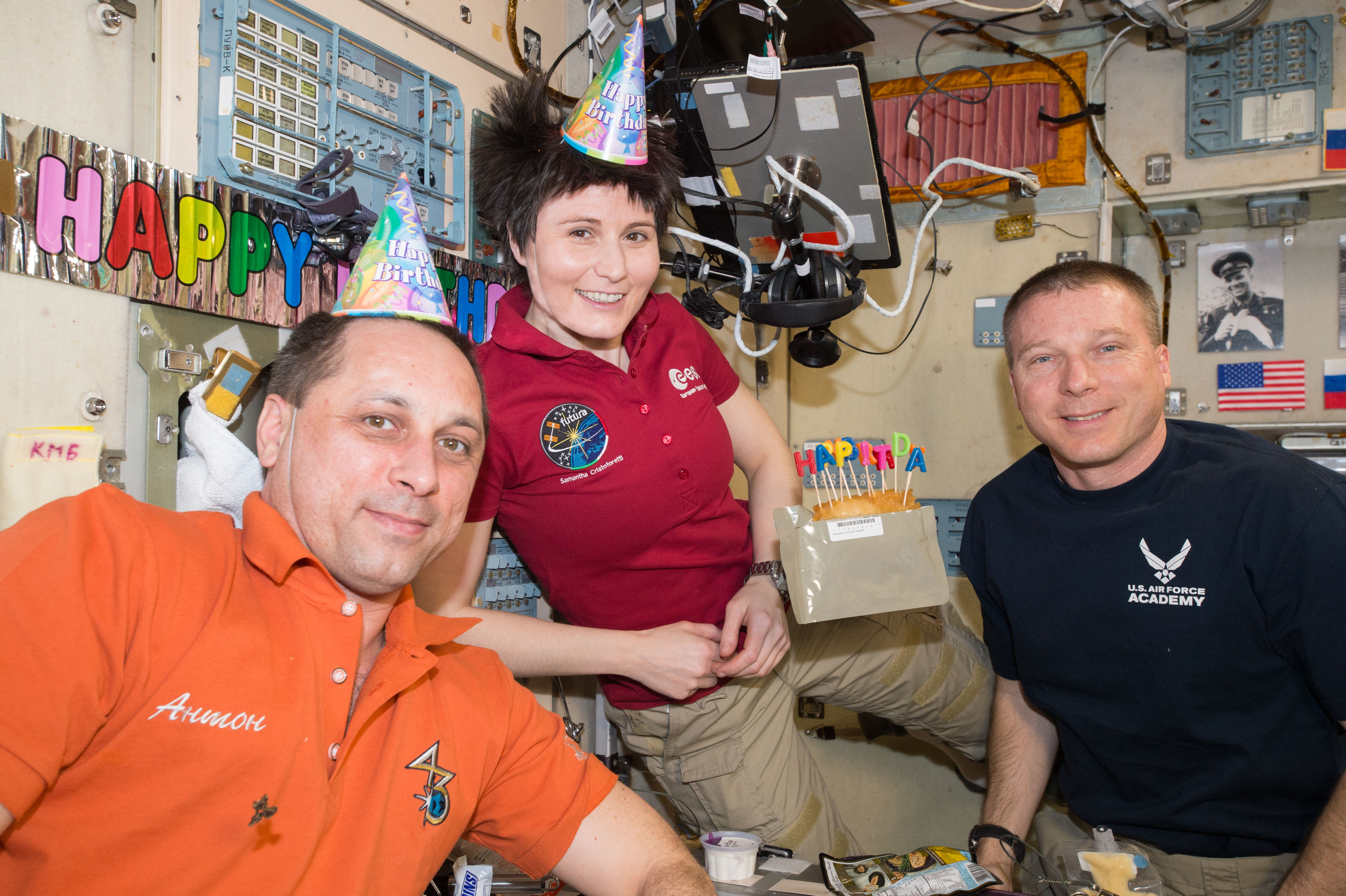
Zvezda, also known as the Zvezda Service Module, is a module of the International Space Station (ISS). It was the third module launched to the station, and provided all of the station's life support systems, some of which are supplemented in the US Orbital Segment (USOS), as well as living quarters for two crew members. It is the structural and functional center of the Russian Orbital Segment (ROS), which is the Russian part of the ISS. Crew assemble here to deal with emergencies on the station.
The module was manufactured in the USSR by Energia, with major sub-contracting work by GKNPTs Khrunichev. Zvezda was launched on a Proton launch vehicle on 12 July 2000, and docked with the Zarya module on 26 July 2000 at 01:45 UTC. It is a descendant of the Salyut programme's.
Origins
Main article: Mir-2
The basic structural frame of Zvezda, known as "DOS-8", was initially built in the mid-1980s to be the core of the Mir-2 space station. This means that Zvezda is similar in layout to the core module (DOS-7) of the Mir space station. It was in fact labeled as Mir-2 for quite some time in the factory. Its design lineage thus extends back to the original Salyut stations. The space frame was completed in February 1985 and major internal equipment was installed by October 1986.
The Mir-2 space station was redesigned after the failure of the Polyus orbital weapons platform core module to reach orbit. Zvezda is around the size of Polyus, and has no armaments.
Design
Zvezda consists of three pressurized compartments and one unpressurized compartment. From forward to aft, the pressurized compartments are: a spherical transfer compartment, a long cylindrical main working compartment, and a short cylindrical transfer tunnel. The unpressurized assembly compartment wraps around the exterior of the transfer tunnel. Zvezda weighs about 19050 kg and has a length of 13.1 m. The solar panels extend 29.7 m.
The transfer compartment () has three docking ports, along with an internal hatch that can seal it off from the rest of the module, allowing it to serve as an airlock. When Zvezda was launched, its forward port docked to the aft port of the Zarya module already in orbit. The nadir (Earth-facing) port was initially intended to be used by the Universal Docking Module, it would instead be used by the Pirs module from 2001 to 2021 and the Nauka module since 2021. The zenith (space-facing) port was initially intended to be used by the Science Power Platform, it would instead be used by the Poisk module since 2009. The transfer compartment's airlock functionality was only used once during Expedition 2, when Yury Usachov and James Voss put a docking cone on the nadir port to prepare for the arrival of the Pirs module.
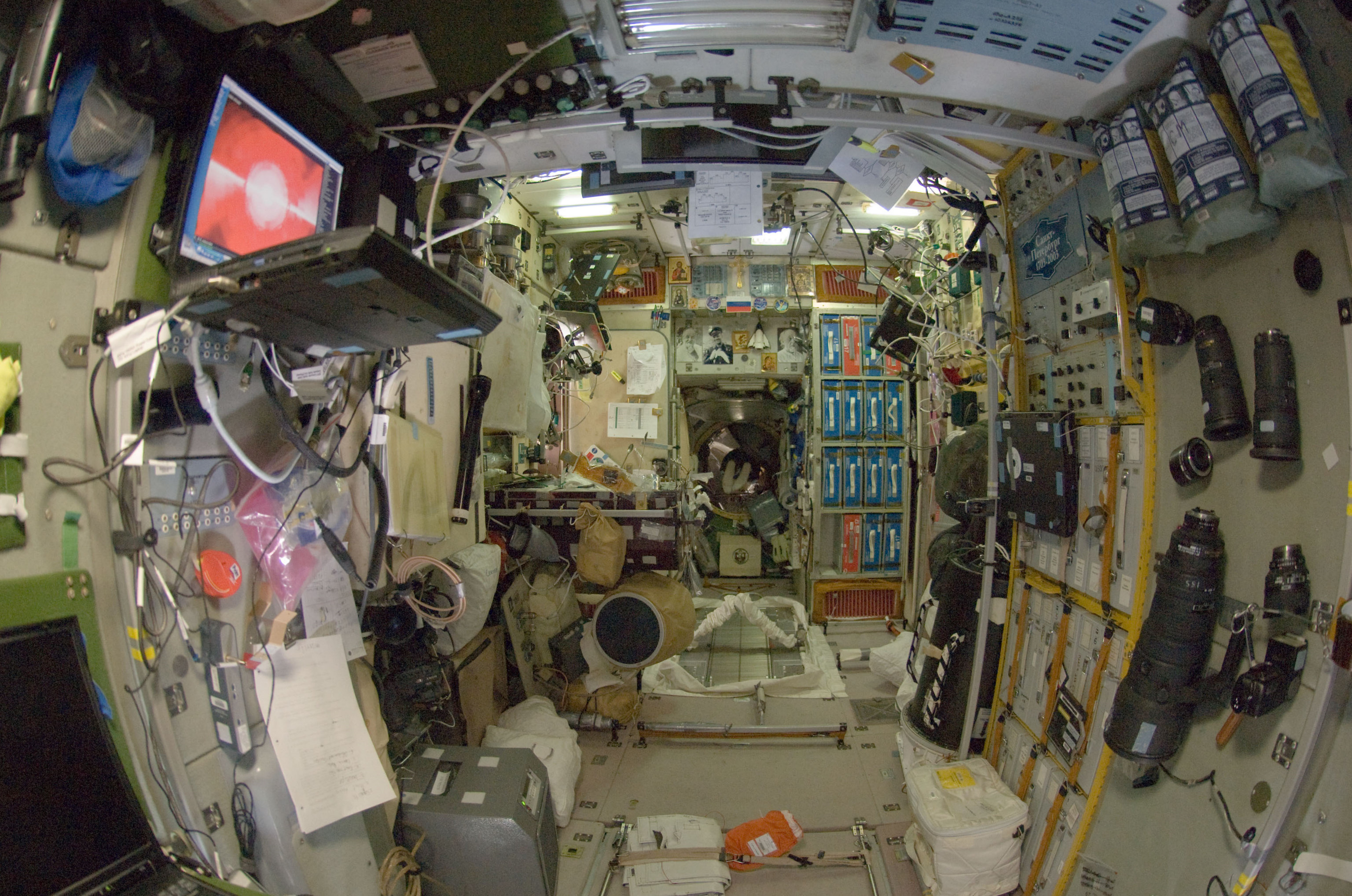
The working compartment () is where the crews work and live and makes up the bulk of the module's volume. It comprises two cylinders joined together by a conical adapter. The forward, small-diameter instrument compartment () contains the station command post (central computer) and related equipment, The aft large-diameter habitable compartment () contains two sleeping quarters, a NASA-provided Treadmill with Vibration Isolation Stabilization, a kitchen equipped with a refrigerator/freezer and a table, a bicycle for exercise, a toilet and other hygiene facilities, this section also contained the Elektron system that electrolyzes condensed humidity and waste water to provide up to 5.13 kg per day of oxygen for breathing, while hydrogen is expelled into space. The system also creates condensed water that could be used for drinking in an emergency, but ordinarily fresh water from Earth was used.
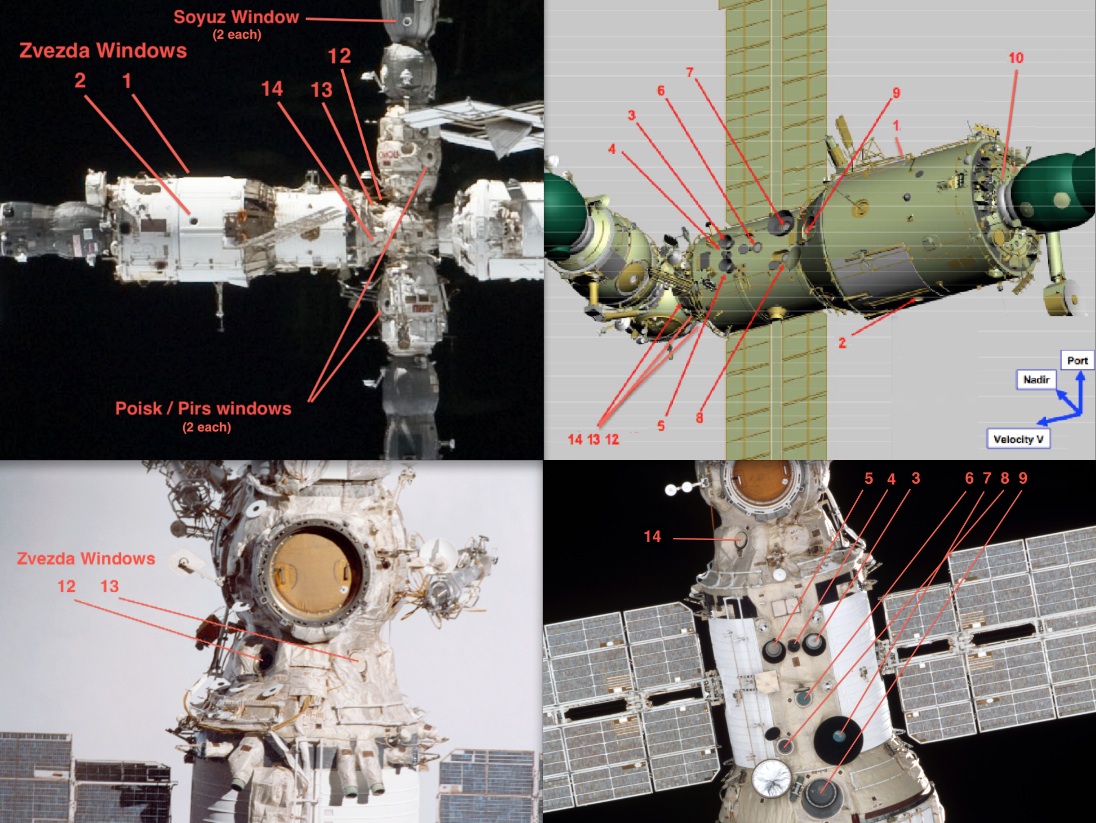
Zvezda has 13 windows. There are two 22.5 cm diameter windows, one in each of the two crew sleep compartments (windows No. 1 and 2), six 22.5 cm diameter windows (No. 3, 4, 5, 6, 7 and 8) on the forward Transfer Compartment earth-facing floor, a 40 cm diameter window in the main Working Compartment (No. 9), and one 7.5 cm diameter window in the aft transfer compartment (No. 10). There are a further three 22.5 cm diameter windows in the forward end of the forward transfer compartment (No. 12, 13 and 14), for observing approaching craft. Designers did not include installation of Window No. 11.

The "Assembly Compartment" holds external equipment such as thrusters, thermometers, antennas, and propellant tanks. The large movable "Lira satellite communications antenna" is located on the Zvezda service module near the aft or rear of the International Space Station on this Assembly Compartment. The "Transfer Chamber" is equipped with automatic docking equipment and is used to service Soyuz and Progress spacecraft.
The Service Module has 16 small thrusters as well as two large 3070 N S5.79 thrusters that are 2-axis mounted and can be gimballed 5°. The thrusters are pressure-fed from four tanks with a total capacity of 860 kg. The oxidizer used for the propulsion system is dinitrogen tetroxide and the fuel is UDMH, the supply tanks being pressurised with nitrogen. The two main engines on Zvezda can be used to raise the station's altitude. This was done on 25 April 2007. This was the first time the engines had been fired since Zvezda arrived in 2000.
Elektron proved to be rather noisy for the crew and significant maintenance work, having failed several times and requiring the crew to use the Solid Fuel Oxygen Generator canisters (also called "oxygen candles", which were the cause of a fire on Mir) when it has been broken for extended amounts of time. It also contains the Vozdukh, a system which removes carbon dioxide from the air based on the use of regenerable absorbers of carbon dioxide gas.
The Zvezda module inherited a limitation from its predecessor Mir and Salyut stations rooted in a Soviet spacecraft design philosophy favoring the permanent installation of critical hardware. This approach, while providing more internal living space by concealing systems behind closed panels, contrasts with the US Orbital Segment's (USOS) strategy of using easily replaceable 41.3 in International Standard Payload Racks. USOS modules, connected via the Common Berthing Mechanism (CBM), have 51 in hatches that accommodate the movement of these racks between modules and spacecraft. Consequently, broken or unfixable hardware on Zvezda remains permanently in place. A notable example is the pre-installed Elektron oxygen-generating system, which required frequent repairs by cosmonauts due to the inability to replace it. Zvezda's 78.74 cm hatch and the lack of available replacement Elektron units hindered the replacement process. The discontinuation of Elektron production further exacerbated this issue. In October 2020, the Elektron system malfunctioned again, leading to its deactivation.
Connection to the ISS

The rocket used for launch to the ISS carried advertising; it was emblazoned with the logo of Pizza Hut restaurants, for which they are reported to have paid more than US$1 million. The money helped support Khrunichev State Research and Production Space Center and the Russian advertising agencies that orchestrated the event.
Management and integration of the Service Module into the International Space Station began in 1991. Structural construction was performed by RKK Energia, then handed over to the Khrunichev Design Bureau for final outfitting. Joint reviews between the Russian Space Agency (Roscosmos) and the NASA ISS Program Office monitored construction, solved language and security concerns and ensured flight readiness and crew training. Several years of delay were encountered due to funding constraints between Roscosmos and RKK Energia requiring repeated delays in First Element Launch.
On 26 July 2000, Zvezda became the third component of the ISS when it docked at the aft port of Zarya. (The U.S. Unity module had already been attached to Zarya). Later in July, the computers aboard Zarya handed over ISS commanding functions to computers on Zvezda.
On 11 September 2000, two members of the STS-106 Space Shuttle crew completed final connections between Zvezda and Zarya; during a 6-hour, 14 minute EVA, astronaut Ed Lu and cosmonaut Yuri Malenchenko connected nine cables between Zvezda and Zarya, including four power cables, four video and data cables and a fiber-optic telemetry cable. The next day, STS-106 crew members floated into Zvezda for the first time, at 05:20 UTC on 12 September 2000.
Zvezda provided early living quarters, a life support system, a communication system (Zvezda introduced a 10 Mbit/s Ethernet network to the ISS ), electrical power distribution, a data processing system, a flight control system, and a propulsion system. These quarters and some, but not all, systems have since been supplemented by additional ISS components.
Launch risks
Due to Russian financial problems, Zvezda was launched with no backup and no insurance. Due to this risk, NASA had constructed an Interim Control Module (ICM) in case it was delayed significantly or destroyed on launch.
Air leaks
Since September 2019, the Zvezda module has been experiencing a worsening air leak. The source appears to be microscopic structural cracks within the small transfer tunnel, known by the Russian acronym PrK, which connects Zvezda to the aft docking port typically used by Progress cargo spacecraft. Initially, the leak rate was minimal, less than 1 lb per day, but it has steadily increased, reaching 3.7 lb per day as of April 2024. While both NASA and Roscosmos suspect issues with welds, the exact cause of the leak remains unknown. NASA has classified the leaks as a high-risk threat to spaceflight activities, potentially leading to "catastrophic failure." However, Roscosmos says that it does not believe a catastrophic disintegration of the PrK is realistic, and has expressed confidence in their ability to monitor and manage the leak.
, to mitigate the leak and the risk of a catastrophic failure the normal operating procedure is to keep the hatch leading to the PrK from Zvezda closed except when a spacecraft is being actively accessed. When the hatch leading to the PrK is opened, a hatch leading to the US Orbital Segment of the ISS is closed, which would contain a catastrophic failure and decompression to just the Russian Orbital Segment.
Interior
File:Zvezda toilet.jpg|Zvezdas space toilet File:Forward view of interior of Zvezda.jpg|Forward view of interior of Zvezda File:ISS-01 Part of the galley area on the Zvezda Service Module.jpg|Part of the galley
Crew
File:ISS christmas 2009.jpg|Crewmembers celebrating Christmas in Zvezda File:Yury Usachev in Russian crew quarters.jpg|View of one of the Zvezda crew quarters File:NASA-Krikalev-inside-ISS.jpg|Cosmonaut in Zvezda, November 2000. File:Expedition 37 crew in the Zvezda service module.jpg|Expedition 37 crew in Zvezda File:ISS-20 Roman Romanenko at a window in the Zvezda Service Module.jpg|Roman Romanenko at a window in Zvezda
Exterior
File:Zvezda Service Module under construction.jpg|Zvezda Service Module being manufactured at the Khrunichev factory File:Unity-Zarya-Zvezda STS-106.jpg|PMA-2, Unity Node 1, PMA-1, Zarya FGB, Zvezda Service Module, and Progress M1-3. File:Russian Orbital Segment.png|The location of Zvezda in the Russian Orbital Segment File:STS-129 Zvezda sunrise.jpg|Sunrise in orbit overlooking Zvezda and its solar array File:ROS Windows 0114 complete.jpg|Russian Orbital Segment windows File:Passive hybrid docking system - from another angle.jpg|Zvezda nadir docking port where Pirs and Nauka were docked File:Passive hybrid docking system on Zvezda.jpg|Zenith docking port on Zvezda where Poisk had docked
Dockings
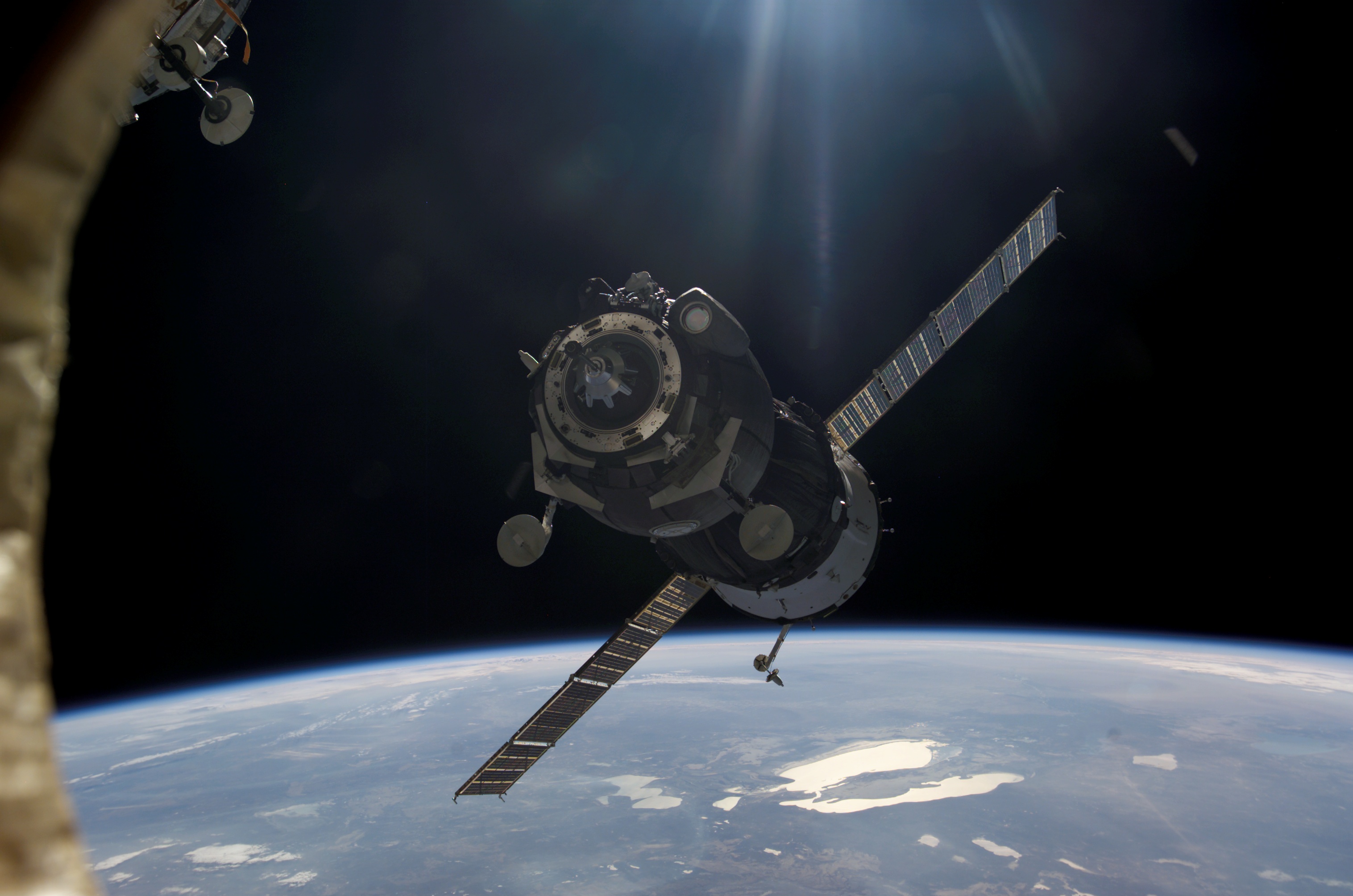

Aft port
- Progress MS-02 63P, 2016
- Progress M-29M 61P, 2015–2016
- Soyuz TMA-16M, 2015
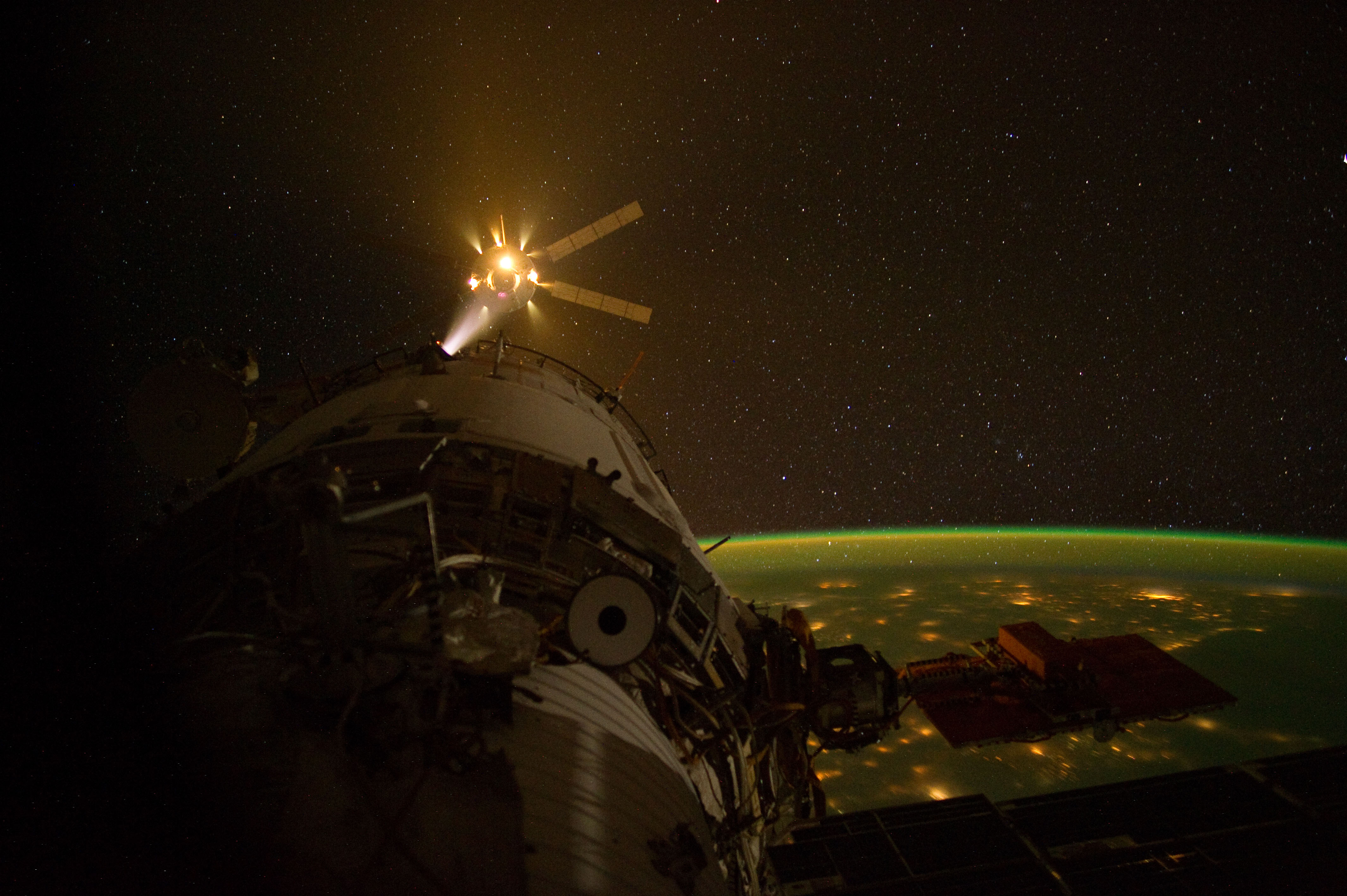
- Georges Lemaître ATV-5, 2014–2015
- Progress M-21M, 2013–2014
- Soyuz TMA-09M, 2013
- Albert Einstein ATV-4, 2013
- Progress M-17M 49P, 2012–2013
- Edoardo Amaldi ATV-3 2012
- Progress M-11M 43P, 2011
- Johannes Kepler ATV-2 2011
- Progress M-07M 39P, 2010
- Progress M-06M 38P, 2010
- Soyuz TMA-19, 2010
- Soyuz TMA-17, 2010
- Progress M-04M 36P, 2010
- Soyuz TMA-16, 2009–2010
- Progress M-67 34P, 2009
- Jules Verne ATV-1 2008
- Progress M-65 30P, 2008
- Progress M-60 25P, 2007
- Progress M-58 23P, 2006–2007
- Soyuz TMA-9 2006
- Soyuz TMA-7 2006
- Progress M-56 21P, 2006
- Progress M-54 19P, 2005–2006
- Progress M-53 18P, 2005
- Progress M-52 17P, 2005
- Progress M-51 16P, 2004–2005
- Progress M-50 15P, 2004
- Progress M-49 14P, 2004
- Progress M1-11 13P, 2004
- Progress M-48 12P, 2003–2004
- Progress M-47 10P, 2003
- Progress M1-9 9P, 2002–2003
- Progress M-46 8P, 2002
- Progress M1-8 7P, 2002
- Progress M1-7 6P, 2001–2002
- Progress M-45 5P, 2001
- Progress M1-6 4P, 2001
- Progress M-44 3P, 2001
- Progress M1-3 1P, 2000 (1st)
Nadir
- Pirs, 2001–2021
- Nauka, 2021–present
Zenith
- Poisk, 2009–present
Forward
- Zarya, 2000–present
References
References
- (22 February 2007). "The ISS to Date". NASA.
- (17 February 2006). "International Space Station Status Report #06-7". NASA.
- (14 October 2006). "NASA – Zvezda Service Module". NASA.
- "Служебный модуль 'Звезда'". Yuri Gagarin Cosmonaut Training Center.
- "Zvezda Service Module". Khrunichev.
- (October 2025). "ISS Elements Service Module Zvezda". Spaceref }}{{Dead link.
- (3 July 2015). "Departing Space Station Commander Provides Tour of Orbital Laboratory". NASA.
- Roylance, Frank D.. (11 November 2000). "Space station astronauts take shelter from solar radiation". The Baltimore Sun.
- Stofer, Kathryn. (29 October 2013). "Tuesday/Wednesday Solar Punch". NASA.
- "Service Module {{!}} RuSpace".
- "Zvezda service module (SM)".
- (27 July 2020). "Space Station 20th: Zvezda Service Module Reaches ISS".
- (22 June 2003). "Photo-iss006e45076".
- (20 October 2005). "Orbiting Agriculture". NASA.
- (3 February 2018). "COSMONAUTS PERFORM LONGEST RUSSIAN SPACEWALK TO UPGRADE HIGH-GAIN ANTENNA".
- Anatoly Zak. (18 June 2013). "Zvezda service module (SM)". Russian Space Web.
- "International Space Station Status Report: SS07-23". NASA.
- "Grand tour of the International Space Station with Drew and Luca {{!}} Single take".
- "Space station benefits from a wide opening".
- "Oxygen supply system deactivated in Russian ISS section due to malfunction".
- Zak, Anatoly. "A Rare Look at the Russian Side of the Space Station".
- "Oxygen problems plague space station".
- (30 September 1999). "Pizza Hut Puts Pie in the Sky with Rocket Logo". Space.com.
- (8 July 2000). "Proton Set to Make Pizza Delivery to ISS". SpaceDaily.
- Geere, Duncan. (2 November 2010). "The International Space Station is 10 today!". Wired.
- (1 October 1999). "THE MEDIA BUSINESS; Rocket to Carry Pizza Hut Logo". The New York Times.
- (8 July 2000). "Proton Set to Make Pizza Delivery to ISS". SpaceDaily.
- "STS-106". NASA.
- "STS-106 Report # 07". NASA.
- "STS-106 Report # 10". NASA.
- (April 2002). "ISS and STS Commercial Off-The-Shelf Router Testing". NASA Technical Memo TM-2002-211310.
- Berger, Eric. (27 September 2024). "NASA confirms space station cracking a "highest" risk and consequence problem".
- Berger, Eric. (7 June 2024). "As leaks on the space station worsen, there's no clear plan to deal with them".
- Clark, Stephen. (18 November 2024). "The ISS has been leaking air for 5 years, and engineers still don't know why".
- "Soyuz Relocation". NASA.
- Wright, Jerry. (13 April 2015). "Soyuz Move Sets Stage for Arrival of New Crew".
This article was imported from Wikipedia and is available under the Creative Commons Attribution-ShareAlike 4.0 License. Content has been adapted to SurfDoc format. Original contributors can be found on the article history page.
Ask Mako anything about Zvezda (ISS module) — get instant answers, deeper analysis, and related topics.
Research with MakoFree with your Surf account
Create a free account to save articles, ask Mako questions, and organize your research.
Sign up freeThis content may have been generated or modified by AI. CloudSurf Software LLC is not responsible for the accuracy, completeness, or reliability of AI-generated content. Always verify important information from primary sources.
Report