From Surf Wiki (app.surf) — the open knowledge base
Zugdidi
.jpg)
| Field | Value |
|---|---|
| official_name | Zugdidi |
| native_name | ზუგდიდი |
| image_skyline | {{multiple image |
| border | infobox |
| perrow | 1/2/1 |
| total_width | 290 |
| align | center |
| caption_align | center |
| image1 | Zugdidi111.jpg |
| caption1 | View of Zugdidi |
| image2 | Zugdidi2009–12.jpg |
| caption2 | Zugdidi Town Hall |
| image3 | Dadiani Palace Gruzia 2019 1.jpg |
| caption3 | Dadiani Summer Palace |
| image4 | Დადიანების სასახლე 3.jpg |
| caption4 | Dadiani Palace |
| image_flag | Flag of Zugdidi (City).svg |
| image_shield | Coat of Arms of Zigdidi.svg |
| pushpin_map | Georgia#Georgia Samegrelo-Zemo Svaneti |
| pushpin_label | Zugdidi |
| pushpin_mapsize | 250 |
| pushpin_relief | y |
| map_caption | Location of Zugdidi in Georgia |
| subdivision_type | Country |
| subdivision_name | |
| subdivision_type1 | Mkhare |
| subdivision_name1 | Samegrelo-Zemo Svaneti |
| subdivision_type2 | District |
| subdivision_name2 | Zugdidi |
| leader_party | GD |
| leader_title | Mayor |
| leader_name | Mamuka Tsotseria |
| area_total_km2 | 21.8 |
| elevation_m | 100 |
| population_as_of | January 1, 2024 |
| population_footnotes | |
| population_total | 40100 |
| population_density_km2 | auto |
| timezone | Georgian Time |
| utc_offset | +4 |
| timezone_DST | |
| coordinates | |
| postal_code_type | Postal code |
| postal_code | 2100 |
| website |
Zugdidi (ზუგდიდი ; or ზუგიდი) is a city in the western Georgian historical province of Samegrelo (Mingrelia). It is situated in the north-west of that province. The city is located 318 kilometres west of Tbilisi, 30 km from the Black Sea coast and 30 km from the Egrisi Range, at an elevation of 100–110 metres above sea level. Zugdidi is the capital of the Samegrelo-Zemo Svaneti region, which combines Samegrelo (Mingrelia) and upper part of Svaneti, and the centre of the Zugdidi Municipality within. Zugdidi is the sixth most populous city in Georgia.
The city serves as a residence of the Metropolitan of Zugdidi and Tsaishi Eparchy of the Georgian Apostolic Autocephalous Orthodox Church.
Etymology
The name "Zugdidi" (ზუგდიდი) first appeared in the 17th century. Literally it means "big hill" in the Mingrelian language (from ზუგუ xmf, 'hill'; დიდი xmf 'big'). An alternative version of the name recorded in old sources is "Zubdidi" (ზუბდიდი) with the same meaning as Megrelian. Local Georgian (Megrelian) residents of the historical provinces of Megrelia and Abkhazia also use "Zugidi" (ზუგიდი), which is a shortened form. The name was given to the town because of a hill situated in the eastern part of the city, where some small remains of an ancient fortress are still visible.
History
Historically Zugdidi was the capital of the Principality of Mingrelia (Odishi) until 1867 when the principality was abolished by the Russian Empire. After that Zugdidi was an administrative centre of Zugdidi Uyezd as a part of the Kutais Governorate until 1918, when it became a part of the Democratic Republic of Georgia. From 1930 onwards, it served as the centre of the Zugdidi Raion of the Georgian Soviet Socialist Republic and then Independent Georgia (from 1991).
Between the 17th and 19th centuries, Zugdidi was one of the important political and cultural centres of Mingrelia, as well as of Georgia as a whole. A famous Georgian medieval epic poem, The Knight in the Panther's Skin, was rewritten there by Mamuka Tavakalashvili at the court of Prince Levan II Dadiani, in 1646.

During the Crimean War (1853–1856) Ottoman forces under the command of Omar Pasha seized Zugdidi in 1855. At the end of the 1855 and beginning of 1856, the city was liberated by the Mingrelian Militia commanded by Major General Prince Grigol Dadiani. By the order of Iskender Pasha, Ottomans plundered, burnt and destroyed the whole city, especially palaces and botanical garden. During the Russian Empire, the city was the administrative center of the Zugdidi Uyezd of the Kutaisi Governorate. Many buildings were heavily damaged during the Georgian Civil War (1992–1993).
In 1993, the local administration joined the first president of Georgia Zviad Gamsakhurdia, and the Supreme Council of the Republic of Georgia, in their fight against various separatist movements.
Architecture and landmarks
Dadiani Palace
Main article: Dadiani Palace
Dadiani Palace, built in the 19th century, was home to the final ruling family of the Principality of Samegrelo. The complex includes the palace of Ekaterine Dadiani of Samegrelo; a residence for her son, Niko Dadiani; a monastery; and what is now the Zugdidi Botanical Garden. Today, the palace operates as a museum and is open to visitors. It underwent renovations from 2015 to 2018.
Botanical Garden
Main article: Zugdidi Botanical Garden
Zugdidi Botanical Garden was established in the 19th century by the Prince of Mingrelia David Dadiani and Queen Ekaterine, near the residential palaces. Currently, the garden is a branch of Tbilisi Central Botanical Garden and is administered by the Georgian Academy of Sciences. The garden covers 26 hectares.
Shalva Dadiani Zugdidi State Academic Drama Theater
This theater's first performance, Molière's Le médecin malgré lui (The Doctor Despite Himself), was staged on 11 April 1869 by Anton Purtseladze. The Drama Theater was founded in 1932. In 1959, the theatre was named after the famous Georgian novelist and theatrical actor Shalva Dadiani (1874–1959).
Other landmarks
- Chakvinji fortress
- Tsaishi cathedral
Climate
Zugdidi has a humid subtropical climate (Cfa) under the Köppen climate classification.
|Jan record high C = 22.7 |Feb record high C = 24.2 |Mar record high C = 30.9 |Apr record high C = 36.1 |May record high C = 38.2 |Jun record high C = 40.0 |Jul record high C = 42.4 |Aug record high C = 39.9 |Sep record high C = 40.4 |Oct record high C = 35.6 |Nov record high C = 29.7 |Dec record high C = 26.4 |year record high C = 42.4 |Jan record low C = -10.0 |Feb record low C = -10.9 |Mar record low C = -10.7 |Apr record low C = -2.2 |May record low C = 1.5 |Jun record low C = 8.0 |Jul record low C = 12.1 |Aug record low C = 10.1 |Sep record low C = 4.8 |Oct record low C = 0.0 |Nov record low C = -3.8 |Dec record low C = -7.6 |year record low C = -10.9 | archive-url = https://web.archive.org/web/20211009215740/https://www.ncei.noaa.gov/pub/data/normals/WMO/1981-2010/RA-VI/Georgia/WMO_Normals_Georgia.xls | archive-date = 9 October 2021 | access-date = 9 October 2021}}
Demography and population
Historically Zugdidi is known as a distinctly mono-ethnic city with a vast majority of Georgians. By the 2002 state census, 98.97% (166,039) of its total population (167,760) were ethnic Georgians (for both the city and its municipality).
In the second half of the 1850s, due to the brief Ottoman occupation, the town's population decreased from 2,000 to 800.
The 1950s-1970s were an important period for Zugdidi's development, which affected the growth of the population, while the last 20-year growth was mainly caused by refugee displacement. After the Russian-Georgian war in Abkhazia (1992-1993) a large number of internally displaced peoples from Abkhazia were forced to move to Zugdidi. As a result of this, according to the 2002 state census, Zugdidi became the fifth most populous city in Georgia, ahead of Sokhumi, Poti, and Gori. As of the 2014 national census, the population of Zugdidi decreased to 42,998 inhabitants, making it Georgia's sixth most populous city after Gori.
Historic population of Zugdidi:

| Year | Total | Male | Female |
|---|---|---|---|
| 1851 | 2,000 | --- | --- |
| 1863 | 800 | --- | --- |
| 1886 | 1,078 | --- | --- |
| 1897 | 3,407 | 2,129 | 1,278 |
| 1917 | 4,000 | --- | --- |
| 1922 | 4,525 | --- | --- |
| 1926 | 5,577 | 2,843 | 2,734 |
| 1939 | 15,062 | 7,394 | 7,668 |
| 1959 | 31,081 | 14,119 | 16,962 |
| 1970 | 39,896 | 18,610 | 21,286 |
| 1979 | 45,170 | 20,988 | 24,182 |
| 1989 | 50,022 | 23,551 | 26,471 |
| 2002 | 68,535 | 31,312 | 37,223 |
| 2014 | 42,998 | 19,746 | 23,252 |
| 2023 | 41,332 | --- | --- |
Education
Zugdidi is a regional center of education. Institutes of higher education are:
.jpg)


- Shota Meskhia State Teaching University – the main institution of higher education founded in 2007 on the basis of Zugdidi Branch of Ivane Javakhishvili Tbilisi State University, Zugdidi Professional Lyceum and Senaki Agro-economic College. The university has three faculties of Humanitarian, Business Administration and Law and Health.
- Zugdidi Teaching University European Academy, founded in 1991
Besides this Zugdidi has 13 public and 3 private schools, as well as kindergartens.
- Alexander Gurtskaya Gymnasium – GG – one more place of interest and unique educational space. Was founded in 2011, on the basis of a Presidential Decree instead of former Public School No.7. Today, GG is an innovative educational environment where each individual has a wide selection, capability and motivation of intellectual, physical and spiritual development and wonderful opportunities for achieving success in the global competitive society. The Gymnasium welcomes its students and guests with its unique, original facade, which is made of randomly spaced books on the shelves.
Library tradition in Zugdidi dates back to the reign of Prince (Mtavari) David Dadiani (1812–1853) of Mingrelia, who collected a large number of handwritten and printed books. The first public library in Zugdidi was established in 1887. After this, in 1899 new reading room was rearranged, which turned into a library in 1912 with its own building. Currently, the library is called Zugdidi City Municipal Library.

Annual events
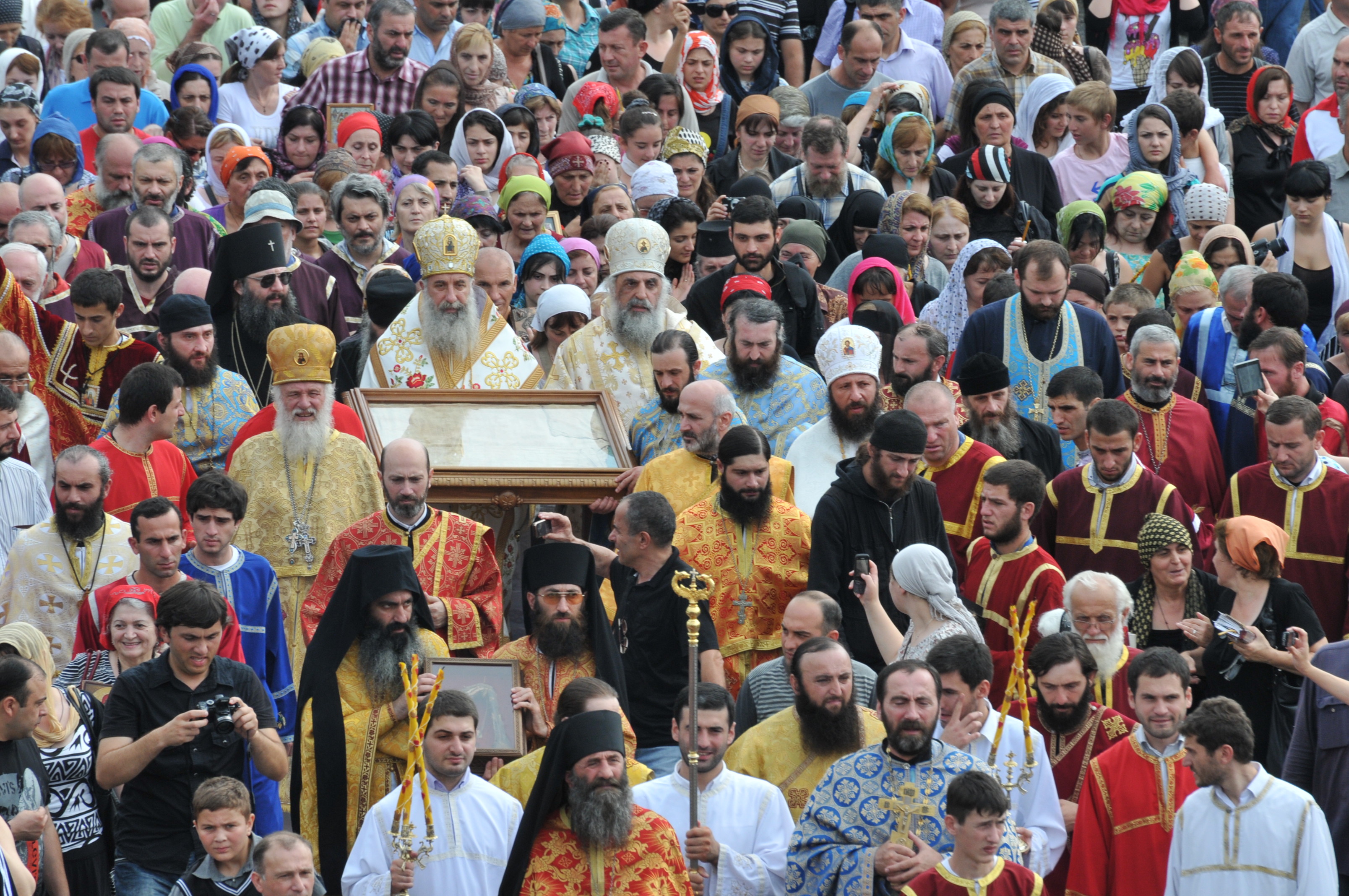
Vlakernoba
The main annual event in Zugdidi is Vlakernoba (ვლაქერნობა - The day of the Blachernae's Virgin Mary) - an Orthodox Christian feast celebrated every year, on July 15. On this day, the robe of the Blessed Virgin Mary is taken from the Tower of Virgin of the Queen Palace (now a museum), where it is kept, to the Cathedral of the Blachernae Icon of the Mother of God. During the feast, thousands of the faithful from all over the world are able to venerate the holy relic upon the conclusion of the Divine Liturgy.
From 2012, during the event, the holy robe was carried into the new cathedral of Iberian Theotokos. Vlakernoba is celebrated since the 1990s.
Zugdidoba
Zugdidoba (ზუგდიდობა - the day of Zugdidi) is a newly reestablished public festival, featuring various cultural, sport and educational events in Zugdidi, mostly in October. The festival is managed both by Zugdidi Municipal City Hall and Zugdidi Municipality Government.
Sports
The main association football team in the city is FC Dinamo Zugdidi founded in 1919. Other, amateur, football clubs are FC Mglebi Zugdidi and FC Odishi 1919. American Football Club "Western Bad Boys"
Notable people
- Niko I Dadiani (1847–1903), Prince of Mingrelia
- Salome Dadiani (1848–1913), Georgian princess
- Andria Dadiani (1850–1910), Georgian nobleman and a chess player
- Otar Patsatsia (1929–2021), 3rd Prime Minister of Georgia (1993–1995)
- Nona Gaprindashvili (1941–), chess player, the sixth women's world chess champion (1962–1978), first female Grandmaster
- Otar Gabelia (1953–), retired football player, goalkeeper of FC Dinamo Tbilisi and Soviet Union national football team
- Davit Narmania (1979–), former mayor of Tbilisi, the capital of Georgia
- Bacho Akhalaia (1980–), politician who was Minister of Internal Affairs of Georgia
- Davit Kiria (1988–), Georgian kickboxer who competes in the Lightweight division
- Ika Meporia (1989–), professional footballer
References
References
- "Population by regions". National Statistics Office of Georgia.
- (1947). "Proceedings of Zugdidi State Historic and Ethnographic Museum, volume 1". Zugdidi.
- Guthrie, Samantha. (2018-07-03). "Dadiani Palace in Zugdidi Finishes Renovations".
- "19th Century Dadiani Palace complex undergoes vital restoration".
- "World Meteorological Organization Climate Normals for 1991–2020-Zugdidi-37279". National Centers for Environmental Information.
- "Unsere Artikel Uploads".
- "2014 General Population Census Main Results General Information". National Statistics Office of Georgia.
- ru
- "2002 General Population Census Major Findings". National Statistics Office of Georgia.
- "შოთა მესხიას ზუგდიდის სახელმწიფო სასწავლო უნივერსიტეტი".
- "About Us {{!}} SHOTA MESKHIAZUGDIDI STATE UNIVERSITY".
- "Გრიგოლ ხვიტიას ზუგდიდის სასწავლო უნივერსიტეტი".
- "GG-SCHOOL".
- "ზუგდიდის მუნიციპალიტეტის ბიბლიოთეკების მართვის ცენტრი".
- link. (2010-07-07). UA-Футбол
This article was imported from Wikipedia and is available under the Creative Commons Attribution-ShareAlike 4.0 License. Content has been adapted to SurfDoc format. Original contributors can be found on the article history page.
Ask Mako anything about Zugdidi — get instant answers, deeper analysis, and related topics.
Research with MakoFree with your Surf account
Create a free account to save articles, ask Mako questions, and organize your research.
Sign up freeThis content may have been generated or modified by AI. CloudSurf Software LLC is not responsible for the accuracy, completeness, or reliability of AI-generated content. Always verify important information from primary sources.
Report