From Surf Wiki (app.surf) — the open knowledge base
Ziprasidone
Antipsychotic medication
Antipsychotic medication
| Field | Value | |
|---|---|---|
| Watchedfields | changed | |
| verifiedrevid | 470637441 | |
| image | Ziprasidone.svg | |
| image_class | skin-invert-image | |
| width | 250px | |
| image2 | Ziprasodone-3D-Ball-And-Stick-Model.png | |
| image_class2 | bg-transparent | |
| width2 | 250px | |
| alt2 | ||
| tradename | Geodon, others | |
| Drugs.com | ||
| MedlinePlus | a699062 | |
| DailyMedID | Ziprasidone | |
| pregnancy_AU | C | |
| routes_of_administration | By mouth, intramuscular injection (IM) | |
| class | Atypical antipsychotic | |
| ATC_prefix | N05 | |
| ATC_suffix | AE04 | |
| ATC_supplemental | ||
| legal_AU | S4 | |
| legal_AU_comment | ||
| legal_BR | C1 | |
| legal_BR_comment | ||
| legal_CA | ||
| legal_DE | ||
| legal_NZ | ||
| legal_UK | ||
| legal_US | Rx-only | |
| legal_US_comment | ||
| legal_UN | ||
| legal_status | ||
| <!-- Pharmacokinetic data --> | bioavailability | 60% (oral) |
| metabolism | Liver (aldehyde reductase) | |
| elimination_half-life | 7 to 10 hours | |
| excretion | Urine and feces | |
| <!-- Identifiers --> | CAS_number_Ref | |
| CAS_number | 146939-27-7 | |
| PubChem | 60854 | |
| IUPHAR_ligand | 59 | |
| DrugBank_Ref | ||
| DrugBank | DB00246 | |
| ChemSpiderID_Ref | ||
| ChemSpiderID | 54841 | |
| UNII_Ref | ||
| UNII | 6UKA5VEJ6X | |
| KEGG_Ref | ||
| KEGG | D08687 | |
| ChEBI_Ref | ||
| ChEBI | 10119 | |
| ChEMBL_Ref | ||
| ChEMBL | 708 | |
| synonyms | ||
| IUPAC_name | 5-{2-[4-(1,2-benzisothiazol-3-yl)-1-piperazinyl]ethyl}-6-chloro-1,3-dihydro-2H-indol-2-one | |
| C | 21 | |
| H | 21 | |
| Cl | 1 | |
| N | 4 | |
| O | 1 | |
| S | 1 | |
| SMILES | O=C1Cc2c(N1)cc(Cl)c(c2)CCN3CCN(CC3)c4nsc5ccccc45 | |
| StdInChI_Ref | ||
| StdInChI | 1S/C21H21ClN4OS/c22-17-13-18-15(12-20(27)23-18)11-14(17)5-6-25-7-9-26(10-8-25)21-16-3-1-2-4-19(16)28-24-21/h1-4,11,13H,5-10,12H2,(H,23,27) | |
| StdInChIKey_Ref | ||
| StdInChIKey | MVWVFYHBGMAFLY-UHFFFAOYSA-N |
| Drugs.com =
100% (IM) | elimination_half-life = 7 to 10 hours
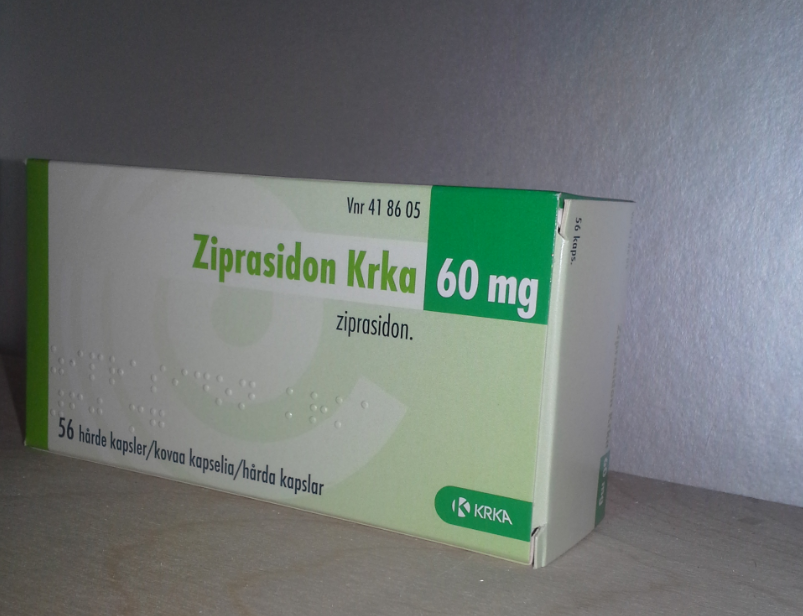
Ziprasidone, sold under the brand name Geodon among others, is an atypical antipsychotic used to treat schizophrenia and bipolar disorder. It may be used by mouth and by injection into a muscle (IM). The intramuscular form may be used for acute agitation in people with schizophrenia.
Common side effects include tremors, tics, dizziness, dry mouth, restlessness, nausea, and mild sedation.
Ziprasidone was approved for medical use in the United States in 2001.
Medical uses
Ziprasidone is approved by the US Food and Drug Administration (FDA) for the treatment of schizophrenia as well as acute mania and mixed states associated with bipolar disorder. Its intramuscular injection form is approved for acute agitation in schizophrenic patients for whom treatment with just ziprasidone is appropriate.
In a 2013 study in a comparison of 15 antipsychotic drugs in effectiveness in treating schizophrenic symptoms, ziprasidone demonstrated mild-standard effectiveness. Ziprasidone was 15% more effective than lurasidone and iloperidone, approximately as effective as chlorpromazine and asenapine, and 9–13% less effective than haloperidol, quetiapine, and aripiprazole. Ziprasidone is effective in the treatment of schizophrenia, though evidence from the CATIE trials suggests it is less effective than olanzapine, and equally as effective compared to quetiapine. There are higher discontinuation rates for lower doses of ziprasidone, which are also less effective than higher doses.
Adverse effects
Ziprasidone (and all other second generation antipsychotics (SGAs)) received a boxed warning in the US due to increased mortality in elderly people with dementia-related psychosis.
Sleepiness and headache are very common adverse effects (10%).
Common adverse effects (1–10%), include producing too much saliva or having dry mouth, runny nose, respiratory disorders or coughing, nausea and vomiting, stomach aches, constipation or diarrhea, loss of appetite, weight gain (but the smallest risk for weight gain compared to other antipsychotics), rashes, fast heart beats, blood pressure falling when standing up quickly, muscle pain, weakness, twitches, dizziness, and anxiety.
Ziprasidone is known to trigger mania in some bipolar patients.
This medication can cause birth defects, according to animal studies, although this side effect has not been confirmed in humans.
Recently, the FDA required the manufacturers of some atypical antipsychotics to include a warning about the risk of hyperglycemia and Type II diabetes with atypical antipsychotics. Some evidence suggests that ziprasidone does not cause insulin resistance to the degree of other atypical antipsychotics, such as olanzapine. Weight gain is also less of a concern with ziprasidone compared to other atypical antipsychotics. In fact, in a trial of long term therapy with ziprasidone, overweight patients (BMI 27) actually had a mean weight loss overall. According to the manufacturer insert, ziprasidone caused an average weight gain of 2.2 kg (4.8 lbs), which is significantly lower than other atypical antipsychotics, making this medication better for patients that are concerned about their weight. In December 2014, the FDA warned that ziprasidone could cause a potentially fatal skin reaction, Drug Reaction with Eosinophilia and Systemic Symptoms (DRESS), although this was believed to occur only rarely.
Discontinuation
The British National Formulary recommends a gradual withdrawal when discontinuing antipsychotics to avoid acute withdrawal syndrome or rapid relapse. Symptoms of withdrawal commonly include nausea, vomiting, and loss of appetite. Other symptoms may include restlessness, increased sweating, and trouble sleeping. Less commonly there may be a feeling of the world spinning, numbness, or muscle pains. Symptoms generally resolve after a short period of time.
There is tentative evidence that discontinuation of antipsychotics can result in psychosis. It may also result in reoccurrence of the condition that is being treated. Rarely tardive dyskinesia can occur when the medication is stopped.
Pharmacology
Pharmacodynamics
| Site | Ki (nM) | Action | Ref | ||||||||||
|---|---|---|---|---|---|---|---|---|---|---|---|---|---|
| 112 | Blocker | ||||||||||||
| 44 | Blocker | ||||||||||||
| 10000+ | ND | ||||||||||||
| 5-HT1A | 2.5–76 | Partial agonist | vauthors = Schmidt AW, Lebel LA, Howard HR, Zorn SH | title = Ziprasidone: a novel antipsychotic agent with a unique human receptor binding profile | journal = European Journal of Pharmacology | volume = 425 | issue = 3 | pages = 197–201 | date = August 2001 | pmid = 11513838 | doi = 10.1016/s0014-2999(01)01188-8 }} | ||
| 5-HT1B | 0.99–4.0 | Partial agonist | |||||||||||
| 5-HT1D | 5.1–9.0 | Partial agonist | |||||||||||
| 5-HT1E | 360–1279 | ND | |||||||||||
| 5-HT2A | 0.08–1.4 | Antagonist | vauthors = Graham JM, Coughenour LL, Barr BM, Rock DL, Nikam SS | title = 1-Aminoindanes as novel motif with potential atypical antipsychotic properties | journal = Bioorganic & Medicinal Chemistry Letters | volume = 18 | issue = 2 | pages = 489–493 | date = January 2008 | pmid = 18160289 | doi = 10.1016/j.bmcl.2007.11.106 }} | ||
| 5-HT2B | 27.2 | Antagonist | |||||||||||
| 5-HT2C | 0.72–13 | Antagonist | |||||||||||
| 5-HT3 | 10000+ | ND | |||||||||||
| 5-HT5A | 291 | ND | |||||||||||
| 5-HT6 | 61–76 | Antagonist | |||||||||||
| 5-HT7 | 6.0–9.3 | Antagonist | |||||||||||
| α1A | 18 | Antagonist | |||||||||||
| α1B | 9.0 | Antagonist | |||||||||||
| α2A | 160 | Antagonist | |||||||||||
| α2B | 48 | Antagonist | |||||||||||
| α2C | 59–77 | Antagonist | |||||||||||
| β1 | 2570+ | ND | |||||||||||
| β2 | 10000+ | ND | |||||||||||
| D1 | 30–130 | ND | |||||||||||
| D2 | 4.8 | Antagonist | vauthors = Seeman P, Tallerico T | title = Antipsychotic drugs which elicit little or no parkinsonism bind more loosely than dopamine to brain D2 receptors, yet occupy high levels of these receptors | journal = Molecular Psychiatry | volume = 3 | issue = 2 | pages = 123–134 | date = March 1998 | pmid = 9577836 | doi = 10.1038/sj.mp.4000336 | doi-access = | s2cid = 16484752 }} |
| D2L | 4.6 | Antagonist | vauthors = Arnt J, Skarsfeldt T | title = Do novel antipsychotics have similar pharmacological characteristics? A review of the evidence | journal = Neuropsychopharmacology | volume = 18 | issue = 2 | pages = 63–101 | date = February 1998 | pmid = 9430133 | doi = 10.1016/S0893-133X(97)00112-7 | doi-access = free }} | |
| D2S | 4.2 | Antagonist | |||||||||||
| D3 | 7.2 | Antagonist | |||||||||||
| D4 | 0.8–105 | Antagonist | |||||||||||
| D4.2 | 28–39 | Antagonist | |||||||||||
| D4.4 | 14.9 | Antagonist | vauthors = Newman-Tancredi A, Audinot V, Chaput C, Verrièle L, Millan MJ | title = [35S]Guanosine-5'-O-(3-thio)triphosphate binding as a measure of efficacy at human recombinant dopamine D4.4 receptors: actions of antiparkinsonian and antipsychotic agents | journal = The Journal of Pharmacology and Experimental Therapeutics | volume = 282 | issue = 1 | pages = 181–191 | date = July 1997 | doi = 10.1016/S0022-3565(24)36804-1 | pmid = 9223553 }} | ||
| D5 | 152 | ND | |||||||||||
| H1 | 15–130 | Antagonist | |||||||||||
| H2 | 3500+ | ND | |||||||||||
| H3 | 10000+ | ND | |||||||||||
| H4 | 10000+ | ND | |||||||||||
| M1 | 300+ | ND | vauthors = Bymaster FP, Felder CC, Tzavara E, Nomikos GG, Calligaro DO, Mckinzie DL | title = Muscarinic mechanisms of antipsychotic atypicality | journal = Progress in Neuro-Psychopharmacology & Biological Psychiatry | volume = 27 | issue = 7 | pages = 1125–1143 | date = October 2003 | pmid = 14642972 | doi = 10.1016/j.pnpbp.2003.09.008 | s2cid = 28536368 }} | |
| M2 | 3000+ | ND | |||||||||||
| M3 | 1300+ | ND | |||||||||||
| M4 | 1600+ | ND | |||||||||||
| M5 | 1600+ | ND | |||||||||||
| σ1 | 110 | ND | |||||||||||
| σ2 | ND | ND | ND | ||||||||||
| Opioid | 1000+ | ND | |||||||||||
| 10000+ | ND | ||||||||||||
| NMDA | |||||||||||||
| (PCP) | 10000+ | ND | |||||||||||
| 10000+ | ND | ||||||||||||
| 2620 | ND | ||||||||||||
| 169 | Blocker | vauthors = Kongsamut S, Kang J, Chen XL, Roehr J, Rampe D | title = A comparison of the receptor binding and HERG channel affinities for a series of antipsychotic drugs | journal = European Journal of Pharmacology | volume = 450 | issue = 1 | pages = 37–41 | date = August 2002 | pmid = 12176106 | doi = 10.1016/s0014-2999(02)02074-5 }} | |||
| Values are Ki (nM). The smaller the value, the more strongly the drug binds to the site. All data are for human cloned proteins, except H3 (guinea pig), σ1 (guinea pig), opioid (rodent), NMDA/PCP (rat), VDCC, and VGSC. |
Correspondence to clinical effects
Ziprasidone mostly affects the receptors of dopamine (D2), serotonin (5-HT2A, partially 5-HT1A, 5-HT2C, and 5-HT1D) and epinephrine/norepinephrine (α1) to a high degree, while of histamine (H1) - moderately. It also somewhat inhibits reuptake of serotonin and norepinephrine, though not dopamine.
Ziprasidone's efficacy in treating the positive symptoms of schizophrenia is believed to be mediated primarily via antagonism of the dopamine receptors, specifically D2. Blockade of the 5-HT2A receptor may also play a role in its effectiveness against positive symptoms, though the significance of this property in antipsychotic drugs is still debated among researchers. Blockade of 5-HT2A and 5-HT2C and activation of 5-HT1A as well as inhibition of the reuptake of serotonin and norepinephrine may all contribute to its ability to alleviate negative symptoms.; however, its effects on the 5-HT1A receptor may be limited as a study found ziprasidone would likely "produce detectable occupancy [of 5-HT1A receptors] only at higher doses that would produce unacceptable levels of side effects in man, although lower doses are sufficient to produce pharmacological effects." The relatively weak antagonistic actions of ziprasidone on the α1-adrenergic receptor likely in part explains some of its side effects, such as orthostatic hypotension. Unlike many other antipsychotics, ziprasidone has no significant affinity for the mACh receptors, and as such lacks any anticholinergic side effects. Like most other antipsychotics, ziprasidone is sedating due primarily to serotonin and dopamine blockade.
It has also been identified as a potent vesicular monoamine transporter 2 (VMAT2) inhibitor ( = 15nM).
Pharmacokinetics
The systemic bioavailability of ziprasidone is 100% when administered intramuscularly and 60% when administered orally without food.
After a single dose intramuscular administration, the peak serum concentration typically occurs at about 60 minutes after the dose is administered, or earlier. Steady state plasma concentrations are achieved within one to three days. Exposure increases in a dose-related manner and following three days of intramuscular dosing, little accumulation is observed.
The bioavailability of the drug is reduced by approximately 50% if a meal is not eaten before Ziprasidone ingestion.
Ziprasidone is hepatically metabolized by aldehyde oxidase; minor metabolism occurs via cytochrome P450 3A4 (CYP3A4). Medications that induce (e.g. carbamazepine) or inhibit (e.g. ketoconazole) CYP3A4 have been shown to decrease and increase, respectively, blood levels of ziprasidone.
Its biological half-life time is 10 hours at doses of 80–120 milligrams.
History
Ziprasidone is chemically similar to risperidone, of which it is a structural analogue. It was first synthesized in 1987 at the Pfizer central research campus in Groton, Connecticut.
Phase I trials started in 1995. In 1998 ziprasidone was approved in Sweden. After the FDA raised concerns about long QT syndrome, more clinical trials were conducted and submitted to the FDA, which approved the drug on February 5, 2001.
Society and culture
Lawsuit
In September 2009, the U.S. Justice Department announced that Pfizer had been ordered to pay a historic fine of $2.3 billion as a penalty for fraudulent marketing of several drugs, including Geodon.
Brand names
In the US, Geodon is marketed by Viatris after Upjohn was spun off from Pfizer.
Research
Ziprasidone has been studied in and reported to be effective in the treatment of borderline personality disorder, but findings are mixed.
References
References
- (May 2025). "Therapeutic Goods (Poisons Standard— June 2025) Instrument 2025".
- Anvisa. (March 31, 2023). "RDC Nº 784 - Listas de Substâncias Entorpecentes, Psicotrópicas, Precursoras e Outras sob Controle Especial". [[Diário Oficial da União]].
- (January 13, 2025). "Geodon- ziprasidone hydrochloride capsule; Geodon- ziprasidone mesylate injection, powder, lyophilized, for solution; Geodon- ziprasidone capsule".
- (February 2011). "Ziprasidone hydrocloride: what role in the management of schizophrenia?". Journal of Central Nervous System Disease.
- (December 2007). "Ziprasidone in the treatment of mania in bipolar disorder". Neuropsychiatric Disease and Treatment.
- "Ziprasidone Monograph for Professionals". American Society of Health-System Pharmacists.
- "The Top 300 of 2020".
- "Ziprasidone - Drug Usage Statistics".
- "Pfizer to pay $2.3 billion to resolve criminal and civil health care liability relating to fraudulent marketing and the payment of kickbacks". Stop Medicare Fraud, US Dept of Health & Human Svc, and of US Dept of Justice.
- (September 2013). "Comparative efficacy and tolerability of 15 antipsychotic drugs in schizophrenia: a multiple-treatments meta-analysis". Lancet.
- (June 2009). "Effect of ziprasidone dose on all-cause discontinuation rates in acute schizophrenia and schizoaffective disorder: a post-hoc analysis of 4 fixed-dose randomized clinical trials". Schizophrenia Research.
- (February 24, 2016). "Product Information: Zeldox IM (ziprasidone mesilate)". Australia Therapeutic Goods Administration.
- (February 24, 2016). "Product Information: Zeldox (ziprasidone hydrochloride)". Australia Therapeutic Goods Administration.
- (July 19, 2000). "Briefing Document for Zeldoz Capsules". FDA.
- (February 2003). "Ziprasidone-associated mania: a case series and review of the mechanism". Bipolar Disorders.
- (2005). "Ziprasidone-associated mania: a review and report of 2 additional cases". Clinical Neuropharmacology.
- (April 2002). "Ziprasidone induction of hypomania in depression?". The American Journal of Psychiatry.
- (January 2009). "Effects of six second generation antipsychotics on body weight and metabolism - risk assessment and results from a prospective study". Pharmacopsychiatry.
- (January 2007). "Risk of diabetes mellitus associated with atypical antipsychotic use among Medicaid patients with bipolar disorder: a nested case-control study". Pharmacotherapy.
- (June 2008). "Effects of olanzapine and ziprasidone on glucose tolerance in healthy volunteers". Neuropsychopharmacology.
- (2005). "Second-generation (atypical) antipsychotics and metabolic effects: a comprehensive literature review". CNS Drugs.
- (May 2025). "FDA Drug Safety Communication: FDA reporting mental health drug ziprasidone (Geodon) associated with rare but potentially fatal skin reactions".
- (March 2009). "British National Formulary". Royal Pharmaceutical Society of Great Britain.
- (2004). "Adverse Syndromes and Psychiatric Drugs: A Clinical Guide". OUP Oxford.
- (July 2006). "Does antipsychotic withdrawal provoke psychosis? Review of the literature on rapid onset psychosis (supersensitivity psychosis) and withdrawal-related relapse". Acta Psychiatrica Scandinavica.
- (2013). "Adherence to Antipsychotics in Schizophrenia". Springer Science & Business Media.
- "PDSP Ki Database". University of North Carolina at Chapel Hill and the United States National Institute of Mental Health.
- (August 2001). "Ziprasidone: a novel antipsychotic agent with a unique human receptor binding profile". European Journal of Pharmacology.
- (March 1996). "Risperidone compared with new and reference antipsychotic drugs: in vitro and in vivo receptor binding". Psychopharmacology.
- (March 2003). "H1-histamine receptor affinity predicts short-term weight gain for typical and atypical antipsychotic drugs". Neuropsychopharmacology.
- (January 2008). "1-Aminoindanes as novel motif with potential atypical antipsychotic properties". Bioorganic & Medicinal Chemistry Letters.
- (March 1998). "Antipsychotic drugs which elicit little or no parkinsonism bind more loosely than dopamine to brain D2 receptors, yet occupy high levels of these receptors". Molecular Psychiatry.
- (February 1998). "Do novel antipsychotics have similar pharmacological characteristics? A review of the evidence". Neuropsychopharmacology.
- (July 1997). "[35S]Guanosine-5'-O-(3-thio)triphosphate binding as a measure of efficacy at human recombinant dopamine D4.4 receptors: actions of antiparkinsonian and antipsychotic agents". The Journal of Pharmacology and Experimental Therapeutics.
- (October 2003). "Muscarinic mechanisms of antipsychotic atypicality". Progress in Neuro-Psychopharmacology & Biological Psychiatry.
- (August 2002). "A comparison of the receptor binding and HERG channel affinities for a series of antipsychotic drugs". European Journal of Pharmacology.
- (October 1995). "Ziprasidone (CP-88,059): a new antipsychotic with combined dopamine and serotonin receptor antagonist activity". The Journal of Pharmacology and Experimental Therapeutics.
- (2011). "Goodman & Gilman's The Pharmacological Basis of Therapeutics 12th Edition". McGraw-Hill.
- (June 24, 2011). "Bipolar Psychopharmacotherapy: Caring for the Patient". John Wiley & Sons.
- (November 2005). "From clinical research to clinical practice: a 4-year review of ziprasidone". CNS Spectrums.
- (March 1999). "Pharmacological profile of neuroleptics at human monoamine transporters". European Journal of Pharmacology.
- (2006). "Pharmakologie und Toxikologie: Arzneimittelwirkungen verstehen- Medikamente gezielt einsetzen; ein Lehrbuch für Studierende der Medizin, der Pharmazie und der Biowissenschaften, eine Informationsquelle für Ärzte, Apotheker und Gesundheitspolitiker". Georg Thieme Verlag.
- (February 10, 2006). "Essentials of Clinical Psychopharmacology". American Psychiatric Pub.
- (May 2004). "Occupancy of agonist drugs at the 5-HT1A receptor". Neuropsychopharmacology.
- (March 2010). "Serotonin 5-HT(2A) receptor antagonists in the treatment of insomnia: present status and future prospects". Drugs of Today.
- (April 2000). "Sedative effects of the dopamine D1 receptor agonist A 68930 on rat open-field behavior". NeuroReport.
- (22 December 2025). "Evaluation of the Relationship between Vesicular Monoamine Transporter 2 (VMAT2) Inhibition and Neurologic Adverse Events in Approved Drugs". ACS Pharmacology & Translational Science.
- "Ziprasidone (Professional Patient Advice)".
- (2007). "The effect of food on the absorption of oral ziprasidone". Psychopharmacology Bulletin.
- (2005). "An overview of psychotropic drug-drug interactions". Psychosomatics.
- (2000). "The effect of carbamazepine on the steady-state pharmacokinetics of ziprasidone in healthy volunteers". British Journal of Clinical Pharmacology.
- (2000). "The effects of ketoconazole on ziprasidone pharmacokinetics--a placebo-controlled crossover study in healthy volunteers". British Journal of Clinical Pharmacology.
- (January 24, 2012). "Foye's Principles of Medicinal Chemistry". Lippincott Williams & Wilkins.
- (2005). "Atypicality of atypical antipsychotics". Primary Care Companion to the Journal of Clinical Psychiatry.
- (2009). "The American Psychiatric Publishing textbook of psychopharmacology". American Psychiatric Pub..
- (May 26, 1998). "Approval Package For: Application Number 20-919". FDA Center For Drug Evaluation And Research.
- "First Approval For Pfizer's Zeldoxs".
- (September 13, 2000). "Pfizer's Zeldox approvable in USA – Pharmaceutical industry news". The Pharma Letter.
- PsychoPharmacological Drugs Advisory Committee. (July 19, 2000). "FDA Background On ZeldoxTM (ziprasidone hydrochloride capsules) Pfizer, Inc.". U.S. Food and Drug Administration.
- "Pfizer to Launch Zeldox in 9 European Union Countries Beginning Next Month". Pfizer Inc.
- (September 2, 2009). "Justice Department Announces Largest Health Care Fraud Settlement in Its History".
- (November 16, 2020). "Pfizer Completes Transaction to Combine Its Upjohn Business with Mylan". Pfizer.
- "Geodon".
- (November 16, 2020). "Brands".
- (2021). "Current Clinical Psychopharmacology in Borderline Personality Disorder". Curr Neuropharmacol.
- (June 2010). "Pharmacological interventions for borderline personality disorder". Cochrane Database Syst Rev.
- (April 2008). "Ziprasidone in the treatment of borderline personality disorder: a double-blind, placebo-controlled, randomized study". J Clin Psychiatry.
- (September 2004). "Ziprasidone in the acute treatment of borderline personality disorder in psychiatric emergency services". J Clin Psychiatry.
This article was imported from Wikipedia and is available under the Creative Commons Attribution-ShareAlike 4.0 License. Content has been adapted to SurfDoc format. Original contributors can be found on the article history page.
Ask Mako anything about Ziprasidone — get instant answers, deeper analysis, and related topics.
Research with MakoFree with your Surf account
Create a free account to save articles, ask Mako questions, and organize your research.
Sign up freeThis content may have been generated or modified by AI. CloudSurf Software LLC is not responsible for the accuracy, completeness, or reliability of AI-generated content. Always verify important information from primary sources.
Report