From Surf Wiki (app.surf) — the open knowledge base
Zhang Daoling
2nd century Chinese Taoist leader
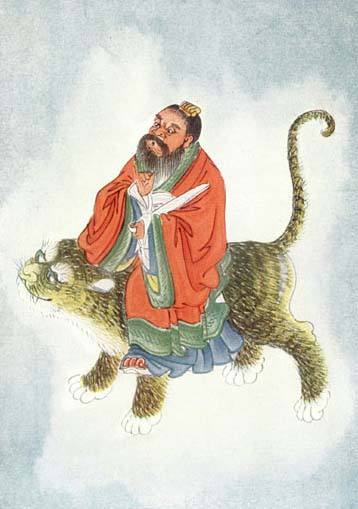
2nd century Chinese Taoist leader
| Field | Value |
|---|---|
| image | Zhang Daoling, by Ren Xiong and Cai Zhaochu (cropped).jpg |
| caption | Zhang Daoling, as illustrated by Ren Xiong and engraved by Cai Zhaochu |
| birth_name | Zhang Ling |
| birth_date | February 22, 34 (traditionally) |
| death_date | October 10, 156 (traditionally, aged 121–122) |
| death_place | Mount Qingcheng |
| other_names | Fuhao (courtesy name) |
| known | Founder of Way of the Five Pecks of Rice |
| Founder of religious Taoism | |
| occupation | Religious leader |
| Ruler of Zhang Han |
Founder of religious Taoism Ruler of Zhang Han
Zhang Daoling (, traditionally February 22, 34October 10, 156), birth name Zhang Ling (), courtesy name Fuhan (), was a Chinese Taoist religious leader who lived during the Eastern Han dynasty. He founded the Way of the Five Pecks of Rice millenarian movement, and established a theocratic state. The Way of the Celestial Masters grew out of those beginnings, and so Zhang is considered the founder of religious Taoism by scholars and is venerated as such by followers of Zhengyi Dao.
His son Zhang Heng () and grandson Zhang Lu inherited leadership of the movement and state. Also known as Celestial Master Zhang (), Ancestral Celestial Master () or Zhengyi Zhenren (), Zhang is sometimes pictured riding on a tiger. In some Taoist sects, Zhang, along with Ge Xuan, Xu Xun () and Sa Shoujian (), are called the "Four Celestial Masters" ().
Biography
The details of the life of the historical figure Zhang Daoling are obscure; most of the information about him comes from later scripture and hagiography. According to these, Zhang traced his ancestral home to Feng County, Jiangsu, and was said to be a descendant of Zhang Liang. He was born in the tenth year of the Jianwu era during the reign of Emperor Guangwu of Han. He started reading the Tao Te Ching at a young age and studied in the Taixue (Imperial Academy) before. He served as a magistrate in Jiangzhou, Ba Commandery (present-day Chongqing) during the reign of Emperor Ming of Han.
Zhang later retired and led a reclusive life at Mount Beimang, where he practiced taoist methods of achieving longevity. When invited to serve as a boshi (equivalent of a present-day professor) in the Imperial Academy, he claimed that he was ill. Emperor He of Han summoned him thrice to serve as the Taifu (Imperial Tutor) but he refused again.
According to hagiographies compiled in approximately 400 C.E., in 142 C.E. the deity Taishang Laojun (a deified Laozi) revealed to Zhang on Mount Heming the "Doctrine of the Orthodox One [Resting On] the Authority of the Alliance" (), and bestowed upon him the title Celestial Master. The deity warned that plagues, beasts, and the demons of the Three Offices and Six Heavens of the underworld were due to be released upon humankind, and that only 240,000 people would be chosen as survivors and "seed people" () to populate the new age, the era of Great Peace.
Zhang then endeavored to reform supposedly degenerate religious practices. After gathering numerous followers, he started a health cult that advocated certain longevity practices, recorded in books which have been lost. He founded a theocratic state in Sichuan organized into 24 parishes, later 28, which outsiders called the Way of Five Pecks of Rice, after a tax of that amount levied on followers.
A major change instituted by the new Covenant was the rejection of food and animal sacrifices. According to Zhang, the updated teachings of Laozi included the first true Taoist religious pantheon as distinguished from the prior ancient religion of China. The Xiang'er, a commentary on the Tao Te Ching preserved today in a sixth-century manuscript, is traditionally ascribed to Zhang Daoling's authorship and even if not his work may reflect his teachings.
Zhang is said to have died on Mount Qingcheng in 156 during the reign of Emperor Huan of Han at the purported age of 123. However, it is also said that Zhang did not die but ascended in broad daylight (Xiandao). Zhang reportedly disappeared on the day of his death, leaving nothing behind but his clothes.
Descendants
His descendants have held the title of Celestial Masters up to the present day, with the most recent claimants of the title currently residing in Mainland China and Taiwan. They also held the title of 正一嗣教眞人 zh.
Notes
References
- (30 April 1992). "《重修臺灣省通志‧卷三‧住民志‧宗教篇(第一冊)》". [[Taiwan Historica]].
- "8th July, 2020: 張道陵 Zhang Dao Ling – Purple Cloud".
- Greg Woolf. (2007). "Ancient civilizations: the illustrated guide to belief, mythology, and art". Barnes & Noble.
- Kohn, Livia. ''Daoism Handbook''. Leiden: Brill, 2000. pp. 264–266.
- Robinet, Isabelle. "Zhang Daoling". in Jones, Lindsay ed. ''Encyclopedia of Religion''. 2nd ed. Detroit: Macmillan Reference USA, 2005. p. 9954.
- Bokenkamp, Stephen R. ''Early Daoist Scriptures''. Berkeley: University of California Press, 1997. pp.29–148. (includes full, annotated translation of the text)
- Meyer, Milton Walter. (1997). "Asia: a concise history". Rowman & Littlefield.
- "Present Day Political Organization of China". Routledge.
This article was imported from Wikipedia and is available under the Creative Commons Attribution-ShareAlike 4.0 License. Content has been adapted to SurfDoc format. Original contributors can be found on the article history page.
Ask Mako anything about Zhang Daoling — get instant answers, deeper analysis, and related topics.
Research with MakoFree with your Surf account
Create a free account to save articles, ask Mako questions, and organize your research.
Sign up freeThis content may have been generated or modified by AI. CloudSurf Software LLC is not responsible for the accuracy, completeness, or reliability of AI-generated content. Always verify important information from primary sources.
Report