From Surf Wiki (app.surf) — the open knowledge base
Zealandia
Mostly submerged continental crust area in Oceania
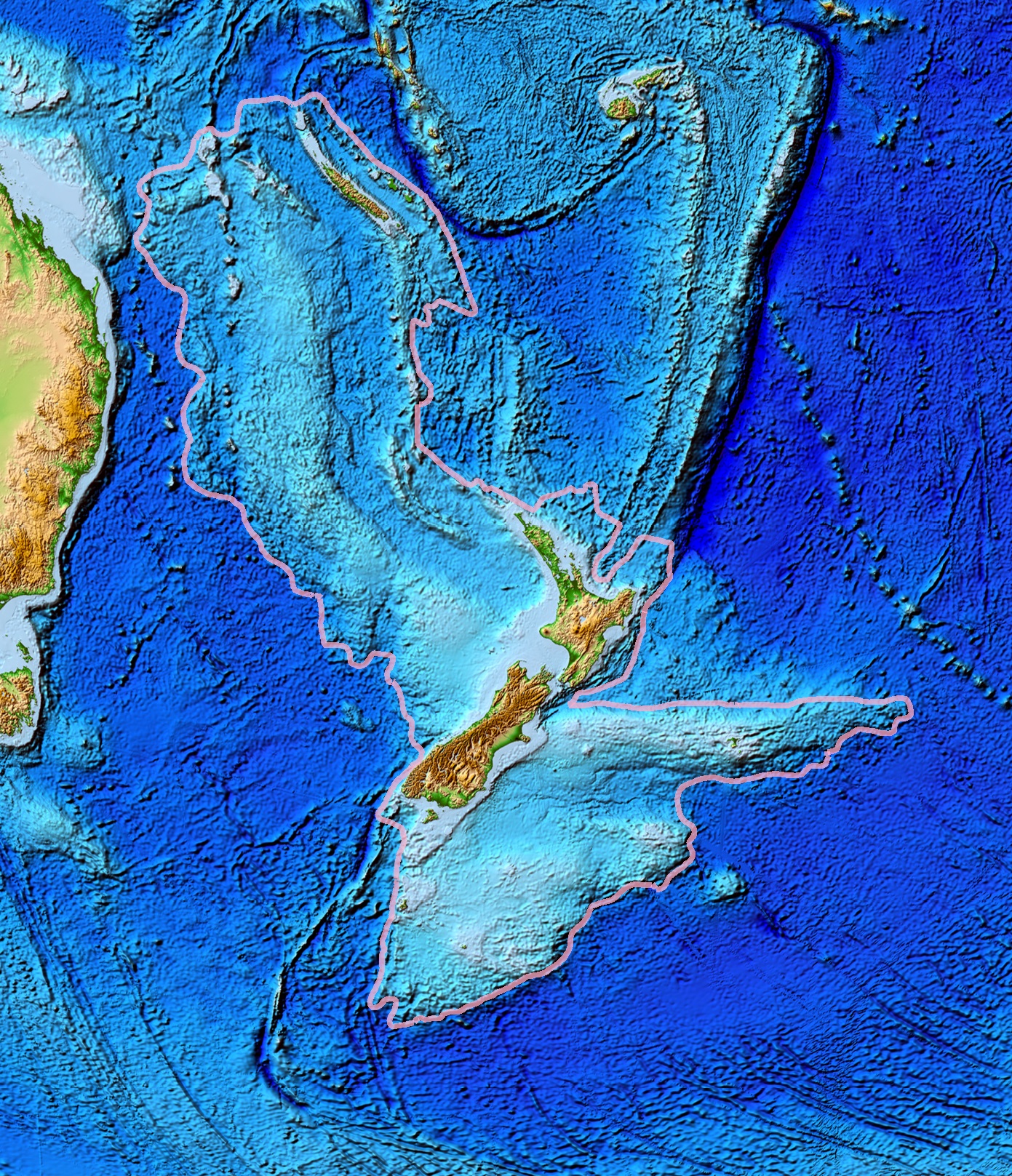
Mostly submerged continental crust area in Oceania

Zealandia (pronounced ), also known as Te Riu-a-Māui (Māori) or Tasmantis (from Tasman Sea), is an almost entirely submerged mass of continental crust in Oceania that subsided after breaking away from Gondwana 83–79 million years ago. It has been described variously as a submerged continent, continental fragment, and microcontinent. and satellite imagery shows it to be almost the size of Australia. A 2021 study suggests Zealandia is over a billion years old, about twice as old as geologists previously thought.
By approximately 23 million years ago, the landmass may have been completely submerged. Today, most of the landmass (94%) remains submerged beneath the Pacific Ocean. New Zealand is the largest part of Zealandia that is above sea level, followed by New Caledonia.
Mapping of Zealandia concluded in 2023. With a total area of approximately 4900000 km2, some geologists from New Zealand, New Caledonia, and Australia have concluded that Zealandia fulfills all the requirements to be considered a continent rather than a microcontinent or continental fragment.
Zealandia supports substantial inshore fisheries and contains gas fields, of which the largest known is the New Zealand Maui gas field, near Taranaki. Permits for oil exploration in the Great South Basin were issued in 2007. Offshore mineral resources include ironsands, volcanic massive sulfides and ferromanganese nodule deposits.
Etymology
GNS Science recognises two names for the landmass. In English, the most common name is Zealandia, a latinate name for New Zealand; the name was coined in the mid-1990s and became established through common use. In the Māori language, the landmass is named Te Riu-a-Māui, meaning 'the hills, valleys, and plains of Māui'.
Geology

Biogeography
New Caledonia is at the northern end of the ancient continent, while New Zealand rises at the plate boundary that bisects it. These land masses constitute two outposts of the Antarctic flora, featuring araucarias and podocarps. At Curio Bay, logs of a fossilized forest closely related to modern kauri and Norfolk pine can be seen that grew on Zealandia approximately 180 million years ago during the Jurassic period, before it split from Gondwana. The trees growing in these forests were buried by volcanic mud flows and gradually replaced by silica to produce the fossils now exposed by the sea.
As sea levels drop during glacial periods, more of Zealandia becomes a terrestrial environment rather than a marine environment. Originally, it was thought that Zealandia had no native land mammal fauna, but the discovery in 2006 of a fossil mammal jaw from the Miocene in the Otago region demonstrates otherwise.
Political divisions
The total land area (including inland water bodies) of Zealandia is 286,660.25 km2. Of this, New Zealand comprises the overwhelming majority, at 267,988 km2, or 93.49%) that includes the mainland (North Island and South Island), nearby islands, and most outlying islands, including the Chatham Islands, the New Zealand Subantarctic Islands, the Solander Islands, and the Three Kings Islands (but not the Kermadec Islands or Macquarie Island (Australia), which are parts of the rift).
New Caledonia and the islands surrounding it comprise some 18,576 km2 or 6.48%) and the remainder is made up of various territories of Australia including the Lord Howe Island Group (New South Wales) at 56 km2 or 0.02%), Norfolk Island at 35 km2 or 0.01%), as well as the Cato, Elizabeth, and Middleton reefs (Coral Sea Islands Territory) with 5.25 km2.
Population
the total human population of Zealandia is approximately 5.4 million people. The largest city is Auckland with about 1.7 million people; roughly one-third of the total population of the continent.
- – 5,112,300
- (France) – 268,767
- (Australia) – 1,748
- (Australia) – 382
- Coral Sea Islands Cato Reef (Australia) – 0
- Coral Sea Islands Elizabeth Reef (Australia) – 0
- Coral Sea Islands Middleton Reef (Australia) – 0
References
References
- (1997). "Figure 8.1: New Zealand in relation to the Indo-Australian and Pacific Plates". The State of New Zealand's Environment 1997.
- (2 May 2019). "The origin and meaning of the name Te Riu-a-Māui/Zealandia". [[GNS Science]].
- (2002). "The Future Eaters: An Ecological History of the Australasian Lands and People". Grove Press.
- Danver, Steven L.. (22 December 2010). "Popular Controversies in World History: Investigating History's Intriguing Questions". ABC-CLIO.
- (2004). "Evolving force balance during incipient subduction: Geochemistry, Geophysics, Geosystems, v. 5, Q07001".
- Luyendyk, Bruce P.. (April 1995). "Hypothesis for Cretaceous rifting of east Gondwana caused by subducted slab capture". Geology.
- (8 February 2021). "The missing continent it took 375 years to find". BBC.
- (2021-08-01). "A hidden Rodinian lithospheric keel beneath Zealandia, Earth's newly recognized continent". Geology.
- Aylin Woodward. (14 Aug 2021). "A fragment of a mysterious 8th continent is hiding under New Zealand - and it's twice as old as scientists thought".
- (29 September 2007). "Searching for the lost continent of Zealandia". The [[The Dominion Post (Wellington).
- Campbell, Hamish. (2007). "In Search of Ancient New Zealand". [[Penguin Books]].
- (2003). "New Zealand's Continental Shelf and UNCLOS Article 76". National Institute of Water and Atmospheric Research.
- Newcomb, Tim. "Earth's Hidden Eighth Continent Is No Longer Lost".
- (11 July 2007). "Great South Basin – Questions and Answers".
- (30 May 2007). "New survey published on NZ mineral deposits".
- "Fossil forest: Features of Curio Bay/Porpoise Bay".
- (2007). "In Search of Ancient New Zealand". Penguin Books.
- "The Lost Continent of Zealandia".).
- "Detailed map of Zealandia".
- "Population {{!}} Stats NZ".
- "268 767 habitants en 2014.". ISEE.
- "2016 Census QuickStats: Norfolk Island".
- {{Census 2016 AUS
This article was imported from Wikipedia and is available under the Creative Commons Attribution-ShareAlike 4.0 License. Content has been adapted to SurfDoc format. Original contributors can be found on the article history page.
Ask Mako anything about Zealandia — get instant answers, deeper analysis, and related topics.
Research with MakoFree with your Surf account
Create a free account to save articles, ask Mako questions, and organize your research.
Sign up freeThis content may have been generated or modified by AI. CloudSurf Software LLC is not responsible for the accuracy, completeness, or reliability of AI-generated content. Always verify important information from primary sources.
Report