From Surf Wiki (app.surf) — the open knowledge base
Zastava M70 assault rifle

| Field | Value | |
|---|---|---|
| name | Zastava M70 | |
| image | File:M70AB2.jpg | |
| image_size | 300 | |
| caption | A Zastava M70AB2 | |
| type | Assault rifle | |
| origin | Yugoslavia | |
| <!-- Type selection --> | is_ranged | Yes |
| <!-- Service history --> | service | 1970–1982 (limited use) |
| 1982–present (standard service rifle) | ||
| used_by | See Users | |
| wars | {{Plain list | |
| * War in Iraq (2013-2017)<ref name | "PMU" | |
| * Russian invasion of Ukraine<ref name | "N1" | |
| <!-- Production history --> | designer | Zastava Arms |
| design_date | 1962–1968 | |
| manufacturer | Zastava Arms | |
| production_date | 1970–present | |
| number | 4,000,000 | |
| variants | See Variants | |
| <!-- General specifications --> | weight | 3.70 kg |
| length | 890 mm | |
| part_length | 415 mm | |
| diameter | ||
| cartridge | 7.62×39mm | |
| action | Gas-operated (rotating bolt) | |
| rate | 600–650 rounds/min | |
| velocity | 720 m/s | |
| range | 350 m | |
| feed | 30-round AK-47 detachable magazine | |
| sights | Iron sights graduated from 100 to 1,000 meters |
1982–present (standard service rifle)
- Rhodesian Bush War
- South African Border War
- Lebanese Civil War
- Iran–Iraq War
- Gulf War
- Yugoslav Wars
- Rwandan Civil War
- First Congo War
- Kosovo War
- Insurgency in the Republic of Macedonia
- War in Afghanistan
- Iraq War
- Kivu conflict
- Libyan Civil War
- Syrian civil war
- Northern Mali conflict
- War in Iraq (2013-2017)
- Russian invasion of Ukraine
- Gaza War
The Zastava M70 (Застава М70) is a 7.62×39mm assault rifle developed in the Socialist Federal Republic of Yugoslavia by Zastava Arms. The M70 was an unlicensed derivative of the Soviet AK-47 (specifically the Type 3 variant). Although the M70 was functionally identical to the AK, it had unique in-built features that better enabled it to fire rifle grenades. These included a thicker receiver, a new latch for the dust cover to ensure it would not be jarred loose by a grenade discharge, and a folding grenade sight bracket over the rifle's gas block, which also shut off the gas system when raised.
The M70 became the standard issue infantry weapon in the Yugoslav People's Army in 1970, complementing and later superseding the Zastava M59/66. The M70 was also used by Republika Srpska in the Bosnian War alongside the AK-74 and other weapons. Both the original M70 design, as well as commercial variants of the weapon without select-fire capability, known as the Zastava PAP series, are still produced by Zastava for export.
History
Beginning in 1952, Yugoslavia's defence industry had been experimenting with new automatic rifle designs, mostly patterned after the German StG 44, an unknown quantity of which had been captured by Yugoslav Partisans during World War II. In 1959, two Albanian soldiers defected to Yugoslavia with Soviet AK-47s, which were promptly passed on by the Yugoslav government to be inspected by Zastava engineers. Zastava was able to make metal castings of the two sample AKs, but could not glean enough technical data to reproduce the weapons or their associated parts. By the end of the year, however, the Yugoslav government had obtained more early pattern AKs from an unidentified Third World nation that was receiving Soviet military aid, most likely Egypt. At this point, there were enough AKs in Zastava's possession for its engineers to study and effectively reverse engineer the weapon type. Unlicensed production of an AK-47 derivative commenced in 1964.
The first domestic Kalashnikov rifles submitted by Zastava for military field trials were unofficially designated M64 and incorporated a milled receiver based heavily on that of the AK Type 3 but with several cosmetic differences. As the recoil from the rifle grenade could dislodge the standard AK dust cover, this was replaced with a new design that utilized a spring-loaded bolt. The stock of the M64 was also fitted with a heavy rubber recoil pad to help absorb the recoil. The M64 was fed from modified AK-pattern magazines and was manufactured with a device that left the bolt open after the last round in the magazine had been fired. It also possessed longer handguards that were not interchangeable with the Soviet type. The placement of the AK-47's rear sight was moved even further to the rear, giving the operator a longer sight radius. Though performances during field trials were satisfactory, the Yugoslav People's Army did not adopt the M64 in large numbers.
The M64 was produced in three iterations for trials purposes: a variant with a wooden stock and a 20 inch barrel, a variant with a fixed wooden stock and a 16.3 inch barrel, and a variant with a 16.3 inch barrel and a folding stock. The variant with the 20 inch barrel did not prove popular and was discarded early on. The other two variants were produced in greater numbers and received the designation M64A (for the fixed stock) and M64B (for the folding stock), respectively.
In 1970, the Yugoslav government approved the M64A for serial production as the AP M70 (Automatska Puška Model 1970, "Automatic Rifle Model 1970"), with a few alterations to the original design.
Shortly afterwards, Zastava ceased threading the barrels of M70s into their receivers and adopted the cheaper and easier method of pressing and pinning barrels into the receivers. The M70s produced with pressed and pinned barrels, along with other detail improvements, were redesignated M70B, with the folding stock variant being redesignated M70 AB.
By the mid 1970s, Zastava began manufacturing the M70 with a stamped rather than a milled receiver to reduce production costs. This was known as the M70B1. Derivatives of the M70B1 with folding stocks were designated M70AB2. Both the M70B1 and M70AB2 were fitted with night sights, which alternatively utilized tritium vials or were marked with luminescent paint, that could be raised or lowered as needed. Small numbers of M70B1s and M70AB2s were manufactured with mounting brackets for optics, these were designated M70B1N and M70AB2N, respectively.
The final variant of the M70 to be produced was the M70B2, which possessed a new stamped receiver thicker and heavier than those found on comparable stamped receiver Kalashnikov rifles such as the AKM. The M70B2 and most later models of the M70AB2 were also manufactured with sturdier barrel trunnions resembling those on the RPK light machine gun. The rifles now possessed distinct bulges on either side of their forward receivers, necessary to accommodate the larger RPK-pattern trunnions. The addition of the larger trunnions and thicker receivers was seen as a necessary measure to strengthen the rifle design and make it more suitable for launching grenades.
Features

The original M70 design was based on the early pattern Soviet AK-47 (specifically Type 3), which utilised a milled receiver. There are a number of cosmetic differences between the two receiver patterns, namely the smooth left side of the receiver, which lacks the machined section normally found on original Soviet Type 3 AKs and their derivatives. The M64/M70 dust covers were secured into place by a unique locking recoil spring guide, which prevents it from being dislodged while firing rifle grenades. Additionally, Zastava serial numbers were engraved just above the magazine well on milled receiver M64s and M70s rather than on the trunnion. Even after Zastava began producing the M70 with a stamped receiver, many of the weapon's features more closely resembled those of the Type 3 AK rather than the stamped receiver AKM.
Zastava began incorporating larger, RPK-pattern barrel trunnions in the M70 during the mid to late 1970s, which resulted in a distinctive bulge on the forward receiver beneath the rifle's bolt handle. Each M70B1 was marked on the left above the bulged trunnion with the Zastava brandmark, model number, year of production, and a serial number. There are three fire selector markings on the right side of the receiver: "U" ("Ukočeno", safety), "R" ("Rafalna", automatic fire), and "J" ("Jedinačna", semi-automatic fire).
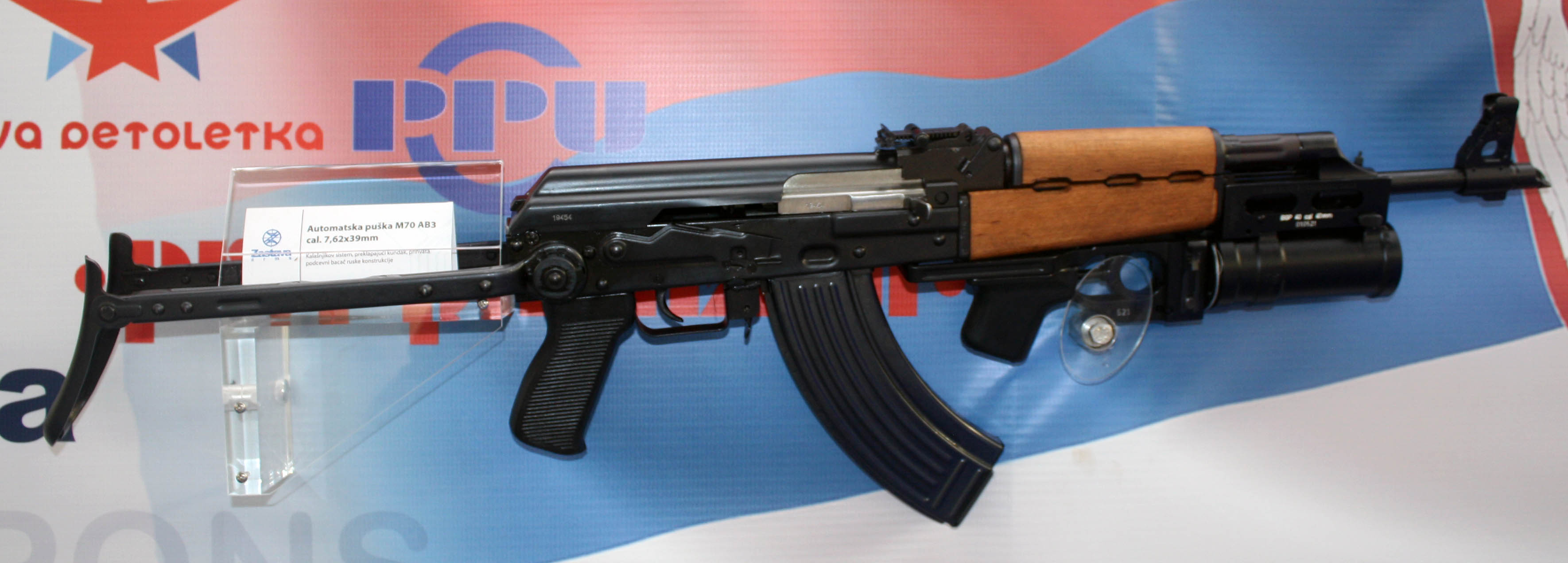
The M70 included an integral folding ladder sight and a detachable grenade launcher spigot for launching rifle grenades. The sight is normally locked into a folded position atop the rifle's upper handguard. Prior to firing a rifle grenade, the sight is raised and locked in the vertical position, which closes off the gas port in the barrel and prevents the M70's action from being cycled while a grenade is being launched. The M70 was designed to fire the M60 rifle grenade, with either a high-explosive or shaped charge warhead. The sight markings on the left side of the ladder sight are graduated for high-explosive or anti-personnel rounds, while those on the right are graduated for targeting armored vehicles and other hard targets.
The M70 was issued with a late pattern AKM bayonet, copied from the original Soviet product, with a leather scabbard hanger. It was also issued with a unique Yugoslavian canvas sling, which was secured to the rifle by a flat steel hook. The hook design required a much broader sling swivel to be attached to the M70's gas block than was usual to other Kalashnikov rifles.
Variants
Yugoslavia/Serbia
- AP M64A – prototype milled receiver with stock tangs and bolt hold-open, screw-in barrel, fixed stock
- AP M64B – prototype milled receiver with bolt hold-open, screw-in barrel, underfolding stock
- AP M70 – early milled receiver, screw-in barrel, fixed stock
- M70A – milled receiver, press-in barrel, underfolding stock
- M70AB – milled receiver, press-in barrel, underfolding stock, mount for night or optical sights
- M70B1 – stamped receiver, fixed stock
- M70AB2 – stamped receiver, underfolding stock
- M70B1N – stamped receiver, fixed stock, mount for night or optical sights
- M70AB2N – stamped receiver, underfolding stock, mount for night or optical sights
- M70AB3 – stamped receiver, underfolding stock, rifle grenade sight removed and replaced with a BGP 40 mm underslung grenade launcher
- M70B3 – stamped receiver, fixed stock, rifle grenade sight removed and replaced with a BGP 40 mm underslung grenade launcher
- M92 – carbine, the shorter variant of the M70AB2
- PAP M70 – semi-automatic variant intended for the civilian market
Iraq
- Tabuk - Iraqi copy. Bore and chamber are not chrome plated.
- Tabuk Carbine - Iraqi carbine variant with underfolding stock
- Tabuk Sniper Rifle – Iraqi long barrel stamped receiver and fixed stock variant
Users

Current
- : Received as military aid from the United States. Several were captured by the Taliban in 2021
- Angola
- Bosnia and Herzegovina
- Burkina Faso: used by the Burkinabe contingent of the United Nations Multidimensional Integrated Stabilization Mission in Mali
- Cyprus
- Iran: Some captured from Iraq and re-issued during the Iran–Iraq War.
- Iraq
- Jordan
- Lebanon
- Liberia
- Libya
- Mali: 1,000 rifles donated by Croatia in 2013
- Montenegro: Used by the Special Police Unit (PJP).
- North Macedonia
- Palestine: Used by the PLO and later by the Palestinian National Authority.
- Rwanda
- Slovenia
- South Sudan
- Ukraine: Donated by Croatia in 2022.
- United Kingdom: Purchased a number of M70s for training of Ukrainian soldiers.
Former
- Croatia
- Serbia (stored in reserve)
- Republika Srpska (1992–95)
- Yugoslavia
- Zaire: Used by the White Legion
Non-state users
- Hamas
- Islamic State
- Palestinian Islamic Jihad
- Flag of UNITA.svg UNITA
References
References
- (5 January 2017). "Iraq: Turning a blind eye: The arming of the Popular Mobilization Units". [[Amnesty International]].
- "M70". Weapon Systems Net.
- Ezell, Edward. (1986). "The AK47 Story: Evolution of the Kalashnikov Weapons". Stackpole Books.
- McNab, Christopher. (January 2022). "Armies of the Iran-Iraq War 1980-1988". Osprey Publishing.
- Wybranowski, Dariusz. (2013). "Armia Republiki Serbskiej w Bośni (1992–1995) – geneza, struktura i pierwsze lata istnienia". Wydawnictwo Uniwersytetu Łódzkiego.
- Chivers, C. J.. (2011). "The Gun". Simon and Schuster.
- (2025). "Zastava’s First Kalashnikov, The M64". TFB.
- Brayley, Martin. (June 1, 2013). "Kalashnikov AK47 Series: The 7.62 x 39mm Assault Rifle in Detail". The Crowood Press.
- Steve Kehaya. (1996). "The SKS Carbine (CKC45g)". North Cape Publications, Inc..
- Hobart, Major F.. (1975). "Jane's Infantry Weapons, 1975". Jane's Information Group.
- (2008). "History of Zastava Arms 1945–1970". Zastava Arms.
- . (16 April 2016). ["Ask not from whom the AK-47s flow"](https://www.economist.com/europe/2016/04/16/ask-not-from-whom-the-ak-47s-flow). *[[The Economist]]*.
- (14 October 2021). "Arms Captured by the Taliban during their Conquest of Afghanistan". [[Armament Research Services]].
- "Zastava oružje najavila povratak na tržište Angole i Egipta". eKapija.
- "Infantry weapons of Army B&H".
- Cherisey, Erwan de. (July 2019). "El batallón de infantería "Badenya" de Burkina Faso en Mali – Noticias Defensa En abierto". Revista Defensa.
- (February 1, 2013). "Kipar prodaje Maliju Zastavine kalašnjikove". [[Kurir]].
- Republic of Serbia: Ministry of Economy and of Regional Development. "Annual Report on the Transfers of Controlled Goods in 2008".
- Small Arms Survey. (2009). "Small Arms Survey 2009: Shadows of War". [[Cambridge University Press]].
- (April 2017). "Web Trafficking: Analysing the Online Trade of Small Arms and Light Weapons in Libya".
- Drazen. "Croatia delivers donated infantry weapons to Mali – Ministry of Defence of the Republic of Croatia".
- "Policija Crne Gore: Pretresi na osnovu napada na službenike".
- Krott, Rob. (October 2003). "Macedonia's Weaponry: A New Nation Re-Arms and Fights". Small Arms Review.
- . (2017). ["Automat M70 AB2"](https://www.iwm.org.uk/collections/item/object/30029526). *National Army Museum*.
- Liever, Dov. (4 August 2016). "Fatah, Hamas accuse each other of sabotaging elections". [[The Times of Israel]].
- Ben-Gedalyahu, Tzvi. (4 December 2013). "PA 'Counter Terror" Army and Al Aqsa Terrorists Armed to the Teeth". [[The Jewish Press]].
- Small Arms Survey. (2015). "Small Arms Survey 2015: weapons and the world". [[Cambridge University Press]].
- (October 12, 2015). "Oropali SKB Banko v Ljubljani". [[RTV Slovenija]].
- "Government Soldiers Leave Juba Before Rebel Leader's Return".
- "Britain purchased Zastava M70 assault rifles for Ukrainian soldiers training".
- (January 27, 2009). "Jane's Infantry Weapons 2009/2010". [[Jane's Information Group]].
- (2013). "Great Lakes Holocaust: First Congo War, 1996−1997". Helion and Company.
- (2023-10-25). "Hamas armed with Yugoslav Kalashnikov?".
- Candea, Stefan. (2016-03-24). "Following the Path of the Paris Terror Weapons". Der Spiegel.
- (June 2016). "Armed to Kill". Flemish Peace Institute.
- "פצצות מרגמה מוחבאות במיטות מטופלים: תיעוד מפעילות סיירת נח"ל במחלקת היולדות בבי"ח שיפאא'".
- Cock, Jacklyn. (1998). "War and Peace in Southern Africa: Crime, Drugs, Armies, Trade". Brookings Institution Press.
- Anstee, Margaret Joan. (1996). "Orphan of the Cold War: The Inside Story of the Collapse of the Angolan Peace Process, 1992-93". St. Martin's Press.

This article was imported from Wikipedia and is available under the Creative Commons Attribution-ShareAlike 4.0 License. Content has been adapted to SurfDoc format. Original contributors can be found on the article history page.
Ask Mako anything about Zastava M70 assault rifle — get instant answers, deeper analysis, and related topics.
Research with MakoFree with your Surf account
Create a free account to save articles, ask Mako questions, and organize your research.
Sign up freeThis content may have been generated or modified by AI. CloudSurf Software LLC is not responsible for the accuracy, completeness, or reliability of AI-generated content. Always verify important information from primary sources.
Report