From Surf Wiki (app.surf) — the open knowledge base
Zassenhaus lemma
Technical lemma in group theory
Technical lemma in group theory
In mathematics, the butterfly lemma or Zassenhaus lemma, named after Hans Zassenhaus, is a technical result on the lattice of subgroups of a group or the lattice of submodules of a module, or more generally for any modular lattice.
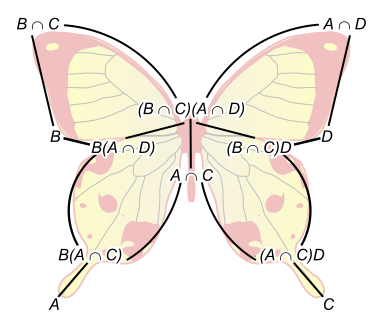
:Lemma. Suppose G is a group with subgroups A and C. Suppose B\triangleleft A and D\triangleleft C are normal subgroups. Then there is an isomorphism of quotient groups: ::\frac{(A\cap C)B}{(A\cap D)B} \cong \frac{(A\cap C)D}{(B\cap C)D}.
This can be generalized to the case of a group with operators (G, \Omega) with stable subgroups A and C, the above statement being the case of \Omega=G acting on itself by conjugation.
Zassenhaus proved this lemma specifically to give the most direct proof of the Schreier refinement theorem. The 'butterfly' becomes apparent when trying to draw the Hasse diagram of the various groups involved.
Zassenhaus' lemma for groups can be derived from a more general result known as Goursat's theorem stated in a Goursat variety (of which groups are an instance); however the group-specific modular law also needs to be used in the derivation.
References
Resources
- .
- .
- Carl Clifton Faith, Nguyen Viet Dung, Barbara Osofsky (2009) Rings, Modules and Representations. p. 6. AMS Bookstore,
- Hans Zassenhaus (1934) "Zum Satz von Jordan-Hölder-Schreier", Abhandlungen aus dem Mathematischen Seminar der Universität Hamburg 10:106–8.
- Hans Zassenhaus (1958) Theory of Groups, second English edition, Lemma on Four Elements, p 74, Chelsea Publishing.
References
- Pierce, R.S.. (1982). "Associative algebras". Springer.
- J. Lambek. (1996). "Logic and Algebra". CRC Press.
This article was imported from Wikipedia and is available under the Creative Commons Attribution-ShareAlike 4.0 License. Content has been adapted to SurfDoc format. Original contributors can be found on the article history page.
Ask Mako anything about Zassenhaus lemma — get instant answers, deeper analysis, and related topics.
Research with MakoFree with your Surf account
Create a free account to save articles, ask Mako questions, and organize your research.
Sign up freeThis content may have been generated or modified by AI. CloudSurf Software LLC is not responsible for the accuracy, completeness, or reliability of AI-generated content. Always verify important information from primary sources.
Report