From Surf Wiki (app.surf) — the open knowledge base
Zaporozhian Sich
16th to 18th-century Cossack polity in modern southern Ukraine

16th to 18th-century Cossack polity in modern southern Ukraine
| Field | Value | |
|---|---|---|
| native_name | uk | |
| conventional_long_name | Free lands of the Zaporozhian Host the Lower | |
| common_name | Zaporozhian Sich | |
| iso3166code | omit | |
| era | Early modern period | |
| status | De facto independent | |
| government_type | Cossack Republic | |
| <!-- only fill in the start/end event entry if a specific article exists. Don't just say "abolition" or "declaration" --> | event_start | |
| date_start | ||
| year_start | 1552 | |
| event_end | Liquidated by Catherine II | |
| date_end | ||
| year_end | 1775 | |
| year_exile_start | ||
| year_exile_end | ||
| event1 | ||
| event_pre | ||
| event_post | ||
| date_post | ||
| p1 | Wild Fields | |
| flag_p1 | ||
| image_p1 | ||
| s1 | Novorossiya Governorate | |
| flag_s1 | Flag of Russia (1896–1918).svg | |
| image_s1 | ||
| s2 | Danubian Sich | |
| flag_s2 | Flag_of_the_Zaporizhian_Sich.svg | |
| image_flag | Flag of the Zaporizhian Sich.svg | |
| flag_alt | ||
| flag_alt2 | ||
| flag | ||
| flag2 | ||
| flag2_type | ||
| image_coat | Herb Viyska Zaporozkogo Nyzovoho (Alex K).svg | |
| coa_size | ||
| coat_alt | ||
| symbol_type | Cossack with a musket | |
| symbol_type_article | ||
| image_map | 007 Ukrainian Cossack Hetmanate and Russian Empire 1751.jpg | |
| image_map_caption | Historical map of the Ukrainian Cossack Hetmanate (dark green) and the territory of the Zaporozhian Cossacks (purple) between the Russian Empire (khaki), the Crimean Khanate (pink) and the Polish–Lithuanian Commonwealth (yellow) | |
| image_map2 | ||
| capital | Sich (various locations in Zaporozhia) | |
| capital_exile | ||
| common_languages | Church Slavonic, Ruthenian, Ukrainian, | |
| religion | Eastern Orthodox | |
| demonym | Zaporozhtsi (Zaporozhians), Sichovyky (Sich Cossacks), Rusyny (Ruthenians), Ukraintsi (Ukrainians), Nyzovyky | |
| (members of Lower host) | ||
| currency | ||
| leader1 | Baida Vyshnevetsky | |
| (founder of Khortytsia castle) | ||
| leader2 | Petro Kalnyshevskyi | |
| year_leader1 | 1552-1563 (first) | |
| year_leader2 | 1765-1775 (last) | |
| title_leader | Kish otaman | |
| representative1 | ||
| year_representative1 | ||
| title_representative | ||
| deputy1 | ||
| year_deputy1 | ||
| title_deputy | ||
| <!-- Legislature --> | legislature | |
| house1 | ||
| type_house1 | ||
| house2 | ||
| type_house2 | ||
| <!-- Area and population of a given year --> | stat_year1 | |
| stat_area1 | ||
| stat_pop1 | ||
| population_estimate | 100,000 | |
| 183,700 | ||
| population_estimate_year | 1650, 1762 | |
| today | Ukraine | |
| footnote_a | ||
| footnote_b | ||
| footnote_h | ||
| footnotes |
De jure vassal of:
- Poland–Lithuania (1583–1654)
- Muscovy (1654-1709)
- Ottoman Empire (1711-1734)
- Russian Empire (1734-1775) (members of Lower host) (founder of Khortytsia castle) 183,700
The Zaporozhian Sich or Zaporizhian Sich, also known as the Free lands of the Zaporozhian Host the Lower, was a semi-autonomous polity and proto-state of Zaporozhian Cossacks that existed between the 16th to 18th centuries. For the latter part of that period, it was an autonomous stratocratic state within the Cossack Hetmanate. The lands of Zaporozhian Sich were centred around the Great Meadow region of Ukraine, spanning the lower Dnieper river. In different periods the area came under the sovereignty of the Polish–Lithuanian Commonwealth, the Ottoman Empire, the Tsardom of Russia, and the Russian Empire.
The establishment of Zaporozhian Sich was an important factor in defense of Ukraine and Russia from Crimean-Nogai raids. In 1650, its total population consisted of 100,000. In 1657–1687, Zaporizhian Sich was practically independent, possessing its own administration and armed forces consisting of 12,000–20,000 Cossacks. It was reliant on population growth, mainly consisting of Ukrainian refugees from devastated lands.
In 1775, shortly after Russia annexed the territories ceded to it by the Ottoman Empire under the Treaty of Küçük Kaynarca (1774), Catherine the Great disbanded the Sich. She incorporated its territory into the Russian province of Novorossiya.
The term Zaporozhian Sich can also refer metonymically and informally to the whole military-administrative organisation of the Zaporozhian Cossack host.
Name
The name Zaporizhzhia refers to the military and political organization of the Cossacks and to the location of their autonomous territory 'beyond the rapids' (uk) of the Dnieper River. The Dnieper rapids were a major portage on the north–south Dnieper trade route. The term sich is a noun related to the East Slavic verb sich (сѣчь), meaning 'to chop' or 'cut'; it may have been associated with the usual wood sharp-spiked stockades around Cossack settlements.
Zaporizhzhia was located in the region around the Great Meadow (Velykyi Luh) in today's south-eastern Ukraine, which was flooded by the Kakhovka Reservoir from the construction of the Kakhovka Dam in 1956 until its destruction in 2023. The area was also known under the historical term Wild Fields.
History
A possible precursor of the Zaporozhian Sich was a fortification (sich) built on the Tomakivka island () in the middle of the Dnieper River in the present-day Zaporizhzhia region of Ukraine. However, there is no direct evidence about the exact time of the existence of Tomakivka Sich, whereas indirect data suggest that at the time of Tomakivka Sich there was no Zaporozhian Sich yet.
The history of Zaporozhian Sich spans six time-periods:
- the emergence of the Sich (construction of ) (1471–1583)
- as part of the Lesser Poland Province of the Polish Crown by inclusion in the Kiev Voivodeship (1583–1657)
- the struggle against the Rzeczpospolita (the Polish-Lithuanian state), the Ottoman Empire, and the Crimea Khanate for the independence of the Ukrainian part of the Rzeczpospolita (Commonwealth) (1657–1686)
- the struggle with Crimea, the Ottoman Empire, and the Russian Empire for the unique identity of Cossacks (1686–1709)
- the standoff with the Russian government during its attempts to cancel the self-governing of the Sich, and its fall (1734–1775)
- the formation of the Danubian Sich outside the Russian Empire and finding ways to return home (1775–1828)
Formation
The Zaporozhian Sich emerged as a method of defence by Slavic colonists against the frequent and devastating raids of Crimean Tatars, who captured and enslaved hundreds of thousands of Ukrainians, Belarusians and Poles to supply the Crimean slave trade in operations called "the harvesting of the steppe". The Ukrainians created a self-defence force, the Cossacks, to stop the Tatars, and built sichi, fortified camps that were later united to form a central fortress, the Zaporozhian Sich.
Prince Dmytro Vyshnevetsky established the first Zaporozhian Sich on the island of Small (Mala) Khortytsia in 1552, building a fortress at Niz Dnieprovsky (Lower Dnieper) and placing a Cossack garrison there; Tatar forces destroyed the fortress in 1558. The Tomakivka Sich was built on a now-inundated island to the south, near the modern city of Marhanets; the Tatars also razed that sich in 1593. A third sich soon followed, on Bazavluk Island, which survived until 1638, when it was destroyed by a Polish expeditionary force suppressing a Cossack uprising. These settlements, founded during the 16th century, were already complex enough to constitute an early proto-state.
Struggle for independence


The Zaporozhian Cossacks became included in the Kiev Voivodeship from 1583 to 1657, which was part of the Lesser Poland Province of the Kingdom of Poland. They resented Polish rule, however. One of the reasons being religious differences, as the cossacks were Eastern Orthodox Christians whereas the Poles were mostly Catholics. They thus engaged in a long struggle for independence from surrounding powers, the Polish–Lithuanian Commonwealth (I Rzechpospolita), the Ottoman Empire, the Crimean Khanate, and the Tsardom of Russia, later the Russian Empire. The Sich became the centre of Cossack life, governed by the Sich Rada alongside its Kish otaman (sometimes called a hetman from German Hauptmann).
In 1648, Bohdan Khmelnytsky captured a sich at Mykytyn Rih, near the current city of Nikopol, Ukraine. From there the Khmelnytsky Uprising began against the I Rzechpospolita that led to the establishment of the Cossack Hetmanate (1648–1764).
After the Pereiaslav Agreement with the Tsar in 1654, the Zaporozhian Host was split into the Hetmanate, with its capital at Chyhyryn, and the more autonomous region of Zaporizhzhia, which continued to be centred on the Sich. During this period, the Sich changed location several times but was generally located in the Great Meadow. The Chortomlyk Sich was built at the mouth of the Chortomlyk River in 1652. In 1667 the Truce of Andrusovo made the Sich a condominium ruled jointly by Russia and the Polish–Lithuanian Commonwealth.
During the reign of Peter the Great, Cossacks were used to construct canals and fortification lines in northern Russia. An estimated 20–30 thousand were sent each year. Hard labour led to a high mortality rate among builders, and only an estimated 40% of Cossacks returned home.
After the Battle of Poltava in 1709, the Chortomlyk Sich (sometimes referred to as the "Old Sich" (Stara Sich)) was destroyed and Baturyn, the capital of Hetman Ivan Mazepa, was razed. Another sich was built at the mouth of the Kamianka river but was destroyed in 1711 by the Russian government. The Cossacks then fled to the Crimean Khanate to avoid persecution and founded the Oleshky Sich in 1711 (today the city of Oleshky). In 1734, they were allowed to return to the Russian Empire. Suffering from discrimination in the Khanate, Cossacks accepted the offer to return and built another Sich close to the former Chortomlyk Sich, referred to as the Nova Sich.
Fear of the independence of the Sich resulted in the Russian administration abolishing the Hetmanate in 1764. The Cossack officer class was incorporated into the Russian nobility (Dvoryanstvo). However, rank and file Cossacks were reduced to peasant status, including a substantial portion of the old Zaporozhians. Tension rose after the Treaty of Küçük Kaynarca, when the need for a southern frontier ended after the annexation of the Crimea. The Imperial colonisation of Novorossiya (New Russia) with Serbs and Romanians created further conflict. After the end of the war between Russia and the Ottoman Empire for possession of the Black Sea and Crimean steppes, Russia no longer needed the Zaporozhian Cossacks for protection of the border region. Russia finally destroyed the Zaporozhian Sich through military force in 1775.
Destruction and aftermath

In May 1775, Russian General Peter Tekeli received orders to occupy and destroy the Zaporozhian Sich from Grigory Potemkin, who had been formally admitted into Cossackdom a few years earlier. Potemkin was given direct orders from Catherine the Great. On 5 June 1775, Tekeli surrounded the Sich with artillery and infantry. He postponed the assault and even allowed visits while the head of the Host, Petro Kalnyshevsky, decided how to react to the Russian ultimatum. The Zaporozhians chose to surrender. The Sich was officially disbanded by the 3 August 1775 manifesto of Catherine, "On the Liquidation of Zaporozhian Sich and Annexation thereof to Novorossiya Governorate", and the Sich was razed to the ground.
Some of the Cossack officer class, the starshyna, became hereditary Russian nobility and obtained huge lands despite their previous attempts to relocate the Sich to North America or Australia. Under the guidance of a starshyna named Lyakh, a conspiracy was formed among a group of fifty Cossacks to pretend to go fishing on the Inhul next to the Southern Buh in the Ottoman provinces and to obtain fifty passports for the expedition. The pretext was enough to allow about 5000 Zaporozhians to flee, some travelling to the Danube Delta, where they formed a new Danubian Sich as a protectorate of the Ottoman Empire. Others moved to Hungary to form a Sich there as a protectorate of the Austrian Empire. According to folklore, some moved to Malta, because Kosh otamans and other senior members of the starshyna considered themselves a kind of Maltese chivalry.
_Last_Rada_on_Sich.jpg)
The leader of the Zaporozhian Host, Petro Kalnyshevsky, was arrested and exiled to the Solovetsky Islands (where he lived to the age of 112 in the Solovetsky Monastery). Four high-level starshynas were repressed and exiled, later dying in Siberian monasteries. Lower level starshynas who remained and went over to the Russian side were given army ranks and all the privileges that accompanied them, and allowed to join Hussar and Dragoon regiments. Most of the ordinary Cossacks were made peasants and even serfs.
In 1780, after disbanding the Zaporozhian Cossack Host, Potemkin attempted to gather and reorganize the Cossacks voluntarily, and they helped to defend Ukraine from the Turks during the Russo-Turkish War (1787–1792). He gathered almost 12,000 Cossacks and called them the Black Sea Cossacks. After the conflict was over, rather than allowing the Cossacks to settle across Southern Ukraine, the Russian government began to resettle them on the Kuban River. In 1860, they changed their name to the Kuban Cossacks.
Ukrainian writer Adrian Kashchenko (1858–1921) and historian Olena Apanovych note that the abolition of the Zaporozhian Sich had a strong symbolic effect. Memories of the event remained for a long time in local folklore.
Organization and government
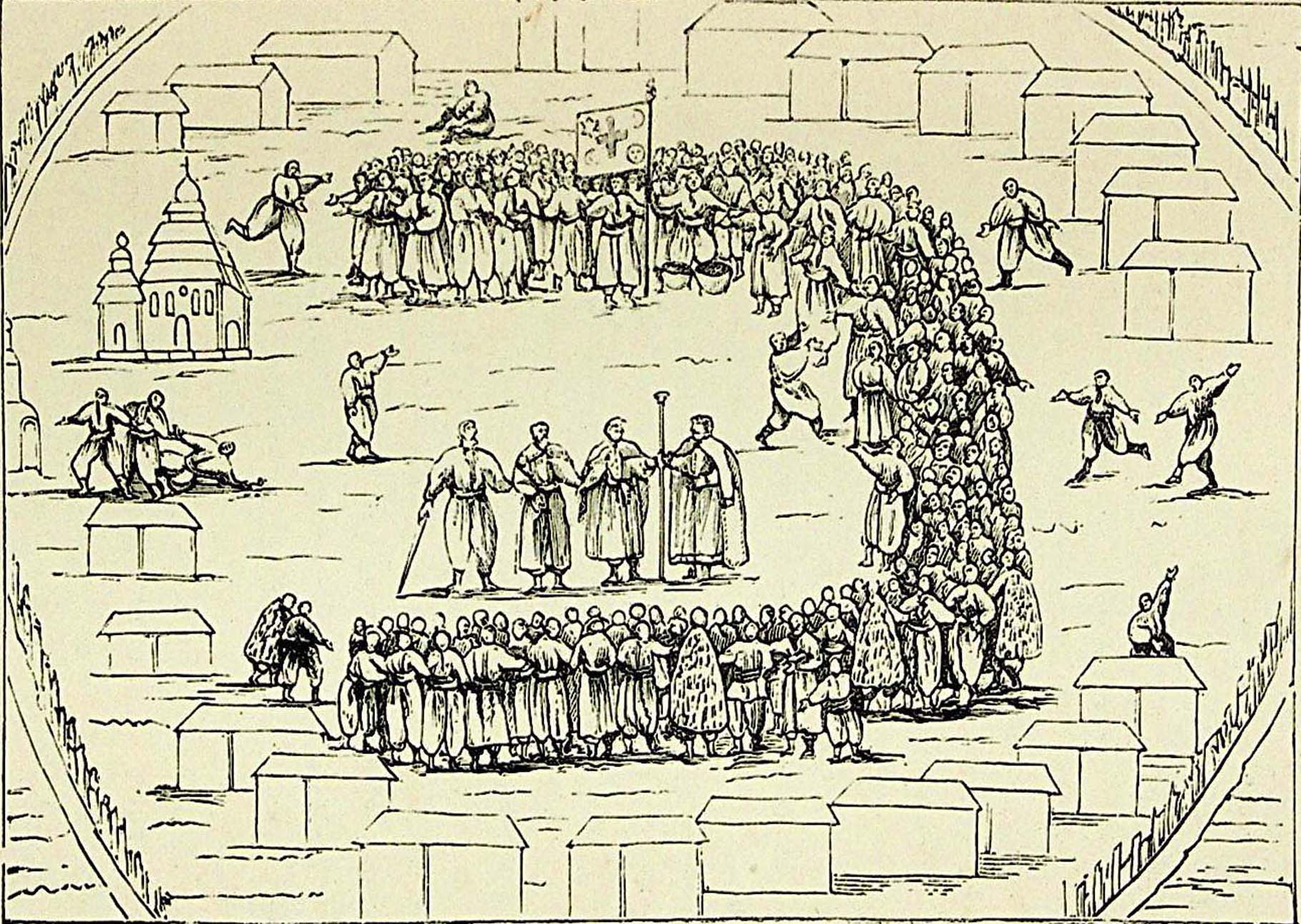
The Zaporozhian Host was led by the Sich Rada that elected a Kish otaman as the host's leader. He was aided by a head secretary (pysar), head judge, and head archivist. During military operations the Otaman carried unlimited power supported by his staff as the military collegiate. He decided with an agreement from the Rada whether to support a certain Hetman (such as Bohdan Khmelnytsky) or other leaders of state.
Some sources refer to the Zaporozhian Sich as a "Cossack republic", because the highest power in it belonged to the assembly of all its members, and its leaders (starshyna) were elected. The Cossacks formed a society (hromada) that consisted of "kurins" (each with several hundred Cossacks). A Cossack military court severely punished violence and stealing among compatriots, the bringing of women to the Sich, the consumption of alcohol in periods of conflict, and other offenses. The administration of the Sich provided Orthodox churches and schools for the religious and secular education of children.
The population of the Sich had a cosmopolitan component, including Ukrainians, Moldavians, Tatars, Poles, Lithuanians, Jews, Russians and many other ethnicities. The social structure was complex, consisting of destitute gentry and boyars, szlachta (Polish nobility), merchants, peasants, outlaws of every sort, runaway slaves from Turkish galleys, and runaway serfs (as the Zaporozhian polkovnyk Pivtorakozhukha). Some of those who were not accepted to the host formed gangs of their own, and also claimed to be Cossacks. However, after the Khmelnytsky Uprising these formations largely disappeared and were integrated mainly into Hetmanate society.
Army and warfare

The Cossacks developed a large fleet of fast, light vessels. Their campaigns were targeted at rich settlements on the Black Sea shores of the Ottoman Empire, and several times took them as far as Constantinople and Trabzon (formerly Trebizond).
Zaporozhian Sich centers and locations
- Khortytsia Sich (1556–1557)
- Khortytsia Island (today part of Zaporizhzhia)
- Tomakivka Sich (1564–1593)
- Great Meadow, formerly submerged (located near today's Marhanets)
- Bazavluk Sich, (1593–1638)
- Great Meadow, formerly submerged (located near today's village of Kapulivka, Nikopol Raion)
- Mykytyn Sich (1639–1652)
- Nikopol
- Chortomlyk Sich (1652–1709)
- Great Meadow, formerly submerged (located near today's village of Kapulivka, Nikopol Raion)
- Kamianka Sich (1709–1711)
- near village of Respublikanets, Beryslav Raion
- Oleshky Sich (1711–1734)
- eastern outskirts of the city of Oleshky
- Nova Pidpilnenska Sich (1734–1775)
- Great Meadow, formerly submerged near the village of Pokrovske, Nikopol Raion (about same location of Chortomlyk and Bazavluk)
Zaporozhian Siches and their leaders
As Kish Otamans also known as "Hetmans":
- Khortytsia Sich (1556–1557)
- Wężyk Chmielnicki (1534–1569)
- Tomakivka Sich (1564–1593)
- Wężyk Chmielnicki (1534–1569)
- Michał Wiśniowiecki (1529–1584) (1569–1570)
- Iwan Swiergowski (1574)
- Samiylo Kishka (1574–1575)
- Bohdan Ruzhynski (1575–1576)
- Jacub Szach (1576–1578)
- Ivan Pidkova (1577–1578)
- Lukyan Chornynsky (1578)
- Jan Oryszowski (1581)
- Samuel Zborowski (1581–1584)
- Bohdan Mokoshynsky (1584)
- Mykhailo Ruzhynski (1585)
- Zakhar Kulaha (1585)
- Bohdan Mokoshynsky (1586)
- Lukyan Chornynsky (1586)
- Demyan Skalozub (1585–1589)
- Krzysztof Kosiński (−1593)
- Bazavluk Sich (1593–1638)
- Hryhoriy Loboda (1593–1596)
- Bohdan Mokoshynsky (1594)
- Jan Oryszowski (1596)
- Severyn Nalyvaiko (1596)
- Khrystofor Netkovsky (1596–1597)
- Hnat Vasylevych (1596–1597)
- Tykhin Baybuza (1597–1598)
- Fedir Polous (1598)
- Semen Skalozub (1599)
- Samiylo Kishka (1600–1602)
- Havrylo Krutnevych (1602–1603)
- Ivan Kutskovych (1602–1603)
- Ivan Kosyi (1603)
- Kaletnyk Andriyevych (1609–1610)
- Olifer Holub (1622–1623)
- Mykhailo Doroshenko (1623–1625)
- Kaletnyk Andriyevych (1624–1625)
- Marko Zhmailo (1625)
- Mykhailo Doroshenko (1625–1628)
- Hryhoriy Chorny (1628–1630)
- Ivan Sulyma (1628–1629)
- Lev Ivanovych (1629–1630)
- Taras Triasylo (1630)
- Timothy Orendarenko (1630–1631)
- Semen Perevyazka (1632)
- Timothy Orendarenko (1632–1633)
- Ivan Petrizhitsky-Kulaga (1632)
- Andriy Didenko (1633)
- Dorothy Doroshenko (1633)
- Ivan Sulyma (1633–1635)
- Sava Kononovych (1637)
- Pavlo Pavliuk-But (1637)
- Illyash Karayimovych (1638)
- Yakiv Ostryanyn (1638)
- Dmytro Hunia (1638)
- Mykytyn Sich (1639–1652)
- Karpo Pivtora-Kozhukha (1639–1642)
- Maksym Hulak (1642–1646)
- Fedir Lutay (1647-1648) As Kish Otamans formally subject to the Hetman of Zaporizhian Host:
- Mykytyn Sich (1639–1652)
- Hutskyi (1650)
- Chortomlyk Sich (1652–1709)
- Fedir Lutay (1652)
- Pavlo Homin (1654-1657)
- Yakiv Barabash (1657-1658)
- Pavlo Homin (1658-1659)
- Ivan Briukhovetsky (1659)
- Petro Sukhoviy (1660)
- Ivan Briukhovetsky (1661)
- Ivan Velychko-Bosovskyi (1662)
- Sashko Turovets (1663)
- Ivan Sirko (1663)
- Sashko Turovets (1664)
- Ivan Sirko (1664)
- Ivan Shcherbyna (1664-1665)
- Levko Shkura (1665)
- Ivan Kurylo (1665)
- Ivan Velychko-Bosovskyi (1665)
- Levko Shkura (1665-1666)
- Ivan Zhdan-Rih (1666-1667)
- Ostap Vasiutenko-Chemerys (1667)
- Ivan Zhdan-Rih (1667)
- Ivan Bilkovskyi (1668)
- Lukash Martynovych (1669)
- Mykhailo Khanenko (1669-1670)
- Hryhoriy Pelekh (1670)
- Lukash Martynovych (1671)
- Yevseviy Shashol (1672)
- Stepan Vdovychenko (1672)
- Lukyan Andriyiv (1672-1673)
- Ivan Sirko (1673-1680)
- Ivan Stiahaylo (1680-1681)
- Trokhym Voloshanyn (1681-1682)
- Vasyl Oleksiyenko (1682)
- Hryhoriy Yeremeyev (1682-1684)
- Hryhoriy Sahaidachnyi (1686)
- Fedir Ivanyk (1686)
- Filon Lykhopiy (1687)
- Hryhoriy Sahaidachnyi (1687)
- Filon Lykhopiy (1688)
- Ivan Husak (1688-1689)
- Fedko Husak (1689)
- Ivan Husak (1690-1692)
- Vasyl Kuzmenko (1692-1693)
- Ivan Husak (1693)
- Semen Ruban (1693-1694)
- Ivan Sharpylo (1694)
- Petro Pryma (1694-1695)
- Maksym Samiylenko (1695)
- Ivan Husak (1695)
- Yakiv Moroz (1696-1697)
- Hryhoriy Yakovenko (1697-1698)
- Martyn Stukalo (1698-1699)
- Petro Pryma (1699-1700)
- Herasym Krysa (1701)
- Petro Sorochynskyi (1701-1702)
- Kost Hordiienko (1702)
- Herasym Krysa (1703)
- Kost Hordiienko (1703-1706)
- Lukash Tymofiyenko (1706-1707)
- Petro Sorochynskyi (1707)
- Tymofiy Fenenko (1708)
- Kost Hordiyenko (1708-1709)
- Kamianka Sich (1709–1711)
- Petro Sorochynskyi (1709-1710)
- Yakym Bohush (1710)
- Yosyp Kyrylenko (1710)
- Oleshky Sich (1711–1734)
- Kost Hordiyenko (1711-1714)
- Ivan Malashevych (1714-1720)
- Kost Hordiienko (1720-1728)
- Ivan Bilytskyi (1733)
- Nova Sich (1734–1775)
- Ivan Malashevych (1734, 1734-36, 1737)
- Ivan Bilytskyi (1735, 1738)
- Kost Pokotylo (1739)
- Yakiv Turkalo (1739-1740)
- Ivan Cherevko (1740)
- Stepan Umanskyi (1740)
- Stepan Hladkyi (1741)
- Semen Yeremiyevych (1742)
- Yakym Ihnatovych (1744)
- Vasyl Sych (1745-1747)
- Pavlo Kozeletskyi (1747)
- Marko Kazhan (1748)
- Yakym Ihnatovych (1748-1749)
- Oleksiy Kozeletskyi (1749-1750)
- Ivan Kazhan (1750)
- Vasyl Sych (1751)
- Yakiv Ihnatovych (1752)
- Pavlo Kozeletskyi (1752-1753)
- Semen Yeremiyevych (1753)
- Danylo Hladkyi (1753)
- Yakym Ihnatovych (1754)
- Hryhoriy Lantukh (1755-1756)
- Fedir Shkura (1756)
- Danylo Hladkyi (1757)
- Hryhoriy Lantukh (1757-1758)
- Oleksiy Bilytskyi (1759-1760)
- Hryhoriy Lantukh (1761)
- Stepan Rud (1762)
- Petro Kalnyshevskyi (1762)
- Hryhoriy Lantukh (1763)
- Pylyp Fedoriv (1764)
- Ivan Bilytskyi (1765)
- Petro Kalnyshevskyi (1765-1775)
- Danubian Sich (1775–1828)
- Andriy Liakh (1775-1778)
- Abdula (1778)
- Hardovyi (1778-1791)
- Trokhym Pomelo (1791-1794)
- Hnat Koval (1805-1809)
- Samiylo Kalnybolotskyi (1809-1813)
- Semen Moroz (1813-1815)
- Vasyl Smyk (1815-1816)
- Kindrat Riasnyi (1816-1817)
- Ivan Taran (1817-1818)
- Mykhailo Huba (1818-1819)
- Vasyl Cherniha (1819-1820)
- Vasyl Lytvyn (1820-1821)
- Nykyfor Biluha (1821-1822)
- Hrytsko Huba (1822-1823)
- Semen Moroz (1823-1825)
- Mykhailo Huba (1825-1826)
- Vasyl Cherniha (1826)
- Vasyl Nezamayivskyi (1826-1827)
- Yosyp Hladkyi (1827-1828)
- Mykhailo Chayka (1853-1870) - proclaimed Cossack otaman under Turkish command during the Crimean War
Notes
References
Works cited
- {{cite book
References
- "січовики".
- (27 September 2024). "Чи можна називати запорозьких козаків - українцями?".
- Бартоломей Зиморович. "Памʼять війни турецької, року 1621-го польським народом перенесеної...".
- "НИЗОВИК".
- [http://ponomariv-kultura-slova.wikidot.com/fonetyka Запорізька (не Запорозька) Січ] {{Webarchive. link. (5 листопада 2019 // [[Пономарів Олександр Данилович). Пономарів О. Д.]] Культура слова: мовностилістичні поради / Навч. посібник. 2-ге вид., стереотип. — К.: [[Либідь (видавництво). Либідь]], 2001. — 240 с. — С. 24–25.
- Сечь ист. Січ, -і; Запорожская /~чь Запорізька Січ // [http://chtyvo.org.ua/authors/Holovaschuk_Serhii/Ros-ukr_slovnyk_t3_pro-Ya/ Російсько-український словник : [в 3 т.]] / АН УССР, Ин-т языковедения им. А. А. Потебни; редкол.: И. К. Белодед (председатель) [и др.]. - Киев : Наук. думка, 1969. – Т. 3: Про-Я / ред. тома: С. И. Головащук [и др.]. – 1969. – 727 c. – C. 270. {{Webarchive. link. (6 листопада 2019)
- [https://web.archive.org/web/20180123093239/http://lib.pu.if.ua/elib/local/sk429128.djvu Запорі́зька Січ, Запорозька Січ] // [[Українська радянська енциклопедія]]: в 12-ти т. / гол. ред. М. П. Бажан; редкол.: О. К. Антонов та ін. — 2-ге вид. — Т. 4: Електрод — Кантаридин. — К. : Голов. ред. УРЕ, 1979. — 558 с. — С. 206—209.
- link. (2003)
- (1989). "Hetman state".
- link. Ukrainian Historical Journal. (1991)
- link. (2002). Kyiv
- Borys Krupnytsky & Arkadii Zhukovsky. (1993). "The Zaporozhia".
- Видавництво "Світ" ("Svit" Publishing House). (1990)
- (1998). "Kozatski sichi (narysy z istoriyi ukrayinskoho kozatstva XVI–XIX st.)". [[NASU Institute of History of Ukraine.
- [http://haidamaka.org.ua/0146.html Томаківська Січ], by Гурбик А.О., in: Історія українського козацтва: нариси у 2 т.\ Редкол: Смолій (відп. Ред) та інші. – Київ.: Вид.дім "Києво-Могилянська академія", 2006р, Т.1.
- (1993). "Zaporozhian Sich".
- (15 March 2018). "Along Ukraine's River: A Social and Environmental History of the Dnipro". Central European University Press.
- link. exlibris.org.ua. (1991)
- (1985). "The Jews of Odessa: A Cultural History, 1794-1881". Stanford University Press.
- (17 October 2006). "Capital city of liberties: How many Zaporozhian Siches were there?". day.kyiv.ua.
- (2002). "Ukrains'ke kozatstvo. Mala entsyklopediia". Unknown.
- (1991). "Opovidannia pro slavne viys'ko zaporoz'ke nyzove". Sich.
- Olena Apanovich, "Ne propala ihnya slava", "Vitchizna" Magazine, N 9, 1990
- (28 June 2006). "Speech of H.E. Roman Shpek, Head of the Mission of Ukraine to EU on debate in the EP dedicated to 10th Anniversary of the Ukrainian Constitution". Mission of Ukraine to EU.
- (1996). "Cossack Navy 16th – 17th Centuries".
This article was imported from Wikipedia and is available under the Creative Commons Attribution-ShareAlike 4.0 License. Content has been adapted to SurfDoc format. Original contributors can be found on the article history page.
Ask Mako anything about Zaporozhian Sich — get instant answers, deeper analysis, and related topics.
Research with MakoFree with your Surf account
Create a free account to save articles, ask Mako questions, and organize your research.
Sign up freeThis content may have been generated or modified by AI. CloudSurf Software LLC is not responsible for the accuracy, completeness, or reliability of AI-generated content. Always verify important information from primary sources.
Report