From Surf Wiki (app.surf) — the open knowledge base
Zamak
Metal alloy
Metal alloy
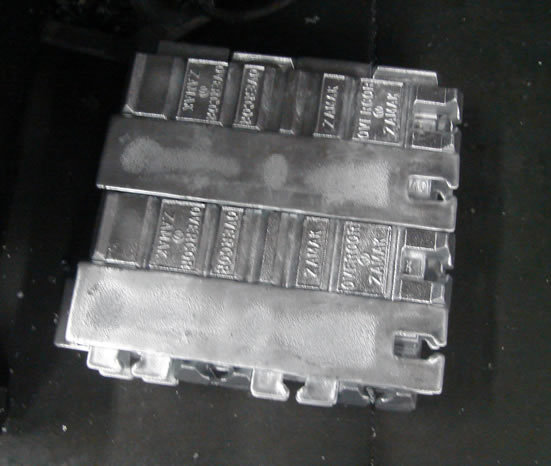
ZAMAK (or Zamac, formerly trademarked as MAZAK) is an eclectic family of alloys with a base metal of zinc and alloying elements of aluminum, magnesium, and copper.
Zamak alloys are part of the zinc aluminum alloy family; they are distinguished from the other ZA alloys because of their constant 4% aluminum composition.
The name zamak is an acronym of the German names for the metals of which the alloys are composed: Zink (zinc), Aluminum, Magnesium, and Kupfer (copper). The New Jersey Zinc Company developed zamak alloys in 1929.
The most common zamak alloy is zamak 3. Besides that, zamak 2, zamak 5, and zamak 7 are also commercially used. These alloys are most commonly die-cast. Zamak alloys (particularly #3 and #5) are frequently used in the spin-casting industry.
A large problem with early zinc-die-casting materials was zinc pest, owing to impurities in the alloys. Zamak avoided this by the use of 99.99% pure zinc metal, produced by New Jersey Zinc's use of a refluxer as part of the refining-process.
Zamak can be electroplated, wet-painted, and chromate-conversion-coated well.
Mazak
In the early 1930s, Morris Ashby in Britain had licensed the New Jersey zamak alloy. The 99.99%-purity refluxer zinc was not available in Britain and so they acquired the right to manufacture the alloy using a locally-available electrolytically-refined zinc of 99.95% purity. This was given the name Mazak, partly to distinguish it from zamak and partly from the initials of Morris Ashby. In 1933, National Smelting licensed the refluxer patent with the intent of using it to produce 99.99% zinc in their plant at Avonmouth.
Standards
Zinc alloy chemical composition standards are defined per country by the standard listed below:
| Country | Zinc ingot | Zinc casting |
|---|---|---|
| Europe | EN1774 | EN12844 |
| US | ASTM B240 | ASTM B86 |
| Japan | JIS H2201 | JIS H5301 |
| Australia | AS 1881 - SAA H63 | AS 1881 - SAA H64 |
| China | GB 8738-88 | - |
| Canada | CSA HZ3 | CSA HZ11 |
| International | ISO 301 | - |
Zamak goes by many different names based on standard and/or country:
| Traditional name | Short composition name | Form | Common | ASTM† | Short European designation | JIS | China | UK BS 1004 | France NFA 55-010 | Germany DIN 1743-2 | UNS | Other | |||||
|---|---|---|---|---|---|---|---|---|---|---|---|---|---|---|---|---|---|
| Zamak 2 | |||||||||||||||||
| or | |||||||||||||||||
| Kirksite | ZnAl4Cu3 | Ingot | Alloy 2 | AC 43A | title = Alloy designation - cross reference table | url = http://www.brockmetal.com/downloads/documents/NOGUOHRYMM_designation_and_stress_curves.pdf | access-date = 2010-10-31 | archive-url = https://web.archive.org/web/20110708094953/http://www.brockmetal.com/downloads/documents/NOGUOHRYMM_designation_and_stress_curves.pdf | url-status = usurped | archive-date = 2011-07-08}} | - | ZX04 | - | Z-A4U3 | Z430 | Z35540 | ZL2, ZA-2, ZN-002 |
| Cast | ZP0430 | - | Z35541 | ZP2, ZA-2, ZN-002 | |||||||||||||
| Zamak 3 | ZnAl4 | Ingot | Alloy 3 | AG 40A | ZL0400 | title = JIS H2201 - Japanese Industrial Standard - Zinc alloy ingot for die casting (1999) | url =http://www.nyrstar.com/en/productsServices/products/zinc/ZincAlloysZamakProducts/ZZ_standards/DieCasting/JIS_H2201-Zinc-Alloy-Ingot-for-die-casting.htm | access-date =2008-02-26}} | ZX01 | Alloy A | Z-A4 | Z400 | Z35521 | ZL3, ZA-3, ZN-003 | |||
| Cast | ZP0400 | title = JIS H5301 - Japanese Industrial Standard - Zinc alloy die casting (1979) | url =http://www.nyrstar.com/en/productsServices/products/zinc/ZincAlloysZamakProducts/ZZ_standards/DieCasting/JIS_H5301-Zinc-Alloy-die-castings.htm | access-date =2008-02-26}} | - | Z33520 | ZP3, ZA-3, ZN-003 | ||||||||||
| Zamak 4{{Citation | title = zamak 4 (Alloy 4) | url =http://www.nyrstar.com/en/productsServices/products/zinc/ZincAlloysZamakProducts/Zinc-Diecasting-Product-Zamak4-GZ4/Zamak4-GZ4-ZincAlloyForHotChamberDieCasting.htm | access-date = 2008-03-01}} | Ingot | Used in Asia only | ZA-4, ZN-004 | |||||||||||
| Zamak 5 | ZnAl4Cu1 | Ingot | Alloy 5 | AC 41A | ZL0410 | Ingot type 1 | ZX03 | Alloy B | Z-A4UI | Z410 | Z35530 | ZL5, ZA-5, ZN-005 | |||||
| Cast | ZP0410 | ZDC1 | - | Z35531 | ZP5, ZA-5, ZN-005 | ||||||||||||
| Zamak 7 | ZnAl4Ni | Ingot | Alloy 7 | AG 40B | - | - | ZX02 | - | - | - | Z33522 | ZA-7, ZN-007 | |||||
| Cast | - | Z33523 | |||||||||||||||
| †color of the cell is the color of the material designated by ASTM B908. |
The short European designation code breaks down as follows (using ZL0430 as the example):
- Z is the material (Z=-zinc)
- P is the use (P=pressure-die-casting (casting), L=ingot)
- 04 is the percent aluminum (04=4% aluminum)
- 3 is the percent copper (3=3% copper)
Zamak 2==
Zamak 2 has the same composition as zamak 3 with the addition of 3% copper in order to increase strength by 20%, which also increases the price. Zamak 2 has the greatest strength out of all the zamak alloys. Over time it retains its strength and hardness better than the other alloys; however, it becomes more brittle, shrinks, and is less elastic.
Zamak 2 is also known as Kirksite when gravity-cast for use as a die. It was originally designed for low volume sheet-metal-dies. It later gained popularity for making short-run injection-molding-dies. It is also less-commonly used for non-sparking tools and mandrels for metal-spinning.
| Alloying elements | Impurities | Standard | Limit | Al | Cu | Mg | Pb | Cd | Sn | Fe | Ni | Si | In | Tl |
|---|---|---|---|---|---|---|---|---|---|---|---|---|---|---|
| ASTM B240 (Ingot) | min | 3.9 | 2.6 | 0.025 | - | - | - | - | - | - | - | - | ||
| max | 4.3 | 2.9 | 0.05 | 0.004 | 0.003 | 0.002 | 0.075 | - | - | - | - | |||
| ASTM B86 (Cast) | min | 3.5 | 2.6 | 0.025 | - | - | - | - | - | - | - | - | ||
| max | 4.3 | 2.9 | 0.05 | 0.005 | 0.004 | 0.003 | 0.1 | - | - | - | - | |||
| EN1774 (Ingot) | min | 3.8 | 2.7 | 0.035 | - | - | - | - | - | - | - | - | ||
| max | 4.2 | 3.3 | 0.06 | 0.003 | 0.003 | 0.001 | 0.02 | 0.001 | 0.02 | - | - | |||
| EN12844 (Cast) | min | 3.7 | 2.7 | 0.025 | - | - | - | - | - | - | - | - | ||
| max | 4.3 | 3.3 | 0.06 | 0.005 | 0.005 | 0.002 | 0.05 | 0.02 | 0.03 | - | - | |||
| GB8738-88 | min | 3.9 | 2.6 | 0.03 | - | - | - | - | - | - | - | - | ||
| max | 4.3 | 3.1 | 0.06 | 0.004 | 0.003 | 0.0015 | 0.035 | - | - | - | - |
| Property | Metric value | Imperial value | Mechanical properties | Physical properties |
|---|---|---|---|---|
| Ultimate tensile strength | 397 MPa (331 MPa aged) | 58,000 psi | ||
| Yield strength (0.2% offset) | 361 MPa | 52,000 psi | ||
| Impact strength | 38 J (7 J aged) | 28 ft-lbf (5 ft-lbf aged) | ||
| Elongation at Fmax | 3% (2% aged) | |||
| Elongation at fracture | 6% | |||
| Shear strength | 317 MPa | 46,000 psi | ||
| Compressive yield strength | 641 MPa | 93,000 psi | ||
| Fatigue strength (reverse bending 5x10⁸ cycles) | 59 MPa | 8,600 psi | ||
| Hardness | 130 Brinell (98 Brinell aged) | |||
| Modulus of elasticity | 96 GPa | 14,000,000 psi | ||
| Solidification range (melting range) | 379–390 °C | 714–734 °F | ||
| Density | 6.8 kg/dm3 | 0.25 lb/in3 | ||
| Coefficient of thermal expansion | 27.8 μm/m-°C | 15.4 μin/in-°F | ||
| Thermal conductivity | 105 W/m-K | 729 BTU-in/hr-ft2-°F | ||
| Electrical resistivity | 6.85 μΩ-cm at 20°C | 2.70 μΩ-in at 68 °F | ||
| Latent heat (heat of fusion) | 110 J/g | 4.7x10⁻⁵ BTU/lb | ||
| Specific heat capacity | 419 J/kg-°C | 0.100 BTU/lb-°F | ||
| Coefficient of friction | 0.08 |
KS
The KS alloy was developed for spin casting decorative parts. It has the same composition as zamak 2, except with more magnesium in order to produce finer grains and reduce the orange peel effect.
| Alloying elements | Impurities | Standard | Limit | Al | Cu | Mg | Pb | Cd | Sn | Fe | Ni | Si | In | Tl |
|---|---|---|---|---|---|---|---|---|---|---|---|---|---|---|
| Nyrstar | min | 3.8 | 2.5 | 0.4 | - | - | - | - | - | - | - | - | ||
| max | 4.2 | 3.5 | 0.6 | 0.003 | 0.003 | 0.001 | 0.020 | - | - | - | - |
| Property | Metric value | Imperial value | Mechanical properties | Physical properties |
|---|---|---|---|---|
| Ultimate tensile strength | ||||
| Yield strength (0.2% offset) | ||||
| Elongation | ||||
| Hardness | 150 Brinell max | |||
| Solidification range (melting range) | 380-390°C | 716-734°F | ||
| Density | 6.6g/cm3 | 0.25lb/in3 | ||
| Coefficient of thermal expansion | 28.0μm/m-°C | 15.4μin/in-°F | ||
| Thermal conductivity | 105W/m-K | 729BTU-in/hr-ft2-°F | ||
| Electrical conductivity | 25% IACS | |||
| Specific heat capacity | 419J/kg-°C | 0.100BTU/lb-°F | ||
| Coefficient of friction | 0.08 |
Zamak 3
Zamak 3 is the de facto standard for the zamak series of zinc alloys; all other zinc alloys are compared to this. Zamak 3 has the base composition for the zamak alloys (96% zinc, 4% aluminum). It has excellent castability and long term dimensional stability. More than 70% of all North American zinc die castings are made from zamak 3.
| Alloying elements | Impurities | Standard | Limit | Al | Cu† | Mg | Pb | Cd | Sn | Fe | Ni | Si | In | Tl | ||
|---|---|---|---|---|---|---|---|---|---|---|---|---|---|---|---|---|
| ASTM B240{{Citation | title = ASTM B240: Standard specification for zinc in ingot form for die casting: chemical composition | url =http://www.nyrstar.com/en/productsServices/products/zinc/ZincAlloysZamakProducts/ZZ_standards/DieCasting/ASTMB240-zamak-and-zincdiecastingstandard-zincalloysUSA.htm | access-date =2008-02-27}} (Ingot) | min | 3.9 | - | 0.025 | - | - | - | - | - | - | - | - | |
| max | 4.3 | 0.1 | 0.05 | 0.004 | 0.003 | 0.002 | 0.035 | - | - | - | - | |||||
| ASTM B86{{Citation | title = ASTM B86: Standard specification for zinc die casting: chemical composition | url =http://www.nyrstar.com/en/productsServices/products/zinc/ZincAlloysZamakProducts/ZZ_standards/DieCasting/ASTMB86-zamak-and-zincdiecastingstandard-zincalloysUSA.htm | access-date =2008-02-27}} (Cast) | min | 3.5 | - | 0.025 | - | - | - | - | - | - | - | - | |
| max | 4.3 | 0.25 | 0.05 | 0.005 | 0.004 | 0.003 | 0.1 | - | - | - | - | |||||
| EN1774{{Citation | title = EN1774 Standard - zinc and zinc alloys - alloys for foundry purposes - ingot and liquid | url =http://www.nyrstar.com/en/productsServices/products/zinc/ZincAlloysZamakProducts/ZZ_standards/DieCasting/EN1774-zamak-and-zincdiecastingstandard-Alloys-for-foundry-purposes-ingot-and-liquid.htm | access-date =2008-02-27}} (Ingot) | min | 3.8 | - | 0.035 | - | - | - | - | - | - | - | - | |
| max | 4.2 | 0.03 | 0.06 | 0.003 | 0.003 | 0.001 | 0.02 | 0.001 | 0.02 | - | - | |||||
| EN12844{{Citation | title = EN12844: Standard - zinc and zinc alloys - castings - specification (September 1998) | url =http://www.nyrstar.com/en/productsServices/products/zinc/ZincAlloysZamakProducts/ZZ_standards/DieCasting/EN12844-zamak-zincdiecastingstandard-zinc-and-zinc-alloys-castings-specifications.htm | access-date =2008-02-27}} (Cast) | min | 3.7 | - | 0.025 | - | - | - | - | - | - | - | - | |
| max | 4.3 | 0.1 | 0.06 | 0.005 | 0.005 | 0.002 | 0.05 | 0.02 | 0.03 | - | - | |||||
| JIS H2201 (Ingot) | min | 3.9 | - | 0.03 | - | - | - | - | - | - | - | - | ||||
| max | 4.3 | 0.03 | 0.06 | 0.003 | 0.002 | 0.001 | 0.075 | - | - | - | - | |||||
| JIS H5301 (Cast) | min | 3.5 | - | 0.02 | - | - | - | - | - | - | - | - | ||||
| max | 4.3 | 0.25 | 0.06 | 0.005 | 0.004 | 0.003 | 0.01 | - | - | - | - | |||||
| AS1881{{Citation | title = AS1881 - Australia standard - Zinc alloys - casting ingots and casting requirements (1986) | url =http://www.nyrstar.com/en/productsServices/products/zinc/ZincAlloysZamakProducts/ZZ_standards/DieCasting/AS1881-1986-Zinc-Alloys-Casting-ingots-and-castings-quaility-requirements.htm | access-date =2008-02-27}} | min | 3.9 | - | 0.04 | - | - | - | - | - | - | - | - | |
| max | 4.3 | 0.03 | 0.06 | 0.003 | 0.003 | 0.001 | 0.05 | - | 0.001 | 0.0005 | 0.001 | |||||
| GB8738-88{{Citation | title = GB8738 - Chinese standard: zinc alloys ingots for casting (2006) | url =http://www.nyrstar.com/en/productsServices/products/zinc/ZincAlloysZamakProducts/ZZ_standards/DieCasting/GB8738-88-Zinc-Alloys-Casting-ingots-and-castings-quaility-requirements.htm | access-date =2008-02-27}} | min | 3.9 | - | 0.03 | - | - | - | - | - | - | - | - | |
| max | 4.3 | 0.1 | 0.06 | 0.004 | 0.003 | 0.0015 | 0.035 | - | - | - | - | |||||
| †Impurity |
| Property | Metric value | Imperial value | Mechanical properties | Physical properties |
|---|---|---|---|---|
| Ultimate tensile strength | 268 MPa | 38,900 psi | ||
| Yield strength (0.2% offset) | 208 MPa | 30,200 psi | ||
| Impact strength | 46 J (56 J aged) | 34 ft-lbf (41 ft-lbf aged) | ||
| Elongation at Fmax | 3% | |||
| Elongation at fracture | 6.3% (16% aged) | |||
| Shear strength | 214 MPa | 31,000 psi | ||
| Compressive yield strength | 414 MPa | 60,000 psi | ||
| Fatigue strength (reverse bending 5x10⁸ cycles) | 48 MPa | 7,000 psi | ||
| Hardness | 97 Brinell | |||
| Modulus of elasticity | 96 GPa | 14,000,000 psi | ||
| Solidification range (melting range) | 381-387°C | 718-729°F | ||
| Density | 6.7g/cm3 | 0.24lb/in3 | ||
| Coefficient of thermal expansion | 27.4μm/m-°C | 15.2μin/in-°F | ||
| Thermal conductivity | 113W/mK | 784BTU-in/hr-ft2-°F | ||
| Electrical resistivity | 6.37μΩ-cm at 20°C | 2.51μΩ-in at 68°F | ||
| Latent heat (heat of fusion) | 110J/g | 4.7x10⁻⁵ BTU/lb | ||
| Specific heat capacity | 419J/kg-°C | 0.100BTU/lb-°F | ||
| Coefficient of friction | 0.07 |
Zamak 4
Zamak 4 was developed for the Asian markets to reduce the effects of die-soldering while maintaining the ductility of zamak 3. This was achieved by using half the amount of copper from the zamak 5 composition.
| Alloying elements | Impurities | Standard | Limit | Al | Cu | Mg | Pb | Cd | Sn | Fe | Ni | Si | In | Tl |
|---|---|---|---|---|---|---|---|---|---|---|---|---|---|---|
| Ningbo Jinyi Alloy Material Co. | min | 3.9 | 0.3 | 0.03 | - | - | - | - | - | - | - | - | ||
| max | 4.3 | 0.5 | 0.06 | 0.003 | 0.002 | 0.002 | 0.075 | - | - | - | - |
| Property | Metric value | Imperial value | Mechanical properties | Physical properties |
|---|---|---|---|---|
| Ultimate tensile strength | 317 MPa | 46,000 psi | ||
| Yield strength (0.2% offset) | 221-269 MPa | 32,000-39,000 psi | ||
| Impact strength | 61 J (7 J aged) | 45ft-lbf (5ft-lbf aged) | ||
| Elongation | 7% | |||
| Shear strength | 214-262 MPa | 31,000-38,000 psi | ||
| Compressive yield strength | 414-600 MPa | 60,000-87,000 psi | ||
| Fatigue strength (rotary bending 5x10⁸ cycles) | 48-57 MPa | 7,000-8,300 psi | ||
| Hardness | 91 Brinell | |||
| Solidification range (melting range) | 380-386°C | 716-727°F | ||
| Density | 6.6g/cm3 | 0.24lb/in3 | ||
| Coefficient of thermal expansion | 27.4 μm/m-°C | 15.2 μin/in-°F | ||
| Thermal conductivity | 108.9-113.0W/m-K @ 100 °C | 755.6-784.0 BTU-in/hr-ft2-°F @ 212°F | ||
| Electrical conductivity | 26-27% IACS | |||
| Specific heat capacity | 418.7 J/kg-°C | 0.100 BTU/lb-°F |
Zamak 5
Zamak 5 has the same composition as zamak 3 with the addition of 1% copper in order to increase strength (by approximately 10%), hardness and corrosive resistance, but reduces ductility. It also has less dimensional accuracy. Zamak 5 is more commonly used in Europe.
| Alloying elements | Impurities | Standard | Limit | Al | Cu | Mg | Pb | Cd | Sn | Fe | Ni | Si | In | Tl | Zn |
|---|---|---|---|---|---|---|---|---|---|---|---|---|---|---|---|
| ASTM B240 (Ingot) | min | 3.9 | 0.75 | 0.03 | - | - | - | - | - | - | - | - | |||
| max | 4.3 | 1.25 | 0.06 | 0.004 | 0.003 | 0.002 | 0.075 | - | - | - | - | ||||
| ASTM B86 (Cast) | min | 3.5 | 0.75 | 0.03 | - | - | - | - | - | - | - | - | |||
| max | 4.3 | 1.25 | 0.06 | 0.005 | 0.004 | 0.003 | 0.1 | - | - | - | - | ||||
| EN1774 (Ingot) | min | 3.8 | 0.7 | 0.035 | - | - | - | - | - | - | - | - | |||
| max | 4.2 | 1.1 | 0.06 | 0.003 | 0.003 | 0.001 | 0.02 | 0.001 | 0.02 | - | - | ||||
| EN12844 (Cast) | min | 3.7 | 0.7 | 0.025 | - | - | - | - | - | - | - | - | |||
| max | 4.3 | 1.2 | 0.06 | 0.005 | 0.005 | 0.002 | 0.05 | 0.02 | 0.03 | - | - | ||||
| JIS H2201 (Ingot) | min | 3.9 | 0.75 | 0.03 | - | - | - | - | - | - | - | - | |||
| max | 4.3 | 1.25 | 0.06 | 0.003 | 0.002 | 0.001 | 0.075 | - | - | - | - | ||||
| JIS H5301 (Cast) | min | 3.5 | 0.75 | 0.02 | - | - | - | - | - | - | - | - | |||
| max | 4.3 | 1.25 | 0.06 | 0.005 | 0.004 | 0.003 | 0.01 | - | - | - | - | ||||
| AS1881 | min | 3.9 | 0.75 | 0.04 | - | - | - | - | - | - | - | - | |||
| max | 4.3 | 1.25 | 0.06 | 0.003 | 0.003 | 0.001 | 0.05 | - | 0.001 | 0.0005 | 0.001 | ||||
| GB8738-88 | min | 3.9 | 0.7 | 0.03 | - | - | - | - | - | - | - | - | |||
| max | 4.3 | 1.1 | 0.06 | 0.004 | 0.003 | 0.0015 | 0.035 | - | - | - | - |
| Property | Metric value | Imperial value | Mechanical properties | Physical properties |
|---|---|---|---|---|
| Ultimate tensile strength | 331 MPa (270 MPa aged) | 48,000 psi (39,000 psi aged) | ||
| Yield strength (0.2% offset) | 295 MPa | 43,000 psi | ||
| Impact strength | 52 J (56 J aged) | 38 ft-lbf (41 ft-lbf aged) | ||
| Elongation at Fmax | 2% | |||
| Elongation at fracture | 3.6% (13% aged) | |||
| Shear strength | 262 MPa | 38,000 psi | ||
| Compressive yield strength | 600 MPa | 87,000 psi | ||
| Fatigue strength (reverse bending 5x10⁸ cycles) | 57 MPa | 8,300 psi | ||
| Hardness | 91 Brinell | |||
| Modulus of elasticity | 96 GPa | 14,000,000 psi | ||
| Solidification range (melting range) | 380—386 °C | 716—727 °F | ||
| Density | 6.6 kg/cm3 | 0.24 lb/in3 | ||
| Coefficient of thermal expansion | 27.4 μm/m-°C | 15.2 μin/in-°F | ||
| Thermal conductivity | 109 W/mK | 756 BTU-in/hr-ft2-°F | ||
| Electrical resistivity | 6.54 μΩ-cm at 20 °C | 2.57 μΩ-in at 68 °F | ||
| Latent heat (heat of fusion) | 110 J/g | 4.7x10⁻⁵ BTU/lb | ||
| Specific heat capacity | 419 J/kg-°C | 0.100 BTU/lb-°F | ||
| Coefficient of friction | 0.08 |
Zamak 7
Zamak 7 has less magnesium than zamak 3 to increase fluidity and ductility, which is especially useful when casting thin wall components. In order to reduce inter-granular corrosion a small amount of nickel is added and impurities are more strictly controlled.
| Alloying elements | Impurities | Standard | Limit | Al | Cu† | Mg | Pb | Cd | Sn | Fe | Ni‡ | Si | In | Tl |
|---|---|---|---|---|---|---|---|---|---|---|---|---|---|---|
| ASTM B240 (Ingot) | min | 3.9 | - | 0.01 | - | - | - | - | - | - | - | - | ||
| max | 4.3 | 0.1 | 0.02 | 0.002 | 0.002 | 0.001 | 0.075 | - | - | - | - | |||
| ASTM B86 (Cast) | min | 3.5 | - | 0.005 | - | - | - | - | 0.005 | - | - | - | ||
| max | 4.3 | 0.25 | 0.02 | 0.003 | 0.002 | 0.001 | 0.075 | 0.02 | - | - | - | |||
| GB8738-88 | min | 3.9 | - | 0.01 | - | - | - | - | 0.005 | - | - | - | ||
| max | 4.3 | 0.1 | 0.02 | 0.002 | 0.002 | 0.001 | 0.075 | 0.02 | - | - | - | |||
| †Impurity ‡Alloying element |
| Property | Metric value | Imperial value | Mechanical properties | Physical properties |
|---|---|---|---|---|
| Ultimate tensile strength | 285 MPa | 41,300 psi | ||
| Yield strength (0.2% offset) | 285 MPa | 41,300 psi | ||
| Impact strength | 58.0 J | 42.8 ft-lbf | ||
| Elongation at fracture | 14% | |||
| Shear strength | 214 MPa | 31,000 psi | ||
| Compressive yield strength | 414 MPa | 60,000 psi | ||
| Fatigue strength (reverse bending 5x10⁸ cycles) | 47.0 MPa | 6,820 psi | ||
| Hardness | 80 Brinell | |||
| Solidification range (melting range) | 381—387 °C | 718—729 °F | ||
| Coefficient of thermal expansion | 27.4 μm/m-°C | 15.2 μin/in-°F | ||
| Thermal conductivity | 113 W/m-K | 784 BTU-in/hr-ft2-°F | ||
| Electrical resistivity | 6.4 μΩ-cm | 2.5 μΩ-in | ||
| Specific heat capacity | 419 J/kg-°C | 0.100 BTU/lb-°F | ||
| Casting temperature | 395—425 °C | 743—797 °F |
Uses
Common uses for zamak alloys include appliances, bathroom fixtures, die cast toys and automotive industry. Zamak alloys are also used in the manufacture of some firearms such as those from Hi-Point Firearms. In World War 2, zamak alloy buttplates were one of three variations common on Canadian and American-made .303 Lee Enfield rifles, particularly during mid-war production.
References
References
- "Zamak Latest Status Info".
- "Diecasting Alloys".
- (May 2005). "Corrosion-induced cracking of model train zinc-aluminum die castings". National Aerospace Laboratory NLR.
- (1968). "A History of the Zinc Smelting Industry in Britain". Harrap.
- "World wide zinc die casting standards". Nyrstar.
- Now defunct due to standardization of European countries under EN 1774 & EN 12844.
- (2004-10-01). "ASTM B86-04e2".
- (1998-05-01). "ASTM B240-98".
- Semiatin, S. L.. (2006). "ASM Handbook, Volume 14B: Metalworking: Sheet Forming". ASM International.
- "Alloy designation - cross reference table".
- "JIS H2201 - Japanese Industrial Standard - Zinc alloy ingot for die casting (1999)".
- "JIS H5301 - Japanese Industrial Standard - Zinc alloy die casting (1979)".
- "Husite Engineering - Benefits of Cast Kirksite Tooling".
- "Cast Kirksite Re-Emerges as RT Approach for Molding Plastics".
- Parker, Dana T. ''Building Victory: Aircraft Manufacturing in the Los Angeles Area in World War II,'' p. 86, 119, 120, Cypress, CA, 2013. {{ISBN. 978-0-9897906-0-4.
- "ZL2/ZL0430/ZnAl4Cu3 (Zamak 2)".
- "KS (spin casting alloy)".
- "zamak 4 (Alloy 4)".
- "ZN-004".
- "Zinc alloy mechanical characteristics".
- "Zinc alloy physical characteristics".
- "Zinc Die Casting Alloy Guide".
- "Zinc Alloy 7; AG40B; Zn-4Al-0.015Mg".
- "Zamak is an alloy".
- "Zamak Alloys in the automotive industry".
- "Metals: Zamak". Met-Mex Peñoles S.A..
- (3 April 2019). "SW380 - Forgotten Pocket Gun That Should Stay Thataway".
- "An Official Journal of the NRA | Pistol-Caliber Pairing: Hi-Point's Affordable Firearms".
- Charles R. Stratton, British Enfield Rifles, Vol 2, North Cape Publications, 1999 and 2003, pages 106-107
This article was imported from Wikipedia and is available under the Creative Commons Attribution-ShareAlike 4.0 License. Content has been adapted to SurfDoc format. Original contributors can be found on the article history page.
Ask Mako anything about Zamak — get instant answers, deeper analysis, and related topics.
Research with MakoFree with your Surf account
Create a free account to save articles, ask Mako questions, and organize your research.
Sign up freeThis content may have been generated or modified by AI. CloudSurf Software LLC is not responsible for the accuracy, completeness, or reliability of AI-generated content. Always verify important information from primary sources.
Report