From Surf Wiki (app.surf) — the open knowledge base
Zaharije Orfelin
Serbian polymath
Serbian polymath
| Field | Value |
|---|---|
| name | Zaharije Orfelin |
| Захаријe Орфелин | |
| image | Zaharije_Orfelin.png |
| birth_date | 1726 |
| birth_place | Vukovar, Slavonia, Hungary |
| death_date | 19 January |
| death_place | Novi Sad, Hungary |
| occupation | Poet, writer, historian, editor, engraver |
| movement | Baroque |
Захаријe Орфелин Zaharije Orfelin (Захаријe Орфелин; 1726 – 19 January 1785) was a Serbian polymath who lived and worked in the Habsburg monarchy and Venice. Considered a Renaissance man, he is variously described as a theologist, scientist, poet, engraver, painter, lexicographer, herbalist, oenologist, historian, publisher and translator.
Biography
He was born in a Serb family in Vukovar in 1726, in the period after the Great Turkish War. His father's name was Jovan. Zaharije's nephew was the painter Jakov Orfelin.
Orfelin's first published work was Краткоје о богоподобајуштем телу и крови Христовој поклоненији и временитога настављенија, written during his scribal service as a scribe for the Metropolitan Nenadović in 1758.
It is assumed that he was trained in Budapest and Vienna, as well as that he subsequently studied on his own in Novi Sad.
Свети Ђорђе са изгледом манастира Сенђурђа (Saint George with a view of the Senđurđa monastery) from 1767 is Orfelin's work from 1760, for which the art historian Dinko Davidov believes that this copper engraving was "a kind of specialist exercise" on the basis of which Jakob Schmutzer accepted as an honorary member of the Viennese copper engraving academy in 1767.
Orfelin served under bishop Vićentije Jovanović Vidak in Temesvár until 1764. Then he went to Venice, where he worked as a proofreader of Serbian books in Dimitrije Teodosi's printing house. It is believed that he occasionally traveled to Vienna from Venice for work and other reasons.
He died on January 19, 1785, in Novi Sad, Sajlovo, and is buried in a nearby church.
Serbian poet Đorđe Nešić wrote a poem titled A toast to Zaharije Orfelin, inspired by his poetry and publications on winemaking. He is the main character of the novel "Drugo Telo" by Milorad Pavić.
A private secondary school based in Belgrade is named after him.
Work
Orfelin appeared on the Serbian cultural scene in 1758.
He was successful as a painter, calligrapher and copper-engraver, he did several works in copper-engraving. One of them represents Saint Sava. In the 1870s, he was elected an honorary member of the Academy of Arts in Vienna.
As a poet, Orfelin is the most significant figure in Serbian poetry of the 18th century. He wrote a dozen longer poems, the most significant of which is Плач Сербији (Lament of Serbia, 1761) in two versions, folk version and Church-Slavonic. It is an anti-Austrian, rebellious song. In that song, Serbia regrets the former glory of the medieval state and criticizes compatriots who forget their national identity.
Orfelin also wrote a manuscript Against Roman Papacy as a reaction to Austria and the Roman Catholic Church's proselytism towards Habsburg Serbs.
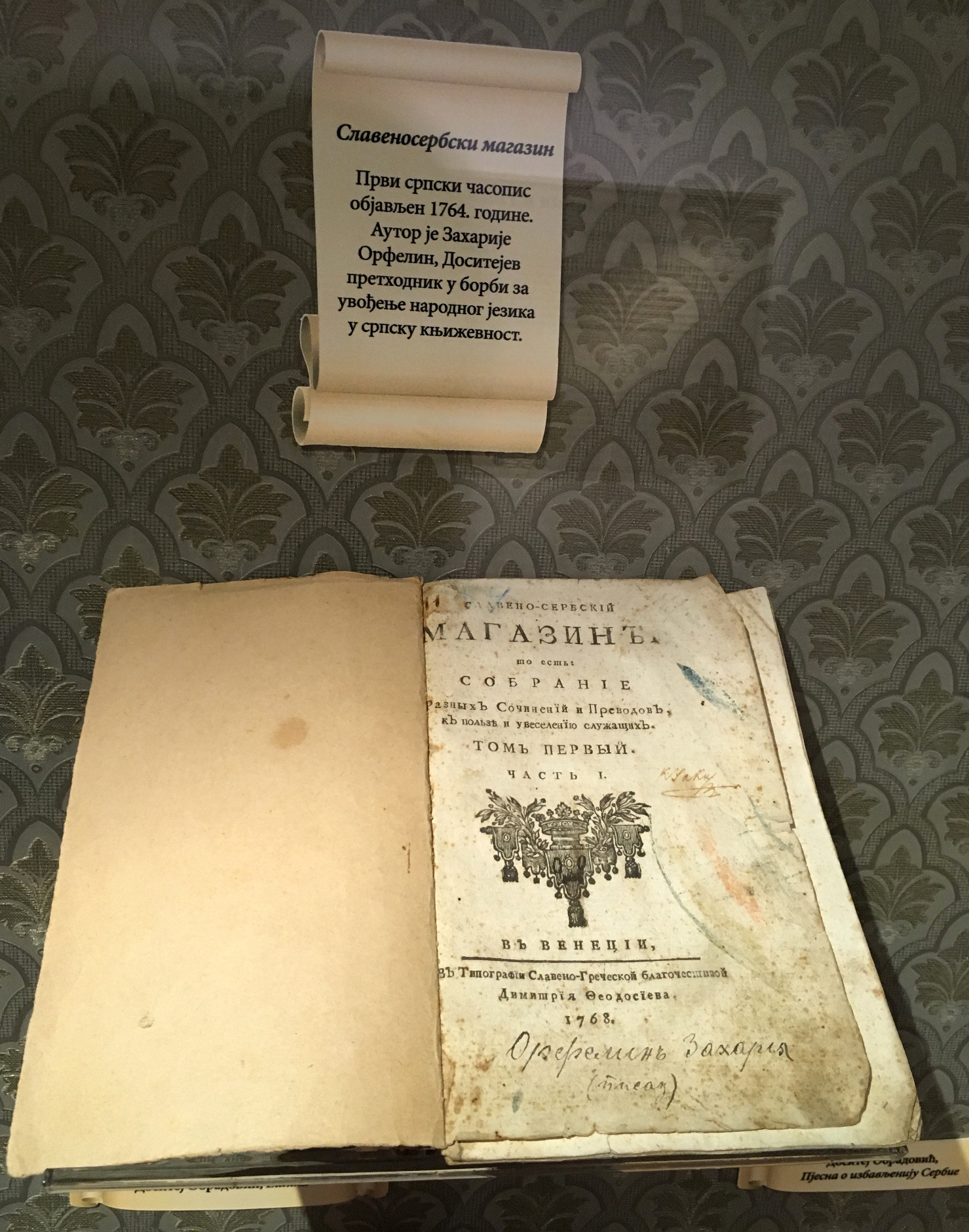
Orfelin founded Slavenoserbski magazin in Venice in 1768, credited as the first South Slavic or Serbian journal/periodical though only one number came out.
In 1768, Zaharije Orfelin proclaimed a mixture of Church-Slavonic and vernacular into the Serbian literary language, in which there was always room for specific Russian words, thus practically establishing the Slavic Serbian language. Literary historian Jovan Deretić considers him, along with Jovan Rajić, to be the most important writer of the Russo-Slavic era in Serbian literature.
In 1776 Orfelin's name appears in a lexicon of Austrian artists, Des Gelehte Osterisch by de Luca, where he is listed as both an engraver and a writer, elected as an academician in the newly established Art Academy of Engraving in Vienna, and acknowledged by its director Jacob Matthias Schmutzer.
Zaharije Orfelin is the author of the first modern Serbian spelling book from 1767, which was used by numerous generations of children. The second edition was published in 1797.
He is also the author of the first textbooks of the Latin language. His most extensive work is "The Life of Peter the Great" (Venice, 1772), in whom he saw an enlightened monarch. Zaharije Orfelin also wrote the first Serbian "Perpetual Calendar" in 1780, printed in Vienna in 1783.
Orfelin noted the great importance of medicinal plants and wrote the (unfinished) book "The Great Serbian Herbarium" in which he described about 500 plants, giving each a Latin and folk name. In addition, for each plant he listed "benefits and uses" with data on medicinal effects and therapies, i.e. how that plant can be usefully used, which was common at that time in Europe, and for the first time among the Serbs.
His book Искусни подрумар (Experienced Cellarer, Vienna, 1783) has several hundred recipes for making herbal wines and many other alcoholic and non-alcoholic beverages and medicines. The book also discusses the method and time of harvesting and drying medicinal plants and the usefulness and medicinal value of complex preparations made from more than 200 domestic and exotic medicinal and aromatic plants. Writing about recipes for wine production, Zaharije Orfelin also mentions the recipe for making bermet, which differed from house to house. Orfelin gave a recipe that became popular with various modifications in the Fruška gora region. It is the first book of its kind in the Serbian language.
Works
.jpg)
- Pesan novosadelanuje za gradjanku gospodicnu Femku, between 1748 and 1757
- Pozdrav Mojseju Putniku, Novi Sad, 1757.
- Omologija, 1758.
- Hulitelj, Sremski Karlovci, 1759.
- Kratkoje o sedmih tajinstvah nastavlenije, 1760.
- Gorestni plač slavnija inogda Serbiji, Venice, 1761
- Trenodija, Venice, 1762
- Plač Serbii, jejaže sini v različnija gosudarstva rasjejali sja, Venice, 1762
- Oda na vospominanije vtorago Hristova prišestvija, 1763.
- Apostolskoje mleko, Timișoara, 1763.
- Istina o Boze, Novi Sad, 1764.
- Hristoljubivih dus stihoslovije, Novi Sad, 1764.
- Sjetovanije naučenogo mladago čelovjeka, 1764.
- Strasno jevandljelje, Venice, 1764.
- Pjesn istoriceskaja, Venice 1765.
- Melodija k proleću, Novi Sad, 1765.
- Slavenosrpski kalendar za godionu 1766., Novi Sad, 1765.
- Latinski bukvar, Venice, 1766.
- Pervija načatki latinskogo jazika, 1767.
- Pervoje ucenije hotjastim ucitisja knig pismeni slavenskimi nazivaemo Bukvar, Venice, 1767.
- Latinska gramatika, Venice, 1768.
- Slaveno-serbski magazin, Venice, 1768.
- Istorija o žitija i slavnih djelah velikago gosudarja i imperatora Petra Pervago, Venice, 1772
- Generalnaja karta vserosijkoj Imperiji, 1774.
- Položenije provuncij: Liflandije, Finlandije, Karelije, Ingrije, i Kurlandije, 1774.
- Karta georaf. Germanije, Holandije, Danije, Poljane, 1774.
- Karta Male Tatarije, 1774.
- Bukvar za srpsku decu slovenski, Venice, 1776.
- Propisi srpski, Sremski Karlovci, 1776.
- Slavenska i vlaska Kaligrafija, Sremski Karlovci, 1778.
- Večni kalendar, Vienna, 1783.
- Iskusni podrumar, Budapest, 1808.
- Sedam stepenej premudrosti
;Edited or translated
- Srpska gramatika, 1755.
- Kratkoje nastavlenije, Sremski Karlovci, 1757.
- Ortodoksosomologija ili pravoslavnoje ispovjedanije, Sremski Karlovci, edited 1758.
- Kratko nastavljenije, Sremski Karlovci, 1758.
- Oda na vospominanije vtoraga Hristova prisestvija, Vienna, 1759.
- Molitvoslav, Venice, 1762.
- Psaltir, Venice, 1762.
- Trebnik, Venice, 1762.
- Propoved ili slovo o osuzdeniji, Venice, 1764.
- Evangelija ctomaja vo sjatij i velikij cetveretok, Venice, 1764.
- Catechisis by Peter Mohyla
- Catechisis by Jovan Rajić
- Srbljak (a compedium of old Serbian writings)
- Short Stories by Feofan Prokopovich
References
Literature
References
- (1995). "Der Literatur Brockhaus". BI-Taschenbuchverl..
- (2015). "Cultural Heritage of East Central Europe: A Historical Outline". Instytut Studiów Politycznych Polskiej Akademii Nauk.
- (2023). "A Concise History of Serbia". Cambridge University Press.
- (1995). "The History of Serbian Culture". Porthill Publishers.
- (2019). "The Polymath: Unlocking the Power of Human Versatility". John Wiley & Sons.
- (2014). "Ethnobotany and Biocultural Diversities in the Balkans: Perspectives on Sustainable Rural Development and Reconciliation". Springer.
- (2020). "Pen, print and communication in the eighteenth century". Liverpool University Press.
- "ZAHARIJA STEFANOVIĆ ORFELIN".
- (1977). "Jahrbücher für Geschichte Osteuropas, Volume 25". Priebatsch's Buchhandlung.
- M. Simić, Vladimir. (2014). "ZAHARIJA ORFELIN I LIKOVNA AKADEMIJA U BEČU: PRILOG BIOGRAFIJI*". Zbornik Narodnog Muzeja U Beogradu.
- "Zaharije Stefanović Orfelin".
- (2015). "Antologija boemske poezij". Neven.
- "Почетна, Орфелин".
- Simić, Vladimir. (January 2014). "Zaharija Orfelin i likovna akademija u Becu: prilog biografiji". Zbornik Narodnog muzeja. Istorija umetnosti = Recueil du Musee National de Belgrade. Histoire de lʹart XXI/2.
- (21 January 1901). "Srpski Sion".
- (2013). "Zaharija Orfelin (1726–1785), doktorska disertacija". Filozofski fakultet Univerziteta u Beogradu.
- Dalibor. (2016-08-29). "Zaharije Orfelin - Plač Serbiji (1761)".
- (27 February 2013). "Zechariah Orfelin's manuscript found". Serbian Orthodox Church.
- (1963). "The Balkans in Transition: Essays on the Development of Balkan Life and Politics Since the Eighteenth Century". University of California Press.
- (2017). "Newspapers in Central and Eastern Europe / Zeitungen in Mittel- und Osteuropa". Walter de Gruyter GmbH & Co KG.
- (1973). "Studies on Voltaire and the Eighteenth Century, Volume 189". Institut et musée Voltaire.
- (1998). "The Cultural Treasury of Serbia". IDEA.
- [http://istorijskenovine.unilib.rs/view/index.html#panel:pp. issue:UB_00008_19110301. page:48. query:%D0%B7%D0%B0%D1%85%D0%B0%D1%80%D0%B8%D1%98%D0%B5%20%D0%BE%D1%80%D1%84%D0%B5%D0%BB%D0%B8%D0%BD Godina 1811. u srpskoj književnosti. - U: Prosvetni glasnik, 1. mart 1911.]
- Čurčić, Laza. "Knjiga o Zahariji Orfelinu". agreb : Srpsko kulturno društvo Prosvjeta, 2002..
- (1993). "Serbs in European Civilization".
- "Zaharija Orfelin, Iskusni podrumar".
- [http://istorijskenovine.unilib.rs/view/index.html#panel:pp. issue:UB_00021_19271009. page:5. query:%D0%B7%D0%B0%D1%85%D0%B0%D1%80%D0%B8%D1%98%D0%B5%20%D0%BE%D1%80%D1%84%D0%B5%D0%BB%D0%B8%D0%BD Vino bermet. - U: Težak, 9. oktobar 1927.]
- (April 2008). "POEZIJA I PROZA". Matica Srpska.
- (18 June 2011). "Zaharija Stefanović Orfelin (1726—1785)". Riznicasrpska.net.
- "Збирка књига Захаријe Орфелина – Дигитална Народна библиотека Србије". Scc.digital.nb.rs.
This article was imported from Wikipedia and is available under the Creative Commons Attribution-ShareAlike 4.0 License. Content has been adapted to SurfDoc format. Original contributors can be found on the article history page.
Ask Mako anything about Zaharije Orfelin — get instant answers, deeper analysis, and related topics.
Research with MakoFree with your Surf account
Create a free account to save articles, ask Mako questions, and organize your research.
Sign up freeThis content may have been generated or modified by AI. CloudSurf Software LLC is not responsible for the accuracy, completeness, or reliability of AI-generated content. Always verify important information from primary sources.
Report