From Surf Wiki (app.surf) — the open knowledge base
Yumi

| Field | Value | |
|---|---|---|
| name | ||
| image | Yumi02.jpg | |
| caption | ja from behind, profile | |
| type | Asymmetrical bow | |
| <!-- Type selection --> | sheath_type | Lacquered wood |
| image_size | 280 | |
| origin | Japan | |
| is_ranged | yes | |
| used_by | Samurai, Onna-musha, Kyudo practitioners | |
| production_date | Since 3rd century (the asymmetrical ja) | |
| variants | ja | |
| length | 212 – | |
| cartridge | Arrow length: 85 – | |
| hilt_type | laminating bamboo, wood and leather |
the Japanese bow
is the Japanese term for a bow. As used in English, ja refers more specifically to traditional Japanese asymmetrical bows, and includes the longer and the shorter used in the practice of ja and ja, or Japanese archery.
The ja was an important weapon of the samurai warrior during the feudal period of Japan. It is typically shot with Japanese arrows known as ja.
The most famous style of ja is an asymmetrically shaped long bow with a length of more than 2 m, characterized by the archer holding the part of the bow below the center to shoot the arrow.
History
Most of the excavated Jōmon period () bows are 1.2 to 1.6 m in length, while most of the Yayoi period () bows are 2 to 2.3 m in length. The bows in these periods were made from a single processed wood, and the bows with this structure were called and were used until the Nara period (710–794 CE). It is unknown when the asymmetrical ja came into use, but the first written record is found in the Book of Wei, a Chinese historical manuscript dating to the 3rd century CE, which describes the people of the Japanese islands using "spears, shields, and wooden bows for arms; the wooden bows are made with the lower limbs short and the upper limbs long; and bamboo arrows with points of either iron or bone." The oldest asymmetrical ja found to date was discovered in Nara Prefecture, and is estimated to be from the 5th century.
Some of the bows found as burial goods in ja (ancient tombs) during the Kofun period (300–538 CE) were decorated with gold or silver, and it is believed that they were also used in ceremonies. The length of most bows in this period ranged from 70 to 150 cm, and it is thought that they were powerful enough to shoot enemies and animals at close range.
In the Nara period, lacquered bows with more weather resistance and decorative features appeared. Euonymus hamiltonianus, Zelkova serrata, and Toxicodendron succedaneum, which are highly elastic wood, came to be used for making ja, and many ja became as long as roughly 7 ja 3 ja (2.21 m), increasing their power and range. Since then, the structure of the bow has gradually evolved, but its length of roughly 7 ja 3 ja has been passed down to the present day.
From the mid to late Heian period (794–1185), the Japanese developed the style of ja, the first ja in Japan with a laminated structure. This style of ja was made by attaching bamboo to a wooden ja with a flat front side using glue made from a fish float, and the elasticity of the bamboo improved the bow's range, power and durability. Nasu no Yoichi was famous as a master of archery in the late Heian period; his fame was depicted in The Tale of the Heike and ja, and he was the subject of various Japanese traditional performing arts and fine arts such as Noh, ja, ja, kabuki, and ukiyo-e of later generations.
From the end of the Heian period to the beginning of the Kamakura period (1185–1333), the was developed, and bamboo was glued not only on the front side but also on the reverse side of the ja. In the late Kamakura period, the shape of the bow became more asymmetrical, with the upper part bent from the lower part, so that it resembled a modern bow, further increasing the range and power of the ja.
From the middle of the Heian period, the style of ja, in which rattan was wrapped around a laminated-structure ja to improve its elasticity and sturdiness, became popular. The style ja in particular was the strongest weapon of the Kamakura period, with a maximum range of 400 m and an effective range of 80 m that could inflict fatal wounds on targets. There are more than 20 varieties of ja, depending on how and where on the bow the rattan is wound. In the Muromachi period (1336–1573), the ja went from its luxurious exterior to a piece of equipment that symbolized the rank of commander.
During the Kamakura period, when the samurai class came to power, ja (archery) became more and more popular, especially the three types of mounted archery: ja, ja, and ja.
The was developed during the Muromachi period, and bamboo was used on the side of the bow to increase its range and power.
During the Sengoku period (1467–1615), the used in modern ja was developed, completing the original form of the Japanese bow now known around the world. The characteristic of the bow is that it has a greatly changed laminated structure from the conventional bow. The core of the structure is about four pieces of bonded bamboo, with bamboo glued to the front side and the other side and wood glued to the sides. This improved the range and power of the bow and enabled it to shoot through targets 132 m away in the Sanjusangen-do archery contest, ja, a famous event still held today. Research on ja (arrowheads) was actively conducted to enhance their killing ability, and ja of various shapes were developed. During this period, the ja was mass-produced by Japanese swordsmiths, and mobilized ja (foot soldiers) used them to exert tremendous power on the battlefield. However, because ja took a long time to load, were inconvenient in rainy weather when damp gunpowder would not fire, and utterly lacked subtlety in use due to their extraordinary noisiness, the ja did not go out of fashion and continued to be used as an important military force on the battlefield.
When Japanese society became more peaceful in the Edo period (1603–1867), the spirituality and decorativeness of the ja became important, and ja developed as a samurai's way of doing things.
Even today, the ja is used in ja and ceremonies, and in Grand sumo tournaments, a ceremony called the , which is dedicated to Shinto ja, is held.
| Time period | Type of bow | Bow formation |
|---|---|---|
| Prehistoric | ja | Single piece of wood |
| ja or ja | Wood with bamboo front | |
| ja | Wood with bamboo front and back | |
| ja or ja | Wood surrounded with bamboo | |
| ja | Three-piece bamboo laminate core, wooden sides, bamboo front and back | |
| ja | Four-piece bamboo laminate core, wooden sides, bamboo front and back | |
| ja | Five-piece bamboo (or bamboo and wood) laminate core, wooden sides, bamboo front and back | |
| –Modern times | Glass fiber | Wooden laminate core, FRP front and back |
Shape
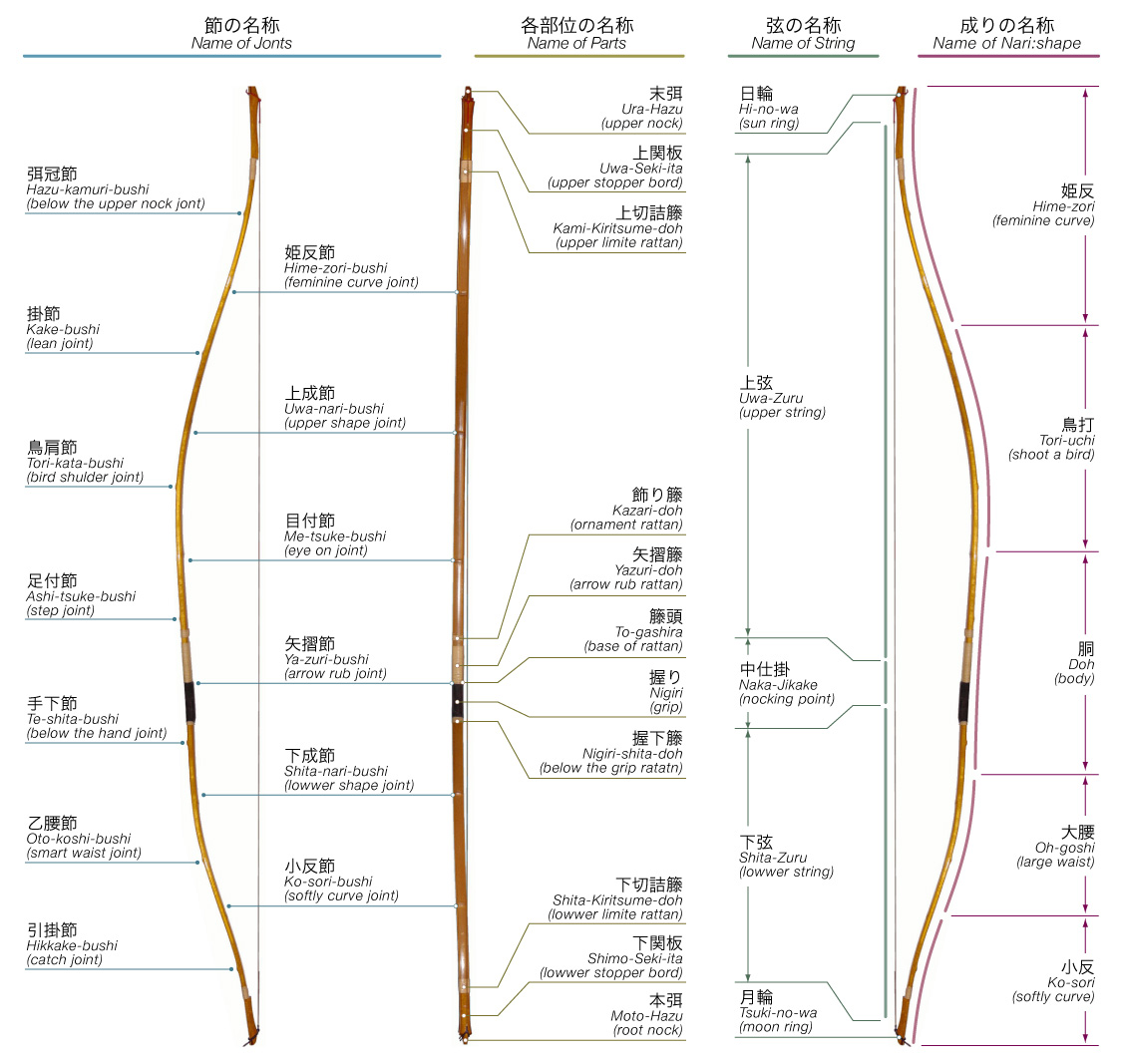
The ja is exceptionally tall, standing over 2 m in height, and typically surpasses the height of the archer. They are traditionally made by laminating bamboo, wood and leather, using techniques which have not changed for centuries, although some archers (particularly beginners) may use a synthetic ja.
The ja is asymmetrical; according to the All Nippon Kyudo Federation, the grip () has to be positioned at about two thirds of the distance from the upper tip.

The upper and lower curves also differ. Several hypotheses have been offered for this asymmetric shape. Some believe it was designed for use on a horse, where the ja could be moved from one side of the horse to the other with ease; however, there is evidence that the asymmetrical shape predates its use on horseback.
Others claim that asymmetry was needed to enable shooting from a kneeling position. Yet another explanation is the characteristics of the wood from a time before laminating techniques. In case the bow is made from a single piece of wood, its modulus of elasticity is different between the part taken from the treetop side and the other side. A lower grip balances it.
The hand holding the ja may also experience less vibration due to the grip being on a vibration node of the bow. A perfectly uniform pole has nodes at 1/4 and 3/4 of the way from the ends, or 1/2 if held taut at the ends – these positions will change significantly with shape and consistency of the bow material.
String
The string of a ja, a , is traditionally made of hemp, although most modern archers will use strings made of synthetic materials such as Kevlar, which will last longer.
The nocking-point on the string is built up through the application of hemp and glue to protect the string and to provide a thickness which helps hold the nock ( of the arrow, a , in place while drawing the ja. However, it can also be made of strands of waxed bamboo.
Care and maintenance
A bamboo ja requires careful attention. Left unattended, the ja can warp out of shape and may eventually become unusable. The shape of a ja will change through normal use and can be re-formed when needed through manual application of pressure, through shaping blocks, or by leaving it strung or unstrung when not in use.
The shape of the curves of a ja is greatly affected by whether it is left strung or unstrung when not in use. The decision to leave a ja strung or unstrung depends upon the current shape of the ja. A ja that is relatively flat when unstrung will usually be left unstrung when not in use (a ja in this state is sometimes referred to as being 'tired'). A ja that has excessive curvature when unstrung is typically left strung for a period of time to 'tame' the ja.
A well cared-for ja can last many generations, while the usable life of a mistreated ja can be very short.
Bow lengths
| Height of archer | Arrow length | Suggested bow length |
|---|---|---|
| ja (212 cm) | ||
| 150–165 cm | 85–90 cm | ja (221 cm) |
| 165–180 cm | 90–100 cm | ja (227 cm) |
| 180–195 cm | 100–105 cm | ja (233 cm) |
| 195–205 cm | 105–110 cm | ja (239 cm) |
| 205 cm | 110 cm | ja (245 cm) |
Gallery
Moto hazu (bottom nock).jpg|ja (bottom nock) Nigiri (grip).jpg|ja (grip) Ura hazu (top nock).jpg|ja (top nock) Tsurumaki string holder 1.JPG|ja (string holder) and ja (string) Antique Japanese (samurai) hankyū(small yumi).jpg|Antique ja (shortbow) Antique Japanese (samurai) daikyū and hankyū yumi 3.jpg|Antique ja (longbow) and ja (shortbow) Antique Japanese (samurai) yumi bukuro.jpg|ja (cloth cover) Yoshitoshi - 100 Aspects of the Moon - 67.jpg|Ukiyo-e by Tsukioka Yoshitoshi depicting Minamoto no Tsunemoto hunting a sika deer with a ja 豇豆(ささげ)蒔絵矢筒, Japanese quiver.jpg|A ja (quiver) decorated with ja. Edo period, 18th century. Tokyo National Museum.
Popular culture
- ja are featured in the Teenage Mutant Ninja Turtles franchise, used by Splinter in Teenage Mutant Ninja Turtles II: The Secret of the Ooze and the 2003 episode "Exodus, Part 1". The Foot Clan includes Foot Archers who use ja. Leonardo, Donatello, Raphael, and Michaelangelo occasionally used ja in the 2012 version, and ja were also used by Karai, as shown on the flashbacks of the 2003 episode "City At War, part 3". A ja bow was used by Murakami Gennosuke, a rhino bounty hunter in the 2003 episode "The Real World, Part 1".
- Power Rangers Samurai features the Blue Ranger Kevin Douglas using the Hydro Bow, which is based on a ja bow.
- ja bows were used by samurai in Deadliest Warrior and The Last Samurai.
- The character Hanzo Shimada from Overwatch uses a futuristic yumi as his weapon of choice due to him abandoning the way of the sword after nearly killing his brother Genji.
- Kikyo uses the Yumi bow as her preferred weapon of choice while her younger sister, Kaede did the same thing in her own right before and after her death and resurrection in Inuyasha both the anime and manga series
References
References
- link. Kotobank/Digitalio, Inc/[[Asahi Shimbun]]
- ''Records of the Three Kingdoms'', Book of Wei: 兵用矛楯木弓木弓短下長上竹箭或鐵鏃或骨鏃
- link. Nagoya Japanese Sword Museum Nagoya Touken World
- link. Kotobank/Digitalio, Inc/[[Asahi Shimbun]]
- link. Nagoya Japanese Sword Museum Nagoya Touken World
- link. Nagoya Japanese Sword Museum Nagoya Touken World
- link. Nagoya Japanese Sword Museum Nagoya Touken World.
- (1993). "Kyudo: The Essence and Practice of Japanese Archery". Kodansha International Ltd..
- (2004). "Samurai, Warfare and the State in Early Medieval Japan". Routledge.
This article was imported from Wikipedia and is available under the Creative Commons Attribution-ShareAlike 4.0 License. Content has been adapted to SurfDoc format. Original contributors can be found on the article history page.
Ask Mako anything about Yumi — get instant answers, deeper analysis, and related topics.
Research with MakoFree with your Surf account
Create a free account to save articles, ask Mako questions, and organize your research.
Sign up freeThis content may have been generated or modified by AI. CloudSurf Software LLC is not responsible for the accuracy, completeness, or reliability of AI-generated content. Always verify important information from primary sources.
Report