From Surf Wiki (app.surf) — the open knowledge base
Yoweri Museveni
President of Uganda since 1986

President of Uganda since 1986
| Field | Value | |
|---|---|---|
| honorific-prefix | His Excellency | |
| honorific-suffix | ||
| name | Yoweri Museveni | |
| image | Yoweri Museveni 2024.jpg | |
| caption | Museveni in 2024 | |
| office | President of Uganda | |
| primeminister | ||
| vicepresident | ||
| term_start | 26 January 1986 | |
| predecessor | Tito Okello | |
| office2 | Secretary General of the Non-Aligned Movement | |
| term_start2 | 16 January 2024 | |
| predecessor2 | Ilham Aliyev | |
| birth_name | Yoweri Kaguta Museveni Tibuhaburwa | |
| birth_date | . | |
| birth_place | Ntungamo, Uganda | |
| party | NRM | |
| spouse | ||
| children | Muhoozi Kainerugaba | |
| Natasha Karugire | ||
| Patience Rwabwogo | ||
| Diana Kamuntu | ||
| education | University of Dar es Salaam | |
| signature | M7 signature.jpg | |
| website | ||
| allegiance | Uganda | |
| branch | Front for National Salvation | |
| Popular Resistance Army | ||
| National Resistance Army | ||
| serviceyears | 1971–1986 | |
| rank | General | |
| battles | 1972 invasion of Uganda | |
| Uganda–Tanzania War | ||
| Ugandan Bush War | ||
| father | Amos Kaguta | |
| mother | Esteri Kokundeka Nganzi | |
| otherparty | UPM (1980–1986) | |
| relations |
| honorific-prefix = His Excellency | honorific-suffix = Natasha Karugire Patience Rwabwogo Diana Kamuntu Popular Resistance Army National Resistance Army Uganda–Tanzania War Ugandan Bush War Yoweri Kaguta Museveni Tibuhaburwa (born 15 September 1944) is a Ugandan politician and former military officer who has served as the president of Uganda since 1986. Born in Ntungamo, Uganda (then under British control), Museveni studied political science from the University of Dar es Salaam where he initiated the University Students' African Revolutionary Front. In 1972, he joined the failed invasion of Uganda against Idi Amin's dictatorship.
The next year, Museveni established the Front for National Salvation and fought alongside Tanzanian forces in the Tanzania–Uganda War, which overthrew Amin. Museveni contested the subsequent 1980 general election on the platform of Uganda Patriotic Movement, though claimed electoral fraud after losing to the unpopular Milton Obote. Museveni unified the opposition under the National Resistance Movement and started the Ugandan Bush War. On 30 January 1986, after the decisive Battle of Kampala, Museveni was sworn as president.
As president, Museveni suppressed the Ugandan insurgency and oversaw involvement in the Rwandan Civil War and the First Congo War. He ordered an intervention against the Lord's Resistance Army in an effort to halt their insurgency. His rule has been described by scholars as competitive authoritarianism, or illiberal democracy. The press has been under the authority of government. His presidency has been characterized by relative economic success and, in its later period, an upsurge in anti-homosexuality activity alongside numerous constitutional amendments, like the scrapping of presidential term limits in 2005 and age limits in 2017.
On 14 January 2021, Museveni was re-elected to a sixth term with 58.6% of the vote, despite many videos and reports showing ballot box stuffing, over 400 polling stations with 100% voter turnout and human rights violations. In response to protests during the 2026 Ugandan general election, Museveni has reportedly deployed the military, sent special military forces to jail opposition leader Bobi Wine, and deployed "snatch squads" to kidnap protesters.
Early life
Museveni is estimated to have been born on 24 September 1944 to parents Mzee Amos Kaguta (1916–2013), a cattle keeper, and Esteri Kokundeka Nganzi (1918–2001), in Ntungamo. He is an ethnic Hima of the kingdom of Mpororo (now part of Ankole). According to Julius Nyerere, Museveni's father, Amos Kaguta, was a soldier in the King's African Rifles' 7th battalion during World War II. When Yoweri was born, relatives used to say, "His father was a mu-seven" (meaning "one of the seventh"). This is how he obtained the name Museveni.
His family migrated to Ntungamo in 1960s, then within the British Protectorate of Uganda. Museveni attended Kyamate Elementary School, Mbarara High School, and Ntare School for his primary and secondary education. He attended the University of Dar es Salaam in Tanzania for his tertiary education, where he studied economics and political science. While at university, he formed the University Students' African Revolutionary Front student activist group and led a student delegation to FRELIMO-held territory in Portuguese Mozambique where they received military training. Studying under Walter Rodney, among others, Museveni wrote a university thesis on the applicability of Frantz Fanon's ideas on revolutionary violence to post-colonial Africa.
Career
1971–1979: Front for National Salvation and the toppling of Amin
Main article: 1972 invasion of Uganda, Uganda–Tanzania War
Museveni eventually began to gather a group of left-leaning intellectuals who were ready to engage in militant operations against the Ugandan government of Milton Obote. When Obote was overthrown by Idi Amin during the 1971 Ugandan coup d'état, however, Museveni's group allied with Obote's exiled loyalists to oppose Amin. Based in Tanzania, Museveni's group repeatedly entered Uganda to gather intelligence and carry out sabotage missions. In August 1971, Museveni's force unsuccessfully attempted to set up a guerrilla base on Mount Elgon.
The coalition of exile forces opposed to Amin invaded Uganda from Tanzania in September 1972 and were repelled. Museveni's group suffered heavy losses during this failed operation. In October, Tanzania and Uganda signed the Mogadishu Agreement that denied the rebels the use of Tanzanian soil for aggression against Uganda. Museveni broke away from the mainstream opposition and formed the Front for National Salvation (FRONASA) in 1973. In August of the same year, he married Janet Kainembabazi.
In October 1978, Ugandan troops invaded the Kagera Salient in northern Tanzania, initiating the Uganda–Tanzania War. Tanzanian President Julius Nyerere ordered the Tanzania People's Defence Force (TPDF) to counter-attack and mobilized Ugandan dissidents to fight Amin's regime. Museveni was pleased by this development. In December 1978 Nyerere attached Museveni and his forces to Tanzanian troops under Brigadier Silas Mayunga. Museveni and his FRONASA troops subsequently accompanied the Tanzanians during the counter-invasion of Uganda. He was present during the capture and destruction of Mbarara in February 1979, and involved in the Western Uganda campaign of 1979.
In course of these operations, he alternatively spent time at the frontlines and in Tanzania. While in Tanzania, he discussed the cooperation of various anti-Amin rebel groups as well as the political future of Uganda with Tanzanian politicians and other Ugandan opposition figures such as Obote. He played a significant part in the Moshi Conference which led to the unification of the opposition as the Uganda National Liberation Front (UNLF). Yusuf Lule was appointed as UNLF chairman and the potential President of Uganda after Amin's overthrow. Museveni felt dissatisfied with the results of the conference, believing that he and his followers were not granted enough representation.
1980–1986: Ugandan Bush War
Main article: Ugandan Bush War
Obote II and the National Resistance Army
With the overthrow of Amin in 1979 and the contested election that returned Milton Obote to power in 1980, Museveni returned to Uganda with his supporters to gather strength in their rural strongholds in the Bantu-dominated south and south-west to form the Popular Resistance Army (PRA). They planned a rebellion against the second Obote regime (Obote II) and its armed forces, the Uganda National Liberation Army (UNLA). The insurgency began with an attack on an army installation in the central Mubende district on 6 February 1981. The PRA later merged with former president Yusufu Lule's fighting group, the Uganda Freedom Fighters, to create the National Resistance Army (NRA) with its political wing, the National Resistance Movement (NRM). Two other rebel groups, the Uganda National Rescue Front (UNRF) and the Former Uganda National Army (FUNA), engaged Obote's forces. The FUNA was formed in the West Nile sub-region from the remnants of Amin's supporters.
In June 1985, a group of NRA/NRM members including Museveni met in , Austria, where they penned a manifesto and developed a "Ten-point Programme" for Uganda's future. The ten points encompassed proposed policies for: democracy; security; consolidation of national unity; defending national independence; building an independent, integrated, and self-sustaining economy; improvement of social services; elimination of corruption and misuse of power; redressing inequality; cooperation with other African countries; and a mixed economy. The Central Intelligence Agency's World Factbook estimates that the Obote regime was responsible for more 100,000 civilian deaths across Uganda.
1985 Nairobi Agreement
Main article: Nairobi Agreement, 1985
On 27 July 1985, sub factionalism within the Uganda People's Congress government led to a successful military coup against Obote by his former army commander, Lieutenant-General Tito Okello, an Acholi. Museveni and the NRM/NRA were angry that the revolution for which they had fought for four years had been "hijacked" by the UNLA, which they viewed as having been discredited by gross human rights violations during Obote II.
Despite these reservations, the NRM/NRA eventually agreed to peace talks presided over by a Kenyan delegation headed by President Daniel arap Moi. The talks, which lasted from 26 August to 17 December, were notoriously acrimonious and the resultant ceasefire broke down almost immediately. The final agreement, signed in Nairobi, called for a ceasefire, demilitarization of Kampala, integration of the NRA and government forces, and absorption of the NRA leadership into the Military Council. These conditions were never met.
Battle of Kampala
Main article: Battle of Kampala
While involved in the peace negotiations, Museveni was courting General Mobutu Sésé Seko of Zaire to forestall the involvement of Zairean forces in support of Okello's military junta. On 20 January 1986, several hundred troops loyal to Amin were accompanied into Ugandan territory by the Zairean military. The forces intervened following secret training in Zaire and an appeal from Okello ten days previously. By 22 January, government troops in Kampala had begun to quit their posts en masse as the rebels gained ground from the south and south-west.
Presidency
Museveni was sworn in as president on 29 January. After a ceremony conducted by British-born Chief Justice Peter Allen, he said this was not "a mere change of guard" but "a fundamental change". Speaking to crowds of thousands outside the Ugandan parliament, Museveni promised a return to democracy, stating: "The people of Africa, the people of Uganda, are entitled to a democratic government. It is not a favor from any regime. The sovereign people must be the public, not the government."
Rise to power: 1986–1996

Political and economic regeneration
Uganda began participating in an IMF Economic Recovery Program in 1987. Its objectives included the restoration of incentives in order to encourage growth, investment, employment, and exports; the promotion and diversification of trade with particular emphasis on export promotion; the removal of bureaucratic constraints and divestment from ailing public enterprises so as to enhance sustainable economic growth and development through the private sector and the liberalization of trade at all levels.
Human rights and internal security
The NRM came to power promising to restore security and respect for human rights. This was part of the NRM's ten-point programme, as Museveni noted in his swearing in speech:
Although Museveni headed a new government in Kampala, the NRM could not project its influence fully across Ugandan territory, finding itself fighting a number of insurgencies. From the beginning of Museveni's presidency, he drew strong support from the Bantu-speaking south and southwest, where Museveni had his base. Museveni managed to get the Karamojong, a group of semi-nomads in the sparsely populated northeast that had never had a significant political voice, to align with him by offering them a stake in the new government. The northern region along the Sudanese border proved more troublesome. In the West Nile sub-region, inhabited by Kakwa and Lugbara (who had previously supported Amin), the UNRF and FUNA rebel groups fought for years until a combination of military offensives and diplomacy pacified the region.
The leader of the UNRF, Moses Ali, gave up his struggle to become the second deputy prime minister. People from the northern parts of the country viewed the rise of a government led by a person from the south with great trepidation. Rebel groups sprang up among the Lango, Acholi, and Teso peoples, though they were overwhelmed by the strength of the NRA except in the far north where the Sudanese border provided a safe haven. The Acholi rebel Uganda People's Democratic Army (UPDA) failed to dislodge the NRA occupation of Acholiland, leading to the desperate chiliasm of the Holy Spirit Movement (HSM). The defeat of both the UPDA and HSM left the rebellion to a group that eventually became known as the Lord's Resistance Army, which turned upon the Acholi themselves.

The NRA subsequently earned a reputation for respecting the rights of civilians, although Museveni later received criticism for using child soldiers. Undisciplined elements within the NRA soon tarnished a hard-won reputation for fairness. "When Museveni's men first came they acted very well—we welcomed them", said one villager, "but then they started to arrest people and kill them".
In March 1989, Amnesty International published a human rights report on Uganda, Uganda, the Human Rights Record 1986–1989. It documented gross human rights violations committed by NRA troops. According to Olara Otunnu, a United Nations Diplomat argued that Museveni pursued a genocide to Nilotic – Luo people living in the Northern part of the country. In one of the most intense phases of the war, between October and December 1988, the NRA forcibly cleared approximately 100,000 people from their homes in and around Gulu town. Soldiers committed hundreds of extrajudicial executions as they forcibly moved people, burning down homes and granaries. In its conclusion, the report offered some hope:
On 13 September 2019, Museveni's former Inspector General of Police (IGP) General Kale Kayihura was placed on the United States Department of the Treasury sanctions list for gross violation of Human rights during his reign as the IGP (from 2005 to March 2018). This was due to activities of the Uganda Police's Flying Squad Unit that involved torture and corruption. Kayihura was subsequently replaced with Martin Okoth Ochola.
First elected term (1996–2001)
Elections
The first elections under Museveni's government were held on 9 May 1996. Museveni defeated Paul Ssemogerere of the Democratic Party, who contested the election as a candidate for the "Inter-party forces coalition", and the upstart candidate Kibirige Mayanja. Museveni won with 75.5 percent of the vote from a turnout of 72.6 percent of eligible voters. Although international and domestic observers described the vote as valid, both the losing candidates rejected the results. Museveni was sworn in as president for the second time on 12 May 1996. In 1997, he introduced free primary education.
The second set of elections were held in 2001. Museveni got 69 percent of the vote to beat his rival Kizza Besigye. Besigye had been a close confidant of the president and was his physician during the Ugandan Bush War. They had a terrible fallout shortly before the 2001 elections, when Besigye decided to stand for the presidency. The 2001 election campaigns were a heated affair with Museveni threatening to put his rival "six feet under".
The election culminated in a petition filed by Besigye at the Supreme Court of Uganda. The court ruled that the elections were not free and fair but declined to nullify the outcome by a 3–2 majority decision. The court held that although there were many cases of election malpractice, they did not affect the result in a substantial manner. Chief Justice Benjamin Odoki and Justices Alfred Karokora and Joseph Mulenga ruled in favor of the respondents while Justices Aurthur Haggai Oder and John Tsekoko ruled in favor of Besigye.
International recognition
Museveni was elected chairperson of the Organisation of African Unity (OAU) in 1991 and 1992. Perhaps Museveni's most widely noted accomplishment has been his government's successful campaign against HIV/AIDS. During the 1980s, Uganda had one of the highest rates of HIV infection in the world, but now Uganda's rates are comparatively low, and the country stands as a rare success story in the global battle against the virus. One of the campaigns headed by Museveni to fight against HIV/AIDS was the ABC program. The ABC program had three main parts "Abstain, Be faithful, or use Condoms if A and B are not practiced." In April 1998, Uganda became the first country to be declared eligible for debt relief under the Heavily Indebted Poor Countries (HIPC) initiative, receiving US$700 million in aid.
Museveni was lauded by some for his affirmative action program for women in the country. He had a female vice-president, Specioza Kazibwe, for nearly a decade, and has done much to encourage women to go to college. On the other hand, Museveni has resisted calls for greater women's family land rights (the right of women to own a share of their matrimonial homes). The New York Times in 1997 said about Museveni:
These are heady days for the former guerilla who runs Uganda. He moves with the measured gait and sure gestures of a leader secure in his power and his vision. It is little wonder. To hear some of the diplomats and African experts tell it, President Yoweri K. Museveni started an ideological movement that is reshaping much of Africa, spelling the end of the corrupt, strong-man governments that characterized the cold-war era. These days, political pundits across the continent are calling Mr. Museveni an African Bismarck. Some people now refer to him as Africa's "other statesman", second only to the venerated South African President Nelson Mandela.
In official briefing papers from Madeleine Albright's December 1997 Africa tour as Secretary of State, Museveni was claimed by the Clinton administration to be a "beacon of hope" who runs a "uni-party democracy", despite Uganda not permitting multiparty politics. Museveni has been an important ally of the United States in the war on terror.
Regional conflict
Main article: First Congo War, Second Congo War
Following the Rwandan genocide of 1994, the new Rwandan government felt threatened by the presence across the Rwandan border in the Democratic Republic of the Congo (DRC) of former Rwandan soldiers and members of the previous regime. These soldiers were aided by Mobutu Sese Seko, leading Rwanda (with the aid of Museveni) and Laurent Kabila's rebels during the First Congo War to overthrow Mobutu and take power in the DRC.
In August 1998, Rwanda and Uganda invaded the DRC again during the Second Congo War, this time to overthrow Kabila, who was a former ally of Museveni and Kagame. Museveni and a few close military advisers alone made the decision to send the Uganda People's Defence Force (UPDF) into the DRC. A number of highly placed sources indicate that the Ugandan parliament and civilian advisers were not consulted over the matter, as is required by the 1995 constitution.
Museveni apparently persuaded an initially reluctant High Command to go along with the venture. "We felt that the Rwandese started the war and it was their duty to go ahead and finish the job, but our President took time and convinced us that we had a stake in what is going on in Congo", one senior officer is reported as saying.
The official reasons Uganda gave for the intervention were to stop a "genocide" against the Banyamulenge in the DRC in concert with Rwandan forces, and that Kabila had failed to provide security along the border and was allowing the Allied Democratic Forces (ADF) to attack Uganda from rear bases in the DRC. In reality, the UPDF were deployed deep inside the DRC, more than 1000 km to the west of Uganda's border with the DRC.
Troops from Rwanda and Uganda plundered the country's rich mineral deposits and timber. The United States responded to the invasion by suspending all military aid to Uganda, a disappointment to the Clinton administration, which had hoped to make Uganda the centerpiece of the African Crisis Response Initiative. In 2000, Rwandan and Ugandan troops exchanged fire on three occasions in the DRC city of Kisangani, leading to tensions and a deterioration in relations between Kagame and Museveni. The Ugandan government has also been criticized for aggravating the Ituri conflict, a sub-conflict of the Second Congo War. The Ugandan army officially withdrew from the Congo in 2003 and a contingent of UN peace keepers was deployed. In December 2005, the International Court of Justice ruled that Uganda must pay compensation to the DRC for human rights violations during the Second Congo War.
Second term (2001–2006)
2001 elections
In 2001, Museveni won the presidential elections by a substantial majority, with his former friend and personal physician Kizza Besigye as the only real challenger. In a populist publicity stunt, a pentagenarian Museveni travelled on a bodaboda motorcycle taxi to submit his nomination form for the election. Boda-boda is a cheap and somewhat dangerous (by western standards) method of transporting passengers around towns and villages in East Africa.
There was much recrimination and bitterness during the 2001 presidential elections campaign, and incidents of violence occurred following the announcement of the win by Museveni. Besigye challenged the election results in the Supreme Court of Uganda. Two of the five judges concluded that there were such illegalities in the elections and that the results should be rejected. The other three decided that the illegalities did not affect the result of the election in a substantial manner, but stated that "there was evidence that in a significant number of polling stations there was cheating" and that in some areas of the country, "the principle of free and fair election was compromised."
Political pluralism and constitutional change

After the elections, political forces allied to Museveni began a campaign to loosen constitutional limits on the presidential term, allowing him to stand for election again in 2006. The 1995 Ugandan constitution provided for a two-term limit on the tenure of the president.
Moves to alter the constitution and alleged attempts to suppress opposition political forces have attracted criticism from domestic commentators, the international community, and Uganda's aid donors. In a press release, the main opposition party, the Forum for Democratic Change (FDC), accused Museveni of engaging in a "life presidency project", and for bribing members of parliament to vote against constitutional amendments, FDC leaders claimed:
As observed by some political commentators, including Wafula Oguttu, Museveni had previously stated that he considered the idea of clinging to office for "15 or more" years ill-advised. Comments by the Irish anti-poverty campaigner Bob Geldof sparked a protest by Museveni supporters outside the British High Commission in Kampala. "Get a grip Museveni. Your time is up, go away", said Geldof in March 2005, explaining that moves to change the constitution were compromising Museveni's record against fighting poverty and HIV/AIDS.
In an opinion article in the Boston Globe and in a speech delivered at the Wilson Center, former US Ambassador to Uganda Johnnie Carson heaped more criticism on Museveni. Despite recognizing the president as a "genuine reformer" whose "leadership [has] led to stability and growth", Carson also said, "we may be looking at another Mugabe and Zimbabwe in the making". "Many observers see Museveni's efforts to amend the constitution as a re-run of a common problem that afflicts many African leaders – an unwillingness to follow constitutional norms and give up power".
In July 2005, Norway became the third European country in as many months to announce symbolic cutbacks in foreign aid to Uganda in response to political leadership in the country. The UK and Ireland made similar moves in May. "Our foreign ministry wanted to highlight two issues: the changing of the constitution to lift term limits, and problems with opening the political space, human rights and corruption", said Norwegian Ambassador Tore Gjos. Of particular significance was the arrest of two opposition MPs from the FDC. Human rights campaigners charged that the arrests were politically motivated. Human Rights Watch stated that "the arrest of these opposition MPs smacks of political opportunism".
A confidential World Bank report leaked in May suggested that the international lender might cut its support to non-humanitarian programmes in Uganda. "We regret that we cannot be more positive about the present political situation in Uganda, especially given the country's admirable record through the late 1990s", said the paper. "The Government has largely failed to integrate the country's diverse peoples into a single political process that is viable over the long term... Perhaps most significant, the political trend-lines, as a result of the President's apparent determination to press for a third term, point downward."
Museveni responded to the mounting international pressure by accusing donors of interfering with domestic politics and using aid to manipulate poor countries. "Let the partners give advice and leave it to the country to decide ... [developed] countries must get out of the habit of trying to use aid to dictate the management of our countries." "The problem with those people is not the third term or fighting corruption or multiparters", added Museveni at a meeting with other African leaders, "the problem is that they want to keep us there without growing".
In July 2005, a constitutional referendum lifted a 19-year restriction on the activities of political parties. In the non-party "Movement system" (so-called "the movement") instituted by Museveni in 1986, parties continued to exist, but candidates were required to stand for election as individuals rather than representative of any political grouping. This measure was ostensibly designed to reduce ethnic divisions, although many observers have subsequently claimed that the system had become nothing more than a restriction on opposition activity. Before the vote, the FDC spokesperson stated, "Key sectors of the economy are headed by people from the president's home area... We have got the most sectarian regime in the history of the country in spite of the fact that there are no parties."
Many Ugandans saw Museveni's conversion to political pluralism as a concession to donors – aimed at softening the blow when he announces he wants to stay on for a third term. Opposition MP Omara Atubo has said Museveni's desire for change was merely "a façade behind which he is trying to hide ambitions to rule for life".
Death of John Garang
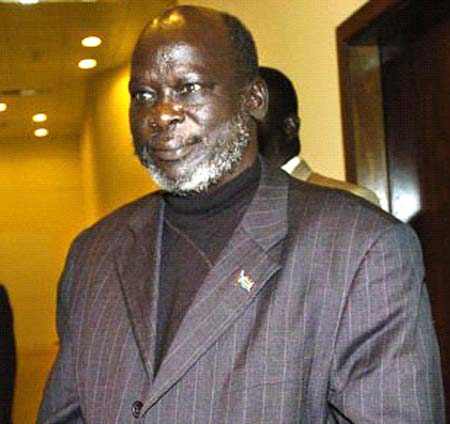
On 30 July 2005, Sudanese vice-president John Garang was killed when the Ugandan presidential helicopter crashed while he was flying back to Sudan from talks in Uganda. Garang had been Sudan's vice-president for three weeks before his death. Widespread speculation as to the cause of the crash led Museveni, on 10 August, to threaten the closure of media outlets that published "conspiracy theories" about Garang's death. In a statement, Museveni claimed that the speculation was a threat to national security. "I will no longer tolerate a newspaper which is like a vulture. Any newspaper that plays around with regional security, I will not tolerate it – I will close it." The following day, popular radio station KFM had its license withdrawn for broadcasting a debate on Garang's death. Radio presenter Andrew Mwenda was eventually arrested for sedition in connection with comments made on his KFM talk show.
February 2006 elections
Main article: 2006 Ugandan general election
On 17 November 2005, Museveni was chosen as the NRM's presidential candidate for the February 2006 elections. His candidacy for a further third term sparked criticism, as he had promised in 2001 that he was contesting for the last time. The arrest of the main opposition leader Kizza Besigye on 14 November – charged with treason, concealment of treason, and rape – sparked demonstrations and riots in Kampala and other towns. Museveni's bid for a third term, the arrest of Besigye, and the besiegement of the High Court during a hearing of Besigye's case (by a heavily armed Military Intelligence group dubbed by the press as the "Black Mambas Urban Hit Squad"), led Sweden, the Netherlands, and the United Kingdom to withhold economic support to Museveni's government because of their concerns about the country's democratic development. On 2 January 2006, Besigye was released after the High Court ordered his immediate release.
The 23 February 2006 elections were Uganda's first multi-party elections in 25 years and were seen as a test of its democratic credentials. Although Museveni did worse than in the previous election, he was elected for another five-year tenure, having won 59 percent of the vote against Besigye's 37 percent. Besigye alleged fraud and rejected the result. The European Union and independent Ugandan electoral observers described the 2006 elections as not a fair and free contest. The Supreme Court of Uganda later noted that the election was marred by intimidation, violence, voter disenfranchisement and other irregularities; it voted 4–3 to uphold the results.
Third term (2006–2011)
In 2007, Museveni deployed troops to the African Union's peacekeeping operation in Somalia. Also in this term, Museveni held meetings with investors that included Wisdek, to promote Uganda's call centre and outsourcing industry and create employment to the country.
September 2009 riots
In September 2009, Museveni refused Kabaka Muwenda Mutebi, the Buganda King, permission to visit some areas of the Buganda Kingdom, particularly the Kayunga district. Riots occurred and over 40 people were killed while others were imprisoned. Furthermore, nine more people were killed during the April 2011 "Walk to Work" demonstrations. According to the Human Rights Watch 2013 World Report on Uganda, the government failed to investigate the killings associated with both of these events.
Fundamentalist Christianity
In 2009, MSNBC and NPR reported on Jeff Sharlet's investigation regarding ties between Museveni and the American fundamentalist Christian organization The Fellowship (also known as "The Family"). Sharlet reports that Douglas Coe, leader of The Fellowship, identified Museveni as the organization's "key man in Africa".
LGBT rights
Further international scrutiny accompanied the 2009 Ugandan efforts to institute the death penalty for homosexuality, with British, Canadian, French, and American leaders expressing concerns for human rights. British newspaper The Guardian reported that Museveni "appeared to add his backing" to the legislative effort by, among other things, claiming "European homosexuals are recruiting in Africa", and saying gay relationships were against God's will. Museveni and members of NRM continue to use the terms "gay" and "homosexuals" to degrade opponents and in particular members of the National Unity Platform. In 2023, Museveni signed an anti-LGBTQ+ bill and called on other African leaders to reject the "promotion of homosexuality".
Fourth term (2011–2016)
Main article: 2011 Ugandan general election

Museveni was reelected on 20 February 2011 with a 68 percent majority with 59 percent of registered voters having voted. The election results were disputed by both the European Union and the opposition. "The electoral process was marred with avoidable administrative and logistical failures", according to the European Union election observer team. Following the fall of Egypt's Hosni Mubarak and Libya's Muammar Gaddafi, Museveni became the fifth-longest serving African leader.
In October 2011, the annual inflation rate reached 30.5 percent, principally due to food and fuel increases. Earlier in 2011, opposition leader Kizza Besigye staged "Walk to Work" protests against the high cost of living. On 28 April 2011, Besigye was arrested because Museveni said Besigye had attacked first, a charge he denied. Besigye's arrest led to more riots in Kampala. Besigye promised that "peaceful demonstrations" would continue. The government's response to the riots has been condemned by donor nations. [[File:Yoweri Museveni with Obamas 2014.jpg|thumb|Museveni is greeted by US President [[Barack Obama]] in August 2014|223x223px]]In more recent years, infringements on press freedom have increasingly been a central focus. According to Human Rights Watch, "Between January and June [2013], a media watchdog organization registered 50 attacks on journalists, despite multiple pledges to respect media freedom." During this period, two widely read periodicals, The Daily Monitor and The Red Pepper, were shut down and seized by the government because they published allegations about a "plot to assassinate senior government and military officials who [were] opposed to Ugandan President Yoweri Museveni ... and his plans to hand over power to his son when he retires".
Another issue of human rights became an issue in early 2014 when Museveni signed an anti-homosexuality bill into law. In an interview with CNN, Museveni called homosexuals "disgusting" and said that homosexuality was a learned trait. Western leaders, including United States President Obama, condemned the law. Museveni has criticized the US's involvement in the Libyan Civil War, and in a UN speech argued that military intervention from African countries produces more stable countries in the long term, which he calls "African solutions for African problems".
Fifth term (2016–2021)
2016 election
Main article: 2016 Ugandan general election
The presidential candidates included Museveni and Kizza Besigye, who complained of rigging and violence at polling stations. Voting was extended in several locations after reports of people not being allowed to cast their votes. According to the Electoral Commission, Museveni was reelected (18 February 2016) with 61 percent of the vote to Besigye's 35 percent. Opposition candidates claimed that the elections were marred by widespread fraud, voting irregularities, the repeated arrest of opposition politicians, and a climate of voter intimidation.
2018 age limit bill
.jpg)
Museveni, as the incumbent president of Uganda, signed the Constitutional Amendment Bill No. 2 2017, commonly known as the "Age Limit" bill on 27 December 2017. The bill was passed by the 10th parliament of Uganda on 20 December 2017. As of 27 December 2017, in accordance with articles 259 and 262 of the Constitution of Uganda, the bill has effectively amended the Constitution to remove the presidential age limit caps. Before the amendment, article 102 (b) barred people above 75 and below 35 from running for the highest office. The current age limit bill also extends the term of office of parliament from five years to seven. The bill also restores presidential two-term limits which had been removed in a 2005 constitutional amendment.
Challenge to the bill
After Museveni signed the 2018 Age Limit Bill into law on 27 December 2017 (but parliament received the letter on 2 January 2018), the general public protested as they had been doing prior to the signing of the bill, using all avenues including on social media. In October 2017, some MPs returned what they alleged were bribes to facilitate the bill.
The Uganda Law Society and members of the opposition house sued and challenged the bill in court, citing that the process leading to the vote was in violation of Articles 1, 2, 8A, 44 (c), 79 and 94 of the Ugandan constitution because the Speaker of Parliament [Kadaga] closed debate on the Amendment after only 124 out of 451 legislators had debated the bill. They also argue that the use of force by the army and police during the bill debate was inconsistent with and in contravention of Articles 208(2), 209 and 259 among others. The third argument they make is that the bill violates other constitutional clauses in relation to the extension of terms and electoral procedures. One legislature [Mbwaketamwa Gaffa] is quoted as saying, "when the president to the bill, it might be legal, but it will be illegitimate, and we are going to challenge it."
Public reaction to the new bill
.jpg)
The law enforcement agencies in Uganda, i.e. the police, the military etc., have arrested at least 53 people, including opposition leader Kizza Besigye, for demonstrating against the bill to scrap the presidential age limit. A group of legislators from the ruling party, the National Resistance Movement (NRM), clandestinely agitated to remove the age limit because it would give Museveni leeway to run for another term in the 2021 elections.
A three-month survey conducted between September and November by civil society organizations recorded that 85 percent of the sampled population opposed the removal of the age limit, with only 15 percent in support. Ugandan lawmakers have voted predominantly to remove the presidential age limits because they want to pave way for the Museveni to spend a sixth term in office. Human rights lawyer Nicholas Opiyo said that removing the age limitone of the most important safeguardswill entrench a dictatorial and autocratic regime in Uganda.
Sixth term (2021–2026)
.jpg)
On 16 January 2021, the electoral commission of Uganda announced that Museveni had won reelection to a sixth term on 14 January with 58.6% of the vote. Runner-up Bobi Wine, and other opposition leaders refused to accept the results, claiming that the election was the most fraudulent in Uganda's history. During the campaign for the presidential elections on 19 November 2020, Museveni described Wine's campaign as being financed by foreigners, and, in particular, foreign homosexuals.
Independent organizations and democracy experts confirmed the elections were neither free nor fair. The Electoral Commission published a Declaration of Results form that turned out to be fraudulent. The Electoral Commission promised an investigation which did not take place. Wine was placed under house arrest on 15 January. Independent international observers called for investigation into potential election fraud amidst a nationwide internet shutdown, human rights abuses, and denied accreditation requests. Wine was released on 26 January.
In June 2021, 44 people were arrested at an LGBT center, with the pretext of violating COVID SOPs. In July 2022, Museveni hosted Russian Foreign Minister Sergey Lavrov, saying that "We don't believe in being enemies of somebody's enemy." In October 2022 Museveni apologized to Kenya on behalf of his son, Muhoozi Kainerugaba who tweeted that he could invade Kenya in two weeks.
In July 2023, Museveni attended the 2023 Russia–Africa Summit in Saint Petersburg and met with Russian President Vladimir Putin. Without specifically mentioning the Russian invasion of Ukraine or any other war, Museveni said that the "only justified wars are the just wars, like the anti-colonial wars. Wars of hegemony will fail and waste time and opportunity. Dialogue is the correct way."
After the Hamas attack on Israel in October 2023, Museveni expressed concern over the situation and called for dialogue and a two-state solution to the Israeli–Palestinian conflict. In June 2025, Museveni announced his candidacy for the January 2026 presidential election. He was formally declared the candidate of his party the following month. On 27 August 2025, the ruling National Resistance Movement endorsed Museveni as presidential candidate for the 2026 election. The party, which was holding its 5th National Conference, also endorsed Museveni as the party chairperson until 2031.
Seventh term (2026–present)
Initial results released on 16 January showed Museveni leading in the 2026 presidential election with 76.25% of the vote, followed by Bobi Wine with 19.85%. Wine's supporters protested the results. On 17 January, Museveni was officially declared the winner of the presidential election with 71.65% of the vote.
Personal life
Museveni is an Anglican and a member of the Church of Uganda. He is married to Janet Kataaha Museveni, née Kainembabazi, with whom he has four children:
- Muhoozi Kainerugaba – born in 1974, a general in the Uganda People's Defence Forces (UPDF), who was promoted to the rank of major general in 2016.
- Natasha Karugire – born in 1976, fashion designer and consultant, married to Edwin Karugire, private secretary to the president of Uganda for household affairs.
- Patience Rwabwogo – born in 1978, pastor of Covenant Nations Church, Buziga, Kampala, married to Odrek Rwabwogo.
- Diana Kamuntu – born in 1980, married to Geoffrey Kamuntu.
Electoral history
| Year | Office | Party | Votes received | Result | Total | % | . | Swing | 1996 | 2001 | 2006 | 2011 | 2016 | 2021 | 2026 | |
|---|---|---|---|---|---|---|---|---|---|---|---|---|---|---|---|---|
| President of Uganda | Independent politician}};" | IND | 4,458,195 | 74.33% | 1st | |||||||||||
| 5,123,350 | 69.33% | 1st | −5.00 | |||||||||||||
| National Resistance Movement}};" | NRM | 4,109,449 | 59.26% | 1st | −10.07 | |||||||||||
| 5,428,369 | 68.38% | 1st | +9.12 | |||||||||||||
| 5,971,872 | 60.62% | 1st | −7.76 | |||||||||||||
| 6,042,898 | 58.38% | 1st | −2.24 | |||||||||||||
| 7,946,772 | 71.65% | 1st | +13.27 |
Honours and awards
National honours
- [[File:Order of Katonga (Uganda) - ribbon bar.png|60px]] Order of Katonga (6 February 2023)
Foreign honours
| Ribbon | Distinction | Country | Date | Reference | |
|---|---|---|---|---|---|
| [[File:CUB Order of Playa Giron 3rd type (after 1979) ribbon.svg | 80px]] | Order of Playa Girón | Cuba | 9 January 1988 | |
| [[File:Ord.GoodHope-ribbon.gif | 80px]] | Grand Cross of the Order of Good Hope | South Africa | November 1997 | |
| [[File:Orden Republike Srbije 2.gif | 80px]] | Order of the Republic of Serbia, 2nd Class | Serbia | 2016 | |
| [[File:Ordine dell'Indipendenza (Guinea Equatoriale).png | 80px]] | Grand Collar of the Order of Independence | Equatorial Guinea | 25 August 2017 | |
| [[File:National Order of Merit - Grand Cross (Guinea).png | 80px]] | Grand Cross of the National Order of Merit | Guinea | 30 June 2018 | |
| Member of the Order of South Africa | South Africa | 28 February 2023 | |||
| [[File:Order of the Golden Heart of Kenya.svg | 80px]] | Chief of the Order of the Golden Heart | Kenya |
Honorary degrees
| University | Country | Honour | Year |
|---|---|---|---|
| Humphrey School of Public Affairs | United States | Doctor of Laws | 1994 |
| Mbarara University of Science and Technology | Uganda | Doctor of Laws | 2003 |
| Latin University of Theology | United States | Doctor of Divinity | 2007 |
| Fatih University | Turkey | Honorary degree | 2010 |
| Makerere University | Uganda | Doctor of Laws | 2010 |
| University of Dar es Salaam | Tanzania | Doctor of Literature | 2015 |
Notes
References
Sources
References
- "How do you say YOWERI MUSEVENI?".
- (13 February 2020). "Definition of 'Museveni'".
- (17 November 2011). "The Lord's Resistance Army: End Game?".
- "Scrapping Presidential Age Limits Sets Uganda on a Course of Instability".
- (24 February 2014). "Ugandan President Yoweri Museveni signs anti-gay bill". BBC News.
- (16 January 2026). "Uganda election descends into deadly violence as President Yoweri Museveni looks to cling to power". Sky News.
- (6 March 2017). "Age is but a number". Africa Research Institute.
- (17 February 2016). "Yoweri Museveni – Uganda's president profiled". BBC.
- (24 May 2021). "Yoweri Kuaguta Museveni (1944– )".
- "Yoweri Museveni".
- (January 2026). "Museveni's father, Amos Kaguta to be buried Sunday".
- (15 February 2006). "Profile of Yoweri Kaguta Museveni".
- (4 December 2021). "Deadliest Conflicts in Uganda". Top Ten Uganda.
- "Uganda's Presidential Election: Voting for an Autocrat".
- (9 January 2021). "Why Museveni's UPM party lost the 1980 election".
- (2014). "In Idi Amin's Shadow". Ohio University Press.
- (5 June 2013). "Chronology". Conciliation Resources.
- Butagira, Tabu. (22 May 2010). "Janet Museveni Opens Up On Love, Family And Politics".
- (March 1997). "Amin's attack on Tanzania". New African.
- (2010). "Peace, and conflict in northern Uganda 2002–06". Conciliation Resources.
- "1985: Preparing for Ugandan Democracy in Unterolberndorf".
- (1 January 1996). "Ugandas neue Verfassung".
- (2002). "Profiles of the parties to the conflict". Conciliation Resources.
- "CIA Factbook – Uganda". Cia.gov.
- Tindigarukayo, Jimmy K.. (1988). "Uganda, 1979–85: Leadership in Transition". The Journal of Modern African Studies.
- "Kampala troops flee guerrilla attacks", ''[[The Times]]'', 23 January 1986
- "Troops from Zaire step up Uganda civil war", ''[[The Guardian]]'', 21 January 1986
- "Museveni sworn in as President", ''[[The Times]]'', 30 January 1986
- (15 February 2006). "Uganda: Profile of Yoweri Kaguta Museveni". IRIN.
- "Structural Adjustment in Uganda". Members.aol.com.
- Sheila Rule. (30 January 1986). "Rebel Sworn In as Uganda President". The New York Times.
- "Museveni 24 Years Later: Ours is not a mere change of guard; it is a fundamental change".
- (2012). "Handbook of Ethnic Conflict: International Perspectives". Springer Science & Business Media.
- link. (22 October 2012 , ''Daily Times'', 30 May 2002)
- "teachkidspeace.org".
- (1989). "Uganda: The human rights record 1986–1989". Amnesty International.
- "Uganda: Breaking the circle: Protecting human rights in the northern war zone – Amnesty International".
- "Elections in Uganda".
- (1999). "Elections in Africa: A Data Handbook". OUP Oxford.
- (29 October 2010). "Uganda's first Batwa pygmy graduate". BBC News.
- (17 February 2016). "Uganda's Kizza Besigye – veteran opposition leader profiled". BBC News.
- Lawrence, J. P.. "In Uganda, Museveni finds biggest election obstacle in former friends". Christian Science Monitor.
- "2001 Elections : Supreme Court Judges ruling – Uganda Elections 2016".
- (14 September 2020). "Justice Karokora was judge of integrity, say colleagues".
- "2001 Elections: Supreme Court Judges ruling – Uganda Elections 2016".
- Leone, Daniel A., ed. Responding to the AIDS Epidemics. Farmington Hills: Greenhaven Press, 2008.
- "Uganda Home".
- [http://www.wougnet.org/Documents/gender_politicalparties.html "Gender implications for opening up political parties in Uganda"] {{webarchive. link. (18 January 2012 , Sylvia Tamale, Faculty of Law, Makerere University, from the [http://www.wougnet.org/ Women of Uganda Network] {{Webarchive). link. (9 November 2005)
- link. (29 January 2006 , James C. McKinley, ''[[New York Times]]'', 15 June 1997)
- French, Howard. (16 December 1997). "Albright in Africa: The Embraceable Regimes?". [[The New York Times]].
- Helen Epstein. "Uganda: The General Challenges the Dictator".
- Clark, John F.. (June 2001). "Explaining Ugandan intervention in Congo: evidence and interpretations". The Journal of Modern African Studies.
- (29 August 2022). "International Crisis Group".
- ''[[New Vision]]'', 26 and 28 August 1998
- politique-africaine.com. (5 July 2023). "L'Ouganda et les guerres congolaises".
- "Will Uganda Pay Up for Congo Occupation?".
- "Armed Activities on the Territory of the Congo (Democratic Republic of the Congo v. Uganda)".
- Kagoro, Jude. (2016). "Competitive authoritarianism in Uganda: The not so hidden hand of the military". Springer Fachmedien.
- "Telegraph {{!}} News {{!}} Worldwide".
- [http://hrw.org/reports/2004/uganda0404/5.htm "State of Pain:Torture in Uganda"] {{Webarchive. link. (15 August 2005 – Part III, Human Rights Watch)
- (10 January 2021). "Uganda's Yoweri Museveni: How an ex-rebel has stayed in power for 35 years". BBC News.
- Tapscott, Rebecca. (2021). "Arbitrary States: Social Control and Modern Authoritarianism in Museveni's Uganda". Oxford University Press.
- Tripp, Aili Mari. (2004). "The Changing Face of Authoritarianism in Africa: The Case of Uganda". Africa Today.
- Kagoro, Jude. (2016). "Competitive authoritarianism in Uganda: The not-so-hidden hand of the military". Springer.
- [http://www.fdcuganda.org/pages/press_releases/June_27_Press_Release.doc "Press release: FDC Position on amending article 105(2) of the constitution"] {{webarchive. link. (6 March 2012 , ''Forum for Democratic Change'', 27 June 2005)
- [http://www.theperspective.org/africabigmen.html "The Travails and Antics of Africa's "Big Men" – How Power Has Corrupted African Leaders"] {{Webarchive. link. (1 November 2005 , Wafula Okumu, ''The Perspective'', 11 April 2002)
- [http://news.bbc.co.uk/1/hi/world/africa/4371265.stm "Ugandans march against Bob Geldof"] {{Webarchive. link. (7 February 2006 , ''BBC News'', 22 March 2005)
- "Uganda: An African Success Turning Sour", Johnnie Carson, speech delivered at the [[Wilson Center]], 2 June 2005
- [http://www.boston.com/news/globe/editorial_opinion/oped/articles/2005/05/01/a_threat_to_africas_success_story/ "A threat to Africa's success story"] {{Webarchive. link. (7 May 2005 , Johnnie Carson, ''[[Boston Globe]]'', 1 May 2005)
- [https://mg.co.za/article/2005-07-19-norway-cuts-aid-to-uganda "Norway cuts aid to Uganda"] {{Webarchive. link. (25 October 2019 , [[Reuters]], 19 July 2005)
- (27 April 2005). "Uganda: Key Opposition MPs Arrested". [[Human Rights Watch]].
- (14 September 2020). "Justice Karokora was judge of integrity, say colleagues".
- [http://www.newvision.co.ug/D/8/12/435022 "World Bank may cut aid"] {{webarchive. link. (18 October 2015, Paul Busharizi, ''[[New Vision]]'', 17 May 2005)
- [http://www.newvision.co.ug/D/8/12/436513 "Museveni advises donors"] {{webarchive. link. (18 October 2015, ''[[New Vision]]'', 27 May 2005)
- [http://allafrica.com/stories/200505260253.html "Donors Fear Me, Says Museveni"] {{Webarchive. link. (28 May 2005 , Frank Nyakairu, ''[[The Monitor (Uganda)). The Monitor]]'', 26 May 2005
- link. (25 August 2006 , UNOCHA-IRIN, 27 July 2005)
- [https://news.bbc.co.uk/2/hi/africa/4726419.stm "Uganda backs multi-party return"] {{Webarchive. link. (30 January 2019 , [[BBC]], 30 July 2005)
- "Referendum ends 20-year ban on political parties", [[Reuters]], 1 August 2005
- "Southern Sudanese leader John Garang's mysterious death".
- "John Garang". Encyclopædia Britannica.
- Usher, Sebastian. (10 August 2005). "Museveni warns press over Garang". BBC News.
- [http://news.bbc.co.uk/2/hi/africa/4165344.stm "Banned Ugandan radio back on air"] {{Webarchive. link. (13 October 2005 , BBC News, 19 August 2005)
- [http://news.bbc.co.uk/1/hi/world/africa/4435490.stm "Uganda riots over treason charge"] {{Webarchive. link. (29 June 2006 , BBC News, 14 November 2005)
- "The Netherlands has cut its budget support to Uganda this year by 27% or (six million Euros) over concerns about the political transition and budgetary indiscipline, an embassy statement has said".
- "SWEDEN said on Monday it would withhold 65 million Swedish crowns ($8.22m) in budget support from Uganda due to problems with the development of democracy".
- [http://www.newvision.co.ug/D/8/12/466145 "Col Besigye Case Opens"] {{webarchive. link. (18 October 2015, ''New Vision'', 16 November 2005)
- (22 June 2021). "Have Ugandan elections been free and fair in last 30 years?".
- (25 February 2006). "Uganda's Museveni wins election". BBC News.
- (July 2016)
- (2013). "World Report 2013 (Uganda)".
- (30 November 2009). "Rachel Maddow Show transcript". NBC News.
- (24 November 2009). "The Secret Political Reach of 'The Family'". NPR Fresh Air transcript.
- Chase, Steven. [https://www.theglobeandmail.com/news/politics/harper-lobbies-uganda-on-anti-gay-bill/article1381835/ "Harper lobbies Uganda on anti-gay bill"] {{Webarchive. link. (3 March 2016, ''The Globe and Mail'' (Toronto), 29 November 2009.)
- [http://www.monitor.co.ug/artman/publish/sun_news/British_PM_against_anti-gay_legislation_95302.shtml "British PM against anti-gay legislation"] {{webarchive. link. (2 December 2009, ''Monitor Online'', 29 November 2009)
- Rice, Xan. (29 November 2009). "Uganda considers death sentence for gay sex in bill before parliament". The Guardian.
- Atuhaire, Patience. (29 March 2023). "Gay Ugandan asks 'Where will I go?' as secret shelters under threat". BBC News.
- (3 April 2023). "Ugandan president calls on Africa to 'save the world from homosexuality'".
- Kron, Josh. (20 February 2011). "President Yoweri Museveni of Uganda Easily Wins Election". The New York Times.
- (20 February 2011). "Uganda's Museveni wins disputed presidential vote". Reuters.
- (21 October 2011). "Who among the seven longest serving African leaders will be deposed next?". Reuters.
- (31 October 2011). "Ugandan Inflation Rate Climbs to 18-Year High on Food, Fuel". Business Week.
- (1 May 2011). "Uganda: Besigye vows protests will continue". BBC.
- (30 April 2011). "Ugandans Riot over Kizza Besigye's arrest". BBC.
- (23 April 2011). "Deadly Crackdown on Uganda's Walk-to-Work Protests".
- Human Rights Watch. (2013). ''World Report 2013 (Uganda)''
- Natabaalo, Grace. (2013). Ugandan Police Shutdown Papers Over 'Plot'. ''[[Al Jazeera Arabic. Al Jazeera]]''.
- "Uganda president: Homosexuals are 'disgusting'". CNN.com.
- (6 May 2015). "AP Interview: Uganda's president says he's the one bullied".
- "Opposition leader arrested as Uganda holds elections".
- (28 September 2017). "The Constitution (Amendment) (No. 2) Bill, 2017".
- (2 January 2018). "Museveni assents to age limit bill". The Observer – Uganda.
- Mpagi, Charles M.. (2 January 2018). "Museveni assents to controversial age limit Bill". The East African.
- Mumbere, Daniel. "Uganda: Pres. Museveni signs Age Limit Bill into law". Africanews.
- (26 October 2017). "Ugandan MPs return 'bribes' for age-limit bill". citifmonline.com.
- Kiyonga, Derrick. (22 December 2017). "Government sued over age limit law". The Observer – Uganda.
- Kiyonga, Derrick. "MPs challenge 'age limit' law in court". The Observer – Uganda.
- (16 January 2018). "Uganda Law Society petitions court over 'age limit' law". The Observer – Uganda.
- "Uganda opposition to challenge age limit law". The East African.
- "Ugandan police arrests dozens over presidential age limit protest | DW | 20.07.2017".
- (26 September 2017). "Ugandan police shut down protests over presidential age limit bill".
- (9 December 2017). "85% of Ugandans opposed to age limit amendment – survey".
- (21 December 2017). "How Ugandan MPs voted to scrap presidential age limit". The Independent.
- "Two Presiding Officers Arrested in Lugazi for Ballot Stuffing".
- "409 Polling Stations had 100% Voter Turnout, Giving Museveni 95.8%".
- (16 January 2021). "Museveni declared winner of disputed Uganda presidential election". Al Jazeera.
- "Rigged (page 22)".
- (22 June 2021). "Is it true that Uganda has not held fair elections for 30 years?".
- Muhumuza, William. (1 September 2009). "From Fundamental Change to No Change: The NRM and democratization in Uganda". Les Cahiers d'Afrique de l'Est.
- (2 March 2021). "EC Admits Error in Poll Results Declaration Form".
- (4 March 2021). "EC posts fake results to dispel "fake news"".
- (21 January 2021). "Uganda: Bobi Wine files arbitrary detention complaint at UN". Al Jazeera.
- (21 January 2021). "Uganda: Elections Marred by Violence".
- "Museveni declared winner of disputed Uganda presidential election".
- Hancock, Sam. (18 January 2021). "Ugandan opposition to challenge 'fraudulent' election result as two killed in protests". The Independent.
- (13 January 2021). "Statement by U.S. Ambassador Natalie E. Brown on Cancellation of U.S. Diplomatic Observer Mission of Uganda's Elections". US Embassy in Uganda.
- (3 February 2021). "Uganda security forces withdraw from Bobi Wine's home ending 11 days of house arrest". CNN.
- Lavers, Michael K.. (2 June 2021). "Uganda Police arrests 44 at LGBTI center.".
- (26 February 2023). "Is Africa still 'neutral' a year into the Ukraine war?". Al Jazeera.
- Princewill, Nimi. (6 October 2022). "General Muhoonzi: Uganda's Museveni apologizes to Kenya for son's invasion tweets". CNN.
- (28 July 2023). "Zimbabwe and Uganda leaders meet with Russian President Putin". Africanews.
- (28 July 2023). "Putin woos African leaders at a summit in Russia with promises of expanding trade and other ties".
- Matovu, Muhamadi. (8 October 2023). "Uganda: Museveni Urges Implementation of a Two-State Solution to End Palestine-Israel Conflicts". Nile Post News.
- (24 June 2025). "Uganda: President Museveni, in power since 1986, will be a candidate for re-election". Radio France International.
- (6 July 2025). "Uganda's 80-year-old president in bid to extend 40-year rule". BBC.
- (29 August 2025). "Uganda's ruling party NRM endorses President Museveni as flag bearer for 2026 election".
- (16 January 2026). "At least seven killed overnight in Uganda after tense presidential election". [[Al Jazeera]].
- "Ugandan opposition leader 'forcibly taken,' party says, as President Museveni nears reelection".
- (17 January 2026). "Uganda's Museveni wins seventh term as observers denounce intimidation". AFP.
- "Leaders in waiting".
- "Lt. Col. Muhoozi is Commander Special Forces".
- NTVUganda. (16 May 2016). "Muhoozi Kainerugaba promoted to Major General".
- (16 January 2021). "Museveni promotes Muhoozi to rank of Major General".
- "Natasha is a Fashion Guru".
- "Welcome To CNC".
- "Patience Rwabwogo is a Pastor".
- "Geoffrey Kamuntu and His Wife".
- (6 February 2023). "Well Done Mr President! Museveni Awarded Katonga Medal For His Role In Creating UPDF". Uganda Online Media.
- (1988). "Consejo de Estado". Gaceta Oficial de la República de Cuba.
- "1997 National Orders awards".
- (1 October 2000). "South Africa: Queston of Principle: Arms Trade and Human Rights". [[Human Rights Watch]].
- "Decrees on decorations signed by the President of the Republic of Serbia Aleksandar Vucic". www.predsednik.rs/en.
- "Укази о одликовањима". Председник Републике Србије.
- (26 August 2017). "Museveni Awarded Equatorial Guinea's Highest Honor". ChimpReports.
- (30 June 2018). "Museveni given highest order of merit award in Guinea". The Insider.
- (1 March 2023). "Museveni Receives 'Order of South Africa' Award". ChimpReports.
- Okoth, Brian. "Uhuru awards Koome, Mugenda, Kananu EGH honours; journalists get HSC".
- "Honorary Degrees". [[University of Minnesota]].
- (30 April 2013). "H. E. President Yoweri Kaguta Museveni – Former Chancellor". Makerere University.
- (January 2007). "Museveni awarded doctorate degree". New Vision.
- (6 May 2010). "Museveni gets Turkish doctorate". New Vision.
- (14 December 2010). "Makerere honours President Museveni". Makerere University.
- (31 July 2015). "President Museveni awarded with Doctorate of Literature".
This article was imported from Wikipedia and is available under the Creative Commons Attribution-ShareAlike 4.0 License. Content has been adapted to SurfDoc format. Original contributors can be found on the article history page.
Ask Mako anything about Yoweri Museveni — get instant answers, deeper analysis, and related topics.
Research with MakoFree with your Surf account
Create a free account to save articles, ask Mako questions, and organize your research.
Sign up freeThis content may have been generated or modified by AI. CloudSurf Software LLC is not responsible for the accuracy, completeness, or reliability of AI-generated content. Always verify important information from primary sources.
Report