From Surf Wiki (app.surf) — the open knowledge base
York Castle
Grade I listed monument in York, England
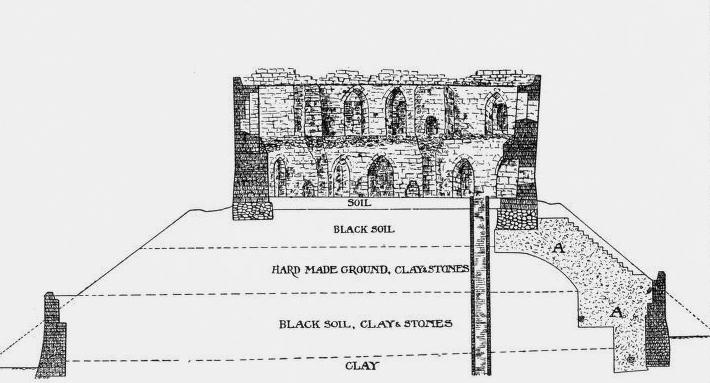
Grade I listed monument in York, England
| Field | Value |
|---|---|
| name | York Castle |
| location | Yorkshire, England |
| coordinates | |
| gridref | |
| image | Clifford's Tower (5259021070).jpg |
| image_size | 300px |
| caption | Clifford's Tower, the keep of York Castle |
| pushpin_map | North Yorkshire |
| pushpin_mapsize | 300 |
| pushpin_map_caption | Shown within North Yorkshire |
| type | Shell keep and bailey |
| materials | Magnesian Limestone |
| condition | Ruined keep, restored part curtain-wall, surviving 18th century buildings used as a museum and York's Crown Court |
| ownership | English Heritage, York Museums Trust, Her Majesty's Courts Service |
| battles | Siege of York in 1644 |
| events | Jewish massacre of 1190 |
| embedded | {{infobox designation list |
| embed | yes |
| designation1 | Grade I |
| designation1_date | 14 June 1954 |
| designation1_number | 1259325 |
| 1259360 | |
| 1259324 | |
| 1259328 | |
| 1259329 |
1259360 1259324 1259328 1259329
York Castle is a fortified complex in the city of York, England. It consists of a sequence of castles, prisons, law courts and other buildings, which were built over the last nine centuries on the north-west side of the River Foss. The now ruined keep of the medieval Norman castle is commonly referred to as Clifford's Tower. Built originally on the orders of William I to dominate the former Viking city of Jórvík, the castle suffered a tumultuous early history before developing into a major fortification with extensive water defences. After a major explosion in 1684 rendered the remaining military defences uninhabitable, York Castle continued to be used as a jail and prison until 1929.
The first motte and bailey castle on the site was built in 1068 following the Norman conquest of York. After the destruction of the castle by rebels and a Viking army in 1069, York Castle was rebuilt and reinforced with extensive water defences, including a moat and an artificial lake. York Castle formed an important royal fortification in the north of England. In 1190, 150 local Jews died in the timber castle keep; most of them committed suicide in order not to fall into the hands of the mob. In the middle of the 13th century, Henry III rebuilt the castle in stone creating a keep with a unique quatrefoil design, supported by an outer bailey wall and a substantial gatehouse. During the Scottish wars between 1298 and 1338, York Castle was frequently used as the centre of royal administration across England, as well as an important military base of operations. York Castle fell into disrepair by the 15th and 16th centuries, becoming used increasingly as a jail for both local felons and political prisoners. By the time of Elizabeth I the castle was estimated to have lost all of its military value but was maintained as a centre of royal authority in York.
The outbreak of the English Civil War in 1642 saw York Castle being repaired and refortified, playing a part in the Royalist defence of York in 1644 against Parliamentary forces. York Castle continued to be garrisoned until 1684, when an explosion destroyed the interior of Clifford's Tower. The castle bailey was redeveloped in a neoclassical style in the 18th century as a centre for county administration in Yorkshire, and was used as a jail and debtors' prison. Prison reform in the 19th century led to the creation of a new prison built in a Tudor Gothic style on the castle site in 1825; used first as a county and then as a military prison, this facility was demolished in 1935. By the 20th century the ruin of Clifford's Tower had become a well-known tourist destination and national monument; today the site is owned by English Heritage and open to the public. The other remaining buildings serve as the York Castle Museum and the Crown Court.
History
11th century
| mark-lat1= 53.96273
| mark-lon1= -1.08510
| mark-size1=10
| label-size1=12
| label-color1=dark red
| label-pos1=left
| mark-title1=Bootham Bar
| mark-image1=
| mark-description1=
| mark-lat2=53.96278 | mark-lon2=-1.07847 | label-pos2=bottom | mark-title2=Monk Bar | mark-image2= | mark-description2=
| mark-lat3= 53.95520 | mark-lon3= -1.07077 | label-pos3=left | mark-title3=Walmgate Bar | mark-image3= | mark-description3=
| mark-lat4=53.95586 | mark-lon4=-1.09084 | label-pos4=top | mark-title4=Micklegate Bar | mark-image4= | mark-description4=
| mark-lat5=53.95397 | mark-lon5=-1.07524 | label-pos5=bottom | mark-title5=Fishergate Bar | mark-image5= | mark-description5=
| mark-lat6=53.95418 | mark-lon6=-1.08677 | label-pos6=bottom | mark-title6=Victoria Bar | mark-image6= | mark-description6=
| mark-lat7=53.96135 | mark-lon7=-1.08700 | label-pos7=bottom | mark-title7=Multangular Tower | mark-image7= | mark-description7=
| mark-coord8 =
| label-pos8 = top
| mark-title8 = York Castle
| mark-image8 =
| mark-description=8
| mark-size8 = 14
| label-size8 = 15
York was a Viking capital in the 10th century, and continued as an important northern city in the 11th century. In 1068, on William the Conqueror's first northern expedition after the Norman Conquest, he built a number of castles across the north-east of England, including one at York. The motte was originally around 200 ft wide at the base. As it was built in an urban environment, hundreds of houses had to be destroyed to make way for the development. William Malet, the sheriff of Yorkshire, was placed in charge of the castle and successfully defended it against an immediate uprising by the local population.
In response to the worsening security situation, William conducted his second northern campaign in 1069. He built another castle in York, on what is now Baile Hill on the west bank of the Ouse opposite the first castle, in an effort to improve his control over the city. This second castle was also a motte and bailey design, with the Baile Hill motte probably reached by a horizontal bridge and steps cut up the side of the motte. Later that year, a Danish Viking fleet sailed up to York along the Humber and the Ouse, and attacked both castles with the assistance of Cospatrick of Northumbria and a number of local rebels. The Normans, attempting to drive the rebels back, set fire to some of the city's houses. The castles were captured and partially dismantled, and Malet was taken hostage by the Danes.
William conducted a widespread sequence of punitive operations across the north of England in the aftermath of the attacks in 1069 and 1070. By the time the Domesday Book was compiled in 1086, York Castle was also surrounded by a water-filled moat and a large artificial lake called the King's Pool, fed from the river Foss by a dam built for the purpose. More property, including two watermills, had to be destroyed to make way for the water defences. Over time the Baile Hill site was abandoned in favour of the first castle site, leaving only the motte, which still exists.
12th century
Henry II visited York Castle four times during his reign. The royal chambers at the time were inside the keep for safety, and Henry paid £15 for repairs to the keep. During his 1175 visit, Henry used the castle as the base for receiving the homage of William the Lion of Scotland.Castle mills were built close by to support the garrison, and the military order of the Knights Templar was granted ownership of the mills in the mid-12th century. The mills proved to be vulnerable to the flooding of the two rivers and had to be repeatedly repaired.
Massacre of Jews
History of the Jews in England (1066–1290)#Massacres at London, Bury and York (1189–1190)}} 1190 pogromIn 1190, York Castle was the location of one of the worst pogroms in England during the medieval period. English Jews were subject to considerable religious prejudice and primarily worked from towns and cities in which there was a local royal castle that could provide them with protection in the event of attacks from the majority Christian population. Royal protection was usually granted as the Norman and Angevin kings had determined that Jewish property and debts owed to Jews ultimately belonged to the crown, reverting to the king on a Jew's death.
Richard I was crowned king in 1189 and announced his intention to join the Crusades; this inflamed anti-Jewish sentiment. Rumours began to spread that the king had ordered that the English Jews be attacked. In York, tensions broke out into violence the following year. Richard de Malbis, who owed money to the powerful Jewish merchant Aaron of Lincoln, exploited an accidental house fire to incite a local mob to attack the home and family of a recently deceased Jewish employee of Aaron in York. The mob surrounded the castle, and when the constable left the castle to discuss the situation, the Jews, fearing the entry of the mob or being handed over to the sheriff, refused to allow him back in. However, a handful of Jews did surrender, promising to convert to Christianity, but they were killed by the angry crowd. The keep was rebuilt, again in wood, on the motte, which was raised in height by 13 ft at a cost of £207.
13th century
King John used York Castle extensively during his reign, using the keep as his personal quarters, for security. The castle was kept in good repair during that time. During this period, the first records of the use of the castle as a jail appear, with references to prisoners of John's Irish campaigns being held there. By the 13th century there was a well-established system of castle-guards in place, under which lands around York were granted in return for knights and crossbowmen to assist in protecting the castle.
Henry III also made extensive use of the castle, but during his visit at Christmas 1228 a gale destroyed the wooden keep on the motte. The keep was apparently not repaired, and a building for the king's use was built in the bailey. In 1244, when the Scots threatened to invade England, King Henry III visited the castle and ordered it to be rebuilt in white limestone, at a cost of about £2,600.{{refn|Comparison of medieval financial figures with modern equivalents is notoriously challenging. For comparison, £2,600 is around thirteen times the £200 a year average income of a baron during this period.
{{anchor|clifford}}Clifford's Tower====
The new stone keep, built between 1245 and 1272 for Henry III, There are two explanations offered for the origin of the later name. It has been cited as evidence that the Clifford family claimed that the post of constable to be hereditary. Others suggest that it refers to Roger Clifford, 2nd Baron Clifford, who was involved in a rebellion against Edward II. He was executed after the Battle of Boroughbridge in 1322 and his body hung on a gibbet at the castle. The first recorded use of the name "Clifford's Tower" was in 1596 in correspondence about a scandal involving a gaoler who was selling stone from part of the building he had demolished.

The keep is of an unusual design. The two-storey tower has a quatrefoil plan with four circular lobes. Each lobe measures 22 ft across, with walls 9 ft thick; at its widest, the tower is 79 ft across. A square gatehouse, 21 ft wide, protected the entrance on the south side between two of the lobes. Loopholes of a design unique to York Castle provided firing points. A chapel was built over the entrance, measuring 15 by doubling as a portcullis chamber as at Harlech and Chepstow Castles. The tower is believed to be an experiment in improving flanking fire by making more ground visible from the summit of the keep. Although unique in England, the design of the tower closely resembles that at Étampes in France, and may have influenced the design of the future keep of Pontefract Castle. Henry employed master mason Henry de Rayns and chief carpenter Simon of Northampton for the project, and the cost of the tower accounted for the majority of the overall expenditure on the castle during this period of work.
The new castle needed constant investment to maintain its quality as a military fortification. There was originally a chapel, which had a new lead roof put on it in 1312. Winter floods in 1315–16 damaged the soil at the base of the motte, requiring immediate repairs. Further repairs were carried out in 1360-65, to fix cracks in the masonry. Around 1358–60, the heavy stone keep again suffered from subsidence and the south-eastern lobe cracked from top to bottom. Royal officials recommended that the keep be completely rebuilt, but, instead, the lobe was repaired at a cost of £200.
Edward I gave wide-reaching powers to the sheriff of Yorkshire for enforcing law and order in the city of York, and the sheriffs established their headquarters in Clifford's Tower during his reign (1272 to 1307).
The keep was neglected through the 15th and 16th centuries, and the upper portion was demolished in 1596 by a gaoler in order to sell the stone (when it was first referred to by its current name
14th century
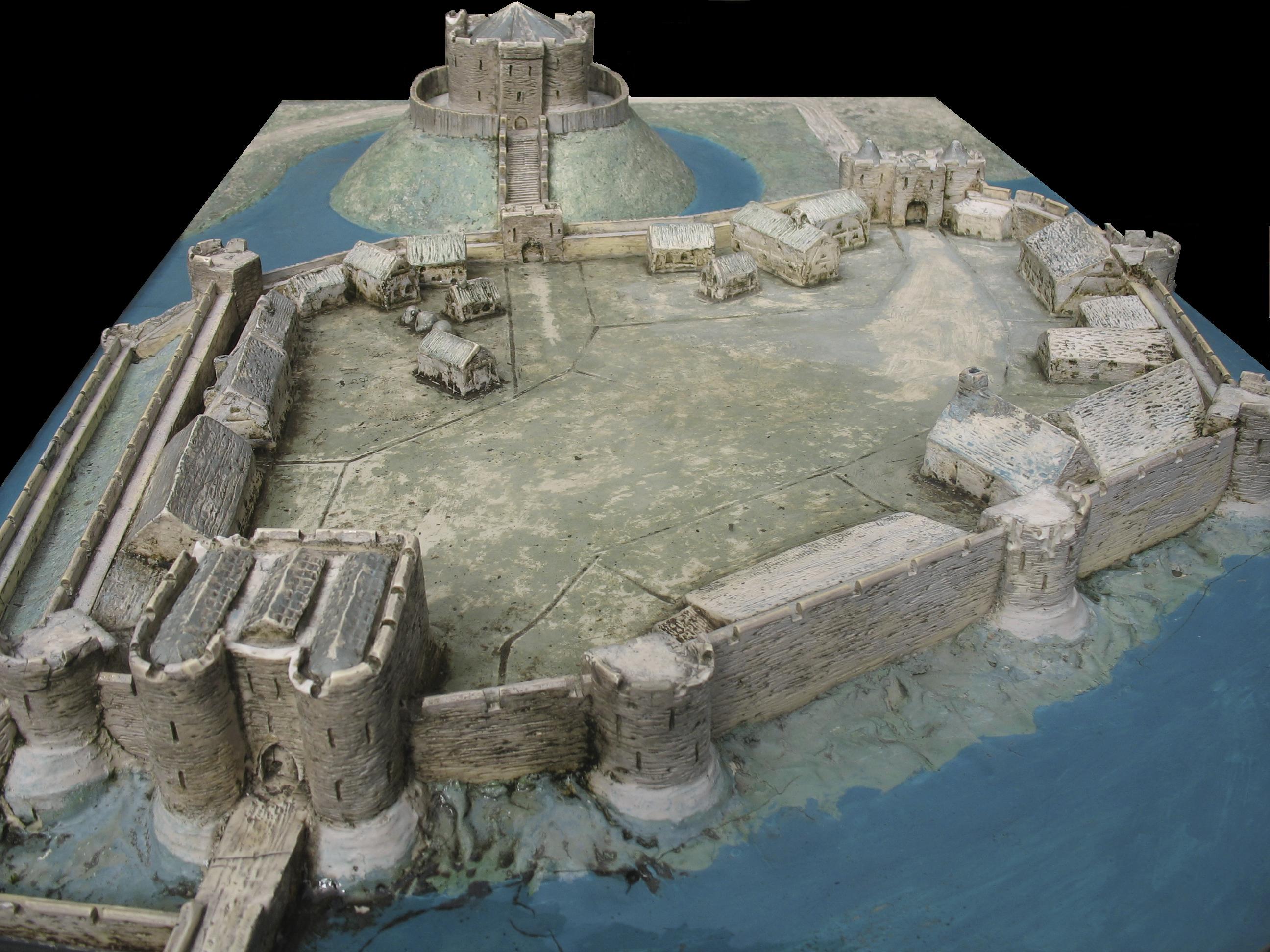
During the wars against the Scots under both Edward and his son, York Castle also formed the centre of royal administration in England for almost half the years between 1298 and 1338. Many Westminster institutions followed the king north to York, basing themselves in the castle compound. The existing castle buildings were insufficient to house all the administrative institutions; a temporary building inside the castle was built for the Court of Common Pleas at the beginning of the period, and rebuilt on a larger scale during 1319–20. The Exchequer took over Clifford's Tower.
Other buildings around the city had to be commandeered to absorb the overflow from the castle itself. European coiners were brought to York to establish the facility.
Henry III extended the castle's role as a jail for holding a wide range of prisoners. The sheriff was responsible for the jail at this time, and his deputy usually took the role of a full-time jailer. Up to three hundred and ten prisoners were held in the castle at any one time. The conditions in which prisoners were held were "appalling", and led to the widespread loss of life amongst detainees. Prison escapes were relatively common, and many of them, such as the break-out by 28 prisoners in 1298, were successful. The castle mills, as former Templar property, returned to royal control at the same time. Edward II also used the castle as a jail in his campaign against his rebellious barons in 1322, and after the Battle of Boroughbridge many of the defeated rebel leaders were executed at York Castle.
By the end of the 14th century, the castle bailey was primarily occupied by the local county administration. It was used extensively as a jail, with prisoners being kept in the various towers around the bailey. Increasingly, royalty preferred to stay at the Franciscan friary, between the castle and King's Staith on the Ouse, while their staff resided at St Mary's Abbey and St Andrew's Priory in the Fishergate area.
15th and 16th centuries

In the 15th century, York Castle, along with Nottingham Castle, was considered a key security asset in the north of England, but investment even in these castles diminished. Repairs to York Castle grew infrequent from 1400 onwards, and it fell into increasing disrepair. Richard III recognised the issue and in 1483 had some of the most decrepit structures removed, but he died at the Battle of Bosworth before replacement work could commence. By the reign of Henry VIII, the antiquary John Leland reported that the castle was in considerable disrepair; nonetheless the water defences remained intact, unlike those of many other castles of the period. As a result of the deterioration, Henry had to be advised that the king's councillors no longer had any official residence in which to stay and work when they were in York. The castle mint was shut down after the death of Edward VI in 1553, and the castle mills were given to a local charitable hospital in 1464. The hospital was then closed during the Reformation, and the mills passed into private ownership once again.
The castle continued to be used as a jail, increasingly for local felons, and a location for political executions. By the 16th century it had become traditional to execute traitors by hanging them from the top of Clifford's Tower, rather than killing them at Micklegate Bar, the usual previous location for capital punishment in York. In 1536, for example, the political leader Robert Aske was executed at York Castle on the orders of Henry VIII, following the failure of Aske's Pilgrimage of Grace protest against the dissolution of the monasteries. At the end of the 16th century, however, the Clifford family (Earls of Cumberland), became the hereditary constables of the castle, and Clifford's Tower took its name from the family at around this time.
The deterioration of the castle continued into the reign of Elizabeth I, who was advised that it no longer had any military utility. Robert Redhead, the tower keeper, became infamous at the time for taking parts of the castle to pieces and selling off the stonework for his own profit. Proposals were made to pull down Clifford's Tower altogether in 1596, but were turned down because of the strength of local feeling.
17th century

Maintaining the castle was becoming increasingly expensive, and in 1614 King James sold the lease on Clifford's Tower and the surrounding land to John Babington and Edmund Duffield, a pair of property speculators. In turn, Babington and Duffield sold Clifford's Tower to a York merchant family. In 1642, however, the English Civil War broke out between the rival factions of the Royalists and Parliament. Forces loyal to Charles I, under the command of Henry Clifford, garrisoned York Castle and the surrounding city in 1643. York effectively became the "northern capital" for the Royalist cause. Clifford repaired the castle and strengthened the walls to permit them to support cannon, placing his arms alongside those of the king above the entrance. Clifford's Tower's gatehouse was substantially remodelled, losing its original medieval appearance. Baile Hill, on the other side of the river, became a gun emplacement. The castle mint was reopened to supply the king's forces with coins.
The war turned against the Royalist factions, and on 23 April 1644 Parliamentary forces commenced the siege of York. A Scottish army under Alexander Leslie came from the south, while a Parliamentary force under Ferdinando Fairfax came from the east. Six weeks later, Edward Montagu brought a third contingent to York, bringing the number of forces besieging the city to over 30,000 men. William Cavendish commanded the city during the siege, while Colonel Sir Francis Cobb was appointed the governor of the castle. Prince Rupert, sent to relieve York, approached with reinforcements, and through clever manoeuvring was able to force the besiegers to withdraw, lifting the siege on 1 July. The next day, Parliamentary forces defeated Rupert at the Battle of Marston Moor, six miles west of York, making the surrender of York and the castle inevitable. On 14 July the city and castle surrendered to the Parliamentary forces, who permitted the Royalists to march out with full honours.
Parliament then appointed Thomas Dickenson, the local mayor, as the governor of Clifford's Tower. Efforts were made to separate the structures of Clifford's Tower, which Parliament used as a garrison, from the buildings of the bailey, which continued to be used as a prison. Oliver Cromwell visited Clifford's Tower in 1650, and received a salute from the guns stationed on top of it. The cost of the garrison was levied on the city of York.

After the Restoration of Charles II, the pre-war owners of the property laid claim to Clifford's Tower, eventually being granted ownership. A garrison continued to be stationed there, however, which prevented the owners from actually occupying or using the property. Repairs were made to the tower, and it became a magazine for storing gunpowder and shot. Some political prisoners continued to be held at the castle during the Restoration period, including George Fox, the founder of the Society of Friends.
The county facilities in the bailey were expanded during these years, with improvements to the Grand Jury House and the Common Hall, but by the 1680s the role of the military garrison at York Castle was being called into question. Sir Christopher Musgrave produced a report for the Crown in 1682; he argued that it would cost at least £30,000 to turn the castle into a modern fortification, producing a proposal for the six bastions that such a star fort would require.
On St George's Day in 1684 at around 10 pm, an explosion in the magazine destroyed the interior of Clifford's Tower entirely. Most historians, however, believe the explosion was not accidental. The heat of the fire turned the limestone of the tower to its current, slightly pink, colour. The now-ruined tower was returned fully to private ownership, eventually forming part of the lands of the neighbouring house and gardens belonging to Samuel Waud.
18th century
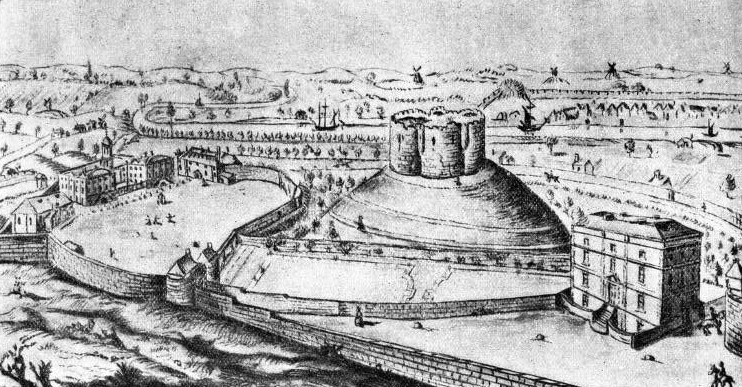
Visits by the prison reformer John Howard as part of the research for his book The State of the Prisons found these prisons flawed, but in relatively good condition compared to others at the time. The Debtors' Prison as a whole was an "honour to the county" of York, with "airy and healthy" rooms, but the felons' wing of the prison attracted some criticism. The felons' wing was "too small" and had "no water" for the inmates; felons were forced to sleep on piles of straw on the floor. Indeed, conditions were so bad in the felons' wing that nine prisoners suffocated in one night during 1739.
Just outside the main walls, the castle mills had become increasingly ineffective from the 16th century onwards because of a reduction in the flow of the rivers driving the water-wheels. As a result, in 1778 they were rebuilt with a new steam engine to drive the machinery; this steam engine caused considerable discomfort to the prisoners affected by the smoke and noise.
19th century

Criticism of the castle prison increased at the end of the 18th century. The facilities were felt to be inadequate and the crowds of spectators who gathered outside the prison to see inmates being taken into York for execution unseemly.
The suitability of the prison was finally brought to a head at the 1821 assizes in York, when an official complaint was made and an investigation begun. Sydney Smith, the famous wit, writer and vicar of Foston-le-Clay, successfully led a campaign to save Clifford's Tower, emphasising the historic importance of the location for the surrounding city. An alternative proposal, put forward by architect Robert Wallace, would have seen the conversion of Clifford's Tower back into a habitable building to form the hub of a radial prison design, but this was turned down.
In 1825, Clifford's Tower and the Waud house were purchased by the county of Yorkshire at the cost of £8,800 () The new prison buildings, designed by architects P. F. Robinson and G. T. Andrews, were constructed in a Tudor Gothic style, including a gatehouse 35 ft high and a radial prison block, protected by a long, high stone wall. The prison, considered to be the strongest such building in England, was built entirely of stone to be both secure and fireproof. Dark grey gritstone was used in the construction to produce a forbidding appearance, although the prison itself was considered healthy and well ventilated. Clifford's Tower played no part in the formal design of the prison, although the talus, or sloping edge of the motte, was cut away and replaced by a retaining wall to allow more space for the new prison building. The backyard of the Female Prison, concealed from public view by the new wall, was used for hangings from 1868 onwards.
The Prison Act, 1877, reformed the English prison system, and York Castle jail was passed into the control of central government the following year. It was used as the county prison until 1900, when the remaining prisoners were transferred to Wakefield Prison, and from then onwards the facility was used as a military prison instead.

By the early 19th century, dredging and other improvements to the river Foss had made it possible to import flour into York by river, reducing the economic significance of the castle mills. In 1856, the castle mills were finally demolished as part of a further sequence of improvements to this part of the river. The King's Pool that formed part of the castle's water defences was drained.
20th century
In 1890 the Prison Commissioners agreed to declare Clifford's Tower a national monument and to conserve it as a historic location.
Today

.jpg)
York Prison finally closed in 1929, and the Tudor Gothic Victorian prison buildings were demolished in 1935. The Assize Courts building now houses the York Crown Court, while the former Debtors' Prison and Female Prison, together with a modern entrance area, are now the Castle Museum. The circular grassed area between these buildings that was once known as the "Eye of the Ridings" is now known as Castle Green, or the "Eye of York". Clifford's Tower is the most prominent surviving part of the original medieval fortification, although the stone steps up the side of the motte are modern. Fragments of the bailey wall, parts of the south gatehouse and one of the corner towers also survive.
The castle is classed as a Grade I listed building and a scheduled monument. The site, managed by English Heritage, is open to the public. Until the 1970s, the pogrom of 1190 was often underplayed by official histories of the castle; early official guides to the castle made no reference to it. In 1978, however, the first memorial tablet to the victims was laid at the base of Clifford's Tower, and in 1990 the 800th anniversary of the killings was commemorated at the tower. Recently, commercial interests have sought to introduce retail development to the area surrounding it. Citizens, visitors, academics, environmentalists, local businesspeople and Jewish groups have opposed the development with some success, winning a lengthy and bitter public inquiry in 2003.
In March 2022 an English Heritage conservation project, including work on the limestone fabric of the tower and care of the chapel roof, was completed. New internal access stairways of gluelam timber leading to a new roof deck allow visitors a close view of some original features of the building and less-crowded viewpoints over the city.
Notes
References
Bibliography
- {{cite journal |last=Clark |first=G. T.
- Hull, Lise E. (2006) Britain's Medieval Castles. Westport: Praeger. .
- McLynn, Frank. (2007) Lionheart and Lackland: King Richard, King John and the Wars of Conquest. London: Vintage. .
- Pounds, Norman John Greville. (1990) The Medieval Castle in England and Wales: a Social and Political History. Cambridge: Cambridge University Press. .
- Sears, Robert. (1847) A New and Popular Pictorial Description of England, Scotland, Ireland, Wales and the British Islands. New York: Robert Sears. .
- Stenton, Doris Mary. (1976) English Society in the Early Middle Ages (1066–1307). Harmondsworth, UK: Penguin. .
- Toy, Sidney. (1985) Castles: Their Construction and History. New York: Dover Publications. .
- Twyford, Anthony William. (2010) Records of York Castle – Fortress, Courthouse and Prison. Alcester, UK: Read Books. .
References
- ''[https://historicengland.org.uk/listing/the-list/list-entry/1259325 Clifford's Tower] {{Webarchive. link. (6 August 2016 '', Historic England. Accessed 22 June 2016.)
- ''[https://historicengland.org.uk/listing/the-list/list-entry/1259360 Debtors Prison] {{Webarchive. link. (6 August 2016 '', Historic England. Accessed 22 June 2016.)
- ''[https://historicengland.org.uk/listing/the-list/list-entry/1259324 Female Prison] {{Webarchive. link. (6 August 2016 '', Historic England. Accessed 22 June 2016.)
- ''[https://historicengland.org.uk/listing/the-list/list-entry/1259328 York Crown Court] {{Webarchive. link. (6 August 2016 '', Historic England. Accessed 22 June 2016.)
- ''[https://historicengland.org.uk/listing/the-list/list-entry/1259329 Curtain Wall, Castle Precinct] {{Webarchive. link. (6 August 2016 '', Historic England. Accessed 22 June 2016.)
- Cooper, p.149.
- "The Massacre of the Jews at Clifford's Tower".
- Butler, p.2.
- Brown, p.32.
- This first castle at York was a basic wooden motte and bailey castle built between the rivers [[River Ouse, Yorkshire. Ouse]] and [[River Foss
- Cooper, p.14.
- Clark, p.239.
- Pounds, p.7; Clark, p.239.
- Brown, p.32; Pounds, p.7.
- Brown, p.41; Butler, p.3.
- Hull, p.98.
- The fire grew out of control and also set fire to [[York Minster]] and, some argue, the castles as well.Hull, p.98
- Clark, p.255
- Pounds, p.7.
- Cooper, p.23.
- Pounds, p.59.
- Pounds, p.193.
- The Normans had introduced [[History of the Jews in England#William I to Henry I: 1066–1135. the first Jewish communities into England]], where some occupied a [[Economy of England in the Middle Ages#Jewish contribution to the English economy. special economic role as moneylenders]], an essential but otherwise banned activity.Hillaby, p.16.
- Hillaby, pp.21–2.
- Stenton, p.197.
- McLynn, pp.120–1.
- Hillaby, p.29.
- Hull, p.99
- Pounds, p.147.
- Brown, p.86
- Cooper, p.32.
- Hull, p.99; Butler, p.4.
- watergate]], a small gateway into the city, a chapel, and a new stone keep.Brown, p.86; Hull, p.99; Toy, p.133
- was first known as the King's Tower, and later Clifford's Tower.Brown, p.86; Hull, p.99; Toy, p.133
- (30 March 1915). "History of Clifford's Tower".
- Clark, p.256.
- pier]] supported the huge weight of stone and the first floor.Toy, pp.134–5.
- Cooper, pp.42–3.
- Clark, p.257.
- Brown, p.86; Butler, p.16.
- Hull, p.99; Toy, p.133.
- Cooper, p.63.
- Cooper, p.50.
- (2023). "Clifford's Tower".
- Musson, p.164.
- As a result of the extended use of the castle for these purposes, the law courts at York Castle began to compete with those in London, a pattern that lasted into the 1360s. The castle eventually acquired its own [[Mint (coin)|mint]] in 1344, when [[Edward III]] decided to create a permanent mint in York Castle to produce gold and silver coins to serve the needs of the north of England.Cooper, p.151.
- Twyford, p.45.
- Cooper, p.98.
- Cooper, p.97.
- When the Military Order of the [[Knights Templar]] was dissolved in England in 1307, York Castle was used to hold many of the arrested knights.Cooper, pp.102–3.
- Cooper, p.126.
- The old castle-guard system for securing the castle had changed into a system whereby the crown used rents from local royal lands to hire local guards for the castle.Cooper, p.115.
- Butler, p.17.
- Pounds, p.258.
- Cooper, p.143.
- Cooper, p.147.
- Timbs, p.170; Clark, p.255.
- Cooper, p.148.
- Cooper, pp.126, 155.
- Twyford, p.46.
- Cooper, p.158.
- For most of the period the sheriffs of Yorkshire remained in control of the castle, although there were some notable exceptions such as the appointment of the royal favourite Sir Robert Ryther by [[Edward IV]] in 1478.Cooper, pp.146–7.
- Butler, p.4.
- Twyford, p.44; Butler, p.20.
- Cooper, p.169.
- Wedgwood, p.77.
- Timbs and Gunn, p.170.
- Wedgwood, p.289.
- Despite bombardment, attempts to undermine the walls and attacks on the gates, the city held out through May and June.Wedgwood, p.311.
- Wedgwood, pp.312–3.
- Wedgwood, p.322.
- Wedgwood, p.322; Twyford, p.41.
- Cooper, p.173.
- Cooper, pp.180–1.
- Clarke, p.261.
- Attempts were made to restore the condition of the moat, which had become badly silted.Twyford, p.42.
- Cooper, p.181.
- Butler, p.20.
- This work was never carried out. Meanwhile, the garrison and the castle had become extremely unpopular with the people of York, who disliked both the cost and the imposition of external authority.Cooper, p.183.
- Cooper, p.177; Butler, p.21.
- Butler, pp.8, 20, 22.
- Butler, p.23.
- Twyford, pp.46–7.
- Howard, quoted Twyford p.47.
- Cooper, p.128.
- Cooper, p.191.
- (22 January 1836). "The Hull Packet".
- Cooper, p.192.
- Cooper, p.239; Twyford, p.45; Butler, p.24.
- Sears, p.180.
- Butler, p.24; Sears, p.180.
- Cooper, p.195.
- Cooper, p.196.
- Butler, p.24.
- Butler, p.8.
- (4 November 1882). "Yorkshire Assizes". York Herald.
- "Administrative Areas Series, 1947". Ordnance Survey.
- (1973). "Census 1971, England and Wales: Volume 59, Parts 1-3". Office of Population Censuses and Surveys.
- "The Massacre of the Jews at Clifford's Tower".
- "York Castle".
- "Castle Area Campaign News 2003".
- "Clifford's Tower Revealed". [[English Heritage]].
This article was imported from Wikipedia and is available under the Creative Commons Attribution-ShareAlike 4.0 License. Content has been adapted to SurfDoc format. Original contributors can be found on the article history page.
Ask Mako anything about York Castle — get instant answers, deeper analysis, and related topics.
Research with MakoFree with your Surf account
Create a free account to save articles, ask Mako questions, and organize your research.
Sign up freeThis content may have been generated or modified by AI. CloudSurf Software LLC is not responsible for the accuracy, completeness, or reliability of AI-generated content. Always verify important information from primary sources.
Report