From Surf Wiki (app.surf) — the open knowledge base
Yokohama
Designated city in Kantō, Japan

Designated city in Kantō, Japan
| Field | Value | |
|---|---|---|
| name | Yokohama | |
| native_name | ||
| official_name | City of Yokohama | |
| settlement_type | Prefecture capital and Designated city | |
| <!-- images, nickname, motto ---> | image_skyline | {{multiple image |
| border | infobox | |
| total_width | 270 | |
| perrow | 1/2/2 | |
| image1 | Minato Mirai In Blue.jpg | |
| alt1 | Minato Mirai 21 | |
| caption1 | Minato Mirai 21 | |
| image2 | Ocean liner marine tower yokohama.jpg | |
| alt2 | Hikawamaru moored at Yamashita Park and Yokohama Marine Tower | |
| caption2 | Hikawa Maru moored at Yamashita Park | |
| image3 | Japon Yokohama1.jpg | |
| alt3 | Nippon Maru Memorial Park | |
| caption3 | Nippon Maru | |
| image4 | Yokohama Baybridge 20250210.jpg | |
| alt4 | Yokohama Bay Bridge | |
| caption4 | Yokohama Bay Bridge | |
| image5 | Yokohama Chinatowns East Gate At Night.jpg | |
| alt5 | Yokohama Chinatown | |
| caption5 | Chinatown | |
| image6 | 58 Honmokusannotani, Naka-ku, Yokohama-shi, Kanagawa-ken 231-0824, Japan - panoramio (1).jpg | |
| alt6 | Sankei-en | |
| caption6 | Sankei-en | |
| image7 | 2024 Yokohama Port Opening Memorial Hall.jpg | |
| alt7 | Yokohama Port Memorial Hall | |
| caption7 | Yokohama Port Memorial Hall | |
| image8 | Interior of Xpark- 06.2024-06-11.jpg | |
| alt8 | Hakkeijima Sea Paradise | |
| caption8 | Hakkeijima Sea Paradise | |
| image9 | Kanagawa prefectural office02s3200.jpg | |
| alt9 | Kannai | |
| caption9 | Kannai | |
| image_flag | Flag of Yokohama, Japan.svg | |
| flag_size | 120px | |
| image_seal | 横浜市き章.svg | |
| seal_type | Emblem | |
| motto | ||
| image_map | ||
| image_map1 | Yokohama in Kanagawa Prefecture Ja.svg | |
| map_caption1 | Map of Kanagawa Prefecture with Yokohama highlighted in purple | |
| pushpin_map | Japan#Asia | |
| pushpin_map_caption | ||
| coordinates | ||
| coor_pinpoint | ||
| coordinates_footnotes | tags -- | |
| <!-- location ------------------> | subdivision_type | Country |
| subdivision_name | Japan | |
| subdivision_type1 | Region | |
| subdivision_name1 | Kantō | |
| subdivision_type2 | Prefecture | |
| subdivision_name2 | Kanagawa | |
| <!-- established ---------------> | established_title | |
| named_for | ||
| seat_type | ||
| seat | ||
| government_footnotes | tags -- | |
| leader_title | Mayor | |
| leader_name | Takeharu Yamanaka | |
| leader_name1 | ||
| <!-- display settings ---------> | total_type | |
| unit_pref | Metric | |
| <!-- area ----------------------> | area_footnotes | tags -- |
| area_total_km2 | 437.38 | |
| area_note | ||
| elevation_footnotes | tags -- | |
| elevation_m | ||
| population_total | 3769595 | |
| population_rank | 2nd in Japan | |
| population_as_of | January 1, 2023 | |
| population_density_km2 | 8606 | |
| population_demonym | ||
| population_note | ||
| timezone1 | Japan Standard Time | |
| utc_offset1 | +9 | |
| postal_code_type | ||
| area_code_type | ||
| area_code | ||
| blank_name_sec1 | City Symbols | |
| blank1_name_sec1 | – Tree | |
| blank1_info_sec1 | Camellia, Chinquapin, Sangoju | |
| Sasanqua, Ginkgo, Zelkova | ||
| blank2_name_sec1 | – Flower | |
| blank2_info_sec1 | Dahlia | |
| Rose | ||
| <!-- blank fields (section 2) --> | blank1_name_sec2 | Address |
| blank1_info_sec2 | 6-50-10 Honchō, Naka-ku, Yokohama-shi, Kanagawa-ken | |
| 231-0005 | ||
| <!-- website, footnotes --------> | website |
the capital city of Kanagawa Prefecture
Sasanqua, Ginkgo, Zelkova Rose 231-0005
Yokohama is the second-largest city in Japan by population as well as by area, and the country's most populous municipality. It is the capital and most populous city in Kanagawa Prefecture, with a population of 3.7 million in 2023. It lies on Tokyo Bay, south of Tokyo, in the Kantō region of the main island of Honshu. Yokohama is also the major economic, cultural, and commercial hub of the Greater Tokyo Area along the Keihin Industrial Zone.
Yokohama was one of the cities to open for trade with the West following the 1859 end of the policy of seclusion and has since been known as a cosmopolitan port city, after Kobe opened in 1853. Yokohama is the home of many of Japan's firsts in the Meiji era, including the first foreign trading port and Chinatown (1859), European-style sport venues (1860s), English-language newspaper (1861), confectionery and beer manufacturing (1865), daily newspaper (1870), gas-powered street lamps (1870s), railway station (1872), and power plant (1882). Yokohama developed rapidly as Japan's prominent port city following the end of Japan's relative isolation in the mid-19th century and is today one of its major ports along with Kobe, Osaka, Nagoya, Fukuoka, Tokyo and Chiba.
Yokohama is the largest port city and high tech industrial hub in the Greater Tokyo Area and the Kantō region. The city proper is headquarters to companies such as Isuzu, Nissan, JVCKenwood, Keikyu, Koei Tecmo, Sotetsu and Bank of Yokohama. Famous landmarks in Yokohama include Minato Mirai 21, Nippon Maru Memorial Park, Yokohama Chinatown, Motomachi Shopping Street, Yokohama Marine Tower, Yamashita Park, and Ōsanbashi Pier.
Etymology
The current area surrounded by Maita Park, the Ōoka River and the Nakamura River have been a gulf divided by a sandbar from the open sea. This sandbar was the original Yokohama fishing village. Since the sandbar protruded perpendicularly from the land, or horizontally when viewed from the sea, it was called "Yokohama".
History
Opening of the Treaty Port (1859–1868)
Before the Europeans arrived, Yokohama was a small fishing village up to the end of the feudal Edo period, when Japan held a policy of national seclusion, having little contact with foreigners. A major turning point in Japanese history happened in 1853–54, when Commodore Matthew Perry arrived just south of Yokohama with a fleet of American warships, demanding that Japan open several ports for commerce, and the Tokugawa shogunate agreed by signing the Treaty of Peace and Amity.
It was initially agreed that one of the ports to be opened to foreign ships would be the town of Kanagawa-juku (in what is now Kanagawa Ward) on the Tōkaidō, a strategic highway that linked Edo to Kyoto and Osaka. However, the Tokugawa shogunate decided that Kanagawa-juku was too close to the Tōkaidō for comfort, and port facilities were instead built across the inlet in the fishing village of Yokohama. The Port of Yokohama was officially opened on June 2, 1859.
Yokohama quickly became the base of foreign trade in Japan. Foreigners initially occupied the low-lying district of the city called Kannai, residential districts later expanding as the settlement grew to incorporate much of the elevated Yamate district overlooking the city, commonly referred to by English-speaking residents as The Bluff. Under pressure from United States and United Kingdom officials, the Tokugawa government built a commercial sex district which opened on November 10, 1859, with 6 brothels and 200 indentured sex workers.**** The area of Yokohama with the highest concentration of brothels was known as Bloodtown.
Kannai, the foreign trade and commercial district (literally, inside the barrier), was surrounded by a moat, foreign residents enjoying extraterritorial status both within and outside the compound. Interactions with the local population, particularly young samurai, outside the settlement inevitably caused problems; the Namamugi Incident, one of the events that preceded the downfall of the shogunate, took place in what is now Tsurumi Ward in 1862, and prompted the Bombardment of Kagoshima in 1863.
To protect British commercial and diplomatic interests in Yokohama a military garrison was established in 1862. With the growth in trade increasing numbers of Chinese also came to settle in the city. Yokohama was the scene of many notable firsts for Japan including the growing acceptance of western fashion, photography by pioneers such as Felice Beato, Japan's first English language newspaper, the Japan Herald published in 1861 and in 1865 the first ice cream confectionery and beer to be produced in Japan. Recreational sports introduced to Japan by foreign residents in Yokohama included European style horse racing in 1862, cricket in 1863 and rugby union in 1866. A great fire destroyed much of the foreign settlement on November 26, 1866, and smallpox was a recurrent public health hazard, but the city continued to grow rapidly – attracting foreigners and Japanese alike.
Meiji and Taisho eras (1868–1923)
After the Meiji Restoration of 1868, the port was developed for trading silk, the main trading partner being Great Britain. Western influence and technological transfer contributed to the establishment of Japan's first daily newspaper (1870), first gas-powered street lamps (1872) and Japan's first railway constructed in the same year to connect Yokohama to Shinagawa and Shinbashi in Tokyo. In 1872 Jules Verne portrayed Yokohama, which he had never visited, in an episode of his widely read novel Around the World in Eighty Days, capturing the atmosphere of the fast-developing, internationally oriented Japanese city.
In 1887, a British merchant, Samuel Cocking, built the city's first power plant. At first for his own use, this coal power plant became the basis for the Yokohama Cooperative Electric Light Company. The city was officially incorporated on April 1, 1889. By the time the extraterritoriality of foreigner areas was abolished in 1899, Yokohama was the most international city in Japan, with foreigner areas stretching from Kannai to the Bluff area and the large Yokohama Chinatown.
The early 20th century was marked by rapid growth of industry. Entrepreneurs built factories along reclaimed land to the north of the city toward Kawasaki, which eventually grew to be the Keihin Industrial Area. The growth of Japanese industry brought affluence, and many wealthy trading families constructed sprawling residences there, while the rapid influx of population from Japan and Korea also led to the formation of Kojiki-Yato, then the largest slum in Japan.
Great Kantō earthquake and World War II (1923–1945)
_(22324277654).jpg)
Much of Yokohama was destroyed on September 1, 1923, by the Great Kantō earthquake. The Yokohama police reported casualties at 30,771 dead and 47,908 injured, out of a pre-earthquake population of 434,170. Fuelled by rumors of rebellion and sabotage, vigilante mobs thereupon murdered many Koreans in the Kojiki-yato slum. Many people believed that Koreans used black magic to cause the earthquake. Martial law was in place until November 19, 1923. Rubble from the quake was used to reclaim land for parks, the most famous being the Yamashita Park on the waterfront which opened in 1930.
Yokohama was rebuilt, only to be destroyed again by U.S. air raids during World War II. The first bombing was in the April 18, 1942 Doolittle Raid. An estimated 7,000–8,000 people were killed in a single morning on May 29, 1945, in what is now known as the Great Yokohama Air Raid, when B-29s firebombed the city and in just one hour and nine minutes, reducing 42% of it to rubble.
Postwar growth and development

During the American occupation, Yokohama was a major transshipment base for American supplies and personnel, especially during the Korean War. After the occupation, most local U.S. naval activity moved from Yokohama to an American base in nearby Yokosuka.
Four years after the Treaty of San Francisco signed, the city was designated by government ordinance on September 1, 1956. The city's tram and trolleybus system was abolished in 1972, the same year as the opening of the first line of Yokohama Municipal Subway. Construction of Minato Mirai 21 ("Port Future 21"), a major urban development project on reclaimed land started in 1983, nicknamed the "Philadelphia and Boston of the Orient" was compared to Center City, Philadelphia and Downtown Boston located in the East Coast of the United States. Minato Mirai 21 hosted the Yokohama Exotic Showcase in 1989, which saw the first public operation of maglev trains in Japan and the opening of Cosmo Clock 21, then the tallest Ferris wheel in the world. The 860 m Yokohama Bay Bridge opened in the same year. In 1993, Minato Mirai 21 saw the opening of the Yokohama Landmark Tower, the second-tallest building in Japan.
The 2002 FIFA World Cup final was held in June at the International Stadium Yokohama. In 2009, the city marked the 150th anniversary of the opening of the port and the 120th anniversary of the commencement of the City Administration. An early part in the commemoration project incorporated the Fourth Tokyo International Conference on African Development (TICAD IV), which was held in Yokohama in May 2008. In November 2010, Yokohama hosted the Asia-Pacific Economic Cooperation (APEC) meeting.
Geography

Topography
Yokohama has a total area of 437.38 km2 at an elevation of 5 m above sea level. It is the capital of Kanagawa Prefecture, bordered to the east by Tokyo Bay and located in the middle of the Kantō plain. The city is surrounded by hills and the characteristic mountain system of the island of Honshū, so its growth has been limited and it has had to gain ground from the sea. This also affects the population density, one of the highest in Japan with 8,500 inhabitants per km2.
The highest points within the urban boundary are Omaruyama (156 m) and Mount Enkaizan (153 m). The main river is the Tsurumi River, which begins in the Tama Hills and empties into the Pacific Ocean.
These municipalities surround Yokohama: Kawasaki, Yokosuka, Zushi, Kamakura, Fujisawa, Yamato, Machida.
Geology
The city is very prone to natural phenomena such as earthquakes and tropical cyclones because the island of Honshū has a high level of seismic activity, being in the middle of the Pacific Ring of Fire.
Most seismic movements are of low intensity and are generally not perceived by people. However, Yokohama has experienced two major tremors that reflect the evolution of Earthquake engineering: the 1923 Great Kantō earthquake devastated the city and caused more than 100,000 fatalities throughout the region, while the 2011 Tōhoku earthquake and tsunami, with its epicenter on the east coast, was felt in the locality but only material damage was lamented because most buildings were already prepared to withstand them.
Climate
Yokohama features a humid subtropical climate (Köppen: Cfa) with hot, humid summers and chilly winters. Weatherwise, Yokohama has a pattern of rain, clouds and sun, although in winter, it is surprisingly sunny due to influence of the Siberian High and being on the relative rain shadow of the Japanese Alps. Frosts at winter are not frequent. Summers can be very oppressive due to heat and humidity combination. The coldest temperature was on 24 January 1927 when -8.2 C was reached, whilst the hottest day was 6 August 2025 at 38.1 C. The highest monthly rainfall was in October 2004 with 761.5 mm, closely followed by July 1941 with 753.4 mm, whilst December and January have recorded no measurable precipitation three times each.
| Jan record high C = 20.8 | Feb record high C = 24.8 | Mar record high C = 24.5 | Apr record high C = 28.7 | May record high C = 31.3 | Jun record high C = 36.1 | Jul record high C = 37.2 | Aug record high C = 38.1 | Sep record high C = 36.2 | Oct record high C = 32.4 | Nov record high C = 26.2 | Dec record high C = 23.7 | Jan record low C = -8.2 | Feb record low C = -6.8 | Mar record low C = -4.6 | Apr record low C = -0.5 | May record low C = 3.6 | Jun record low C = 9.2 | Jul record low C = 13.3 | Aug record low C = 15.5 | Sep record low C = 11.2 | Oct record low C = 2.2 | Nov record low C = -2.4 | Dec record low C = -5.6 | script-title = ja:気象庁 / 平年値(年・月ごとの値) | access-date = May 19, 2021 | archive-date = May 17, 2021 | archive-url = https://web.archive.org/web/20210517161817/http://www.data.jma.go.jp/obd/stats/etrn/index.php?prec_no=46&block_no=47670&year=&month=&day=&view= | url-status = live
Demographics
|1870|64602 | 1880 | 72,630 | 1890 | 132,627 | 1900 | 196,653 | 1910 | 403,303 | 1920 | 422,942
The city's population is 3,772,726 as of 1 June 2024, making it the second-most populated city in the country after Tokyo's 23 special wards. Among Yokohama's 18 wards, the most inhabited was Kohoku with a population of 364,760, followed by Aoba (308,379), Tsurumi (297,230), and Totsuka (282,601). In terms of population density, Nishi and Minami are the most densely populated, with a per square kilometre population exceeding 15,000. Of Yokohama's population, 1,548,077 work outside the city, while 1,226,618 workers commute from outside the city. As these numbers suggest, some of Yokohama's residential areas are commuter suburbs (or "bed towns" as known in Japanese) for those who work in other major cities, primarily Tokyo.
Immigration
As of June 2024, Yokohama's population includes 121,042 foreign nationals, making up 3.2% of the total population, with the number having grown significantly in recent years. While all three countries with the number of nationals living in Yokohama as citizens exceeding 10,000 are all in Asia (China, South Korea, Vietnam), other major countries of origin for Yokohama's non-Japanese residents include Brazil (2,823), the United States (2,793), Peru (1,312), the United Kingdom (840), and Germany (770). There is no official survey of the citizens' countries of birth, hence these numbers do not include naturalized citizens, but they include foreign nationals born outside their country of citizenship.
Administration
Municipal administration
Yokohama is one of the 20 designated cities in the country, which means the city has many powers that usually belong to prefectural governments, while having wards as subdivisions with administrative functions. Yokohama city consists of 18 wards, with its government seat in Naka Ward. The Yokohama City Council consists of 86 members elected from a total of 18 Wards. The LDP has minority control with 36 seats. The incumbent mayor is Takeharu Yamanaka, who defeated his predecessor Fumiko Hayashi in the 2021 Yokohama mayoral election.
Wards
Yokohama has 18 wards (ku):
| Wards of Yokohama | Place Name | Map of Yokohama | Rōmaji | Kanji | Population | Land area in km2 | Pop. density | |||||
|---|---|---|---|---|---|---|---|---|---|---|---|---|
| 1 | Aoba-ku | 青葉区 | 302,643 | 35.14 | 8,610 | [[File:Yokohama Wards.png | alt= | border | center | 510x510px | A map of Yokohama's Wards]] | |
| 2 | Asahi-ku | 249,045 | 32.77 | 7,600 | ||||||||
| 3 | Hodogaya-ku | 保土ヶ谷区 | 205,887 | 21.81 | 9,400 | |||||||
| 4 | Isogo-ku | 163,406 | 19.17 | 8,520 | ||||||||
| 5 | Izumi-ku | 泉区 | 155,674 | 23.51 | 6,620 | |||||||
| 6 | Kanagawa-ku | 神奈川区 | 230,401 | 23.88 | 9,650 | |||||||
| 7 | Kanazawa-ku | 209,565 | 31.01 | 6,760 | ||||||||
| 8 | Kōhoku-ku | 港北区 | 332,488 | 31.40 | 10,588 | |||||||
| 9 | Kōnan-ku | 港南区 | 221,536 | 19.87 | 11,500 | |||||||
| 10 | Midori-ku | 緑区 | 176,038 | 25.42 | 6,900 | |||||||
| 11 | Minami-ku | 197,019 | 12.67 | 15,500 | ||||||||
| 12 | Naka-ku (administrative center) | 中区 | 146,563 | 20.86 | 7,030 | |||||||
| 13 | Nishi-ku | 西区 | 93,210 | 7.04 | 13,210 | |||||||
| 14 | Sakae-ku | 124,845 | 18.55 | 6,750 | ||||||||
| 15 | Seya-ku | 瀬谷区 | 126,839 | 17.11 | 7,390 | |||||||
| 16 | Totsuka-ku | 戸塚区 | 274,783 | 35.70 | 7,697 | |||||||
| 17 | Tsurumi-ku | 鶴見区 | 270,433 | 33.23 | 8,140 | |||||||
| 18 | Tsuzuki-ku | 都筑区 | 211,455 | 27.93 | 7,535 |
Economy
In 2020, Yokohama's total gross regional product was 14.06 trillion yen or US$133 billion, a 1.9 per cent decrease compared to the previous year due to the COVID-19 pandemic. This converts to US$35,107 per citizen, below the national average. A large number of Yokohama's citizens work outside the city (693,064 in 2020), primarily in Tokyo, and the economic value they generate outside the city does not contribute to Yokohama's economic output. The largest contributors to this figure were wholesale and retail (17.8%), healthcare (11.7%), and academic, professional, or technological services (11.0%).
Major companies headquartered
File:Nissan headquarters 2022.jpg|Nissan Global Headquarters in Nishi-ku File:JVCKENWOOD001.jpg|JVCKenwood headquarters in Kanagawa-ku File:Koei Tecmo headquarters -01.jpg|Koei Tecmo headquarters in Kōhoku-ku File:Keikyu Group Headquarters.jpg|Keikyu Group headquarters in Nishi-ku File:Sotetsu HQ Building.jpg|Sotetsu headquarters in Nishi-ku File:Yokohama Gate Tower - 04a.jpg|Isuzu headquarters in Nishi-ku
Culture and sights

Yokohama's cultural and tourist sights include:
- Gumyō-ji, oldest temple in the city
- Harbor View Park
- The Hikawa Maru, historic passenger and cargo ship
- Kanazawa Bunko, preserves the cultural heritage of the Hōjō clan
- Kishine-Park
- Landmark Tower, 296 m high, third tallest skyscraper in Japan
- Minato Mirai 21
- Nippon Maru, museum ship
- Sankei-en Garden
- Yamashita Park (at the harbor)
- Yokohama Chinatown
- Yokohama Foreign Cemetery
- Yokohama Marine Tower
- Yokohama Stadium (the Yokohama DeNA BayStars Pro baseball teams's home field)
- Yokohama Three Towers
- Yokohama Triennale
- Zō-no-Hana Terrace (象の鼻テラス)
- Yokohama City Library
- Kanagawa Prefectural Library
- Kōhoku New Town - one of the largest new towns in Japan and also an attractive shopping area in Yokohama.
Museums

There are 42 museums in the city area, including.
- CupNoodles Museum (Momofuku Andō Instant Ramen Museum): Several-floors of interactive exhibits related to the invention of the Japanese instant noodle soup, including soup kitchens where you can try the culture-specific noodle soups.
- Kanagawa Prefectural Museum of Cultural History: Located in the historic Yokohama Specie Bank building.
- Kanazawa Bunko: Traditional Japanese and Chinese art objects, many dating from the Kamakura period.
- Matsuri Museum: Dedicated to the shrine festivals (Japanese Matsuri) taking place in Yokohama.
- Shin-Yokohama Rāmen Museum: Comprehensive history of ramen and ramen themed food court
- Yokohama Archives of History: Located in the former British Consulate building with exhibits related to port development and the arrival of Matthew Perry.
- Yokohama Museum of Art: Founded in 1989, featuring modern works by well-known international and Japanese artists.
- Yokohama Silk Museum: Exhibits focusing on the production and processing of silk; including many clothes.
Gallery
File:Sangkaien Garden.jpg|Sankei-en Garden File:伊勢佐木町2012年8月24日(金).jpg|Isezakichō File:Saint Patricks Day in Motomachi Yokohama.jpg|Motomachi File:Chinatown in Yokohama 10.jpg|Yokohama Chinatown File:Yokohama3Towers From Akarenga.JPG|Yokohama Three Towers File:Harbour View Park, Yamate, Yokohama.jpg|Harbor View Park towards the Yokohama Bay Bridge File:Kanagawa Prefectural Museum of Cultural History 2009.jpg|Kanagawa Prefectural Museum of Cultural History File:Cupnoodles Museum Yokohama 2017.jpg|CupNoodles Museum File:Left-side view of Hikawa-maru.jpg|Hikawa Maru File:横浜マリンタワー2.jpg|Yokohama Marine Tower File:Nippon maru.JPG|Nippon Maru Memorial Park File:Yokohama_Red_Brick_Warehouse_2012.JPG|Yokohama Red Brick Warehouse File:Yokohama World Porters.JPG|Yokohama World Porters File:YokohamaBaysideMarina01.jpg|Mitsui Outlet Park Yokohama Bayside File:横浜市立金沢動物園.jpg|Yokohama Municipal Kanazawa Zoo File:Yokohama Hakkeijima Sea Paradise.jpg|Yokohama Hakkeijima Sea Paradise File:Cosmo Clock 21 at night.jpg|Yokohama Cosmo World File:Yokohama-west-station-building-202009.jpg|Yokohama Station File:Gaijin bochi.JPG|Yokohama Foreign General Cemetery File:Yokohama Museum of Art 2009.jpg|Yokohama Museum of Art File:Yokohama Archives of History02.jpg|Yokohama Archives of History File:Negishi Horse Racing Track.jpg|Negishi Park File:Iseyama koutai-jingu Torii.jpg|Iseyama Kotai Shrine File:Sōjiji Daisodo 2009.jpg|Sōji-ji File:Mosaic Mall Kohoku.jpg|MOSAIC MALL Kōhoku
In 2016, 46,017,157 tourists visited the city, 13.1% of whom were overnight guests.
Sports
File:Yokohama stadium 2020 wing.jpg|Yokohama Stadium exterior File:Yokohama Stadium, Baseball Stadium.jpg|Yokohama Stadium crowd File:Yokohama Arena 2013.jpg|Yokohama Arena exterior File:Nissan International Stadium Yokohama.jpg|Nissan Stadium exterior File:International Stadium Yokohama-1.jpg|Nissan Stadium crowd
- Baseball: Yokohama DeNA BayStars
- Association football: Yokohama FC (J1 League), Yokohama F. Marinos (J1 League), YSCC Yokohama (Japan Football League), NHK Yokohama FC Seagulls (Nadeshiko League Div. 2)
- Velodrome: Kagetsu-en Velodrome
- Basketball: Yokohama B-Corsairs
- Ice Hockey: Yokohama Grits
- Rugby Union: Yokohama Eagles
- Tennis: Ai Sugiyama
- American football: Yokohama Harbors
Transport
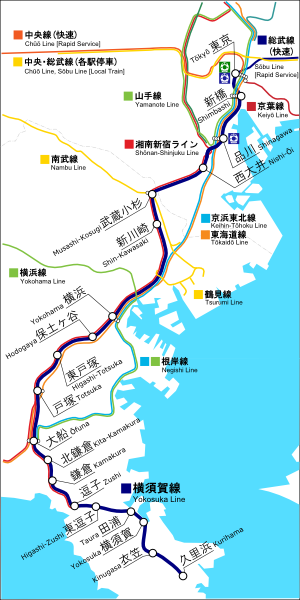
Yokohama is serviced by the Tōkaidō Shinkansen, a high-speed rail line with a stop at Shin-Yokohama Station. Yokohama Station is also a major station, with two million passengers daily. The Yokohama Municipal Subway, Minatomirai Line and Kanazawa Seaside Line provide metro services.
Air transport
Yokohama does not have an airport, but is served by Tokyo's two main airports Haneda Airport which is 17.4 km away and Narita International Airport which is 77 km away.
Maritime transport
Yokohama is the world's 31st largest seaport in terms of total cargo volume, at 121,326 freight tons , and is ranked 37th in terms of TEUs (Twenty-foot equivalent units).
In 2013, APM Terminals Yokohama facility was recognized as the most productive container terminal in the world averaging 163 crane moves per hour, per ship between the vessel's arrival and departure at the berth.
Rail transport
Railway stations
; East Japan Railway Company (JR East) : Tōkaidō Main Line :* – – – : Yokosuka Line :* – Yokohama – – – Totsuka – : Keihin-Tōhoku Line :* – – – – Yokohama : Negishi Line :* Yokohama – – – – – – – – – – – : Yokohama Line :* Higashi-Kanagawa – – – – – – – – – : Nambu Line :* – – : Tsurumi Line :* Main Line : Tsurumi – – – – – – :* Umi-Shibaura Branch : Asano – – ; Central Japan Railway Company (JR Central) : Tōkaidō Shinkansen :* – Shin-Yokohama – ; Keikyu : Keikyu Main Line :* – – – – – – – – – – Yokohama – – – – – – – – – – – – – – : Keikyu Zushi Line :* Kanazawa-Hakkei – – ; Tokyu Railways : Tōyoko Line :* – – – – Kikuna – – – – – Yokohama : Meguro Line :* – Hiyoshi : Den-en-toshi Line :* – – – – – – – – Nagatsuta – : Kodomonokuni Line :* Nagatsuta – – ; Sagami Railway : Sagami Railway Main Line :* Yokohama – – – – – – – – – – – – – : Izumino Line :* Futamata-gawa – – – – – – ; Yokohama Minatomirai Railway : Minatomirai Line :* Yokohama – – – – – ; Yokohama City Transportation Bureau (Yokohama Municipal Subway) : Blue Line :* – – – – – Totsuka – – – – – Kami-Ōoka – – – – – – Kannai – Sakuragichō – – Yokohama – – – – – Shin-Yokohama – – – – – – – : Green Line :* Nakayama – – – Center Minami – Center Kita – – – – – Hiyoshi ; Yokohama New Transit : Kanazawa Seaside Line :* Shin-Sugita – – – – – – – – – – – – – Kanazawa-Hakkei
Education
Public elementary and middle schools are operated by the city of Yokohama. There are nine public high schools which are operated by the Yokohama City Board of Education, and a number of public high schools which are operated by the Kanagawa Prefectural Board of Education. Yokohama National University is a leading university.
- 46,388 children attend the 260 kindergartens.
- Almost 386,000 students are taught in 351 primary schools.
- There are 16 universities including Yokohama National University. The number of students is around 83,000.
- 19 public libraries had 9.5 million loans in 2016.
In popular culture
- Phileas Fogg makes a stop in Yokohama before moving on to San Francisco in Jules Verne's book, Around the World in Eighty Days.
- Yukio Mishima's novel The Sailor Who Fell from Grace with the Sea is set mainly in Yokohama. Mishima describes the city's port and its houses, and the Western influences that shaped them.
- From Up on Poppy Hill is a 2011 Studio Ghibli animated drama film directed by Gorō Miyazaki set in the Yamate district of Yokohama. The film is based on the serialized Japanese comic book of the same name.
- The main setting of James Clavell's book Gai-Jin is in historical Yokohama.
- Vermilion City in the Kanto region from the Pokémon franchise is based on Yokohama. During the closing ceremony of the 2022 Pokémon World Championships in London, Yokohama was announced as the 2023 host city by using footage of Vermilion City from Pokémon Red, Blue, and Yellow. The 2023 World Championships were held at the Pacifico Yokohama between August 11–13, 2023. In the video game division, the host country won the finals of all three age divisions.
- One of the Pretty Cure crossover movies takes place in Yokohama. In the fourth movie of the series, Pretty Cure All Stars New Stage: Friends of the Future, the Pretty Cure appear standing on top of the Cosmo Clock 21 in Minato Mirai.
- The main setting of the Japanese visual novel series Muv-Luv, first a school and then, in an alternate history, a military base is built in Yokohama with the objective of carrying out the Alternative IV Plan meant to save humanity.
- In Command & Conquer: Red Alert 3, Yokohama is under siege by the Soviet Union and Allied Nations to stop the Empire of The Rising Sun. The player must defend Yokohama and then lead a counterattack as the Empire.
- The manga Bungo Stray Dogs is set in Yokohama.
- The Japanese mixed-media project, Hamatora takes place in Yokohama.
- The final battles in Godzilla vs. Mothra (1992) and Godzilla, Mothra and King Ghidorah: Giant Monsters All-Out Attack (2001) take place in Yokohama.
- In My Hero Academia, it is the location of the Nomu Warehouse where they created artificial Humans (a.k.a. Nomus).
- Sumaru City in the Persona 2 duology is based on Yokohama.
- Miyabi City in The Caligula Effect is based on Yokohama, including depictions of landmarks such as an unfinished Landmark Tower and Yokohama Hakkeijima Sea Paradise (referred to in game as Sea Paraiso).
- The video game Yakuza: Like a Dragon is set in Isezaki Ijincho, a fictional district in Yokohama based on Isezakichō.
- Yokohama is also represented in the multimedia project by King Records, Hypnosis Mic: Division Rap Battle
- Yokohama is the main setting of Japanese manga and anime series Komi Can't Communicate. Multiple of the cities' landmarks are featured on the manga, most notably in the more recently released chapters.
- Yokohama is the setting of the anime After the Rain as well as manga series with the same title by Jun Mayuzuki.
- Akira Kurosawa's 1963 film High and Low was filmed and set in Yokohama.
- The later light novels and equivalent second season of the Rascal Does Not Dream anime takes place at the Kanazawa-Hakkei campus of Yokohama City University as well as the Minatomirai waterfront.
- In Bocchi the Rock!, the main character lives near Kanazawa-hakkei Station.
- In April 2022, The Yokohama Convention & Visitors Bureau announced the launch of a new interactive website to aid in the tourism and MICE elements of the city.
International relations

Twin towns – sister cities
Yokohama is twinned with:
- ESP Barcelona, Spain, since June 1968
- USA Boston, United States, since May 1984
- MYS George Town, Malaysia, since January 1992
- DEU Hamburg, Germany, since June 1994
- USA San Francisco, CA, United States, since October 2021, accepted March 2022 Please don't add any of them to this list. --
- ROM Constanța, Constanța County, Romania, since October 1977
- FRA Lyon, Auvergne-Rhône-Alpes, France, since April 1959
- PHL Manila, Philippines, since July 1965
- IND Mumbai, Maharashtra, India, since June 1965
- UKR Odesa, Odesa Oblast, Ukraine, since July 1965
- USA San Diego, CA, United States, since October 1957
- CHN Shanghai, China, since November 1973
- CAN Vancouver, BC, Canada, since July 1965
Partner cities
- CIV Abidjan, Ivory Coast
- CHN Beijing, China, since May 2006
- AUS Brisbane, Queensland, Australia, since June 2008
- KOR Busan, South Korea, since June 2006
- DEU Frankfurt, Hesse, Germany, since September 2011
- VIE Hanoi, Vietnam, since November 2007
- VIE Ho Chi Minh City, Vietnam, since October 2007
- KOR Incheon, South Korea, since December 2009
- AUS Melbourne, Victoria, Australia
- MYS Seberang Perai, Penang, Malaysia, since August 2016
- TWN Taipei, Taiwan, since May 2006
- ISR Tel Aviv, Israel, since July 2012
- CHN Tianjin, China, since May 2008
Sister ports
- ESP Port of Barcelona, Spain, since November 1989
- CHN Port of Dalian, friendship port treaty, since September 1990
- DEU Port of Hamburg, Germany, since October 1992
- AUS Port of Melbourne, Australia, since May 1986
- USA Port of Oakland, United States, since May 1980
- CAN Port of Vancouver, Canada, since May 1981
- CHN Port of Shanghai, friendship port treaty, since October 1983
Notable people
- Lily Abegg, journalist
- Jo Asakura, member of Japanese boy group &Team
- The Brahman Brothers, professional wrestlers
- Annie Florence Brown, community leader
- May J., tv host
- Toru Furuya, singer and voice actor
- Shigetoshi Hasebe, football manager and former player
- Tamon Honda, professional wrestler
- Joe Higuchi, professional wrestler
- Antonio Inoki, professional wrestler and politician
- Naoya Inoue, boxer
- Yuma Kagiyama, figure skater
- Shinobu Kandori, politician and professional wrestler
- Crystal Kay, singer
- Hana Kimura, professional wrestler
- Kyoko Kimura, professional wrestler
- Masahiko Kondō, singer and racing driver
- Miki Koyama, racing driver
- Takehito Koyasu, singer and voice actor
- Ryuji Kumita, racing driver and CEO of B-Max Racing
- Keisuke Kunimoto, racing driver
- Yuji Kunimoto, racing driver
- Natsumi Maki, known by ring name Natsupoi, professional wrestler
- Hiro Matsuda, professional wrestler
- Yūta Mochizuki, actor
- Soichi Noguchi, astronaut
- Akinori Ogata, racing driver
- Radwimps, alternative rock band
- Takuro Shinohara, racing driver
- Minoru Suzuki, professional wrestler
- Kuniaki Takahashi, drifting driver
- Yasuto Wakizaka, footballer
- Yuta Watanabe, NBA player for the Toronto Raptors
- Miki Yamane, footballer
- Yusuke Tomibayashi, racing driver
Notes
References
Citations
Sources
- Hammer, Joshua (2006). Yokohama Burning: The Deadly 1923 Earthquake and Fire that Helped Forge the Path to World War II . New York: Simon & Schuster. (cloth).
- Heilbrun, Jacob. "Aftershocks" . The New York Times, September 17, 2006.
References
- "YOKOHAMA | Meaning & Definition for UK English | Lexico.com". En.oxforddictionaries.com.
- "Yokohama City History, pg. 3".
- ''Der Große Brockhaus.'' 16. edition. Vol. 6. F. A. Brockhaus, Wiesbaden 1955, p. 82
- "Official Yokohama city website it is fresh". City.yokohama.jp.
- Arita, Erika, "[http://search.japantimes.co.jp/cgi-bin/fl20090524x1.html Happy Birthday Yokohama!] {{Webarchive. link. (August 31, 2010 ", ''[[The Japan Times]]'', May 24, 2009, p. 7.)
- Driscoll, Mark W.. (2020). "The Whites are Enemies of Heaven: Climate Caucasianism and Asian Ecological Protection". [[Duke University Press]].
- Fukue, Natsuko, "[http://search.japantimes.co.jp/cgi-bin/nn20090528f1.html Chinese immigrants played vital role] {{Webarchive. link. (August 24, 2010 ", ''[[Japan Times]]'', May 28, 2009, p. 3.)
- Matsutani, Minoru, "[http://search.japantimes.co.jp/cgi-bin/nn20090529f2.html Yokohama – city on the cutting edge] {{Webarchive. link. (August 26, 2010 ", ''[[Japan Times]]'', May 29, 2009, p. 3.)
- (16 June 2013). "Death threats sparked Japan's first cricket game". Japan Times.
- "Interesting Tidbits of Yokohama".
- link. (February 5, 2017)
- link. (February 5, 2017 -170.)
- "Tsurumi River Multipurpose Retarding Basin".
- (September 3, 2013). "Collection of 1923 Japan earthquake massacre testimonies released".
- "FNN Remembering 3/11: Yokohama station and surrounding areas at time of earthquake occurrence.".
- "Yokohama, Japan Köppen Climate Classification (Weatherbase)".
- "Yokohama Weather, When to Go and Yokohama Climate Information". world-guides.com.
- "Extreme Temperatures Around the World".
- Japanese Imperial Commission. (1878). "Le Japon à l'exposition universelle de 1878. Géographie et histoire du Japon".
- "令和6(2024)年 人口・世帯数".
- "令和6(2024)年 外国人の人口".
- "[https://www.city.yokohama.lg.jp/business/kigyoshien/tokei-chosa/date_yokohamakeizai.files/0004_20240322.pdf Yokohama's Economy in Data]" (PDF). ''www.city.yokohama.lg.jp''. Retrieved July 27, 2024.
- "Webseite des Kulturzentrums".
- "Statistical Booklet Book of Yokohama 2018".
- "Ports & World Trade".
- (24 June 2014). "Chinese Ports Lead the World in Berth Productivity, JOC Group Inc. Data Shows". AXIO Data Group.
- "Official Yokohama city website". City.yokohama.jp.
- (28 April 2022). "Virtual Yokohama: Interactive Website Launched". Business Wire.
- "Yokohama's Sister/Friendship Cities". Yokohama.
- (1 August 2016). "MPSP sets sights on city status". [[The Star (Malaysia).
This article was imported from Wikipedia and is available under the Creative Commons Attribution-ShareAlike 4.0 License. Content has been adapted to SurfDoc format. Original contributors can be found on the article history page.
Ask Mako anything about Yokohama — get instant answers, deeper analysis, and related topics.
Research with MakoFree with your Surf account
Create a free account to save articles, ask Mako questions, and organize your research.
Sign up freeThis content may have been generated or modified by AI. CloudSurf Software LLC is not responsible for the accuracy, completeness, or reliability of AI-generated content. Always verify important information from primary sources.
Report