From Surf Wiki (app.surf) — the open knowledge base
Yoho National Park
National park in British Columbia, Canada
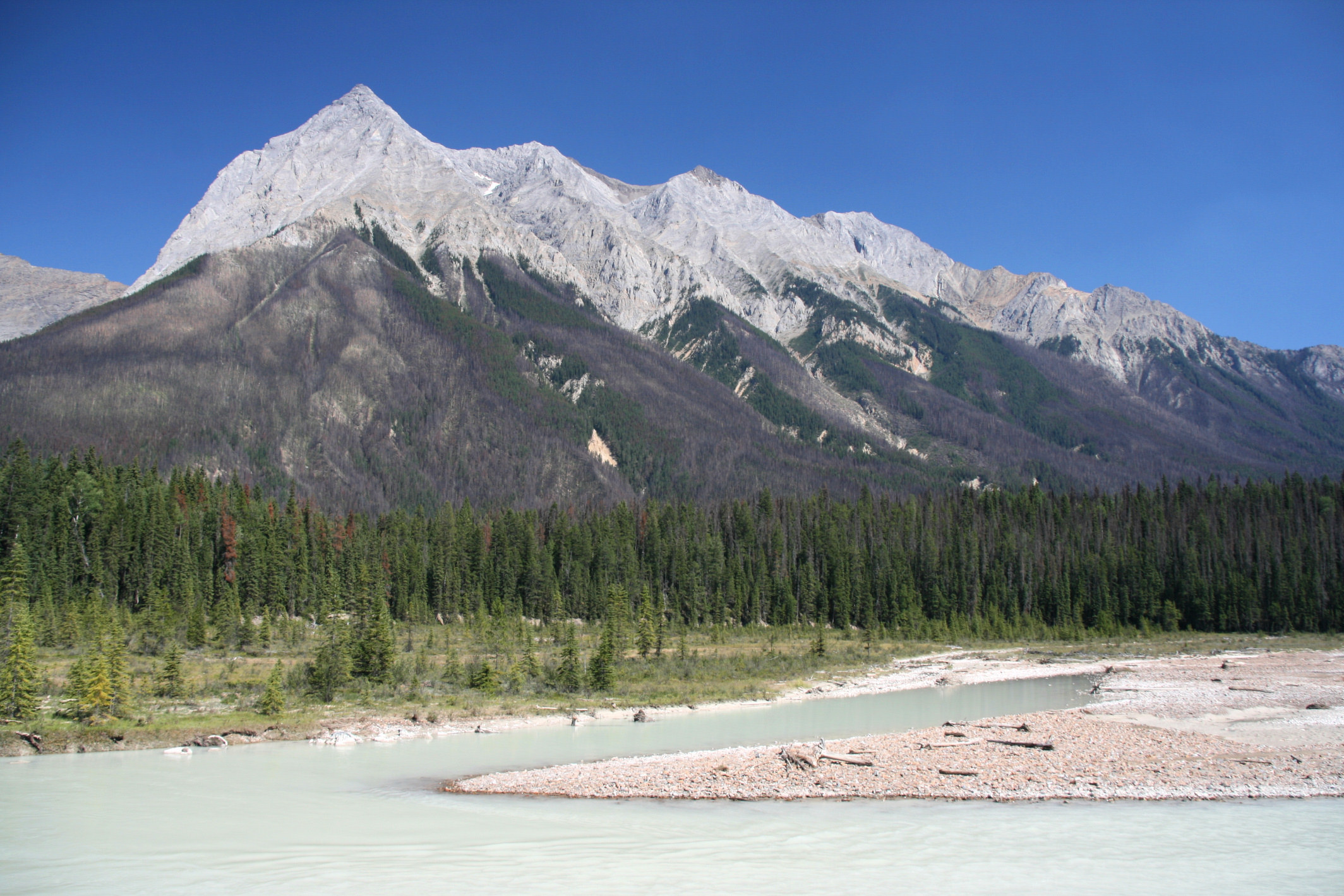
National park in British Columbia, Canada
| Field | Value |
|---|---|
| name | Yoho National Park |
| alt_name | Parc national Yoho |
| iucn_category | II |
| iucn_ref | |
| photo | Takakkaw Falls - panoramio (1).jpg |
| photo_caption | Takakkaw Falls |
| photo_width | 250 |
| map | Canada##British Columbia |
| map_caption | Location in Canada##Location in British Columbia |
| map_width | 250 |
| relief | yes |
| location | British Columbia, Canada |
| nearest_city | Field |
| coordinates | |
| area_km2 | 1313 |
| established | October 10, 1886 |
| visitation_num | 663,878 |
| visitation_year | 2022–23 |
| governing_body | Parks Canada |
| website | |
| mapframe | yes |
| mapframe-zoom | 7 |
| mapframe-wikidata | yes |
| embedded | {{Infobox UNESCO World Heritage Site |
| child | yes |
| part_of | Canadian Rocky Mountain Parks |
| criteria | (vii), (viii) |
| ID | 304 |
| year | 1984 |
| mapframe-zoom = 7 | mapframe-wikidata = yes
Yoho National Park ( ) is a national park of Canada. It is located within the Rocky Mountains along the western slope of the Continental Divide of the Americas in southeastern British Columbia, bordered by Kootenay National Park to the south and Banff National Park to the east in Alberta. The park features a spectacular landscape of massive ice fields and mountain peaks, which rank among the highest in the Canadian Rockies.
Yoho covers an area of 1,313 km2, the smallest of the region's four contiguous national parks, which also include Jasper, Kootenay, and Banff National Parks, as well as three British Columbia provincial parks—Hamber Provincial Park, Mount Assiniboine Provincial Park, and Mount Robson Provincial Park. Together, these parks form the Canadian Rocky Mountain Parks World Heritage Site. Yoho's administrative and visitor centre is in Field, British Columbia, beside the Trans-Canada Highway.
Etymology
The name "Yoho" comes from yo-ho! (also rendered yôhô!), an expression of surprise in the Cree language. In spite of the name's Cree origin, the Cree did not historically inhabit this region and it is not actually an indigenous name, but was chosen in 1901 by Édouard-Gaston Deville, the then Surveyor General of Canada.
History
Yoho National Park is in the traditional territories of the Secwepemc and Ktunaxa First Nations. Before the establishment of the park, the Ktunaxa primarily used the area—specifically, Kicking Horse Pass—to cross the Rockies in order to access bison hunting grounds on the eastern side of the mountains.
The park was created following a trip by Prime Minister John A. Macdonald and his wife Agnes through the Rockies on the newly completed Canadian Pacific Railway, Canada's first transcontinental. On October 10, 1886, two new national parks (then simply referred to as "reserves") were created, the second and third in Canada (Banff Reserve being the first). The new parks were Glacier Reserve, the predecessor to Glacier National Park of Canada, and Mount Stephen Reserve, the predecessor of Yoho National Park.
The area of the new reserve was 256 sqmi in the area around Mount Stephen, and was considerably smaller than the later park. The centerpiece of the park was the Mount Stephen House in Field, British Columbia, a popular stopover on the newly constructed Canadian Pacific Railway.
At this time, many of the mountain areas beyond the Canadian Pacific corridor were completely unexplored by non-native peoples, Emerald Lake having only been discovered by non-natives in 1882. In 1896, German explorer and mountaineer Jean Habel would lead an expedition up the valley of the North Fork of the Wapta River (later renamed the Yoho River) and was awestruck by the sight of Takakkaw Falls and other natural wonders of the valley. Habel presented his findings to the Appalachian Mountain Club in 1898 and news about the beauty of the area spread rapidly. By 1901, the Canadian Pacific Railway was running magazine advertisements for the recently rechristened Yoho Valley, billing the area as "greater than Yosemite" and offering visitors day trips from Mount Stephen House into the valley, led by experienced Swiss mountain guides.
In 1902, the Canadian government decided to expand the area of the reserve to include the Yoho Valley, as well as rename the park for this feature, changing its name to Yoho Park. The expansion also included areas beyond Mount Stephen and the Yoho Valley, and grew the area of the park considerably, to 828.5 sqmi, however, this area was reduced to 560 sqmi in 1911 and further reduced to 476 sqmi in 1922. With the passage of the National Park Act of 1930 that the park would get its current name, Yoho National Park, and also a boundary adjustment that adjusted the area of the park to its current size of 507 sqmi.
In 1909, while fossil hunting in the park, Charles Doolittle Walcott discovered the Burgess Shale deposit, a deposit of geologically very old rocks that were rich in fossils. Paleontologists would find a fossil record in the Burgess Shale that would revolutionize the understanding of the evolution of complex multicellular organisms, particularly the early animal kingdom. This discovery would further raise the profile of the park and underscore its scientific value alongside its natural beauty.
The contiguous national parks of Banff, Jasper, Kootenay, and Yoho, as well as the Mount Robson, Mount Assiniboine, and Hamber provincial parks, were declared a UNESCO World Heritage Site in 1984.
Fauna
Common species of animals that roam in this park are the timber wolf, coyote, badger, moose, elk, mule deer, mountain goat, golden-mantled ground squirrel, rufous hummingbird, hoary marmot, wolverine, cougar, pika, lynx, grizzly bear, and black bear.
Climate
The weather in the park is localized and changeable. Located on the western side of the continental divide, it receives more precipitation than areas east of the divide. Precipitation in the park increases with elevation. In winter, average temperatures are between 5 and from the months November to April although temperatures can range between 10 and. The coldest weather usually occurs in the months December to February. In summer, mean temperatures average 12.5 C with an average high of 20 C and an average low of 5 C. Snowfall and freezing temperatures can occur during the summertime at altitudes above 1500 m.
Geology


The Canadian Rockies consist of sedimentary rock, with numerous fossil deposits. In particular, the Burgess Shale, in Yoho National Park, has among the world's richest deposits of rare fossils. The Burgess Shale was discovered in 1909 by Charles Doolittle Walcott. Mount Stephen has long been well known for its trilobite deposits, the discovery of which predates the Burgess Shale.
In the southeastern corner of the park is an igneous intrusion known as the Ice River Complex containing deposits of sodalite, an ornamental stone.
The Kicking Horse River, a Canadian Heritage River, originates in the Wapta and Waputik icefields in the park. This river has created a natural bridge through solid rock. This formation is located 3 km west of Field, accessible from the road to Emerald Lake.
Mountains
- Mount Goodsir 3,567 m
- Mount Vaux 3,310 m
- Mount Balfour 3,272 m
- Chancellor Peak 3,266 m
- Mount Stephen 3,199 m is the tallest of the four mountains that surround the town of Field, British Columbia. A portion of the Burgess Shale fossils were discovered on Mount Stephen.
- Cathedral Mountain 3,189 m
- The President 3,138 m
- Odaray Mountain 3,137 m
- The Vice President 3,077 m
- Wapta Mountain 2,778 m
- Mount Field 2,643 m
- Mount Burgess 2,599 m is a frequently climbed mountain. For 17 years, it was featured on the Canadian ten-dollar bill.
- Paget Peak 2,560. m
Waterfalls
- Takakkaw Falls have a total height of 373 m, making it the 2nd tallest waterfall in Canada. The main drop of the waterfall has a height of 254 m.
- Wapta Falls is the largest waterfall of the Kicking Horse River, at about 30 m high and 150 m wide. Its average flow can reach 254 m3/s.
References
References
- "Protected Planet {{!}} Yoho National Park Of Canada".
- Canada, Parks. "Parks Canada attendance 2022_23 - Parks Canada attendance 2022_23 - Open Government Portal".
- Parks Canada. (2017-07-26). "Parks Can Can Canada 2017".
- (2017). "Kicking Horse River".
- Lacombe, Albert. (1874). "Dictionnaire de la langue des Cris". CO Beauchemin & Valois.
- (2019). "yôhô". Alberta Language Technology Laboratory, University of Alberta.
- Parks Canada Agency, Government of Canada. (2020-02-13). "What we heard - Yoho National Park".
- "Yoho National Park {{!}} The Canadian Encyclopedia".
- Loy, Thomas H.. (1972). "Archaeological survey of Yoho National Park, 1971". National Historic Parks and Sites Service, Dept. of Indian Affairs and Northern Development.
- Lothian, William F. (1987). "A Brief History of Canada's National Parks". Environment Canada, Parks [Publication no. R62-237/1987E].
- Sandford, Robert W.. (2014). "Ecology & Wonder in the Canadian Rocky Mountain Parks World Heritage Site". Athabasca University Press.
- Habel, Jean. (1898). "The North Fork of the Wapta". Appalachia.
- Canadian Pacific Railway. (1901-05-30). "Greater than Yosemite".
- Lothian, William F. (1987). "A Brief History of Canada's National Parks". Environment Canada, Parks [Publication no. R62-237/1987E].
- Lothian, William F. (1976). "A History of Canada's National Parks". Parks Canada.
- (nd). "Discoveries". Royal Ontario Museum.
- (nd). "Timeline: The Burgess Shale protected by Parks Canada". Royal Ontario Museum.
- "Canadian Rocky Mountain Parks". [[UNESCO]].
- "Yoho National Park Weather". Parks Canada.
- "Mount Balfour".
- Evans, David. "Takakkaw Falls".
- "Waterfalls in the Canadian Rockies: Field, British Columbia".
- "Takakkaw Falls".
- "Northwest Waterfall Survey".
- [http://geoimages.berkeley.edu/Waterfalls/BC/Wapta.html Wapta Falls at Berkeley]
- "Waterfalls of British Columbia - Wapta Falls; Yoho Natl. Park".
- "Wapta Falls - Waterfalls of the Northeastern United States".
This article was imported from Wikipedia and is available under the Creative Commons Attribution-ShareAlike 4.0 License. Content has been adapted to SurfDoc format. Original contributors can be found on the article history page.
Ask Mako anything about Yoho National Park — get instant answers, deeper analysis, and related topics.
Research with MakoFree with your Surf account
Create a free account to save articles, ask Mako questions, and organize your research.
Sign up freeThis content may have been generated or modified by AI. CloudSurf Software LLC is not responsible for the accuracy, completeness, or reliability of AI-generated content. Always verify important information from primary sources.
Report