From Surf Wiki (app.surf) — the open knowledge base
Yaw string
Device for indicating a slip or skid in an aircraft in flight
Device for indicating a slip or skid in an aircraft in flight
The yaw string, also known as a slip string, is a simple device for indicating a slip or skid in an aircraft in flight. It performs the same function as the slip-skid indicator ball, but is more sensitive, and does not require the pilot to look down at the instrument panel.{{cite book | orig-year = 1975 | access-date = 2007-01-21
It is typically constructed from a short piece or tuft of yarn placed in the free air stream where it is visible to the pilot.{{cite book | orig-year = 1963 | access-date = 2007-01-21
The yaw string is considered a primary flight reference instrument on gliders, which must be flown with near zero sideslip angle to reduce drag as much as possible. It is valued for its high sensitivity, and the fact that it is presented in a head-up display. Even the most sophisticated modern racing sailplanes are fitted with yaw strings by their pilots, who reference them constantly throughout the flight.
History
The yaw string dates from the earliest days of aviation, and actually was the first flight instrument. The Wright Brothers used a yaw string on their 1902 glider tied on their front mounted elevator.{{cite web | access-date = 2007-01-21 |access-date = 2006-01-21 |url-status = dead |archive-url = https://web.archive.org/web/20051031193648/http://www.wgc.mb.ca/sac/freeflight/95_01.pdf |archive-date = 2005-10-31
Operation
_as_he_checks_the_systems_of_his_F-14D_Tomcat.jpg)
In flight, pilots are instructed to step on the head of the yaw string; the head is the front of the string, where the string is attached to the aircraft. If the head of the yaw string is to the right of the yaw string tail, then the pilot should apply right rudder pressure. If the head of the yaw string is to the left of the yaw string tail, then the pilot should apply left rudder pressure. Or pilots may be instructed to view the attached point of the yaw string as an arrowhead pointing to the rudder pedal needing application of pressure. According to Helmut Reichmann, "...rudder against the string and/or aileron toward the string."
In a spin the yaw string always points in the direction of spin. Inclinometers do not work in spins because they follow the local centrifugal direction. In a spin, only turn needles and yaw strings are reliable. Turn coordinators work if erect but not when inverted.
Use on powered aircraft
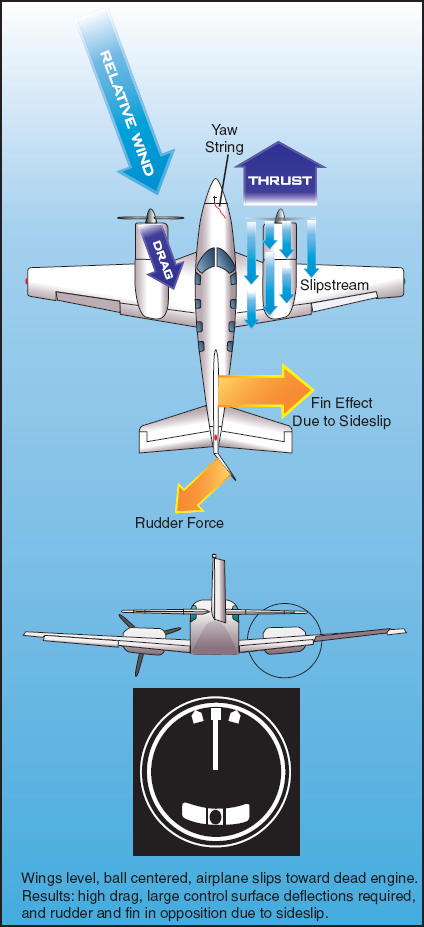
Yaw strings are also fitted to the Lockheed U-2 high-altitude surveillance aircraft{{cite web | access-date = 2007-01-21 | archive-date = 2007-02-22 | archive-url = https://web.archive.org/web/20070222194336/http://www.barryschiff.com/high_flight.htm | url-status = dead In a multiengine airplane with an inoperative engine, the centered ball is no longer the indicator of zero sideslip due to asymmetrical thrust. The yaw string is the only flight instrument that will directly tell the pilot the flight conditions for zero sideslip.{{cite book
Yaw strings are also used on some (especially smaller) helicopters.
Side string

A variation of the yaw string is the side string, used in gliders for a determination of the angle of attack. In this way the speed for best glide angle, the best thermalling speed and the stall speed can be observed independently of other parameters like air speed, aircraft weight, acceleration due to turning, stick movements, and gusts.
Investigations of the side string and on its use in glider flight were performed by the Akaflieg Köln.
References
References
- (2013). "Glider Flying Handbook, FAA-H-8083-13A". U.S. Department of Transportation, FAA.
- (2016). "Pilot's Handbook of Aeronautical Knowledge, FAA-H-8083-25B". U.S. Department of Transportation.
- (2000). "Thermals, Towlines & Tangents". Flying Magazine.
- (2019). "Helicopter Flying Handbook, FAA-H-8083-21B". U.S. Department of Transportation, FAA.
- (1993). "Cross-Country Soaring, A Handbook for Performance and Competition Soaring". Soaring Society of America, Inc..
- "HOME OF M.A.T.S. - the most comprehensive Grumman F-14 Reference Work - by Torsten Anft!".
- [http://www.dg-flugzeugbau.de/index.php?id=seitenfaden-e Use of the side string, DG Flugzeugbau]
- "Use of the side string (German), Akaflieg Köln".
This article was imported from Wikipedia and is available under the Creative Commons Attribution-ShareAlike 4.0 License. Content has been adapted to SurfDoc format. Original contributors can be found on the article history page.
Ask Mako anything about Yaw string — get instant answers, deeper analysis, and related topics.
Research with MakoFree with your Surf account
Create a free account to save articles, ask Mako questions, and organize your research.
Sign up freeThis content may have been generated or modified by AI. CloudSurf Software LLC is not responsible for the accuracy, completeness, or reliability of AI-generated content. Always verify important information from primary sources.
Report