From Surf Wiki (app.surf) — the open knowledge base
Yasuhiro Nakasone
Prime Minister of Japan from 1982 to 1987

Prime Minister of Japan from 1982 to 1987
| Field | Value | |||
|---|---|---|---|---|
| honorific_prefix | Junior First Rank | |||
| name | Yasuhiro Nakasone | |||
| native_name | 中曽根 康弘 | |||
| native_name_lang | ja | |||
| image | Yasuhiro_Nakasone_19821127.jpg | |||
| caption | Official portrait, 1982 | |||
| office | Prime Minister of Japan | |||
| monarch | Shōwa | |||
| deputy | Shin Kanemaru | |||
| term_start | 27 November 1982 | |||
| term_end | 6 November 1987 | |||
| predecessor | Zenkō Suzuki | |||
| successor | Noboru Takeshita | |||
| office1 | President of the Liberal Democratic Party | |||
| vicepresident1 | Susumu Nikaidō | |||
| 1blankname1 | Secretary-General | |||
| 1namedata1 | Susumu Nikaidō | |||
| Rokusuke Tanaka | ||||
| Shin Kanemaru | ||||
| Noboru Takeshita | ||||
| Shintaro Abe | ||||
| term_start1 | 25 November 1982 | |||
| term_end1 | 31 October 1987 | |||
| predecessor1 | Zenkō Suzuki | |||
| successor1 | Noboru Takeshita | |||
| {{collapsed infobox section begin | last | yes | Ministerial offices | titlestyle = border:1px dashed lightgrey;}} |
| {{Infobox officeholder | embed | yes | ||
| office2 | Director-General of the Administrative Management Agency | |||
| primeminister2 | Zenkō Suzuki | |||
| term_start2 | 17 July 1980 | |||
| term_end2 | 27 November 1982 | |||
| predecessor2 | Sōsuke Uno | |||
| successor2 | Kunikichi Saitō | |||
| office3 | Minister of International Trade and Industry | |||
| primeminister3 | Kakuei Tanaka | |||
| term_start3 | 7 July 1972 | |||
| term_end3 | 9 December 1974 | |||
| predecessor3 | Kakuei Tanaka | |||
| successor3 | Toshio Kōmoto | |||
| office4 | Director-General of the Science and Technology Agency | |||
| primeminister4 | Kakuei Tanaka | |||
| term_start4 | 7 July 1972 | |||
| term_end4 | 22 December 1972 | |||
| predecessor4 | Shirō Kiuchi | |||
| successor4 | Kazuo Maeda | |||
| primeminister5 | Nobusuke Kishi | |||
| term_start5 | 18 June 1959 | |||
| term_end5 | 19 July 1960 | |||
| predecessor5 | Tatsunosuke Takasaki | |||
| successor5 | Masuo Araki | |||
| office6 | Director-General of the Defense Agency | |||
| primeminister6 | Eisaku Satō | |||
| term_start6 | 14 January 1970 | |||
| term_end6 | 5 July 1971 | |||
| predecessor6 | Kiichi Arita | |||
| successor6 | Keikichi Masuhara | |||
| office7 | Minister of Transport | |||
| primeminister7 | Eisaku Satō | |||
| term_start7 | 25 November 1967 | |||
| term_end7 | 30 November 1968 | |||
| predecessor7 | Takeo Oohashi | |||
| successor7 | Ken Harada | |||
| office8 | Member of the House of Representatives | |||
| term_start8 | 25 April 1947 | |||
| term_end8 | 10 October 2003 | |||
| predecessor8 | Constituency established | |||
| successor8 | Multi-member district | |||
| constituency8 | Gunma 3rd (1947–1996) | |||
| Northern Kanto PR (1996–2003) | ||||
| birth_date | ||||
| birth_place | Takasaki, Gunma, Japan | |||
| death_date | ||||
| death_place | Tokyo, Japan | |||
| signature | NakasoneY kao.png | |||
| party | LDP (1955–2019) | |||
| otherparty | DP (1947–1950) | |||
| NDP (1950–1952) | ||||
| Kaishintō (1952–1954) | ||||
| JDP (1954–1955) | ||||
| spouse | ||||
| children | Hirofumi Nakasone | |||
| relatives | Yasutaka Nakasone (grandson) | |||
| alma_mater | Tokyo Imperial University | |||
| allegiance | Empire of Japan | |||
| branch | Imperial Japanese Navy | |||
| serviceyears | 1941–1945 | |||
| rank | Lieutenant-commander (as Naval Paymaster) | |||
| battles | World War II | |||
| module |
Rokusuke Tanaka Shin Kanemaru Noboru Takeshita Shintaro Abe Northern Kanto PR (1996–2003) NDP (1950–1952) Kaishintō (1952–1954) JDP (1954–1955)
Yasuhiro Nakasone was a Japanese politician who served as Prime Minister of Japan from 1982 to 1987. His political term was best known for pushing through the privatization of state-owned companies, pursuing a hawkish and pro-United States foreign policy and his rejection of keynesianism and his support of neoliberalism.
Born in Gunma Prefecture, Nakasone graduated from Tokyo Imperial University and served in the imperial navy during the Pacific War. After the war, he entered the National Diet in 1947 and rose through the ranks of the Liberal Democratic Party, serving as chief of the Defense Agency from 1970 to 1971 under Eisaku Satō, international trade and industry minister from 1972 to 1974 under Kakuei Tanaka, and administration minister from 1980 to 1982 under Zenkō Suzuki. As prime minister, he passed large defense budgets and controversially visited the Yasukuni Shrine. A conservative contemporary of U.S. president Ronald Reagan, Nakasone privatized the Japanese National Railways and telephone systems, and favored closer ties with the U.S., once calling Japan an "unsinkable aircraft carrier". After leaving office in 1987, he was implicated in the Recruit scandal, causing the influence of his LDP faction to wane before he retired from the Diet in 2003.
Early life
Family background
Nakasone was born in Takasaki in Gunma, a prefecture northwest of Tokyo, on 27 May 1918. He was the second son of Nakasone Matsugoro II, a lumber dealer, and Nakamura Yuku. He had five siblings: an elder brother named Kichitaro, an elder sister named Shoko, a younger brother named Ryosuke and another younger brother and younger sister who both died in childhood. The Nakasone family had been of the samurai class during the Edo period, and claimed direct descent from the Minamoto clan through the famous Minamoto no Yoshimitsu and through his son Minamoto no Yoshikiyo (d. 1149). According to family records, Tsunayoshi (k. 1417), a vassal of the Takeda clan and a tenth-generation descendant of Yoshikiyo, took the name of Nakasone Juro and was killed at the Battle of Sagamigawa. In about 1590, the samurai Nakasone Sōemon Mitsunaga settled in the town of in Kōzuke Province. His descendants became silk merchants and pawnbrokers. Nakasone's father, originally born Nakasone Kanichi, settled in Takasaki in 1912 and established a timber business and lumberyard which had success as a result of the post-WWI building boom.
Education, bureaucratic career and war
Nakasone described his early childhood and youth as a happy one, and himself as a "quiet, easy-going child" nicknamed "Yat-chan". He attended a local primary school in Takasaki and was a poor student until the fourth grade, after which he excelled and was at the top of his class. He entered Shizuoka Higher School in 1935, where he excelled in history and literature, and learned to speak fluent French.
In the autumn of 1938, Nakasone entered the Faculty of Law of the Imperial University of Tokyo. During his time at the university, he was strongly influenced by , whose lectures on politics fascinated him. He also developed the belief that personality should not be used as a means to achieve something, which contributed to his strong anti-communist and anti-Nazi views. On the night of 10 March 1940, he received a phone call from his father telling him that his mother in Takasaki had fallen seriously ill. By the time he arrived in Takasaki on the first train the next morning, she had already passed away. The fact that his mother had not told him about her illness, so as not to distract him from his studies, became an impetus for him to work harder. He passed the high-level bureaucrat recruitment examination. He began working for the Home Ministry, which was as prestigious as the Ministry of Finance due to its extensive authority.[[File:Nakasone Yasuhiro in Imperial Japanese Navy.JPG|thumb|upright|Nakasone in the [[Imperial Japanese Navy]]]]Nakasone applied for the Navy's programme that allowed graduates from elite universities to serve as officers for two years without rising through the ranks. After completing a training period at the Navy Paymaster's School in Tsukiji, he became a lieutenant. With 2,000 staff under his command, ranging from young doctors and scholars to elderly ex-convicts, Nakasone departed the naval base at Kure on 29 November 1941 on a mission to build airfields. Aboard his ship, he struggled to issue effective orders to his staff and ultimately selected an ex-yakuza with eight convictions as his assistant to relay his commands. In January 1942, he arrived at Balikpapan in Dutch East Indies, where his unit was raided by a retreating Dutch cruiser. On the beach, he cremated the first 23 casualties among his staff, including his ex-yakuza assistant. This experience left a deep and lasting impression, which profoundly influenced his political beliefs. There, he realized that the construction of the airfield had been stalled due to the prevalence of sexual crimes, gambling, and other problems among his men, so he gathered comfort women and organized a brothel called "comfort station" as a solution. He managed to procure four Indonesian women, and a Navy report praised him for having “mitigated the mood of his troops". Nakasone married Tsutako Kobayashi, the daughter of geologist Giichiro Kobayashi, on 11 February 1945. A fortnight later, he lost his younger brother, Ryosuke, in an air accident.
Upon returning to Tokyo after the end of the Second World War, he resumed his suspended career at the Home Ministry. He observed the growing prevalence of communism among the Japanese people, but the Civil Service was largely powerless to address it under the absolute authority of the Allied Occupation Forces. While supervising the police force in Kagawa Prefecture, he decided to abandon his bureaucratic career and stand in the upcoming general election. He later wrote of his return to Tokyo in August 1945 after Japan's surrender: "I stood vacantly amid the ruins of Tokyo, after discarding my officer's short sword and removing the epaulettes of my uniform. As I looked around me, I swore to resurrect my homeland from the ashes of defeat".
Early parliamentary career

He stand in the 1949 general election as a Democratic Party candidate. He campaigned on a nationalist platform, arguing for an enlarged Self-Defence Force, to amend Article 9 of the Japanese Constitution (which outlawed war as a means to settling international disputes), and to revive Japanese patriotism, especially in reverence for the Emperor. He entered the Japanese Diet as a member of the House of Representatives for the Democratic Party. "As a freshman lawmaker in 1951, he delivered a 28-page letter to General MacArthur criticising the occupation, a brazen move. The General angrily threw the letter in [the] bin, Yasuhiro was later told. This stand established [Yasuhiro Nakasone's] credentials as a right-wing politician." He gained brief notoriety in 1952 for blaming Emperor Hirohito for Japan's defeat in the war. In 1955, at Nakasone's urging, the government granted the equivalent of $14,000,000 to the Agency for Industrial Science and Technology to begin nuclear power research. Nakasone rose through the LDP's ranks, becoming Minister of Science in 1959 under the government of Nobusuke Kishi, then Minister of Transport in 1967, Director General of the Japan Defense Agency from 1970 to 1971, Minister of International Trade and Industry in 1972 and Minister of Administration in 1981.
As the head of the Self-Defence Force, Nakasone argued for an increase in defence spending from less than 1% GNP to 3% of GNP. He was also in favour of Japan having tactical nuclear weapons. He was labelled "the weathervane" in 1972 because he switched his support from Takeo Fukuda to Kakuei Tanaka in the leadership election, ensuring Tanaka's victory. In turn, Tanaka would give his powerful support to Nakasone against Fukuda a decade later in the fight for the premiership.
Premiership (1982–1987)
In 1982, Nakasone became prime minister. Along with Minister of Foreign Affairs Shintaro Abe, Nakasone improved Japanese relations with the USSR and the People's Republic of China. Nakasone was best known for his close relationship with U.S. President Ronald Reagan, popularly called the "Ron-Yasu" friendship. Nakasone sought a more equal relationship with the United States, and said: "President Reagan is the pitcher and I'm the catcher. When the pitcher gives the signs, I'll co-operate unsparingly, but if he doesn't sometimes follow the catcher's signs, the game can't be won". Nakasone said Japan would be "America's unsinkable aircraft carrier" in the Pacific and that Japan would "keep complete control of the four straits that go through to Japanese islands, to prevent the passage of Soviet submarines". He was attacked by political opponents as a reactionary and a "dangerous militarist". Nakasone responded by saying: "A nation must shed any sense of ignominy and move forward seeking glory". However his attempt to amend Article 9 failed.
In 1984, Nakasone visited China on the twelfth anniversary of Japan's diplomatic recognition of the People's Republic, for which the Chinese government arranged tours of China for 3,000 Japanese youths. On the trip, Nakasone's son was privately accompanied by the daughter of Hu Yaobang, the-then General Secretary of the Chinese Communist Party. After the event, Hu was criticised by other members of the Chinese Communist Party for the extravagance and warmth of the event. Nakasone also visited President Corazon Aquino in a series of talks between the Philippines and Japan during a special state visit from 1986 to 1987, to provide good economic and trade relations.
In economic affairs, Nakasone's most notable policy was his privatisation initiative, which led to the breakup of Japan National Railways into the modern Japan Railways Group (JR). This led to 80,000 redundancies, unheard of in Japan until that point. He also privatized Nippon Telegraph and Telephone Public Corporation and Japan Tobacco and Salt Public Corporation to create Nippon Telegraph and Telephone Corporation (NTT) and Japan Tobacco Inc. (JT). The privatization of the three public corporations reduced the number of employees and significantly improved ordinary income per employee, productivity, and sales. According to a report by Japan Institute for Labour Policy and Training, 20 years after the privatization of NTT and JT and 16 years after the privatization of JR, the number of employees was reduced to 35% for JT, 65% for NTT and 70% for JR. In addition, NTT, JT and JR increased their ordinary income by 8 times, 5.5 times and 3 times, respectively. The productivity of NTT, JT and JR increased 3 times, 2.5 times and 1.5 times, respectively. Sales at NTT and JR increased 2.2 times and 1.2 times, respectively. Nakasone wrote of his economic reforms:
I was carrying out a kind of "improvement" of Japan's structure. For 110 years, ever since the Meiji restoration, Japan had been striving to catch up with America and Britain. In the 1970s we did catch up. Beyond that point the [state's] regulations only stand in the way of the growth of the economy. If government officials have too much power, the private sector of the economy will not grow. We had to change the system.
For the first time in Japan's post-war history, bureaucrats lost their leading role. In 1985, Nakasone appointed the former Governor of the Bank of Japan, Haruo Maekawa, to head a commission on Japan's economic future. In 1986, the Commission recommended that Japan should grow not through exports (which were angering Japan's trading partners) but from within. Nakasone advised the Japanese public to purchase foreign imports; in a well-publicised shopping trip, he bought an American tennis racket, an Italian tie and a French shirt. He said: "Japan is like a mah-jong player who always wins. Sooner or later the other players will decide that they do not want to play with him". The Japanese public were skeptical but the Commission created a good impression abroad, especially in America, where the Under Secretary of State for Economic Affairs W. Allen Wallis called it a watershed in Japan's post-war economic policy.
Nakasone also became known for having a nationalist attitude and for wanting to stimulate ethnic pride amongst the Japanese. He was an adherent to the nihonjinron theory that claims Japan is incomparably different from the rest of the world. Influenced by Japanese philosopher Tetsuro Watsuji, Nakasone believed that Japan's "monsoon culture" inspired a special Japanese compassion, unlike the desert culture of the Middle East that produced the Judeo-Christian "An eye for an eye, a tooth for a tooth". In a speech in 1986, Nakasone said it was Japan's international mission to spread the monsoon culture abroad.
On 15 August 1985, the fortieth anniversary of Japan's surrender, Nakasone and his Cabinet visited the Yasukuni Shrine, where Japan's war casualties - including convicted war criminals - were buried, in full mourning dress. This had great symbolic significance as he visited the shrine in his official capacity, intending to reassert the Japanese government's respect for the spirits of the ancestors killed in battle, including those who died in World War II. This turned out however to be a controversial move which was heavily criticised by the Chinese Government (including in its newspaper, People's Daily) and led to angry demonstrations in Beijing. It was also attacked by opponents at home for violating the Constitution's separation of religion and state. Nakasone defended his actions by saying, "The true defence of Japan ... becomes possible only through the combination of liberty-loving peoples who are equal to each other ... The manner is desired to be based on self-determination of the race". He also said, "It is considered progressive to criticise pre-war Japan for its faults and defects, but I firmly oppose such a notion. A nation is still a nation whether it wins or loses a war".
Nakasone also sought educational reform, setting up a commission. Its report recommended that "a spirit of patriotism" should be inculcated in children, along with respect for elders and authority. This was not fully implemented and came under attack from the teachers' trade union. The commission also recommended that the national anthem should be taught and that the Rising Sun Flag should also be raised during entrance and graduation ceremonies. History textbooks were also reformed. In 1986, Nakasone dismissed his Education Minister, Masayuki Fujio, after he justified Japan's annexation of Korea in 1910.
Nakasone aroused controversy in September 1986 when he claimed that Americans were, on average, less intelligent than Japanese because "the US has many immigrants, Puerto Ricans, Mexicans, and Blacks, who bring the average level down" and also said that "in America today there are still many Blacks who can't even read." He then clarified his comments, stating that he meant to congratulate the U.S. on its economic success despite the presence of "problematic" minorities. Ainu people living in Japan criticized this comment as ignoring the reality of racial discrimination against them.
In 1987, he was forced to resign after he attempted to introduce a value added tax to reduce the burden of direct taxes in a policy designed to cut the budget deficit.
File:President Reagan and Prime Minister Yasuhiro Nakasone.jpg|Having lunch with Ronald Reagan (at Nakasone's country residence in Hinode, Nishitama, Tokyo in 1983) File:G-7 Summit 1983.jpg|With leaders of the G7 (at the 9th G7 summit in 1983) File:President Ronald Reagan Walking with Prime Minister Yasuhiro Nakasone of Japan at Camp David.jpg|With Ronald Reagan (at Camp David on 13 April 1986) File:President Ronald Reagan and Nancy Reagan receive a gift from Prime Minister Yasuhiro Nakasone.jpg|With Ronald Reagan and Nancy Reagan (at Camp David on 13 April 1986)
Later political life
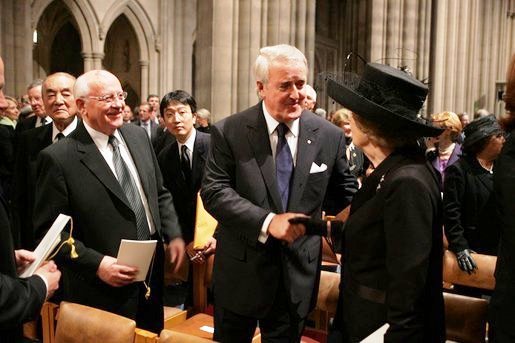
Nakasone was replaced by Noboru Takeshita in 1987, and was implicated, along with other LDP lawmakers, in the Recruit scandal that broke the following year.
Although he remained in the Diet for another decade and a half, his influence gradually waned. In 2003, despite a fight, Nakasone was not given a place on the LDP's electoral list as the party, by then led by Jun'ichirō Koizumi, introduced an age limit of 73 years for candidates in the proportional representation blocks, ending his career as a member of the Diet.
In 2010, "aware of his status as one of the few leaders revered across Japan's suddenly fractured political landscape" and the country's "most revered elder statesman", Nakasone launched a series of interviews to address the direction of prime minister Yukio Hatoyama's government. In a profile at that time, he saw Hatoyama's "inexperienced left-leaning" government as "challenging Japan's postwar political order and its close relationship with the United States". As well, the LDP was "crumbling into disarray" in the wake of Hatoyama's victory. In the profile, Nakasone described the moment "as a national opening on par with the wrenching social and political changes that followed defeat in the [world] war [and] praised the appearance of a strong second political party as a step toward true democracy". "Being knocked out of power is a good chance to study in the cram school of public opinion", he was quoted as saying of the LDP. He "faulted Mr. Hatoyama for giving Washington the impression that [Hatoyama] valued ties with China more than he did those with the United States. 'Because of the prime minister’s imprudent remarks, the current situation calls for Japan to make efforts to improve things,' he said. The [Japanese] relationship with the United States is different from that with China, he said, because 'it is built on a security alliance, and not just on the alliance, but on the shared values of liberal democracy, and on its shared ideals.'" And relative to another high-profile current source of friction between Japan and the United States, Nakasone said: "Problems like Okinawa [and the American military base there] can be solved by talking together."
Personal life and death
On 11 February 1945, Nakasone married Tsutako Nakasone (30 October 1921 – 7 November 2012). Nakasone's son, Hirofumi Nakasone, is also a member of the Diet; he has served as Minister of Education and as Minister of Foreign Affairs. His grandson, Yasutaka Nakasone, is a member of the House of Representatives.
Nakasone died in Tokyo on 29 November 2019, at the age of 101 years and 186 days. Nakasone was the third oldest Prime Minister of Japan by age after Naruhiko Higashikuni and Tomiichi Murayama.
Honours

National honours
- Order of the Chrysanthemum:
- [[File:JPN Daikun'i kikkasho BAR.svg|70px]] Grand Cordon, 29 April 1997
- [[File:JPN Daikun'i kikkasho BAR.svg|70px]] Collar, 29 November 2019 (posthumously)
- [[File:Golden Pheasant Award ribbon.svg |70px]] Golden Pheasant Award of the Scout Association of Japan (1986)
- Junior First Rank (29 November 2019; posthumously)
Foreign honours
- Mexico:
- [[File:MEX Order of the Aztec Eagle 1Class BAR.png|70px]] Grand Cross of the Order of the Aztec Eagle
- Germany:
- [[File:GER Bundesverdienstkreuz 7 Grosskreuz.svg|70px]] Grand Cross 1st Class of the Order of Merit of the Federal Republic of Germany
- Philippines:
- [[File:PHI Order of Sikatuna 2003 Grand Collar BAR.svg|70px]] Grand Collar (Raja) of the Order of Sikatuna
- Egypt:
- [[File:EGY Order of the Nile - Grand Cordon BAR.png|70px]] Grand Cordon of the Order of the Nile
- Indonesia:
- [[File:Bintang Mahaputera Adipurna rib.svg|70px]] Star of Mahaputera, 1st Class ()
- Norway:
- [[File:St Olavs Orden storkors stripe.svg|70px]] Grand Cross (Storkors) of the Order of Saint Olav
- Argentina:
- [[File:ARG Order of the Liberator San Martin - Grand Cross BAR.png|70px]] Grand Cross of the Order of the Liberator General San Martín
- Brunei:
- [[File:First_Class_of_the_Order_of_Seri_Paduka_Mahkota_Brunei_(SPMB).svg|70x70px]] The Most Honourable Order of Seri Paduka Mahkota Brunei, First Class
- Peru:
- [[File:Order of Merit for Distinguished Service (Peru).svg|70px]] Grand Cross of the Order of Merit for Distinguished Service ()
- Finland:
- [[File:FIN Order of the White Rose Grand Cross BAR.png|70px]] Grand Cross of the Order of the White Rose of Finland
- South Korea:
- [[File:Order of Diplomatic Service Merit (Class 1) Grand Gwanghwa Medal ribbon.gif|70px]] Order of Diplomatic Service Merit, 1st Class (Grand Gwanghwa Medal)
- Thailand:
- [[File:Order of the White Elephant - Special Class (Thailand) ribbon.svg|70px]] Knight Grand Cordon of the Most Exalted Order of the White Elephant
- France:
- [[File:Legion Honneur GO ribbon.svg|70px]] Grand Officier of the Légion d'honneur
References
Citations
Sources
- Robert Harvey, The Undefeated: The Rise, Fall and Rise of Greater Japan (London: Macmillan, 1994).
- Karel van Wolferen, The Enigma of Japanese Power: People and Politics in a Stateless Nation (New York: Vintage, 1990).
- The Making of the New Japan. Curzon Press. 6 March 2015.
Offices and distinctions
References
- Kasuya Nobuji. (March 1990). "On the Characteristics of Neoconservativism in Japan".
- Lentz, Harris M.. (4 February 2014). "Heads of States and Governments Since 1945". Routledge.
- Fackler, Martin. (29 January 2010). "Japan's Elder Statesman Is Silent No Longer". The New York Times.
- (6 March 2015). "The Making of the New Japan". Curzon Press.
- (2015). "The Making of the New Japan". Curzon Press.
- (6 March 2015). "The Making of the New Japan". Curzon Press.
- Nakasone, Yasuhiro. (1992-01-06). "私の履歴書 第五回 一心不乱". [[The Nikkei]].
- (14 November 2014). "The Comfort Women and Japan's War on Truth (Published 2014)". The New York Times.
- "『報道特集』 がついに中曽根元首相の「土人女を集め慰安所開設」文書を報道! 息子の弘文が慰安婦否定の責任者ってなんの冗談?". LITERA.
- Nakasone, Yasuhiro. (1992-01-09). "私の履歴書 第八回 戦友を焼く ーー 空襲に腹固めあぐら". [[The Nikkei]].
- Yasuhiro, Nakasone. (1992-01-10). "私の履歴書 第九回 結婚 同僚の妹、お使いが縁". [[The Nikkei]].
- Nakasone, Yasuhiro. (1992-01-12). "私の履歴書 第十一回 初当選 白い自転車駆り演説". [[The Nikkei]].
- Harvey, Robert. (1994). "The Undefeated: The Rise, Fall and Rise of Greater Japan". Macmillan.
- Harvey, p. 362.
- "The Senkyo, 23rd election of the House of Representatives, Gunma's 3rd district".
- Bix, H.P. ''Hirohito'', 2000. page 649.
- [[Daniel P. Aldrich]], [http://www.tnr.com/article/world/85463/japan-nuclear-power-regulation With a Mighty Hand], ''New Republic''
- Harvey, p. 363.
- Harvey, p. 365.
- Lee, Khoon Choy. (2005). "Pioneers of Modern China: Understanding the Inscrutable Chinese". World Scientific Publishing.
- Burgess, John. (11 November 1986). "Japan Promises Aquino Aid". The Washington Post.
- Burgess, John. (14 November 1986). "Aquino Ends Visit to Japan". The Washington Post.
- Harvey, p. 369.
- link. [[Jiji Press]]
- link. [[Japan Institute for Labour Policy and Training]]
- Harvey, p. 364.
- Karel van Wolferen. (1990). "The Enigma of Japanese Power: People and Politics in a Stateless Nation". Vintage.
- Wolferen, p. 267.
- Wolferen, p. 264.
- Harvey, p. 367.
- Haberman, Clyde. (10 October 1985). "Nakasone, Giving in, Will Shun Shrine". The New York Times.
- Harvey, p. 368.
- Thorsten, Marie. (2012-03-15). "Superhuman Japan: Knowledge, Nation and Culture in US-Japan Relations". Routledge.
- Bowen, Ezra. (24 June 2001). "Nakasone's World-Class Blunder".
- (October 24, 1986). "'No Minority Races in Japan,' Says Nakasone". [[The Japan Times]].
- (10 October 1990). "Ex-Executive Is Sentenced in Japan's Recruit Scandal".
- Sanger, David E.. (10 October 1990). "Big Conviction in Recruit Scandal". The New York Times.
- (24 October 2003). "Single-seat constituencies offer refuge for LDP elders who refuse to retire". The Japan Times.
- (28 November 2019). "Yasuhiro Nakasone dies". NHK World-Japan News.
- (6 December 2012). "The Making of the New Japan: Reclaiming the Political Mainstream". Routledge.
- link. Gree.jp
- link. Tisen.jp
- link. Asahi.com. (7 November 2012)
- "Nakasone Hirofumi".
- "LDP Members NAKASONE Yasutaka".
- (29 November 2019). "Ex-Japanese Prime Minister Yasuhiro Nakasone dies at 101". English.kyodonews.net.
- Norimitsu Onishi. (28 November 2019). "Yasuhiro Nakasone, Assertive Prime Minister of Japan, Dies at 101". New York Times.
- (26 May 2018). "Ex-Japan PM Nakasone to turn 100 on May 27". Mainichi Daily News.
- From the corresponding article in the Japanese Wikipedia{{circular reference. (November 2019)
- (27 December 2019). "故中曽根元首相に従一位 最高勲章贈る". The Nikkei.
- (2014-05-23). link
This article was imported from Wikipedia and is available under the Creative Commons Attribution-ShareAlike 4.0 License. Content has been adapted to SurfDoc format. Original contributors can be found on the article history page.
Ask Mako anything about Yasuhiro Nakasone — get instant answers, deeper analysis, and related topics.
Research with MakoFree with your Surf account
Create a free account to save articles, ask Mako questions, and organize your research.
Sign up freeThis content may have been generated or modified by AI. CloudSurf Software LLC is not responsible for the accuracy, completeness, or reliability of AI-generated content. Always verify important information from primary sources.
Report