From Surf Wiki (app.surf) — the open knowledge base
Yamalo-Nenets Autonomous Okrug
| Field | Value |
|---|---|
| en_name | Yamalo-Nenets Autonomous Okrug |
| ru_name | Ямало-Ненецкий автономный округ |
| loc_name1 | Ямалы-Ненёцие автономной ӈокрук |
| loc_lang1 | Nenets |
| image_map | Map of Russia (2014–2022) - Yamalo-Nenets Autonomous Okrug.svg |
| coordinates | |
| image_coa | Coat of Arms of Yamal Nenetsia.svg |
| image_flag | Flag of Yamal-Nenets Autonomous District.svg |
| anthem | "Anthem of Yamalo-Nenets Autonomous Okrug" |
| anthem_ref | |
| political_status | Autonomous okrug |
| political_status_link | Autonomous okrugs of Russia |
| federal_district | Ural |
| economic_region | West Siberian |
| adm_ctr_type | Capital |
| adm_ctr_name | Salekhard |
| pop_2021census | 510490 |
| pop_2021census_rank | 72nd |
| urban_pop_2021census | 84.7% |
| rural_pop_2021census | 15.3% |
| pop_2021census_ref | |
| pop_latest | 540000 |
| pop_latest_date | January 2015 |
| pop_latest_ref | |
| area_km2 | 769250 |
| area_km2_rank | 6th |
| established_date | December 10, 1930 |
| established_date_ref | |
| license_plates | 89 |
| ISO | RU-YAN |
| leader_title | Governor |
| leader_title_ref | |
| leader_name | Dmitry Artyukhov |
| leader_name_ref | |
| legislature | Legislative Assembly |
| legislature_ref | |
| website | https://yanao.ru |
| languages | Nenets |
| Selkup | |
| Khanty |
Selkup Khanty
The Yamalo-Nenets Autonomous Okrug (; ) also known as Yamalia () is a federal subject of Russia and an autonomous okrug of Tyumen Oblast. Its administrative center is the town of Salekhard, and its largest city is Novy Urengoy. The 2021 Russian Census recorded its population as 510,490.
The autonomous okrug borders Krasnoyarsk Krai to the east, the Khanty-Mansi Autonomous Okrug to the south, and the Nenets Autonomous Okrug and Komi Republic to the west.
Geography
The West Siberian petroleum basin is the largest hydrocarbon (petroleum and natural gas) basin in the world covering an area of about 2.2 million km2, and is also the largest oil and gas producing region in Russia.
The Nenets people are an indigenous tribe who have long survived in this region. Their prehistoric life involved subsistence hunting and gathering, including the taking of polar bears; the practice of hunting polar bears (Ursus maritimus) continues up to the present time.
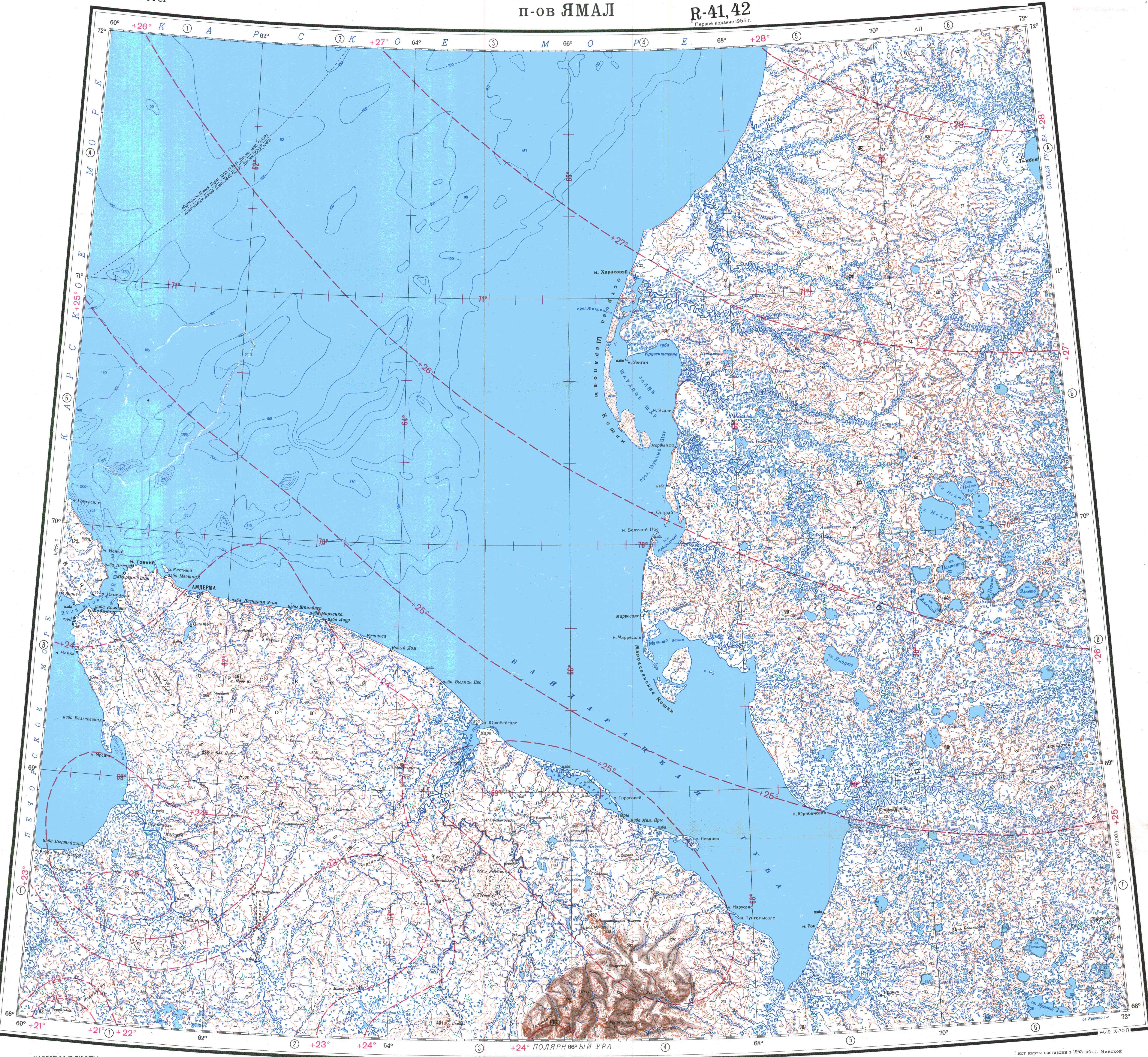
Yamalo-Nenets Autonomous Okrug is traversed by the northeasterly line of equal latitude and longitude, that is, at the point 70°N and 70°E, with equal degrees. The Polar Urals rise in the western part and the highest point of the okrug, as well as of the whole Ural mountain system, is Mount Payer.
The area consists of arctic tundra and taiga, with three large peninsulas – the Yamal Peninsula, Taz Peninsula and the Gyda Peninsula (itself containing the Yavay Peninsula and Mamonta Peninsula). There are nearly 300,000 lakes in the okrug, some of the main ones being Pyakuto, Chyortovo, Neito, Yambuto, Yarroto and Nembuto.
The Ob River flows through Yamalo-Nenets Autonomous Okrug to the Kara Sea via the Gulf of Ob, which dominates the geography of the Okrug (together with its sub-bay, the Taz Estuary and neighboring Gydan Bay).
A number of islands are off the okrug's coast – from west to east, the main ones are Torasovey Island, Bolotnyy Island, Litke Island, Sharapovy Koshki Islands, Bely Island, Shokalsky Island, Petsovyye Islands, Proklyatyye Islands, Oleny Island, and Vilkitsky Island.
History
On December 10, 1930, Yamal (Nenets) National Okrug (Ямальский (Ненецкий) национальный округ) was formed based on Ural Oblast.
Administrative divisions
Main article: Administrative divisions of Yamalo-Nenets Autonomous Okrug
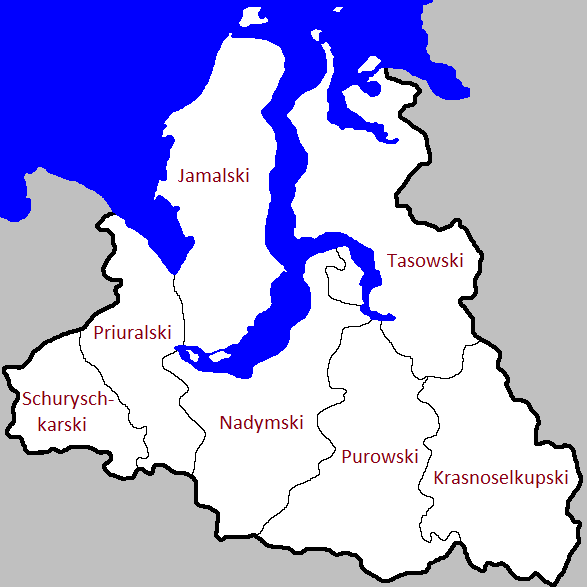
Administrative and municipal divisions |frame-lat = |frame-long = |frame-align = right
| Division | Structure | OKATO | OKTMO | Urban-type settlement/ | |||
|---|---|---|---|---|---|---|---|
| district-level town* | Rural | ||||||
| (selsovet) | Administrative | Municipal | |||||
| Salekhard (Салехард) | city | urban okrug | 71 171 | 71 951 | |||
| Gubkinsky (Губкинский) | city | urban okrug | 71 172 | 71 952 | |||
| Labytnangi (Лабытнанги) | city | urban okrug | 71 173 | 71 953 | |||
| Nadym (Надым) | city | (under Nadymsky) | 71 174 | 71 916 | |||
| Muravlenko (Муравленко) | city | urban okrug | 71 175 | 71 955 | |||
| Novy Urengoy (Новый Уренгой) | city | urban okrug | 71 176 | 71 956 | |||
| Noyabrsk (Ноябрьск) | city | urban okrug | 71 178 | 71 958 | 1 | ||
| Krasnoselkupsky (Красноселькупский) | district | 71 153 | 71 913 | 3 | |||
| Nadymsky (Надымский) | district | okrug | 71 156 | 71 916 | 8 | ||
| Priuralsky (Приуральский) | district | 71 158 | 71 918 | 6 | |||
| Purovsky (Пуровский) | district | okrug | 71 160 | 71 920 | 5 | ||
| Tazovsky (Тазовский) | district | okrug | 71 163 | 71 923 | 4 | ||
| Shuryshkarsky (Шурышкарский) | district | 71 166 | 71 926 | 8 | |||
| Yamalsky (Ямальский) | district | 71 168 | 71 928 | 6 |
Demographics

Population:
From 1960 to 2016, Yamal Nenets population increased from 60 000 people to more than 530 000 due to the natural resources discovered in the region. Currently, Yamal Nenets is the only Arctic Region in the Russian Federation that is not experiencing population decline. Despite the growing pressure on the regional environment, former governor Dmitry Kobylkin assured in 2016 that industrial developments are not affecting the traditional lifestyles of the native population. Official data accounts for an increment of 11 percent of the indigenous population from 2006 to 2016.
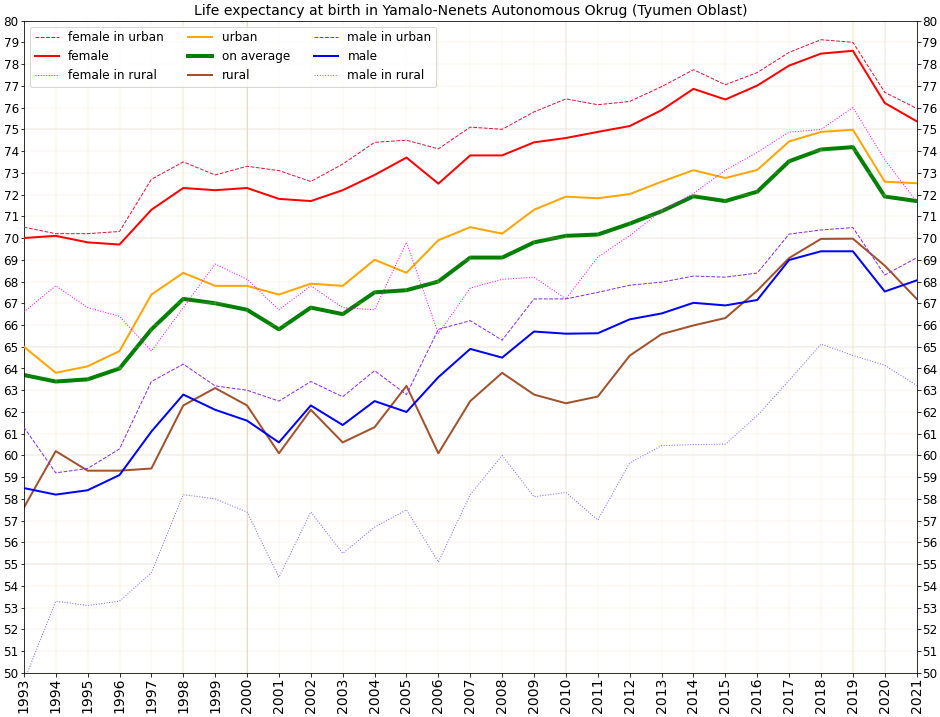
Vital statistics
| Year | Average population (× 1000) | Live births | Deaths | Natural change | Crude birth rate (per 1000) | Crude death rate (per 1000) | Natural change (per 1000) | Source: |
|---|---|---|---|---|---|---|---|---|
| 1970 | 84 | 1,683 | 879 | 804 | 20.0 | 10.5 | 9.6 | |
| 1975 | 127 | 2,307 | 819 | 1,488 | 18.2 | 6.4 | 11.7 | |
| 1980 | 194 | 3,347 | 1,178 | 2,169 | 17.3 | 6.1 | 11.2 | |
| 1985 | 374 | 7,838 | 1,555 | 6,283 | 21.0 | 4.2 | 16.8 | |
| 1990 | 489 | 8,032 | 1,631 | 6,401 | 16.4 | 3.3 | 13.1 | |
| 1991 | 483 | 7,121 | 1,623 | 5,498 | 14.7 | 3.4 | 11.4 | |
| 1992 | 470 | 6,123 | 2,108 | 4,015 | 13.0 | 4.5 | 8.5 | |
| 1993 | 466 | 5,697 | 2,764 | 2,933 | 12.2 | 5.9 | 6.3 | |
| 1994 | 473 | 6,274 | 2,998 | 3,276 | 13.3 | 6.3 | 6.9 | |
| 1995 | 483 | 6,337 | 3,107 | 3,230 | 13.1 | 6.4 | 6.7 | |
| 1996 | 489 | 6,241 | 3,004 | 3,237 | 12.8 | 6.1 | 6.6 | |
| 1997 | 495 | 6,208 | 2,715 | 3,493 | 12.5 | 5.5 | 7.1 | |
| 1998 | 498 | 6,395 | 2,544 | 3,851 | 12.8 | 5.1 | 7.7 | |
| 1999 | 498 | 6,071 | 2,608 | 3,463 | 12.2 | 5.2 | 7.0 | |
| 2000 | 497 | 5,839 | 2,763 | 3,076 | 11.7 | 5.6 | 6.2 | |
| 2001 | 501 | 6,388 | 3,057 | 3,331 | 12.8 | 6.1 | 6.7 | |
| 2002 | 506 | 6,635 | 2,934 | 3,701 | 13.1 | 5.8 | 7.3 | |
| 2003 | 510 | 7,163 | 3,093 | 4,070 | 14.1 | 6.1 | 8.0 | |
| 2004 | 511 | 7,264 | 2,975 | 4,289 | 14.2 | 5.8 | 8.4 | |
| 2005 | 512 | 7,148 | 3,099 | 4,049 | 14.0 | 6.0 | 7.9 | |
| 2006 | 513 | 7,036 | 3,000 | 4,036 | 13.7 | 5.8 | 7.9 | |
| 2007 | 515 | 7,700 | 2,937 | 4,763 | 14.9 | 5.7 | 9.2 | |
| 2008 | 517 | 7,892 | 2,959 | 4,933 | 15.3 | 5.7 | 9.5 | |
| 2009 | 519 | 8,216 | 2,924 | 5,292 | 15.8 | 5.6 | 10.2 | |
| 2010 | 522 | 8,263 | 2,873 | 5,390 | 15.8 | 5.5 | 10.3 |
Regional demographics
.jpg)
| Raion | Pp (2007) | Births | Deaths | Growth | BR | DR | NGR | Source: |
|---|---|---|---|---|---|---|---|---|
| Yamalo-Nenets Autonomous Okrug | 538,600 | 5,814 | 2,202 | 3,612 | 14.39 | 5.45 | 0.89% | |
| Salekhard | 40,500 | 499 | 256 | 243 | 16.43 | 8.43 | 0.80% | |
| Gubkinsky | 22,300 | 263 | 71 | 192 | 15.72 | 4.25 | 1.15% | |
| Labytnangi | 27,700 | 333 | 212 | 121 | 16.03 | 10.20 | 0.58% | |
| Muravlenko | 37,000 | 361 | 104 | 257 | 13.01 | 3.75 | 0.93% | |
| Nadym | 48,500 | 443 | 197 | 246 | 12.18 | 5.42 | 0.68% | |
| Novy Urengoy | 117,000 | 1,122 | 334 | 788 | 12.79 | 3.81 | 0.90% | |
| Noyabrsk | 109,900 | 1,029 | 384 | 645 | 12.48 | 4.66 | 0.78% | |
| Krasnoselkupsky | 6,200 | 99 | 41 | 58 | 21.29 | 8.82 | 1.25% | |
| Nadymsky | 21,300 | 221 | 67 | 154 | 13.83 | 4.19 | 0.96% | |
| Priuralsky | 15,300 | 179 | 72 | 107 | 15.60 | 6.27 | 0.93% | |
| Purovsky | 49,900 | 548 | 195 | 353 | 14.64 | 5.21 | 0.94% | |
| Tazovsky | 17,200 | 268 | 92 | 176 | 20.78 | 7.13 | 1.36% | |
| Shuryshkarsky | 9,900 | 144 | 69 | 75 | 19.39 | 9.29 | 1.01% | |
| Yamalsky | 15,900 | 305 | 108 | 197 | 25.58 | 9.06 | 1.65% |
Ethnic groups
The Nenets make up 8.9% of the population, preceded by ethnic Russians (62.9%), and followed by Tatars (4.7%) and Ukrainians (4.5%). Other prominent ethnic groups include Khanty (2.5%), Azerbaijanis (1.7%), Bashkirs (1.5%), Kumyks (1.2%), and Nogais (0.9%) (all figures are from the 2021 Census).
| Ethnic | ||||||||||||||||||||||||
|---|---|---|---|---|---|---|---|---|---|---|---|---|---|---|---|---|---|---|---|---|---|---|---|---|
| group | 1939 Census | 1959 Census | 1970 Census | 1979 Census | 1989 Census | 2002 Census | 2010 Census1 | 2021 Census | Number | % | Number | % | Number | % | Number | % | Number | % | Number | % | Number | % | Number | % |
| Russians | 19,308 | 42.1% | 27,789 | 44.6% | 37,518 | 46.9% | 93,750 | 59.0% | 292,808 | 59.2% | 298,359 | 58.8% | 312,019 | 61.7% | 253,306 | 62.9% | ||||||||
| Ukrainians | 395 | 0.9% | 1,921 | 3.1% | 3,026 | 3.8% | 15,721 | 9.9% | 85,022 | 17.2% | 66,080 | 13.0% | 48,985 | 9.7% | 18.234 | 4.5% | ||||||||
| Nenets | 13,454 | 29.3% | 13,977 | 22.4% | 17,538 | 21.9% | 17,404 | 11.0% | 20,917 | 4.2% | 26,435 | 5.2% | 29,772 | 5.9% | 35,917 | 8.9% | ||||||||
| Tatars | 1,636 | 3.6% | 3,952 | 6.3% | 4,653 | 5.8% | 8,556 | 5.4% | 26,431 | 5.3% | 27,734 | 5.5% | 28,509 | 5.6% | 18,912 | 4.7% | ||||||||
| Khanty | 5,367 | 11.7% | 5,519 | 8.9% | 6,513 | 8.1% | 6,466 | 4.1% | 7,247 | 1.5% | 8,760 | 1.7% | 9,489 | 1.9% | 9,985 | 2.5% | ||||||||
| Komi | 4,722 | 10.3% | 4,866 | 7.8% | 5,445 | 6.8% | 5,642 | 3.6% | 6,000 | 1.2% | 6,177 | 1.2% | 5,141 | 1.0% | 3,556 | 0.9% | ||||||||
| Selkups | 87 | 0.2% | 1,245 | 2.0% | 1,710 | 2.1% | 1,611 | 1.0% | 1,530 | 0.3% | 1,797 | 0.4% | 1,988 | 0.4% | 2,001 | 0.5% | ||||||||
| Others | 871 | 1.9% | 3,065 | 4.9% | 3,574 | 4.5% | 9,694 | 6.1% | 54,889 | 11.1% | 71,664 | 14.1% | 74,625 | 14.3% | 70,873 | 15.1% | ||||||||
| 1 17,517 people were registered from administrative databases, and could not declare an ethnicity. The proportion of ethnicities in this group is estimated to be the same as that of the declared group. |
Religion
According to a 2012 survey 42.2% of the population of Yamalia adhere to the Russian Orthodox Church, 14% are unaffiliated generic Christians, 1% are believers in Orthodox Christianity who do not belong to any church, 1% are members of the Slavic neopaganism (Rodnovery) or practitioners of local shamanic religions, and 1% are members of Protestant churches; Muslims, mostly Caucasian peoples and Tatars, make up 18% of the total population. In addition, 14% of the population declare to be "spiritual but not religious", 8% are atheist, and 0.8% follow other religions or did not give an answer to the question.
Economy
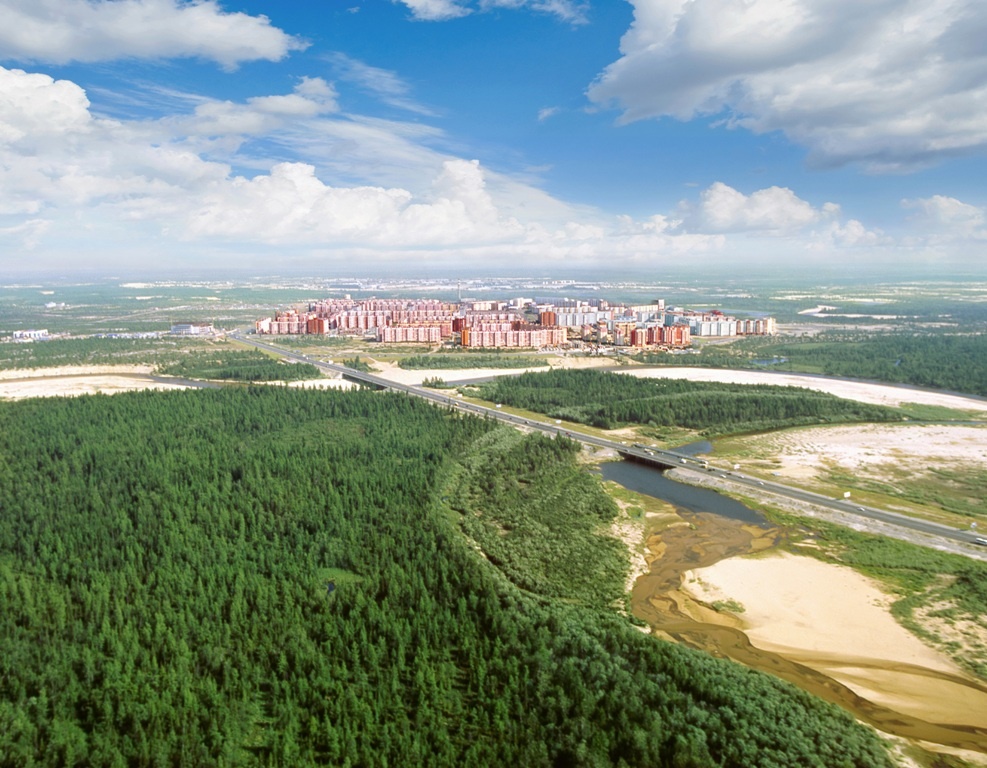
.jpg)
In 2009, Yamalo-Nenetsky Avtonomny Okrug is Russia's most important source of natural gas, with more than 90% of Russia's natural gas being produced there. The region also accounts for 12% of Russia's oil production. The region is the most important to Russia's largest company Gazprom, whose main production fields are located there. Novatek – the country's second-largest gas producer – is also active in the region, with its headquarters located in Tarko-Sale. According to Novatek on 22 October 2019, the natural gas reserves in the Yamalo-Nenets Autonomous Okrug represent 80% of Russia's natural gas and 15% of the world's natural gas supply.
Since the early 2010s Gazprom has been developing Yamal project in the Yamal Peninsula area. As of 2020, Yamal produces over 20% of Russia's gas, which is expected to increase to 40% by 2030. The shortest pipeline routes from Yamal to the northern EU countries are the Yamal–Europe pipeline through Poland and Nord Stream 1 to Germany. The proposed gas route from Western Siberia to China is known as Power of Siberia 2 pipeline.
Notable people
- Anastasia Lapsui (b. 1944), Nenets film director, screenwriter, radio journalist
References
Sources
- {{Cite Russian law
References
- Law #119-ZAO
- "Оценка численности постоянного населения по субъектам Российской Федерации". [[Federal State Statistics Service (Russia).
- Yamalo-Nenets Autonomous Okrug Territorial Branch of the [[Russian Federal State Statistics Service. Federal State Statistics Service]]. [http://yamalstat.gks.ru/wps/wcm/connect/rosstat_ts/yamalstat/resources/9194358047d7a5c68995aded3bc4492f/%D0%A7%D0%B8%D1%81%D0%BB%D0%B5%D0%BD%D0%BD%D0%BE%D1%81%D1%82%D1%8C+%D0%BD%D0%B0%D1%81%D0%B5%D0%BB%D0%B5%D0%BD%D0%B8%D1%8F.htm Численность населения] {{Webarchive. link. (March 4, 2016 {{in lang). ru
- Charter of Yamalo-Nenets Autonomous Okrug, Article 1
- Charter of Yamalo-Nenets Autonomous Okrug, Article 11
- Official website of Yamalo-Nenets Autonomous Okrug. [http://правительство.янао.рф/power/governor/ Dmitry Nikolayevich Kobylkin, Governor of Yamalo-Nenets Autonomous Okrug] {{Webarchive. link. (August 1, 2018 {{in lang). ru
- (July 2013). "Fig 1 – uploaded by Thomas M. Melvin".
- "West Siberian Oil Basin".
- link. (December 24, 2008)
- "Gora Payer - Peakbagger.com".
- [[Google Earth]]
- "R-41_42 Topographic Chart (in Russian)".
- Regional Index: [https://ansipra.npolar.no/english/Regional%20pages/Yamal_1.html Regional Index], accessdate: May 5, 2017
- Yamalo-Nenets region, Russia facts, resources, climate, photos: [http://russiatrek.org/yamalo-nenets-okrug Yamalo-Nenets region, Russia facts, resources, climate, photos], accessdate: May 5, 2017
- Results of the 2002 [[Russian Census (2002). Russian Population Census]]—[http://perepis2002.ru/ct/html/TOM_01_03.htm Territory, number of districts, inhabited localities, and rural administrations of the Russian Federation by federal subject] ''perepis2002.ru'' {{webarchive. link. (September 28, 2011)
- Staalesen, Atle. (8 October 2016). "The Russian Arctic growth region".
- "Russian Federal State Statistics Service".
- http://www.oblstat.tmn.ru/statinfo\act\dwiz.htm{{Dead link. (July 2025)
- "Russian Census of 2021}} {{in lang".
- {{usurped
- [http://sreda.org/en/arena "Arena: Atlas of Religions and Nationalities in Russia"]. Sreda, 2012.
- [http://c2.kommersant.ru/ISSUES.PHOTO/OGONIOK/2012/034/ogcyhjk2.jpg 2012 Arena Atlas Religion Maps]. "Ogonek", № 34 (5243), 27/08/2012. Retrieved 21/04/2017. [https://web.archive.org/web/20170421154615/http://c2.kommersant.ru/ISSUES.PHOTO/OGONIOK/2012/034/ogcyhjk2.jpg Archived].
- (2004-03-05). "Yamalo-Nenets Autonomous Area". Kommersant.
- (22 October 2019). "Пресс-релизы и мероприятия: Сообщение ПАО "НОВАТЭК" в отношении танкеров ледового класса Arc7". [[Novatek]] website.
- Yermakov, Vitaly. (September 2021). "Big Bounce: Russian gas amid market tightness". Oxford Institute for Energy Studies.
- (18 January 2022). "'Power of Siberia 2' Pipeline Could See Europe, China Compete for Russian Gas". VOA News.
This article was imported from Wikipedia and is available under the Creative Commons Attribution-ShareAlike 4.0 License. Content has been adapted to SurfDoc format. Original contributors can be found on the article history page.
Ask Mako anything about Yamalo-Nenets Autonomous Okrug — get instant answers, deeper analysis, and related topics.
Research with MakoFree with your Surf account
Create a free account to save articles, ask Mako questions, and organize your research.
Sign up freeThis content may have been generated or modified by AI. CloudSurf Software LLC is not responsible for the accuracy, completeness, or reliability of AI-generated content. Always verify important information from primary sources.
Report