From Surf Wiki (app.surf) — the open knowledge base
Yamal Peninsula
Peninsula located in the Yamalo-Nenets Autonomous Okrug of Siberia, Russia

Peninsula located in the Yamalo-Nenets Autonomous Okrug of Siberia, Russia
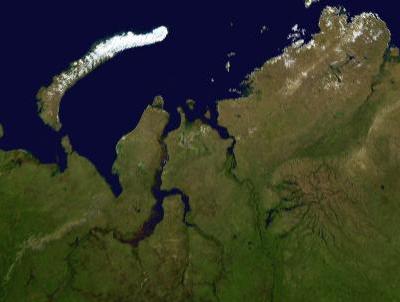
The Yamal Peninsula () is located in the Yamalo-Nenets Autonomous Okrug of northwest Siberia, Russia. It extends roughly 700 km (435 mi) and is bordered principally by the Kara Sea and its Baydaratskaya Bay on the west, and by the Gulf of Ob on the east. At the northern end of this peninsula lie the Malygina Strait and, beyond it, Bely Island. Across Ob estuary lies the Gyda Peninsula. In the languages of the Yamal Peninsula's indigenous inhabitants, the Nenets, Yamal means "End of the Land".
The Yamal peninsula is inhabited by a multitude of migratory bird species.
Climate research
Ancient wildlife
In the summer of 2007 reindeer herder Yuri Khudi found the well-preserved remains of a 37,000-year-old mammoth calf, dubbed "Lyuba", on the peninsula. The female calf was determined to be one month old at the time of death.
Dendrochronology
The Yamal Peninsula is important for the study of climatic history. Dendrochronology is one method used to see how environment has changed.
Dendrochronological research:
- Paper: A continuous multimillennial ring-width chronology in Yamal, northwestern Siberia.
- Paper: An 8768-year Yamal Tree-ring Chronology as a Tool for Paleoecological Reconstructions.
Geography
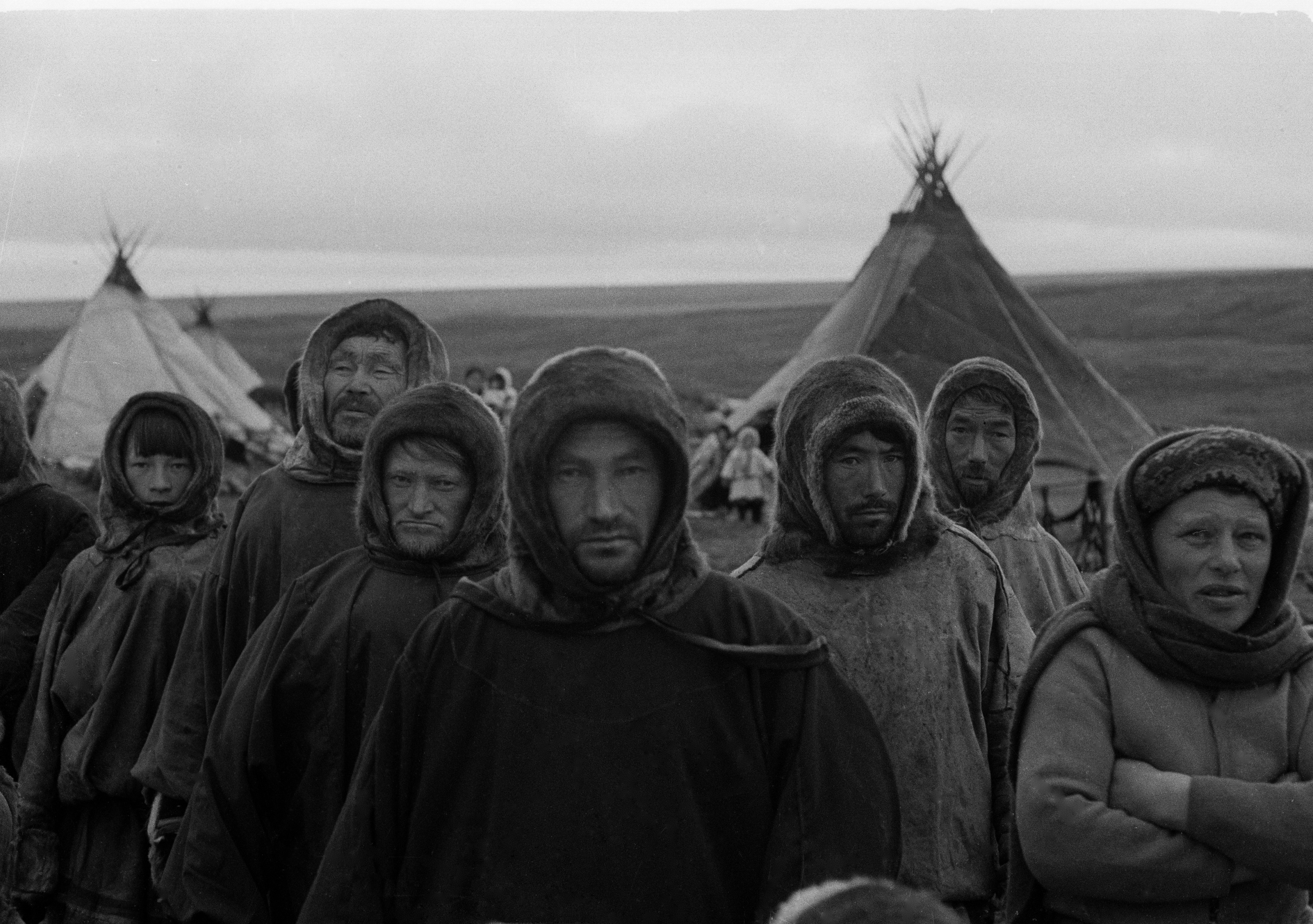
The peninsula consists mostly of permafrost ground and there are numerous lakes of thermokarst origin, the biggest of which are Neito and Yambuto in the central part.
Many hydrocarbon fields have been discovered on the Yamal Peninsula, including large gas fields. The main hydrocarbon resources are concentrated in the permeable Aptian-Cenomanian complex.
Economy
Reindeer husbandry
According to anthropologist Sven Haakanson, the Yamal peninsula is the place within the Russian Federation where traditional large-scale nomadic reindeer husbandry is best preserved. Nenets and Khanty reindeer herders hold about half a million domestic reindeer.
Industry
.jpg)
.jpg)
The area is largely undeveloped, but work is ongoing with several large infrastructure projects, including a gas pipeline and several bridges. Yamal holds Russia's biggest natural gas reserves. The 572 km Obskaya–Bovanenkovo railway, completed in 2011, is the northernmost railway in the world. Russian gas monopolist Gazprom had planned to develop the Yurkharovskoye gas field by 2011–2012. The peninsula's gas reserves are estimated to be 55 trillion cubic meters (tcm). Russia's largest energy project in history, known as the Yamal project, puts the future of nomadic reindeer herding at considerable risk.
Yamal craters
Main article: Gas emission crater
In 2014, Yamal was the discovery site of a distinct sinkhole, dubbed , which quickly drew the attention of world media. The sinkhole appeared to be the result of a huge explosion and several hypotheses were suggested to explain the formation of the crater, including a hit by a meteorite or a UFO, or the collapse of an underground gas facility.
A spokesperson for the Yamal branch of the Emergencies Ministry said, "We can definitely say that it's not a meteorite.". Cryovolcanism has been pointed out as the most probable cause in recent researches.
The 60-meter (66-yard) crater is believed by a senior researcher from the Scientific Research Center of the Arctic, Andrei Plekhanov, in remarks to the Associated Press, to be likely the result of a "buildup of excessive pressure" underground because of warming regional temperatures in that portion of Siberia. Tests conducted by Plekhanov's team showed unusually high concentrations of methane near the bottom of the sinkhole.
The destabilization of gas hydrates containing huge amounts of methane gas is believed to have caused the craters on the Yamal Peninsula.
As of 2015, the Yamal peninsula had at least five similar craters. Another crater appeared in August 2020.
Offshore methane leaks
According to researchers at Norway's (CAGE), through a process called geothermal heat flux, the Siberian permafrost, which extends to the seabed of the Kara Sea, a section of the Arctic Ocean between the Yamal Peninsula and Novaya Zemlya, is thawing. According to a CAGE researcher, Aleksei Portnov:
Methane is leaking in an area of at least 7500 m2. In some areas gas flares extend up to 25 meters. Prior to their research it was proposed that methane was tightly sealed into the permafrost by water depths up to 100 m. Close to the shore however, where the permafrost seal tapers to a depth of as little as 20 m, there are significant amounts of gas leakage.
References
References
- (May 2009). "Ice Baby". National Geographic Magazine.
- (11 July 2007). "Russia: Mammoth's Corpse Found".
- Hantemirov and Shiyatov 2002
- "A continuous multimillennial ring-width chronology in Yamal, northwestern Siberia".
- Hantemirov, R. & Shiyatov, S. & Gorlanova, Ludmila & Kukarskikh, Vladimir & Surkov, A. & Hamzin, Ildar & Fonti, Patrick & Wacker, L.. (2021). An 8768-year Yamal Tree-ring Chronology as a Tool for Paleoecological Reconstructions. Russian Journal of Ecology. 52. 419-427. 10.1134/S1067413621050088.
- "An 8768-year Yamal Tree-ring Chronology as a Tool for Paleoecological Reconstructions".
- "R-41_42 Topographic Chart (in Russian)".
- [[Google Earth]]
- (30 October 2018). "Regional model of the geological structure of the Yamal and Gydan oil-and-gas areas". IOP Conference Series: Earth and Environmental Science.
- Haakanson, Sven. "Reindeer herders". Smithsonian National Museum of Natural History.
- Haakanson, Sven David. (2000). "Ethnoarchaeology of the Yamal Nenets: Utilizing Emic and Etic Evidence in the Interpretation of Archaeological Residues". Harvard University.
- "Yamal megaproject".
- "Obskaya–Bovanenkovo Railroad".
- Harding, Luke. (20 October 2009). "Yamal peninsula: The world's biggest gas reserves".
- Gates, Sara. (16 July 2014). "Giant hole forms in Siberia, and nobody can explain why".
- Bogoyavlensky, Vasily. (October 2015). "Gas Blowouts on the Yamal and Gydan Peninsulas". GEO Publishing Ltd..
- Winter, Lisa. (16 July 2014). "Huge Crater Mysteriously Appears in Siberia". IFL Science.
- (10 September 2018). "Cryovolcanism on the Earth: Origin of a Spectacular Crater in the Yamal Peninsula (Russia)". Scientific Reports.
- "News".
- Moskvitch, Katia. (2014). "Mysterious Siberian crater attributed to methane". Nature.
- Luntz, Stephen. (2 August 2014). "Scientists May Have Solved The Siberian Crater Mystery".
- Winter, Lisa. (26 February 2015). "There are more bizarre craters opening up in Siberia, and scientists still don't know what's causing them".
- Liesowska, Anna. (29 August 2020). "Giant new 50-metre deep crater opens up in Arctic tundra".
- Sojtaric, Maja. (18 December 2014). "Methane is leaking from permafrost offshore Siberia". Centre for Arctic Gas Hydrate (CAGE).
This article was imported from Wikipedia and is available under the Creative Commons Attribution-ShareAlike 4.0 License. Content has been adapted to SurfDoc format. Original contributors can be found on the article history page.
Ask Mako anything about Yamal Peninsula — get instant answers, deeper analysis, and related topics.
Research with MakoFree with your Surf account
Create a free account to save articles, ask Mako questions, and organize your research.
Sign up freeThis content may have been generated or modified by AI. CloudSurf Software LLC is not responsible for the accuracy, completeness, or reliability of AI-generated content. Always verify important information from primary sources.
Report