From Surf Wiki (app.surf) — the open knowledge base
Yalta
City on the southern Crimean Peninsula

City on the southern Crimean Peninsula
| Field | Value |
|---|---|
| official_name | Yalta |
| native_name | Ялта () |
| settlement_type | City |
| image_skyline | Widok na Jałtę ze statku 07.JPG |
| image_flag | Yalta flag 2005.svg100pxborderFlag of Yalta as recognised by Ukraine (de jure)File:Flag of Yalta.svg100pxborderFlag of Yalta as recognised by Russia (de facto)File:1x1.png |
| flag_size | 1px |
| flag_border | no |
| image_shield | COA Yalta, Krym.svg100pxCoat of arms of Yalta as recognised by Ukraine (de jure)File:Coat of arms of Yalta.svg100pxCoat of arms of Yalta as recognised by Russia (de facto)File:1x1.png |
| shield_size | 1px |
| anthem | Southern Capital |
| pushpin_map | Crimea#Ukraine#European Russia#Europe |
| pushpin_map_caption | Location of Yalta within Crimea##Location of Yalta within Ukraine ##Location of Yalta within Russia##Location of Yalta within Europe |
| coordinates | |
| subdivision_type | Country |
| subdivision_type1 | Republic |
| subdivision_name1 | Crimea |
| subdivision_type2 | Municipality |
| subdivision_name2 | Yalta Municipality |
| elevation_m | 40 |
| area_total_km2 | 17.41 |
| area_footnotes | |
| population_density_km2 | auto |
| population_total | 76,746 |
| population_as_of | 2014 |
| timezone | MSK |
| utc_offset | +3 |
| postal_code_type | Postal codes |
| postal_code | (2)98600–(2)98639 |
| area_code | +7-3654 |
| blank_name | Former name |
| blank_info | Yalita (until the 15th century) |
| blank1_name | Climate |
| blank1_info | Cfa |
| mapframe | yes |
| mapframe-zoom | 11 |
| mapframe-wikidata | yes |
| mapframe-point | none |
| mapframe-zoom = 11 | mapframe-wikidata = yes | mapframe-point = none
Yalta (: Ялта) is a resort city on the south coast of the Crimean Peninsula surrounded by the Black Sea. It serves as the administrative center of Yalta Municipality, one of the regions within Crimea. Yalta, along with the rest of Crimea, is internationally recognised as part of Ukraine, and is considered part of the Autonomous Republic of Crimea. However, it is controlled de facto by Russia, which annexed Crimea in 2014 and regards the town as part of the Republic of Crimea. According to the most recent census, its population was
The city is located on the site of the ancient Greek colony of Yalita ( ). It is said to have been founded by Greek settlers who were looking for a safe shore on which to land. It is situated on a deep bay facing south towards the Black Sea, surrounded by the mountain range Ai-Petri. It has a humid subtropical climate and is surrounded by numerous vineyards and orchards.
The area became famous in 1945 when the city held the Yalta Conference as part of the Allied World War II conferences of major wartime national leaders.
The term "Greater Yalta" is used to designate a part of the Crimean southern coast spanning from Foros in the west to Gurzuf in the east, and including the city of Yalta and multiple adjacent urban settlements.
History
12th–19th centuries
The existence of Yalta was recorded in the 12th century by an Arab geographer, who described it as a Byzantine port and fishing settlement. It became part of a network of Genoese trading colonies on the Crimean coast in the 14th century when it was known as Etalita or Galita. Crimea was captured by the Ottoman Empire in 1475, which made it a semi-independent subject territory under the rule of the Crimean Khanate but the southern coast with Yalta was under direct Ottoman rule forming the Eyalet of Kefe (Feodosiya). Yalta was annexed by the Russian Empire in 1783, along with the rest of Crimea, sparking the Russo-Turkish War (1787–1792). Prior to the annexation of the Crimea, the Crimean Greeks were moved to Mariupol in 1778; one of the villages they established nearby is also called Yalta.
In the 19th century, the town became a fashionable resort for the Russian aristocracy and gentry. Leo Tolstoy spent summers there and Anton Chekhov in 1898 bought a house (the White Dacha) here, where he lived until 1902; Yalta is the setting for Chekhov's short story, "The Lady with the Dog", and such prominent plays as The Three Sisters were written in Yalta. The town was also closely associated with royalty. In 1889 Tsar Alexander III finished construction of Massandra Palace a short distance to the north of Yalta and Nicholas II built the Livadia Palace southwest of the town in 1911.
20th century
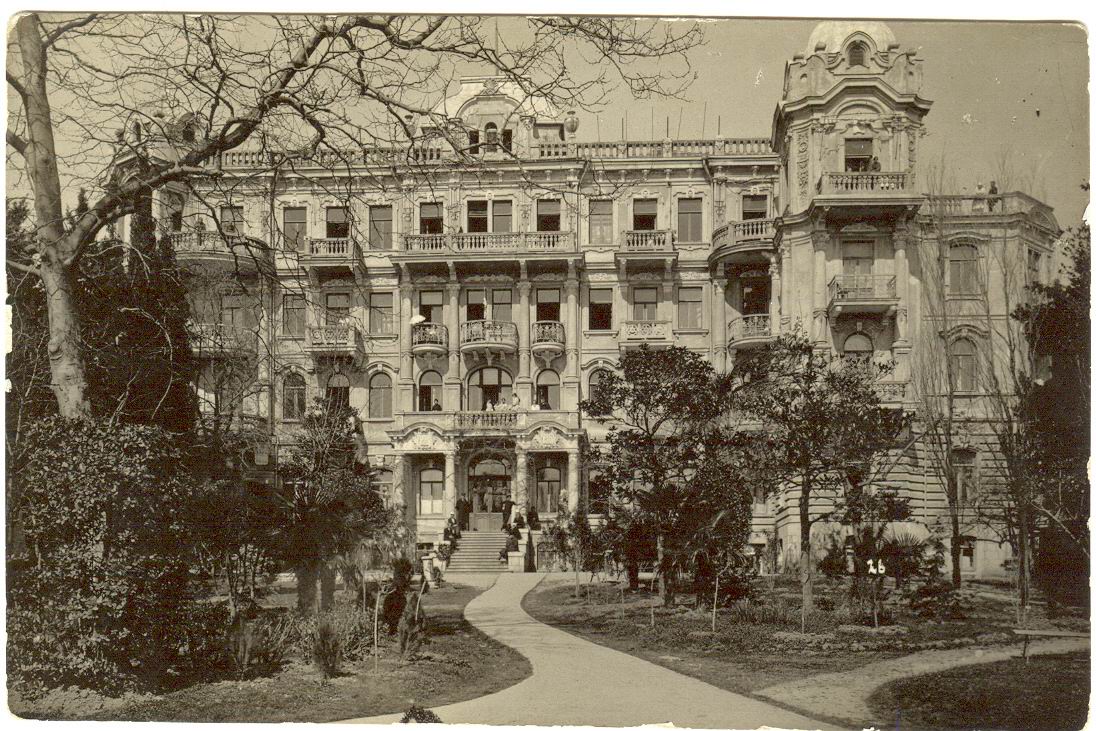
During the 20th century, Yalta was the principal holiday resort of the Soviet Union. In 1920, Vladimir Lenin issued a decree "On the Use of Crimea for the Medical Treatment of the Working People" which endorsed the region's transformation from a fairly exclusive resort area into a recreation facility for tired proletarians. Numerous workers' sanatoria were constructed in and around Yalta and the surrounding district. There were, in fact, few other places that Soviet citizens could come for a seaside holiday, as foreign travel was forbidden to all but a handful. The Soviet elite also came to Yalta; the Soviet premier Joseph Stalin used the Massandra Palace as his summer residence.
Yalta was occupied by the German Army from 9 November 1941 to 16 April 1944.
The town came to worldwide attention in 1945 when the Yalta Conference between the "Big Three" powers – the Soviet Union, the United States and the United Kingdom – was held at the Livadia Palace.
21st century
Following the dissolution of the Soviet Union in 1991, Yalta has struggled economically. Many of the nouveaux riches of ex-Soviet citizens began going to other European holiday resorts, now that they had the freedom and money to travel; conversely, the impoverishment of many ex-Soviet citizens meant that they could no longer afford to go to Yalta. The town's transport links have been significantly reduced with the end of almost all passenger traffic by sea. The longest trolleybus line in Europe goes from the train station in Simferopol to Yalta (almost 90km). Yalta is crowded in the vacation season (July–August) and prices for accommodation are very high. Most of the tourists are from countries of the former Soviet Union; in 2013, about 12% of tourists to Crimea were Westerners from more than 200 cruise ships.
Yalta has a beautiful seafront promenade along the Black Sea. People can be seen strolling there all seasons of the year, and it also serves as a place to gather and talk, to see and be seen. There are several beaches to the east and west of the promenade. Many kinds of pine trees (Stone pine and Aleppo pine for example), oleander shrubs, lemon and olive trees and different sorts of palm trees such as the Chinese windmill palm, the Mexican fan palm and the Canary Island date palm are scattered all over the city. The town has several movie theaters, a drama theater, plenty of restaurants, and several open-air markets.
Two beaches in Yalta are Blue Flag beaches since May 2010, these were the first beaches (with two beaches in Yevpatoria) to be awarded a Blue Flag in a CIS member state.
Main sights


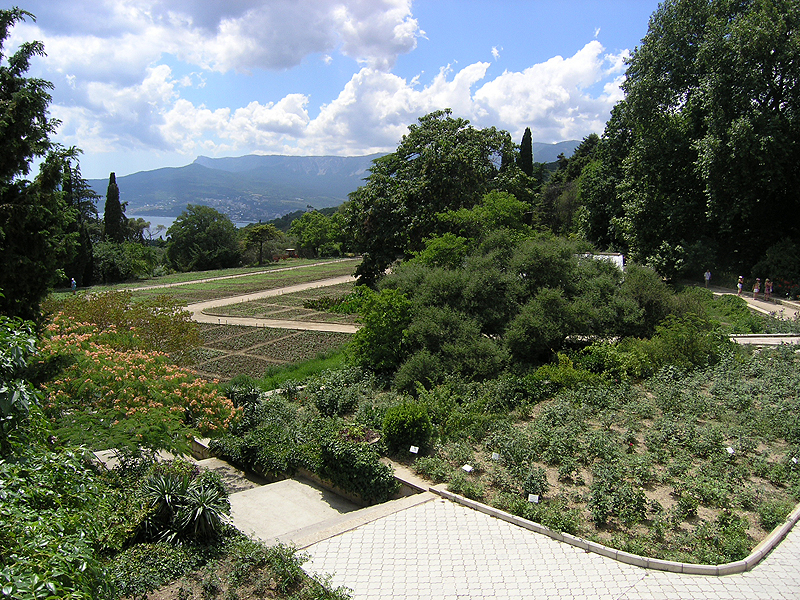
Famous attractions within or near Yalta are:
- Yalta's Sea Promenade (Naberezhnaya), housing many attractions, which was renovated in 2003 and 2004
- Saint Hripsime Church of Yalta, an Armenian Church, with frescoes by V. Surenyants
- A Roman Catholic Church built by Nikolay Krasnov
- Yalta's cable car, taking visitors to the Darsan hill, from which one can see Yalta's shoreline
- Renovated Hotel Taurica, the first hotel in the former Russian Empire with elevators
- Alexander Nevsky Cathedral, constructed by the architect Krasnov, who also constructed the Livadia Palace and the architect P. Terebenyov
- Former main building of the Ministry of Defence hotel, built in the style of a Gothic castle
- Palace of Bukhara Emir
- Yalta's Zoo
- Yalta's Aquarium, housing small dolphins
- Park-museum Polyana Skazok (Glade of Fairytales)
- White Dacha – House-museum of Anton Chekhov
- House-museum of Lesya Ukrainka at Lesya Ukrainka Museum
- House with Caryatids, where the composer A. Spendiarov lived
- Yalta Intourist, the largest hotel in Ukraine
- Roffe Bath, historical monument
Moreover, Yalta's suburbs contain:
- Foros Church
- Nikitsky Botanical Garden (Nikita)
- Livadia Palace (Livadiya)
- Organ hall in Livadiya
- Massandra Palace (Massandra)
- Massandra Winery and Vaults
- International children's centre of Artek (Gurzuf)
- Ai-Petri Mountain (1233 metres high, with a cable car traveling to and from the mountain)
- Alupka Palace
- Swallow's Nest castle near Gaspra.
- Tsar's Path hiking trail
Geography
Climate
As Yalta lies to the south of the Crimean Mountains and within an amphitheatre of hills, the climate is mild. Köppen classifies the city as humid subtropical (Cfa), bordering on a Mediterranean climate (Köppen climate classification: Csa); while the city's Trewartha class is oceanic (Do), barely missing the criteria for humid subtropical (Cf). In February, the average temperature reaches 4 °C. Snow is infrequent and melts soon thereafter. In July, the average temperature reaches 24 °C. The average annual precipitation is 612 mm, most of it being concentrated in the colder months. The sun shines approximately 2,169 hours per year. Since the city is located on the shore of the Black Sea, the weather rarely becomes extremely hot due to the cool sea breezes. The average annual temperature for Yalta is around 14 C, which makes it one of the warmest places in Ukraine.
| Jan record high C = 17.8 | Feb record high C = 20.2 | Mar record high C = 27.8 | Apr record high C = 28.5 | May record high C = 33.0 | Jun record high C = 35.0 | Jul record high C = 39.1 | Aug record high C = 39.1 | Sep record high C = 33.2 | Oct record high C = 31.5 | Nov record high C = 25.2 | Dec record high C = 22.0 | year record high C = 39.1 | Jan record low C = -12.2 | Feb record low C = -12.3 | Mar record low C = -7.3 | Apr record low C = -3.8 | May record low C = 2.8 | Jun record low C = 7.8 | Jul record low C = 12.4 | Aug record low C = 10.0 | Sep record low C = 3.9 | Oct record low C = -1.1 | Nov record low C = -8.9 | Dec record low C = -7.4 | year record low C = -12.3 | Jan snow depth cm = 1 | Feb snow depth cm = 1 | Mar snow depth cm = 1 | Apr snow depth cm = 0 | May snow depth cm = 0 | Jun snow depth cm = 0 | Jul snow depth cm = 0 | Aug snow depth cm = 0 | Sep snow depth cm = 0 | Oct snow depth cm = 0 | Nov snow depth cm = 0 | Dec snow depth cm = 0 | year snow depth cm = 1
.jpg)
.jpg)
Demographics
|1897 | 13155 |1923 | 18345 |1926 | 28758 |1939 | 32683 |1959 | 43994 |1970 | 62170 |1979 | 80098 |1989 | 88549 |1992 | 90000 |1998 | 86000 |2001 | 81654 |2003 | 80979 |2004 | 80416 |2005 | 80140 |2006 | 79796 |2007 | 79380 |2008 | 78935 |2009 | 78584 |2010 | 78334 |2011 | 78034 |2012 | 78040 |2013 | 78115 |2014 | 78200 |2020 | 79056 |2021 | 74652 |2025 | 72013
As of the Ukrainian Census conducted on 1 January 2001, the population of Yalta is 80,500. The main ethnic groups of Yalta are: Russians (65.5%), Ukrainians (27.7%), Belarusians (1.6%), and Crimean Tatars (1.3%). In terms of spoken languages, the majority of the population speaks Russian (88.1%) as their mother tongue, followed by significant minorities of native Ukrainian (8.9%) and Crimean Tatar speakers (1.1%).
This total number does not comprise the population of neighbouring villages and small towns. The metropolitan area population is about 139,500.
Twin towns – sister cities
Main article: List of twin towns and sister cities in Ukraine
Yalta is twinned with:
- TUR Antalya, Turkey
- GER Baden-Baden, Germany
- GEO Batumi, Georgia
- ISR Eilat, Israel
- JPN Fujisawa, Japan
- RUS Grozny, Russia
- RUS Kaluga, Russia
- USA Santa Barbara, United States
- AZE Khachmaz, Azerbaijan
- SYR Latakia, Syria
- UKR Luhansk, Ukraine
- ENG Margate, England, United Kingdom
- FRA Nice, France
- ITA Pozzuoli, Italy
- GRC Rhodes, Greece
- ITA Salsomaggiore Terme, Italy
- CHN Sanya, China
- EGY Sharm El Sheikh, Egypt
- RUS Ulan-Ude, Russia
- RUS Vladikavkaz, Russia
- GEO Gagra, Georgia
Notable people born in Yalta
- Oleksandr Lignau (1872–1938), Ukrainian general and first Minister of War of the Ukrainian State
- Alla Nazimova (1879–1945), Russian-American actress
- Viktor Kopp (1880–1930), Soviet diplomat of German ethnicity
- Louis Hofbauer (1889–1932), Austrian artist
- Serge Piménoff (1895–1960), French art director
- Nathalie Kovanko (1899–1967), Ukrainian actress
- Alla Horska (1929–1970), Ukrainian artist
- Antonina Rudenko (born 1950), Soviet-Ukrainian swimmer
- Nathalia Edenmont (born 1970), Ukrainian-Swedish artist
- Nika Turbina (1974–2002), Russian poet
- Julia Vakulenko (born 1983), Ukrainian tennis player
- Vera Rebrik (born 1989), Ukrainian-Russian track field athlete
- Peter Paltchik (born 1992), Ukrainian-born Israeli Olympic and European champion judoka
- Valentina Ivakhnenko (born 1993), Ukrainian-Russian tennis player
Notes
References
References
- https://yalta.rk.gov.ru/structure/4cafc150-58dc-4778-82ab-2ed29fd8d34c
- "Cities and Settlements in Jalta (Crimea, Ukraine)".
- Wells, John C.. (2008). "[[Longman Pronunciation Dictionary]]". [[Longman]].
- (30 September 2022). "Fictitious Annexation Follows Voting".
- (2015). "The Black Sea Encyclopedia". [[Springer Publishing]].
- Kottek, M.. (2006). "World Map of the Köppen-Geiger climate classification updated". Meteorol. Z..
- [https://www.nytimes.com/2014/05/25/world/europe/for-crimea-its-russian-troops-in-tourists-out.html?_r=0 New York Times], ''For Crimea, It's Russian Troops In, Tourists Out'', by Neil MacFarquhar, 24 May 2014,
- [http://www.kyivpost.com/news/nation/detail/66482/ Four beaches in Crimea receive international certificates of cleanliness], [[Kyiv Post]] (12 May 2010)
- "Климат Ялты". Погода и климат (Weather and Climate).
- "Yalta Climate Normals 1991–2020". [[National Centers for Environmental Information]].
- "Cities & towns of Ukraine".
- https://rosstat.gov.ru/storage/mediabank/CcG8qBhP/mun_obr2020.rar
- https://rosstat.gov.ru/storage/mediabank/tab-5_VPN-2020.xlsx {{Bare URL spreadsheet. (January 2026)
- https://rosstat.gov.ru/storage/mediabank/%D0%A1hisl_MO_01-01-2025.xlsx {{Bare URL spreadsheet. (January 2026)
- [http://sf.ukrstat.gov.ua/perepis1.htm#_jaz Central Statistical Office of AR Crimea] {{Webarchive. link. (28 August 2012, see «Ялта», column №3.)
- "Рідні мови в об'єднаних територіальних громадах України".
- (28 April 2017). "Ялта и итальянский Родвиго планируют стать городами-побратимами". Gazeta Crimea.
- (13 August 2019). "Ялта и Грозный стали городами-побратимами".
- (22 April 2018). "Ялта и итальянский Родвиго планируют стать городами-побратимами". Fontanka.
- (18 January 2019). "Луганск и Ялта побратаются. Луганчан ждут скидки на ЮБК?".
This article was imported from Wikipedia and is available under the Creative Commons Attribution-ShareAlike 4.0 License. Content has been adapted to SurfDoc format. Original contributors can be found on the article history page.
Ask Mako anything about Yalta — get instant answers, deeper analysis, and related topics.
Research with MakoFree with your Surf account
Create a free account to save articles, ask Mako questions, and organize your research.
Sign up freeThis content may have been generated or modified by AI. CloudSurf Software LLC is not responsible for the accuracy, completeness, or reliability of AI-generated content. Always verify important information from primary sources.
Report