From Surf Wiki (app.surf) — the open knowledge base
XpressMusic
Brand name for Nokia phones

Brand name for Nokia phones
| Field | Value |
|---|---|
| logo | Xpressmusic.png |
| image | Nokia 5310 front.jpg |
| producttype | Cellular phones |
| producedby | Nokia |
| origin | Finland |
| introduced | |
| discontinued | 2010 |
| markets | International |
| previousowners | Nokia |
| module | |
| module1 |
XpressMusic was a brand name for a line of Nokia mobile phones that were specially designed for music playback. All of the XpressMusic handsets came with expandable MicroSD memory slots and dedicated music keys, so these phones could also be used as MP3 players. The XpressMusic range was launched in September 2006 to compete with the Walkman brand series from Sony Ericsson. Except the Nokia 3250, all XpressMusic models were marketed with the 5000 series prefixes.
In September 2009, Nokia announced the Xseries line of phones. The Xseries replaced the XpressMusic brand.
On March 19, 2020, HMD Global announced Nokia 5310 as the revival version of Nokia 5310 XpressMusic, running Series 30+. Later, in 2022, they released "XpressAudio" branded feature phone Nokia 5710 with the main feature that have wireless Bluetooth earbuds inside the phone.
History
2006–2007
The original XpressMusic lineup was announced on 27 September 2006, consisting of an all glossy white shell and durable rubberised sides. First models included the rotating candybar Nokia 3250 XpressMusic (a revamped Nokia 3250) and the slider Nokia 5300 XpressMusic. Another slider similar to 5300 was also launched called Nokia 5200, but that model was not marketed as XpressMusic. These were first released before the end of the 2006.
A few months later for the 2007 year, the Nokia 5700 was added to the lineup, using a twisting function like the 3250. The ux design for music services was designed by Justin Small, previously design lead of UK start up Sendo Mobile Phones and later Motorola Mobile EMEUA. Small forecast that the Spotify model would bloom.
| Model | Announced date | Platform | Form factor | Screen | Networks | Memory card |
|---|---|---|---|---|---|---|
| (max size) | ||||||
| 3250 | ||||||
| (XpressMusic variant) | S60 3rd Edition | Candybar | ||||
| (Keypad twists) | 176 × 208 | |||||
| (18-bit) | GSM / (E)GPRS | MicroSD | ||||
| (2 GiB) | ||||||
| 5300 | S40 3rd Ed., FP 2 | Slider | 240 × 320 | |||
| (18-bit) | GSM / (E)GPRS | MicroSD | ||||
| (2 GiB) | ||||||
| 5700 | S60 3rd Ed., FP 1 | Candybar | ||||
| (Keypad twists) | 240 × 320 | |||||
| (24-bit) | GSM / (E)GPRS / UMTS | MicroSD | ||||
| (2 GiB) |
2008
The 2008 lineup saw the first 3G XpressMusic phones, first the 5610 and later the 5320, which included HSDPA. The lineup also added support for MicroSDHC, allowing cards larger than 2GB. The 5610 would be the only XpressMusic phone without a 3.5 mm headphone jack, instead having a 2.5 mm headphone jack.
| Model | Announced date | Platform | Form factor | Screen | Networks | Memory card |
|---|---|---|---|---|---|---|
| (max size) | ||||||
| 5310 | S40 5th Ed., FP 1 | Candybar | 240 × 320 | |||
| (24-bit) | GSM / (E)GPRS | MicroSDHC | ||||
| (2 GiB) | ||||||
| 5610 | S40 5th Ed., FP 1 | Slider | 240 × 320 | |||
| (24-bit) | GSM / (E)GPRS / UMTS | MicroSDHC | ||||
| (4 GiB) | ||||||
| 5220 | S40 5th Ed., FP 1 | Candybar | 240 × 320 | |||
| (18-bit) | GSM / (E)GPRS | MicroSDHC | ||||
| (8 GiB) | ||||||
| 5320 | S60 3rd Ed., FP 2 | Candybar | 240 × 320 | |||
| (24-bit) | GSM / (E)GPRS / UMTS / HSDPA | MicroSDHC | ||||
| (16 GiB) |
2009
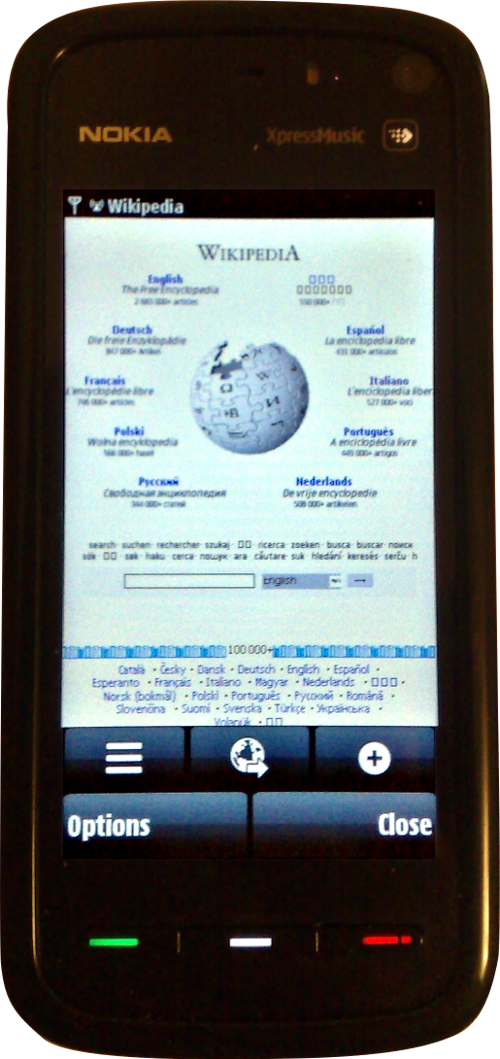
The 2009 lineup started with the 5800, one of two new phones (the other being the N97) to use the new touch-based S60 5th Edition, likely designed as a response to the increasing popularity of touchscreen handsets in the market. However, Nokia used the resistive instead of capacitive touchscreen reportedly to appeal to the global market. In this technology, touch is registered when two thin layers of the screen got pushed together under the finger. The 5800 (nicknamed the Tube) also featured a 3.2 megapixel camera with Carl Zeiss technology. Apart from the 5130 and lesser-known 5330, the rest of the lineup are 3G phones running Symbian S60 software, as the Nseries handsets of the time. Despite being a part of the XpressMusic series, the 5800 combined many standard smartphone capabilities too.
| Model | Announced date | Platform | Form | ||
|---|---|---|---|---|---|
| factor | Input | Screen | Networks | Memory card | |
| (max size) | |||||
| 5800 | S60 5th Edition | Slate | Touch | 360 × 640 | |
| (24-bit) | GSM / (E)GPRS / UMTS / HSDPA / HSUPA / Wi-Fi / GPS / A-GPS | MicroSDHC | |||
| (16 GiB) | |||||
| 5130 | S40 5th Ed., FP 1 | Candybar | Keypad | 240 × 320 | |
| (18-bit) | GSM / (E)GPRS | MicroSDHC | |||
| (16 GiB) | |||||
| 5630 | S60 3rd Ed., FP 2 | Candybar | Keypad | 240 × 320 | |
| (24-bit) | GSM / (E)GPRS / UMTS / HSDPA / HSUPA / Wi-Fi / GPS / A-GPS | MicroSDHC | |||
| (16 GiB) | |||||
| 5330 | S40 5th Ed., FP 1 | Slider | Keypad | 240 × 320 | |
| (24-bit) | GSM / (E)GPRS / 3G / UMTS / GPS / A-GPS | MicroSDHC | |||
| (16 GiB) | |||||
| 5730 | S60 3rd Ed., FP 2 | Candybar | Keypad, | ||
| QWERTY keyboard | 240 × 320 | ||||
| (24-bit) | GSM / (E)GPRS / UMTS / HSDPA / HSUPA / Wi-Fi / GPS / A-GPS | MicroSDHC | |||
| (32 GiB) | |||||
| 5530 | S60 5th Edition | Slate | Touch | 360 × 640 | |
| (24-bit) | GSM / (E)GPRS / Wi-Fi | MicroSDHC | |||
| (16 GiB) |
References
References
- (September 28, 2006). "Nokia 3250 XpressMusic, 5200, and 5300 | Digital Trends".
- Penalva, Javier. (September 27, 2006). "Nokia 5300 XpressMusic, Nokia 5200 & Nokia 3250 XpressMusic".
- "Device Details -- Nokia 3250". [[Nokia]].
- "Device Details -- Nokia 5300 XpressMusic". [[Nokia]].
- "Device Details -- Nokia 5700 XpressMusic". [[Nokia]].
- "Device Details -- Nokia 5310 XpressMusic". [[Nokia]].
- "Device Details -- Nokia 5610 XpressMusic". [[Nokia]].
- "Device Details -- Nokia 5220 XpressMusic". [[Nokia]].
- "Device Details -- Nokia 5320 XpressMusic". [[Nokia]].
- Techradar. (March 30, 2009). "Nokia 5800 XpressMusic".
- Miller, Paul. (October 2, 2008). "Nokia 5800 XpressMusic hands-on".
- Mahoney, John. (2 October 2008). "Nokia 5800 XpressMusic: Hands-on With Nokia's First S60 Touch Phone".
- "Device Details -- Nokia 5800 XpressMusic". [[Nokia]].
- "Device Details -- Nokia 5130 XpressMusic". [[Nokia]].
- "Device Details -- Nokia 5630 XpressMusic". [[Nokia]].
- (March 11, 2009). "Nokia 5330 XpressMusic revealed".
- "Device Details -- Nokia 5730 XpressMusic". [[Nokia]].
- "Device Details -- Nokia 5530 XpressMusic". [[Nokia]].
This article was imported from Wikipedia and is available under the Creative Commons Attribution-ShareAlike 4.0 License. Content has been adapted to SurfDoc format. Original contributors can be found on the article history page.
Ask Mako anything about XpressMusic — get instant answers, deeper analysis, and related topics.
Research with MakoFree with your Surf account
Create a free account to save articles, ask Mako questions, and organize your research.
Sign up freeThis content may have been generated or modified by AI. CloudSurf Software LLC is not responsible for the accuracy, completeness, or reliability of AI-generated content. Always verify important information from primary sources.
Report