From Surf Wiki (app.surf) — the open knowledge base
Xolotl
Aztec god of fire and lightning
Aztec god of fire and lightning
| Field | Value |
|---|---|
| type | Aztec |
| name | Xolotl |
| image | Xolotl from Codex Borgia.jpg |
| caption | Xolotl as depicted in the Codex Borgia |
| god_of | God of twilight, fire, lightning, and twins, lord of monsters, misfortune, death, sickness, and deformities |
| other_names | Evil twin, Xoloitzcuintle, Xoloitzcuintli, Xolo |
| abode | Mictlān (the Underworld) |
| symbol | xoloitzcuintle |
| planet | Venus (Evening Star) Mercury (Codex Borgia) |
| parents | Mixcoatl and Chimalma (Codex Chimalpopoca) |
| siblings | Quetzalcoatl (Codex Chimalpopoca) |
| consort | None |
| children | None |
| gender | Male |
| region | Mesoamerica |
| ethnic_group | Nahuas |
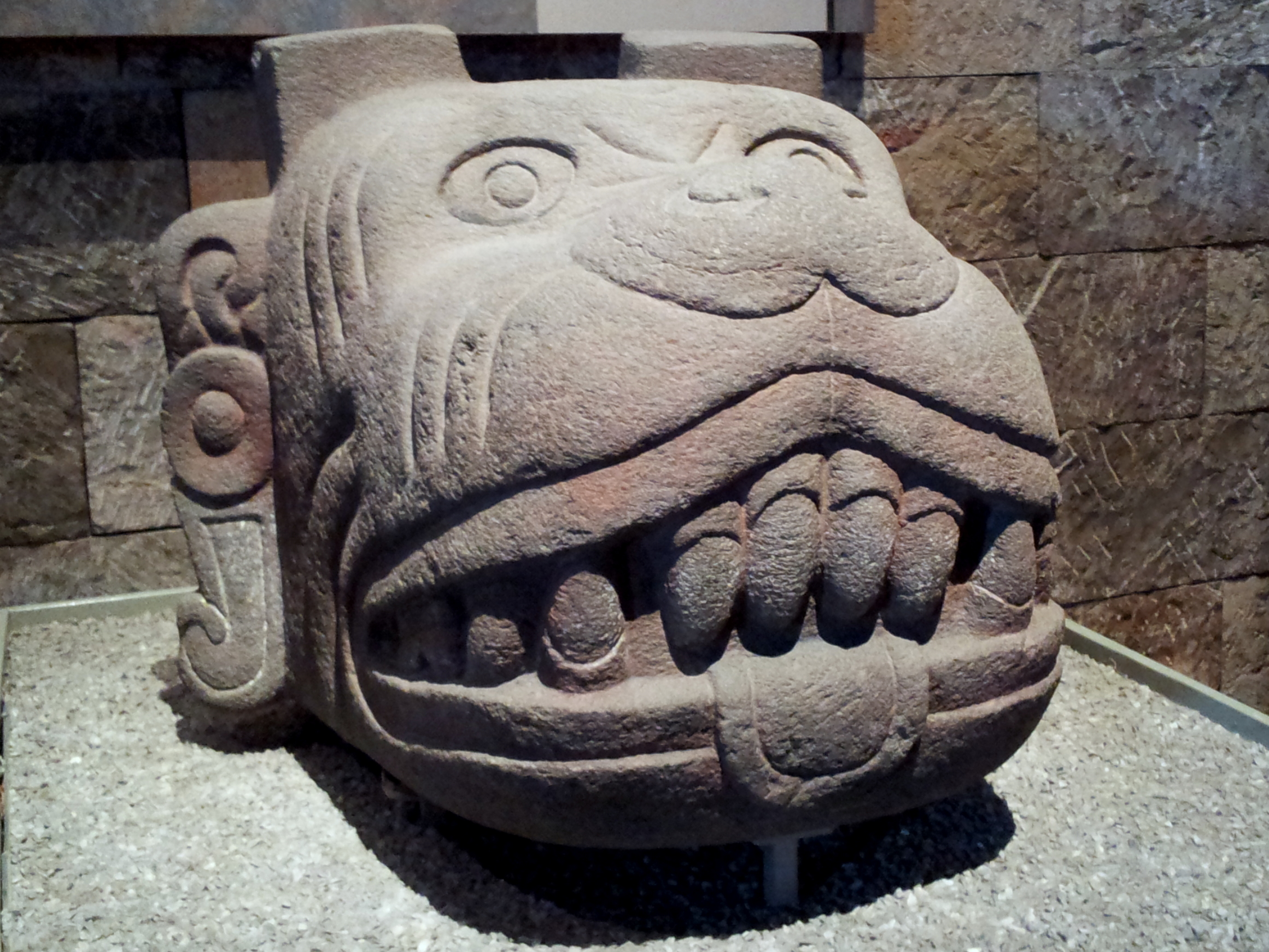
In Aztec mythology, Xolotl () was a god of fire and lightning. He was commonly depicted as a dog-headed man and was a psychopomp. He was also god of twins, monsters, death, misfortune, sickness, and deformities. Xolotl is the canine brother and twin of Quetzalcōātl, the pair being sons of the virgin Chīmalmā. He is the dark personification of Venus as the Evening Star, and was associated with heavenly fire. The axolotl is named after him.
Myths and functions

Xolotl was the sinister god of monstrosities who wears the conch-like ehēcailacacōcatl "twisted wind jewel" of Quetzalcōātl. His job was to protect the sun from the dangers of the underworld. As a double of Quetzalcōātl, Xolotl accompanied Quetzalcōātl to Mictlān, the land of the dead, or the underworld, to retrieve the bones from those who inhabited the previous world (Nāhuiātl) to create new life for the present world, Nahui Ollin, the sun of movement. In a sense, this recreation of life is reenacted every night when Xolotl guides the sun through the underworld. In the tōnalpōhualli, Xolotl rules over day Olin "movement" and over the trecena 1-Cozcacuauhtli (vulture).{{cite web |publisher= azteccalendar.com
His empty eye sockets are explained in the legend of Teotihuacan, in which the gods decided to sacrifice themselves for the newly created sun. Xolotl withdrew from this sacrifice and wept so much that his eyes fell out of their sockets. According to the creation recounted in the Florentine Codex, after the Fifth Sun was initially created, it did not move. Ehecatl ("God of Wind") consequently began slaying all other gods to induce the newly created Sun into movement. Xolotl, however, was unwilling to die in order to give movement to the new Sun. Xolotl transformed himself into a young maize plant with two stalks (xolotl), a doubled maguey plant (mexolotl), and an amphibious animal (axolotl). Xolotl is thus a master transformer. In the end, Ehecatl succeeded in finding and killing Xolotl.
In art, Xolotl was typically depicted as a dog-headed man, a skeleton, or a deformed monster with reversed feet. An censer in the form of a skeletal canine depicts Xolotl.{{cite news |newspaper= World History Encyclopedia |access-date= 2016-01-31 |archive-date= 2019-01-07 |archive-url= https://web.archive.org/web/20190107181326/http://www.xoloitzcuintliclubofamerica.org/about_xolos |url-status= dead
In the Aztec calendar, the ruler of the day Itzcuīntli ("Dog"), is Mictlāntēcutli "lord of Mictlān", the god of death and the underworld.
Origin

Xolotl is sometimes depicted carrying a torch in the surviving Maya codices, which reference the Maya tradition that the dog brought fire to mankind. In the Mayan codices, the dog is conspicuously associated with the god of death, storm, and lightning. Xolotl appears to have affinities with the Zapotec and Maya lightning-dog, and may represent the lightning which descends from the thundercloud, the flash, the reflection of which arouses the misconceived belief that lightning is "double", and leads them to suppose a connection between lightning and twins.
Xolotl originated in the southern regions, and may represent fire rushing down from the heavens or light flaming up in the heavens. Xolotl was originally the name for the lightning beast of the Maya, often taking the form of a dog. The dog plays an important role in Maya manuscripts. He is the lightning beast, who darts from heaven with a torch in his hand. Xolotl is represented directly as a dog, and is distinguished as the deity of air and of the four directions of the wind by Quetzalcoatl's breast ornament. Xolotl is to be considered equivalent to the beast darting from heaven of the Maya manuscript. The dog is the animal of the dead and therefore of the Place of Shadows.
File:Förstemann Dresden Codex Fire Dog (p.6).jpg|Dresden Codex Dog (p. 7) File:Förstemann Dresden Codex Fire Dog (p.68).jpg| Dog (p. 39) File:Förstemann Dresden Codex Fire Dog (p.69).jpg| Dog (p. 40)
Ollin and Xolotl

_Day_symbol.jpg)
Eduard Seler associates Xolotl's portrayal as a dog with the belief that dogs accompany the souls of the dead to Mictlan. He finds further evidence of the association between Xolotl, dogs, death, and Mictlan in the fact that Mesoamericans viewed twins as unnatural monstrosities and consequently commonly killed one of the two twins shortly after birth. Seler speculates that Xolotl represents the murdered twin who dwells in the darkness of Mictlan, while Quetzalcoatl ("The Precious Twin") represents the surviving twin who dwells in the light of the sun.
In manuscripts the setting sun, devoured by the earth, is opposite Xolotl's image. Quetzalcoatl and Xolotl constitute the twin phases of Venus as the morning and evening star, respectively. Quetzalcoatl as the morning star acts as the harbinger of the Sun's rising (rebirth) every dawn, Xolotl as the evening star acts as the harbinger of the Sun's setting (death) every dusk. In this way they divide the single life-death process of cyclical transformation into its two phases: one leading from birth to death, the other from death to birth.
Xolotl was the patron of the Mesoamerican ballgame. Some scholars argue the ballgame symbolizes the Sun's perilous and uncertain nighttime journey through the underworld. Xolotl is able to help in the Sun's rebirth since he possesses the power to enter and exit the underworld. In several of the manuscripts Xolotl is depicted striving at this game against other gods. For example, in the Codex Mendoza we see him playing with the moon-god, and can recognize him by the sign ollin which accompanies him, and by the gouged-out eye in which that symbol ends. Seler thinks "that the root of the name ollin suggested to Mexicans the motion of the rubber ball olli and, as a consequence, ball-playing."
Ollin is pulsating, oscillating, and centering motion-change. It is typified by bouncing balls, pulsating hearts, labor contractions, earthquakes, flapping butterfly wings, the undulating motion of weft activities in weaving, and the oscillating path of the Fifth Sun over and under the surface of the earth. Ollin is the motion-change of cyclical completion.{{cite web |publisher= mexicolore.co.uk
A jade statue of a skeletal Xolotl carrying a solar disc bearing an image of the Sun on his back{{cite web |publisher= Latinamericastudies.org |access-date= 2016-02-01 |archive-date= 2020-05-23 |archive-url= https://web.archive.org/web/20200523144142/https://www.gettyimages.com/detail/illustration/statue-of-xolotl-rear-view-artefact-from-mexico-aztec-stock-graphic/148357417 |url-status= dead
Nanahuatzin and Xolotl

.jpg)
A close relationship between Xolotl and Nanahuatzin exists. Xolotl is probably identical with Nanahuatl (Nanahuatzin). Seler characterizes Nanahuatzin ("Little Pustule Covered One"), who is deformed by syphilis, as an aspect of Xolotl in his capacity as god of monsters, deforming diseases, and deformities. The syphilitic god Nanahuatzin is an avatar of Xolotl.
Notes
References
- {{cite book |author=Sweely |author-first=Tracy L. |title=Manifesting Power: Gender and the Interpretation of Power in Archaeology.
References
- Cecilio A. Robelo. (1905). "Diccionario de Mitología Nahoa". Editorial Porrúa.
- {{harvnb. Johns. 2008
- {{harvnb. Milbrath. 2013
- {{harvnb. Milbrath. 2013
- {{harvnb. Neumann. 1975
- {{harvnb. Seler. 2010
- {{harvnb. Seler. 2010
- "Mictlantecuhtli".
- {{harvnb. Neumann. 1975
- {{harvnb. Johnson. 1994
- {{harvnb. Spence. 2015
- {{harvnb. Seler. 2010
- {{harvnb. Seler. 2010
- {{harvnb. Seler. 2010
- {{harvnb. Seler. 2010
- {{harvnb. Maffie. 2013
- {{harvnb. Spence. 2015
- {{harvnb. Boone. 2013 {{pages needed. (December 2023)
- {{harvnb. Milbrath. 2013
- {{harvnb. Boone. 1985
- {{harvnb. Spence. 1994
- {{harvnb. Sweely. 1999
This article was imported from Wikipedia and is available under the Creative Commons Attribution-ShareAlike 4.0 License. Content has been adapted to SurfDoc format. Original contributors can be found on the article history page.
Ask Mako anything about Xolotl — get instant answers, deeper analysis, and related topics.
Research with MakoFree with your Surf account
Create a free account to save articles, ask Mako questions, and organize your research.
Sign up freeThis content may have been generated or modified by AI. CloudSurf Software LLC is not responsible for the accuracy, completeness, or reliability of AI-generated content. Always verify important information from primary sources.
Report