From Surf Wiki (app.surf) — the open knowledge base
Xanthone
Diphenyline ketone oxide
Xanthone is an organic compound with the molecular formula C13H8O2. It is a white solid.
In 1939, xanthone was introduced as an insecticide and it currently finds uses as ovicide for codling moth eggs and as a larvicide. Xanthone is also used in the preparation of xanthydrol, which is used in the determination of urea levels in the blood. It can also be used as a photocatalyst.
Synthesis
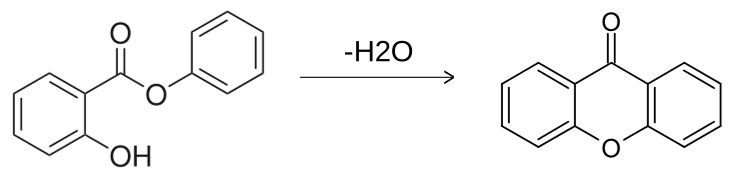
Xanthone can be prepared by the heating of phenyl salicylate:
Various other methods of synthesis given are:
- Heating a mixture of salicylic acid, phenol, and acetic anhydride.
- Warming o-phenoxybenzoic acid with sulfuric acid or phosphorous pentoxide.
- Distillation of o-phenoxybenzoyl chloride under vacuum.
- Heating of aspirin or o-hydroxybenzophenone.
Derivatives
Multiple methods have been reported for synthesizing xanthone derivatives:
- The Michael-Kostanecki method uses an equimolar mix of a polyphenol and a salicylic acid derivative, which are heated with a dehydrating agent in a condensation reaction.
- The Friedel-Crafts method has a benzophenone intermediate.
- The Robinson-Nishikawa method is a variant of the Hoesch synthesis but with low yields.
- The Asahina-Tanase method synthesizes some methoxylated xanthones, and xanthones with acid-sensitive substituents.
- The Tanase method is used to synthesize polyhydroxyxanthones.
- The Ullman method condenses a phenol with an O-chlorobenzene and cyclizes the resulting diphenylether.
Xanthone derivatives
Xanthone forms the core of a variety of natural products, such as mangostin or lichexanthone. These compounds are sometimes referred to as xanthones or xanthonoids. Over 200 natural xanthones have been identified. Many are phytochemicals found in plants in the families Bonnetiaceae, Clusiaceae, and Podostemaceae. They are also found in some species of the genus Iris. Some xanthones are found in the pericarp of the mangosteen fruit (Garcinia mangostana) as well as in the bark and timber of Mesua thwaitesii.
References
References
- "Xanthone".
- Steiner, L. F. and S. A. Summerland. 1943. Xanthone as an ovicide and larvicide for the codling moth. ''Journal of Economic Entomology'' 36, 435-439.
- (1962). "The Estimation of Blood Urea by the Xanthydrol Reaction". Journal of Small Animal Practice.
- (10 June 2016). "Organic Photoredox Catalysis". Chemical Reviews.
- A. F. Holleman. (1927). "Xanthone". Org. Synth..
- (2003). "An update of the Angiosperm Phylogeny Group classification for the orders and families of flowering plants: APG II". Botanical Journal of the Linnean Society.
- (2000). "The pathway of chemical evolution in bearded iris species based on flavonoid and xanthone patterns". Annali di Botanica.
- (1975). "Xanthones and 4-phenylcoumarins of Mesua thwaitesii". Phytochemistry.
- (2006). "Lead Molecules from Natural Products: Discovery and New Trends". Elsevier Science.
This article was imported from Wikipedia and is available under the Creative Commons Attribution-ShareAlike 4.0 License. Content has been adapted to SurfDoc format. Original contributors can be found on the article history page.
Ask Mako anything about Xanthone — get instant answers, deeper analysis, and related topics.
Research with MakoFree with your Surf account
Create a free account to save articles, ask Mako questions, and organize your research.
Sign up freeThis content may have been generated or modified by AI. CloudSurf Software LLC is not responsible for the accuracy, completeness, or reliability of AI-generated content. Always verify important information from primary sources.
Report