From Surf Wiki (app.surf) — the open knowledge base
Wurundjeri
Aboriginal people who inhabited the Melbourne area before colonisation
Aboriginal people who inhabited the Melbourne area before colonisation
| Field | Value |
|---|---|
| group | Wurundjeri |
| image | File:Merri Creek Plenty Ranges-Troedel.jpg |
| image_caption | Aboriginals at Merri Creek by Charles Troedel, 1864 |
| languages | Woiwurrung, English |
| religions | Aboriginal mythology, Christianity |
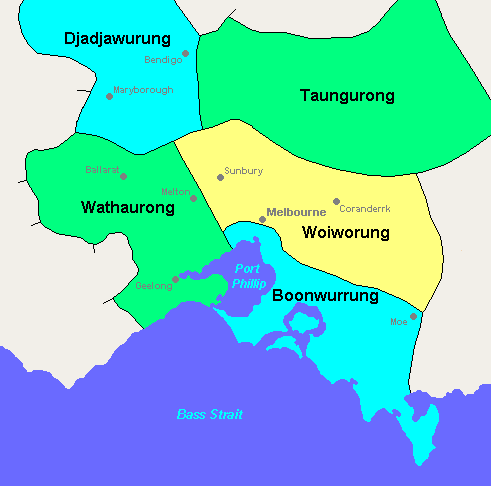
| related | Boonwurrung, Dja Dja Wurrung, Taungurung, Wathaurong |
| see List of Indigenous group names |
see List of Indigenous group names
The Wurundjeri people are an Aboriginal people of the Woiwurrung language group, in the Kulin nation. They are the traditional owners of the Yarra River Valley, covering much of the present location of Melbourne. They continue to live in this area and throughout Australia. They were called the Yarra tribe by early European colonists.
The Wurundjeri Woi Wurrung Cultural Heritage Aboriginal Corporation was established in 1985 by Wurundjeri people.
Ethnonym
According to the early Australian ethnographer Alfred William Howitt, the name Wurundjeri, in his transcription Urunjeri, refers to a species of eucalypt, Eucalyptus viminalis, otherwise known as the manna or white gum, which is common along the Yarra River. Some modern reports of Wurundjeri traditional lore state that their ethnonym combines a word, wurun, meaning Manna gum/"white gum tree" and djeri, a species of grub found in the tree, and take the word therefore to mean "Witchetty Grub People".
Language
Main article: Woiwurrung language
Wurundjeri people speak Woiwurrung, a dialect of Kulin. Kulin is spoken by the five groups in the Kulin nation.
Country
In anthropologist Norman Tindale's estimation – and his data, drawing on anthropologist R. H. Mathews's data which has been challenged – Wurundjeri lands extend over approximately 12500 km2. These took in the areas of the Yarra and Saltwater rivers around Melbourne, and ran north as far as Mount Disappointment, northwest to Macedon, Woodend, and Lancefield. Their eastern borders went as far as Mount Baw Baw and Healesville. Their southern confines approached Mordialloc, Warragul, and Moe.
In June 2021, the boundaries between the land of two of the traditional owner groups in greater Melbourne, the Wurundjeri and Boonwurrung (Bunurong), were agreed between the two groups, after being drawn up by the Victorian Aboriginal Heritage Council. The new borderline runs across the city from west to east, with the CBD, Richmond and Hawthorn included in Wurundjeri land, and Albert Park, St Kilda and Caulfield on Boonwurrung land. It was agreed that Mount Cottrell, the site of a massacre in 1836 with at least 10 Wathaurong victims, would be jointly managed above the 160 m line. The two Registered Aboriginal Parties representing the two groups were the Bunurong Land Council Aboriginal Corporation and the Wurundjeri Woi Wurrung Cultural Heritage Aboriginal Corporation. However, these borders are still in dispute among several prominent figures and Wurundjeri territory has been claimed to spread much further west and south.
Clans
The Wurundjeri balluk was composed of two patrilines who resided in two distinct localities. These were respectively the Wurundjeri-willam and the Baluk-willam, where willam means "camping ground"/dwelling.
The Wurundjeri Willum resided throughout the territory on the Yarra running along its sources as far as Mount Baw Baw and to the area where it forms a junction with the Maribyrnong River.
The Balluk-willam's territory cover an area from Mt. Baw Baw: Their territory covers the area south from Mount Baw Baw to Dandenong, Cranbourne and the swampland at the head of Western Port bay.
History
Main article: Woiwurrung#History
Early colonists estimated that around 11,500-15,000 Aboriginal people, composed of some 38 tribal groups, were living in the area of Victoria. The earliest European settlers came across a park-like landscape extending inland from Melbourne, consisting of large areas of grassy plains to the north and southwest, with little forest cover, something thought to be testimony of indigenous sheet burning practices to expose the massive number of yam daisies which proliferated in the area. These roots and various tuber lilies formed a major source of starch and carbohydrates. Seasonal changes in the weather, availability of foods and other factors would determine where campsites were located, many near the Birrarung and its tributaries.
The Wurundjeri and Gunung Willam Balug clans mined diorite at Mount William stone axe quarry which was a source of the highly valued greenstone hatchet heads, which were traded across a wide area as far as New South Wales and Adelaide. The mine provided a complex network of trading for economic and social exchange among the different Aboriginal nations in Victoria. The quarry had been in use for more than 1,500 years and covered 18 hectares including underground pits of several metres. In February 2008 the site was placed on the Australian National Heritage List for its cultural importance and archeological value.
Settlement and dispossession of the Wurundjeri lands began soon after a ceremony in which Wurundjeri leaders conducted a tanderrum ceremony, whose function was to allow outsiders temporary access to the resources of clan lands. John Batman and other whites interpreted this symbolic act, recorded in treaty form, as equivalent to medieval enfeoffment of all Woiwurrong territory. Within a few years settlement began around Pound Bend with Major Charles Newman at Mullum Mullum Creek in 1838, and James Anderson on Beal Yallock, now known as Anderson's Creek a year later. Their measures to clear the area of Aboriginals was met with guerrilla skirmishing, led by Jaga Jaga, with the appropriation of cattle and the burning of fields. They were armed with rifles, and esteemed to be excellent marksmen, firing close to Anderson to drive him off as they helped themselves to his potato crop while en route to Yering in 1840. A trap set there by Captain Henry Gibson led to Jaga Jaga's capture and a battle as the Wurundjeri fought unsuccessfully to secure his release. Resistance was broken, and settlements throve. One elder, Derrimut, later stated:
You see…all this mine. All along here Derrimut's once. No matter now, me soon tumble down…Why me have no lubra? Why me have no piccaninny? You have all this place. No good have children, no good have lubra. Me tumble down and die very soon now.
Coranderrk
Main article: Coranderrk
In 1863 the surviving members of the Wurundjeri tribe were given "permissive occupancy" of Coranderrk Station, near Healesville and forcibly resettled. Despite numerous petitions, letters, and delegations to the Colonial and Federal Government, the grant of this land in compensation for the country lost was refused. Coranderrk was closed in 1924 and its occupants bar five refusing to leave Country were again moved to Lake Tyers in Gippsland.
Wurundjeri today
All remaining Wurundjeri people are descendants of Bebejan, through his daughter Annie Borate (Boorat), and in turn, her son Robert Wandin (Wandoon). Bebejan was a Ngurungaeta of the Wurundjeri people and was present at John Batman's "treaty" signing in 1835. Joy Murphy Wandin, a Wurundjeri elder, explains the importance of preserving Wurundjeri culture:
In the recent past, Wurundjeri culture was undermined by people being forbidden to "talk culture" and language. Another loss was the loss of children taken from families. Now, some knowledge of the past must be found and collected from documents. By finding and doing this, Wurundjeri will bring their past to the present and recreate a place of belonging. A "keeping place" should be to keep things for future generations of our people, not a showcase for all, not a resource to earn dollars. I work towards maintaining the Wurundjeri culture for Wurundjeri people into the future.
In 1985, the Wurundjeri Woi Wurrung Cultural Heritage Aboriginal Corporation was established to fulfil statutory roles under Commonwealth and Victorian legislation and to assist in raising awareness of Wurundjeri culture and history within the wider community.
Wurundjeri elders often attend events with visitors present where they give the traditional welcome to country greeting in the Woiwurrung language:
Wominjeka yearmenn koondee-bik Wurundjeri-Ballak
which means "Welcome to the land of the Wurundjeri people".
Notable people

Ngurungaeta:
- Bebejan (?-1836): ngurungaeta, and William Barak's father and Billibellary's brother
- Billibellary (1799–1846): ngurungaeta of the Wurundjeri-willam clan
- Simon Wonga (1824–1874): ngurungaeta by 1851 until his death; Billibellary's son
- William Barak (1824–1903): ngurungaeta of the Wurundjeri-willam clan from 1874 until his death
- James Wandin (1933–2006): ngurungaeta until his death, and an Australian rules footballer
- Murrundindi: ngurungaeta from 2006 until present
Other notable Wurundjeri people include:
- Tullamareena: present during the founding of Melbourne
- Derrimut (1810–1864): a Boonwurrung elder associated with the Woiwurrung, present during British invasion
- Diane Kerr: elder
- Winnie Quagliotti (1931–1988): elder
- Joy Murphy Wandin: senior elder
Alternative names/spellings
- Coraloon (?)
- Gungung-willam
- Kukuruk (northern clan name)
- Mort Noular (language name)
- Ngarukwillam
- N'uther Galla
- Nuthergalla (ngatha = juða "no" in the Melbourne dialect)
- Oorongie
- Urunjeri
- Waarengbadawa
- Wainworra
- Wairwaioo
- Warerong
- Warorong
- Warwaroo
- Wavoorong
- Wawoorong, Wawoorong
- Wawurong
- Wawurrong
- Woeworung
- Woiworung (name for the language they spoke, from woi + worung = speech)
- Woiwurru (woi = no + wur:u = lip)
- Woiwurung, Woiwurong, Woiwurrong
- Wooeewoorong
- Wowerong
- Wurrundyirra-baluk
- Wurunjeri
- Wurunjerri
- Wurunjerri-baluk
- Yarra Yarra
- Yarra Yarra Coolies (kulin = man)
Notes
Citations
Sources
- {{Cite web| title = The Abbotsford Convent Muse, Issue 18 | archive-url = https://web.archive.org/web/20090930005032/http://www.abbotsfordconvent.com.au/files/Muse%2018th%20Edition%20September%202007_0.pdf
- {{Cite web| title = AIATSIS map of Indigenous Australia
- {{Cite web| title = Ancestors & Past | access-date = 18 February 2019
- {{Cite journal | title = Mapping the past: an atlas of Victorian clans 1835–1904 | author-link = Diane Barwick | editor-last = McBryde | editor-first = Isabel
- {{Cite web| title = Batmania: The Deed, National Museum of Australia | access-date = 3 November 2008
- {{Cite book| title = Aboriginal Victorians: A History Since 1800 | author-link = Richard Broome
- {{Cite web| title = The Keilor Cranium | archive-url = https://web.archive.org/web/20111115123251/http://www-personal.une.edu.au/~pbrown3/Keilor.html | access-date = 3 November 2008 | archive-date = 15 November 2011
- {{Cite journal | title = "You have all this place, no good have children ..." Derrimut: traitor, saviour, or a man of his people? | author-link = Ian D. Clark (historian)
- {{Cite book| title = Decision in relation to an Application by Wurundjeri Tribe Land and Compensation Cultural Heritage Council Inc to be a Registered Aboriginal Party | title-link = Registered Aboriginal Party
- {{cite news| title = Melbourne's birth destroyed Bunurong and Wurundjeri boundaries. 185 years on, they've been redrawn
- {{Cite book| title = The Melbourne Dreaming: A Guide to the Aboriginal Places of Melbourne | orig-year = First published 1997
- {{Cite book| title = People of the Merri Merri. The Wurundjeri in Colonial Days
- {{Cite book| title = 'I Succeeded Once': The Aboriginal Protectorate on the Mornington Peninsula, 1839–1840
- {{Cite news| title = Tireless ambassador bids you welcome
- {{Cite book| chapter = Introduction | author-link = Tim Flannery | orig-year = First published 1852 | editor-last = Morgan | editor-first = John
- {{Cite book| title = A journal of Grimes' survey: the Cumberland in Port Phillip January–February 1803 | editor-last = Currey | editor-first = John
- {{Cite book| title = The biggest estate on earth: how Aborigines made Australia | author-link = Bill Gammage | orig-year = First published 2011
- {{Cite news| title = Important step for reconciliation | archive-url = https://archive.today/20120918032709/http://www.starnewsgroup.com.au/story/33683
- {{Cite book| chapter = 'Indigenous Placemaking in Urban Melbourne: A Dialogue Between a Wurundjeri Elder and a Non-Indigenous Architect and Academic | editor1-last = Grant | editor1-first = Elizabeth | editor2-last = Greenop | editor2-first = Kelly | editor3-last = Refiti | editor3-first = Albert L. | editor4-last = Glenn | editor4-first = Daniel J. | chapter-url = https://books.google.com/books?id=rS9iDwAAQBAJ&pg=PA587
- {{Cite journal | title = Governor Bourke's Proclamation 1835 (UK) | access-date = 3 November 2008
- {{Cite news| title = Marn Grook, a native game on Sydney's biggest stage
- {{Cite journal | title = On the organisation of Australian tribes | author-link = Alfred William Howitt
- {{Cite web| title = Yarra Creation Story | archive-url = https://web.archive.org/web/20081104085319/http://www.freshwater.net.au/wurundjeri/melbourne_aboriginal_dreamtime.htm
- {{cite web| title = Indigenous Sporting Heroes: History of the Wurundjeri People
- {{Cite magazine| title = Interview with Megan Goulding, CEO Wurundjeri Inc | archive-url = https://web.archive.org/web/20090930005032/http://www.abbotsfordconvent.com.au/files/Muse%2018th%20Edition%20September%202007_0.pdf | access-date = 1 November 2008 | archive-date = 30 September 2009
- {{Cite web| title = Jaga Jaga's Resistance War
- {{Cite web| title = Management of Wurundjeri Properties & Significant Places | access-date = 18 February 2019
- {{Cite journal | title = Kulin Greenstone Quarries: The Social Contexts of Production and Distribution for the Mt William Site | author-link = Isabel McBryde
- {{Cite web| title = National Heritage List: Mount William Stone Hatchet Quarry | archive-url = https://web.archive.org/web/20120406095216/http://www.environment.gov.au/heritage/places/national/mount-william/information.html | access-date = 3 November 2008 | archive-date = 6 April 2012
- {{Cite book| title = Wurundjeri's Cultural Heritage of the Melton Area
- {{Cite book| title = Dark emu black seeds: agriculture or accident?
- {{Cite encyclopedia| title = Keilor Archaeological Site | access-date = 3 November 2008
- {{Cite book| title = Aboriginal Melbourne. The lost land of the Kulin people | author-link = Gary Presland
- {{Cite book| title = The First Residents of Melbourne's Western Region | author-link = Gary Presland
- {{Cite web| title = Channel Deepening Existing Conditions Final Report – Aboriginal Heritage | archive-url = https://web.archive.org/web/20091001143843/http://www.channelproject.com.au/global/docs/Vol%201%20Aboriginal%20Heritage%20Key%20Features.pdf
- {{Cite book| title = The Destruction of Aboriginal Society
- {{cite web| title = Simon Wonga | archive-url = https://web.archive.org/web/20090614203022/http://www.slv.vic.gov.au/ergo/simon_wonga | archive-date = 14 June 2009
- {{Cite web| title = Investigating the Submerged Landscapes of Port Phillip Bay, Victoria | archive-url = https://web.archive.org/web/20120410140434/http://www.heritage.vic.gov.au/admin/file/content2/c7/AIMAPoster_A3.pdf | access-date = 3 November 2008 | archive-date = 10 April 2012
- {{Cite book| title = Letters from Victorian Pioneers | editor-last = Bride | editor-first = Thomas Francis
- {{Cite news| title = Aborigines were playing possum
- {{Cite book| title = Aboriginal Tribes of Australia: Their Terrain, Environmental Controls, Distribution, Limits, and Proper Names | author-link = Norman Tindale
- {{Cite book| title = Lest We Forget. The Tunnerminnerwait and Maulboyheenner Saga
- {{Cite web| title = An address to the Parliament of Victoria | author-link = James Wandin | archive-url = https://web.archive.org/web/20081229001319/http://www.parliament.vic.gov.au/windowintime/views/showview.cfm?viewid=0
- {{Cite news| title = Early History of the Victorian Legal System | author-link = Marilyn Warren
- {{Cite news| title = History should have no divide
- {{Cite book| title = When the Wattles Bloom Again: The Life and Times of William Barak, Last Chief of the Yarra Yarra Tribe
This article was imported from Wikipedia and is available under the Creative Commons Attribution-ShareAlike 4.0 License. Content has been adapted to SurfDoc format. Original contributors can be found on the article history page.
Ask Mako anything about Wurundjeri — get instant answers, deeper analysis, and related topics.
Research with MakoFree with your Surf account
Create a free account to save articles, ask Mako questions, and organize your research.
Sign up freeThis content may have been generated or modified by AI. CloudSurf Software LLC is not responsible for the accuracy, completeness, or reliability of AI-generated content. Always verify important information from primary sources.
Report