From Surf Wiki (app.surf) — the open knowledge base
Wuhan Metro
Rapid transit system for Wuhan

Rapid transit system for Wuhan
| Field | Value | ||||||||
|---|---|---|---|---|---|---|---|---|---|
| name | Wuhan Metro | ||||||||
| image | Wuhan Metro logo.png | ||||||||
| imagesize | 80px | ||||||||
| image2 | {{Photomontage | position=center | |||||||
| photo1a | Guidepost of Wuhan Metro.jpg | ||||||||
| photo1b | Ticket of Wuhan Metro.jpg | ||||||||
| photo1c | Passengers exit or enter Wuhan Metro system by QR code (3).jpg | ||||||||
| photo2a | Rolling Stock of Wuhan Metro Line 11 02APR2018 (05).jpg | ||||||||
| photo3a | Hubei Academy of Agricultural Sciences station (4).jpg | ||||||||
| photo3b | 二七路站.jpg | ||||||||
| photo4a | 中山公园.jpg | ||||||||
| photo4b | Xujiapeng station platform, Line 5.jpg | ||||||||
| photo4c | Zhiyin Station (6).jpg | ||||||||
| photo5a | Wuhan Metro Line 7 train interior.jpg | ||||||||
| photo5b | NO. D51 train of Wuhan Metro Line 4.jpg | ||||||||
| photo6a | Qushuilou Station (5).jpg | ||||||||
| photo6b | Transfer Channel of Zhaojiatiao Station.jpg | ||||||||
| photo6c | Xianggang Rd. Station Platform, Wuhan Metro Line 3 & Line 7.jpg | ||||||||
| size | 300 | ||||||||
| spacing | 2 | ||||||||
| color | white | ||||||||
| border | 0 | ||||||||
| locale | Wuhan, Hubei, China | ||||||||
| transit_type | Rapid transit | ||||||||
| began_operation | |||||||||
| system_length | 518 km | ||||||||
| train_length | 4, 6 or 8 cars | ||||||||
| lines | 12 | ||||||||
| stations | 312 | ||||||||
| ridership | *4.02 million (2024) | ||||||||
| *5.9754 million (Highest record on )<ref>{{cite web | url | https://www.wuhan.gov.cn/sy/whyw/202409/t20240916_2455655.shtml | title= 597.54万乘次!武汉地铁客流创新高 | author=Wuhan Municipal Government | date=2024-09-16 | website= | publisher= | access-date= | quote=}} |
| annual_ridership | 1.468 billion (2024) | ||||||||
| track_gauge | |||||||||
| operator | Wuhan Metro Group Co., Ltd. | ||||||||
| owner | Wuhan Metro Group Co., Ltd. | ||||||||
| website | |||||||||
| map | [[File:Route Map of Wuhan Metro.svg | 300px]] | |||||||
| headway | –9 min | ||||||||
| character | Elevated and underground | ||||||||
| top_speed | 80 km/h | ||||||||
| 100 km/h (Lines 7, 11 and Yangluo Line) | |||||||||
| 120 km/h (Line 16 and Line 19) | |||||||||
| el | 1,500 V DC third rail or overhead catenary (Line 6 and 19) | ||||||||
| 750 V DC third rail (Lines 1, 2, 3 and 4) |
- 5.9754 million (Highest record on ) 100 km/h (Lines 7, 11 and Yangluo Line) 120 km/h (Line 16 and Line 19) 750 V DC third rail (Lines 1, 2, 3 and 4)
Wuhan Metro is a rapid transit system serving the city of Wuhan, Hubei, China. Owned and operated by Wuhan Metro Group Co., Ltd., the network now includes 12 lines, 312 stations, and 518 kilometres of track length. With 1.35 billion annual passengers in 2023, Wuhan Metro is the sixth-busiest rapid transit system in mainland China. There are a number of lines or sections under construction.
Line 1, the first line in the system, opened on 28 July 2004, making Wuhan the seventh city in mainland China with a rapid transit system, after the cities of Beijing, Tianjin, Shanghai, Guangzhou, Changchun, and Dalian. Line 2 opened on 28 December 2012 and is the first underground rail line crossing the Yangtze River. The system has since undergone rapid expansion.
History
Preliminary studies of urban rail transit systems were prompted by the city shortly after a Belgian Railways delegation visit in 1984. Following the demolition of the old Beijing-Hankou Railway, the city of Wuhan planned to utilize the corridor to construct the city's first rapid transit rail line. In September 1992, the Wuhan Metro Construction Group was established by Wuhan Municipal Construction Commission and a supervision group, led by the mayor Qian Yunlu, was subsequently formed in 1993 to facilitate the project's funding, planning, logistics, and organization. It took seven years before the city was able to fund construction.
In October 1999, the National Planning Commission (predecessor of the National Development and Reform Commission) approved the Wuhan "Light Rail" project (Line 1, phase 1), signalling the start of serious work on the rail transit project. On October 2, 2000, the Wuhan Municipal Government ratified the establishment of Wuhan Rail Transit Co., Ltd., and contracted construction, operation, administration and related real estate development to the corporation.
In December 2000, the National Planning Commission accepted a feasibility report on the project and approved construction on phase 1 of Line 1. On December 23, 2000, the project broke ground and comprehensive construction began.
In 2002, with the anticipation of an economic boom and increasing demand for urban rail transit, Wuhan Municipal Government approved the city's first long-term rail transit master plan. On July 28, 2004, the ten-station long "light rail" line was opened to the public and entered revenue service in August. However, low ridership discouraged the city from funding the extension project, for which ground had been broken on December 15, 2005, and a 4-year delay in construction ensued. In April 2006, the NDRC ratified a six-year construction/operation plan, but it was not until a year later on April 9, 2007, that NDRC accepted the feasibility report for line 1, phase 2 (the extension project) and approved construction on the project.
In the interim, construction began on Fanhu station of the fully underground Line 2 on November 16, 2006, as a response to the six-year plan adopted by NDRC earlier. Construction also began on the underground line 4 stations of Wuchang railway station in June, and Wuhan railway station in September, as parts of the integral capital project to revamp and construct the Wuhan Railway Hub.
In May 2007, the Hubei Provincial Development and Reform Commission (HDRC) approved preliminary designs on Line 1, phase 2, and comprehensive construction subsequently commenced in June. On May 15, the city government approved the establishment of Wuhan Metro Group Co., Ltd., which would replace the Wuhan Rail Transit Co., Ltd and assume its responsibilities and benefits.
On September 12, 2007, the NDRC accepted the feasibility report to Line 2, phase 1, and preliminary designs were approved by the HDRC in December 2007. However, it was not until September 2008 that land purchases and funding were facilitated and comprehensive construction began to take place. In October 2009, drilling of the Yangtze River tunnel started.
On March 13, 2009, the NDRC accepted a feasibility report to Line 4, phase 1. On May 13, 2009, the HDRC ratified preliminary designs on Line 4, phase 1. Comprehensive construction ensued on the Wuchang segment of Line 4. A more ambitious urban rapid transit plan was submitted for NDRC review in October 2009, and in late November, on-site panel investigations were conducted by China International Engineering Consulting Corporation.
In February 2010, Wuhan Metro's first commercial property was topped out in Hanxi 1st Road station. On July 29, Line 1 phase 2 entered revenue service from Dijiao to Dongwu Boulevard. Despite plans to extend the westernmost terminus to Jinshan Avenue in Dongxihu District, the station was never built. A short stub with crossover tracks was constructed behind Dongwu Boulevard. Zhuyehai, a station in Qiaokou District, remained non-operational in spite of the existence of complete platforms. Neither exits nor staircases had been built yet. It was due to open when the Wuhan IKEA store was completed in late 2014.
A revised and more detailed construction plan was accepted by the NDRC on January 31, 2011. The plan specified the city's plan to complete construction on Line 3, 4, 6, 7, and 8 before 2017. Beginning on March 1, Line 1 subdivided its fare zones from 3 to 5 and lowered maximum fare per ride from 5 CNY to 4 CNY. Wuhan Tong cardholders will receive a 20 percent discount on single ride fares. On April 9, Line 1 welcomed its 100,000,000th customer, who was awarded a one-year pass to the Metro. On September 9, preliminary designs on Line 4, phase 2 (Hanyang segment) was approved by HDRC.
On February 17, 2012, the NDRC accepted a feasibility report on Line 3, phase 1, the fourth line in Wuhan Metro's grid and the first to cross the Han River, connecting the boroughs of Hankou and Hanyang. A feasibility report to Line 6—the second Hankou-Hanyang connection—was also approved by the NDRC on December 21, 2012. Seven days later, Line 2 entered revenue service, connecting some of the most populated areas of Hankou, Wuchang, and the Optics Valley.
On April 12, 2013, the NDRC granted acceptance to a feasibility report of Line 8, phase 1, which connects Hankou and Wuchang via the Second Yangtze River Bridge corridor. Construction began in June 2013 and was completed in December 2017.
On 23 January 2020, the entire metro network was shut down, along with all other public transport in the city, including national railway and air travel, in an effort to control the spread of the COVID-19 pandemic in Hubei.
On 28 March 2020, six lines (Line 1, 2, 3, 4, 6, 7) resumed operations, after a two-month lockdown. On 8 April 2020, Line 8 Phase 1 resumed operations. On 22 April 2020, Line 8 Phase 3, Line 11, Yangluo line resumed operations.
Timeline of network expansion
| Segment description | Date opened | Station(s) | No. of new stations | Length (km) | ||||||||
|---|---|---|---|---|---|---|---|---|---|---|---|---|
| Phase 1 of Line 1 | 28 July 2004 | Zongguan — Huangpu Road | 9 | 9.769 | ||||||||
| (Phase 1 of Line 1) | 8 April 2006 | Taipingyang | 1 | – | ||||||||
| Phase 2 of Line 1 | 29 July 2010 | Dongwu Boulevard — Zongguan; | ||||||||||
| Huangpu Road — Dijiao | 15 | 18.494 | ||||||||||
| Phase 1 of Line 2 | 28 December 2012 | Jinyintan — Optics Valley Square | 21 | 27.152 | ||||||||
| Phase 1 of Line 4 | 28 December 2013 | Wuchang Railway Station — Wuhan Railway Station | 15 | 15.429 | ||||||||
| Hankou North extension of Line 1 | 28 May 2014 | Dijiao — Hankou North | 3 | 5.555 | ||||||||
| (Phase 2 of Line 1) | 17 September 2014 | Zhuyehai | 1 | – | ||||||||
| Phase 2 of Line 4 | 28 December 2014 | Huangjinkou — Wuchang Railway Station | 13 | 17.974 | ||||||||
| Phase 1 of Line 3 | date=2015-12-24 | script-title=zh:武汉即将地铁成环 "环金时代"重构商业地理 | language=zh | work=长江日报 | url=http://news.xinhuanet.com/house/wh/2015-12/24/c_1117562445.htm | archive-url=https://web.archive.org/web/20151224111431/http://news.xinhuanet.com/house/wh/2015-12/24/c_1117562445.htm | url-status=dead | archive-date=December 24, 2015 | access-date=2015-12-24}} | Zhuanyang Boulevard — Hongtu Boulevard | 24 | 29.660 |
| Phase 1 of Line 6 | 28 December 2016 | Jinyinhu Park — Dongfeng Motor Corporation | 27 | 35.512 | ||||||||
| North extension of Line 2 | Tianhe International Airport — Jinyintan | 7 | 19.957 | |||||||||
| Phase 1 of Line 8 | 26 December 2017 | Jintan Road — Liyuan | 12 | 16.204 | ||||||||
| Yangluo Line | Houhu Boulevard — Jintai | 16 | 34.575 | |||||||||
| Jinghe extension of Line 1 | Dongwu Boulevard — Jinghe | 3 | 4.118 | |||||||||
| Phase 1 of Line 7 | 1 October 2018 | Garden Expo North — Yezhihu | 19 | 30.413 | ||||||||
| Phase 1 of Line 11 | Optics Valley Railway Station — Zuoling | 13 | 18.744 | |||||||||
| South extension of Line 7 | 28 December 2018 | Yezhihu — Qinglongshan Ditiexiaozhen | 7 | 16.550 | ||||||||
| South extension of Line 2 | 19 February 2019 | Optics Valley Square — Fozuling | 10 | 13.195 | ||||||||
| West extension of Line 4 | date=2019-09-23 | title=定了!地铁蔡甸线25日上午9时开通 | url=http://news.cjn.cn/sywh/201909/t3460424.htm}} | Bailin — Huangjinkou | 9 | 16.288 | ||||||
| Phase 3 of Line 8 | date=2019-11-05 | title=明日9点,武汉轨道交通8号线三期工程开通试运营 | url=https://mp.weixin.qq.com/s/3LnB6Rl_lBp71IWU5fBITA | work=Wuhan Metro Operation}} | Yezhihu — Military Athletes' Village | 3 | 4.832 | |||||
| Phase 2 of Line 8 | 2 January 2021 | Liyuan — Yezhihu | 11 | 17.161 | ||||||||
| Gedian segment of Phase 3 of Line 11 | Zuoling — Gediannan Railway Station | 1 | 3.786 | |||||||||
| Phase 1 of Line 5 | 26 December 2021 | Hubei University of Chinese Medicine — East Square of Wuhan Railway Station | 25 | 34.561 | ||||||||
| Phase 2 of Line 6 | Xincheng 11th Road — Jinyinhu Park | 5 | 7.025 | |||||||||
| Phase 1 of Line 16 | South International Expo Center — Zhoujiahe | 12 | 31.692 | |||||||||
| Phase 1 of north extension of Line 7 | 30 December 2022 | Hengdian — Garden Expo North | 7 | 20.890 | ||||||||
| Phase 2 of Line 16 | Zhoujiahe — Hannan General Airport | 2 | 4.766 | |||||||||
| Phase 2 of Line 5 | 1 December 2023 | Hubei University of Chinese Medicine — Hongxia | 2 | 2.655 | ||||||||
| Phase 1 of Line 19 | 30 December 2023 | West Square of Wuhan Railway Station — Xinyuexi Park | 7 | 22.686 | ||||||||
| Phase 2 of north extension of Line 7 | Huangpi Square — Hengdian | 3 | 15.159 | |||||||||
| Phase 2 of Line 11 | 27 December 2024 | East Square of Wuchang Railway Station — Wuhandong Railway Station | 7 | 12.997 | ||||||||
| Wuchang first-opened segment of Phase 3 of Line 11 | Jiang'an Road — East Square of Wuchang Railway Station | 2 | 3.836 |
Lines
| Line | Termini | ||||||||
|---|---|---|---|---|---|---|---|---|---|
| (District) | Opened | Last extension | Length | Stations | Layout | ||||
| **** | |||||||||
| (Dongxihu) | **** | ||||||||
| (Huangpi) | 2004 | 2017 | {{convert | 37.936 | km | mi | abbr=on}} | ||
| **** | |||||||||
| (Huangpi) | **** | ||||||||
| (Jiangxia) | 2012 | 2019 | {{convert | 60.304 | km | mi | abbr=on}} | ||
| **** | |||||||||
| (Hannan) | **** | ||||||||
| (Jiang'an) | 2015 | - | {{convert | 29.660 | km | mi | abbr=on}} | ||
| **** | |||||||||
| (Caidian) | **** | ||||||||
| (Hongshan) | 2013 | 2019 | {{convert | 49.693 | km | mi | abbr=on}} | ||
| **** | |||||||||
| (Hongshan) | **** | ||||||||
| (Hongshan) | 2021 | 2023 | {{convert | 37.216 | km | mi | abbr=on}} | ||
| **** | |||||||||
| (Dongxihu) | **** | ||||||||
| (Caidian) | 2016 | 2021 | {{convert | 42.537 | km | mi | abbr=on}} | ||
| **** | |||||||||
| (Huangpi) | **** | ||||||||
| (Jiangxia) | 2018 | 2024 | {{convert | 83.012 | km | mi | abbr=on}} | ||
| **** | |||||||||
| (Dongxihu) | **** | ||||||||
| (Jiangxia) | 2017 | 2021 | {{convert | 38.197 | km | mi | abbr=on}} | ||
| **** | |||||||||
| (Wuchang) | Gediannan Railway Station | ||||||||
| (Huarong) | 2018 | 2024 | {{convert | 39.363 | km | mi | abbr=on}} | ||
| **** | |||||||||
| (Hanyang) | **** | ||||||||
| (Hannan) | 2021 | 2022 | {{convert | 36.458 | km | mi | abbr=on}} | ||
| **** | |||||||||
| (Hongshan) | **** | ||||||||
| (Hongshan) | 2023 | - | {{convert | 22.686 | km | mi | abbr=on}} | ||
| **** | |||||||||
| (Jiang'an) | **** | ||||||||
| (Xinzhou) | 2017 | - | {{convert | 34.575 | km | mi | abbr=on}} | ||
| Total | '''{{convert | 518 | km | mi | abbr=on}}''' | 312 |
Line 1

Main article: Line 1 (Wuhan Metro)
Line 1 is a 37.788 km elevated urban rail line entirely located in the borough of Hankou. It runs a northwest–southeast route that approximately parallels with Jiefang Avenue for its entire length. There are 27 planned stations, among which 25 are operational. Line 1 operates 33 four-car train sets, 12 of which are manufactured by Changchun Railway Vehicles, and 21 by Zhuzhou Electric Locomotive Co., Ltd.
On July 28, 2004, the first phase of Line 1 began service from Huangpu Road to Zongguan. On July 28, 2010, Line 1 extended from both ends after the completion of phase 2. The phase 3 expansion, which extends the northeast terminus to Hankou North Station, entered revenue service on May 28, 2014. The phase 4 expansion, which extends to Jinghe Station from Dongwu Boulevard. The phase 4 opened on December 26, 2017. Line 1's color is blue.
Line 2

Main article: Line 2 (Wuhan Metro)
Line 2 is a 27.895 km underground subway connecting the boroughs of Hankou and Wuchang. Upon completion, Line 2 was the first subway in China to cross the mighty Yangtze River. It runs in a northwest–southeast route and crosses the Yangtze River near Jianghan Road, and Jiyuqiao in Wuchang. Tunnel drilling concluded on February 26, 2012. Revenue service of Line 2 began on December 28, 2012. Line 2 operates 41 six-car train sets, all of which were manufactured by Zhuzhou Electric Locomotive Co., Ltd.
Line 2 is mostly underground, except for Songjiagang and Hangkongzhongbu stations. It was extended towards both directions. The southern extension brought the southeast terminus from Optics Valley Square to Fozuling, and the northwest extension plan brought the northwest terminus from Jinyintan to Tianhe International Airport, providing convenient access for airport and residential areas en route. Early on, construction work on both extensions was expected to commence in 2013, and the tentative completion dates was set at 2015. In May 2014, it was reported that the construction work on the southern extension would start within 2014, with construction completed by February 19, 2019.
Nowadays, Line 2 only have 6 cars, but in the future, it is possible to add 2 more cars to carry more people during rush hours when 6 cars are not enough. Line 2's color is pink.
Line 3
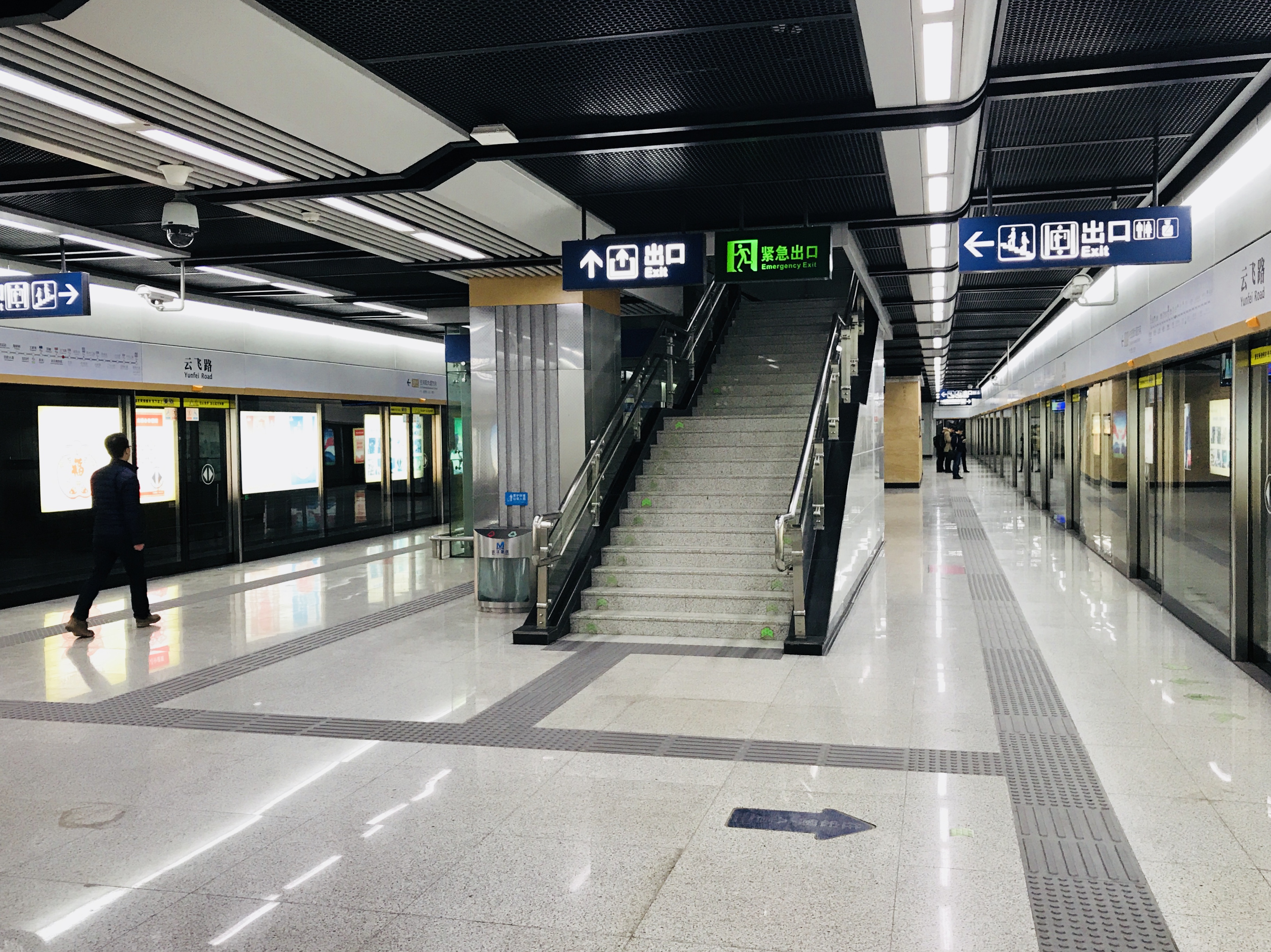
Main article: Line 3 (Wuhan Metro)
Overall construction of Line 3 was approved by National Development and Reform Commission on February 23, 2012, and officially started on March 31, 2012. Line 3 went into operation on December 28, 2015. Line 3 cars are Type B and manufactured by CRRC Changchun Railway Vehicles. Line 3's color is dark yellow.
Line 4
.jpg)
Main article: Line 4 (Wuhan Metro)
Line 4 is mostly underground. It will run in an east–west route serving the Hanyang and Wuchang distincts. The first phase linking Wuchang and Wuhan railway stations opened on December 28, 2013; since that day, all three main railway stations of Wuhan are connected by the Metro. The second phase of Line 4 will crossing the Yangtze River to Hanyang opened in 2014. Line 4 cars are Type B and manufactured by CRRC Zhuzhou Electric Locomotive. Line 4's color is light green.
Line 5

Main article: Line 5 (Wuhan Metro)
Line 5 started operation on 26 December 2021. Line 5's color is coral.
Line 6
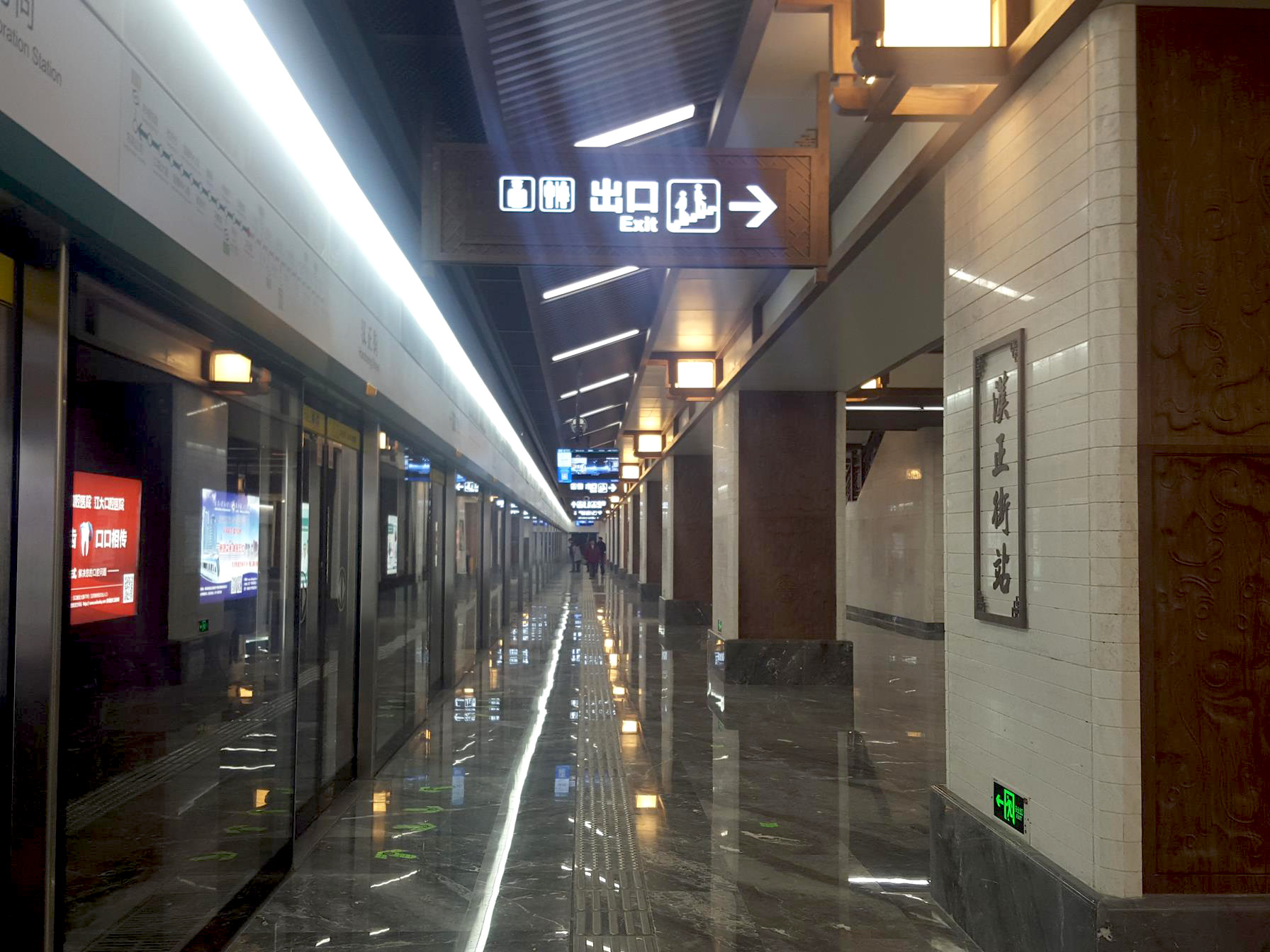
Main article: Line 6 (Wuhan Metro)
Line 6 opened in 2016. And it is the first line of Wuhan Metro to use high capacity A size trains with overhead lines.. Line 6 uses Type A cars manufactured by CRRC Zhuzhou Electric Locomotive. Line 6's color is green.
Line 7

Main article: Line 7 (Wuhan Metro)
Line 7 is a rapid transit line in Wuhan. The line runs from Huangpi Square in Huangpi District to Qinglongshan Ditiexiaozhen in Jiangxia District. It serves residential & business areas such as Nanhu, Wuhan CBD and Wuhan Financial street. Line 7 reserves Wuhan Metro's highest capacity rolling stock to date featuring 8 Type-A car train sets accommodating 2480 people, compared to the standard 6 cars found on other lines. It is also the fastest urban line in the system, with trains capable of reaching the speed of 100 km/h (62 mph) compared to 80 km/h (50 mph) on other lines. Line 7's color is orange.
Line 8
.jpg)
Main article: Line 8 (Wuhan Metro)
Line 8 currently consists of two separate parts. Line 8 Phase 1 was opened in 2017, and Line 8 Phase 3 was opened in 2019. Presently there are 12 stations on the Phase 1 section and 3 on the Phase 3 section. The Phase 2 that is connecting the two parts in 2021. Line 8's color is grey.
Line 11
.jpg)
Main article: Line 11 (Wuhan Metro)
Line 11 Phase 1 from Wuhandong railway station to Gediannan Railway station was opened on 1 October 2018 on National Day and Line 11 Phase 2 and 3 from Wuhandong railway station to Jiaan Road station opened on 27 December 2024. Line 11 uses Type A cars manufactured by CRRC Changchun Railway Vehicles. Line 11's color is yellow.
Line 16

Main article: Line 16 (Wuhan Metro)
Line 16 has a maximum speed of 120 kilometres per hour (75 mph) and has seven underground stations and five elevated stations. The line started operation on 26 December 2021. Line 16's color is fuchsia.
Yangluo Line (Line 21)
.jpg)
Main article: Yangluo line
The Yangluo Line is a rapid transit line that forms part of the Wuhan Metro system. The line in its current form runs from Houhu Boulevard to Jintai, a total distance of 34.575 km. The line connects the urban area of Hankou and Yangluo, Xinzhou District. Yangluo Line's color is magenta.
Services
Service routes
Short turns are used on Line 2, Line 4, and Line 7, while the other lines only operate the full length of the route. As far as Line 2, Line 4, and Line 7 are concerned, the short turns alternate with the full routes.
- Line 2
- Short turn: Jinyintan — Wuhandong Railway Station
- Full route: Tianhe International Airport — Fozuling
- Line 4
- Short turn: Yulong Road — Wuhan Railway Station
- Full route: Bailin — Wuhan Railway Station
- Line 7
- Short turn: Julong Blvd — Banqiao
- Full route: Hengdian — Qinglongshan Ditiexiaozhen
Opening hours
The operating hours start at 6:00 on weekdays and 6:30 on weekends & holidays. The last trains of Line 16, Line 19 and Yangluo Line depart from the origin stations at 22:00 or 22:30, while other lines at 23:00. See the table below for more details.
| Lines | Operating hours on weekdays | Operating hours on weekends or holidays |
|---|---|---|
| Line 1, 2, 3, 4, 5, 6, 7, 8, 11 | 6:00 — 23:00 | 6:30 — 23:00 |
| Line 16 | To Hannan General Airport | 6:00 — 22:30 |
| To South International Expo Center | 6:00 — 22:00 | 6:30 — 22:00 |
| Line 19 | To Xinyuexi Park | 6:00 — 22:30 |
| To West Square of Wuhan Railway Station | 6:00 — 22:00 | 6:30 — 22:00 |
| Yangluo Line | To Jintai | 6:00 — 22:30 |
| To Houhu Boulevard | 6:00 — 22:00 | 6:30 — 22:00 |
Ticketing
Fares vary based on the distance travelled. The specific charging standards are as follows:
| Beyond 50 km, passengers can travel an additional 20 km for every additional ¥1. |
|---|
The single-journey tokens, the multi-day passes, the contactless Wuhantong cards, the China T-union cards and the UnionPay cards are accepted. In addition, Wuhan metro introduced the mobile payment. The travelers can open the Alipay APP on the mobile phones, click on "Transport", and select "Wuhan". After completing identity verification, the travelers will obtain a QR code for the metro pass to enter and exit the metro faregates by having the QR code scanned. |File:Passengers exit or enter Wuhan Metro system by QR code (1).jpg|Wuhan Metro introduced QR code payment across the whole network. |FILE:Ticket of Wuhan Metro.jpg|Single journey token |FILE:Optics Valley Square Station Ticket Machine.jpg|Ticket vending machines |FILE:Qushuilou Station (2).jpg|Faregates |FILE:琴台站(4).jpg|Customer service center
Discount
Most passagers enter and exit the system using a proximity card called Wuhan Tong, which is available at all metro stations. Passagers who pay metro fare with a Wuhan Tong Card can receive a 10% discount. Besides the metro, Passengers can also pay tram, bus, and ferry fees by Wuhan Tong within Wuhan.
Multi-day pass
There are three kinds of multi-day pass cards valid for one, three, and seven days respectively.
- One-day pass: ¥18 each and valid for 1 day;
- Three-day pass: ¥45 each and valid for 3 days;
- Seven-day pass: ¥90 each and valid for 7 days. Cardholders may enjoy one, three, or seven days of unlimited rides in the metro system. The multi-day pass cards are available at the Customer Service Centres in the metro stations. In addition, a RMB 20 deposit is charged for each multi-day pass card.
Amenities
thumb|220px|Lift on the platform 4G LTE services are provided in all stations and trains. As Line 1 was put into operation earlier, it lacks in some facilities. For more amenity information, please see the table below. It is worth mentioning that most of the restrooms are set outside the paid area.
| Station | Restroom | Lift |
|---|---|---|
| Stations on Line 1 | Youyi Road, Liji North Road, | |
| Chongren Road, Qiaokou Road, Taipingyang Station | unavailable | |
| , , , | ||
| , Zongguan StationThe restroom is located in Station Hall of another line but shared by the two lines because it is an interchange station. | available | unequipped |
| The rest | available | equipped |
| Stations on other lines | available | equipped |
Food ban
Wuhan was the first city on the Chinese mainland to ban food and drinks on the subway on December 28, 2013, dishing out fines of up to RMB200. On 1 April 2020, a nationwide food ban was enacted, which also includes conduct rules cracking down on bad subway etiquette, such as stepping on seats, lying down on a bench or floor and playing music or videos out loud.
Rolling stock
Main article: Wuhan Metro rolling stock
|File:Rolling stock NO. A62 of Wuhan Metro Line 1.jpg|Line 1 |File:Rolling Stock of Wuhan Metro Line 2 2018-02-05 (1).jpg|Line 2 |File:Rolling Stock of Wuhan Metro Line 3 2018-02-13.jpg|Line 3 |File:NO. D51 train of Wuhan Metro Line 4.jpg|Line 4 |File:Rolling stock of Wuhan Metro Line 5.jpg|Line 5 |File:武汉地铁6号线列车在金银湖停车场(7).jpg|Line 6 |File:Train No. G10 of Wuhan Metro Line 7 at Yufu Rd station.jpg|Line 7 |file:武汉地铁8号线列车(3).jpg|Line 8 |File:Rolling Stock of Wuhan Metro Line 11 02APR2018 (05).jpg|Line 11 |File:Rolling stock of Wuhan Metro Line 16.jpg|Line 16 |File:Rolling stock of Wuhan Metro Line 19 (13).jpg|Line 19 |File:Rolling Stock of Wuhan Metro Yangluo Line (3).jpg|Yangluo Line |File:Train Interior of Wuhan Metro Line 7 (1).jpg|Train interior of Line 7 |File:武汉轨道交通11号线车厢内部 (2).jpg|Train interior of Line 11 |File:武汉地铁8号线三金潭车辆段.jpg|Sanjintan Depot of Line 8 |File:Wuhan Metro Line 5 train cab.jpg|Train cab of Line 5, which is the first fully automated (GoA4) metro line in Wuhan
Signalling
Wuhan Metro Line 1 is the first one equipped with moving block system in China. All the lines are equipped with CBTC. A fully automated, driverless train system (GoA4), provided by Traffic Control Technology Corporation Limited, has been applied to Line 5 since 26 December 2021.
Ridership
Since 2012, the ridership of the entire network has grown as the new lines or sections come into operation every year. The following data were released by the Wuhan Statistics Bureau, however, the data before 2007 are unavailable. The sudden drop in ridership in 2020 was due to the COVID-19 Pandemic in China, with Hubei, and Wuhan specifically being the worst affected area in China. |File:Wangjiawan Station during the morning rush hour (2).jpg|Wangjiawan Station |File:Wuhan Business District Station Rush Hour (2).jpg|Wuhan Business District Station |File:Xianggang Road Station (Wuhan Metro) during the evening rush hour (1).jpg|Xianggang Road Station
Future expansion
thumb|220px|Wuhan Metro future expansion diagram A number of lines are under construction. Line 12 will be a loop line. Line 9, 10, as well as Line 13, are being planned by the municipal authority.
| Planned Opening | Line | Section | Termini | Length | ||
|---|---|---|---|---|---|---|
| km | Stations | Status | ||||
| 2026 | Phase 1 | **** | **** | 10.9 | 5 | |
| Wuchang section | **** | **** | 22.0 | 14 | Under construction | |
| West ext. | **** | **** | 3.2 | 2 | Under Construction | |
| Phase 2 | **** | **** | 11.8 | 5 | Under Construction | |
| Phase 3 | **** | **** | 2.2 | 2 | Under construction | |
| 2027 | Jiangbei section | Completes Loop Line | 37.9 | 23 | Under Construction | |
| Phase 3 Remaining section | **** | **** | 2.2 | 2 | Under Construction | |
| 2028 | West ext. | **** | **** | 20.3 | 9 | |
| Phase 4 | **** | **** | 16.6 | 6 | Under Construction | |
| TBD | **** | **** | 30.0 | 6 | ||
| **** | **** | 13 | Proposed | |||
| **** | **** | 1 | Proposed | |||
| **** | **** | Proposed | ||||
| **** | **** | Proposed | ||||
| **** | **** | Proposed |
Stations
Main article: List of Wuhan Metro stations
Almost all stations, except the stations on Line 1, are equipped with platform screen doors. There is a plan that stations on Line 1 will be equipped with platform screen doors in the future. The metro stations are equipped to be disabled and elderly friendly, with an automatic fare collection system, announcement system, electronic display boards, escalators and lifts. The stations are also equipped with non-slip flooring, grip-rails, audio announcements and Braille to help visually challenged passengers.
Gallery
|File:Zhuyeshan Station 03.jpg|Station entrance |File:Guidepost of Wuhan Metro.jpg|Guidepost |File:Wuhan Business District Station 09.jpg|The concourse of Wuhan Business District Station |File:Huangpu Road Station in 2017 (6).jpg|The concourse of Huangpu Road Station, Line 8 |File:Widened Platform of Wuhan Metro Line 1 Huangpu Road Station.jpg|The widened platform of Huangpu Road Station, Line 1 |File:Wuhan Metro Line 7 Pangxiejia Station Platform (2).jpg|The platform of Pangxiejia Station, Line 7 |File:Tianhe International Airport Station (Metro) 02.jpg|Tianhe International Airport Station |File:Xujiapeng Station (3).jpg|The platform of Xujiapeng Station, Line 8 |File:Sanyang Rd. Station, Wuhan Metro Line 7 (2).jpg|Transfer passage in Sanyang Road Station |File:Hall of Matoutan Park Station.jpg|The concourse of Matoutan Park Station |File:Hall of Luoxiong Road Station.jpg|The concourse of Luoxiong Road Station |File:Hall of Hanzheng Street Station (1).jpg|The concourse of Hanzheng Street Station |File:English zhongnan & hongguang.svg|Continuous cross-platform transfer on Line 2 & 4
Network map
| frame-lat = 30.56 | frame-long = 114.25 | frame-width = 750 | frame-height = 470
Notes
References
References
- (2024-10-01). "前川线二期今日开通 武汉地铁最长线路刷新纪录". Changjiang Daily.
- Wuhan Municipal Government. (2024-09-16). "597.54万乘次!武汉地铁客流创新高".
- link. [[WeChat]]@地铁客流及运输研究阿牛. (2020-02-15). 中国城市轨道交通协会
- "> Asia > China > Wuhan Metro". UrbanRail.Net.
- link
- link
- link
- "Public Transport In Wuhan Suspended Due To Coronavirus Concerns".
- (2020-01-23). "Virus-hit Chinese city shuts public transport". BBC News.
- "Wuhan buses hit the road after two-month lockdown".
- Huang Lei;Wang Yang. (2020-04-07). "武汉:4月8日起恢复出租车运营 适时恢复网约车运营". Hubei Daily.
- (2020-04-21). "8号线三期、11号线、阳逻线恢复运营,22日起,武汉地铁全线网恢复正常".
- [http://qzgh.qiaokou.gov.cn/qkxw/bmdt/201409/t20140917_139172.shtml 轻轨竹叶海站宜家联廊桥投入使用 (Zhuyehai station opened)]
- [http://cjweek.cjn.cn/html/2013-12/27/content_5269051.htm Section one of Metro Line 4 opens]
- (2015-12-24). 长江日报. link
- [http://tech.cnr.cn/techgd/20161228/t20161228_523405232.shtml 武汉地铁机场线及6号线今日开通 湖北移动全面布局网络覆盖]
- link
- (2019-09-23). "定了!地铁蔡甸线25日上午9时开通".
- (2019-11-05). "明日9点,武汉轨道交通8号线三期工程开通试运营". Wuhan Metro Operation.
- "武汉2条地铁线通车时间定了!_站台".
- "武汉地铁5号线开通人气最旺 吸引众多市民乘客打卡".
- (2024-12-27). "武汉轨道交通11号线东段二期及三期武昌段首开段工程开通初期运营".
- (March 2024). "Ticketing regulations". Wuhan Metro Group Co., Ltd..
- "Wuhan light rail starts test run". China Daily.
- link
- "Subway to cross under Yangtze".
- link
- "Subway ticket price hearing held".
- [http://news.wuhan.fang.com/2014-05-28/12889126.htm 年内开工2019年通车 武汉地铁2号线南延线公布十站点] (Work starting within this year; service opening in 2019. Ten stations announced for the Southern Extension of Line 2 of Wuhan Metro), 2014-05-28
- link
- link
- 荊楚網. link
- (March 2024). "First Wuhan-made A-type metro train rolls off the production line}}{{Dead link".
- "运营时刻表".
- (2024-03-12). "A Guide to Working and Living in China as Business Expatriates(2024 Edition)".
- (2019-07-29). "武汉地铁除普通卡票价9折优惠外还上调奖励金额".
- (2019-07-17). "15年了,武汉人越来越离不开TA!你还记得第一次吗?". 长江日报.
- (2017-08-03). "武汉地铁5号线有望取消驾驶室,实现真正无人驾驶!". 武汉地铁.
- Gong Ping; Liu Dandan; Yuan Yonghua. (2020-05-31). ""武汉造"全自动无人驾驶地铁列车来啦!不设驾驶室,还有这些"高精尖"". 长江网.
- Wuhan Statistics Bureau. "Wuhan Statistical Yearbook-2009".
- Wuhan Statistics Bureau. (August 2010). "Wuhan Statistical Yearbook-2010". China Statistics Press.
- Wuhan Statistics Bureau. (August 2011). "Wuhan Statistical Yearbook-2011". China Statistics Press.
- Wuhan Statistics Bureau. (September 2012). "Wuhan Statistical Yearbook-2012". China Statistics Press.
- Wuhan Statistics Bureau. (September 2013). "Wuhan Statistical Yearbook-2013". China Statistics Press.
- Wuhan Statistics Bureau. (September 2014). "Wuhan Statistical Yearbook-2014". China Statistics Press.
- Wuhan Statistics Bureau. (September 2015). "Wuhan Statistical Yearbook-2015". China Statistics Press.
- Wuhan Statistics Bureau. (September 2016). "Wuhan Statistical Yearbook-2016". China Statistics Press.
- Wuhan Statistics Bureau. (August 2017). "Wuhan Statistical Yearbook-2017". China Statistics Press.
- Wuhan Statistics Bureau. (August 2018). "Wuhan Statistical Yearbook-2018". China Statistics Press.
- (2019-03-26). "2018年武汉市国民经济和社会发展统计公报". Wuhan Statistics Bureau.
- (2020-03-29). "2019年武汉市国民经济和社会发展统计公报". Wuhan Statistics Bureau.
- (2021-04-25). "2020年武汉市国民经济和社会发展统计公报". Wuhan Statistics Bureau.
- (2022-04-02). "2021年武汉市国民经济和社会发展统计公报". Wuhan Statistics Bureau.
- (2023-03-30). "2022年武汉市国民经济和社会发展统计公报". Wuhan Statistics Bureau.
- (2024-04-05). "2023年武汉市国民经济和社会发展统计公报". Wuhan Statistics Bureau.
- (2025-04-03). "2024年武汉市国民经济和社会发展统计公报". Wuhan Statistics Bureau.
- link
- link
- (2024-01-09). "武漢地鐵在建線路11條 在建里程約爲155.6公里".
- "武汉地铁11号线四期全面开建-中国科技网".
- 陶常宁;胡琴. (2015-05-04). "武汉地铁1号线将全线安装站台安全门 与循礼门站一致". 武汉晨报.
- 刘孝斌;黄士峰. (2016-01-06). "武汉女乘客意外跌下1号线站台 轻轨安全门迟迟不装". 楚天都市报.
This article was imported from Wikipedia and is available under the Creative Commons Attribution-ShareAlike 4.0 License. Content has been adapted to SurfDoc format. Original contributors can be found on the article history page.
Ask Mako anything about Wuhan Metro — get instant answers, deeper analysis, and related topics.
Research with MakoFree with your Surf account
Create a free account to save articles, ask Mako questions, and organize your research.
Sign up freeThis content may have been generated or modified by AI. CloudSurf Software LLC is not responsible for the accuracy, completeness, or reliability of AI-generated content. Always verify important information from primary sources.
Report