From Surf Wiki (app.surf) — the open knowledge base
World Zionist Congress
World Zionist Organization governing body

World Zionist Organization governing body
For the most recent meeting see 39th World Zionist Congress

The Zionist Congress was established in 1897 by Theodor Herzl as the supreme organ of the Zionist Organization (ZO) and its legislative authority. In 1960, the names were changed to World Zionist Congress ( HaKongres HaTsioni HaOlami) and World Zionist Organization (WZO), respectively. The World Zionist Organization elects the officers and decides on the policies of the WZO and the Jewish Agency, including "determining the allocation of funds." The First Zionist Congress was held in Basel, Switzerland in 1897. Any Jew over age 18 who belongs to a Zionist association is eligible to vote, and the number of elected delegates to the Congress is 500. 38% of the delegates are allocated to Israel, 29% to the United States of America, and 33% to the remainder of the countries of the Diaspora. In addition there are about 100 delegates which are appointed by International Organizations (e.g. B'nai B'rith, see below) affiliated with WZO.
After the First Zionist Congress in 1897, the Zionist Congress met every year until 1901, then every second year from 1903 to 1913 and 1921 to 1939. Until 1946, the Congress was held every two years in various European cities, save for interruptions during the two World Wars. Their goal was to build an infrastructure to further the cause of Jewish settlement in Palestine. Since the Second World War, meetings have been held approximately every four years. Also, since the creation of the State of Israel, the Congress has met every four or five years in Jerusalem.
The 39th World Zionist Congress is scheduled to convene in Jerusalem from October 28–30, 2025.
Representatives at the World Zionist Congress
The World Zionist Congress includes representatives of Zionist World Unions, Women's Zionist Organizations with Special Status and International Jewish Organizations.

Zionist World Unions
Zionist participants in the World Zionist Congress are free to form Brit Olamit or Zionist World Unions (ideological groupings), which are somewhat like political parties. While Israeli political parties can participate in the Congress, brits are also organized and voted into the Congress by non-Israelis, making the Congress a multinational deliberative body for the Jewish diaspora. However, as aliyah has brought Jews to Israel from other countries, Israeli representation in the legislature has increased at the expense of non-Israeli Jewish diaspora representation. A Brit Olamit (World Union) must have representation in at least five countries to send a delegation to the Congress.
There are currently six Zionist World Unions (with full voting rights):
- World Zionist Union: Labor Zionist Movement – Arzenu – World Union of Meretz. Arzenu is an organization for the political representation of Reform and Progressive Religious Zionist communities in Israel and fourteen other countries. It was founded in 1980 as a Brit Olamit, and is affiliated with the Netzer Olami youth organization.
- United Faction: Kadima–HaNoar HaTzioni– MERCAZ
- World Mizrachi/Ichud Le'umi/Herut/Yisrael Beytenu/Moledet/Tkuma
- World Likud/Shas
- Hadassah/Confederation
- Over The Rainbow – the Zionist movement
Israeli representatives
Since the creation of the State of Israel, there are no elections held for Israeli delegates to the World Zionist Congress. Rather, elections to the Knesset, Israel's parliament, are deemed to fulfill this function, and Zionist parties represented in the Knesset are apportioned a number of Congress delegates proportional to their strength in the Knesset. The late left-wing leader Shulamit Aloni on several occasions criticized this practice, stating that "Most Israeli citizens neither know nor care that when they go to the polls they are among other things also electing delegates to the World Zionist Congress."
Zionist organizations with special status
Two women's organizations have special status in the Zionist Organization and have full voting rights:
- Women's International Zionist Organization – is an international, non-party Zionist body, which receives global representation by virtue of an agreement entered into in 1964.
- Hadassah – received special status by virtue of a decision of the Zionist General Council, in 1994.
International Jewish organizations
The international Jewish organizations have also been represented in the Zionist Congress since 1972, provided that they accept the Jerusalem Program, even if not all their members are declared Zionists. These bodies have limited voting rights they do not vote on matters of candidature and elections to the institutions of the WZO.
The following are the International Jewish Organizations (limited voting rights):
- B'nai B'rith International
- Maccabi World Union
- Na'amat
- Women's International Zionist Organization
- World Council of Conservative Masorti Synagogues (Masorati Olami)
- World Emunah
- World Organization of Orthodox Synagogues & Communities in Israel and the Diaspora
- American Sephardi Federation
- World Union for Progressive Judaism
- World Union of Jewish Students
- Zionist Council in Israel
Other participants in Congress (advisors, observers)
- In addition to the delegates with full voting rights participating in Congress, there are also participants in an advisory capacity which can participate in debates but have no voting rights. These may consist of office holders such as members of the Zionist Executive, members of the Zionist General Council who were not elected as delegates to Congress, Chairs of the Zionist Federations, judicial office holders - the President of the Zionist Supreme Court, the Attorney, the Comptroller and representatives of the Aliyah Movement.
- Observers with no speaking or voting rights can be invited by the Zionist Executive or the Congress Presidium.
Former participants
- Aytzim
The course of the Congress
The Zionist Congress is conducted by the Congress Presidium. Congress deliberations are divided into five stages:
- Opening of the Congress, including a speech by the Chairman of the Executive, and other speeches determined in the agenda, election of the Congress Presidium, the report of the President of the Zionist Supreme Court on the election results, reports of the members of the Zionist Executive in supplement to the printed report, election of the Congress committees.
- Election of the new Executive, according to the proposal of the Congress Standing Committee.
- Meetings of the committees.
- Reports of the committees and voting on the draft resolutions presented by them. The report of the Standing Committee and voting on its proposals for members of the Zionist General Council, the Comptroller and the Legal Institutions.
- Congress closing ceremony.
History
The Zionist Congress, later to become the Zionist Congress, was held at intervals of 1 year (1897–1901), then 2 years (1903–1939) until the outbreak of the Second World War, with an eight-year break (1913–1921) due to the First World War.
| Country/Region | Members | Delegates |
|---|---|---|
| Poland | 299,165 | 109 |
| US | 263,741 | 114 |
| Palestine | 167,562 | 134 |
| Romania | 60,013 | 28 |
| United Kingdom | 23,513 | 15 |
| South Africa | 22,343 | 14 |
| Canada | 15,220 | 8 |


| Number | Name | City | Country | Year | |
|---|---|---|---|---|---|
| 1 | Basel | Switzerland | |||
| 2 | Basel | Switzerland | |||
| 3 | Basel | Switzerland | |||
| 4 | London | United Kingdom | |||
| 5 | Basel | Switzerland | |||
| 6 | Basel | Switzerland | |||
| 7 | Basel | Switzerland | |||
| 8 | The Hague | Netherlands | |||
| 9 | Hamburg | German Empire | |||
| 10 | Basel | Switzerland | |||
| 11 | Vienna | Austria-Hungary | |||
| 12 | Carlsbad (Karlovy Vary) | Czechoslovakia | |||
| 13 | Carlsbad (Karlovy Vary) | Czechoslovakia | |||
| 14 | Vienna | Austria | |||
| 15 | Basel | Switzerland | |||
| 16 | Zürich | Switzerland | |||
| 17 | Basel | Switzerland | |||
| 18 | Prague | Czechoslovakia | |||
| 19 | Lucerne | Switzerland | |||
| 20 | Zürich | Switzerland | |||
| 21 | Geneva | Switzerland | |||
| 22 | Basel | Switzerland | |||
| 23 | Jerusalem | Israel | |||
| 24 | Jerusalem | Israel | |||
| 25 | Jerusalem | Israel | |||
| 26 | Jerusalem | Israel | |||
| 27 | Jerusalem | Israel | |||
| 28 | Jerusalem | Israel | |||
| 29 | Jerusalem | Israel | |||
| 30 | Jerusalem | Israel | |||
| 31 | Jerusalem | Israel | |||
| 32 | Jerusalem | Israel | |||
| 33 | Jerusalem | Israel | |||
| 34 | Jerusalem | Israel | |||
| 35 | Jerusalem | Israel | |||
| 36 | Jerusalem | Israel | |||
| 37 | Jerusalem | Israel | |||
| 38 | Jerusalem | Israel | |||
| 39 | Thirty-ninth Zionist Congress | Jerusalem | Israel | 2025 |
Important moments
-
The First Zionist Congress, held in 1897 in Basel, Switzerland, had Theodor Herzl acting as chairperson. The Congress was attended by some 200 participants who formulated the Zionist platform, known as the "Basel programme", and established the Zionist Organization (ZO). In contrast with the older Hibbat Zion movement, the ZO took a clear stance in favour of political Zionism, stating in its programme that :"Zionism seeks to establish a home in Palestine for the Jewish people, secured under public law." Herzl wrote in his diary, :"Were I to sum up the Basel Congress in a word - which I shall guard against pronouncing publicly - it would be this: At Basel I founded the Jewish State."
-
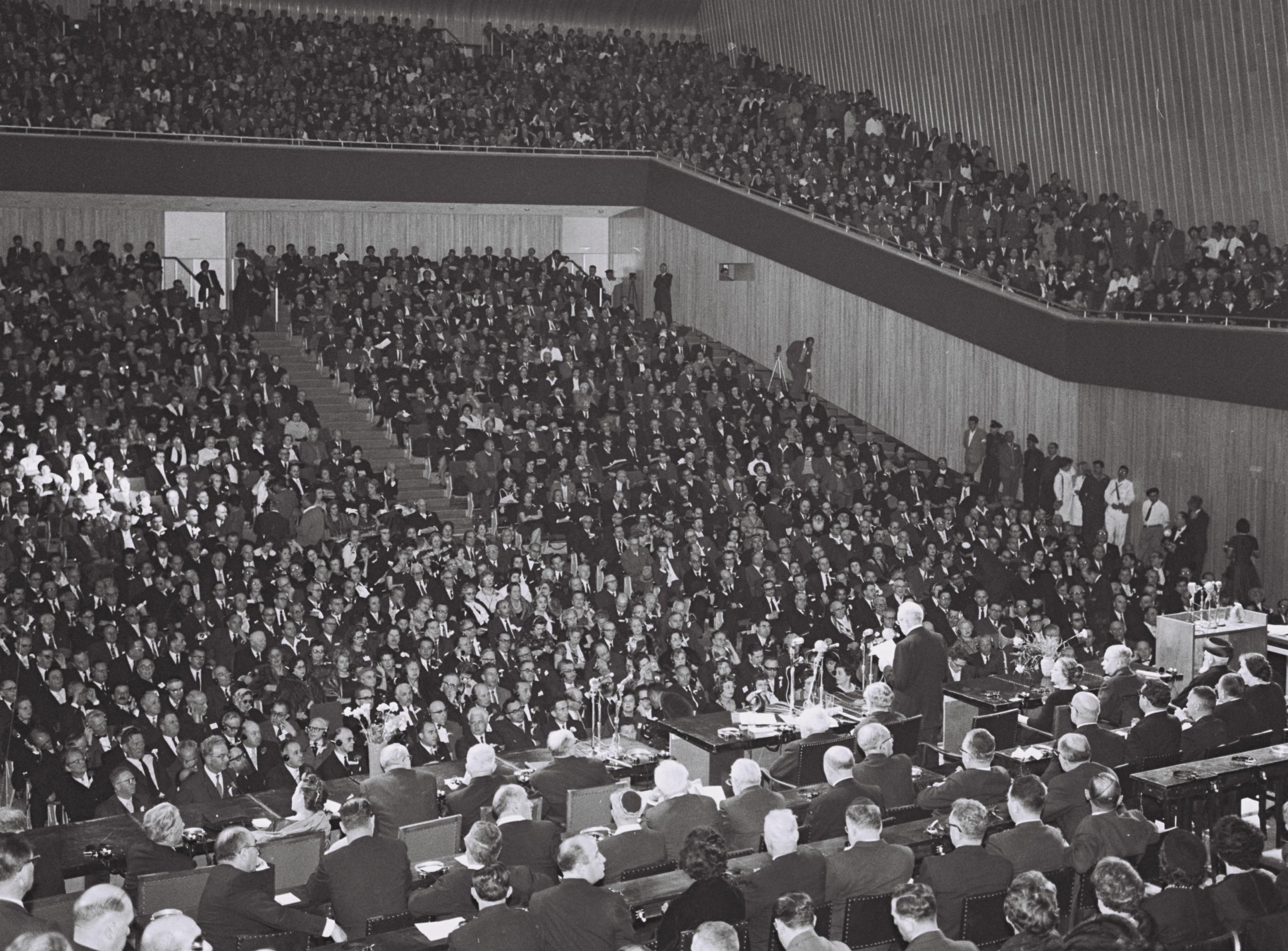
The Twenty-third Zionist Congress, held in 1951 in Jerusalem, was the first to be held after the establishment of the State of Israel, and the first held in Jerusalem, which would become the norm. It was opened at the graveside of Theodor Herzl, whose remains had been moved from Vienna and reburied on the top of a hill in Jerusalem that was renamed after him, Mount Herzl. The Congress issued the "Jerusalem Program", placing its main focus on the newly created state as the central unifying element for the Jewish people.
-
Ruth Popkin was the first woman to be Chair of the Presidium and President of the World Zionist Congress, being elected to both positions in 1987.
References
References
- Battegay, Caspar 1978-. (2018). "Jüdische Schweiz 50 Objekte erzählen Geschichte = Jewish Switzerland : 50 objects tell their stories".
- "Zionist Congress". World Zionist Organization.
- "Zionism: World Zionist Organization (WZO)". American-Israeli Cooperative Enterprise.
- Cortellessa, Eric. (21 October 2015). "At World Zionist Congress, Reform stakes its claim in Israel's future". The Times of Israel.
- (June 2004). "Rules for the Election of Delegates to the Zionist Congress". World Zionist Organization.
- "Home".
- "The Zionist Century | Zionist Congresses". Jafi.org.il.
- https://azm.org/event/39th-world-zionist-congress/
- "About".
- (1 June 2017). "38th World Zionist Congress Elections".
- Source: ''A Survey of Palestine'', prepared in 1946 for the [[Anglo-American Committee of Inquiry]], Volume II p. 907 HMSO 1946.
- Mitchell Geoffrey Bard, Moshe Schwartz. (2005). "1001 Facts Everyone Should Know about Israel". Jason Aronson, Inc..
- (6 August 2019). "The Thirteenth Zionist Congress Is Convened in Czechoslovakia".
- "The Canadian Jewish Chronicle - Google News Archive Search".
- (12 September 1927). "Fifteenth Zionist Congress Approves Jewish Agency Plan Sponsored by Weizmann".
- [http://www.bjpa.org/Publications/details.cfm?PublicationID=18204 Resolutions of the 16th Zionist Congress With a Summary Report of the Proceeding]
- [https://www.jpost.com/International/Article.aspx?id=178563 Jerusalem Post: WZO gets 1st religious-Zionist chairman]
- (15 January 2020). "Diaspora Jews Have Their Say: World Zionist Congress 2020". Jewish Exponent.
- "Zionist Congress: First to Twelfth Zionist Congress (1897 - 1921)". Jewish Virtual Library.
- Tigay, Alan. (5 January 2015). "Ruth Popkin, Hadassah past national president, dies at 101 | Obituaries". Jewish Journal.
This article was imported from Wikipedia and is available under the Creative Commons Attribution-ShareAlike 4.0 License. Content has been adapted to SurfDoc format. Original contributors can be found on the article history page.
Ask Mako anything about World Zionist Congress — get instant answers, deeper analysis, and related topics.
Research with MakoFree with your Surf account
Create a free account to save articles, ask Mako questions, and organize your research.
Sign up freeThis content may have been generated or modified by AI. CloudSurf Software LLC is not responsible for the accuracy, completeness, or reliability of AI-generated content. Always verify important information from primary sources.
Report