From Surf Wiki (app.surf) — the open knowledge base
World War II reparations
Reparations paid by Germany
Reparations paid by Germany
After World War II, both the Federal Republic and Democratic Republic of Germany were obliged to pay war reparations to the Allied governments, according to the Potsdam Conference. Italian, Romanian, Hungarian, Bulgarian and Finnish reparations were determined in Paris Peace Treaties. Austria was not included in any of these treaties. Japan's reparations were determined in Treaty of San Francisco.
Payments
According to the Yalta Conference, no reparations to Allied countries would be paid in money (though that rule was not followed in later agreements). Instead, much of the value transferred consisted of German industrial assets as well as forced labour to the Allies. The Allied demands were further outlined during the Potsdam Conference. Reparations were to be directly paid to the four victor powers (France, United Kingdom, United States, and the Soviet Union); for the countries in the Soviet sphere of influence, the Soviet Union would determine its distribution. To coordinate the distribution of the reparations between the victor powers, the Allied Control Council was established.
The Allies finally agreed for German reparations to be paid in the following forms:
- Dismantling of the German industry
- Transferring all manufacturing equipment, machinery and machine tools to the Allies
- Transferring all railroad cars, locomotives and ships to the Allies
- Confiscation of all German investments abroad
- All gold, silver and platinum in bullion or coin form held by any person/institution in Germany
- All foreign currency
- All patents and research data relevant to military application and processes
- Requisition of current German industrial production and resource extraction
- Forced labour provided by the German population
To oversee the extraction and distribution of the German reparations in their control zone, the Western Allies established the Inter-Allied Reparations Agency (IARA). The distribution of the reparations from Germany was to be allotted by a pre-determined percentage to which the victor powers agreed to. German reparations were to be classified into two categories: A (all forms of German reparations except those included in Category B) and B (industrial and capital equipment, merchant ships, and inland water transports).
The following nations received reparations as part of the proceedings of the IARA:
| Country | % of Category A reparations | % of Category B reparations |
|---|---|---|
| Albania | 0.05 | 0.35 |
| Australia | 0.70 | 0.95 |
| Belgium | 2.70 | 4.50 |
| Czechoslovakia | 3.00 | 4.30 |
| Canada | 3.50 | 1.50 |
| Denmark | 0.25 | 0.35 |
| Kingdom of Egypt Egypt | 0.05 | 0.20 |
| France | 16.00 | 22.80 |
| Greece | 2.70 | 3.35 |
| British Raj India | 2.00 | 2.90 |
| Luxembourg | 0.15 | 0.40 |
| Norway | 1.30 | 1.90 |
| New Zealand | 0.40 | 0.60 |
| Netherlands | 3.90 | 5.60 |
| Union of South Africa | 0.70 | 0.10 |
| United Kingdom | 28.00 | 27.80 |
| United States of America | 28.00 | 11.80 |
| Yugoslavia | 6.60 | 9.60 |
Poland was to be excluded from the proceedings of the IARA by demand from the Soviet Union. The Allies agreed as part of the Potsdam Agreement, that the Soviet Union collects and distributes the Polish share of reparations. Furthermore, the Soviet Union would extract its share of reparations mostly from the territory in its own occupation zone.
Territorial changes
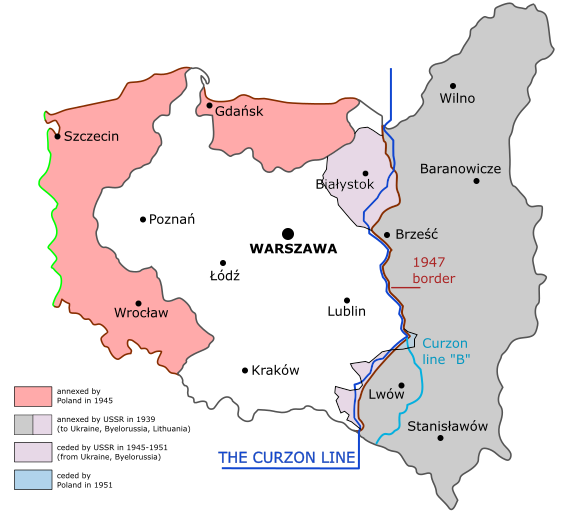
The Soviet Union annexed the German territories east of the Oder-Neisse, leading to the expulsion of 12 million Germans (from East Prussia, Pomerania and Silesia). These territories were incorporated into communist Poland and the Soviet Union respectively and resettled with citizens of these countries, pending a final peace conference with Germany. Since a peace conference never took place, the areas were effectively ceded by Germany. In the case of Poland, the acquired territory was a compensation for the Polish Eastern Borderlands (Kresy), which were annexed by the Soviet Union.
France occupied the Saar protectorate from 1947 to 1956, with the intention of using its coal and steel industrial output to boost the French economy as reparations for the war. France sought to ultimately annex the Saar as well as the entire Ruhr region into France proper, but was denied so by the rest of the Allies. Following the results of a plebiscite, France had to relinquish its control of the Saar region on 1 January 1957.
The Netherlands sought to annex large parts of Western Germany as reparations for WWII. These efforts were mostly thwarted by the Western Allies and ultimately only approximately 69 km2 of German territory was annexed in 1949. Nearly all of these territories were returned to the Federal Republic of Germany in 1957. Under the Dutch-German treaty made in The Hague on 8 April 1960, West Germany agreed to pay to The Netherlands the sum of 280 million German marks in compensation for the return.
Belgium and Luxembourg also sought to annex German territory as reparations for WWII. However, only small areas were occupied and then returned after German compensation payments.
Dismantling of industries
At the beginning of the occupation, the Allies dismantled the remnants of German industries. Plants and machinery were dismantled, the railroad system deconstructed and everything was transported to the Allies. The German merchant fleet and all other ships were handed over. Foreign stocks of about 2.5 billion dollars were confiscated. The remaining German industries had to give up a share of their production to the Allies. Large shipments of steel, coal, but also other industrial products were seized and transported out of the country. Later the Western Allies softened their stance in favour of the Marshall Plan, while Eastern Germany continued to deliver industrial goods and raw materials to the Soviet Union until 1953.
Dismantling of rail infrastructure
In the Soviet Zone of Occupation (later the German Democratic Republic) virtually all double tracked rail lines were reduced to a single track with the material being taken to the Soviet Union. Similarly the (relatively limited) railway electrification was also dismantled with the notable exception of most of the Berlin S-Bahn which retained its third rail infrastructure for the most part.
Similarly, in the French Occupation Zone, key rail lines were dismantled to single track.
Intellectual property
The Allies confiscated large amounts of German patents, copyrights and trademarks worth about 10 billion (1948) dollars.
Forced labour
Main article: Forced labor of Germans after World War II
Millions of Germans were pressed into forced labour for several years to work for the Allies in camps, mining, harvesting or industry.
Occupation costs
After World War II ended, the main four Allied powers – Great Britain, The United States, France, and the Soviet Union – jointly occupied Germany, with the Allied occupation officially ending in the 1950s. During this time, Germany was held accountable for the Allied occupation's expenses, amounting to over several billion dollars.
Holocaust victims
Germany concluded a variety of treaties with Western and Eastern countries as well as the Jewish Claims Conference and the World Jewish Congress to compensate the victims of the Holocaust. Until 2005 about 63 billion euros (equivalent to approximately 87.9 billion euros in 2022) have been paid to individuals. Additional payments by German companies which exploited forced workers have been made.
Recipients
Poland
On 23 August 1953, the People's Republic of Poland, under pressure from the Soviet Union which wanted to free East Germany from any liabilities, announced it would waive its right to further war reparations from East Germany on 1 January 1954. In a United Nations note, dated 24 November 1969, the communist government of Poland demanded action from the organization not only to punish war criminals and those who have committed crimes against humanity but also to establish procedures and divisibility of compensation for war crimes and damages committed by Germany during World War II. In 1970, the 1953 renunciation of reparation rights was confirmed by the Polish Deputy Minister of Foreign Affairs Józef Winiewicz during the course of the negotiations leading to the normalization treaty of November 1970, in which West Germany recognized the Oder-Neisse as the final border between Poland and East Germany.
On 10 September 2004, the Polish parliament (Sejm) passed a resolution stating that: "The Sejm of the Republic of Poland, aware of the role of historical truth and elementary justice in Polish-German relations states that Poland has not yet received adequate financial compensation and war reparations for the enormous destruction and material losses caused by German aggression, occupation and genocide." A month later, on 19 October 2004 the Polish Council of Ministers put out a statement stating: "The Declaration of 23 August 1953 was adopted in accordance with the constitutional order of the time, in compliance with international law laid down in the UN Charter." In August 2017, this position was again confirmed in a statement by Deputy Foreign Minister Marek Magierowski, stating that "(...) the 1953 declaration constitutes a binding unilateral legal act of the Polish state – a subject of international law." According to law professor at the University of Warsaw, Władysłav Czapliński, the reparation question has been closed with the conclusion of the Treaty on the Final Settlement with Respect to Germany, negotiated in 1990 between the Federal Republic of Germany, the German Democratic Republic, and the Four Powers (United States, Soviet Union, United Kingdom, and France), to which Poland voiced no protest. The German government takes the same position.
In the meantime, Poland and Germany concluded several treaties and agreements to compensate Polish persons who were victims of German aggression. In 1972, West Germany paid compensation to Poles that had survived pseudo-medical experiments during their imprisonment in various Nazi camps during the Second World War. In 1975, the Gierek-Schmidt agreement was signed in Warsaw. It stipulated that 1.3 billion DM was to be paid to Poles who, during Nazi occupation, had paid into the German social security system but received no pension. In 1992, the Foundation for Polish-German Reconciliation was founded by the Polish and German governments, and as a result, Germany paid Polish sufferers approximately zl 4.7 billion (equivalent to zl 37.8 billion or US$7.97 billion in 2022). Between 1992 and 2006, Germany and Austria jointly paid compensation to surviving Polish, non-Jewish victims of slave labour in Nazi Germany and also to Polish orphans and children who had been subject to forced labour. The Swiss Fund for the Victims of the Holocaust (which had obtained settlement money from banks in Switzerland) used some of its funds to pay compensation between 1998 and 2002 to Polish Jews and Romani who were victims of Nazi Germany.
The reparation issue arose again in late 2017 with comments made by Polish government officials from the ruling Law and Justice. Since then, the Polish government has taken the position that Poland's 1953 refusal is non-binding because the country was under the sway of the Soviet Union. Przemysław Sobolewski, head of the Bureau of Research of the Sejm, said that the political decision of 1953 was made by the Polish Council of Ministers, even though under the Constitution of the Polish People's Republic, which came into force in 1952, it was the Polish Council of State, which had the sole authority to undertake such a decision. According to Józef Menes from the Council of the Polish War Loss Institute, no diplomatic note was presented to the East German government and that "Probably the meeting of the Council of Ministers of 23 August 1953 did not take place at all" - citing relation of Kazimierz Mijal (head of the office of the Council of Ministers from 21 November 1952 to 1 February 1956).
On the 83rd anniversary of the outbreak of World War II, on 1 September 2022, a Polish government report on Poland's war losses and damages between 1939 and 1945 was presented at the Royal Castle in Warsaw. The three volume report also covered the legal issues regarding the 1953 renunciation of reparation rights by Poland, and according to the report findings: "the alleged unilateral statement of the Council of Ministers of 23 August 1953 on the renunciation of war reparations by the People's Republic of Poland violated the constitution of 22 July 1952 in force at that time, because the matters of ratification and termination of international agreements belonged to the competence of the Council of State, not the Council of Ministers". Also, the report noted that according to the minutes of the Council of Ministers of 19 August 1953, the renunciation concerned only the German Democratic Republic not the Federal Republic, and that no diplomatic note was ever sent to the East German government officially informing it of Poland's decision. On 14 September 2022 the Sejm passed (418 for, 4 against, 15 abstentions) a resolution stating that: "The Polish state has never renounced its claims against the German state; the Sejm of the Republic of Poland calls on the German government to assume political, historical, legal, and financial responsibility for all the effects caused by the unleashing of World War II."
On 2 October 2022, the Polish Foreign Minister Zbigniew Rau signed a diplomatic note asking the German government to undertake an official negotiation process between Poland and Germany, and on 3 October presented the diplomatic note to the visiting German Foreign Minister Annalena Baerbock. According to the German government, there is no legal basis for further compensation payments. On 4 January 2023 the deputy minister of foreign affairs of Poland Arkadiusz Mularczyk stated that "We do not recognize this German position, we reject it in its entirety as absolutely unfounded and erroneous." and "the German state cannot close a case that has never (yet) been opened".
Polish President Karol Nawrocki advocates for pursuing World War II reparations from Germany. On a WW2 anniversary on 1 September 2025, Nawrocki "unequivocally" demanded Germany pays Poland war reparations worth over 6 trillion PLN (1.4 trillion Euros), continuing the course set by the Law and Justice party. During a visit to Germany in September 2025, Nawrocki attempted to discuss the topic of war reparations, but was rejected, with Germany stating that the matter of war reparations is "definitively regulated". An alternative solution to paying war reparations proposed by Nawrocki was for Poland to receive financial aid for its military industry.
Greece

As a result of the Nazi German occupation, much of Greece was subjected to enormous destruction of its industry (80% of which was destroyed), infrastructure (28% destroyed), ports, roads, railways and bridges (90%), forests and other natural resources (25%) and loss of civilian life (7.02–11.17% of its citizens). Other sources put the total number of deaths resulting from the Axis occupation at 273,000 to 747,000 Greeks, or 3.7-10.2% of the prewar population. The occupying Nazi regime forced Greece to pay the cost of the occupation in the country and requisite raw materials and food for the occupation forces, creating the conditions for the Great Famine. Furthermore, in 1942, the Greek Central Bank was forced by the occupying Nazi regime to lend 476 million Reichsmarks at 0% interest to Nazi Germany.
After the war, Greece received its share of the reparations paid by Germany to the Allies as part of the proceedings of the Paris Reparation Treaty of 1946 which the Inter-Allied Reparations Agency enforced. 7.181 billion dollars were initially slated for Greece. This sum rose significantly due to the growing size of the reparations seized by the Allies and Greece ultimately received compensations in the form of money and industrial goods with a worth of about 25 million dollars.
Greece received an additional share of reparations from other Axis powers as a result of the Paris Peace Treaties from 1947.
Greece was a signatory of the London Agreement on German External Debts in 1953. The signatories agreed to postpone additional German debts until a final peace treaty with Germany would be made. These payments were explicitly marked as payments to the victims and were not supposed to be a general reparation treaty. Later Greek governments insist that this was only a down payment and further payments need to be made.
In 1990, West Germany and East Germany signed the Treaty on the Final Settlement with Respect to Germany ('Two Plus Four Agreement') with the former Allied countries of the United States, United Kingdom, France, and the Soviet Union. This treaty was supposed to close all open questions regarding Germany and the aftermath of WWII and paved the way for German reunification. Germany considers this treaty as the final regulation which concludes the question of open reparations which had been made in previous treaties such as the London Debt Agreement. the German government replied that the stipulations of the Two Plus Four treaty still stand and the issue was resolved in 1990.
Israel
West Germany paid reparations to Israel for confiscated Jewish property under Nuremberg laws, forced labour and persecution. Payments to Israel until 1987 amounted to about 14 billion dollars, equivalent to $36.5 billion in 2022.
The Netherlands
Immediately after the end of the war, the Netherlands demanded 25 billion Guilders as compensation for among other things the Dutch winter famine of 1944–1945. But shortly later pursued a policy of radical redrawing of the longstanding Dutch-German border and the transfer of a large part of German territory to the Dutch as reparations. In its most ambitious form, this plan included the annexation of the cities and surroundings of Cologne, Aachen, Münster and Osnabrück. Subsequently, the Dutch government seized and annexed 69 km2 of border territory from Allied occupied Germany in 1949, almost all of which was returned to West Germany in 1963 in exchange for 280 million Deutschmarks paid by the Federal German government to the Dutch.
Yugoslavia
In accordance with the Paris Agreement (24th January 1946), the Federal Republic of Germany should pay the Socialist Federal Republic of Yugoslavia $36 billion as compensation for war damage. Of this amount, Yugoslavia received $36 million, in the form of machinery and transport equipment from the dismantled German factories. West Germany also paid 8 million German marks as reparations for forced human experimentation on Yugoslav citizens, and 26 million German marks as compensation from social insurance demands for workers, who were used as forced labour in Germany during the Second World War.
Soviet Union
The Soviet Union received compensation under the Paris Peace Treaty in 1947 from four Axis allied powers, in addition to the large reparations paid to the Soviet Union by the Soviet Occupation Zone in Germany and the eventual German Democratic Republic in the form of machinery (entire factories were dismantled and shipped to the Soviet Union) as well as food, industrial products, and consumer goods. The USSR was owed $100 million from Italy, $300 million from Finland, $200 million from Hungary, and $300 million from Romania, amounting to approximately $12 billion in total in 2022.
Other Axis nations
Italian reparation payments amounted to about 366 million USD and were paid to the Soviet Union, Greece, Yugoslavia, Albania, and Ethiopia. Finland, Romania and Hungary had to pay reparations worth about 300 million USD each, mostly paid in natural goods. Bulgaria had to pay reparations worth about 70 million USD. Most of these reparations were not paid in full by the countries which later fell under the umbrella of the Soviet Union, because the Soviet Union officially cancelled them.
Japan paid its reparations similar to Germany through dismantling of industrial equipment, delivery of raw materials and confiscation of industrial output. Only minor payments were made to other Asian countries, specifically to Burma, Cambodia, Indonesia, Laos, Philippines, South Korea, Vietnam, and Thailand. Overall Japanese reparations amounted to about 1.5 billion US dollars which was about 4% of its GDP.
References
Bibliography
-
{{cite book
-
{{cite book
|author-link1= Rolf-Dieter Müller |trans-title= The Collapse of Germany 1945 and the Results of the Second World War: The Resolution of the Wehrmacht and the Consequences of the War
-
{{cite book
-
{{cite book
-
{{cite journal
| trans-title = The German question and reparations | access-date = 2 September 2022
- {{cite book
| trans-title=German civil history |author-link=Hans-Ulrich Wehler}}
References
- Pavel Polian-Against Their Will: The History and Geography of Forced Migrations in the USSR Central European University Press 2003 {{ISBN. 963-9241-68-7 P.244-249
- Cook (2013), pp. 461-462.
- Rumpf (1973), p. 346.
- "Agreement on reparation from Germany, on the establishment of an Inter-Allied Reparation Agency and on the restitution of monetary gold.". [[Treaty series#United Nations.
- (15 August 2016). "State Department and Foreign Affairs Records - RG 84: U.S. Delegation to the Inter-Allied Reparations Agency (IARA)". [[National Archives and Records Administration]].
- Cook (2013), p. 462.
- Provisional Polish Government]] concluded the Polish-Soviet Reparation Treaty on 16 August 1945. The treaty allocated Poland's share of confiscated German machinery, goods and raw materials. Furthermore Poland received 15% of the German merchant fleet acquired by the Soviet Union. Deliveries were overseen by a joint Polish-Soviet commission and lasted until 1953.Roth (2022), pp. 149-150; 158-160
- Hinrichsen (2023), p. 133
- Roth (2022), p. 147
- Geoffrey K. Roberts, Patricia Hogwood. (2013). ["The Politics Today Companion to West European Politics"](https://books.google.com/books?id=Q40tDwAAQBAJ}}; {{cite book). Oxford University Press.
- Dieter-Mueller et al. (2008), pp. 366; 370ff.
- Hopf, Simon. (2003). "Alltag zwischen Mark und Gulden - der Selfkant unter niederländischer Auftragsverwaltung 1949 bis 1963". Rheinland-Verlag GmbH.
- Woelk, Wolfgang. (1995). "Das Grenzland von Nordrhein-Westfalen, die Traktatländereien und die niederländischen Grenzkorrekturen 1949 bis 1963". [[University of Muenster]].
- "Vor 75 Jahren: Aufbau der Bahn nach Kriegsende | MDR.DE".
- (28 January 2015). "Die Stunde Null in der Sowjetischen Besatzungszone (SBZ)".
- (13 July 2005). "Wirtschaftsentwicklung von 1945 bis 1949 | BPB".
- "Gäubahn: wechselvolle Historie, ungewisse Zukunft".
- Hinrichsen (2023), p. 141
- Department Of State. The Office of Electronic Information, Bureau of Public Affairs. (2008-07-18). "Allied Occupation of Germany, 1945-52".
- (2007). "Die Entschädigungszahlungen an jüdische Opfer des Nationalsozialismus". [[Deutscher Bundestag.
- Plucinska, Joanna. (26 April 2019). "Germany owes Poland over $850 billion in WW2 reparations: senior lawmaker".
- "Legal Aspects of the Unification of the Two German States". Oxford University Press.
- Krzysztof Ruchniewicz. (26 October 2017). "Die verspätete Rechnung. Zur polnischen Diskussion über Reparationszahlungen aus Deutschland". Leibniz-Zentrum für Zeithistorische Forschung.
- (30 September 2022). "Nieznany dokument ONZ z 1969 r. "Wynika z niego wprost, że Polska nie zrzekła się reparacji"".
- (2007). "Poland-Germany 1945-2007: From Confrontation to Cooperation and Partnership in Europe: Studies and Documents". Polish Institute of International Affairs / Ministry of Foreign Affairs.
- (2 August 2012). "Germany's Foreign Policy of Reconciliation: From Enmity to Amity". Rowman & Littlefield Publishers.
- (2005). "Multilateralism, German Foreign Policy and Central Europe". Routledge.
- Mateusz Piątkowski. (9 September 2022). "The legal questions behind Poland's claim for war reparations from Germany".
- [[Sławomir Sierakowski]]. (21 September 2022). "What's Behind Poland's Reparation Debate?". [[German Council on Foreign Relations]].
- (10 September 2004). "Uchwała Sejmu Rzeczypospolitej Polskiej z dnia 10 września 2004 r. w sprawie praw Polski do niemieckich reparacji wojennych oraz w sprawie bezprawnych roszczeń wobec Polski i obywateli polskich wysuwanych w Niemczech".
- Garsztecki, Stefan. (27 November 2018). "Deutsche Kriegsreparationen an Polen? Hintergründe und Einschätzungen eines nicht nur innerpolnischen Streites". Polen-Analysen.
- Krzysztof Ruchniewicz. (26 October 2017). "Die verspätete Rechnung. Zur polnischen Diskussion über Reparationszahlungen aus Deutschland". Leibniz-Zentrum für Zeithistorische Forschung.
- (8 August 2017). "Odpowiedź na zapytanie nr 3812 w sprawie strat poniesionych podczas II wojny światowej".
- (2007). "Poland-Germany 1945-2007: From Confrontation to Cooperation and Partnership in Europe : Studies and Documents". Polish Institute of International Affairs / Ministry of Foreign Affairs.
- Oltermann, Philip. (2022-09-02). "Germany rejects Poland's claim it owes €1.3tn in war reparations". The Guardian.
- (1973). "On Behalf of Victims of Pseudo-Medical Experiments Red Cross Action". International Review of the Red Cross.
- Clay Clemens. (27 July 1989). "Reluctant Realists: The Christian Democrats and West German Ostpolitik". Duke University Press Books.
- "Fundacja Polsko-Niemieckie Pojednanie | Stiftung Polnisch-Deutsche Aussöhnung".
- WELT, DIE. (2017-08-02). "Zweiter Weltkrieg: Polens Regierung prüft Reparationsforderungen an Deutschland". DIE WELT.
- (9 September 2022). "Szef Biura Analiz Sejmowych: Polska i Niemcy nigdy po II wojnie światowej nie zawarły umowy ws. reparacji".
- (2 September 2022). "Członek Rady ISW: zrzeczenie się reparacji w 1953 r. — wątpliwe prawnie".
- (1 September 2022). "Sprawozdanie w przedmiocie strat i szkód wojennych Polski w latach 1939-1945".
- (3 September 2022). "Mularczyk: Nie ma dokumentu spełniającego formalne wymogi uchwały rządu z 1953 r. o zrzeczeniu się reparacji".
- (14 September 2022). "Uchwała Sejmu ws. dochodzenia przez Polskę zadośćuczynienia za szkody spowodowane przez Niemcy w czasie II wojny światowej.".
- (3 October 2022). "Poland demands $1.3 trillion in World War II reparations from Germany".
- (3 September 2022). "Szef MSZ podpisał notę w sprawie reparacji".
- (13 December 2021). "Leaders of Poland, Germany call for 'swift' solution to Warsaw's rule of law row with EU".
- "Mularczyk: Odrzucamy stanowisko Niemiec".
- Partyła, Magdalena. ({{date). "Reparacje wojenne. Wiemy, jakie są plany prezydenta". [[RMF FM]].
- Bartkiewicz, Artur. ({{date). "Artur Bartkiewicz: O II wojnie światowej nie możemy zapomnieć. Ale nie musimy wciąż jej toczyć". [[Rzeczpospolita (newspaper).
- Frączyk, Jacek. ({{date). "Wizyta prezydenta Nawrockiego w Berlinie. "Żądanie reparacji" odrzucone". [[Business Insider]].
- Kazimierczuk, Agnieszka. ({{date). "Nawrocki o reparacjach: Niemcy mogą je spłacać budując siłę Wojska Polskiego". [[Rzeczpospolita (newspaper).
- Vallianatos, Evaggelos. "The Math of Mass Starvation and Murder: Germany in Greece During World War II".
- "Τα ερείπια της γερμανικής κατοχής στην Ελλάδα (μέρος 2ο)".
- (2015-03-05). "Οι μεγάλες καταστροφές και το γερμανικό χρέος στην Ελλάδα μέσα από ντοκουμέντα". Newsbeast.gr.
- "Council for Reparations from Germany, ''Black Book of the Occupation''(In Greek and German) Athens 2006 p. 1018-1019".
- Gregory, Frumkin. ''Population Changes in Europe Since 1939'', Geneva 1951. pp. 89-91
- (21 March 2015). "Study Sheds New Light on Forced Greek Loans". Spiegel.
- (2015). "Die "Deutsche Restschuld" gegenüber Griechenland".
- Ulf Brunnbauer. (1 July 2015). "Aufrechnungen von Frustrationen. Griechische Reparationsforderungen an Deutschland vor dem Hintergrund der Schuldenkrise". Leibniz-Zentrum für Zeithistorische Forschung.
- (18 March 2022). "Greece gains allies in Bundestag over WWII reparations dispute". EurActiv.
- (10 July 2019). "Greece's claims for war reparations should be resolved by int'l court: Bundestag". Xinhua.
- (7 April 2015). "Greece Nazi occupation: Athens asks Germany for 279bn euros". BBC News.
- Gibbs, Alexandra. (2015-03-18). "Who still owes what for the two World Wars?".
- Hinrichsen (2023), pp. 133-134; 141
- Hinrichsen (2023), pp. 140-141
This article was imported from Wikipedia and is available under the Creative Commons Attribution-ShareAlike 4.0 License. Content has been adapted to SurfDoc format. Original contributors can be found on the article history page.
Ask Mako anything about World War II reparations — get instant answers, deeper analysis, and related topics.
Research with MakoFree with your Surf account
Create a free account to save articles, ask Mako questions, and organize your research.
Sign up freeThis content may have been generated or modified by AI. CloudSurf Software LLC is not responsible for the accuracy, completeness, or reliability of AI-generated content. Always verify important information from primary sources.
Report