From Surf Wiki (app.surf) — the open knowledge base
Women's Land Army
British civilian organisation
British civilian organisation
_badge,_c._1940._(22765131005).jpg)
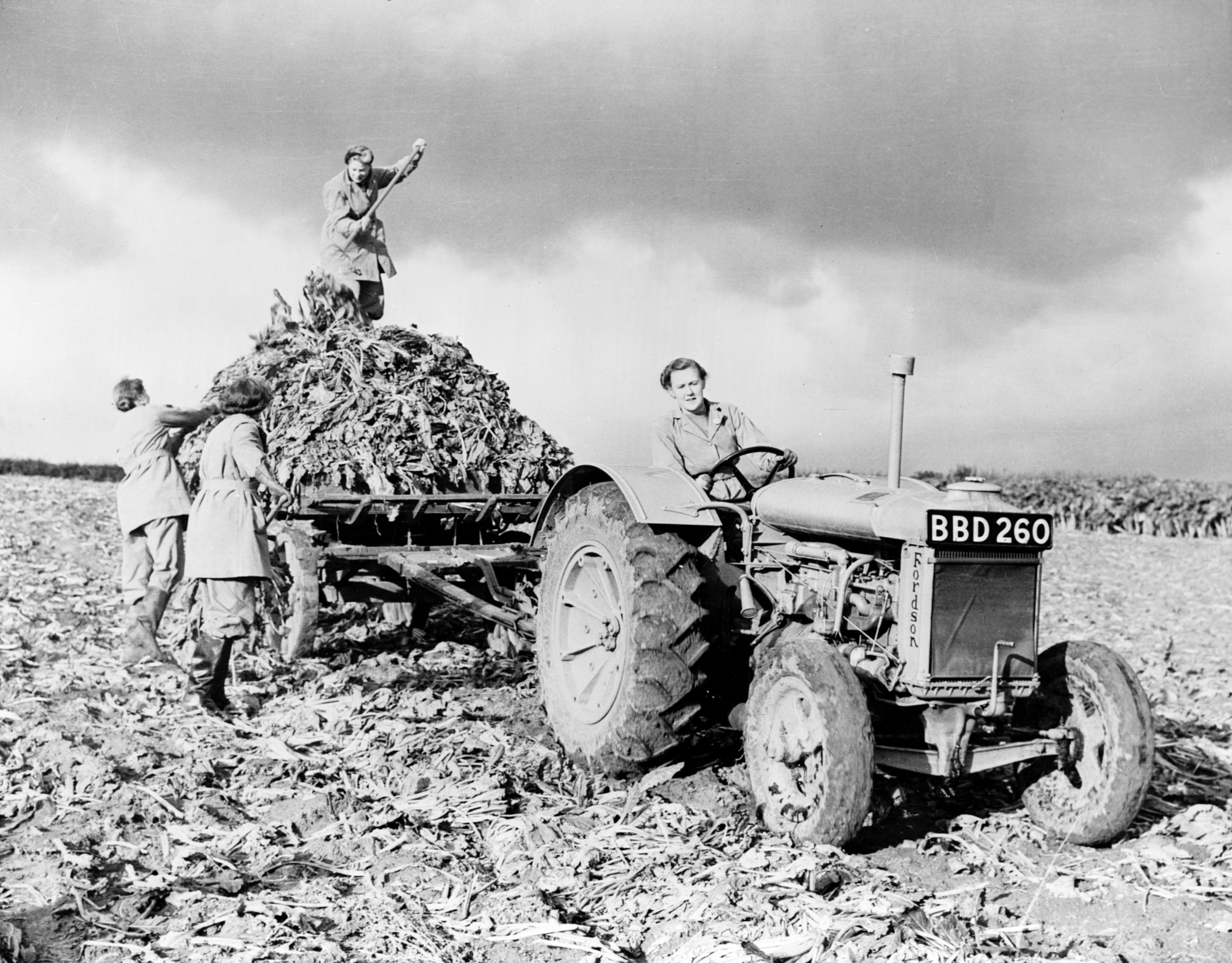
The Women's Land Army (WLA) was a British civilian organisation created in 1917 by the Board of Agriculture during the First World War to bring women into work in agriculture, replacing men called up to the military. Women who worked for the WLA were commonly known as Land Girls (Land Lassies). The Land Army placed women with farms that needed workers, the farmers being their employers. The members picked crops and did all the labour to feed the country. Notable members include Joan Quennell, later a Member of Parliament; John Stewart Collis, Irish author and pioneer ecologist; the archaeologist Lily Chitty and the botanist Ethel Thomas. It was disbanded in 1919 but revived in June 1939 under the same name to again organise new workers to replace workers that served in the military during the Second World War. It was finally disbanded in 1950.
History
First World War

The Women's Farm and Garden Union had existed since 1899 and in February 1916 they sent a deputation to meet Lord Selborne. Selborne's Ministry of Agriculture agreed to fund a Women’s National Land Service Corps with a grant of £150. They were tasked with improving recruitment and provide propaganda about the good cause of women of all classes undertaking agricultural work.

In time the Land Army would take on 23,000 workers who took the place of the 100,000 workers lost to the forces. The women were paid 18 shillings a week and this could be increased to 20 shillings (a pound) if they were considered efficient. 23,000 was a significant contribution but there were estimated to be 300,000 women working on the land during the First World War.
A Good Service Ribbon was awarded to eligible women. January 1918 saw the publication of the first issue of The Landswoman, the official monthly magazine of the Women’s Land Army and the Women’s Institutes. The organisation was disbanded in November 1919.
Second World War

As the prospect of war became increasingly likely, the government wanted to increase the amount of food grown within Britain. In April 1939, peacetime conscription was introduced for the first time in British history, which led to shortages of workers on the farms. To grow more food, more help was needed on the farms and so the government restarted the Women's Land Army in July 1939. Though under the Ministry of Agriculture and Fisheries, it was given an honorary head – Lady Denman. At first it asked for volunteers. This was supplemented by conscription, so that by 1944 it had over 80,000 members.
Inez Jenkins, who had served as Lady Denman's assistant director during the establishment of the WLA served as Chief Administrative Officer until 1948. The last Chief of the WLA was Amy Curtis. The WLA lasted until its official disbandment on 30 November 1950.
The majority of the Land Girls already lived in the countryside, but more than a third came from London and the industrial cities of the north of England. A separate branch was set up in 1942 for forestry industry work, officially known as the Women's Timber Corps and with its members colloquially known as "Lumber Jills" – this was disbanded in 1946.
In 1943, during the Second World War, Amelia King was refused work because she was black. The decision was overturned after being raised in the House of Commons by her MP, Walter Edwards.
Commemoration
In October 2012, the Prince of Wales unveiled the first memorial to the WLA of both World Wars, on the Fochabers estate in Moray, Scotland. The sculpture was designed by Peter Naylor. In October 2014, a memorial statue to the Women's Timber Corps and both incarnations of the Women's Land Army was unveiled at the National Memorial Arboretum in Staffordshire, England.
Recognition

In 1925 the Five Sisters window at York Minster was rededicated to the 1,513 women who died in the line of service during WWI, including ten women from the Land Army.

In December 2007, following campaigning by former Land Girl Hilda Gibson, the Department for Environment, Food and Rural Affairs (DEFRA) announced that the efforts of the Women's Land Army and the Women's Timber Corps would be formally recognised with the presentation of a specially designed commemorative badge to the surviving members. The badge of honour was awarded in July 2008 to over 45,000 former Land Girls.
In October 2012, the Prince of Wales unveiled the first memorial to the WLA of both World Wars, on the Fochabers estate in Moray, Scotland. The sculpture was designed by Peter Naylor. In October 2014, a memorial statue to the Women's Timber Corps and both incarnations of the Women's Land Army was unveiled at the National Memorial Arboretum in Staffordshire, England.
In popular culture
The Women's Land Army was the subject of:
- The Land Girls (1998), a film loosely based on Angela Huth's book Land Girls (1995)
- The ITV sitcom Backs to the Land (1977–78)
- The BBC dramatic TV series Land Girls (2009–11)
- The Powell and Pressburger 1944 film A Canterbury Tale features as the female lead a Land Girl, portrayed by Sheila Sim.
- The play Lilies of the Land (2010) by theatre company The Lions Part.
It also figured largely in:
- Series 3, Episode 3 (2004) of the ITV detective series Foyle's War, entitled "They Fought in the Fields".
- In the 2002 detective novel A Presumption of Death by Jill Paton Walsh and Dorothy L. Sayers, the plot centres on Harriet Vane and Lord Peter Wimsey trying to solve the murder of a land girl in Hertfordshire.
- The Play For Today episode Rainy Day Women.
- In the 2021 novel The Last English Garden by Julia Kelly. Beth Pedley, a main character, is a land girl in Warwickshire. (Gallery Books, Simon & Schuster, New York NY)
References
References
- [https://www.smithsonianmag.com/history/before-rosie-the-riveter-farmerettes-went-to-work-141638628/ "Before Rosie the Riveter, Farmerettes Went to Work"]
- "History – WFGA".
- (2004). "Wilkins [née Jebb], Louisa (1873–1929), agricultural administrator".
- "WW1 Women Land Worker Organisations".
- "Formation".
- [http://www.womenslandarmy.co.uk/97-years-ago-today-presentation-of-good-service-ribbons-in-stafford-1919/ 97 years ago today: Presentation of Good Service Ribbons in Stafford, 1919]
- "The Landswoman Magazine (WW1)". Cherish Watton.
- 'Women's Land Army', ''[[Sheffield Daily Telegraph]]'', 6 October 1919, page
- "Timeline 1948 - Bedfordshire Women's Land Army - The Virtual Library".
- (2009). "[[Dictionary of Irish Biography]]". Cambridge University Press.
- "Disbandment".
- Vickers, Emma. (2011). "'The Forgotten Army of the Woods': The Women's Timber Corps during the Second World War". British Agricultural History Society.
- Bourne, Stephen. (2012). "The Motherland Calls: Britain's Black Servicemen & Women, 1939-45". The History Press.
- Romain, Gemma. (2017). "Race, sexuality and identity in Britain and Jamaica: the biography of Patrick Nelson, 1916-1963".
- "The Prince of Wales unveils memorial to Women's Land Army".
- (21 October 2014). "Memorial Arboretum Land Girls monument unveiled after three-year fundraising campaign". BBC News.
- . (September 1925). "Five Sisters Window: Unveiling by the Duchess of York". *Canadian Nurses’ Association*.
- Fell, Alison S. (2018). "Women as veterans in interwar Britain and France". Cambridge University Press.
- "Women's Land Army". UK National Archives.
- (21 October 2014). "Memorial Arboretum Land Girls monument unveiled after three-year fundraising campaign". BBC News.
- "The Land Girls (1998)".
- Smith, Julia Llewellyn. (27 February 2010). "Land girls: disquiet on the home front". The Telegraph.
- (25 October 2016). "Backs To The Land, 1977".
- (24 September 2009). "Mobilising Land Girls". [[Writers' Guild of Great Britain]].
- House, Christian. (30 August 2014). "A Canterbury Tale at 70: a ray of English sunshine". [[The Daily Telegraph]].
- Loxton, Howard. "Lilies on the Land".
- "Foyle's War:They Fought in the Fields".
- "Fiction Book Review: A PRESUMPTION OF DEATH by Jill Paton Walsh, Author, Dorothy L. Sayers, Author. St. Martin's Minotaur $24.95 (384p) ISBN 978-0-312-29100-6".
This article was imported from Wikipedia and is available under the Creative Commons Attribution-ShareAlike 4.0 License. Content has been adapted to SurfDoc format. Original contributors can be found on the article history page.
Ask Mako anything about Women's Land Army — get instant answers, deeper analysis, and related topics.
Research with MakoFree with your Surf account
Create a free account to save articles, ask Mako questions, and organize your research.
Sign up freeThis content may have been generated or modified by AI. CloudSurf Software LLC is not responsible for the accuracy, completeness, or reliability of AI-generated content. Always verify important information from primary sources.
Report