From Surf Wiki (app.surf) — the open knowledge base
Withington and West Didsbury railway station
Former railway station in Greater Manchester, England
Former railway station in Greater Manchester, England
| Field | Value |
|---|---|
| name | Withington and West Didsbury |
| status | Disused |
| image | File:West Didsbury Station map 1908.jpg |
| caption | A 1908 map of West Didsbury, showing the railway station on Lapwing Lane |
| borough | West Didsbury, City of Manchester, |
| country | England |
| coordinates | |
| grid_name | Grid reference |
| grid_position | |
| platforms | 2 |
| original | South District Railway |
| pregroup | Midland Railway |
| postgroup | London, Midland and Scottish Railway, |
| London Midland Region of British Railways | |
| years | |
| events | Station opened as Withington |
| years1 | 1884 |
| events1 | Station renamed |
| Withington & Albert Park | |
| years2 | |
| events2 | Station renamed |
| Withington & West Didsbury | |
| years3 | |
| events3 | Station closed |
| years4 | |
| events4 | Line fully closed |
the former Midland Railway station
London Midland Region of British Railways Withington & Albert Park Withington & West Didsbury
Withington and West Didsbury (previously named Withington and Withington & Albert Park) is a former railway station in West Didsbury, in south Manchester, England. It was located on Lapwing Lane, close to the junction with Palatine Road and opposite Withington Town Hall. Nothing now remains of the old station buildings, which have been demolished. The area is now served by West Didsbury tram stop, which is approximately 85 m further down the line from the original station.
History
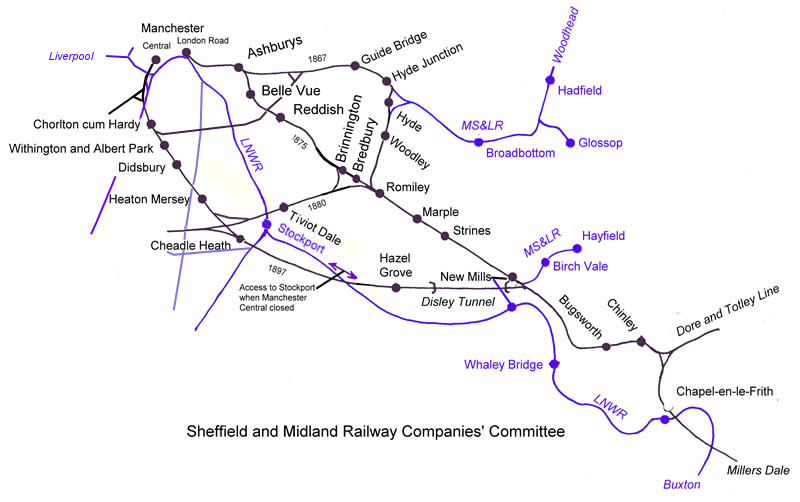
In 1873, the Manchester South District Railway obtained permission to construct a new railway line from Manchester to Alderley. The company fell into financial difficulty and was eventually bought out by the Midland Railway in 1877, which went on to build the line. Construction began in 1878 and the line opened to passenger service on 1 January 1880, running from the new Manchester Central station through south Manchester suburbs to .
The station at West Didsbury opened on 1 January 1880 and was originally named Withington, even though it was located around 1 mi south of Withington. There was uncertainty concerning the station name; four years later in 1884, the Midland Railway decided to rename the station Withington and Albert Park, possibly in an effort to associate it with the fashionable Albert Park housing development and to attract more passengers. In 1915, the station was renamed once again, to Withington & West Didsbury, reflecting its geographical location.
The line ran south through West Didsbury, via a cutting, passing underneath Palatine Road. Withington & West Didsbury station was situated on the north side of Lapwing Lane, set back from the road with a small forecourt area. The station building was a red brick Gothic Revival house, almost identical in style to other nearby stations of the period such as . The building incorporated a booking hall, a parcels office, and ladies' and gentlemen's waiting rooms, as well as a two-storey stationmaster's house. There were two platforms in the cutting with glass canopies and a footbridge. Withington Town Hall, which stood opposite the station, was built for Withington Local Board in the early 1880s.
From 1923, the MR was absorbed into the London, Midland and Scottish Railway and, after 1948, the line became part of British Railways.
Closure

After the station's initial popularity, passenger use from Withington & West Didsbury declined after 1900; this was possibly brought about by competition from Manchester Corporation Tramways, which opened a tram line along Palatine Road to West Didsbury in 1900. When the former London & North Western Railway line from became the principal route for London express trains, the South District Line lost its importance.
In the post-war period, the South District Service declined in frequency and, in 1961, British Railways decided to close the station due to low footfall. The last passenger train departed Withington & West Didsbury station on 2 July 1961. Passenger express and freight trains continued to run through the site until the line was fully closed in 1969.
The station building was demolished in around 1969. Nothing remains today of the old Midland Railway station building, although the platforms remained extant; the site today is occupied by a block of flats.
Line reopening
The former South District Line lay derelict for several decades. In 1984, Greater Manchester Council and the Greater Manchester Passenger Transport Executive announced the Project Light Rail scheme to develop a new light rail/tram system by reopening use of disused railway lines in the region, including the route through West Didsbury.
The first phase of the Manchester Metrolink system opened in 1992, but it was not until 2013 that the network was expanded to reach West Didsbury. Tram tracks were laid along the former trackbed but, as West Didsbury station had been demolished over 40 years earlier, it was decided to locate the new West Didsbury tram stop approximately 85 m further down the line from the original railway station, on the other side of Palatine Road.
Gallery
File:West-didsbury-station2.jpg|The derelict site of the station, 2008 File:Withington & West Didsbury railway station (site), Greater Manchester (geograph 3815626).jpg|The site of the station on the new Metrolink line File:West Didsbury tram stop 09 51 18 392000.jpeg|West Didsbury Metrolink stop, on the opposite side of Palatine Road File:Didsbury transport map.png|Map of railways past and present in Didsbury
References
Citations
Sources
References
- (1988). "Looking Back at Withington and Didsbury". Willow Publishing.
- "Station name: Withington & West Didsbury".
- "History {{!}} Albert Park Conservation Area {{!}} Manchester City Council". Manchester City Council.
- {{NHLE
- (23 May 2013). "First passengers travel on tram extension to East Didsbury". [[Manchester Evening News]].
This article was imported from Wikipedia and is available under the Creative Commons Attribution-ShareAlike 4.0 License. Content has been adapted to SurfDoc format. Original contributors can be found on the article history page.
Ask Mako anything about Withington and West Didsbury railway station — get instant answers, deeper analysis, and related topics.
Research with MakoFree with your Surf account
Create a free account to save articles, ask Mako questions, and organize your research.
Sign up freeThis content may have been generated or modified by AI. CloudSurf Software LLC is not responsible for the accuracy, completeness, or reliability of AI-generated content. Always verify important information from primary sources.
Report