From Surf Wiki (app.surf) — the open knowledge base
Wing Chun
Chinese martial art

Chinese martial art
| Field | Value | |
|---|---|---|
| image | [[File:The age of 18 Bruce Lee and Ye Wen.jpg | 300px]] |
| imagecaption | Ip Man and Bruce Lee practicing "双黐手" (Seung Chi Sau), meaning "double sticky hands" | |
| name | Wing Chun | |
| focus | Striking, grappling, trapping | |
| country | Foshan, China | |
| creator | No definitive founder has been identified; there are eight distinct lineages with different stories regarding its conception. | |
| For further information, see Branches of Wing Chun | ||
| parenthood | Shaolin Kung Fu / Nanquan | |
| descendant arts | Jeet Kune Do, German Jujutsu | |
| famous_pract | (see notable practitioners) |
For further information, see Branches of Wing Chun
Wing Chun (Cantonese) or Yong Chun (Mandarin) (, lit. "singing spring") is a concept-based martial art, a form of Southern Chinese kung fu, and a close-quarters system of self-defense. It is a martial arts style characterized by its focus on close-quarters hand-to-hand combat, rapid-fire punches, and straightforward efficiency. It has a philosophy that emphasizes capturing and sticking to an opponent's centerline. This is accomplished using simultaneous attack and defense, tactile sensitivity, and using an opponent's force against them.
Wing Chun has various spellings in the West, but "Wing Chun" is the most common. The origins of Wing Chun are uncertain, but it is generally attributed to the development of Southern Chinese martial arts. There are at least eight distinct lineages, of which the Ip Man and Yuen Kay-shan lineages are the most prolific.
The martial art was brought to Hong Kong and then the rest of the world by Ip Man, with Bruce Lee being his most famous student. The Ving Tsun Athletic Association, founded in 1967 by Ip Man and his students, helped spread Wing Chun globally. Traditionally taught within a family system, modern Wing Chun lessons have taken on a more academic and commercial character.
Wing Chun gained popularity in the 2010s due to the Ip Man film series starring Donnie Yen and has been featured in video games like Tekken 7. Notable practitioners include Bruce Lee, Donnie Yen, Samuel Kwok, and Carlos Deleon.
Etymology
In Chinese, this martial art is referred to as 咏春拳 (simplified script) or 詠春拳 (traditional script). Though it is written in an almost identical way in traditional and simplified, it is not pronounced and transcribed in the same way according to the regions and their dialects: Yǒngchūn quán in Mandarin pinyin, Wing-Chun keen in Cantonese Wade–Giles. It is made up of two terms: 拳 (quan/kuen) which means "fist, boxing" and the term 詠春 (wing-chun, in Cantonese) meaning "singing spring". The full name is thus translated as "singing spring boxing".
In its short designation, the martial art is simply designated by these two sinograms:
- the sinogram 詠 yǒng/wing: "to sing, to sing..."
- the sinogram 春 chūn/chun: "spring, vitality..."
This martial art is sometimes referred to by 永春, characters different from 詠春, but pronounced and transcribed in the same way: They are literally translated as "eternal spring", the character 永 meaning "eternal, endless". These characters also designate the Yongchun region near the city of Quanzhou (Fujian).
If the use of 詠春 seems privileged today for Wing Chun styles, 永春 still appears in the name of other Southern Chinese martial arts (with 永春 often transcribed Weng Chun); for example jee shim weng chun and Yǒng Chūn Bái Hè Quán (永春白鶴拳).
Romanization
In the West, the name of this martial art has been transcribed variably due to the use of different or personal Chinese language romanization methods, and differences in pronunciation between Chinese languages (but Cantonese was often preferred) or according to Western languages. In addition, some Wing Chun masters voluntarily created their own terms, in order to dissociate their personal teaching from traditional teachings. For example, Yip Man's Ving Tsun or Leung Ting's Wing Tsun.
Finally, this martial art is pronounced quite identically in the West but is written with many spellings: Ving Tsun, Wing Tsun, Wing Tsung, Yong Chun, Weng Chun, Wyng Tjun, Ving Tjun, Wing Tzun, Wing Tschun. Wing Chun is the most common form, used to apply to all lineages of this martial art.
Context
Context of the name Wing Chun varies between various branches of Wing Chun. Common legend is that the name is derived from Yim Wing-chun, the mythical progenator of the martial art, who was a student of the legendary Abbess Ng Mui.
According to the Hung Suen / Hung Gu Biu lineage, the Ng Mui / Yim Wing Chun legend was conceived to protect the identity of Cheung Ng, a Shaolin monk who survived the Manchurian massacres and took refuge at Red Boat Opera. The "Yim Wing Chun" name was chosen for specific reasons, as Yim could be understood as the word for "Secret" or "Protected", and "Wing Chun" refers to Siu Lam Wing Chun Tong (the Always Spring Hall). With "Yim Wing Chun" being a secret code for "the secret art of Siu Lam Wing Chun Hall."
In the Pan Nam lineage, the "Wing" in Wing Chun comes from Chan Wing-wah, one of the founders of Hongmen. According to the Pao Fa Lien lineage, the name Wing Chun is a shortened form of the revolutionary motto, "Wing yun chi jee; Mo mong Hon Juk; Dai dei wu chun." A secret code that allowed the anti-Qing revolutionaries to recognize each other. Eventually, the codeword was shortened to Wing Chun (Always Spring.)
Origins
The definitive origin of Wing Chun remains unknown and is attributed to the development of Southern Chinese martial arts. Complications in the history and documentation of Wing Chun are attributed to the art being passed from teacher to student orally, rather than in writing. Another reason is the secrecy of its development, due to its connections to anti-Qing rebellious movements.
There are at least eight different distinct lineages of Wing Chun, each having its own history of origin. Additionally, there are competing genealogies within the same branch or about the same individual teacher. The eight distinct lineages of Wing Chun which have been identified are:
- Ip Man
- Yuen Kay-shan
- Gu Lao Village
- Nanyang / Cao Dean
- Pan Nam
- Pao Fa Lien
- Hung Suen / Hung Gu Biu
- Jee Shim
Regardless of the origins espoused by various Wing Chun branches and lineages, there is much third-party controversy and speculative theorizing regarding the true origins of Wing Chun. In the West, Wing Chun's history has become a mix of fact and fiction due to the impacts of early secrecy and modern marketing.
Modern Wing Chun
Of the eight Wing Chun lineages, the Ip Man and Yuen Kay-shan lineages are the most prolific branches of Wing Chun worldwide. The other lineages are pretty much unknown outside of China, except for the Pan Nam line, which survives in the USA and the Jee Shim / Weng Chun line with a strong presence in Germany. The Yuen Chai Wan form of Wing Chun has a notable presence in Vietnam, with this lineage having earned the moniker of "Vietnamese Wing Chun".
In 1949, Ip Man, considered the most important grandmaster of modern Wing Chun, brought the style from China to Hong Kong and eventually to the rest of the world. Yip Man's most famous student was Bruce Lee, who had studied under Yip Man before he moved to the United States.{{efn|name="Lee"|Lee was mainly taught Wing Chun by Wong Shun-leung, a senior student of Ip Man.
The Ving Tsun Athletic Association
The Ving Tsun Athletic Association was founded in 1967 by Cantonese master Ip Man and seven of his senior students so they could teach Wing Chun together and Ip Man would not take on all the work himself. The first public demonstration of the Wing Chun fighting system, according to Ip Man, took place in Hong Kong at an official exhibition fight in the winter of 1969 at what was then the Baptist College (now the Hong Kong Baptist University). Leung Ting, a student of Ip Man, invited his master and some well-known representatives of the martial arts scene of the time to the college and conducted the exhibition fights in front of a specialist audience. The Association helped Wing Chun to spread to the rest of the world.
International Wing Chun Organization (IWCO)
The International Wing Chun Organization (IWCO) was founded by Grandmaster Donald Mak in 1997, a respected Wing Chun practitioner and instructor who studied under the Great Grandmaster Chow Tze Chueng.
Characteristics
General
Wing Chun puts emphasis on economic movement and encourages its practitioners to "feel" through their opponents' defenses and to utilize the incoming attacks with parrying, deflection, rapid punches, and finger pokes. Slapping and defensive maneuvers are used to distract the opponent to make them shift their defenses away from their centerline.
Wing Chun favors a relatively high, narrow stance with the elbows close to the body. Within the stance, arms are generally positioned across the vital points of the centerline with hands in a vertical "wu sau" ("protecting hand" position). This puts the practitioner in a position to make readily placed blocks and fast-moving blows to vital striking points down the center of the body, i.e. the neck, chest, belly, and groin. Shifting or turning within a stance is done on the heels, balls, or middle (K1 or Kidney point 1) of the foot, depending on the lineage. Some Wing Chun styles discourage the use of high kicks because this risks counter-attacks to the groin. The practice of "settling" one's opponent to brace them more effectively against the ground helps one deliver as much force as possible.
Relaxation
Softness (via relaxation) and performance of techniques in a relaxed and controlled manner By training the physical, mental, breathing, energy, and force in a relaxed manner a "soft wholesome force" known as Chi is develop which is fundamental to Wing Chun. On "softness" in Wing Chun, Ip Man said during an interview:
Forms
Most common forms
The most common system of forms in Wing Chun consists of three empty hand forms, two weapon forms: the Dragon pole and Butterfly swords, and a wooden dummy form.
[[Hand-to-hand combat|Empty hand]]
Siu nim tau
The first and most important form in Wing Chun, siu nim tau (), is practiced throughout the practitioner's lifetime. It is the foundation or "seed" of the art, on which all succeeding forms and techniques are based. Fundamental rules of balance and body structure are developed here. Using a car analogy; for some branches this would provide the chassis and for others, this is the engine. It serves as the basic alphabet of the system. Some branches view the symmetrical stance as the fundamental fighting stance, while others see it as a training stance used in developing technique.
Although many of the movements are similar, siu nim tau varies significantly between the different branches of Wing Chun. In Ip Man's Wing Chun, the first section of the form is done by training the basic power for the hand techniques by tensing and relaxing the arms. In Moy Yat's Wing Chun, the first section of the form is done without muscle tension and slowly in a meditative, calm, and being "in the moment" way. In 1972, weeks before he died, Ip Man demonstrated Siu Nim Tau (also known as Siu Lim Tau) on film, showing how the form is to be performed.
Chum kiu
The second form, chum kiu , focuses on coordinated movement of body mass and entry techniques to "bridge the gap" between practitioner and opponent, and move in to disrupt their structure and balance. Close-range attacks using the elbows and knees are also developed here. It also teaches methods of recovering position and centerline when in a compromised position where Siu Nim Tau structure has been lost. For some branches, bodyweight in striking is a central theme, either from pivoting (rotational) or stepping (translational). Likewise, for some branches, this form provides the engine to the car. For branches that use the "sinking bridge" interpretation, the form has more emphasis on "uprooting", adding multi-dimensional movement and spiraling to the already developed engine.
Biu jee
The third and last form, biu jee , is composed of extreme short-range and extreme long-range techniques, low kicks and sweeps, and "emergency techniques" to counter-attack when structure and centerline have been seriously compromised, such as when the practitioner is seriously injured., As well as the pivoting and stepping developed in Chum Kiu, a third degree of freedom, involves more upper body, and stretching is developed for more power. Such movements include close-range elbow strikes and finger thrusts to the throat. For some branches, this is the turbo-charger of the car; for others, it can be seen as a "pit stop" kit that should never come into play, recovering your "engine" when it has been lost. Still, other branches view this form as imparting deadly "killing" and maiming techniques that should never be used without good reason. A common Wing Chun saying is, "Biu jee doesn't go out the door". Some interpret this to mean the form should be kept secret; others interpret it as meaning it should never be used if you can help it.
Wooden dummy
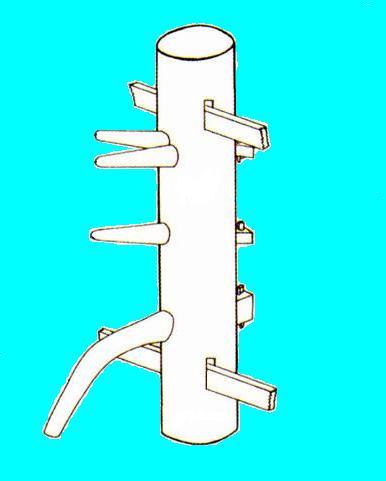
Mu ren zhuang () is performed on a wooden dummy, which serves as a training tool to teach the student the use of Wing Chun Kuen's 108 movements against a live opponent. There are many versions of this form which come from a variety of Wing Chun Kung Fu lineages.
Other forms
San Sik (Chinese: 散式; Cantonese Yale: Sáan Sīk; pinyin: Sǎn Shì; 'Separate forms'), along with the other three forms, is the basis of all Wing Chun techniques. They are compact in structure, and can be loosely grouped into three broad categories: (1) Focus on building body structure through basic punching, standing, turning, and stepping drills; (2) Fundamental arm cycles and changes, firmly ingraining the cardinal tools for interception and adaptation; (3) Sensitivity training and combination techniques.
Weapons
The Yuen Kay Shan / Sum Nung branch also historically trained to throw darts (Biu).
In film and popular culture
Sammo Hung directed two films about Wing Chun practitioner Leung Jan: Warriors Two (1978), in which Leung is played Sammo Hung himself, and The Prodigal Son (1981), in which Leung is played by Yuen Biao.
Donnie Yen played the role of Wing Chun Grandmaster Ip Man in the 2008 movie Ip Man, and in its sequels Ip Man 2, Ip Man 3, and Ip Man 4. The Ip Man series of movies is credited for reviving interest in the martial art in the 2010s and the Ip Man trilogy received critical acclaim in the box office. Ip Man was Bruce Lee's master, which made the trilogy so popular. Lee was largely responsible for launching the "kung fu craze" of the 1970s.
For the 2008 American action thriller film Bangkok Dangerous, actor Nicolas Cage trained in Wing Chun extensively. A particular scene in the film shows Cage's skills whilst drilling moves with another Wing Chun practitioner (played by Thai actor Shahkrit Yamnam).
In December 2019, a new Wing Chun fighter named Leroy Smith was introduced to the fighting game Tekken 7 roster as downloadable content. When creating characters to represent real-world martial arts, the developers wanted to introduce a new fighter utilizing Wing Chun. The developers consulted a student of Ip Man's nephew, who provided motion capture for the character.
Notable practitioners
Bibliography
Notes
References
References
- Benjamin N. Judkins & Jon Nielson 2015
- Braun, Christian (2004). Ju-Jutsu – Effektives Training. Das Prüfungsprogramm vom Gelb- und Orangegurt. Aachen, Germany: Meyer & Meyer Verlag. {{ISBN. 3-89899-011-7.
- See Etymology
- « As the art grows in popularity, many different Romanizations for the Chinese character "Wing Chun" continue to be created, often as a result of the local dialect and pronunciation. This results in the ability to determine a lineage, student/teacher family tree, or origin, by the spelling alone. The most common spelling is "wing chun", which applies generally to all families. » - Wayne Belonoha, The Wing Chun Compendium, p.20
- (November 23, 2020). "Why traditional martial arts lose to hand-to-hand combat – US military hand-to-hand combat trainer who teaches Wing Chun sees it this way.".
- Semyon, Neskorodev. (2016). "Mantis fist in Wing Chun".
- Womack, Mari. (2003). "Sport as Symbol: Images of the Athlete in Art, Literature and Song". McFarland & Company.
- Use of {{lang. zh. 永春 by several branches, including [[Pan Nam]] himself, attested by [[Leung Ting]] in ''Roots and Branches of Wing Tsun'' and by the authors of ''Complete Wing Chun'' . See also http://weng-chun.com and http://www.yongchunbaihechuen.com
- The Wing Chun compendium
- « As the art grows in popularity, many different romanizations for the Chinese character "wing chun" continue to be created, often as a result of the local dialect and pronunciation. This results in the ability to determine a lineage, student/teacher family tree, or origin, by the spelling alone. The most common spelling is "wing chun", which applies generally to all families. » - Wayne Belonoha, The Wing Chun compendium, p.20
- Chu, Ritchie & Wu 2015, pp. 4–27
- Ritchie, R. (''c.'' 2007): [https://web.archive.org/web/20061112065319/http://www.wingchunkuen.com/modules.php?name=News&file=article&sid=4 What's in a name?] Retrieved on 9 May 2010.
- Chris Crudelli. (2008). "The Way of the Warrior". Dorling Kindersley Ltd.
- Chu, Ritchie & Wu 2015, pp. 83–89
- Chu, Ritchie & Wu 2015, pp. 69–77
- Chu 2015, pg.78
- Benjamin N. Judkins & Jon Nielson. (2015). "The Creation of Wing Chun: A Social History of the Southern Chinese Martial Arts". SUNY Press.
- Chu 2015, pg. 1-2, 106-108
- Leung Ting, pg.238
- Leung Ting, page 289 & 290
- / [[Weng Chun]]Leung, Ting (2000). Roots and Branches of Wing Tsun, Second edition (January 1, 2000). Leung Ting Co ,Hong Kong. ISBN 9627284238, pg. 53, 90-99
- see [[#Origins. Origins]]
- Leung Ting, Roots and Branches of Wing Tsun, ISBN 9627284239
- David Peterson. (2001). "Look Beyond the Pointing Finger: The Combat Philosophy of Wong Shun Leung". Melbourne Chinese Martial Arts Club.
- Jan P. Hintelmann. (2005). "Westliche Sinnfindung durch östliche Kampfkunst?". IKO – Verlag für Interkulturelle Kommunikation.
- (3 March 2016). "Pocket area Wing Chun school preserves rare martial arts tradition". Valley Community Newspapers.
- (8 December 2009). "The Open Gate to the Garden of Chinese Martial Arts". Plum Publications.
- Andreas Hoffmann, Nadine Poerschke: Weng Chun Kung Fu. Budo International Publ. Co., Madrid 2011, ISBN 978-3-86836-183-4.
- Chu 2015, page 94
- (31 March 2000). "Yuen Kay-San Wing Chun Kuen". Action Pursuit Group.
- (4 February 2016). "Sư tổ võ Vịnh Xuân Việt Nam là "đại ca" Diệp Vấn". Công ty Cổ phần Quảng cáo Trực tuyến 24H.
- "Những truyền kỳ về sư tổ phái Vịnh Xuân Việt Nam". Kien Thuc.
- (24 March 2019). "Vietnamese Wing Chun Master Nguyen Te Cong". Dansaigon.
- (6 October 2016). "Bậc thầy võ Việt làm Diệp Vấn, Lý Tiểu Long phải phục". SOHA.
- Rawcliffe, Shaun. (2012). "Wing Chun Kung Fu: The Wooden Dummy". Crowood.
- (November 2011). "Ip Man Tong virtual tour".
- (January 22, 2014). "An Interview with Grandmaster Yip Man".
- . (25 July 2018). ["Who taught Bruce Lee kung fu? He was born to be a fighter, but the martial arts superstar also trained with the best"](https://www.scmp.com/culture/film-tv/article/2156574/who-taught-bruce-lee-kung-fu-he-was-born-be-fighter-martial-arts). *South China Morning Post*.
- Complete Wing Chun: The Definitive Guide to Wing Chun's History and Traditions, Robert Chu, Rene Ritchie, Y. Wu, page 9, Tuttle Publishing; 1st edition (20 June 1998). ISBN 0-8048-3141-6, ISBN 978-0-8048-3141-3.
- Ing, Ken. (2010). "Wing Chun Warrior: The True Tales of Wing Chun Kung Fu Master Duncan Leung, Bruce Lee's Fighting Companion". Blacksmith Books.
- Thomas, Bruce. (1994). "Bruce Lee: Fighting Spirit". Frog Books.
- Chris Crudelli. (2008). "The Way of the Warrior". Dorling Kindersley Ltd.
- (2020). "Bruce Lee: The Life of a Legend". Birlinn.
- (2019-11-27). "詠春體育會 - Ving Tsun Athletic Association".
- (2019-11-27). "詠春體育會發展簡介 - Kurzer Überblick zur Entwicklung des Ving Tsun Athletic Association".
- (2019-11-27). "The Development of Ving Tsun Kung Fu in Hong Kong (1961–1970) – 香港詠春體育會發展 (1961–1970)".
- "International Wing Chun Organization HQs – One World, One Family".
- (2024-12-30). "Mästare Donald Mak".
- "Donald Mak 麥廣權 {{!}} eWingChun".
- "Donald Mak Books from the Chow Tze Chuen lineage of Wing Chun Kung Fu.".
- "Chow Tze Chuen 鄒子傳 {{!}} eWingChun".
- (2024-12-30). "Mästare Chow Tze Chuen".
- (2016-09-07). "How to Wu Sau Correctly – Technique is Everything {{!}} Sifu Och Wing Chun". Sifu Och Wing Chun.
- "Rediscovering the Roots of Wing Chun". [[Kung Fu Magazine]].
- "Integrative Wing Chun". [[Kung Fu Magazine]].
- Roselando, Jim. (2011-01-28). "One Wing Chun Kung Fu Family – W1NG : Coaching From The Ancestors".
- (2013-07-11). "An Interview With Grandmaster Yip Man from 1972". My Way of Wing Chun.
- "Wing Chun Forms".
- (May 2011). "The Book of Wing Chun". The [[Hong Kong]] Social Sciences Press.
- (2022-11-10). "SIU NIM TAO: The first form of Wing Chun".
- Michel Boulet. "The Simple Basics of a Complex Art". the Wing Chun Archive.
- Jim Fung. (2009-02-23). "Wing Chun Stance". Wingchun.com.au.
- (2017-05-22). "The Hidden Power of Siu Nim Tau by Tsui Sheung Tin".
- Sifu Cogar. "An Overview of Wing Chun".
- Knight, Dan. (March 13, 2014). "Sil Lim Tao the first form".
- "Ip Man performs Wing Chun Forms".
- "The Forms of Wing Chun Kuen Kung Fu | Reading Academy Wing Chun & Kali". Teamwingchun.co.uk.
- "Ving Tsun Martial Arts Studio – Training". Tstvingtsun.bc.ca.
- "City Wing Chun – Training Notes".
- (February 2023). ["World of Martial Arts !"]({{Google books). Lulu.com.
- (9 November 2021). "Uno de los mejores tres maestros de kung fu en la historia de China fue Latino". El Español.
- "2008 Chinese Box Office records". Box Office Mojo.
- (18 March 2019). "IP Man 4 Teaser Trailer Pits Donnie Yen Against Scott Adkins".
- (2002). "The Cinema of Hong Kong: History, Arts, Identity". [[Cambridge University Press]].
- (September 11, 2014). "Bureaucracy may be wing chun kung fu master's biggest foe". South China Morning Post.
- Mike, Miller. (2016-12-12). "Why Rogue One Star Donnie Yen Performed All of His Amazing Fight Scenes 'Blind'". PEOPLE.com.
- Zhang, Rui. (December 1, 2016). "Donnie Yen leaves hand and foot prints in Hollywood- China.org.cn".
- [http://wghot.wwwwang.com/content/200910/167376.shtml 甄子丹对《叶问》票房无信心 耍咏春拳赚口碑. 网网网络] {{webarchive. link. (28 March 2012)
- "《叶问前传》首映 叶准改口赞甄子丹学咏春很快Ip Chun says Yen learns Wing Chun Fast | 人民网 People's news". People's Daily.
- Heath, Adam. (2012). "Mixed Martial Arts' Most Wanted – The Top 10 book of Crazy Combat, Great Grappling, and Sick Submissions". Potomac Books Inc.
- Yin-Poole, Wesley. (August 5, 2019). "Tekken 7 gets a brand new character called Leroy Smith".
- Walker, Ian. (December 12, 2019). "New Tekken 7 Character's Dog Sidekick Is Good And Pure".
- Herranen, Jaakko. (August 5, 2019). "Tekken 7:n kolmas kausi tuo muassaan täysin uuden hahmon – tällainen on Leroy Smith".
- (January 27, 2020). "TEKKEN 7 – Dev Diary: Leroy Smith & Fahkumram".
- {{Harvnb. Chu. Ritchie. Wu. 2015
- {{Harvnb. Chu. Ritchie. Wu. 2015
- {{Harvnb. Chu. Ritchie. Wu. 2015
- {{Harvnb. Chu. Ritchie. Wu. 2015
- {{Harvnb. Chu. Ritchie. Wu. 2015
- {{Harvnb. Chu. Ritchie. Wu. 2015
- {{Harvnb. Chu. Ritchie. Wu. 2015
- {{Harvnb. Chu. Ritchie. Wu. 2015
- {{Harvnb. Chu. Ritchie. Wu. 2015
This article was imported from Wikipedia and is available under the Creative Commons Attribution-ShareAlike 4.0 License. Content has been adapted to SurfDoc format. Original contributors can be found on the article history page.
Ask Mako anything about Wing Chun — get instant answers, deeper analysis, and related topics.
Research with MakoFree with your Surf account
Create a free account to save articles, ask Mako questions, and organize your research.
Sign up freeThis content may have been generated or modified by AI. CloudSurf Software LLC is not responsible for the accuracy, completeness, or reliability of AI-generated content. Always verify important information from primary sources.
Report