From Surf Wiki (app.surf) — the open knowledge base
Winchester, Virginia
Independent city in Virginia, United States

Independent city in Virginia, United States
| Field | Value |
|---|---|
| name | Winchester, Virginia |
| settlement_type | Independent city |
| image_skyline | Loudoun Street Mall.jpg |
| image_caption | Loudoun Street Mall in Winchester in July 2020 |
| image_flag | Flag of Winchester, Virginia USA.svg |
| image_seal | Winchester_Virginia_Seal.jpg |
| image_map | Winchester-Location.svg |
| map_caption | Location of Winchester in Virginia |
| pushpin_map | #Shenandoah Valley#USA Virginia Northern#USA Virginia#USA |
| pushpin_relief | yes |
| pushpin_label | Winchester |
| pushpin_map_caption | Location of Winchester in Shenandoah Valley |
| subdivision_type | Country |
| subdivision_type1 | State |
| subdivision_type2 | County |
| subdivision_name | United States |
| subdivision_name1 | Virginia |
| subdivision_name2 | None (Independent city) |
| leader_title | Mayor |
| leader_name | Les Veach (R) |
| established_title | Founded |
| established_date | 1744 |
| named_for | Winchester, England |
| area_total_sq_mi | 9.21 |
| area_land_sq_mi | 9.19 |
| area_water_sq_mi | 0.02 |
| area_footnotes | |
| area_total_km2 | 23.86 |
| area_land_km2 | 23.81 |
| area_water_km2 | 0.05 |
| unit_pref | Imperial |
| population_as_of | 2020 |
| population_total | 28120 |
| population_density_sq_mi | auto |
| population_density_km2 | auto |
| timezone | EST |
| utc_offset | −5 |
| timezone_DST | EDT |
| utc_offset_DST | −4 |
| coordinates | |
| elevation_ft | 725 |
| postal_code_type | ZIP Code |
| postal_code | 22601 |
| area_code | 540 |
| blank_name | FIPS code |
| blank_info | 51-86720 |
| blank1_name | GNIS feature ID |
| blank1_info | 1498552 |
| website |
Winchester is the northernmost independent city in the Commonwealth of Virginia, United States. It is the county seat of Frederick County, although the two are separate jurisdictions. As of 2020 United States census, the city's population was 28,120. It is the principal city of the Winchester metropolitan area with a population of just over 145,000 extending into West Virginia, which is a part of the Washington–Baltimore combined statistical area. Winchester is home to Shenandoah University and the Museum of the Shenandoah Valley.
History
Indigenous peoples lived along the waterways of present-day Virginia for thousands of years before European contact. Archeological, linguistic, and anthropological studies have provided insights into their cultures.
17th century
The Shenandoah Valley area, considered a sacred common hunting ground, appears by the 17th century to have been controlled mostly by the local Iroquoian-speaking groups, including the Senedo and herando.
The Algonquian-speaking Shawnee began to challenge the Iroquoians for the hunting grounds later in that century. The explorers Batts and Fallam in 1671 reported the Shawnee were contesting with the Iroquoians for control of the valley and were losing. During the later Beaver Wars, the powerful Iroquois Confederacy from New York, including the Seneca from the western part of the territory, subjugated all tribes in the frontier region west of the fall line.
French Jesuit expeditions may have first entered the valley as early as 1606, as the explorer Samuel de Champlain made a crude map of the area in 1632. The first confirmed exploration of the northern valley was by the explorer John Lederer, who viewed the region from the current Fauquier and Warren County line on August 26, 1670.
18th century
By the time Anglo-European settlers arrived in the Shenandoah Valley around 1729, the Shawnee were the principal occupants in the area of the Shenandoah Valley that developed into Winchester. During the first decade of white settlement, the valley was also a conduit and battleground in a bloody intertribal war between the Seneca and allied Algonquian-speaking Lenape from the north, and their distant traditional enemies, the Siouan Catawba based in the Carolinas.
In 1705, the Swiss explorer Louise Michel and in 1716 Governor Alexander Spotswood did more extensive mapping and surveying. In the late 1720s, Governor William Gooch promoted settlement by issuing large land grants. Robert "King" Carter, manager of the Lord Fairfax proprietorship, acquired 200000 acre. This combination of events directly precipitated an inrush of settlers from Pennsylvania and New York, made up of a blend of Quakers and German and Scots-Irish homesteaders, many of them new immigrants. The Scots-Irish comprised the most numerous group of immigrants from the British Isles before the American Revolutionary War.
The Iroquois Six Nations (the Tuscarora people had joined them by 1722 after losing battles in the Carolinas in the early 18th century) finally ceded their nominal claim to the Shenandoah Valley at the Treaty of Lancaster (1744), arranged by British officials. The treaty also established the right of colonists to use the Indian Road through the valley, later known as the Great Wagon Road.
The father of Shawnee chief Cornstalk had his own court at Shawnee Springs, near today's Cross Junction, Virginia, until 1754. In 1753, on the eve of the French and Indian War (Seven Years' War), messengers came to the Shawnee from tribes further west, inviting them to leave the Valley and cross the Alleghenies, which they did the following year. The Shawnee settled for some years in the Ohio Country before being forced by the US government under Indian Removal in the 1830s to remove to Indian Territory.
The settlement of Winchester began as early as 1729, when Quakers such as Abraham Hollingsworth migrated up (south) the Great Valley along the long-traveled Indian Path (later called the Great Wagon Road by the colonists) from Pennsylvania. He and others began to homestead on old Shawnee campgrounds. Tradition holds that the Quakers purchased several tracts on Apple-pie Ridge from the natives, who did not disturb those settlements. The first German settler appears to have been Jost Hite in 1732, who brought ten other families, including some Scots-Irish. Though Virginia was an Anglican colony, Governor William Gooch had a tolerant policy on religion. The availability of land grants brought in many religious families, who were often given 50 acre plots through the sponsorship of fellow-religious grant purchasers and speculators. As a result, the Winchester area became home to some of the oldest Presbyterian, Quaker, Lutheran and Anglican churches in the valley. The first Lutheran worship was established by Rev. John Casper Stoever Jr. and Alexander Ross established Hopewell Meeting for the Quakers. By 1736, Scots-Irish built the Opequon Presbyterian Church in Kernstown.
A legal fight erupted in 1735 when Thomas Fairfax, Sixth Lord Fairfax came to Virginia to claim his land grant. It included "all the land in Virginia between the Rappahannock and the Potomac rivers", an old grant from King Charles II which overlapped and included Frederick County. It took some time for land titles to be cleared among early settlers.
By 1738, these settlements became known as Frederick Town. The county of Frederick was carved out of Orange County. The first government was created, consisting of a County Court as well as the Anglican Frederick Parish (for purposes of tax collection). Colonel James Wood, an immigrant from Winchester, England, was the first court clerk and had been a surveyor for Orange County, Virginia. He contracted for his own home Glen Burnie homstead around 1737, and it may have been used for early government business. Wood laid out 26 half-acre (2,000 m2) lots in 1744. The County Court held its first session on November 11, 1743, where James Wood served until 1760. Lord Fairfax, understanding that possession is 9/10ths of the law, built a home here (in present-day Clarke County) in 1748.
In February 1752, the Virginia House of Burgesses granted the fourth city charter in Virginia to 'Winchester' as Frederick Town was renamed after Colonel Wood's birthplace in England. In 1754, Abraham Hollingsworth built the local residence called Abram's Delight, which served as the first local Quaker meeting house. George Washington spent a good portion of his young life in Winchester helping survey the Fairfax land grant for Thomas Fairfax, Sixth Lord Fairfax, as well as performing surveying work for Colonel Wood. In 1758 Wood added 158 lots to the west side of town. In 1759 Thomas Lord Fairfax contributed 173 more lots to the south and east.
General Edward Braddock's expeditionary march to Fort Duquesne crossed through this area in 1755 on the way to Fort Cumberland. Knowing the area well from work as a surveyor, George Washington accompanied General Braddock as his aide-de-camp. Resident Daniel Morgan joined Braddock's Army as a wagoner on its march to Pennsylvania. In 1756, on land granted by James Wood, Colonel George Washington designed and began constructing Fort Loudoun, which ultimately covered 0.955 acre in present-day downtown Winchester on North Loudoun Street. Fort Loudoun was occupied and manned with guns until the start of the American Revolutionary War.
During this era, a jail was built in Winchester. It occasionally held Quakers from many parts of Virginia who protested the French and Indian War and refused to pay taxes to the Anglican parish. While their cousins in Pennsylvania dominated politics there, Virginia was an Anglican colony and did not tolerate pacifism well. The strong Quaker tradition of pacifism against strong Virginia support for this war and the next, led to long-term stifling of the Quaker population. Winchester became a gateway to Quaker settlements further west; by the mid-19th century, the Quaker population was a small minority here.
During the war in 1758, at the age of 26, Colonel George Washington was elected to represent Frederick County to the House of Burgesses. Daniel Morgan later served as a ranger protecting the borderlands of Virginia against Indian raids, returning to Winchester in 1759. Following the war, from 1763 to 1774 Daniel Morgan served in Captain Ashby's company and defended Virginia against Pontiac's Rebellion and Shawnee Indians in the Ohio valley (that part now in West Virginia).

During the American Revolutionary War, the Virginia House of Burgesses chose local resident and French and Indian War veteran Daniel Morgan to raise a company of militia to support General George Washington's efforts during the Siege of Boston. He led the 96 men of "Morgan's Sharpshooters" from Winchester on July 14, 1775, and marched to Boston in 21 days. Morgan, Wood, and others also performed duties in holding captured prisoners of war, particularly Hessian soldiers. Hessian soldiers were known to walk to the high ridge north and west of town, where they could purchase and eat apple pies made by the Quakers. The ridge became affectionately known as Apple Pie Ridge. The Ridge Road built before 1751 leading north from town was renamed Apple Pie Ridge Road. The local farmers found booming business in feeding the Virginia Militia and fledgling volunteer American army.
Following the war, the town's first newspapers, The Gazette and The Centinel, were established. Daniel Morgan continued his public service, being elected to one term in the U.S. House of Representatives (1797–1799).
19th century
American Civil War
Main article: Winchester in the American Civil War

Winchester and the surrounding area were the site of numerous battles during the American Civil War, as the Confederate and Union armies strove to control that portion of the Shenandoah Valley. Seven major battlefields are in the original Frederick County:
Within the city of Winchester:
- The First Battle of Kernstown, March 23, 1862
- The First Battle of Winchester, May 25, 1862
- The Second Battle of Winchester, June 13–15, 1863
- The Second Battle of Kernstown, July 24, 1864
- The Third Battle of Winchester, September 19, 1864
Near the city of Winchester:
- The Battle of Cool Spring at Snicker's Gap, July 17–18, 1864
- The Battle of Berryville, September 3–4, 1864
- The Battle of Belle Grove (or Cedar Creek), October 19, 1864

Winchester was a key strategic position for the Confederate States Army during the war. It was an important operational objective in Gen Joseph E. Johnston's and Col Thomas J. "Stonewall" Jackson's defense of the Shenandoah Valley in 1861, Jackson's Valley Campaign of 1862, the Gettysburg campaign of 1863, and the Valley Campaigns of 1864. Including minor cavalry raids and patrols, and occasional reconnaissances, historians claim that Winchester changed hands as many as 72 times and 13 times in one day. Battles raged along Main Street at points in the war. Union General Sheridan and Stonewall Jackson located their headquarters just one block apart at times.
At the north end of the lower Shenandoah Valley, Winchester was a base of operations for major Confederate invasions into the Northern United States. At times the attacks threatened the capital of Washington, D.C. The town served as a central point for troops conducting major raids against the Baltimore and Ohio Railroad, Chesapeake and Ohio Canal, and turnpike and telegraph paths along those routes and the Potomac River Valley. For instance, in 1861, Stonewall Jackson removed 56 locomotives and over 300 railroad cars, along with miles of track, from the B&O Railroad. His attack closed down the B&O's main line for ten months. Much of the effort to transport this equipment by horse and carriage centered in Winchester.
.png)
During the war, Winchester was occupied by the Union Army for four major periods: by Major General Nathaniel Banks (March ? May 12 to 25, 1862, and June 4 to September 2, 1862), Major General Robert Milroy (December 24, 1862, to June 15, 1863), Major General Philip Sheridan (September 19, 1864, to February 27, 1865), and Major General Winfield Scott Hancock (February 27, 1865, to June 27, 1865). Major General Sheridan raided up the valley from Winchester, where his forces destroyed "2,000 barns filled with grain and implements, not to mention other outbuildings, 70 mills filled with wheat and flour" and "numerous head of livestock," to lessen the area's ability to supply the Confederates.
Numerous local men served with the Confederate Army, mostly as troops. Hunter McGuire was Chief Surgeon of the Second "Jackson's" Corps of the Army of Northern Virginia. He laid the foundations for the future Geneva conventions regarding the treatment of medical doctors during warfare. Winchester served as a major center for Confederate medical operations, particularly after the Battle of Sharpsburg in 1862 and the Battle of Gettysburg in 1863. Among those who took part in battles at Winchester were future U.S. presidents McKinley and Hayes, both as officers in the Union IX Corps.
The United States assigned military presence to Winchester and other parts of the South during Reconstruction after the war. Winchester was part of the First Military District, commanded by Major General John Schofield. This period lasted until January 26, 1870.
20th century
Winchester was the first city south of the Potomac River to install electric light. In 1917 the Winchester and Western Railroad connected Winchester with Rock Enon Springs, moving both vacationers and supplies to the resort that is now Camp Rock Enon with far greater speed. Winchester is the location of the bi-annual N-SSA national competition, keeping the tradition of Civil War era firearms alive. A three-block section of downtown Loudoun Street was closed to vehicular traffic in the 1970s and is a popular pedestrian area featuring many boutiques and cafés. The street was repaved with brick and landscaped in 2013. Apple Blossom Mall opened in 1982.
In 1983, a tire dump in the area containing over seven million tires burned for nine months, polluting nearby areas with lead and arsenic. The location was cleaned up as a Superfund project between 1983 and 2002.
Winchester has been designated as a Tree City USA by the Arbor Day Foundation for over three decades.
Geography


Winchester is located at .
According to the United States Census Bureau, the city has a total area of 9.3 sqmi, virtually all land.
It is in the Shenandoah Valley, located between the Blue Ridge Mountains and the Allegheny Mountains, and is 15 miles north-northeast of the northern peak of Massanutten Mountain. I-81 passes through the city, along with US 50, US 522, US 17, which ends in the city, and SR 7, which also ends in the city. The city is approximately 75 mi to the west of Washington, D.C., 24 mi south of Martinsburg, West Virginia, 25 mi north of Front Royal, 118 mi south of Harrisburg, PA and 180 mi north of Roanoke.
Climate
The climate in this area is characterized by hot, humid summers and generally mild to cool winters. According to the Köppen Climate Classification system, Winchester has depending on which isotherm is used, either a humid continental climate or a humid subtropical climate, abbreviated "Cfa" on climate maps. The hardiness zone is 6b/7a. |Jan record high F = 80 |Feb record high F = 81 |Mar record high F = 89 |Apr record high F = 98 |May record high F = 98 |Jun record high F = 104 |Jul record high F = 107 |Aug record high F = 107 |Sep record high F = 103 |Oct record high F = 99 |Nov record high F = 85 |Dec record high F = 80 |year record high F = 107 |Jan record low F = −18 |Feb record low F = −16 |Mar record low F = -6 |Apr record low F = 12 |May record low F = 28 |Jun record low F = 36 |Jul record low F = 42 |Aug record low F = 36 |Sep record low F = 30 |Oct record low F = 16 |Nov record low F = 4 |Dec record low F = -6 |year record low F = -18 | access-date = July 2, 2021}} | access-date = July 2, 2021}}
Demographics
|align-fn=center 1790-1960 1900–1990 1990-2000 2010 2020
2020 census
| Race / Ethnicity | title=P2 Hispanic or Latino, and Not Hispanic or Latino by Race – 2010: DEC Redistricting Data (PL 94-171) – Winchester city, Virginia | url=https://data.census.gov/cedsci/table?q=p2&g=1600000US5186720&tid=DECENNIALPL2010.P2 | website=United States Census Bureau}} | title=P2 Hispanic or Latino, and Not Hispanic or Latino by Race – 2020: DEC Redistricting Data (PL 94-171) – Winchester city, Virginia | url=https://data.census.gov/cedsci/table?q=p2&g=1600000US5186720&tid=DECENNIALPL2020.P2 | website=United States Census Bureau}} | % 2010 | % 2020 |
|---|---|---|---|---|---|---|---|---|
| White alone (NH) | 18,085 | 17,623 | 69.02% | 62.67% | ||||
| Black or African American alone (NH) | 2,783 | 2,800 | 10.62% | 9.96% | ||||
| Native American or Alaska Native alone (NH) | 37 | 66 | 0.14% | 0.23% | ||||
| Asian alone (NH) | 599 | 700 | 2.29% | 2.49% | ||||
| Pacific Islander alone (NH) | 3 | 14 | nil | nil | ||||
| Some Other Race alone (NH) | 57 | 135 | 0.22% | 0.48% | ||||
| Mixed Race/Multi-Racial (NH) | 598 | 1,288 | 2.28% | 4.58% | ||||
| Hispanic or Latino (any race) | 4,041 | 5,494 | 15.42% | 19.54% | ||||
| Total | 26,203 | 28,120 | 100% | 100% |
Note: the US Census treats Hispanic/Latino as an ethnic category. This table excludes Latinos from the racial categories and assigns them to a separate category. Hispanics/Latinos can be of any race.
Economy

Companies based in Winchester include American Woodmark, Trex, and Rubbermaid Commercial Products. Federal agencies with operations in Winchester include the Federal Emergency Management Agency, the Federal Bureau of Investigation, and the United States Army Corps of Engineers.
According to the City's 2016 Comprehensive Annual Financial Report, the top employers in the city are:
| # | Employer | # of Employees | |
|---|---|---|---|
| 1 | Valley Health | 1,000 and over | |
| 2 | Rubbermaid Commercial Products | 500–999 | |
| 3 | Winchester City Public Schools | 500–999 | |
| 4 | Walmart | 500–999 | |
| 5 | Shenandoah University | 500–999 | |
| 6 | City of Winchester | 500–999 | |
| 7 | Axiom Staffing Group | 500–999 | |
| 8 | Martin's Food Markets | 500–999 | |
| 9 | Trex | 250–499 | |
| 10 | Kohl's | 250–499 |
Record manufacturing
Winchester was home to Capitol Records' East Coast Pressing Plant. Capitol Records Distribution Corporation announced in 1968 the purchasing of land in Winchester, Va for a new record processing plant. Along with this plant they built several houses, bought a few small businesses and later built a tape production plant. The Winchester plant began construction in 1968 and production in 1969. The plant initially had a workforce of 250 people. This plant complemented the other existing manufacturing facilities of Capitol Records in Scranton, PA, Jacksonville, FL and Los Angeles, CA. In 1969 Capitol Records' Pressing Plant in Scranton began phasing out its vinyl manufacturing in favor of the new Winchester plant. Records pressed here include Talking Heads' Remain in Light, Dead Boys' Young, Loud and Snotty, and Yoko Ono's Fly. Capitol Records announced in late 1987 that it would end tape duplicating production in the US, in favor of offshore manufacturing, including in Winchester by early 1988, putting more than 500 employees out of work when they closed the Winchester plant.
Arts and culture


Historic sites
Main article: National Register of Historic Places listings in Winchester, Virginia
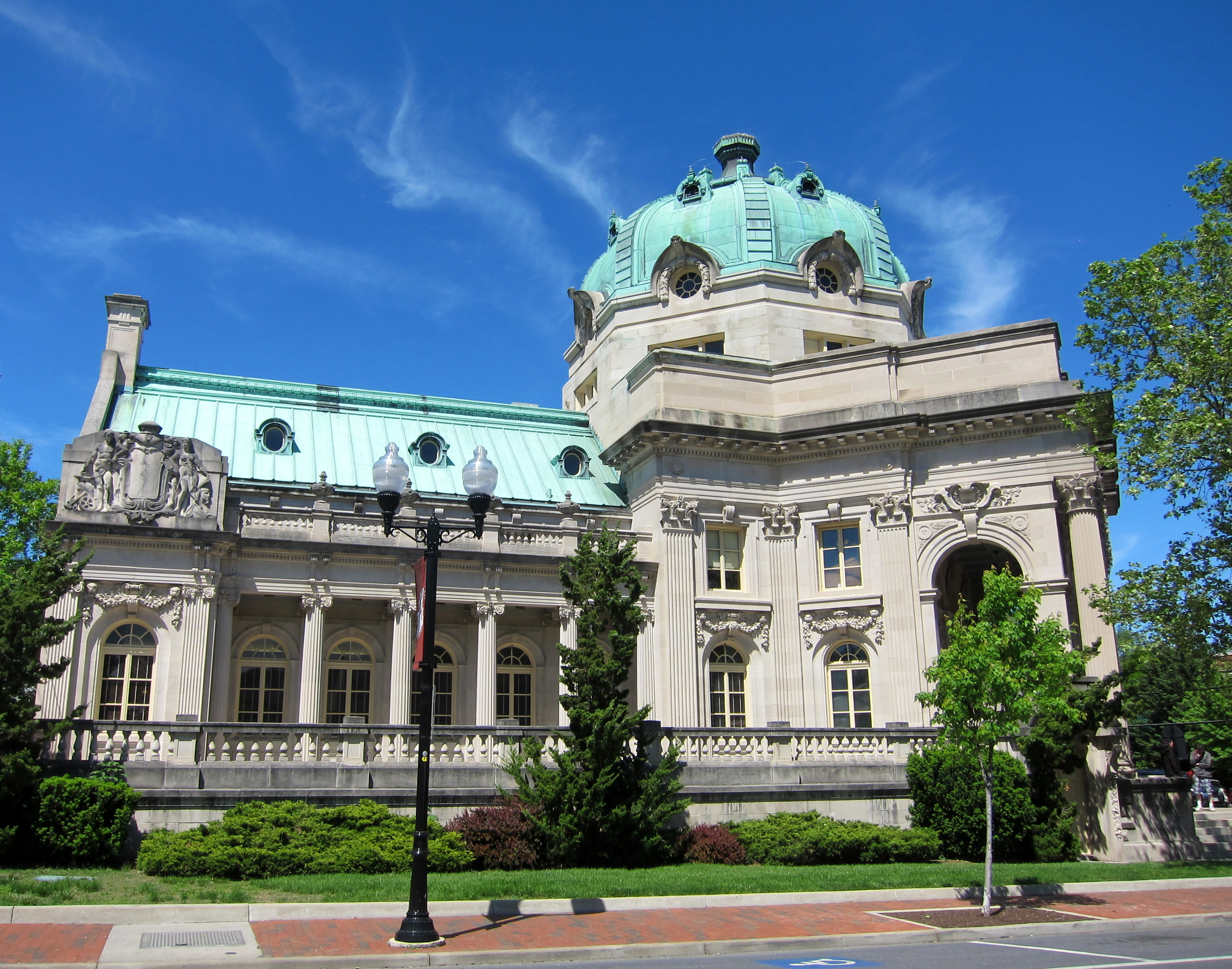

| Site | Year built | Address | Listed |
|---|---|---|---|
| Abram's Delight | 1754 | Parkview Street & Rouss Spring Road | 1973 |
| Douglas School | 1927 | 598 North Kent Street | 2000 |
| Fair Mount | 19th century | 311 Fairmont Avenue | 2004 |
| Glen Burnie | 1794 | 901 Amherst Street | 1979 |
| Handley Library | 1913 | Braddock & Piccadilly Streets | 1969 |
| John Handley High School | 1920s | 425 Handley Boulevard | 1998 |
| Hawthorne and Old Town Spring | 1811 | 610 and 730 Amherst Street | 2013 |
| Hexagon House | 1870s | 530 Amherst Street | 1987 |
| Stonewall Jackson's Headquarters Museum | mid-19th century | 415 North Braddock Street | 1967 |
| Adam Kurtz House | 1757 | Braddock & Cork Streets | 1976 |
| Old Stone Church (Winchester, Virginia) | 1788 | 304 East Piccadilly Street | 1977 |
| Triangle Diner | 1948 | 27 West Gerrard Street | 2010 |
| Winchester Historic District | 1750–1930 | US 522, US 11 & US 50/US 17 | 1980 |
| Winchester Historic District (Boundary Increase) | 120 & 126 North Kent Street | 2003 | |
| Winchester National Cemetery | 1860s | 401 National Avenue | 1996 |
| George Washington's Office Museum | by 1748 | 32 West Cork Street | 1975 |
| Patsy Cline Historic House | 1880 | 608 S. Kent St. | 2005 |
| Mount Hebron Cemetery and Stonewall Confederate Cemetery | 1844 | 305 E. Boscawen Street | 2008 |
| The George Washington Hotel | 1924 | 103 E Piccadilly Street | 2010 |
Shenandoah Apple Blossom Festival
Winchester is the location of the annual Shenandoah Apple Blossom Festival, which has existed since 1924. It is usually held during the first weekend in May. The festival includes a carnival, firework show, parades, several dances and parties, and a coronation where the Apple Blossom Queen is crowned. Local school systems and many businesses close the Friday of Apple Blossom weekend.
Winchester has more than 20 different "artistic" apples that are made of various materials including wood, rubber pipe, plaster, and paint. These apples were created in 2005 by occupants of the city and were placed at a specific location at the artists' request after being auctioned off. For example, a bright red apple with a large stethoscope attached to it was placed beside a much-used entrance to the Winchester Medical Center.
Sports
Winchester is home to the Winchester Royals, which is part of the Valley Baseball League, a National Collegiate Athletic Association-sanctioned collegiate summer baseball league in the Shenandoah Valley of Virginia.
Shenandoah University is located in Winchester and has numerous male and female sports in the Old Dominion Athletic Conference. Winchester is also home to the Winchester Speedway, a 3/8-mile clay oval track, which plays host to a number of touring series, such as the World of Outlaws Late Model Series, and the Lucas Oil Late Model Dirt Series.
Government and politics
Winchester had long favored Republican candidates through the second half of the 20th Century. However, in 2008 the city swung strongly into the Democratic column to support Barack Obama. Even though Obama lost ground in 2012 and only carried the city by 148 votes, it has nevertheless stayed Democratic-leaning ever since. In 2020, Joe Biden won the city with the highest percentage for a Democrat since 1936.
City council
Winchester's follows a Council-Manager form of government. It is governed by the Common Council, an elected body within a ward system. The city is composed of four wards, each with 2 councilmen, with the city's mayor serving as the ninth representative and leader of the council. While the council began as a 13-member board, it transitioned from 13 to 9, beginning in 2006 and ending in 2008.
- Mayor: Les Veach (R)
- Ward 1: Chip Newcom (D), Richard Bell (D)
- Ward 2: Emily Windle (R), Terry Sloane (I)
- Ward 3: Kim Herbstritt (D), Corey Sullivan (R)
- Ward 4: Kathy Tagnesi (R), John Fox (R)
Education
Winchester Public Schools operates public schools, including John Handley High School.
Transportation

The most prominent highway serving Winchester is Interstate 81, with Winchester located roughly halfway between its northernmost and southernmost ends. I-81 extends northeast to southwest, beginning on the New York side of the Thousands Island National Park in Ontario. From here, the highway continues through upstate New York into northeastern Pennsylvania, where it passes through central and southern Pennsylvania into western Maryland. From here, it passes through a small portion of eastern West Virginia, all of Virginia, from Winchester, Virginia's northernmost city, through central and southern Virginia. After Virginia, the highway finally passes through the short border with eastern Tennessee. The highway terminates shortly after this.
Other highways passing through Winchester include U.S. Route 11, U.S. Route 17, U.S. Route 50 and U.S. Route 522. These four highways follow city streets through downtown Winchester, with U.S. Route 17 coming to its northern terminus. Virginia State Route 7 also serves Winchester, terminating in downtown. Virginia State Route 37 bypasses the city to the west.
Winchester Transit provides weekday transit for the city of Winchester. Winchester Regional Airport provides general aviation and air taxi service to the area.
Notable people
18th century
- John H. Aulick (1787–1873), United States Navy officer and veteran of the War of 1812
- Briscoe Baldwin (1789–1852), Virginia delegate and member of the Constitutional Convention
- Rebecca Boone (1739–1813), pioneer and wife of frontiersman Daniel Boone
- Jane Frazier (1735–1815), frontier woman
- Daniel Morgan (1735–1802), major general of Virginia militia in Revolutionary War; buried at Mount Hebron cemetery
- Presley Neville (1756–1818), general, Revolutionary War aide-de-camp to the Marquis de Lafayette and Chief Burgess of the Borough of Pittsburgh
- Francis White (–1826), U.S. Representative
- James Wood (1741–1813), brigadier general, Governor of Virginia, son of Winchester's founder
19th century===
- Robert T. Barton (1842–1917), Virginia Delegate, Mayor of Winchester and Confederate veteran of the American Civil War
- Frances Courtenay Baylor (1848–1920), American novelist
- Rear Admiral Richard E. Byrd (1888–1957), pioneering polar explorer
- John Snyder Carlile (1817–1878), U.S. Senator, instrumental in the creation of West Virginia*U.S. Solicitor General
- Charles Magill Conrad (1804–1878), Secretary of War under President Millard Fillmore
- Holmes Conrad (1840–1915), United States Assistant Attorney General and Solicitor General of the United States under President Grover Cleveland and Confederate cavalry Major in the American Civil War
- James William Denver (1817–1892), briefly a Brigadier General in the Union Army during the American Civil War, and for whom the city of Denver, Colorado, was named
- Helen H. Gardener (1853–1925), rationalist orator and novelist
- Frederick W. M. Holliday (1828–1899), colonel of 33rd Virginia Regiment, Provisional Army of the Confederate States, member of the Confederate Congress during the American Civil War and the Governor of Virginia from 1878 to 1882.
- George Hay Lee (1808–1873), United States judge
- Mary Greenhow Lee (1819–1907), diarist during the Civil War.
- James M. Mason, U.S. Senator
- Cornelia Peake McDonald (1822–1909), diarist during the Civil War
- Hunter McGuire, M.D. (1835–1900), Chief Surgeon of the Second "Jackson's" Corps of the Army of Northern Virginia. President of the American Medical Association.
- Admiral Louis M. Nulton (1869–1954), superintendent of the U.S. Naval Academy (1925–1928) and Commander Battle Fleet (1929–1930).
- Sara Winifred Brown (1868–1948), African American professor and doctor of gynecology. Founded the National Association of University Women, and was the first woman to serve as an alumni trustee of Howard University.
- Spot Poles (1887–1962), accomplished baseball player in the precursor to the Negro leagues
- James Innes Randolph (1837–1887), Confederate Army officer, lawyer, and poet
- Heyward Shepherd (†1859), Black baggage porter on the Baltimore and Ohio Railroad, first person killed during John Brown's raid on Harpers Ferry. There is a monument to him in Harpers Ferry.
- John Randolph Tucker (1823–1897), U.S. Representative from Virginia
- Josiah T. Walls (1842–1905), first African-American U.S. congressman from Florida
- Charles Franklin Moss (1878–1961), photographer and artist
20th century
- Anne Tucker McGuire (1913–1988) was an American-born actress who appeared largely in British films and television
- Joe Bageant (1946–2011), writer and journalist
- Brian Benben (1956–), actor
- Harry F. Byrd Jr. (1914–2013), politician and U.S. Senator
- Lang Campbell (1981–), professional football quarterback
- Patsy Cline (1932–1963), country/pop vocalist and music icon, born in Winchester, interred at Shenandoah Memorial Park.
- Doug Creek (1969–2024), professional baseball player
- Claude Dallas (1950–), self-styled mountain man convicted of voluntary manslaughter in the deaths of two game wardens in Idaho.
- Penny DeHaven (1948–2014), country music singer
- John Gilkerson (1985–), professional soccer player
- Erick Green (1991–), professional basketball player
- Jack Holt (1888–1951), actor
- John Kirby (1908–1952), jazz musician
- Mark McFarland (1978–), NASCAR driver
- Devon McTavish (1984–), professional soccer player with D.C. United
- J. Kenneth Robinson (1916–1990), U.S. Representative
- Rick Santorum (1958–), presidential candidate, former U.S. senator
- Henry H. Whiting (1923–2012), Justice of the Supreme Court of Virginia
- Emma Howard Wight (1863–1935), author
- James "Clayster" Eubanks (1992–), professional Call of Duty player
Sister cities
- [[Image:Flag of Ecuador.svg|25px]] Ambato, Ecuador
- [[Image:Flag of the United Kingdom.svg|25px]] Winchester, United Kingdom
Winchester's first sister city, Winchester, England, is where the Virginia town gets its name. During the Eisenhower administration, Winchester also formalized a sister city relationship with Ambato, Ecuador.
References
References
- "Les Veach".
- "2019 U.S. Gazetteer Files". United States Census Bureau.
- "U.S. Census website". [[United States Census Bureau]].
- (2007-10-25). "US Board on Geographic Names". [[United States Geological Survey]].
- "Find a County". National Association of Counties.
- "Winchester city, Winchester city, Virginia".
- [[David Hackett Fischer]], ''[[Albion's Seed: Four British Folkways in America]]'', New York: Oxford University Press, 1989
- Carrie Hunter Willis and Etta Belle Walker, 1937, ''Legends of the Skyline Drive and the Great Valley of Virginia'', p. 16-17.
- Joseph Doddridge, ''A History of the Valley of Virginia'', 1850, p. 44
- Joseph Doddridge, ''A History of the Valley of Virginia'', 1850, p. 40.
- (2003). "The Gardens of Glen Burnie". The Glass-Glen Burnie Museum Inc., Winchester, VA.
- Historical Statement Relative to the Town of Winchester
- Greene, Katherine Glass. (1926). "Winchester, Virginia And Its Beginnings, 1743–1814". Shenandoah Publishing House.
- [[Official Records]]
- "First Military District".
- "Winchester, VA".
- Report of the Secretary of the Commonwealth to the Governor and General Assembly of Virginia. (1918).
- "Rhinehart Tire Fire Dump". [[United States Environmental Protection Agency.
- (3 December 1983). "Experts Learning on the Job Fighting Fire in Pile of Tires". timesmachine.nytimes.com.
- "Trees—City of Winchester".
- (2011-02-12). "US Gazetteer files: 2010, 2000, and 1990". [[United States Census Bureau]].
- "Winchester, Virginia Köppen Climate Classification".
- "Census of Population and Housing from 1790-2000". [[US Census Bureau]].
- "Historical Census Browser". University of Virginia Library.
- "Population of Counties by Decennial Census: 1900 to 1990". United States Census Bureau.
- "Census 2000 PHC-T-4. Ranking Tables for Counties: 1990 and 2000". United States Census Bureau.
- "P2 Hispanic or Latino, and Not Hispanic or Latino by Race – 2010: DEC Redistricting Data (PL 94-171) – Winchester city, Virginia".
- "P2 Hispanic or Latino, and Not Hispanic or Latino by Race – 2020: DEC Redistricting Data (PL 94-171) – Winchester city, Virginia".
- "FEMA Disaster Operations Center To Be Housed At New Facility In Winchester".
- "Records Management".
- "Middle East District > Contact".
- "City of Winchester, Virginia Comprehensive Annual Financial Report, for the Year ended June 30, 2016".
- (January 6, 2024). "Capitol Records Pressing Plant, Winchester".
- "Handley Regional Library".
- "Shenandoah Apple Blossom Festival".
- "Winchester Royals". [[Valley Baseball League]].
- "Valley League Baseball". [[Valley Baseball League]].
- "Dave Leip's Atlas of U.S. Presidential Elections".
- Leip, David. "Dave Leip's Atlas of U.S. Presidential Elections".
- (March 7, 2012). "About the City Government". City of Winchester.
- "John H. Aulick (ca. 1791–1873)".
- "Briscoe Gerard Baldwin (1789–1852)".
- (1966). "Wilderness Wife". D. McKay Co..
- "Jane Frazier House".
- Hogg, J. Bernard. (1936). "Presley Neville". The Western Pennsylvania Historical Magazine.
- (2004). "Hampshire County, West Virginia, 1754–2004". The Hampshire County 250th Anniversary Committee.
- "Colonel James Wood, II Chapter".
- "Robert Thomas Barton". Arlis Herring.com.
- (October 16, 1920). "Mrs. Barnum, Author, Dead". The Washington Post.
- Davis, William A.. (1 February 1987). "The Admiral of the Ends of the Earth A Household Name to Millions, Richard E. Byrd Was Truly Known by Few HE ADMIRAL OF THE ENDS OF THE EARTH A HOUSEHOLD NAME TO MILLIONS, RICHARD E. BYRD WAS TRULY KNOWN BY FEW". Boston Globe.
- Hubbell, John T.. (1995). "Biographical dictionary of the Union : Northern leaders of the Civil War". Greenwood.
- "CONRAD, Charles Magill {{!}} US House of Representatives: History, Art & Archives".
- [https://www.handleyregional.org/services/departments/archives/manuscripts/c/893-THL "Holmes Conrad Collection." ''Handley Regional Library System.''] Retrieved June 12, 2021.
- "Denver, James William – Biographical Information".
- "Helen Hamilton Gardener," in ''The National Cyclopaedia of America Biography: Volume 9.'' New York: James T. White and Co., 1899; p. 451.
- [https://archives.lib.duke.edu/catalog/hollidayfrederick "Frederick W. M. Holliday papers, 1846–1899." ''Duke University Libraries.''] Retrieved June 12, 2021.
- (2014-05-02). "George Hay Lee, July 1, 1852-April 1861". Virginia Appellate Court History.
- [https://quod.lib.umich.edu/c/clementsead/umich-wcl-M-6026.1lee?id=navbarbrowselink;view=text "Mary Greenhow Lee collection (1861–1907)." '' William L. Clements Library, University of Michigan.''] Retrieved June 12, 2021.
- (May 8, 2012). "A Woman's Civil War: A Diary with Reminiscences of the War, from March 1862 (publisher's book information page)". Univ of Wisconsin Press.
- [https://www.handleyregional.org/services/departments/archives/manuscripts/m/956-WFCHS-THL "Hunter Holmes McGuire Collection." ''Handley Regional Library System.''] Retrieved June 12, 2021.
- [https://www.history.navy.mil/research/library/research-guides/modern-biographical-files-ndl/modern-bios-n/nulton-louis-mccoy.html "Louis McCoy Nulton." ''Naval History and Heritage Command.''] Retrieved June 12, 2021.
- [https://www.winchesterva.gov/black-history "Black History." ''City of Winchester.''] Retrieved June 12, 2021.
- "nlbpa.com – Poles, Spottswood".
- 'Southern Writers: Anew Biographical Dictionary,' Joseph M. Flora/Amber Vogel-editors,' Louisiana State University Press, Baton Rouge, Louisiana: 2006, Biographical Sketch of James Innes Randolph, p. 331
- https://www.shenandoahatwar.org/history/heyward-shepherd/ "Heyward Shepherd." ''Shenandoah at War.''Retrieved June 12, 2021.
- [https://stonesentinels.com/harpers-ferry/tour-battlefield/lower-town-harpers-ferry/monument-hayward-shepherd/ "Monument to Heyward Shepherd." ''Stone Sentinels.''] Retrieved June 12, 2021.
- "Tucker, John Randolph {{!}} US House of Representatives: History, Art & Archives".
- "WALLS, Josiah Thomas {{!}} US House of Representatives: History, Art & Archives".
- "Ann Tucker McGuire profile".
- (March 10, 2015). "Toxically Pure".
- "Brian Benben profile". Filmreference.com.
- Yardley, William. (30 Jul 2013). "Harry F. Byrd, Virginia Senator, Dies at 98". The New York Times.
- "Lang Campbell – 2004 – Football".
- [https://familysearch.org/ark:/61903/1:1:J2CZ-9ZV Hilda Hensley death record] accessed 4/4/2015
- "Doug Creek".
- Bieter, John. (2015). "Claude Dallas: The Myth Comes to Life".
- Bush, John. "Penny DeHaven biography".
- "John Gilkerson | MLSsoccer.com".
- "11 Erick Green".
- (October 25, 2019). "Jack Holt".
- "John Kirby, Jazz Musician".
- "Driver – Racing-Reference".
- "Devon McTavish".
- (1990-04-10). "Former va. congressman Kenneth Robinson, 73, dies". [[The Washington Post]].
- (January 31, 2012). "GOP Candidate Rick Santorum's Daughter Hospitalized In Virginia". [[CBS]].
- (September 17, 2012). "Henry H. Whiting, former Virginia Supreme Court Justice, dies".
- (25 June 1935). "Miss Emma Howard Wight". The Times Dispatch.
- Tsukayama, Hayley. (May 1, 2015). "Five ways professional gaming is like any other sport". [[Washington Post]].
This article was imported from Wikipedia and is available under the Creative Commons Attribution-ShareAlike 4.0 License. Content has been adapted to SurfDoc format. Original contributors can be found on the article history page.
Ask Mako anything about Winchester, Virginia — get instant answers, deeper analysis, and related topics.
Research with MakoFree with your Surf account
Create a free account to save articles, ask Mako questions, and organize your research.
Sign up freeThis content may have been generated or modified by AI. CloudSurf Software LLC is not responsible for the accuracy, completeness, or reliability of AI-generated content. Always verify important information from primary sources.
Report