From Surf Wiki (app.surf) — the open knowledge base
William Gaston
American judge
American judge
| Field | Value | ||||
|---|---|---|---|---|---|
| state | North Carolina | ||||
| district | 4th | ||||
| term_start | March 4, 1813 | ||||
| term_end | March 3, 1817 | ||||
| predecessor | William Blackledge | ||||
| successor | Jesse Slocumb | ||||
| image | WilliamGaston.jpg | ||||
| birth_date | |||||
| birth_place | New Bern, North Carolina, US | ||||
| death_date | |||||
| death_place | Raleigh, North Carolina, US | ||||
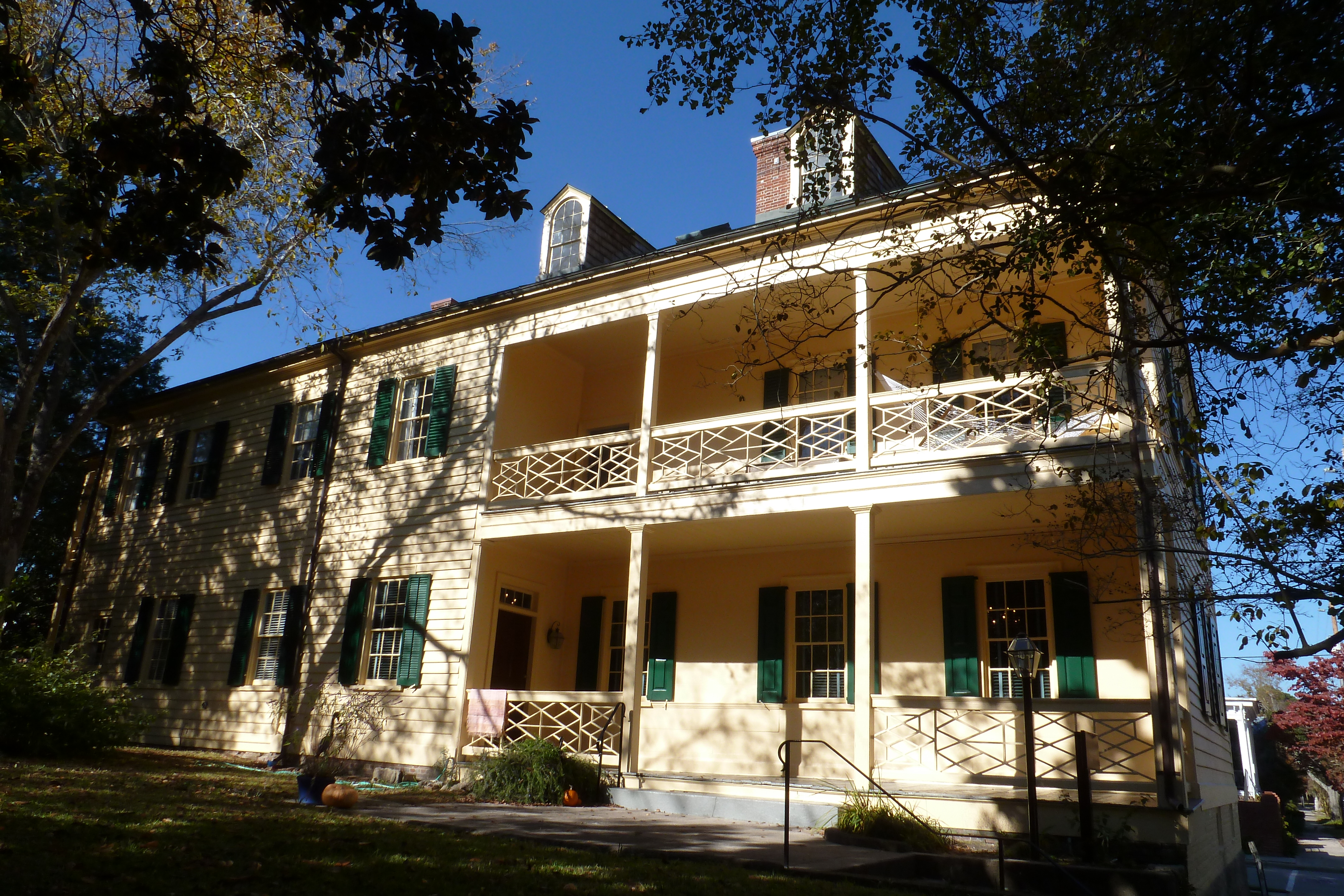
| residence | Coor-Gaston House | ||||
| Elmwood | |||||
| education | Georgetown University | ||||
| alma_mater | Princeton University | ||||
| party | Federalist, Whig | ||||
| spouse | {{plainlist | ||||
| * {{marriage | Susan Hay | September 4, 1803 | 1804 | reason | her death}} |
| * {{marriage | Hannah McClure | October 6, 1805 | 1813 | reason | her death}} |
| * {{marriage | Eliza Ann Worthington | September 3, 1816 | 1819 | reason | her death}} |
| children | 5 | ||||
| caption | Portrait of Gaston by Asher Brown Durand, 1834 |
Elmwood
William J. Gaston (September 19, 1778 – January 23, 1844) was a jurist and United States Representative from North Carolina. He was the author of the official state song of North Carolina, "The Old North State". Gaston County, North Carolina, created just after his death, was named for him, as later were the city of Gastonia, North Carolina, artificial Lake Gaston, and the Gaston Hall auditorium at his alma mater, Georgetown University.
Early life
Gaston was born in New Bern, North Carolina, on September 19, 1778. He was the son of Dr. Alexander Gaston and Margaret Sharpe.{{cite encyclopedia |editor-first1=Samuel A |editor-last1=Ashe |editor-first2=Stephen B. |editor-last2=Weeks |editor-first3=Charles L. |editor-last3=Van Noppen}}
He entered Georgetown Academy, a Roman Catholic school in Washington, D.C. in 1791 at the age of thirteen, becoming its first student. Due to illness shortly thereafter, he also became its first dropout. After Georgetown and some education in North Carolina, he studied law at the College of New Jersey (today Princeton University), graduating in 1796.
Career
Gaston was admitted to the bar in 1798 and commenced practice in New Bern. He was a member of the North Carolina General Assembly in 1800, served in the State House of Commons (now known as the House of Representatives) from 1807 to 1809, and as its Speaker in 1808. He was a member of the North Carolina State Senate in 1812. He was elected to the U.S. House of Representatives, on the Federalist ticket, serving from March 4, 1813, to March 3, 1817 (the 13th and 14th U.S. Congresses). While in Congress, he obtained a federal charter for Georgetown College (today Georgetown University). In 1814, Gaston was elected a member of the American Antiquarian Society. In 1817, he was elected a member of the American Philosophical Society.
Gaston did not run for Congress in 1816, returning to serve in the North Carolina Senate in 1818–1819. He again served in the U.S. House of Representatives in 1824, 1827, 1828, 1829, and 1831.
In 1832, Gaston delivered the annual graduation address at the University of North Carolina. Although he owned slaves, his speech included what was the last public statement in North Carolina urging the abolition of slavery:
|author-link=William Gaston
Gaston was appointed to the North Carolina Supreme Court in 1833; as a legislator in 1818, he had introduced the bill that established the Court as a distinct body. He held the position until his death. He wrote a decision that limited the control that slave-owners could exercise over enslaved humans.{{cite journal |author-link=Alfred Brophy |author-link=Alfred Brophy
Gaston won elective office on several occasions, even though the Constitution of North Carolina before 1835 seemed to prohibit it, because Gaston was a Roman Catholic. The young Rev. Andrew Byrne, later bishop of the Diocese of Little Rock, having contracted a serious illness during the course of his lengthy missionary labors, recuperated under the hospitable roof of Judge Gaston. Gaston was largely responsible, as a member of the Constitutional Convention of 1835, for removing official discrimination against Catholics from North Carolina law.
Personal life
.jpg)
Gaston married (first) on September 4, 1803, Susan Hay, who died in 1804. He married (second) on October 6, 1805, Hannah McClure, who died in 1813, and with whom he had three children:
- Alexander Gaston (1807–1848), who married Eliza W. Jones and then Sarah Lauretta Murphy.
- Susan Jane Gaston (1808–1866), who married Robert Donaldson Jr.
- Hannah Margaret Gaston (1811–1835), who married Matthias E. Manly.
Gaston married (third) on September 3, 1816, Eliza Ann Worthington, who died in 1819, and with whom he had two daughters:
- Elizabeth Gaston (1817–1874), who married George W. Graham.
- Catherine Jane Gaston (1819–1885), who did not marry.
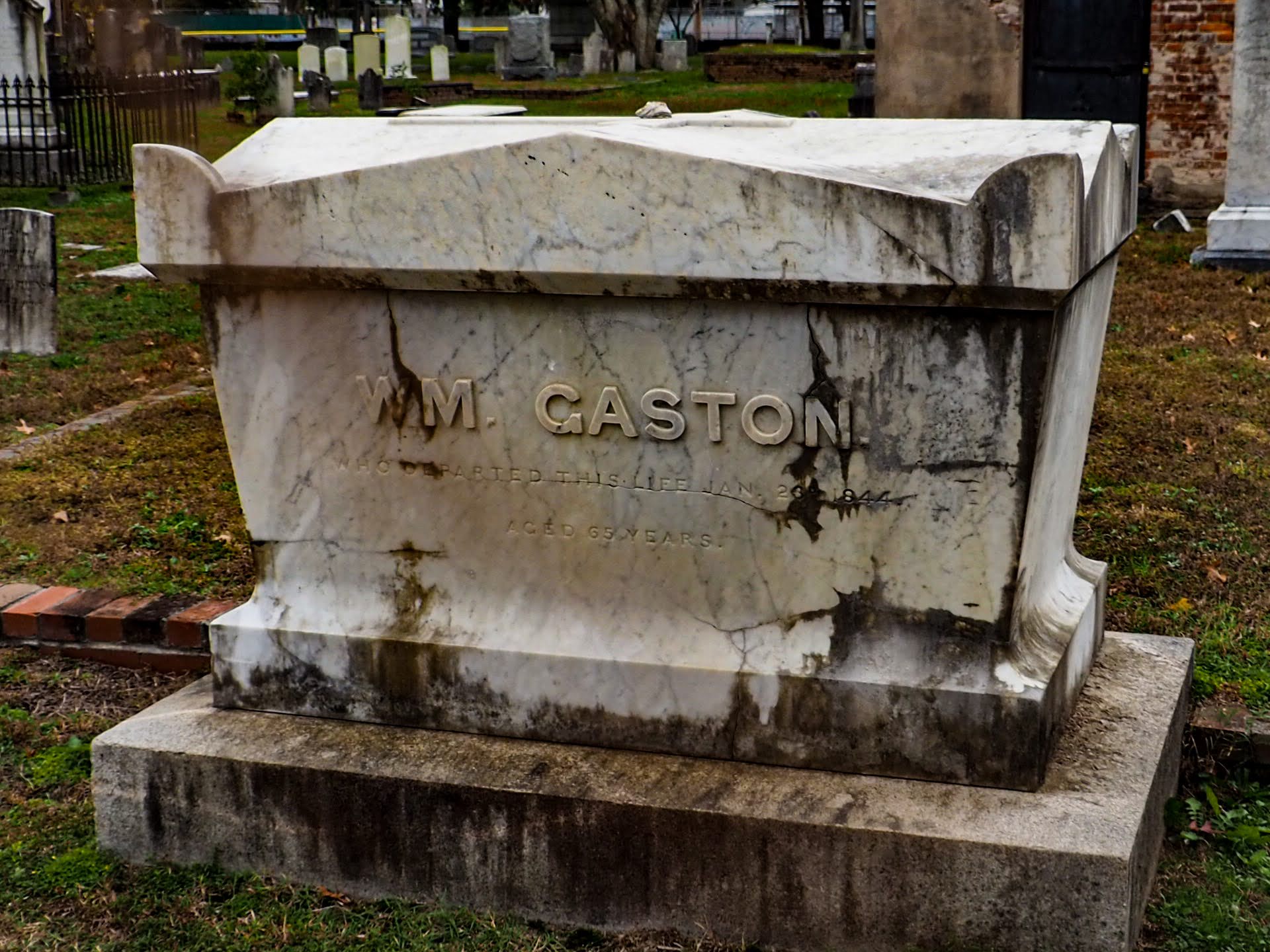
Gaston died at his office in Raleigh, North Carolina on January 23, 1844, and was buried in Cedar Grove Cemetery, New Bern, N.C. His home at New Bern, the Coor-Gaston House, was listed on the National Register of Historic Places in 1972. Elmwood, his home at Raleigh, North Carolina, was listed in 1975.
References
References
- [http://www.americanantiquarian.org/memberlistg American Antiquarian Society Members Directory]
- "APS Member History".
- [http://blurblawg.typepad.com/files/republics-liberty-letters.pdf Alfred L. Brophy, The Republics of Liberty and Letters: Progress, Union, and Constitutionalism at Graduation Addresses at the Antebellum University of North Carolina, North Carolina Law Review (2011)].
- "William J. Gaston (1778-1844)". North Carolina History Project.
- Weeks, Stephen Beauregard. (1893). "Church and State in North Carolina". The Johns Hopkins Press.
- [https://books.google.com/books?id=Z79LiSQC8YEC&q=Francis+Garcia+Moreno&pg=PA264 Clarke, Richard Henry. "Rt. Rev. Andrew Byren, D.D.", ''Lives of the Deceased Bishops of the Catholic Church in the United States'', Vol. 2, P. O'Shea, 1872, p. 265]{{PD-notice}}
- "William Gaston". [[Catholic Encyclopedia]].
- "William Gaston Papers, 1744-1950 (bulk 1791-1844)". Southern Historical Collection, The Wilson Library, [[University of North Carolina at Chapel Hill]]..
- Survey Planning Unit Staff. (September 1972). "Cedar Grove Cemetery". North Carolina State Historic Preservation Office.
- {{NRISref
- (July 1975). "Elmwood". North Carolina State Historic Preservation Office.
This article was imported from Wikipedia and is available under the Creative Commons Attribution-ShareAlike 4.0 License. Content has been adapted to SurfDoc format. Original contributors can be found on the article history page.
Ask Mako anything about William Gaston — get instant answers, deeper analysis, and related topics.
Research with MakoFree with your Surf account
Create a free account to save articles, ask Mako questions, and organize your research.
Sign up freeThis content may have been generated or modified by AI. CloudSurf Software LLC is not responsible for the accuracy, completeness, or reliability of AI-generated content. Always verify important information from primary sources.
Report