From Surf Wiki (app.surf) — the open knowledge base
William Bloye
English sculptor (1890–1975)
English sculptor (1890–1975)
| Field | Value |
|---|---|
| name | William Bloye |
| birth_name | William James Bloye |
| birth_date | 8 July 1890 |
| birth_place | Birmingham, England |
| death_date | |
| death_place | Arezzo, Italy |
| field | Sculpture |
| awards |
William James Bloye (8 July 1890 – 6 June 1975) was an English sculptor, active in Birmingham either side of World War II. After serving in World War I, Bloye studied and later taught at the Birmingham School of Art. Becoming a member of the Birmingham Civic Society in 1925, he played a significant role as Birmingham's unofficial civic sculptor, contributing to various public commissions. Bloye was a member of the Royal British Society of Sculptors, attaining the status of fellow in 1938. His association with the Royal Birmingham Society of Artists (RBSA) included serving as its president from 1948 to 1950 and as the Professor of Sculpture. He retired in 1956 and died away in 1975.
Life
Bloye studied, and later, taught at the Birmingham School of Art (his training was interrupted by World War I, when he served in the Royal Army Medical Corps from 1915 to 1917; he was eventually succeeded at Birmingham by John Bridgeman), where his pupils included Gordon Herickx, Roy Kitchin, Raymond Mason, John Poole and Ian Walters. He also studied stone-carving and letter cutting under Eric Gill around 1921.
In 1925 Bloye became a member of the Birmingham Civic Society, having, at about that time, a studio at 111, Golden Hillock Road, Small Heath, Birmingham. As Birmingham's unofficial civic sculptor he worked on virtually all public commissions including libraries, hospitals and the University. He often carved bas-relief plaques, typically for public houses in Birmingham, and decorated a number of buildings by the architect Holland W. Hobbiss. During the 1920s, he served on the Technical Committee of the Birmingham Civic Society.
Bloye became a member of the Royal British Society of Sculptors: associate (with the honorific suffix ARBS) in 1934, and fellow (FRBS) in 1938. He also won the latter's Otto Beit Medal. Retiring from the School of Art in 1956 he moved to Solihull. He died in Arezzo, Italy in 1975.
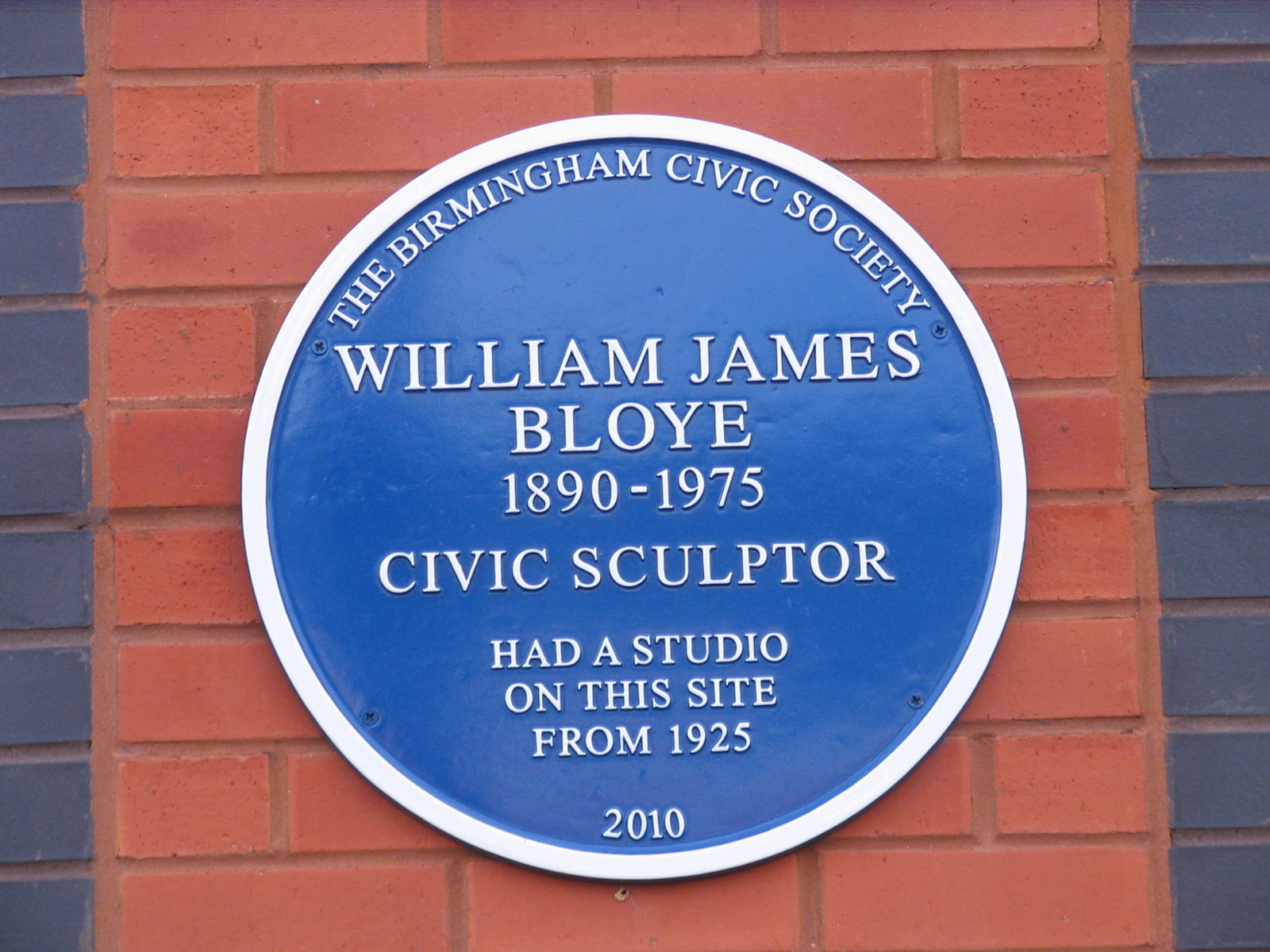
In December 2010, a blue plaque was unveiled at City College, on the site of his former studio.
As of January 2010, Birmingham City Council are working on the restoration of Bloye's statue of Pan at Aston Hall. The statue's head is missing, and they have appealed for old photographs to assist in its reconstruction.
Royal Birmingham Society of Artists

Bloye was closely associated with the Royal Birmingham Society of Artists. Although the two 1919 bronze plaques at the RBSA entrance are the earliest known work by Bloye in Birmingham, he became a member only in 1930. After a period as vice-president, he became president in 1948 and served in that role until 1950. He was also the RBSA's Professor of Sculpture from the mid-1940s until at least 1961 (after which time the post is no longer mentioned in the annual catalogues).
The Society's permanent collection includes one of his works, a life-size plaster bust, Head of Man. It is undated and not usually on display. The subject's name is not recorded.
Selected public works
1919
1920–1929
1930–1940
1950–1959
1960–1974
Date unknown
References
References
- "William James Bloye ARBS". University of Glasgow History of Art.
- (December 2010). "Life of Birmingham sculptor William Bloye commemorated". City College.
- "Ornamental Fountain". Public Monument and Sculpture Association.
- Anon. (1930). "The Spring Exhibition, 1930 (catalogue)". RBSA.
- Anon. (1948). "Royal Birmingham Society of Artists Autumn Exhibition 1948 (catalogue)". RBSA.
- Anon. (1961). "The Second Spring Exhibition, 1961 (catalogue)". RBSA.
- RBSA catalogues, 1962 onwards
- RBSA archives, catalogue number B43
- Noszlopy, George T.. (2005). "Public Sculpture of Staffordshire and the Black Country". Liverpool University Press.
- Noszlopy, George T.. (2003). "Public Sculpture of Warwickshire, Coventry and Solihull". Liverpool University Press.
- (17 January 2011). "The mystery of the headless statue". [[Birmingham City Council]].
- Anisah Vasta. (8 September 2022). "Iconic Sparkhill pub The Bear to be transformed into 60 seater South Asian restaurant 'Chai Green'". [[Birmingham Mail]].
- Noszlopy, George T.. (1998). "Public Sculpture of Birmingham including Sutton Coldfield". Liverpool University Press.
- Anon. (2 April 2001). "Former city man tribute". [[Birmingham Mail.
- Accession numbers: 1991P111; 1991P112
- (2000). "A User's Guide to Public Sculpture". English Heritage / PMSA.
- "Trail 1 – South Cambridge".
- [http://www.moseleians.co.uk/index2.asp?id=126&bid=P28&Title=William_Bloye The Moseleians Association – Moseley School and the work of William Bloye (1890–1975)]
This article was imported from Wikipedia and is available under the Creative Commons Attribution-ShareAlike 4.0 License. Content has been adapted to SurfDoc format. Original contributors can be found on the article history page.
Ask Mako anything about William Bloye — get instant answers, deeper analysis, and related topics.
Research with MakoFree with your Surf account
Create a free account to save articles, ask Mako questions, and organize your research.
Sign up freeThis content may have been generated or modified by AI. CloudSurf Software LLC is not responsible for the accuracy, completeness, or reliability of AI-generated content. Always verify important information from primary sources.
Report