From Surf Wiki (app.surf) — the open knowledge base
Willamette Falls
Waterfall on the Willamette River in Clackamas County, Oregon, United States

Waterfall on the Willamette River in Clackamas County, Oregon, United States
| Field | Value |
|---|---|
| photo | Willamette Falls from Oregon City.jpg |
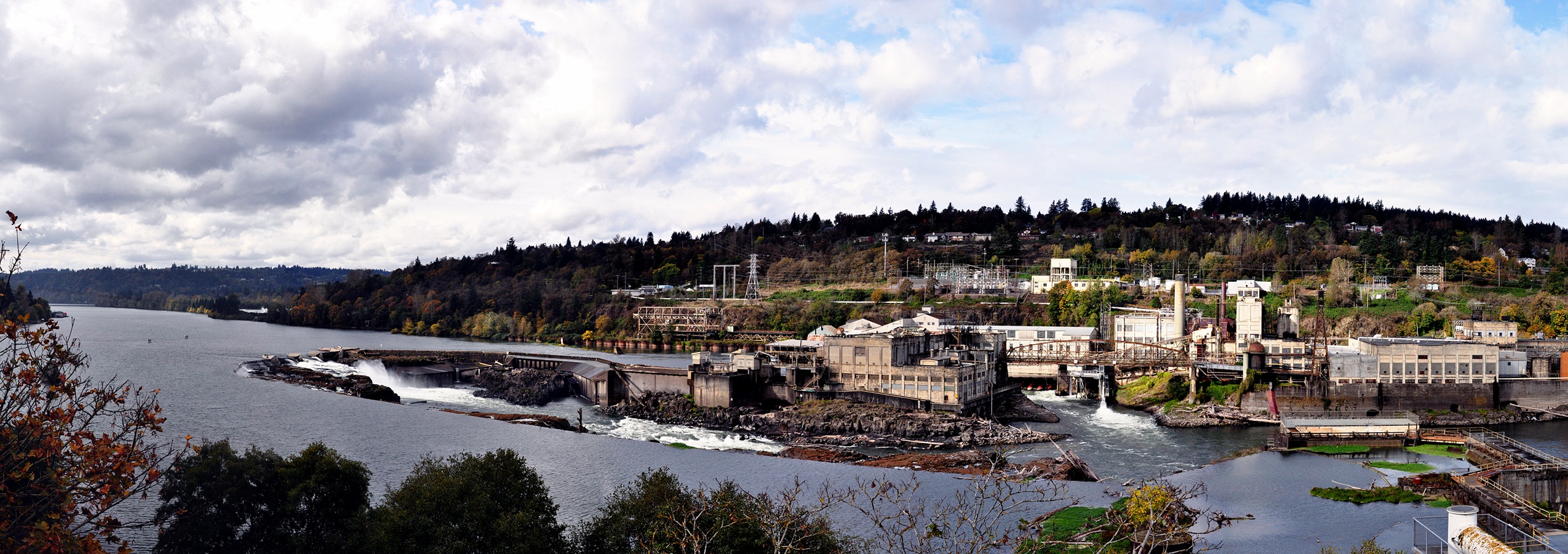
| photo_caption | View from Oregon City in 2004 |
| photo_width | 260 |
| name | Willamette Falls |
| location | Oregon City / West Linn, Clackamas County, Oregon, U.S. |
| type | Block |
| height | 40 ft |
| number_drops | 1 |
| average_flow | 30,850 cuft/s |
| coords |
The Willamette Falls is a natural waterfall in the northwestern United States, located on the Willamette River between Oregon City and West Linn, Oregon. The largest waterfall in the Northwest U.S. by volume, it is the seventeenth widest in the world. Horseshoe in shape, it is 1500 ft wide and 40 ft high, with a flow rate of 30,850 cuft/s. Located 26 mi upriver from the Willamette's mouth at Portland, Willamette Falls is a culturally significant site for many tribal communities in the region.
Opened in 1873 and closed since 2011, the Willamette Falls Locks allowed boat traffic on the Willamette to pass into the main Willamette Valley.
History
Native American oral history taught that the falls were placed there by the ancient hero T'allapus (Coyote) so that their people would have fish to eat all winter.· Willamette Falls was once the home to the Charcowah village of the Clowewalla band of Tumwaters or Willamette Band of Tumwaters, an upper Chinookan speaking people. These lands were ceded to the United States Government under the Willamette Valley Treaty of 1855 (signed on January 22, 1855; ratified on March 3, 1855). Tribal members were then removed from these ancestral lands to the Grand Ronde Reservation and the Siletz Indian Reservation.
.JPG)
Willamette Falls is an important location for many tribes. The abundance of salmon brought tribal communities from all over to fish, trade, and interact at the falls - creating an economic and cultural hub for the region. Each year many tribes harvest ceremonial salmon at Willamette Falls and collect lamprey during the summer, including the Confederated Tribes and Bands of the Yakama Nation, the Confederated Tribes of the Grand Ronde, the Confederated Tribes of Siletz Indians, the Confederated Tribes of the Umatilla Indian Reservation, and the Confederated Tribes of Warm Springs.
European fur traders became aware of the falls in 1810. John McLoughlin established a land claim at the falls in the name of the Hudson's Bay Company in 1829. Oregon City was established in 1842 near the east end of the falls. The town of Linn City was founded on the western shore one year later in 1843. The two towns competed economically, vying for the lucrative steamboat traffic and the trade it generated. With the falls representing the end of the line for boat traffic, river boat captains were forced to choose a side of the river on which they would dock to unload their passengers and goods; some of which would continue their upriver journey on winding portage toll roads. Competition between the towns was fierce until the Great Flood of 1862. Oregon City was inundated and badly damaged, while Linn City was obliterated.
Modifications and industrialization

Navigating past the falls was not possible until the completion of the Willamette Falls Locks in 1873. During construction of the locks, channels were blasted from the rocks that formerly supported the town of Linn City. Along with the locks, the city of West Linn sits on a portion of the former town site. The locks were sold by the Willamette Falls Canal and Locks Company to the United States Army Corps of Engineers in 1915. They were closed in 2011.
The Willamette Falls Electric Company (later renamed Portland General Electric) was formed in 1888 to build a hydro-electric generation facility at the falls. Four turbine-driven dynamos were built on the east end of the falls. A 14-mile (23-kilometer) long transmission line to Portland was built, becoming the first long-distance transmission of electrical energy in the United States in 1889.
In 1895 Portland General Electric built a second generation station on the west side of the falls. The newer plant, called the T.W.Sullivan Plant (previously Station B), is still in operation with a capacity of 16,000 kilowatts. The foundations of the old plant still remain.
The falls have been home to several paper mills beginning with the Oregon City Paper Manufacturing Co. in 1866. The Willamette Pulp and Paper Co. opened on the West Linn side during 1889. The ownership of the mills has changed several times. The last two remaining mills in 2011 were owned by the West Linn Paper Company and the Blue Heron Paper Company. West Linn Paper Company announced it was shutting down in October 2017, and reopened in November 2019 as Willamette Falls Paper Company. Blue Heron Paper Company closed its mill in February 2011.
The Blue Heron site has subsequently been auctioned off for redevelopment. The milling facilities were sold to a Canadian investment firm, NRI Global, Inc., which has begun work removing the old machinery and cleaning the grounds of contamination. An agreement for the sale of the site itself was announced in June 2013, but later fell apart. In May 2014, another developer, George Heidgerken, purchased the property. Heidgerken then sold the property to the Confederated Tribes of Grand Ronde in August 2019.
Ecology
The falls is a horseshoe-shaped, block waterfall caused by a basalt shelf in the river floor. The 40 ft (12 m) high and 1500 ft (457 m) wide falls occur 26 river miles (42 km) upstream from the Willamette's confluence with the Columbia River. Operated by the U.S. Army Corps of Engineers, the lock was a four lock canal and was the oldest continuous operating, multiple lift navigation canal in the United States.
The industrialization of the area led to diminishing salmon and steelhead runs, prompting the construction of a fish ladder in 1882. A new fish ladder, built in 1971, is operated by the Oregon Department of Fish and Wildlife. The estimated spring chinook salmon run for 2007 was 52,000.
Access
The public can view the falls from viewpoints on the bluffs of Oregon City, from a signed viewpoint along Highway 99E, from the Oregon City Bridge, from a viewpoint on northbound I-205, or from boats in the river.
The industrialization precluded public access to the base of the waterfall for well over a century. As of 2017, a process to redevelop the Blue Heron Paper Mill site and provide public access to the area, including a river walk, is underway. The Willamette Falls Trust is coordinating the Willamette Falls Inter-Tribal Public Access Project that is led by a team that includes Tribal Council Members and appointees from several sovereign nations, including the Confederated Tribes and Bands of the Yakama Nation, Confederated Tribes of Siletz Indians, Confederated Tribes of the Umatilla Indian Reservation and Confederated Tribes of the Warm Springs.
Gallery
File:Willamette Falls 1918 Moorehouse.jpg|The falls in 1918 File:Oregon City Falls P.jpg|The falls after the Hanukkah Eve windstorm of 2006 swelled the Willamette River and part of the paper mill File:Willamete Falls flood aerial.jpeg|An aerial view of the Willamette Falls with the river near flood stage, taken on January 22, 2006 File:USACE Willamette Falls Oregon.jpg|View is downriver facing northeast. The locks are at far left. File:Willamette Falls from drone.jpg|Willamette Falls as seen from overhead via a drone on July 19, 2017
References
References
- "World's Largest Waterfalls". World Waterfall Database.
- "A Legend: Tallapus and the Hyas Tyee Tumwater (Willamette Falls)". Oregon Historical Quarterly.
- 10 Stat. 1143, also known as the "Treaty with the Kalapuya Etc."
- Established by President James Buchanan's Executive Order dated June 30, 1857; printed in Indian Affairs: Laws and Treaties Vol. 1 (Charles Joseph Kappler, ed.), p.886
- Arden, Amanda. (2022-09-08). "Tribe decides new name of Willamette Falls site". KOIN.
- Eastman, Janet. (2022-09-08). "Grand Ronde tribe names its 23-acre Willamette Falls site Tumwata Village". The Oregonian.
- "The City on Willamette Falls". End of the Oregon Trail Interpretive Center.
- "Power Generation". Northwest RiverPartners.
- "PGE - 2/5/04 News Release". Portland General Electric.
- "Willamette Falls & Sullivan Plant History". Portland General Electric.
- (October 31, 2017). "End of an era: West Linn paper mill to close, after 128 years". Northwest Labor Press.
- "West Linn paper mill reopens, 120 employees hired".
- Case, Elizabeth. (August 4, 2013 ). "Mill runoff gets a cleanup: With a compost wall and rainwater gardens, metals from Blue Heron mill won't contaminate Willamette". [[The Oregonian.
- Mayes, Steve. (June 25, 2013). "California developer to purchase historic site of Blue Heron Paper mill in Oregon City". [[The Oregonian]].
- Mayes, Steve. (February 3, 2014). "Langley Investment Properties drops bid to buy Blue Heron paper mill site". The Oregonian.
- Mayes, Steve. (May 20, 2014). "George Heidgerken buys Blue Heron paper mill almost sight unseen but he envisions great things". The Oregonian.
- (2019-08-16). "Confederated Tribes of Grand Ronde purchase paper mill site". KOIN.
- "2007 Willamette Spring Chinook Catch and Falls Counts". Oregon Department of Fish and Wildlife.
- Mesh, Aaron. (September 14, 2022). "Cheryle A. Kennedy, Chairwoman of the Grand Ronde Tribes, Describes a Vision for Willamette Falls".
- McCluskey, Ian. (November 2, 2017). "The Hidden World Of Oregon's Overlooked Falls". OPB.
- Brown, Kate. (June 20, 2024). "Opinion: Willamette Falls project a momentous opportunity to heal historical missteps". The Oregonian.
- Jones, Joelle. (2023-06-30). "‘A sacred, special place’: Joint project to restore public access to the Willamette Falls is underway". KOIN.
This article was imported from Wikipedia and is available under the Creative Commons Attribution-ShareAlike 4.0 License. Content has been adapted to SurfDoc format. Original contributors can be found on the article history page.
Ask Mako anything about Willamette Falls — get instant answers, deeper analysis, and related topics.
Research with MakoFree with your Surf account
Create a free account to save articles, ask Mako questions, and organize your research.
Sign up freeThis content may have been generated or modified by AI. CloudSurf Software LLC is not responsible for the accuracy, completeness, or reliability of AI-generated content. Always verify important information from primary sources.
Report